
September 14, 2026
Prepared by Diana Bozhyk
President Trump claimed Ukraine and Russia have agreed to a mutual halt on energy strikes, but Zelensky said Kyiv would only stop if partners could guarantee Russia genuinely reciprocates, warning that Ukrainian ports, food warehouses, and pharmaceutical storage are struck almost daily. Roughly six hours before Trump’s demand that Ukraine stop hitting Russian diesel infrastructure, more than 400 Ukrainian drones had already set the Slavyansk-EKO and TANEKO refineries ablaze in Krasnodar Krai and Tatarstan, part of a record-breaking month of strikes that’s cut Russian fuel-processing capacity by roughly a third. Poland convened an emergency security meeting and NATO Secretary General Mark Rutte condemned Sunday’s strike on a train carrying European officials as evidence of Putin’s desperation, while Germany ordered its first mandatory, non-voluntary troop postings since the Bundeswehr’s founding in 1955 to reinforce its brigade in Lithuania.
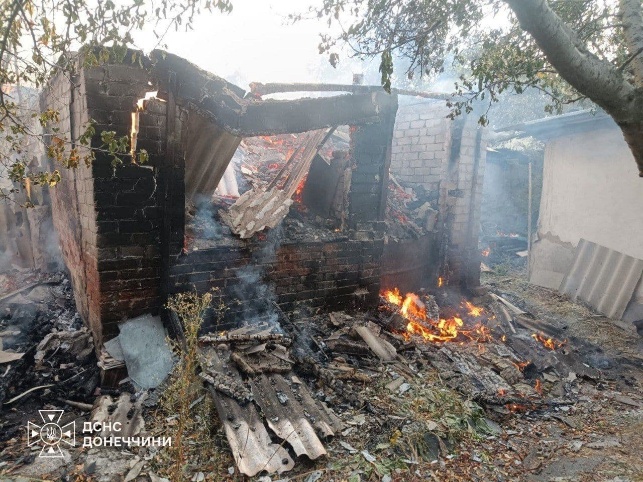
Aftermath of a Russian attack in Donetsk Oblast, Ukraine. (Ukraine’s State Emergency Service/Telegram)
THE DAY’S RECKONING
Six hours. That’s roughly how long it took Ukrainian drones to make Trump’s demand obsolete before he’d even finished making it. He told Zelensky to stop hitting Russian diesel plants at a golf tournament in Ireland. By the time he said it, two more refineries were already burning, hit hours earlier in the largest single-night drone campaign of the war so far. Zelensky’s answer arrived within the hour: Ukraine will stop, the moment Russia actually does too, and not a moment before.
Everything else about today moved with the same mixture of genuine alarm and quiet resolve. Poland’s prime minister called his security council into emergency session. NATO’s own secretary general said openly that Sunday’s strike on a diplomatic train proved how desperate Putin has become. Germany, for the first time since its army was founded seven decades ago, ordered soldiers to a NATO frontline posting whether they volunteered or not. Three people in a small Chernihiv city died because Russian forces hit a food warehouse. A Russian general may be dead, and Russian sources themselves are wondering aloud whether his own side killed him. Nothing today resolved cleanly. Everything today measured how much distance still separates a president’s claimed ceasefire from the war everyone else keeps actually fighting.
TRUMP CLAIMS A MUTUAL ENERGY TRUCE — ZELENSKY SAYS NOT YET
President Trump wrote on Truth Social today that Ukraine and Russia have agreed to halt strikes on each other’s energy infrastructure, offering no further detail. “Ukraine has agreed not to hit Russian Energy targets. Russia has agreed to do so, likewise,” Trump wrote, again blaming Ukraine’s refinery campaign, rather than his own administration’s war with Iran, for rising global diesel prices. Kremlin spokesperson Dmitry Peskov had earlier welcomed Trump’s separate call for Ukraine to stop striking Russian diesel infrastructure, but pointedly declined to say whether Russia would reciprocate by halting its own strikes on Ukraine.
Zelensky’s response, issued within the hour, was considerably more cautious than Trump’s claim suggested. “Every day, Ukrainian energy facilities, port infrastructure, logistics, and even warehouses storing food and pharmaceuticals are targeted,” Zelensky said, confirming Ukraine had proposed a moratorium on strikes against Russian food, energy, and other critical infrastructure — but only if partners could actually guarantee Russian reciprocity. “Ukraine is not convinced that Russia is willing to abide by any agreement,” he said, warning against a temporary arrangement that could simply collapse once Russia’s State Duma elections concluded later this month. He called a genuine de-escalatory step “the first step toward peace,” while making clear no such step had actually been confirmed by either side as of tonight.
RUSSIA SETS TWO MORE REFINERIES ON FIRE HOURS BEFORE TRUMP’S DEMAND
Roughly six hours before Trump told reporters in Ireland that Zelensky needed to stop striking Russian diesel infrastructure, Ukrainian drones had already hit two more refineries overnight: the Slavyansk-EKO facility in Krasnodar Krai, roughly 300 kilometers inside Russian-controlled territory, damaging a crude-processing unit and fuel reservoirs, and the TANEKO refinery in Tatarstan — one of Russia’s most modern plants and a top national diesel producer — roughly 1,200 kilometers from the border. NASA satellite fire-tracking data confirmed major thermal signatures still burning at both sites as of today. Ukraine’s Unmanned Systems Forces and military intelligence agency HUR both claimed credit; milbloggers reported more than 400 drones launched against targets across western and southern Russia in a single overnight window, with Russia’s Defense Ministry claiming 389 intercepted nationwide.
The strikes cap a genuinely unprecedented campaign: Ukraine set a wartime record of 21 separate Russian refineries hit in August alone, according to strike-tracking group DeepStrike UA — a 50 percent jump over July’s already-elevated 14, and triple October 2025’s pace. Refineries in Omsk, Perm, and Tyumen were struck for the first time in the war during August specifically. Bloomberg estimated in late August that the campaign has cut Russia’s national fuel-processing output by more than 30 percent, a figure Russian industry analysts have largely confirmed, warning that restoring capacity remains difficult because Russian air defenses are struggling to stop the drones reaching these facilities at all.
POLAND CONVENES EMERGENCY MEETING AS NATO CONDEMNS THE TRAIN STRIKE
Polish Prime Minister Donald Tusk urgently convened ministers, military officials, and intelligence chiefs today following yesterday’s Russian strike on a train near Poland’s border, warning that “the coming weeks and months will be a period of very intense activity on the Russian side” and that Poland “cannot rule out that this escalation will also affect our territory.” Tusk revealed Warsaw had received prior intelligence suggesting Russia was planning exactly this kind of attack on border crossings, tying it to a strike that killed two people at a Ukraine-Moldova checkpoint just last week.
NATO Secretary General Mark Rutte condemned the strike bluntly today: “The strike on a passenger train in Ukraine yesterday shows how desperate Putin has become. He thinks that he can stop us from supporting Ukraine and that he can undermine our unity. He is wrong. Our answer is to increase support.” A spokesperson for UK Prime Minister Keir Starmer called it “a futile attempt by Russia to undermine our support for Ukraine,” while the EU said the strikes were intended to “scare Western countries from supporting Ukraine.” Kremlin spokesperson Peskov, asked directly about the strike, offered no denial: “If I understand correctly, this is about Ukrainian territory. Our military is fulfilling their tasks on the whole territory of Ukraine. They will continue to do so.”
SIKORSKI SAYS NATO COULD “DEFEAT RUSSIA QUITE QUICKLY” — MOSCOW FIRES BACK
Polish Foreign Minister Radoslaw Sikorski told the Yalta European Strategy conference this week that NATO holds overwhelming air-power superiority over Russia and could win a direct confrontation rapidly if attacked. “If Russia attacked us and we took our gloves off, I think we would defeat Russia quite quickly. We have overwhelming superiority over Russia in air power… something like 2,500 aircraft,” Sikorski said, referring to NATO’s combined fleet rather than Poland’s own roughly 75 to 80 combat aircraft against Russia’s estimated 300. He added a pointed comparison to Ukraine’s own campaign: “If the Ukrainians have knocked out half of Russia’s refining capacity in six months, we could do it in six weeks and take out the other half.”
Russian Foreign Ministry spokesperson Maria Zakharova accused Sikorski of “Russophobia of the brain,” mischaracterizing his remarks as a claim that Poland alone could defeat Russia rather than the full NATO alliance he’d actually described. The exchange reflects a broader rhetorical escalation running in both directions this month — European officials increasingly willing to publicly assert military confidence rather than caution, and Russian officials just as quick to seize on any such statement as evidence of Western aggression, regardless of how accurately it’s actually characterized.
GERMANY ORDERS MANDATORY TROOP POSTINGS FOR THE FIRST TIME SINCE 1955
Germany is preparing to order up to 1,000 active-duty soldiers to mandatory postings with its permanent brigade in Lithuania this fall, after the Bundeswehr failed to attract enough volunteers, according to German outlet Bild. Defense Minister Boris Pistorius approved the compulsory assignments after only 60 percent of the brigade’s roughly 5,000 positions were filled voluntarily, with the most severe shortages among IT specialists, logistics personnel, cooks, and enlisted soldiers. Compulsory postings could currently affect as much as 20 percent of the brigade’s positions, a figure the Bundeswehr hopes to reduce to around 10 percent through continued recruitment before the assignments are finalized.
The 45th Armored Brigade Lithuania will become the first German combat brigade permanently based outside the country since the Bundeswehr’s founding in 1955, eventually including roughly 5,000 personnel and 2,000 military vehicles once fully operational by the end of 2027. Lithuania borders both Belarus and the Russian exclave of Kaliningrad and sits near the Suwalki Gap, a narrow corridor NATO considers among its most vulnerable points in any potential conflict with Russia. “Voluntariness remains the top principle,” Bild reported, citing German officials, “but to guarantee the brigade’s operational readiness, compulsory assignments can no longer be avoided” — a quiet but significant break from seven decades of German military policy built entirely around volunteer service.
THREE KILLED IN PRYLUKY AS RUSSIA HITS A FOOD WAREHOUSE
Russian forces struck warehouse buildings belonging to an agricultural enterprise in central Pryluky, Chernihiv Oblast, today, killing three people and injuring seven more, regional police confirmed, revising an initial toll of two dead as emergency crews completed their assessment. At least two explosions shattered windows in nearby apartment buildings. Authorities haven’t disclosed what weapon Russia used in the strike, and Russian officials had not commented as of this report.
Police investigative teams, explosives specialists, and other emergency services worked the site through the day, documenting the damage and urging residents to avoid the area given the possibility of a follow-up strike — the same double-tap caution that’s become standard practice across Ukraine after months of Russian forces striking rescue workers a second time at active response sites.
Pryluky, a regional city with no particular strategic or military significance, adds another entry to the long list of Ukrainian communities absorbing Russian strikes against purely civilian and agricultural infrastructure, part of a broader pattern of economic targeting that’s expanded well beyond the refineries and factories that make international headlines. The full extent of the damage remained under assessment by evening, with Russian officials offering no comment on the strike or the weapon used to carry it out.
“HUMAN SAFARI” KILLS TWO MORE CIVILIANS IN ZAPORIZHZHIA AND KHERSON
Russian forces killed a civilian with a first-person-view drone strike on a car in Kushuhun, Zaporizhzhia Oblast, according to Ukrainian officials, part of what researchers describe as an institutionalized pattern of Russian forces deliberately hunting civilians rather than military targets in the region’s near rear. A separate drone strike hit a civilian car in Kherson City’s Dniprovskyi district the same day, killing one more person, while Russian forces separately struck a hospital in Kherson City, injuring an employee. Geolocated footage published today shows Russia’s 18th Combined Arms Army striking civilians in Kherson City with drone-dropped munitions.
Ukrainian Marine Corps spokesperson Pavlo Drohal said Russian forces have largely ceased offensive ground operations in the Kherson direction this month, particularly around the island delta southwest of the city, as sustained Ukrainian strikes on Russian logistics and the sheer density of Ukrainian drones over the Dnipro River make any attempted crossing prohibitively costly. Drohal said Russia has instead shifted almost entirely toward using drones to strike civilian infrastructure along the river’s right bank near Kherson City and Nikopol — an explicit strategy, he said, to make these areas increasingly uninhabitable rather than attempt to physically retake them.
Separately, the Ukrainian Marine Corps spokesperson noted that Russian forces are actively placing electronic-warfare systems at the occupied Zaporizhzhia Nuclear Power Plant and using the surrounding territory to launch drones against Nikopol directly across the river — a continued military use of the plant’s grounds that international monitors have repeatedly flagged as incompatible with the facility’s supposed civilian protection status under international nuclear-safety norms.
RUSSIA LAUNCHES CRUISE MISSILES DIRECTLY FROM PORT FOR A FOURTH MONTH
Ukrainian Navy spokesperson Dmytro Pletenchuk confirmed today that Russia has been launching its naval Kalibr cruise missiles directly from port for four consecutive months, rather than from ships or submarines at sea as originally designed. “Even the use of cruise missile carriers that launch Kalibrs takes place directly at the base, that is, right in the harbor. This is a trend that has been observed for the fourth month in a row,” Pletenchuk said, noting the awkward, technically difficult nature of the workaround: “Submarines, for example, are also not so easy to use. To do this, they need to dive. I still can’t imagine how they can use them in the mode in which they are currently launching them.”
Pletenchuk said Russia currently fields four vessels in the Black Sea capable of launching Kalibr missiles — two Buyan-M-class warships and two Varshavyanka-class submarines — though Ukraine’s September 9 strike on the Admiral Essen frigate in Novorossiysk has further degraded that already-limited capability. He noted a meaningful decline in launch frequency: just two documented Kalibr launches this month, compared to a summer high of three in a single month, alongside a broader slowdown from July’s peak of 251 total cruise missiles fired, including single-day totals as high as 65.
A RUSSIAN GENERAL MAY BE DEAD — KILLED, POSSIBLY, BY HIS OWN SIDE
Ukrainian partisan movement Atesh claimed today that Lieutenant General Sergey Milchakov, commander of Russia’s 51st Guards Combined Arms Army, was likely killed in an August 26 Ukrainian strike on a military command post in occupied Donetsk — and suggested, provocatively, that Russian forces may have inadvertently helped Ukraine target him. “Russian military correspondents are sure that he was handed over by his own people, because they hit with aim. A very interesting version!” Atesh wrote, without providing further evidence. There’s no official confirmation of Milchakov’s death from either side.
The claim arrived alongside separate, seemingly unrelated reports of the alleged death of a different Milchakov — Alexei Milchakov, commander of the sanctioned far-right combat group “Rusich” — creating genuine confusion among Russian military bloggers before an outlet close to Rusich’s leadership said Alexei Milchakov remains alive. Sergey Milchakov headed the 1st Donetsk Army Corps, later reorganized into the 51st Army, since 2022, reportedly commanding Russian operations to capture Avdiivka and other settlements in Donetsk Oblast, and received Russia’s “Hero of Russia” title in 2024.
If Sergey Milchakov’s death is eventually confirmed, he would become the 23rd Russian general killed in the war, continuing a remarkably high senior-officer casualty rate that reflects both the intensity of Ukrainian strikes on Russian command infrastructure and the unusually forward positioning Russian generals have adopted throughout this conflict — a pattern that’s made senior Russian commanders far more exposed to precision strikes than their counterparts typically are in most modern militaries.
BILETSKY: WINTER WILL DECIDE WHETHER RUSSIA CAN JUSTIFY CONTINUING THE WAR
Brigadier General Andriy Biletsky, commander of Ukraine’s 3rd Army Corps, told the Yalta European Strategy conference this week that Ukraine’s ability to defend its skies against Russian ballistic missiles and jet-powered drones this winter will determine the war’s broader trajectory. “Our victory or defeat will depend on whether we can protect Ukrainian skies this winter,” he said, adding that if Ukraine withstands Russia’s winter air campaign while preventing further battlefield advances, Moscow could face an existential question by spring: “I think March or April will confront Russia with an existential question: Why and how should it continue the war if it has not achieved any of its strategic objectives?”
Biletsky said Russia’s political leadership has set an unrealistic early-2027 deadline for fully seizing Donetsk and Luhansk oblasts, while Russian military commanders have privately pushed that timeline to mid-April — the latest in a long string of missed Kremlin deadlines for the same objective. He described the current frontline situation as difficult but not the war’s hardest stretch, expressing confidence Ukraine would demonstrate concrete improvements in contested sectors “within a month,” though he declined to provide operational specifics. He identified financing, industrial capacity, and training as Ukraine’s three greatest remaining needs from Western partners heading into the colder months.
MEANWHILE, AT THE ACTUAL FRONT
Neither Russian nor Ukrainian forces made confirmed advances anywhere along the front today. Near Dobropillya, Russian forces are increasingly relying on drone and glide-bomb saturation rather than direct assault, likely due to localized personnel shortages after repeated failures to consolidate positions; a Ukrainian artillery commander reported up to 10 Russian combat aircraft operating daily in his brigade’s sector, conducting large glide-bomb strikes that have significantly strained Ukraine’s own ability to operate artillery in response. The officer noted Russian forces cannot yet return to using wheeled and armored vehicles at scale, since Ukrainian drones detect and destroy large vehicle groupings before they reach the line of contact — though he assessed colder weather, which hinders certain drone operations, may eventually let Russia resume more conventional mechanized tactics.
Near Lyman, Russian milbloggers themselves described the situation as increasingly difficult for Russian forces near Zarichne, Ivanivka, and along the Ridkodub-Nove line, with unconfirmed reports that Ukrainian forces may have reached the Zherebets River in at least one location. Near Kharkiv, Russian sources continued baselessly claiming an encirclement northeast of the city that researchers still find no evidence to support, eleven days after the claim first surfaced, while a Ukrainian brigade spokesperson noted Russian sources routinely claim settlement seizures prematurely against a far more fluid actual battlefield picture.
KHARKIV HOLDS UKRAINE’S ONLY FRONTLINE PRIDE MARCH
Roughly 200 people joined KharkivPride’s first march on foot since Russia’s full-scale invasion began, walking a tightly secured 500-meter route through underground metro stations before holding a stationary protest near the regional administration building — a deliberately low-visibility format organizers designed specifically around wartime security risks in a city that remains close to the front line. Participants, who registered in advance and underwent security screening, included civil society activists, LGBTQ+ allies, active-duty service members, and veterans.
The event highlighted four demands through separate performances: withdrawal of discriminatory provisions from Ukraine’s draft Civil Code, legal recognition that would let homophobic and transphobic motives be considered in criminal investigations, greater civic investment from Kharkiv’s city government, and tribute to LGBTQ+ Ukrainian service members killed in the war, whose surviving partners currently lack many legal rights granted to recognized family members.
“I understand what Pride means for Kharkiv. Despite threats from bigots and the city authorities’ silent acceptance of violence, we held KharkivPride today,” co-organizer Anna Sharyhina said, describing the march as part of a broader push for equality “in the greater European family” Ukraine continues working to join. Co-organizer Yakiv Lavrynetz noted the group had submitted 95 pages of proposed amendments to the draft Civil Code and met personally with the parliament’s chairman, but said officials have offered “neither specifics nor clear decisions — only promises” more than four months after the code’s first reading.
A REFINERY BURNING, A TRAIN NEARLY HIT, A DEAL NOT YET REAL
By nightfall, today’s contradictions were hard to reconcile in a single frame. A president claimed a ceasefire that neither side has actually confirmed. Two refineries kept burning regardless of what anyone in Washington said about them. Germany broke seven decades of all-volunteer military tradition to reinforce a border Russia keeps testing.
Three people in Pryluky won’t see tomorrow. A Russian general may already be dead, killed possibly by the very side he served. And in Kharkiv, 200 people walked a short, carefully guarded route underground simply to say they still exist, still matter, still belong to the country they’re helping defend. Nothing today ended. Everything today measured how much further this war still has to travel before any claimed truce becomes an actual one.
A PRAYER FOR UKRAINE
1. For the Three Lost in Pryluky
Lord, three people are gone tonight in a small city few outside Ukraine will ever hear named, killed at a food warehouse that fed people rather than armed them. We grieve violence aimed at the ordinary business of feeding a nation. Receive them, comfort the seven injured and their families, and protect every worker still showing up to warehouses and fields across this country.
2. For Every Civilian Hunted Rather Than Caught in Crossfire
Father, we lift up the people in Kherson and Zaporizhzhia killed today not by accident but by deliberate choice — drones aimed specifically at cars, at individuals, at ordinary movement through their own cities. Protect those still living under this daily threat, and give the world clarity to call this pattern exactly what it is, without softening language that lets it continue unnamed.
3. For Clarity Between a Claimed Peace and an Actual One
Lord of truth, we pray for discernment between diplomatic announcements and battlefield reality still unfolding on the ground. Give leaders on every side the integrity to describe agreements honestly, neither overstating progress nor dismissing genuine steps forward toward something real. And give Ukraine’s own negotiators wisdom to hold firm on verification, even when the pressure to simply announce peace grows loud.
4. For Every Ally Choosing Harder Commitments Over Easier Words
God of courage, we pray for the nations making genuinely difficult choices this week — soldiers ordered rather than asked to a frontier posting, security councils convened at short notice, alliances tested by strikes that keep creeping closer to their own borders. Give their leaders resolve that matches the moment, and give their people patience with sacrifices most never expected to be asked to make.
5. For a City That Marched Anyway
God of belonging, we give thanks for every person in Kharkiv who walked a careful, guarded route today to be seen and counted. Protect them from those who’d rather they stayed silent, and give this country wisdom to extend full dignity to everyone defending it. Let unity include, rather than exclude, on the way toward whatever peace eventually comes.
In Your mercy, in Your justice, in Your time — bring this war to its end, and let the ending be worthy of what Ukraine has endured.