
September 15, 2026
Prepared by Diana Bozhyk
Ukrainian Brigadier General Andrii Biletskyi confirmed for the first time that Ukraine is running an active counteroffensive, codenamed Operation Vivaldi, against the Russian salient north of Lyman, liberating 85 square kilometers and collapsing Moscow’s plan to encircle Ukraine’s Fortress Belt from the north. President Zelensky told CBS News that Russian drones targeted his presidential plane twice in recent weeks — once as it departed Chisinau and again as he returned through Moldova days later — calling both incidents deliberate attempts to intimidate him and the foreign officials who travel with him. President Trump claimed Ukraine and Russia agreed to a mutual halt on energy strikes, but the Kremlin only called the idea “good,” while a Kyiv School of Economics analysis found the US war in Iran has disrupted more than twice as much global diesel supply as Ukraine’s refinery campaign has cut from Russia. A Russian frigate fired flares at a Danish surveillance helicopter in the Baltic Sea, and suspected Russian-linked drones and sabotage incidents rippled across Lithuania, Germany, and the Netherlands within a single 24-hour span.
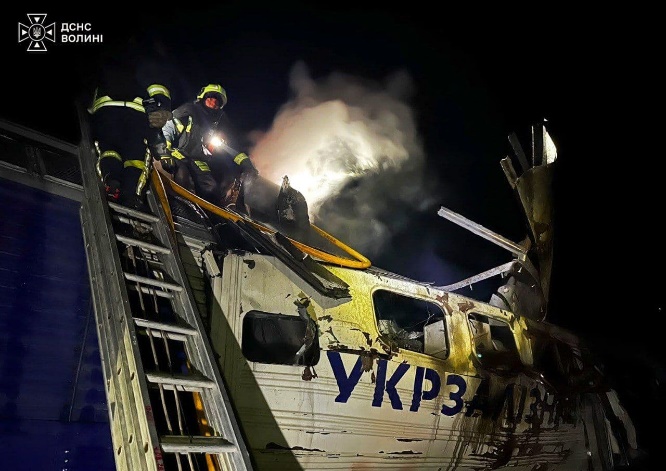
A photo capturing the destruction after an overnightRussian attack hit a railway infrastructure, causing a diesel locomotive to catch on fire, the State Emergency Service reported. (State Emergency Service / Telegram)
THE DAY’S RECKONING
For months, Ukraine let its gains north of Lyman speak through geolocated footage and cautious denials of Russian claims. Today, a general finally said the word out loud: counteroffensive. Operation Vivaldi has quietly clawed back 85 square kilometers and broken apart the northern half of Russia’s plan to encircle Ukraine’s most important defensive line. It’s the kind of news that doesn’t often arrive anymore — genuine, confirmed, Ukrainian-initiated progress.
Everywhere else, the day moved with its usual mixture of threat and denial. Zelensky revealed that his own plane has now been targeted twice by Russian drones in a matter of weeks, a claim that reframes last week’s near-miss as something considerably more deliberate. Trump announced a ceasefire nobody in Moscow actually confirmed. A Danish helicopter dodged Russian flares in international waters. Drones and mystery debris turned up near military bases in three separate NATO countries within a single day. ISW spent the day documenting something almost darkly comic: Russian units increasingly faking their own victories with AI-generated flag-raising footage, because the real ones keep failing to materialize. Nothing today resolved cleanly. Everything today measured just how much of this war is now being fought in the space between what’s claimed and what’s actually true.
UKRAINE CONFIRMS OPERATION VIVALDI: A COUNTEROFFENSIVE NORTH OF LYMAN
Ukrainian 3rd Army Corps Commander Brigadier General Andrii Biletskyi gave the military’s first explicit confirmation today that Ukraine has been running an active counteroffensive — codenamed Operation Vivaldi — against the Russian salient north of Lyman. Biletskyi said Ukrainian forces have cleared or liberated a total of 85 square kilometers, including the settlement of Serednie and Russian infiltrators from Novoselivka, Yarova, Oleksandrivka, and the outskirts of Korovii Yar, describing these gains as only the first phase of a continuing operation. Russian sources are beginning to quietly acknowledge the losses: one prominent milblogger admitted Russian forces are attempting to push Ukrainian troops out of Kolodyazi — an implicit confirmation that Ukraine had already taken it.
The 3rd Army Corps also disclosed the operation’s less visible half: a deliberate intermediate-range strike campaign against Russian logistics at depths up to 120 kilometers from the front, which forced Russian forces to shut down a fuel pipeline supplying occupied Luhansk Oblast entirely and relocate support elements of the 144th Motorized Rifle Division back into Russia proper. Even Kremlin-aligned commentary now concedes the operational significance: one milblogger acknowledged Ukraine’s gains will delay Russia’s long-planned assault on Slovyansk and warned that the northern flank of Russia’s Southern Grouping of Forces near Kramatorsk is now newly exposed to Ukrainian counterattacks. The advance effectively renders Russia’s already-strained plan to encircle Ukraine’s Fortress Belt from both north and south unfeasible, having collapsed the northern half entirely.
ZELENSKY: RUSSIA TARGETED MY PLANE TWICE
President Zelensky told CBS News today that Russian drones targeted his presidential aircraft on two separate occasions in recent weeks, describing both as deliberate attempts to intimidate him and the foreign officials traveling with him. “In Moldova, my presidential jet was there, and that’s why they attacked,” Zelensky said, confirming drones entered Moldovan airspace both as his plane departed Chisinau for Oslo on September 8 and again days later as he returned to Ukraine through the same capital. Norwegian Prime Minister Jonas Gahr Store had separately confirmed the first incident, saying Zelensky’s plane was “nearly hit” during takeoff.
Zelensky directly linked the pattern to Russia’s September 13 strike on a passenger train carrying Western officials, including former British Prime Minister Boris Johnson and former CIA Director David Petraeus, near the Polish border. “Maybe they didn’t know that some Americans had been there or maybe… they knew, because I don’t trust them. I think that they knew,” he said. “That’s why, Europeans, Americans, the big delegation had been in this train, and they attacked.” The claim sits in direct tension with Putin’s own September 2 remarks following the Shanghai Cooperation Organization summit, when asked whether Zelensky and senior officials had immunity from Russian strikes: “As you can see, we do not carry out such strikes,” Putin said, adding that Moscow needs Ukrainian officials alive to eventually negotiate with.
TRUMP CLAIMS AN ENERGY TRUCE — THE KREMLIN ONLY CALLS IT A “GOOD IDEA”
President Trump announced on Truth Social that Ukraine and Russia had agreed to a mutual halt on energy-infrastructure strikes, writing: “Ukraine has agreed not to hit Russian Energy targets. Russia has agreed to do so, likewise!” The announcement reportedly caught Ukrainian officials off guard, according to the Financial Times, and Moscow never actually confirmed accepting any such deal. Kremlin spokesperson Dmitry Peskov called the US-proposed ceasefire “a very good idea” and “a good initiative” — careful language that stopped well short of an actual commitment — while separately arguing that any energy truce wouldn’t resolve global energy prices unless the West also lifted sanctions to let Russia “saturate” international markets.
People familiar with the Kremlin told the Financial Times that Putin remains reluctant to accept any winter energy ceasefire, believing continued strikes on Ukraine’s grid during the coldest months increase pressure on Kyiv to make concessions it otherwise wouldn’t. Zelensky reiterated Ukraine’s own conditional willingness to pause strikes, provided partners can verify Russia genuinely reciprocates: “Ukraine is not convinced that Russia is willing to abide by any agreement,” he said, noting Ukrainian energy facilities, ports, logistics centers, and food and medicine warehouses continue to be struck almost daily regardless of ongoing diplomatic talk.
DIESEL PRICES: IRAN’S WAR DID FAR MORE DAMAGE THAN UKRAINE’S DRONES
A Kyiv School of Economics Institute assessment released this week directly challenges Trump’s repeated claim that Ukraine’s refinery campaign is the primary driver behind rising global diesel prices. According to the analysis, oil exports from the Persian Gulf fell by 152 million barrels between March and August — a consequence of America’s own war with Iran — compared to a 68 million-barrel decline in Russian exports over the same period. The Gulf disruption, in other words, was roughly 2.2 times larger than the reduction Ukraine’s strikes caused in Russian supply.
Two senior Ukrainian officials told the Financial Times they believe Trump’s public pressure campaign against Ukraine’s refinery strikes is aimed primarily at reassuring American voters concerned about fuel prices, rather than reflecting an accurate accounting of where the actual disruption originates. Ukraine has continued framing its refinery campaign as essential to degrading Russia’s capacity to finance and sustain the invasion, a strategic rationale that doesn’t disappear simply because the campaign has become politically inconvenient for an American president dealing with his own, considerably larger, self-inflicted oil-market disruption.
The comparison matters beyond a single data point: Trump’s own war against Iran forced the near-total shutdown of tanker exports through the Strait of Hormuz, while Houthi forces separately captured the Red Sea’s southern exit at the Bab el-Mandeb Strait, compounding worldwide crude and refined-fuel price pressure well beyond anything Ukraine’s drones have managed against Russia’s considerably larger energy sector.
A RUSSIAN FRIGATE FIRES FLARES AT A DANISH HELICOPTER
A Russian frigate fired two flares at a Danish Air Force Fennec helicopter conducting routine surveillance in international waters off Gedser in the Baltic Sea on September 14, with one flare passing within a short distance of the aircraft, the Danish Armed Forces reported. Danish Defense Minister Jeppe Bruus called it the first incident of its kind and said it demonstrates Russia’s increasing willingness to take risks in contested international waters. Denmark’s Ministry of Foreign Affairs summoned the Russian ambassador, calling the action “completely unacceptable.”
The incident adds a new, more dangerous category to the pattern of Russian provocations that’s defined the Baltic region throughout the year — moving beyond drone incursions and undersea cable sabotage attempts toward direct, active measures against NATO surveillance aircraft operating entirely within international waters. Denmark has emerged as one of the most consistently targeted countries in this pattern, given its central geographic position monitoring Russia’s Baltic Fleet movements and its deepening role as one of Ukraine’s most committed defense-industrial partners.
Danish officials said the incident will be raised through formal diplomatic channels and factored into ongoing NATO discussions about strengthening the alliance’s response posture in the Baltic, where member states have already expanded joint patrols following a string of undersea cable disruptions and airspace violations attributed, directly or circumstantially, to Russian activity throughout 2026.
SABOTAGE ATTEMPTS RIPPLE ACROSS EUROPE
Within a single 24-hour span, suspected Russian-linked incidents surfaced in at least three NATO countries. Italian fighter jets operating as part of NATO’s air-defense mission intercepted an unidentified drone in Lithuanian airspace overnight, which Lithuanian officials said flew in from Belarusian territory and likely carried an explosive device; Italian Defense Minister Guido Crosetto said the drone was likely Russian, and a Ukrainian military source told Reuters its debris resembled a Geran-2. Separately, German authorities discovered unspecified drone debris just one kilometer from the Wunstorf Air Base, a German military installation, with German outlet Bild reporting officials had actually known about the incident since the previous day.
In the Netherlands, state railway infrastructure manager ProRail reported that unidentified actors deliberately placed pipes and other materials on railway tracks, causing 35 separate disruptions to passenger and cargo services nationwide before authorities resolved the interference. None of the incidents has been formally attributed to Russia, and researchers caution that confirmed Russian involvement remains unestablished in each case — but the clustering of drone incursions, explosive debris near a military airfield, and coordinated rail sabotage within roughly a day of each other fits a pattern security officials across Europe increasingly describe as deliberate hybrid pressure rather than coincidence.
LAVROV BLAMES THE WEST FOR COLLAPSING THE ANCHORAGE SUMMIT
Russian Foreign Minister Sergei Lavrov claimed today that the war could have ended a year ago had the US and Europe not “backed away” from agreements supposedly reached at last year’s Anchorage summit between Trump and Putin. “If the Americans had not backed away from the Anchorage agreements, if Europe had not derailed those agreements, we would have been living without war for a year already,” Lavrov said, calling it “an obvious fact.” The claim doesn’t match the public record: Trump left the August 2025 Anchorage summit without securing any ceasefire or formal agreement, Ukraine wasn’t even present at the talks, and Secretary of State Marco Rubio has said only that proposals and discussions occurred, not that any binding deal was struck.
Lavrov reiterated Russia’s unchanged core demands — preventing NATO expansion, guaranteeing rights for Russian-speaking residents of Ukraine, and pursuing what Moscow still calls Ukraine’s “denazification” and “demilitarization,” despite the fact that Ukraine’s own democratically elected president is Jewish. He insisted Russia has “never refused talks” while simultaneously confirming Moscow won’t suspend military operations during any negotiation process — the same contradiction that’s defined virtually every Russian statement on diplomacy throughout the war, professing openness to talks while refusing the single concession, a pause in fighting, that would make those talks meaningful.
RUSSIA FAKES ITS OWN VICTORIES WITH AI-GENERATED VIDEO
A new report from the Institute for the Study of War documented a systematic Russian campaign using AI-generated and AI-altered video to fabricate the appearance of captured Ukrainian territory. Researchers identified at least 35 suspected AI-altered flag-raising videos published between June 1 and August 30, with commercially available detection software confirming at least 10 were manipulated with high confidence — a figure ISW says likely understates the true total, since existing detection tools don’t consistently catch every manipulation. The footage typically shows Russian soldiers raising flags in settlements Russian forces never actually captured, using camera movements, zooms, and jump cuts to obscure telltale visual anomalies like distorted proportions, inconsistent shadows, and flags that inexplicably deform or vanish.
The most striking example remains Svyatohirsk, where Putin and Russia’s Defense Ministry both publicly claimed capture in early September even as the town remained behind Ukrainian lines — a fact Brigadier General Biletskyi personally demonstrated by publishing video of himself walking through the town’s center. Even Russia’s own pro-war “Z-channels” have begun pushing back: one prominent Kremlin-aligned outlet admitted footage purporting to show Svyatohirsk’s “liberation” had actually been generated by a neural network, warning the practice risks distorting Russian commanders’ own understanding of the battlefield badly enough to shape flawed operational planning. ISW noted most settlements claimed using suspected AI footage remained under confirmed Ukrainian control as of late August, and expects the tactic to expand as video-generation technology grows more accessible and harder to detect.
UKRAINE TESTS A NEW INTERCEPTOR, STRIKES FIVE MORE RUSSIAN TARGETS
President Zelensky announced today that Ukrainian manufacturers successfully tested another jet-powered drone interceptor, hitting a Shahed target during trials, though Commander-in-Chief Mykhailo Drapatyi said the system still needs refinement to its control mechanisms before deployment. The test comes as Russia’s jet-powered drone volume has climbed sharply — from roughly 450 in June to nearly 2,850 in August, according to Ukrainian military data — with the faster models capable of 240 to 500 kilometers per hour, well beyond the roughly 200 kilometers per hour ceiling of older propeller-driven Shaheds.
Overnight, Ukrainian forces struck an oil refinery in Syzran, Samara Oblast, damaging its primary processing unit and an oil tank farm; a drone-production facility in Taganrog producing Molniya-type strike drones and Orion components; a drone launch site in Oryol Oblast; and unspecified targets in the Black Sea. Zelensky separately confirmed he’d met with Defense Minister Yevhen Khmara and Drapatyi to identify Ukraine’s next priority targets for the long-range strike campaign, along with the munitions required to hit them.
“The results of our long-range impact on the oil base underpinning Russia’s war are quite significant, and this is exactly what gives diplomacy the necessary potential,” Zelensky said. Ukraine has occasionally deployed F-16 fighter jets against jet-powered drones when other interception options weren’t available, but officials say the country’s real objective remains securing enough fast, affordable interceptors and guided missiles to handle the volume at scale, rather than relying on scarce and expensive manned aircraft for a threat that keeps multiplying by the month.
HEAVIEST FIGHTING CONCENTRATES ON THE POKROVSK AXIS
Ukraine’s General Staff reported 219 combat engagements along the front over the past 24 hours, with the most intensive fighting concentrated on the Pokrovsk axis, where Ukrainian forces repelled 38 separate attacks near 17 settlements including Dobropillya, Udachne, and Molodetske. Russian forces conducted 68 airstrikes, dropped 249 guided aerial bombs, deployed 4,153 loitering munitions, and shelled Ukrainian positions at least 1,638 times over the same period. Preliminary figures indicated 66 Russian servicemembers killed and five wounded in the Pokrovsk sector alone, with Ukrainian forces destroying or damaging dozens of vehicles, artillery systems, ammunition depots, and 146 combined Russian shelters.
Elsewhere, Ukrainian forces repelled 15 Russian assaults near Lyman and surrounding settlements, two attacks near Kupyansk with a third engagement ongoing, six attempted advances in the broader Lyman axis, four near Slovyansk, and eight near Kostyantynivka with four more still underway by evening. Ukrainian forces separately destroyed or suppressed at least 147 Russian drones of various types nationwide.
No significant activity was reported on the North Slobozhanskyi, Kursk, or Prydniprovske axes, and officials noted no meaningful changes elsewhere along the broader front. The scale of the disparity between the Pokrovsk sector and the rest of the line underscores just how deliberately Russian command has concentrated its remaining offensive capacity into a single, costly push, even as every other axis settles into the same grinding stalemate that’s defined most of the front for months.
UKRAINE’S RAILWAYS: 500 LOCOMOTIVES LOST, MORE ATTACKS THREATENED
Foreign Minister Andrii Sybiha said today that Russia has damaged or destroyed more than 500 Ukrainian locomotives since the war began, with over half of those losses recorded this year alone, urging international partners to help source replacement locomotives compatible with Ukraine’s 1,520mm rail gauge and provide funding to accelerate procurement. “Ukraine’s railway keeps the country moving,” Sybiha said, calling it “a key system for economic and social stability.” Since the start of 2026, Russia has struck Ukraine’s railway infrastructure at least 1,534 times, according to Infrastructure Minister Mykola Kalashnyk, killing 52 Ukrzaliznytsia employees on duty and injuring 317 more.
The appeal follows this week’s strike on a passenger train near the Polish border carrying Western officials and comes as Ukraine simultaneously confirmed plans to significantly reinforce railway defenses. Zelensky said after a meeting of Ukraine’s top military command that contracts have been confirmed to strengthen electronic-warfare coverage and increase procurement of protective systems specifically for railways, fuel stations, and other priority infrastructure, with mobile fire groups and air-defense lines being reorganized around these facilities and backup logistics routes — combining rail and bus transport where necessary — being developed for frontline regions.
Officials also discussed railway security specifically in border areas near EU countries and Moldova, alongside support for Ukrzaliznytsia’s rolling-stock repairs and equipment supplies. “Solutions for protection exist,” Zelensky said, though he declined to disclose operational specifics of the updated measures, citing security concerns given how precisely Russian forces have targeted rail infrastructure in recent weeks.
JAPAN’S PARLIAMENT SPEAKER ADDRESSES THE RADA FOR THE FIRST TIME
Eisuke Mori, speaker of Japan’s House of Representatives, became the first holder of that position to address Ukraine’s parliament directly, meeting with officials to discuss energy support and defense cooperation ahead of winter. Zelensky called the visit “particularly important” given Japan’s potential participation in the Prioritized Ukraine Requirements List, the joint US-NATO mechanism speeding delivery of American-made weapons, including urgently needed Patriot interceptors, to Ukraine. “Today, Eisuke Mori came to the Verkhovna Rada wearing a vyshyvanka. For me, this was more than a gesture — it was a deeply personal sign of respect for Ukraine and solidarity with our people,” Rada Chairman Ruslan Stefanchuk said.
Japan has provided political backing and more than $20 billion in financial and humanitarian support throughout the war, including a $1.3 billion grant delivered in April funded through profits from frozen Russian assets under the G7’s Extraordinary Revenue Acceleration initiative, and $14.7 million contributed to PURL in May specifically for non-lethal equipment. Mori’s address deepens a relationship increasingly framed around shared vulnerability: Ukraine supported Japan following the 2011 Fukushima disaster, and Japan-Russia relations have separately soured further this year after Putin’s visit to the disputed Kuril Islands, territory Zelensky formally recognized as Japanese under temporary Russian occupation back in 2022.
A WAVE OF WINTER FUNDING: NETHERLANDS, FINLAND, CANADA
The Netherlands announced an additional €327 million for Ukraine’s recovery and reconstruction between 2027 and 2029, on top of €878 million already pledged for non-military support over the same period, directing the funds toward energy-system repairs, humanitarian relief, and private-sector assistance. “The Netherlands will continue to provide Ukraine with unwavering political, military, and financial support in its fight against Russian aggression in the years to come,” the Dutch government said, timing the announcement alongside preparations for its 2029 EU Council presidency.
Finnish President Alexander Stubb separately announced Finland’s 34th military aid package to Ukraine, worth €290 million, saying the country supports Ukraine “because it is morally right and it is a matter of the security of all of Europe, and thus also Finland.” Ukraine’s Finance Ministry confirmed it would soon receive $841 million from the World Bank under a Canadian government guarantee, earmarked specifically to cover pension payments in the state budget — the latest disbursement building on Canada’s broader pledge of more than $2 billion in fresh support, including over $1 billion for defense, announced during Zelensky’s visit to Calgary five days earlier.
Taken together, the three announcements landed within a single 24-hour span, illustrating how routinely allied nations are now layering pension guarantees, military packages, and multi-year reconstruction pledges on top of each other — a steady drumbeat of support that rarely generates individual headlines but collectively represents billions in commitments Ukraine will need to actually convert into delivered equipment and disbursed funds before winter tests the country’s resilience once again.
VTB SANCTIONED AGAIN OVER IRAN TIES
The US Treasury Department announced additional sanctions against Russian state-majority-owned bank VTB for its involvement in Iranian sanctions evasion and expanding Russian-Iranian bilateral trade, noting the bank significantly increased its presence in Tehran starting in January 2025. It’s the third round of US sanctions against VTB specifically, following earlier measures in February 2022 tied to its role in the Russian state and economy, and January 2025 sanctions targeting its facilitation of Chinese efforts to help Russia evade broader sanctions.
The action underscores how deeply Russia’s financial infrastructure has become entangled with Iran’s own sanctioned economy as both countries seek workarounds to Western restrictions — a relationship that extends beyond banking into the military cooperation Russia and Iran have deepened throughout the war, including Iranian-designed Shahed drones now manufactured domestically inside Russia and reportedly used to strike targets as far as Ukraine’s own presidential aircraft.
The Treasury’s repeated targeting of the same institution reflects a broader pattern in Western sanctions enforcement: rather than a single decisive measure, officials increasingly layer successive rounds against the same entities as new evasion pathways emerge, treating sanctions less as a one-time barrier than as an ongoing enforcement effort that requires continuous updating as Russia and its partners adapt their workarounds.
A COUNTEROFFENSIVE NAMED, A PLANE TARGETED TWICE, A TRUCE THAT WASN’T
By nightfall, today’s confirmations cut in genuinely different directions. Ukraine finally said the word “counteroffensive” out loud, attaching real numbers and a real name to gains that had been building quietly for weeks. Zelensky confirmed his own plane had been targeted not once but twice, reframing what looked like a single close call into a deliberate pattern.
A ceasefire that one president announced on social media still hasn’t been confirmed by the country supposedly party to it. A Danish helicopter dodged flares in international waters. And somewhere in Russia’s own military bureaucracy, officers are increasingly asked to believe flags raised by artificial intelligence over towns their own soldiers were never actually able to reach. Nothing today ended. Everything today measured how much of this war is now fought in the gap between what’s claimed and what’s real.
A PRAYER FOR UKRAINE
1. For Every Soldier Advancing North of Lyman
Lord, we give thanks for genuine ground reclaimed today, and we pray for every soldier who fought for those 85 square kilometers north of Lyman. Protect them as the operation continues, and give their commanders wisdom to press forward without unnecessary cost to the men carrying it out. Let this progress hold through the harder fighting still to come, and let it open real space for the Fortress Belt to finally breathe.
2. For a President Whose Travel Has Become a Calculated Risk
Father, we pray for President Zelensky’s continued safety, now confirmed to have been targeted twice in a matter of weeks by drones that came close enough to raise real alarm. Give his security teams the foresight to anticipate what a determined adversary keeps attempting. And give every leader whose work requires travel through danger the protection their service demands, regardless of how routine that danger has quietly become.
3. For Truth to Outlast Every Fabricated Victory
Lord of truth, we pray for the researchers and soldiers who keep exposing Russia’s manufactured claims, one doctored video at a time, often at real personal risk. Give them persistence as the deception grows more sophisticated by the month, and give the world discernment to recognize a lie even when it’s convincingly rendered. Let reality eventually outweigh whatever fiction is built to hide it.
4. For Every Railway Worker Still Showing Up
God of provision, we pray for the 52 Ukrzaliznytsia employees killed and 317 injured keeping this country’s trains running despite everything aimed against them daily. Give their surviving colleagues courage to keep working through each new attack, and give Ukraine’s partners urgency in providing the locomotives and protection this essential service still needs before winter makes the need even more acute.
5. For a Truce That Might Yet Become Real
God of peace, we pray that today’s uncertain, unconfirmed announcement might somehow become something true. Give negotiators on every side the patience to turn a premature claim into an actual commitment. And give Ukraine’s people, who’ve heard hopeful words before without seeing them kept, the strength to keep hoping without letting hope alone stand in for a peace not yet secured.
In Your mercy, in Your justice, in Your time — bring this war to its end, and let the ending be worthy of what Ukraine has endured.