
As Putin Decries U.S. Strikes on Iran, Russian Forces Launch Devastating Attack on Kyiv Killing Nine and Striking Educational Facilities Across Ukraine
Summary of the Day – June 23, 2025
In a display of staggering hypocrisy that encapsulated Russia’s warped moral universe, Vladimir Putin condemned U.S. strikes on Iranian nuclear facilities as “completely unprovoked aggression” mere hours before his forces launched one of their most devastating attacks on Ukrainian civilians in months. The overnight assault on Kyiv killed at least nine people, including an 11-year-old girl, while separate strikes targeted educational institutions in Odesa Oblast and civilian areas in Sumy Oblast. As rescue workers pulled bodies from the rubble of a partially collapsed apartment building, Putin’s diplomatic theater continued with Iranian Foreign Minister Abbas Araghchi, showcasing the limitations of the Kremlin’s strategic partnerships even as it deepened its reliance on Tehran’s drone technology to terrorize Ukrainian cities.
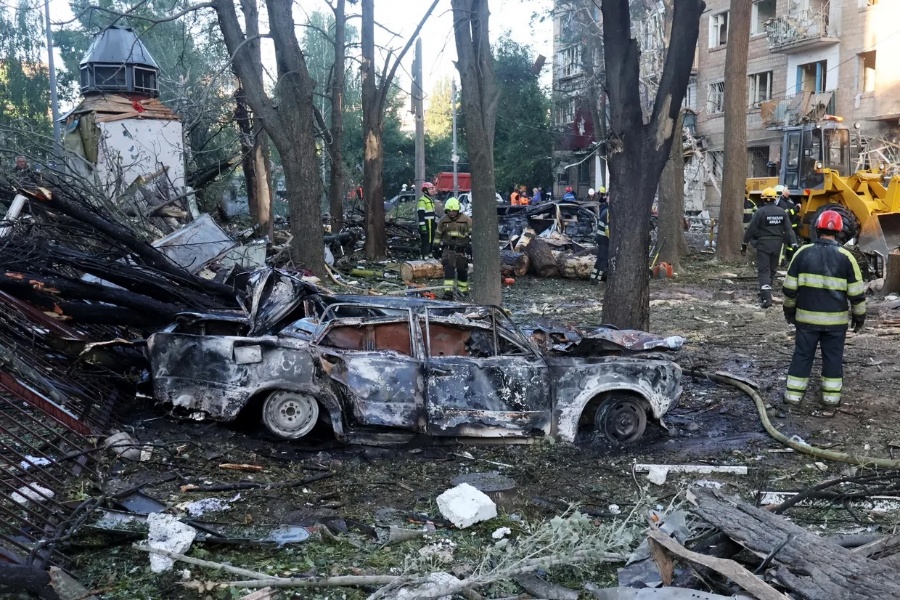
Firefighters work at the site of an apartment building hit by a Russian drone and missile strike. (Aleksandr Gusev / SOPA Images / LightRocket via Getty Images)
Death in the Night: Kyiv Endures Massive Aerial Bombardment
The capital trembled under the weight of 368 Russian aerial weapons during a 3.5-hour assault that began at 1 a.m. local time, transforming residential neighborhoods into scenes of devastation. Russian forces deployed 352 attack drones, including 159 Iranian-made Shaheds, alongside 16 missiles in what Ukrainian officials described as one of the largest air assaults on the capital this year.
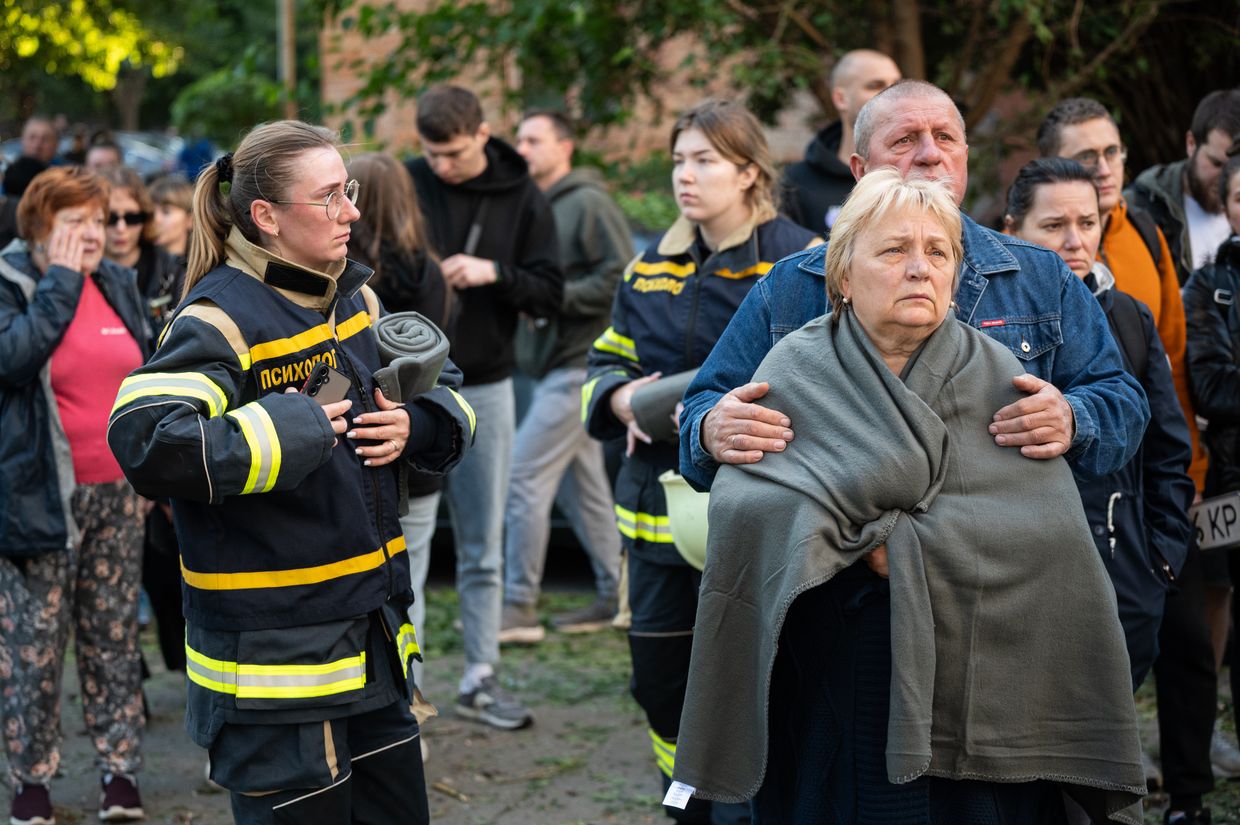
Local residents react as teams continue search and rescue efforts at the site of Russian attack in Kyiv, Ukraine. (Danylo Antoniuk/Anadolu via Getty Images)
The most catastrophic blow struck the Shevchenkivskyi district, where a ballistic missile tore through a five-story residential building, causing its partial collapse. Nine people died in the ruins, their lives extinguished in an instant of terror that began with the screaming of incoming ordnance. Among the victims was an 11-year-old girl whose mother’s body was recovered earlier from the same rubble.
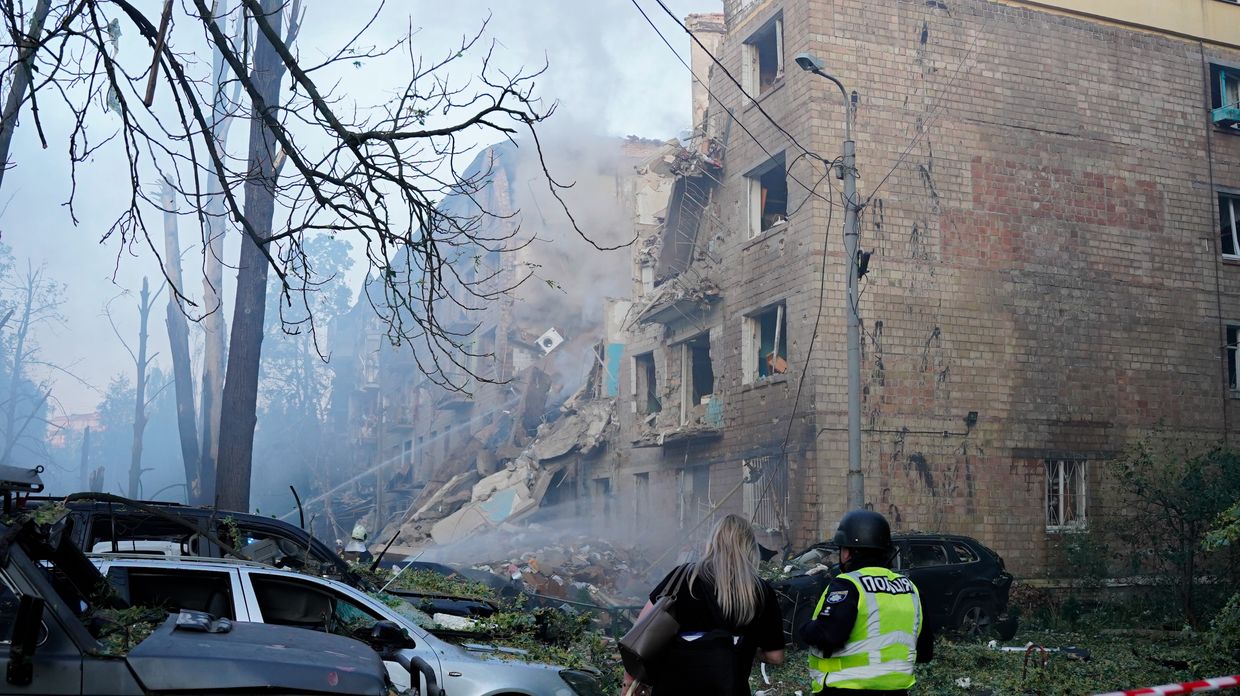
A woman and policeman stand in front of the partially collapsed residential building after a Russian attack in Kyiv, Ukraine (Ihor Kuznietsov/Novyny LIVE/Global Images Ukraine via Getty Images)
“It was impossible to look at,” said student Veronika Sherinova, whose friends lived in the destroyed building. “We saw them coming out in just their underwear, covered in blood, wounded. Most of my former classmates lived in this building, most of my friends and acquaintances, too.”
The strike killed an entire family—father, mother, and grandfather—while their teenage son survived, left in a state of shock so profound he couldn’t comprehend the magnitude of his loss. Sherinova’s other friends fled the country immediately after the attack, boarding buses to escape a homeland that offered no sanctuary from Russian hatred.
State Emergency Service spokesperson Svitlana Vodolaha revealed the grim reality facing rescue workers: “As it turned out, the information we had was not reliable—there were more people here than we had been told. We still don’t have complete information on how many people might be trapped under the rubble.”
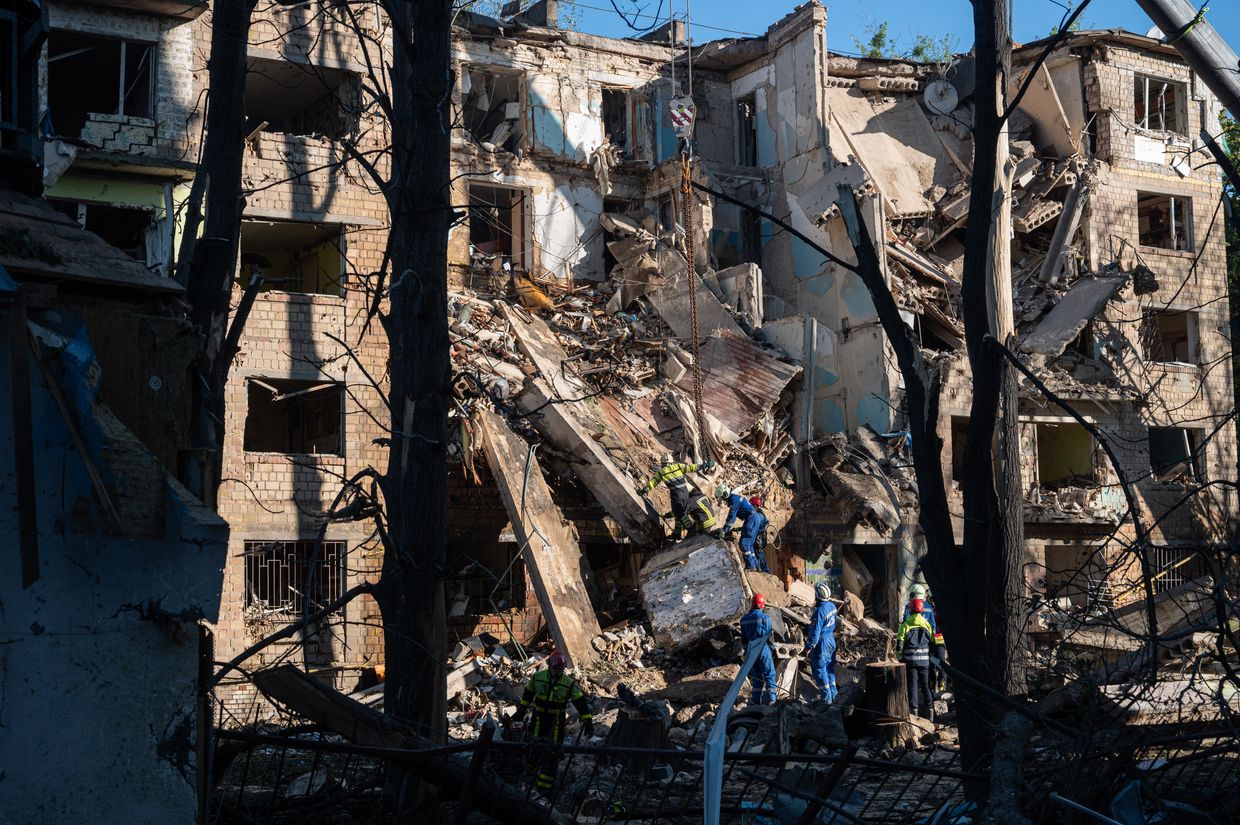
The residential building damaged by a Russian attack as teams continue search and rescue effort in Kyiv, Ukraine. (Danylo Antoniuk/Anadolu via Getty Images)
Putin’s Moral Inversion: Condemning “Aggression” While Waging War
The timing of Putin’s denunciation of American strikes on Iranian nuclear facilities revealed the depths of Kremlin duplicity. Meeting with Iranian Foreign Minister Abbas Araghchi at the Kremlin, Putin declared that “the completely unprovoked aggression against Iran has no basis and no justification,” employing language that perfectly described his own three-year campaign of destruction against Ukraine.
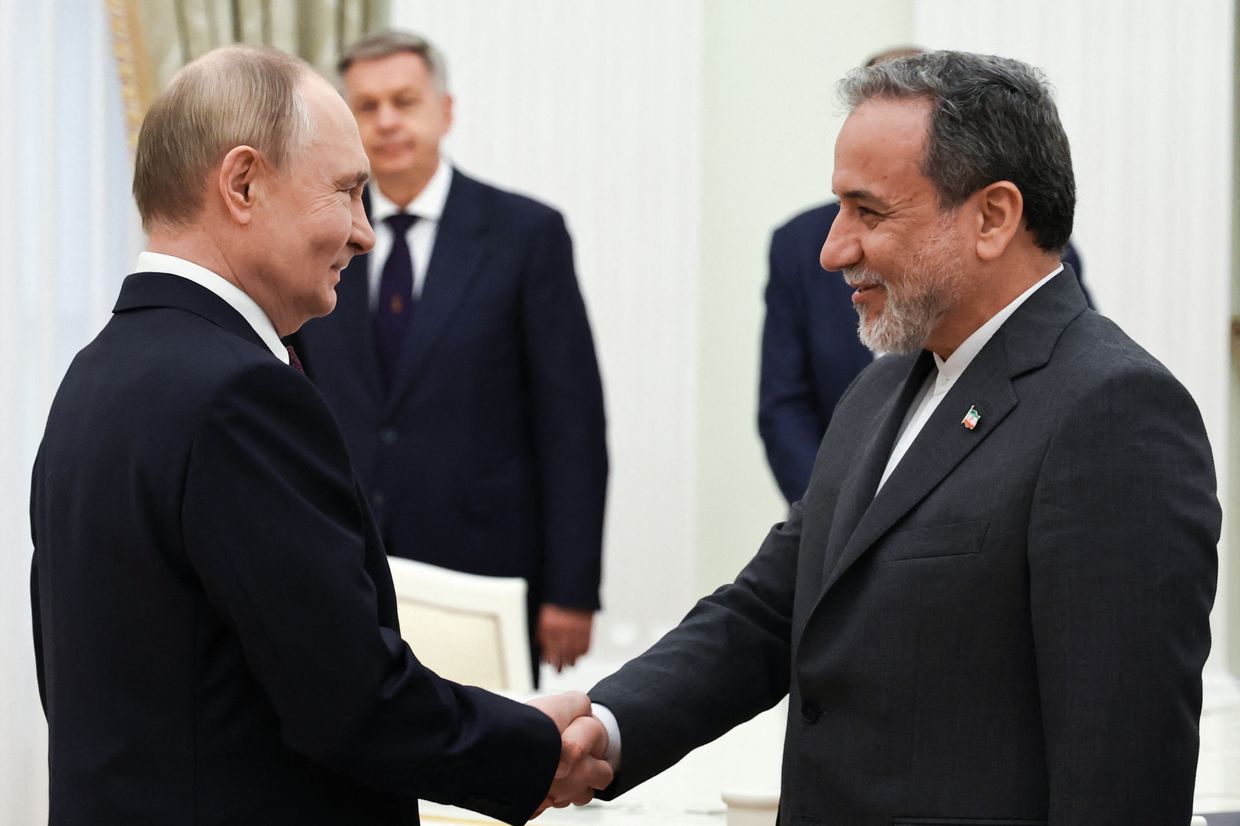
Russia’s President Vladimir Putin and Iranian Foreign Minister Abbas Araghchi shake hands during a meeting at the Kremlin in Moscow. (Alexander Kazakov/Pool/AFP via Getty Images)
The irony was not lost on President Volodymyr Zelensky, who highlighted Russia’s moral bankruptcy in stark terms: “After the strikes on Iran’s nuclear facilities, there was an uproar from Moscow. The Russian leadership demonstratively condemned the ‘missile and bomb’ actions. Today, Moscow is silent—after its own army launched a cynical attack using Russian-Iranian ‘Shaheds’ and missiles on civilian infrastructure in Kyiv and other cities.”
Putin’s meeting with Araghchi underscored the limitations of Russia’s strategic partnerships even as Moscow deepened its dependence on Iranian weapons technology. Despite claims that Russian-Iranian relations have become “strategic in nature,” unspecified Iranian sources told Reuters that Tehran “has not been impressed with Russia’s support so far and wants Putin to do more to back Iran against Israel and the United States.”
The dynamic revealed Russia’s constrained position: too committed in Ukraine to provide meaningful military support to Iran, yet too desperate for Iranian drones and missiles to risk alienating its weapons supplier. Putin’s diplomatic overtures remained the extent of his assistance—hollow words from a leader whose actions spoke only of destruction.
Educational Institutions Under Fire: Russia Targets Learning and Hope
The Kremlin’s war against Ukrainian civilization extended beyond residential areas to strike at the foundations of education and knowledge. In Bilhorod-Dnistrovskyi, Odesa Oblast, a Russian ballistic missile obliterated a local educational institution, killing three people and injuring at least 12 others, including two teenagers.
Governor Oleh Kiper reported that teaching staff members remained trapped under the rubble of the destroyed building, their fate unknown as rescue operations continued. The strike occurred during summer holidays, sparing the children who would normally fill the classrooms with life and learning. By evening, the death toll had risen as a 60-year-old woman succumbed to her injuries, while eight victims remained hospitalized.
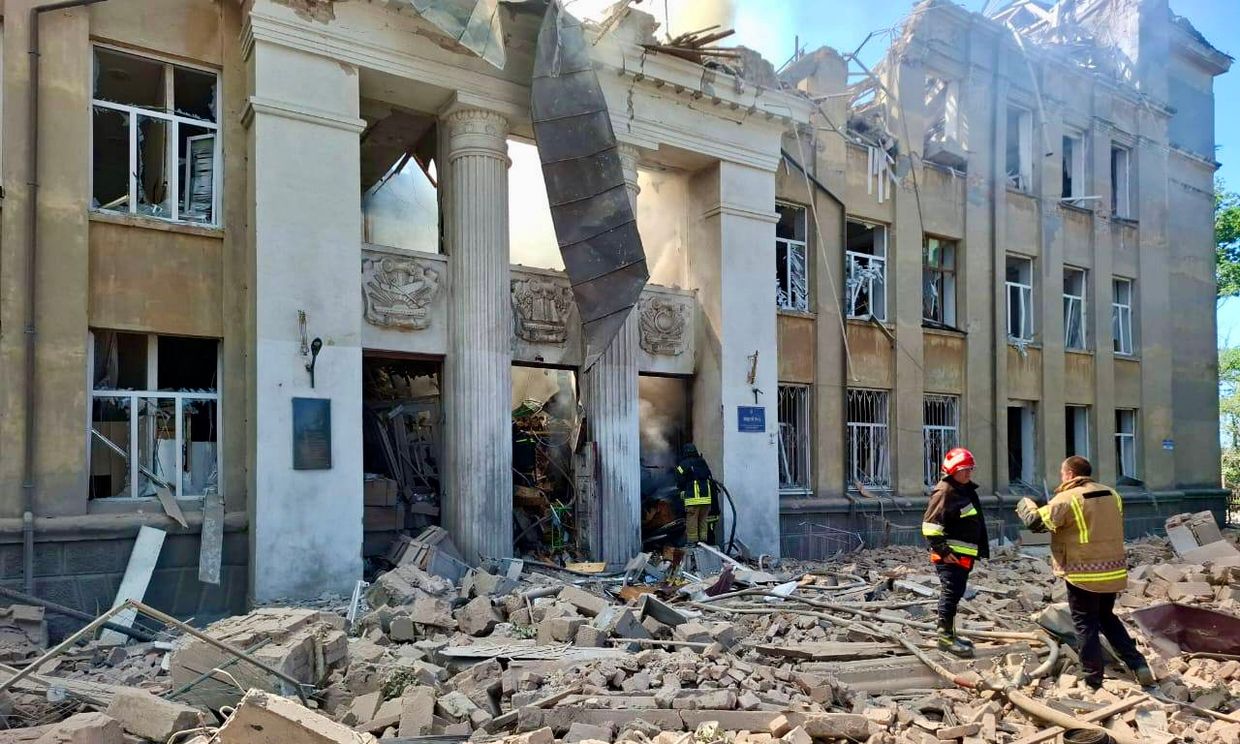
A Russian ballistic missile strike hit the city of Bilhorod-Dnistrovskyi in Odesa Oblast, 2025, destroying a local educational institution. (Oleh Kiper / Telegram)
The targeting of educational facilities represents more than tactical terrorism—it constitutes an assault on Ukraine’s future, an attempt to destroy the institutions that nurture young minds and preserve cultural identity. Under international humanitarian law, such attacks on civilian infrastructure may constitute war crimes, yet Russia continues to demonstrate its contempt for the laws of armed conflict.
Children’s Blood in Sumy: Cross-Border Terror Claims Young Lives
The horror extended to Ukraine’s northeastern border, where Russian drone strikes on Sumy Oblast claimed the lives of three people, including an 8-year-old boy whose short life ended in the flames of Russian hatred. The overnight attack near Verkhnia Syrovatka also killed an adult man and woman while injuring six others, including three children who now face a lifetime of trauma from surviving what their young minds cannot comprehend.
Governor Oleh Hryhorov reported that the strike damaged approximately 30 residential buildings and four cars while sparking a large-scale fire that illuminated the night sky—a beacon of destruction visible across the border in Russia, where citizens remained largely ignorant of the crimes committed in their name.
The attack represented the latest escalation in Russia’s campaign to establish a buffer zone in Sumy Oblast, where Moscow’s forces have captured around 200 square kilometers since March and prompted evacuations from over 200 settlements. The systematic targeting of civilian areas reveals the true nature of Russia’s “buffer zone”—a depopulated wasteland created through terror and ethnic cleansing.
The Economics of Occupation: Russia’s Investment in Stolen Land
While Russian missiles fell on Ukrainian children, occupation administrators gathered at the St. Petersburg International Economic Forum to showcase their success in monetizing theft. Officials from occupied Kherson, Zaporizhzhia, Luhansk, Donetsk oblasts, and Crimea secured investment pledges totaling billions of rubles for development projects in territories seized through violence.
Sevastopol occupation governor Mikhail Razvozhaev announced 200 billion rubles ($2.5 billion) in investment commitments for seaport development and housing construction, while Crimea occupation head Sergei Aksyonov signed agreements worth 68 billion rubles ($866 million). The systematic integration of occupied Ukraine into Russia’s economic sphere represents a long-term strategy to make territorial gains irreversible while extracting maximum benefit from conquest.
The prevalence of Russian companies in occupied territories serves dual purposes: strengthening Moscow’s economic control while complicating future Ukrainian reintegration efforts. Occupation authorities offered incentives such as “war risk” insurance to attract investors, revealing their awareness that Ukrainian sovereignty remained an existential threat to their illegitimate enterprises.
Expanding the Architecture of Child Abuse: Russia’s Deportation Infrastructure
Russia’s systematic campaign to steal Ukrainian children gained new infrastructure with announcements about the “Solnechny” children’s camp at the sanctioned “Artek” international children’s center in occupied Crimea. First Deputy Director Elena Zhivoglyad confirmed the facility would open by the end of 2025, enabling “Artek” to increase its annual capacity to 56,000 children.
The expansion represents more than summer camp development—it constitutes infrastructure for war crimes. Ukrainian President Volodymyr Zelensky recently sanctioned “Artek” for its central role in forcibly removing Ukrainian children from their homes and subjecting them to militarization and indoctrination programs designed to erase their national identity.
Deputy Prime Minister Marat Khusnullin reported that “Solnechny” had completed construction of two dormitories capable of housing 1,000 children, providing Russia with enhanced capacity to process stolen Ukrainian youth through its systematic Russification programs. The industrial scale of these operations reflects the Kremlin’s long-term commitment to demographic warfare against Ukrainian identity.
Religious Persecution: Dismantling Faith and Heritage
Russian occupation forces continued their assault on religious diversity by dismantling a church organ and Catholic-Orthodox unity bell at the Berdyansk Catholic Cathedral of the Nativity of the Blessed Virgin Mary. Officials planned to transport the organ to Russia—effectively looting cultural heritage—while converting the sacred space into residential quarters for Russian “specialists” relocated to occupied territory.
The appropriation of worship sites belonging to religious minorities represents another dimension of Russia’s colonial project in occupied Ukraine. By erasing the physical manifestations of diverse religious traditions, occupation authorities seek to create a uniform Orthodox landscape that serves Russian imperial ideology while destroying the multicultural fabric that defined Ukrainian society.
Military Restructuring: Putin’s Preparation for Broader Conflict
Speaking to graduates of Russia’s military academies, Putin announced the completion of major force restructuring efforts in 2025, including the formation of Moscow and Leningrad military districts and the reorganization of naval infantry brigades into divisions. The president also confirmed Russia’s establishment of Unmanned Systems Forces as a new military branch while beginning serial production of Oreshnik ballistic missiles.
Putin’s acknowledgment of efforts to empower internal security services revealed the regime’s growing concerns about domestic stability. The expansion of Rosgvardia capabilities and Federal Security Service force generation reflects lessons learned from the Wagner Group rebellion, as Putin seeks to insulate his regime from internal threats while preparing for potential future conflicts with NATO.
The military reforms, particularly in western Russia along the border with NATO, demonstrate Moscow’s longer-term preparation for expanded conflict beyond Ukraine. Putin’s rhetoric about NATO’s “global militarization” attempts to frame Russia’s aggressive military expansion as defensive reactions, inverting reality to justify continued escalation.
Ukraine’s Defensive Response: Striking Back at Russian Infrastructure
Ukrainian forces demonstrated their growing capability to project power into Russian territory by striking the Atlas oil depot in Rostov Oblast, igniting fires at a facility that supplies fuel and lubricants to Russian military units. The attack represented part of Ukraine’s broader campaign to disrupt Russian supply chains and degrade Moscow’s capacity to sustain its invasion.
The successful strike on the depot—previously targeted in November 2024—highlighted Ukraine’s ability to repeatedly hit strategic targets despite Russian air defenses. Located near the Azov Sea and bordering Ukraine, Rostov Oblast serves a crucial logistical role for Russia’s war effort, making such facilities high-value targets for Ukrainian operations.
International Support Amid Ongoing Terror
Norway’s commitment to invest $400 million in Ukrainian defense industry marked a significant expansion of Western support for Ukraine’s domestic production capabilities. The announcement followed a visit by Norwegian Defense Minister Tore Onshuus Sandvik and included funding for drone production and joint air defense manufacturing inside Ukraine.
Norway’s largest defense company, Kongsberg Defence & Aerospace, opened an office in Ukraine as part of the cooperation, with agreements to jointly develop and produce missiles for the National Advanced Surface-to-Air Missile System (NASAMS). The collaboration represents a model for other Western nations seeking to support Ukraine’s long-term defense capabilities while reducing dependence on traditional aid packages.
Diplomatic Choreography: Zelensky’s Strategic Engagement
President Zelensky’s visit to the United Kingdom provided a stark contrast to Putin’s diplomatic theater with Iran. Meeting with King Charles III and Prime Minister Keir Starmer, Zelensky secured an “industrial military co-production agreement” that Starmer described as “a massive step forward” in British contributions to Ukrainian defense.
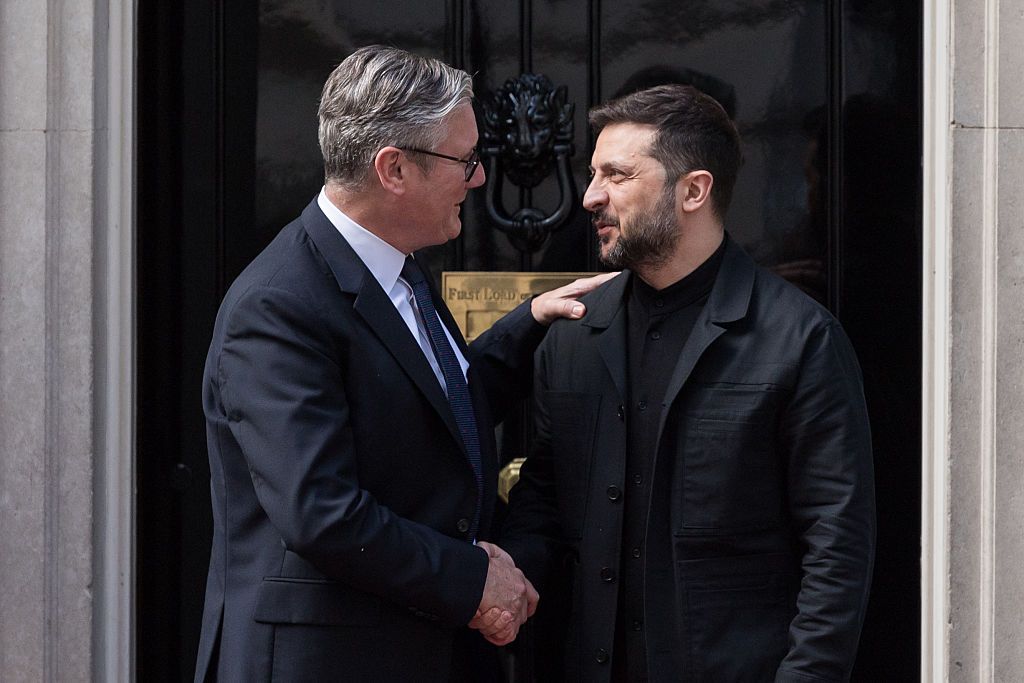
British Prime Minister Keir Starmer (L) and President of Ukraine Volodymyr Zelenskyy stand outside 10 Downing Street after their meeting in London, United Kingdom. (Wiktor Szymanowicz/Future Publishing via Getty Images)
The visit coincided with announcements about NATO’s new defense spending targets, with member states committing to spend five percent of GDP on defense—a quantum leap from previous commitments. NATO Secretary General Mark Rutte characterized the move as “ambitious, historic and fundamental to securing our future,” reflecting the alliance’s recognition of the existential threat posed by Russian aggression.
The Corruption of Power: Ukraine’s Internal Challenges
The formal naming of Deputy Prime Minister Oleksii Chernyshov as a suspect in a land grab case marked the highest-ranking corruption charges against a sitting Ukrainian official in the country’s history. The National Anti-Corruption Bureau accused Chernyshov of participating in a scheme that undervalued land plots by five times while accepting significant discounts on apartments as kickbacks.
Chernyshov’s defiant refusal to resign—”I will stay in this position”—highlighted the challenges Ukraine faces in maintaining governance standards while defending against existential threats. His close relationship with President Zelensky complicated the political dynamics, with anti-corruption experts predicting attacks on law enforcement institutions rather than accountability for misconduct.
Bodies of Deception: Russia’s Manipulation of the Dead
Ukraine’s Interior Ministry revealed that Russia had attempted to pass off the remains of three Russian soldiers as Ukrainian during body exchanges, part of a broader pattern to obscure the scale of Russian military losses from its domestic population. Interior Minister Ihor Klymenko ordered the suspension of further body transfers until DNA confirmation could verify identities, highlighting Russia’s willingness to manipulate even the sacred duty of returning the war dead.
The discovery of Russian military insignia, documents, and equipment on bodies supposedly belonging to Ukrainians revealed the systematic nature of Moscow’s deception. With at least 20 such incidents recorded during recent repatriations, the practice represents another dimension of Russian information warfare designed to hide the true cost of Putin’s imperial ambitions from his own people.
Battlefield Dynamics: The Grinding War Continues
While diplomatic and terrorist activities dominated headlines, the grinding reality of frontline combat continued across multiple axes. Ukrainian forces liberated Andriivka north of Sumy City in mid-June, while Russian forces made limited advances near Hrekivka in the Borova direction and south of Udachne in the Pokrovsk sector.
Commander-in-Chief Oleksandr Syrskyi reported Ukrainian assault operations toward Yunakivka, with forces advancing between 200 and 700 meters over the course of a week. The characterization of contested areas as “gray zones” reflected the fluid nature of frontline combat, where control shifted based on the tactical initiative of small unit actions rather than large-scale mechanized operations.
Russian forces continued their reliance on small assault groups and motorcycle attacks, tactics necessitated by Ukrainian air defenses and the changing weather conditions that increased visibility for defensive fires. The shift away from large mechanized assaults reflected both Ukrainian defensive improvements and Russian resource constraints across the extended front.
Technology and Terror: The Evolution of Warfare
The appearance of Russian Geran-2 drones in frontline strikes marked a significant evolution in Moscow’s employment of Iranian-designed weapons. Previously reserved for long-range attacks against Ukraine’s rear areas, the deployment of these systems for tactical support indicated enhanced drone production capabilities and the increasing integration of Iranian technology into Russian tactical doctrine.
Ukrainian forces demonstrated their own technological advancement by striking specialized equipment including “Mur” surveillance systems and “Sylok-M1” electronic warfare systems in the Lyman direction. The successful targeting of these sophisticated defensive assets highlighted Ukraine’s growing capability to identify and neutralize key Russian technologies that enabled tactical coordination.
The Economics of War: Resources and Reconstruction
Ukraine’s partnership with European aerospace giant Airbus through Ukroboronprom marked another step in the country’s effort to integrate with Western defense industrial bases. The trilateral cooperation memorandum focused on developing maintenance and repair capabilities for Airbus aircraft, providing Ukrainian specialists with training and certification that would serve both military and civilian aviation needs.
DTEK’s partnership with British clean energy group Octopus Energy to install rooftop solar panels and battery storage systems represented Ukraine’s parallel effort to rebuild more resilient energy infrastructure. The RISE program’s goal of raising 100 million euros for 100 energy projects over three years embodied Ukraine’s strategy of using reconstruction to build back better rather than simply replacing destroyed Soviet-era systems.
Regional Implications: Serbia’s Balancing Act
Serbian President Aleksandar Vucic’s announcement that Serbia had halted all arms exports provided a window into the complex pressures facing nations attempting to navigate between Russian and Western spheres of influence. While denying that the move responded to criticism over Serbian munitions reaching Ukraine, Vucic’s decision reflected the unsustainable nature of arms dealing in a polarized international environment.
The Serbian case highlighted broader challenges facing countries that maintained economic relationships with both sides of the conflict. As international pressure mounted and supply chains became more scrutinized, traditional arms exporters found themselves forced to choose sides or exit markets entirely.
Serbia’s Strategic Retreat: Arms Export Suspension Amid Russian Pressure
Serbian President Aleksandar Vucic’s announcement that Serbia had halted all arms exports marked a significant shift in the Balkan nation’s delicate balancing act between Russia and the West. Speaking after a meeting with senior military officials, Vucic denied that the move responded to mounting criticism over allegations that Serbian munitions had reached Ukraine, instead citing national security and economic interests.
The decision came amid increasing scrutiny from Russia’s Foreign Intelligence Service, which in May accused Belgrade of supplying weapons to Kyiv despite Serbia’s declared neutrality and friendly ties with Moscow. A 2024 Financial Times investigation had revealed that Serbian ammunition was making its way to Ukraine through intermediaries, creating pressure on Vucic’s government from both sides of the conflict.
Serbia’s Defense Ministry confirmed the suspension of all arms and military equipment exports, reflecting the impossible position facing countries attempting to maintain economic relationships with both belligerents. The Serbian case highlighted broader challenges for traditional arms exporters forced to choose sides in an increasingly polarized international environment.
Diplomatic Breakthroughs: Prisoner Releases and International Engagement
US Special Envoy to Ukraine General Keith Kellogg’s acknowledgment of leading a delegation to Belarus on June 21 marked a significant diplomatic development that came to light on June 23. The negotiations resulted in the release of 14 political prisoners from Belarus, including citizens from Japan, Poland, and four other countries, demonstrating the complex web of international diplomacy operating parallel to the main conflict.
Belarusian opposition leader Svetlana Tikhanovskaya announced that Belarus had freed prominent opposition leader Sergey Tikhanovsky as part of the exchange, representing a rare humanitarian breakthrough involving the Lukashenko regime. The successful prisoner release highlighted the potential for diplomatic solutions even with Russia’s closest allies when international pressure and skilled negotiation converged.
Putin’s Personal Vendetta: Assassination Orders Against Ukrainian Journalists
Security Service of Ukraine head Vasyl Maliuk revealed that Putin personally authorized at least two attempts to assassinate Ukrainian journalist Dmytro Gordon, exposing the Kremlin’s systematic targeting of media figures who challenge Russian narratives. The disclosure highlighted the personal nature of Putin’s war against Ukrainian civil society, extending beyond military targets to include prominent voices of resistance.
Gordon, whose YouTube channel boasts 4.5 million subscribers, represents the power of independent media to penetrate Russian information barriers and reach audiences across the former Soviet space. The assassination plots—involving a former Party of Regions lawmaker and a criminal group from Dagestan—demonstrated the FSB’s sophisticated network of assets deployed against Ukrainian targets.
The first network planned to use homemade explosive devices or coordinate missile strikes, but only if Gordon’s presence could be confirmed at targeted locations. The second group, operating under cover as fugitives from Russian law enforcement, conducted detailed surveillance while planning either close-range assassination or sniper attacks depending on security arrangements.
Karma in Crimea: Collaborator Attacked by Lion
In a darkly ironic twist, businessman Oleg Zubkov—who renounced his Ukrainian citizenship to collaborate with Russian authorities following the 2014 annexation of Crimea—was attacked by a lion at his Taigan Safari Park. The collaborator, who had smuggled animals from zoos in occupied Zaporizhzhia and Kherson oblasts after the full-scale invasion, suffered severe injuries when the lion tore his trachea, neck, and chest muscles.
The attack represented the latest in a series of incidents at the park, where three lions killed employee Leokadia Perevalova in 2024 while she cleaned their enclosure. Zubkov’s condition remained stable after surgery, but the symbolic nature of the attack—a man who betrayed his country being mauled by a captive predator—provided a grim metaphor for the fate of those who collaborate with occupying forces.
The Architecture of Exchange: Understanding Prisoner Swaps
Detailed revelations about Ukraine’s prisoner exchange mechanisms provided insight into one of the war’s most sensitive diplomatic channels. Since the start of the full-scale invasion, Ukraine has brought home over 5,700 people through more than 65 exchanges, while maintaining consistent proposals for “all-for-all” swaps that Russia continues to reject.
The complexity of negotiations varies dramatically, with some exchanges requiring weeks or months of preparation while others, like the recent 1,000-for-1,000 swap agreed in Istanbul, involved simple list exchanges without extended bargaining. Ukrainian officials revealed that over 70,000 people remain classified as missing, the majority of them soldiers, highlighting the enormous scale of the humanitarian crisis.
The systematic torture of Ukrainian prisoners emerged as a defining characteristic of Russian captivity, with over 95% of released Ukrainian POWs reporting torture during detention. The contrast with Russian treatment in Ukrainian facilities—where International Committee of the Red Cross inspections occur every two months—underscored the fundamental difference in how each side approached the laws of armed conflict.
Industrial Partnerships: Building Ukraine’s Defense Future
Ukraine’s expanding partnerships with Western defense companies gained momentum with Ukroboronprom’s trilateral cooperation agreement with Airbus at the Le Bourget International Air Show. The deal launched initiatives to develop maintenance and repair capabilities for Airbus aircraft operating in Ukraine, with the aerospace giant sending representatives to train local specialists who would become certified instructors.
The partnership represented more than technical cooperation—it symbolized international confidence in Ukraine’s long-term stability and industrial potential. Ukroboronprom Director General Oleh Hulyak emphasized that “trust in our defense industrial complex is growing among global high-tech companies,” indicating the success of Ukraine’s strategy to integrate with Western supply chains while building domestic capabilities.
DTEK’s partnership with British clean energy group Octopus Energy further demonstrated Ukraine’s commitment to rebuilding more resilient infrastructure. The RISE program’s ambitious goal of raising 100 million euros for 100 energy projects over three years embodied the dual strategy of immediate reconstruction and long-term modernization that characterized Ukraine’s approach to post-conflict development.
Looking Forward: The Persistence of Terror and Resilience
As search and rescue operations continued in Kyiv’s ruins and families mourned their dead across Ukraine, the events of June 23 crystallized the moral chasm separating Russian rhetoric from reality. Putin’s condemnation of “unprovoked aggression” while orchestrating mass murder revealed a regime so divorced from moral truth that it had become incapable of recognizing its own contradictions.
The day’s violence—from the collapsed apartment building in Kyiv to the destroyed school in Odesa Oblast to the dead child in Sumy—testified to Russia’s commitment to terror as state policy. Yet Ukraine’s resilience, demonstrated through continued international partnerships, diplomatic breakthroughs, and defensive operations, showed that Putin’s campaign to break Ukrainian will through civilian targeting had failed.
The revelation of Putin’s personal involvement in assassination plots against Ukrainian journalists exposed the dictator’s fear of voices that could penetrate Russian information barriers. Meanwhile, the ironic fate of collaborator Zubkov served as a reminder that those who betray their homeland often find that predators recognize no loyalty.
As NATO prepared to announce historic defense spending increases and Ukraine deepened its partnerships with allies, the strategic balance continued shifting against Russian aggression. Putin’s hollow diplomatic posturing with Iran could not disguise the reality that his war had isolated Russia from the civilized world while strengthening Ukrainian resolve and Western unity.
The phantom reconciliation between Russia’s words and deeds would continue haunting Putin’s regime, exposing the bankruptcy of a system built on lies and sustained by violence. For Ukraine and its people, June 23 marked another day of survival, another step toward ultimate victory over an empire built on the bones of the innocent.