
As Explosions Rock Russian Pipelines in Vladivostok and Tankers Burn in Baltic Ports, Moscow Claims New Village Captures While Concealing Growing Death Tolls
Summary of the Day – July 5-6, 2025
The weekend brought a devastating escalation in Ukraine’s long-range capabilities as explosions ripped through military supply pipelines in Russia’s Far East and struck the Black Sea Fleet’s home port of Novorossiysk. While Moscow claimed territorial gains in two villages and boasted of downing 120 Ukrainian drones, the reality painted a different picture: civilian airports paralyzed across Russia, another shadow fleet tanker mysteriously exploding, and the Kremlin’s statistical agency quietly ceasing to report death figures—a telltale sign of mounting military losses. Ukraine’s army chief warned of renewed Russian offensives in the northeast as his forces demonstrated their ability to strike targets from the Sea of Japan to the Baltic, bringing the war’s consequences ever closer to ordinary Russians celebrating their summer holidays.
From Vladivostok to the Black Sea: Ukraine’s Expanding Strike Network
In perhaps the most audacious strike of the conflict, explosions in Russia’s Far Eastern port of Vladivostok damaged critical infrastructure supplying the Pacific Fleet’s 155th Marine Brigade. The early morning blasts between 1-2 a.m. local time destroyed sections of a gas pipeline along the Sea of Japan and completely eliminated a water pipeline serving military garrisons. Russian special services reportedly cut mobile internet and communications in the area—a desperate measure that revealed the attack’s significance across 6,000 miles of Russian territory.
Hours later, Ukrainian drones attacked Russia’s Black Sea Fleet at Novorossiysk, the primary naval base after Crimea’s Sevastopol became too dangerous for major operations. Russian media published footage of a burning maritime drone allegedly shot down during the assault, as air raid sirens wailed across Krasnodar Krai for hours.
The strikes formed part of a broader 157-drone assault that reached its crescendo at the Borisoglebsk airfield in Voronezh Oblast, where explosions destroyed a warehouse filled with guided bombs and damaged aircraft. The base, hosting Su-34, Su-35S, and Su-30SM fighter-bombers regularly used to strike Ukrainian cities, became a towering inferno visible from space as NASA satellites detected the fire. Residents reported 8-10 powerful explosions around 2 a.m., potentially destroying at least one training and combat aircraft.
Russian Aviation Paralyzed: Chaos at Major Airports
The drone campaign sent shockwaves across Russian airspace, forcing cancellation of 287 flights at major airports including Moscow’s Sheremetyevo, St. Petersburg’s Pulkovo, and Nizhny Novgorod’s Strigino. At Sheremetyevo alone, 171 flights were canceled and 56 delayed, creating scenes of chaos as passengers slept on airport floors with no available seating even in business lounges. Some travelers waited over nine hours while others weren’t allowed to disembark after landing.
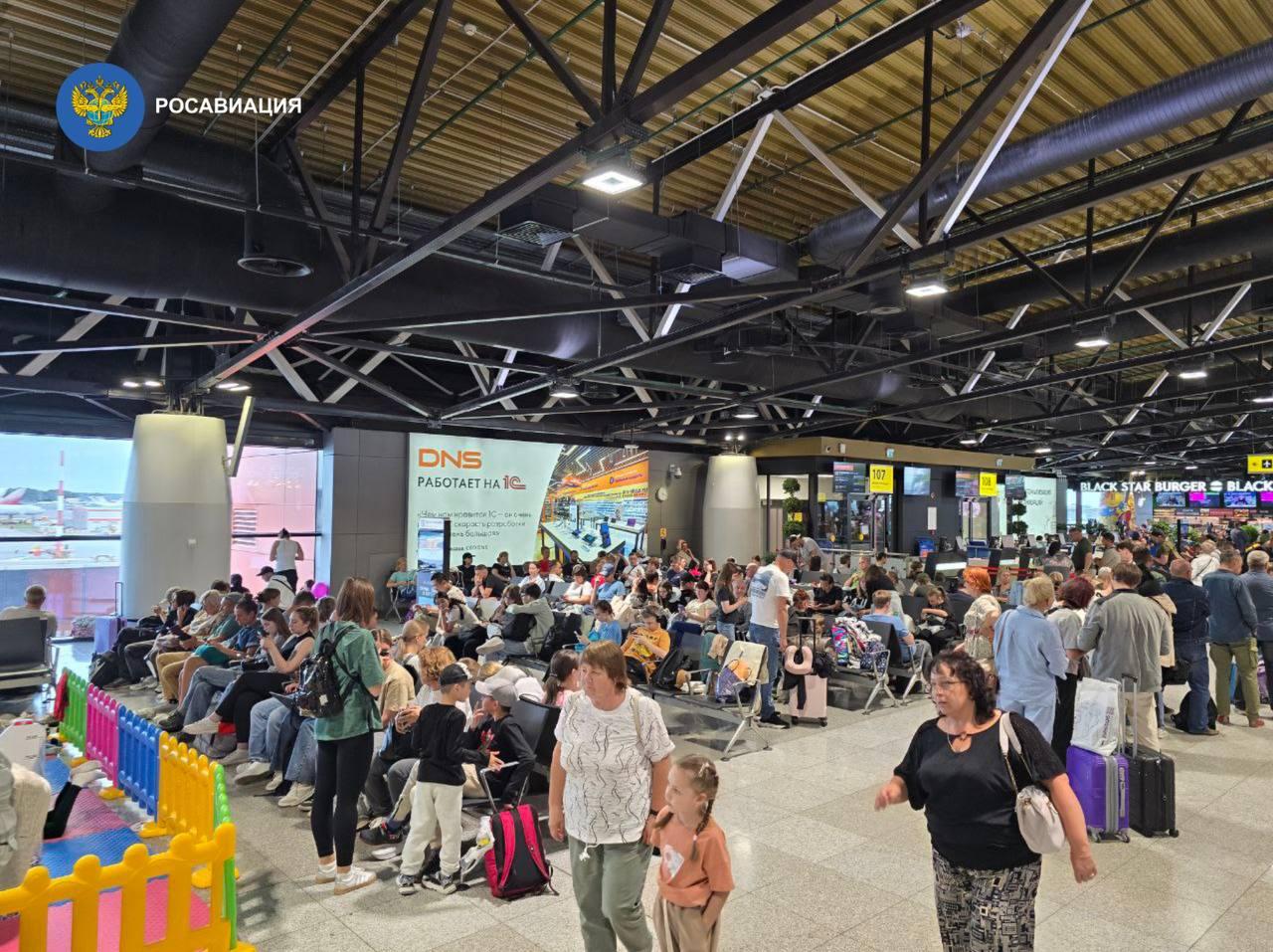
Russia’s Defense Ministry claimed to have downed 120 drones overnight across 10 regions, with the highest concentrations over Bryansk (30), Kursk (29), and Oryol (18) oblasts. The paralysis of Russian aviation demonstrated how Ukraine’s drone strategy has evolved from purely military targets to disrupting daily lives of ordinary Russians far from any battlefield.
Electronic Warfare Inferno: Striking the Heart of Russian Precision Weapons
Deep in Russia’s interior, Ukrainian drones found their most strategically valuable target in Cheboksary: JSC VNIIR-Progress, a state institute developing electronic warfare systems for Russia’s most lethal weapons. Located 745 miles from the Ukrainian border, the facility produces Kometa antenna arrays used in Shahed drones, Iskander-K cruise missiles, and guided bomb modules—the precision weapons terrorizing Ukrainian civilians daily.
This marked the second Ukrainian strike on the EU-sanctioned facility in less than a month, revealing both the site’s importance and Ukraine’s determination to cripple Russia’s precision-strike capabilities at their source. Local Russian Telegram channels reported explosions overnight, while Moscow’s Defense Ministry claimed to have shot down two drones—a reflexive response that has become meaningless given the evident success of the strike.
Putin’s Recruitment Drive and Russia’s Statistical Blackout
As Ukrainian drones terrorized Russian skies, Vladimir Putin appeared at Moscow’s “Everything for Victory” forum, revealing the Kremlin’s growing desperation for volunteers. Speaking to the People’s Front, Putin claimed “overwhelming majority” support from citizens while highlighting the organization’s military contributions: 110,000 drones and 14,000 vehicles supplied to forces in Ukraine. The timing suggested Russia is struggling to maintain voluntary recruitment rates while remaining averse to declaring another partial mobilization.
More telling was the simultaneous revelation that Russia’s Federal State Statistics Service quietly stopped reporting death figures in its regular demographic reports. When researcher Dmitry Kobak requested 2024 male excess mortality data, Rosstat simply refused. The statistical blackout represents a desperate attempt to conceal the war’s true human cost as Western intelligence estimates suggest Russian military casualties have exceeded 600,000 killed and wounded.
Shadow Fleet Sabotage: The Eco Wizard Explosion
In Russia’s Ust-Luga port, another mysterious explosion rocked the shadow fleet tanker Eco Wizard, causing an ammonia leak and forcing evacuation of the 23-person crew. The blast, described as “of unknown nature,” represents the sixth tanker linked to Russia to suffer an explosion this year—suggesting either systematic sabotage or the inherent dangers of operating aging vessels under sanctions pressure.
The Marshall Islands-flagged vessel had arrived from Antwerp just three days earlier, highlighting vulnerabilities in Russia’s parallel oil transportation network crucial for funding its war machine through circumvented sanctions.
Russian Resilience: Middle-Class Moscow Adapts to Sanctions Reality
In Moscow’s suburbs, the war’s economic impact tells a different story. Sergei Duzhikov and Maria Tyabut, earning around $3,800 monthly, represent a Russian middle class that has successfully adapted through Chinese imports and domestic substitutes. They drive a Chinese car, vacation in Venezuela, and buy Russian-made “Camembert” cheese—embodying Moscow’s narrative of economic resilience.
“From the perspective of my everyday life, I honestly don’t feel the impact of sanctions,” said Maria, whose experience reflects broader Russian adaptation strategies: McDonald’s replaced by “Vkusno i tochka,” European vacations swapped for “friendly” Latin American nations. While they admitted some inconveniences—Sergei waited three months for Korean car parts—their lifestyle remained largely unchanged, illustrating how Russia’s pivot to alternative suppliers has cushioned many urban Russians from immediate sanctions impact.
Territorial Trades and Front-Line Pressure
Russian forces confirmed capture of Piddubne in Donetsk Oblast, a 500-person settlement just seven kilometers from Dnipropetrovsk region, while claiming Sobolivka in Kharkiv Oblast. These grinding territorial gains came as Commander-in-Chief Oleksandr Syrskyi warned of renewed Russian offensives in the northeast, where Ukrainian troops repelled more than 60 assaults over the past week.
“Russian forces are trying to overwhelm us with quantity,” Syrskyi warned during his Kharkiv Oblast front line visit, coordinating with Joint Forces Commander Major General Mykhailo Drapatyi as Russian forces advanced up to 3 kilometers near border village Milove. Ukrainian forces demonstrated their own capabilities with advances in eastern Novoyehorivka, southeast of Borova.
Double-Tap Terror and Civilian Casualties
Russian forces conducted deliberate “double-tap” strikes against Ukrainian emergency responders in Kharkiv and Kherson—calculated attacks designed to kill first responders arriving at initial strike sites. These war crimes accompanied a broader assault of 157 Shahed drones and four S-300 missiles striking civilian, energy, and military infrastructure across five oblasts.
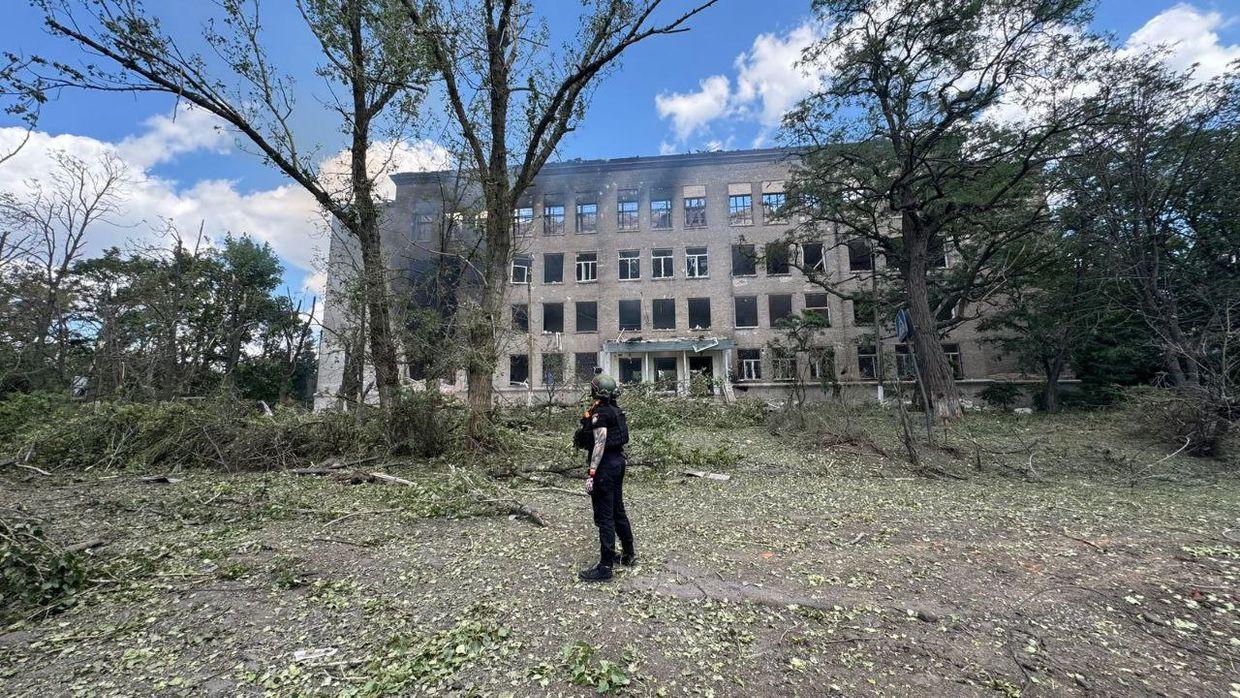
The weekend’s violence claimed at least 11 civilian lives, with the youngest victim an 8-year-old boy killed in Kharkiv Oblast’s Odnorobivka village. In Donetsk Oblast’s Kostiantynivka, airstrikes killed four people while damaging 14 homes and four high-rise buildings. The town, 10-15 kilometers from Russian-occupied areas, faces what Governor Vadim Filashkin described as an imminent “humanitarian catastrophe.”
Additional casualties included a woman who died from Russia’s July 3 Poltava attack, bringing that total to three deaths, while attacks on Druzhkivka and multiple other settlements demonstrated the geographic scope of Russia’s terror campaign across eight oblasts.
Germany’s Green Light: Pressure Mounts for Military Aid
Four German Green party members sent a pointed letter to Chancellor Friedrich Merz demanding significant increases in military aid to Ukraine, arguing that the planned increase from $8.4 billion to $9.8 billion remains insufficient as Russia launches nightly barrages of 500 drones.
“Without further air defense and assured supplies, Russian dictatorship over Ukraine becomes more likely,” warned lawmakers Robin Wagener, Sara Nanni, Sebastian Schafer, and Anton Hofreiter, emphasizing urgent needs to strengthen Ukraine’s defensive capabilities. The pressure carries particular weight given Merz’s previous signals about overturning his predecessor’s ban on delivering 500-kilometer Taurus cruise missiles.
NATO’s Taiwan Warning and Global Implications
NATO Secretary General Mark Rutte issued a stark warning about potential Chinese-Russian coordination, suggesting Beijing might ask Moscow to open a second front against NATO during any Taiwan invasion. “If Xi Jinping would attack Taiwan, he would first make sure that he makes a call to his very junior partner Vladimir Putin, telling him, ‘I need you to keep them busy in Europe,'” Rutte warned, emphasizing the interconnected nature of global security challenges.
Internal Ukrainian Politics and International Sanctions
Reports emerged of Presidential Office head Andriy Yermak allegedly leading campaigns to replace three top officials, including the corruption probe against Deputy Prime Minister Oleksii Chernyshov. The machinations highlighted internal tensions amid Ukraine’s most challenging war period.
Meanwhile, President Zelensky announced new sanctions targeting Russian financial schemes, including cryptocurrency networks, imposing restrictions on 60 legal entities and 73 Russian citizens. The focus on cryptocurrency reflects evolving sanctions evasion tactics as traditional financial restrictions tighten.
Tragedy on the Highway: Ukrainian Children Injured in Hungarian Crash
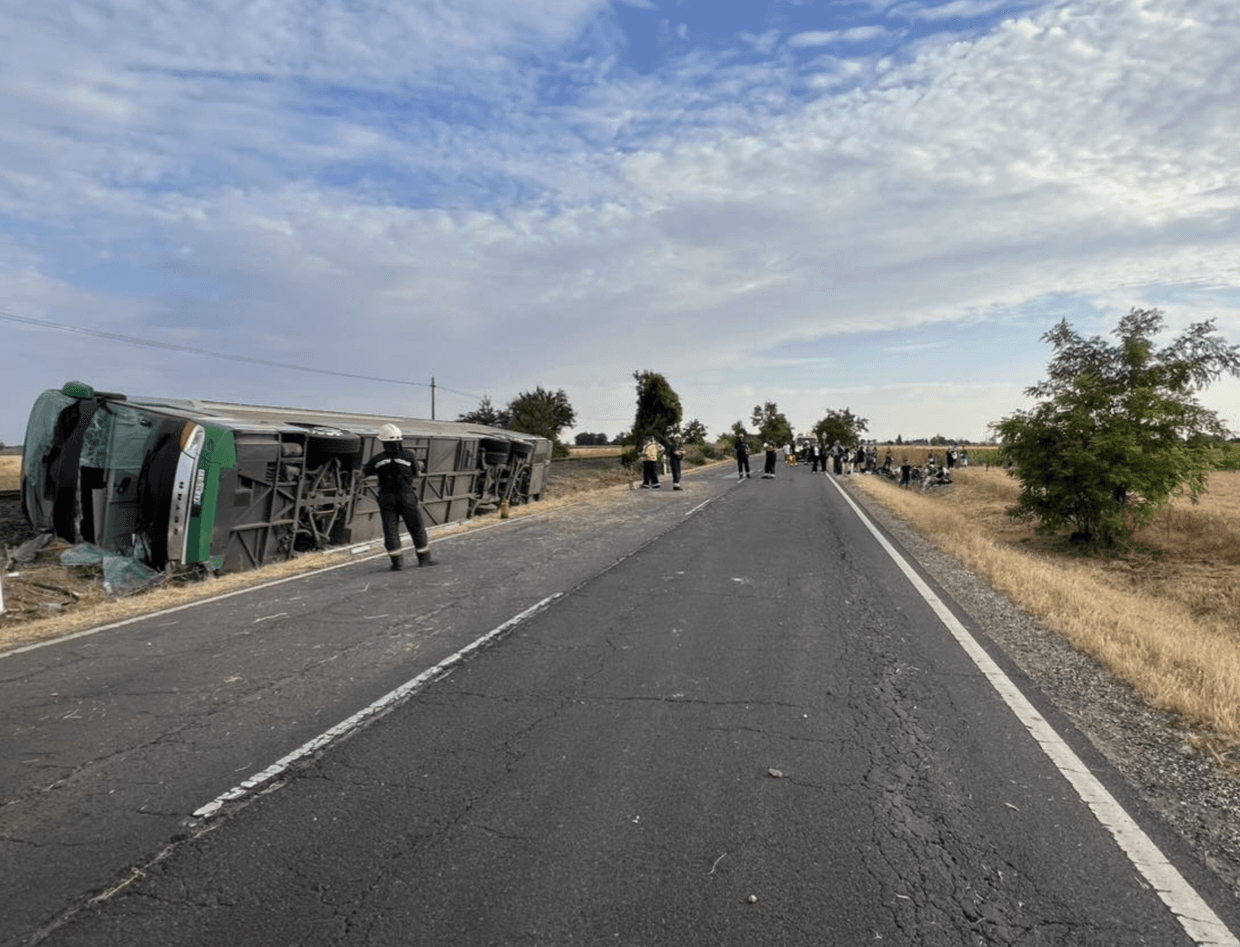
A bus carrying Ukrainian children from Lviv to a dance festival in North Macedonia overturned on a Hungarian highway, injuring 21 people including four seriously. The accident highlighted the human cost of war displacement as Ukrainian cultural groups seek normalcy through international exchanges. Among 77 passengers were ensemble members and chaperones en route to Ohrid for a festival performance, with injured including teenagers and elderly chaperones.
Moldova’s Electoral Battlefield: Pro-Russian Forces Mobilize
Moldova faces another political challenge as exiled oligarch Ilan Shor’s Victory bloc announced participation in September parliamentary elections, despite his banned party status. The bloc, headed by sanctioned Gagauzia leader Evgenia Gutul, aims to “overthrow the fascist regime” using inflammatory rhetoric echoing Russian propaganda.
With EU candidate status granted in 2022 and President Maia Sandu’s party targeting 2030 membership, September’s vote will determine whether Moldova continues Western integration or falls back into Russia’s sphere of influence amid mounting pressure from Moscow through energy manipulation and political interference.
The American Chamber’s Independence Day Appeal
As Americans celebrated Independence Day, the American Chamber of Commerce in Ukraine issued a stark appeal highlighting war’s impact on U.S. business interests. More than 50% of the chamber’s 600 members suffered direct damage to offices, factories, and infrastructure, representing hundreds of millions in destroyed American investments and underscoring how the war extends beyond military considerations to encompass economic interests binding Ukraine to the Western world.