
As Moscow Unleashes Record-Breaking Aerial Assaults Two Days Running, Ukraine Scrambles for Solutions While Trump Promises “Major Statement” on Russia
Summary of the Day – July 10, 2025
The war entered a terrifying new phase as Russia launched its second consecutive night of maximum terror against Ukraine, deploying 397 drones and 18 missiles primarily against Kyiv in what officials described as an unprecedented escalation. Just 24 hours after the largest aerial attack of the entire war, Moscow demonstrated its commitment to psychological warfare through sustained bombardment of civilian targets. Two women died and 28 were injured in the capital alone, while President Zelensky warned that Russia plans to launch up to 1,000 drones per day. Against this backdrop of mounting horror, diplomatic activity intensified with U.S. Secretary of State Marco Rubio discussing a “new approach” with Russian Foreign Minister Lavrov, Trump promising a “major statement” on Russia next week, and Germany offering to purchase additional Patriot systems for Ukraine.
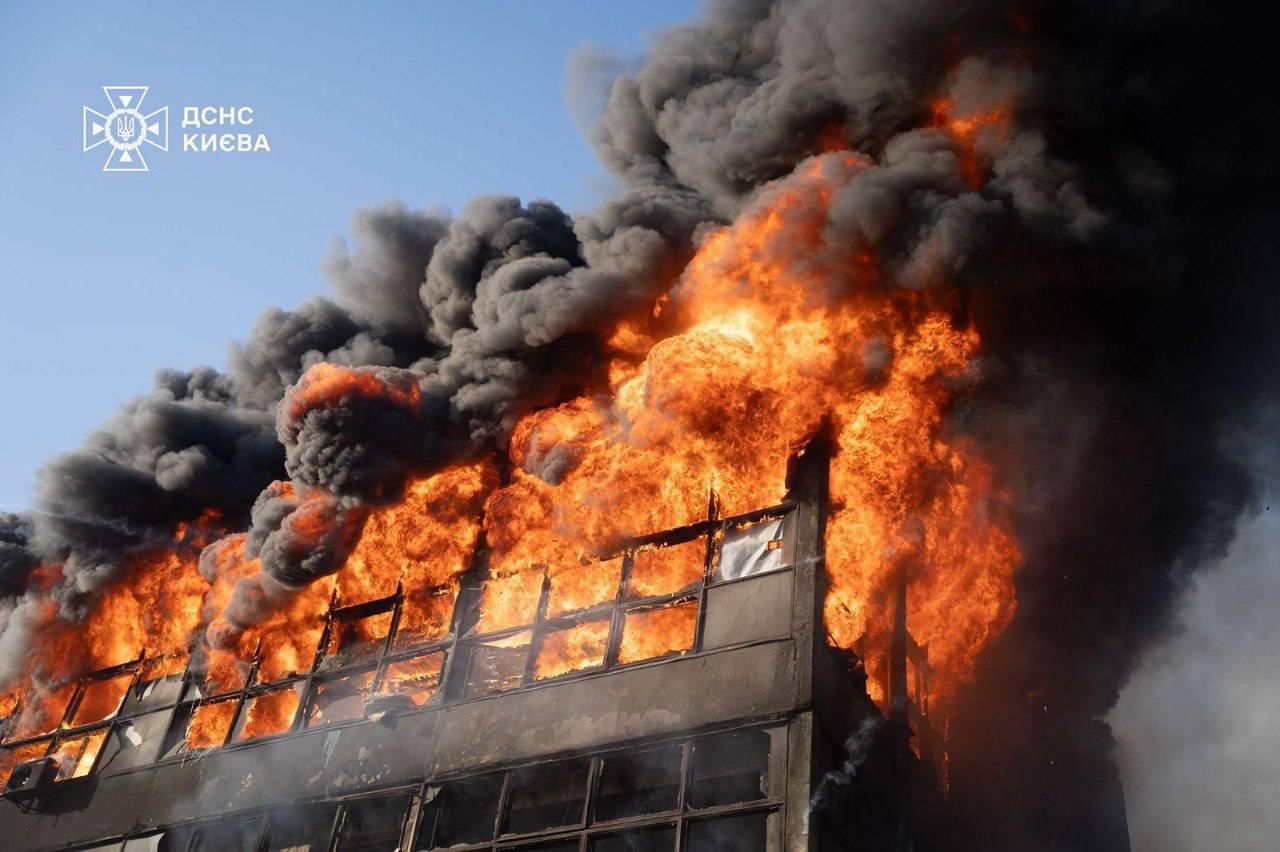
The aftermath of a mass Russian aerial attack on Kyiv, Ukraine. (State Emergency Service)
The Second Night of Terror: Kyiv Under Maximum Assault
For the second consecutive night, air raid sirens pierced the darkness across Ukraine as Russian forces unleashed another record-breaking barrage. At 1:15 a.m. local time, Kyiv residents were jolted awake by the distinctive whine of Shahed-type drones buzzing overhead, followed by hours of near-constant explosions that shook buildings throughout the capital.
The scale was staggering: 397 drones and 18 missiles targeted primarily Kyiv, marking the second largest aerial attack in the war’s history. Russian forces launched almost 200 Shahed-type kamikaze drones alongside 197 decoys designed to overwhelm Ukrainian air defenses, eight Iskander-M ballistic missiles, six Kh-101 cruise missiles, and four S-300 guided air defense missiles.
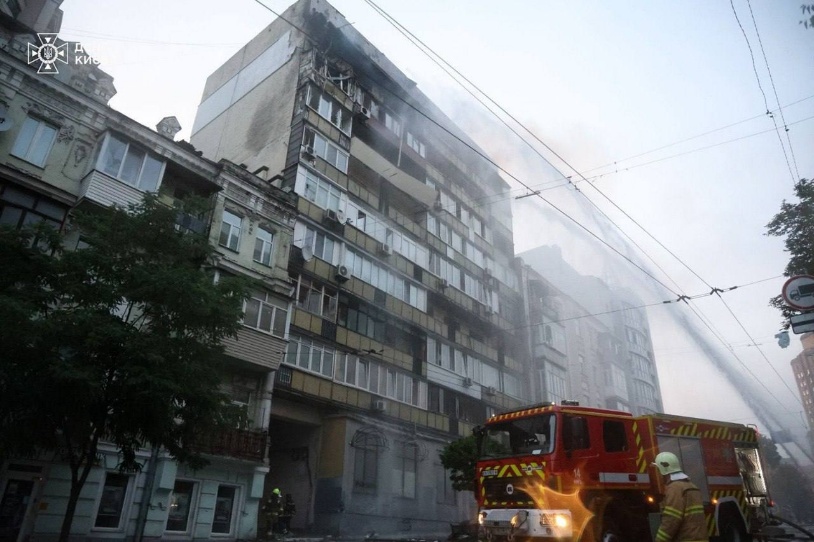
The aftermath of a mass Russian aerial attack on Kyiv, Ukraine. (State Emergency Service)
“You lie down, look into the abyss of night, and hear the loudest attack,” said Hryhorii Matsebok, a 47-year-old artist in Kyiv’s Shevchenkivskyi district. “And you think the end has already come.”
The assault claimed two lives—both women, including a 68-year-old resident and a 22-year-old police officer—while injuring 28 others, including two children. Additionally, in Kherson Oblast, two people were injured by drone strikes and another four were injured by Russian artillery fire late on July 9, highlighting the continued targeting of liberated territories along the front lines. Fires erupted across the capital in apartment buildings, gas stations, and garages, while a primary healthcare center in the Podilskyi district was almost completely destroyed.
Ukrainian air defenses performed admirably under impossible circumstances, downing 164 Shahed-type drones, all eight Iskander-M missiles, and all six Kh-101 missiles. An additional 204 drones and missiles reportedly disappeared from radars or were neutralized by electronic warfare systems.
The Coming Storm: Russia’s Plan for 1,000 Drones Daily
Speaking at the Ukraine Recovery Conference in Rome, President Zelensky confirmed intelligence assessments that Russia intends to drastically escalate its aerial terror campaign. “The second story they have is a plan for 1,000 drones… 700-1,000 drones per day,” Zelensky revealed, adding that Russia aims to destabilize Ukraine through prolonged air raids.
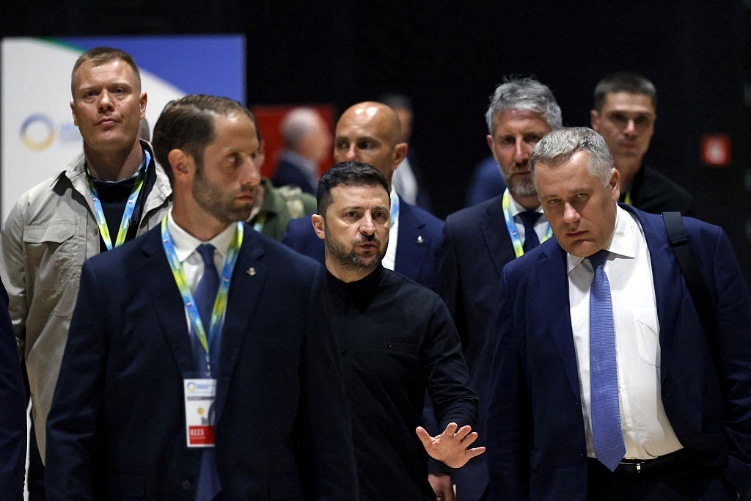
Volodymyr Zelensky arrives for a news conference at the Ukraine Recovery Conference (URC) in Rome, Italy. Zelensky said a meeting with U.S. and European allies in Rome stoked optimism that Donald Trump’s administration will resume military aid to the war-battered country. (Alessia Pierdomenico / Bloomberg via Getty Images)
The warning builds on earlier assessments from Robert “Magyar” Brovdi, Commander of Ukraine’s Unmanned Systems Forces, who had warned that Russian Shahed drone strikes could escalate to 1,000 per day. “Under the pressure of increasing mass use by the enemy of a cheap, but everywhere accessible Shahed… There will be 1,000 units per day and more,” Brovdi had stated, emphasizing that his warning was based on intelligence analysis.
Yet Zelensky expressed confidence that Ukraine has found effective countermeasures. “We have found a solution as a country. Scientists and engineers have found a solution. This is the key. We need finances. And we will raise it,” he emphasized, noting that Ukrainian scientists and engineers have identified proven technology from several manufacturers capable of countering Iranian-designed Shahed drones.
Commander in Chief Oleksandr Syrskyi previously reported that the effectiveness of Shahed interceptor drones stands at 70%, nearly twice as high as that of mobile fire groups, though the technology reportedly lacks radar capabilities.
Terror Spreads West: Chernivtsi and the End of Safe Havens
The war’s psychological boundaries shifted dramatically as Russia targeted Ukraine’s far-western regions with unprecedented intensity. The city of Chernivtsi, just 90 kilometers from the Romanian border and previously considered one of Ukraine’s safest areas, found itself under direct attack for the first time in the conflict.
The strikes on Chernivtsi represent more than tactical expansion—they signal Russia’s commitment to eliminate any sense of safety across Ukraine’s entire territory. Local residents, many of whom had never experienced direct attacks, described the shock of hearing Shahed drones overhead in a region that had served as a haven for displaced civilians.
Meanwhile, the western city of Lutsk in Volyn Oblast endured what officials called its heaviest attack of the war during the July 9 assault, with nearly everything in the massive 728-drone barrage aimed at the city. “Nearly everything was aimed at Lutsk,” Volyn Oblast Governor Ivan Rudnytskyi confirmed, describing an industrial site and garage damaged by fires in what Mayor Ihor Polishchuk called “the most massive Russian attack” on the city since the full-scale war began.
Diplomatic Stirrings: Rubio’s “New Approach” and Trump’s Coming Statement
As Russia intensified its aerial terror campaign, diplomatic activity reached new heights with Secretary of State Marco Rubio discussing what he termed a “new and different approach” to ending the war during a meeting with Russian Foreign Minister Sergey Lavrov in Malaysia.
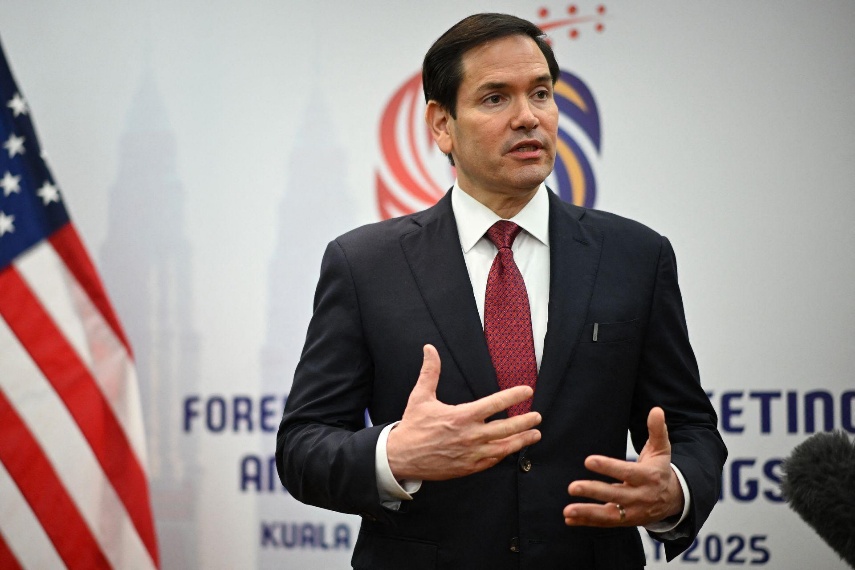
U.S. Secretary of State Marco Rubio takes part in a media briefing during the 58th Association of Southeast Asian Nations (ASEAN) Foreign Ministers’ meeting in Kuala Lumpur. (Mandel Ngan/Pool/AFP via Getty Images)
“I wouldn’t characterize it as something that guarantees peace, but it’s a concept that, you know, that I’ll take back to the president,” Rubio said following the meeting, declining to provide specifics about the proposal. “We’re going to continue to stay involved where we see opportunities to make a difference.”
The diplomatic engagement occurred against the backdrop of continued Russian escalation, with Rubio acknowledging Trump’s “disappointment and frustration at the lack of progress.” The Secretary of State emphasized the need for “a roadmap moving forward about how this can conclude” while sharing “some ideas about what that might look like.”
Adding to the diplomatic intrigue, Trump announced plans for a “major statement” on Russia next week during an exclusive interview with NBC News. “I’m disappointed in Russia, but we’ll see what happens over the next couple of weeks,” Trump said. “I think I’ll have a major statement to make on Russia on Monday.”
Germany Steps Forward: Merz Offers Patriot Purchase
In a significant development for Ukraine’s air defense capabilities, German Chancellor Friedrich Merz announced Berlin’s readiness to purchase additional Patriot air defense systems from the United States and transfer them to Ukraine. The offer came as Russia’s aerial assault demonstrated the urgent need for enhanced air defense coverage.
“We are also prepared to purchase additional Patriot systems from the U.S. to make them available to Ukraine,” Merz said on the sidelines of the Ukraine Recovery Conference in Rome. “The Americans need some of them themselves, but they also have a lot of them.”
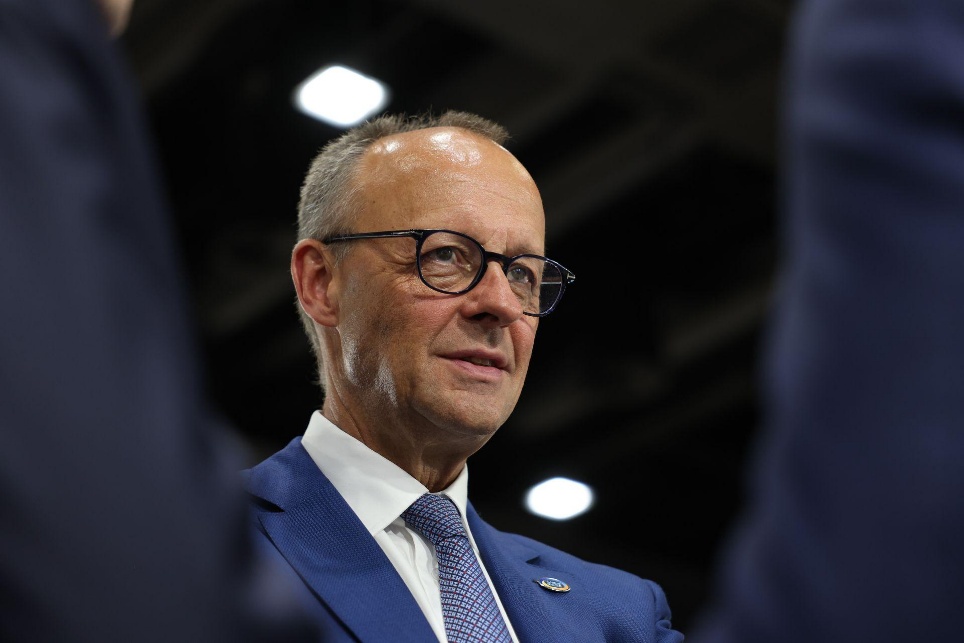
Germany’s Chancellor Friedrich Merz during the Ukraine Recovery Conference (URC) in Rome, Italy. (Alessia Pierdomenico/Bloomberg via Getty Images)
The German proposal follows Trump’s indication that his administration is “going to have to take a look” at supplying Ukraine with another Patriot system. According to Axios, the White House is working on a deal under which Germany would sell a Patriot battery to Ukraine, with the U.S. and European allies sharing the cost.
Washington has so far delivered three Patriot batteries to Ukraine, while Germany has sent three more. A European coalition has contributed an additional battery, though not all systems are currently operational due to maintenance rotations.
The NATO Triangle: Trump’s New Weapons Transfer Arrangement
President Trump outlined what he described as a revolutionary arrangement for weapons transfers to Ukraine during his NBC News interview, claiming to have finalized a deal during last month’s NATO summit whereby the alliance would fully reimburse the United States for weapons destined for Ukraine.
Additionally, Trump announced plans to authorize his first weapons shipment to Ukraine using Presidential Drawdown Authority, potentially worth around $300 million. Sources indicated the package could include defensive Patriot missiles and offensive medium-range rockets, with weapons from U.S. stocks positioned in Europe potentially reaching front lines within days.
“We’re sending weapons to NATO, and NATO is paying for those weapons, 100%. So what we’re doing is the weapons that are going out are going to NATO, and then NATO is going to be giving those weapons [to Ukraine], and NATO is paying for those weapons,” Trump explained during his NBC interview.
The arrangement, if implemented as described, would represent a fundamental shift in how Western military aid reaches Ukraine, potentially insulating U.S. defense spending from domestic political pressures while ensuring continued support for Kyiv’s defense efforts.
Aid Flows Resume: Washington’s Zigzag Weapons Policy
After days of confusion and contradiction, the Trump administration reportedly resumed shipments of at least some weapons to Ukraine following a Pentagon-ordered pause. U.S. officials confirmed that deliveries now include 155mm artillery rounds and GMLRS guided rocket munitions, though the full scope of resumed shipments remains unclear.
The weapons deliveries had been halted last week when Defense Secretary Pete Hegseth unilaterally ordered a pause on ongoing deliveries, including Patriot air defense missiles and precision munitions, amid a review of U.S. stockpiles. The decision apparently surprised Ukraine, European partners, and the U.S. State Department, with CNN reporting that Hegseth did not consult with the White House before ordering the pause.
According to Reuters, the paused shipment had included 30 Patriot missiles, 8,500 155mm artillery shells, 250 GMLRS rockets, and 142 Hellfire air-to-surface missiles. Trump later denied involvement in the pause decision and expressed frustration with Putin for failing to pursue a ceasefire.
Rubio sought to downplay the controversy during his press conference, characterizing the situation as having been “mischaracterized” and describing it as “a very limited review of certain types of munitions to ensure that we have sufficient stockpiles.”
Zelensky’s Marshall Plan Vision: Recovery Conference Seeks $12 Billion
Against the backdrop of mounting destruction, President Zelensky called for a Marshall Plan-style reconstruction strategy during his opening remarks at the Ukraine Recovery Conference in Rome. The president drew explicit parallels to the post-World War II American aid program that helped rebuild European economies.
“We need a Marshall Plan-style approach, and we should develop it together,” Zelensky told representatives of governments, international organizations, and businesses. “Rebuilding Ukraine is not just about our country. It’s also about your countries, your companies, your technology, your jobs.”
The conference yielded significant financial commitments, with participants agreeing to “more than 10 billion euros ($12 billion) commitment” for reconstruction efforts, according to Italian Prime Minister Giorgia Meloni. The Italian leader emphasized the need to mobilize private capital and entrepreneurial spirit for Ukraine’s reconstruction.
Zelensky stressed that Kyiv would welcome only “true partners” in the initiative, “those who are not helping Russia continue this war.” He also called for more “active” ways of using roughly $300 billion in Russian assets immobilized by the West to aid Ukraine’s recovery efforts.
Diplomatic Maneuvers: Zelensky Meets U.S. Senators on Sanctions
President Zelensky met with U.S. Senators Lindsey Graham and Richard Blumenthal in Rome, urging stronger sanctions against Russia and emphasizing the need to maintain international pressure. The meeting focused on a bipartisan sanctions bill that has garnered support from 85 U.S. senators.
During the meeting with the senators, Zelensky stressed the “need to increase sanctions pressure on Russia, which, despite enormous losses, shows no intention of ending its aggression against Ukraine.” The leaders also discussed broader U.S. support for Ukraine’s defense, including continued arms supplies, plans for joint weapons production, and Ukraine’s readiness to purchase a large defense package from the United States.
The legislation, first introduced in April 2025, proposes a 500% tariff on imports from countries that continue to purchase Russian oil and raw materials. Senator Graham recently indicated that—following a conversation with Trump—Congress is preparing to advance the bill after the July recess.
Zelensky expressed gratitude to the senators for the bipartisan support, stating that the bill’s adoption would “serve as an important lever to compel the aggressor state to engage in real negotiations” and pressure “those who continue to support Russia’s war of aggression.”
Britain’s Long-Term Commitment: 5,000 Missiles Over 19 Years
The United Kingdom announced a massive long-term commitment to Ukraine’s air defense capabilities, signing a deal to supply 5,000 Thales air defense missiles over the next 19 years in a £2.5 billion ($3.1 billion) project. The agreement underscores Western recognition that the conflict may continue for years to come.
“This announcement underlines our continued support for Ukraine—boosting their air defenses against devastating drone and missile attacks and supporting the critical work to reconstruct this nation and provide the hope that they need,” British Deputy Prime Minister Angela Rayner said.
In addition to missile supplies, the U.K. committed to providing bilateral assistance to Ukraine totaling up to £283 million ($354 million) through 2026. Thales-made missiles, including the high-speed Starstreak and versatile Martlet models, have become key elements of Ukraine’s air defense network.
Coalition of the Willing: Command Structure Finalizes
Leaders of the “Coalition of the Willing” moved to finalize command structures for a future multinational reassurance force in Ukraine during an online meeting that included, for the first time, U.S. participation through Special Envoy Keith Kellogg and Senators Lindsey Graham and Richard Blumenthal.
The coalition, led by British Prime Minister Keir Starmer and French President Emmanuel Macron, aims to establish a multinational force to help monitor a potential ceasefire deal in Ukraine and boost Kyiv’s defense capabilities. The force will be coordinated by a UK- and France-led three-star operational headquarters in Paris, rotating to London after 12 months.
“Everyone acknowledges that this is a war that can only be overcome through unity—and we have built the unity we need,” Zelensky said after joining the meeting via video from Rome. The mission will aim to regenerate Ukraine’s land forces, provide air policing in coordination with Ukraine’s Air Force, and expand Black Sea mine-clearing efforts.
Russia’s Occupation Apparatus: Passportization and Property Theft
While international attention focused on aerial attacks and diplomacy, Russia continued its systematic efforts to erase Ukrainian identity in occupied territories. The Artek International Children’s Center in occupied Crimea facilitated passport ceremonies for 17 Ukrainian children, part of the “We Are Citizens of Russia” project that amounts to the bureaucratic elimination of Ukrainian identity.
Simultaneously, Russian President Vladimir Putin signed legislation establishing procedures for recognizing real estate documents in occupied territories, effectively legalizing the appropriation of property belonging to Ukrainians who fled the invasion. Ukrainian Mariupol Mayoral Advisor Petro Andryushchenko reported the first official court case finalizing the seizure and transfer of an apartment from a Ukrainian citizen who fled Melitopol.
Russian banks including Promsvyazbank, Sber, VTB, and RostFinance are implementing the process of seizing property and selling it to Russian citizens at preferential rates, according to the Ukrainian Eastern Human Rights Group. The digitalization of real estate records in occupied areas will likely accelerate property appropriation efforts.
Battlefield Dynamics: Russian Advances Continue Despite Losses
Russian forces made tactical advances in several directions despite sustaining enormous casualties. Geolocated footage confirmed Russian progress northeast of Borivska Andriivka in the Borova direction, along the T-0504 Pokrovsk-Kostyantynivka highway north of Yablunivka in the Toretsk direction, and east of Voskresenka in the Novopavlivka direction.
Fighting continued in Kursk Oblast, with Russian forces conducting attacks in unspecified areas while Ukrainian forces attacked toward Glushkovo and Tetkino. In Sumy Oblast, Russian forces continued offensive operations but did not make confirmed advances, with Ukrainian counterattacks reportedly complicating Russian progress and threatening to encircle Russian forces near Andriivka.
The Economist’s analysis revealed that Russia would need approximately 89 years to seize all of Ukraine at its current accelerated rate of advance—roughly 15 square kilometers per day during the summer offensive that began May 1. However, this rate has come at an extraordinary human cost, with estimates suggesting Russia has suffered between 900,000 and 1.3 million personnel casualties since February 2022, including 190,000 to 350,000 killed in action.
The publication estimated that Russia may have suffered about 31,000 killed in action since May 1 alone, gaining approximately 0.038 square kilometers per soldier killed. Despite these staggering losses, Russian forces continue offensive operations across multiple fronts.
Russia’s Industrial Integration: Occupied Territories Economic Exploitation
Russia continued efforts to integrate occupied Ukrainian territories into its economic system through the Innoprom-2025 international industrial exhibition in Yekaterinburg. Representatives from occupation administrations in Kherson, Luhansk, and other occupied areas attended to discuss industrial cooperation with Russian regions.
The Kherson Oblast occupation administration announced plans to start an “interregional industry cluster” with Russia’s Sverdlovsk Oblast and Krasnodar Krai to encourage growth of the radio-electronic industry. The Luhansk Oblast occupation administration signed a separate agreement on industrial cooperation with Krasnodar Krai on July 9, demonstrating Russia’s systematic effort to economically bind occupied territories to prevent future reintegration with Ukraine.
Putin’s Personnel Shuffle: Bogdanov Dismissed
Russian President Vladimir Putin dismissed Deputy Foreign Minister and Presidential Special Representative to the Middle East and Africa Mikhail Bogdanov on July 9. Kremlin sources claimed Putin released Bogdanov from his duties at Bogdanov’s request for unspecified personal reasons.
Bogdanov had been heavily involved in Russian efforts to provide military support to the Sudanese Armed Forces in exchange for a Russian Red Sea naval base. Putin may have dismissed Bogdanov in favor of a replacement who can better manage the situation in the Middle East and North Africa following the fall of the Assad regime in Syria.
Energy Infrastructure Under Siege: DTEK’s Battery Revolution
As Russia systematically targets Ukraine’s energy infrastructure, the country’s largest private energy company DTEK announced the final commissioning of the country’s largest battery energy storage project. The 200-megawatt system spans six locations across Ukraine and represents one of Eastern Europe’s most significant energy storage deployments.
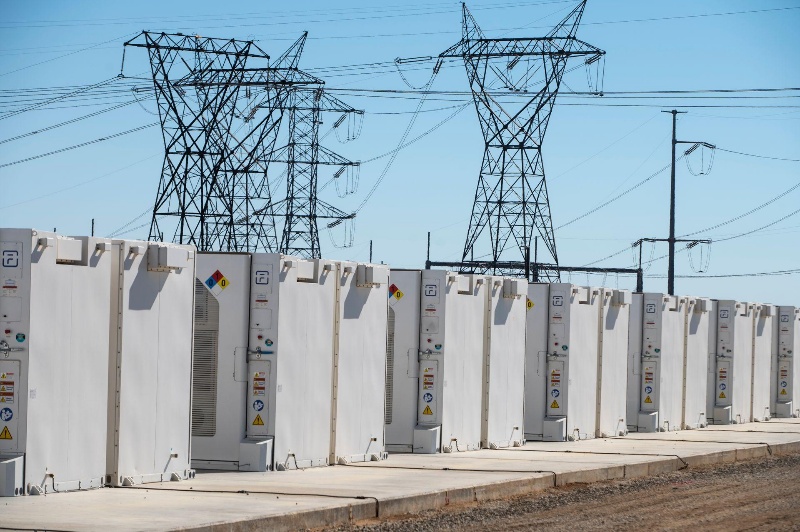
DTEK’s Fluence Gridstack battery units at one of six energy storage sites across Ukraine, part of the country’s largest battery energy storage project announced. (DTEK press service)
Developed in partnership with American energy company Fluence Energy Inc., the project can store 400 megawatt-hours of electricity—enough to power 600,000 Ukrainian homes for two hours. Commercial operations are scheduled to begin in October 2025, just before Ukraine’s critical winter heating season.
“We are laying the foundation of a new energy system in Ukraine because bringing an energy storage system of this scale into the Ukrainian power grid means that we are building an absolutely new, much more resilient energy system in the country,” DTEK CEO Maxim Timchenko explained.
Personnel Changes: Zelensky Considers Umerov for U.S. Ambassador
President Zelensky announced he is considering appointing Defense Minister Rustem Umerov as Ukraine’s next ambassador to the United States, confirming plans to replace current ambassador Oksana Markarova, who has held the post since 2021.
“We need a person to be strong and to be in the context of the most important thing, in the context of strengthening Ukraine—through weapons, first of all. Therefore, one of my ideas is that it can be Ukraine’s defense minister,” Zelensky said during a press conference in Rome.
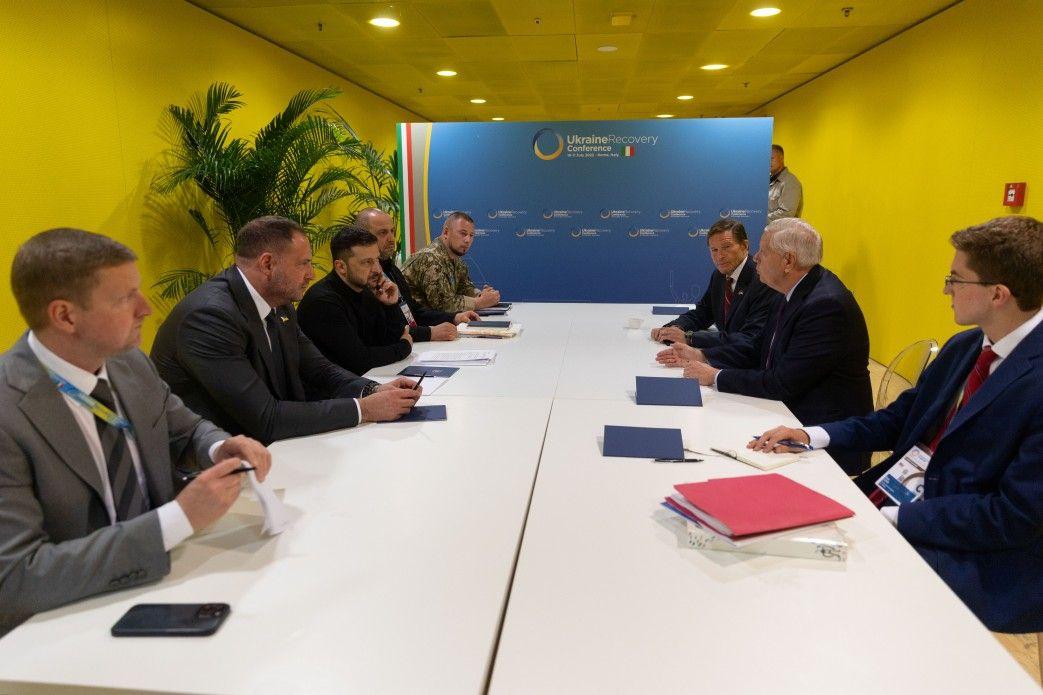
President Volodymyr Zelensky meets with United States Senators Lindsey Graham and Richard Blumenthal in Rome.(President’s Office)
The potential appointment would necessitate a significant government reshuffle, with Umerov’s Defense Ministry portfolio requiring a replacement. Bloomberg had previously reported that Umerov was among candidates being considered alongside Prime Minister Denys Shmyhal, Deputy Prime Minister Olha Stefanishyna, and Energy Minister Herman Halushchenko.
Russian Court Convictions: 184 Ukrainian POWs Sentenced
A Russian military court convicted 184 Ukrainian prisoners of war captured in Kursk Oblast of acts of terrorism, according to Mediazona reports. The POWs were charged with carrying out grave terrorist acts by a group of individuals under the Russian Criminal Code.
Among those convicted was Junior Lieutenant Yevhen Hoch, found guilty of allegedly carrying out an act of terrorism by participating in Ukraine’s Kursk Oblast incursion. The mass convictions represent another violation of international conventions protecting the rights of prisoners of war.
Ombudsman’s Error: False U.N. Report Claims Corrected
Ukrainian Ombudsman Dmytro Lubinets acknowledged mistakenly presenting a report by a little-known organization as an internal U.N. analysis on the 2022 Olenivka prison explosion. Lubinets had referred to a report by the Center for Human Rights in Armed Conflict, whose website was only created on May 22, 2025.
“Unfortunately, the Secretariat of the Commissioner did not properly verify the information. Once its inaccuracy was discovered, the publication was removed,” Lubinets’s office stated. The incident highlights the ongoing information warfare surrounding the Olenivka attack that killed over 50 Ukrainian POWs.
Czech Republic Joins Training Effort: F-16 Pilot Program Announced
The Czech Ministry of Defense announced that the Czech government approved an F-16 training program for up to eight Ukrainian pilots, aiming to provide 150 hours of flight training per pilot by 2026. The program represents another European contribution to Ukraine’s air force modernization efforts.
The training initiative comes as Ukraine continues to receive F-16 fighter jets from multiple Western partners. The Netherlands has committed 24 aircraft, Denmark has pledged 19, and Norway has promised between 6 and 22 F-16s for Ukraine’s defense.
International Incidents: Chinese Nationals and Missile Technology
Ukraine’s SBU security service detained a Chinese father and son for allegedly attempting to smuggle naval missile technology out of the country. The 24-year-old son, a former student at a technical university in Kyiv, and his father, who lives in China, were attempting to “illegally export secret documentation on the Ukrainian RK-360MC Neptune missile system to China,” according to the SBU.
Beijing responded cautiously to the allegations, with foreign ministry spokeswoman Mao Ning stating that China was “still verifying” the case while promising to “safeguard Chinese citizens’ legitimate rights and interests in accordance with the law.” The incident highlights the complex web of international espionage surrounding advanced military technology during the conflict.
Looking Ahead: The Escalation Continues
As diplomatic efforts intensify and reconstruction planning accelerates, the fundamental reality remains unchanged: Russia continues to escalate its war against Ukrainian civilians while maintaining maximalist territorial demands. The past 48 hours have demonstrated Moscow’s commitment to terror as a weapon of war, targeting cities far from front lines in an apparent effort to break Ukrainian morale.
With Russia planning to launch up to 1,000 drones daily and Trump promising a “major statement” on Russia next week, the coming days will be critical in determining whether diplomatic pressure can match the intensity of Russian military escalation. For now, Ukraine faces the dual challenge of defending against unprecedented aerial attacks while building the international coalition necessary for both immediate survival and long-term reconstruction.
The war has entered a new phase of maximum violence, and the world watches to see whether diplomatic innovation can match the pace of military escalation.