
As Germany confirms Patriot purchases for Ukraine and Trump prepares his “major statement,” Russian forces fortify airbases while their grinding summer offensive captures Myrne but fails to meet Kremlin expectations
Summary of the Day – July 13, 2025
The machinery of Western military support began grinding into higher gear as Germany officially confirmed its commitment to purchase additional Patriot air defense systems for Ukraine, while President Donald Trump announced the U.S. would send Patriots but with NATO paying “100%” of the costs. Behind these diplomatic maneuvers, the battlefield told its own story: Russian forces continued their grinding summer offensive, capturing the settlement of Myrne in the Novopavlivka direction and making assessed advances near Pokrovsk, even as President Volodymyr Zelensky declared that Moscow’s campaign had “fallen far short” of the Kremlin’s expectations. Meanwhile, satellite imagery revealed Russia’s belated recognition of its vulnerability, with construction of protective bunkers at key airbases following Ukraine’s devastating Operation Spider Web. The convergence of escalating military aid, North Korean unconditional support for Russia, and intensifying battlefield realities set the stage for what could prove a pivotal week in the war.
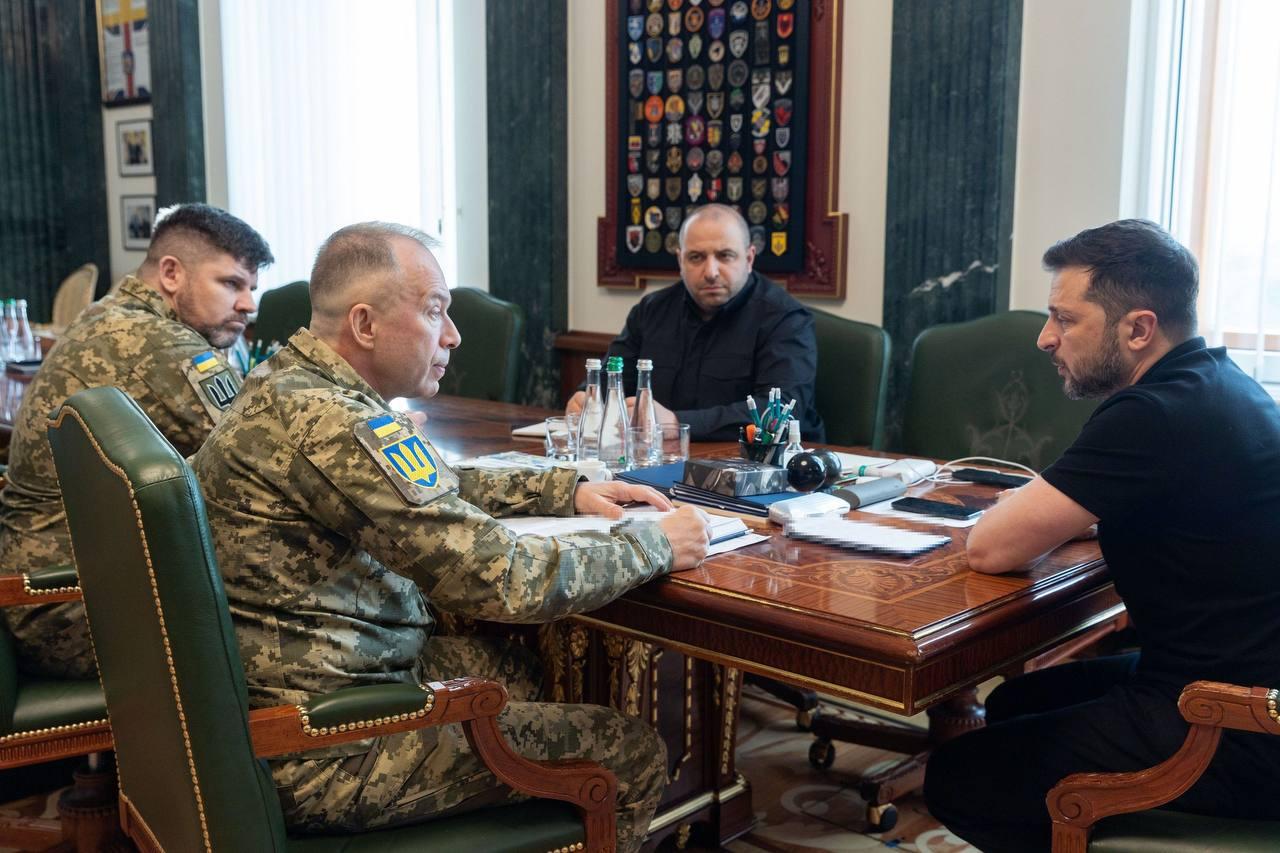
President Volodymyr Zelensky (R), alongside member of his administration, meets with Commander-in-chief Oleksandr Sirskyi (second from L). (Presidential Office/Telegram)
Trump Announces Patriots for Ukraine: NATO to Pay Full Cost
President Donald Trump announced that the United States would send additional Patriot air defense batteries to Ukraine, with NATO paying “100%” of the costs. Speaking at Joint Base Andrews, Trump stated: “Putin really surprised a lot of people. He talks nice and then bombs everybody in the evening. But there’s a little bit of a problem there. I don’t like it.”
Trump explained the new financing arrangement: “We basically are going to send them various pieces of very sophisticated military equipment. They are going to pay us 100% for that, and that’s the way we want it.” The president did not specify the number of Patriot systems to be delivered.
Senator Lindsey Graham told CBS News he expected “weapons flowing at a record level” to help Ukraine, adding that Trump would likely exercise Presidential Drawdown Authority to deliver previously approved weapons. Sources told Axios that Trump’s plans would include offensive weapons and long-range missiles for Ukraine.
Germany Confirms Patriot Purchase for Ukraine
German Defense Ministry Planning and Command Staff head Major General Christian Freuding confirmed that Germany was pursuing the purchase of two Patriot air defense systems from the United States specifically for Ukraine. German Defense Minister Boris Pistorius and U.S. Defense Secretary Pete Hegseth had discussed the purchase several weeks prior, while Chancellor Friedrich Merz and President Trump had also spoken about the potential purchase in recent days.
Freuding announced that Germany had opened a Patriot interceptor production line and would produce the first European-made Patriot interceptors in late 2026 or early 2027. Pistorius was scheduled to travel to Washington on July 14 for additional discussions about the purchase.
German Arsenal: Long-Range Weapons by Month’s End
Freuding’s announcements extended beyond Patriots to offensive capabilities. Germany would provide hundreds of domestically produced long-range weapon systems to Ukraine by the end of July under a German-financed agreement with Ukrainian arms producers. The weapons would arrive in “high triple-digit quantity,” marking the first major delivery of German-funded, Ukrainian-manufactured long-range capabilities.
The program represented Chancellor Friedrich Merz’s May commitment that there would be “no restrictions on long-range weapons,” allowing Ukraine to “fully defend itself and also strike military targets outside the territory of Ukraine.” The arrangement offered dual advantages: supporting Ukraine’s defense industrial base while providing operational capabilities for deep strikes.
The weapons could not come soon enough. As Russian forces adapted their tactics and built protective structures at airbases, Ukraine needed capabilities to reach targets that Moscow was desperately trying to protect. The timing suggested coordination between intelligence about high-value targets and weapons delivery schedules.
The Spider’s Web: Russia Builds Bunkers After the Barn Burns
Satellite imagery from multiple Russian airbases revealed the Kremlin’s belated recognition of its strategic vulnerability. Frontelligence Insight’s analysis of July 7 imagery from Khalino Air Base in Kursk Oblast showed a frantic construction program: roughly 10 reinforced bunkers with soil coverings, 12 concrete bunker-type structures without soil coverings, and eight hangar-style buildings.
The construction boom followed Ukraine’s devastating Operation Spider Web on June 1, which had struck multiple Russian airbases deep in the country’s interior. At Saky Air Base in occupied Crimea, two concrete bunker-style structures had appeared, while bomber wreckage still littered Belaya Air Base in Irkutsk Oblast and Olenya Air Base in Murmansk Oblast—testament to the operation’s continuing impact.
The fortification effort represented more than tactical adaptation—it revealed strategic failure. After three years of war, Russia was only now attempting to protect its most valuable military assets. Russian officials and military bloggers had blamed leadership for failing to defend Russian infrastructure, criticism that now carried visible consequences in concrete and steel.
Every ruble spent on bunkers was a ruble not spent on offensive operations, maintenance of existing aircraft, or production of new weapons. Ukraine’s deep strike campaign was forcing Russia to play defense with its most valuable assets, fundamentally altering the war’s resource allocation dynamics.
The Summer That Wasn’t: Grinding Gains, Strategic Failure
As engineers poured concrete at Russian airbases, the Kremlin’s much-vaunted summer offensive continued to disappoint expectations. President Zelensky declared that “the Russian army has fallen far short of its command’s expectations for this summer,” a claim supported by the grinding, village-level nature of Russian advances.
Russian forces achieved their most significant gain in the Novopavlivka direction, where geolocated footage showed Russian flags raised in Myrne, confirming the settlement’s capture. The Russian Ministry of Defense claimed the victory while a Kremlin-affiliated milblogger noted that Russian forces had seized Myrne prior to July 13, suggesting the operation had taken longer than Moscow preferred to acknowledge.
Near Pokrovsk, Russian forces managed only marginal advances despite massive resource commitments. Geolocated footage published July 13 indicated Russian advances southeast of Novotoretske, while the Russian Ministry of Defense claimed seizure of Mykolaivka. Yet these village-level gains came at enormous cost, with Ukrainian sources reporting that Russian forces were sending poorly-equipped infantry in highly attritional assaults to divert Ukrainian attention.
Ukrainian Khortytsia Group of Forces Spokesperson Colonel Viktor Trehubov provided crucial strategic context: Russian forces in the Pokrovsk direction were trying to advance north along the T-0504 Pokrovsk-Kostyantynivka highway to Kostyantynivka. The goal was ambitious, but the means were inadequate. The spokesperson of a Ukrainian brigade operating in the Pokrovsk direction reported that Russian forces outnumbered Ukrainian forces “several” times over but that Russian infantry were poorly trained.
The Frontline Grind: Tactical Stalemate Across Multiple Axes
Across the vast front, Russian forces maintained offensive operations without achieving breakthrough. In Kursk Oblast, Russian forces continued offensive operations but made no confirmed advances, while a Russian milblogger claimed fighting near Tetkino was becoming less intense—suggesting Ukrainian defensive success.
In northern Sumy Oblast, Russian forces launched attacks across multiple settlements but achieved no confirmed gains. Unconfirmed Russian claims of advances in Yunakivka, Myropillya, Oleksiivka, and Ryzhivka remained just that—unconfirmed. A Russian source claimed elements of the 155th Naval Infantry Brigade advanced in Kindrativka, but another Russian milblogger claimed forces had withdrawn from the settlement, highlighting confusion in Russian command structures.
The Kharkiv front demonstrated similar patterns. Russian forces conducted offensive operations north of Kharkiv City toward Lyptsi and northeast near Vovchansk and Zelene, but achieved no territorial changes. In the Velykyi Burluk direction, unconfirmed claims of Russian seizure of Dehtyarne remained unverified, while Ukrainian forces successfully counterattacked near Milove.
The pattern repeated across every major axis: Russian pressure, limited or no gains, Ukrainian adaptation. In the Kupyansk direction, Russian attacks near Kindrashivka, Holubivka, Synkivka, Petropavlivka, and Stepova Novoselivka produced no confirmed advances. The Borova direction saw Russian forces attack near Zahryzove, Kolisnykivka, Zelenyi Hai, Kopanky, Hrekivka, and toward Cherneshchyna—again without territorial gains.
The Lyman Lesson: Russia’s Strategic Overstretch
The Lyman direction provided the clearest insight into Russian strategic thinking and its fundamental limitations. Ukrainian Khortytsia Group spokesperson Major Viktor Trehubov noted that Russian forces were “trying to prevent Ukrainian forces from redeploying to more critical areas of the frontline, including to the Pokrovsk and Novopavlivka directions.”
The admission revealed Russia’s core problem: insufficient forces to achieve breakthrough while maintaining pressure across the entire front. Russian attacks northwest of Lyman toward Shandryholove and Serednie, north near Karpivka and Zelena Dolyna, northeast near Kolodyazi and Yampolivka, and east near Torske and the Serebryanske forest area tied down Ukrainian forces but produced no strategic gains.
Unconfirmed Russian claims that Ukrainian forces had retaken most of Ridkodub illustrated the back-and-forth nature of tactical combat. Another unconfirmed claim of Russian advances in Torske highlighted the marginal nature of territorial changes. These village-level contests consumed enormous resources for minimal strategic benefit.
The Drone Deluge: Moscow’s New Terror Weapon
While Russian ground forces struggled, Moscow had discovered a new weapon of choice: mass drone attacks designed to overwhelm Ukrainian air defenses through sheer volume. Russia launched over 1,800 drones against Ukraine in the past week alone, including a single-night record of 728 drones on July 9.
The night of July 12-13 demonstrated the new reality. Ukrainian Air Force reported that Russian forces launched 60 strike and decoy drones, up to 40 of which were Shahed-type drones, from Kursk City and Millerovo in Rostov Oblast. Ukrainian forces shot down 20 Shahed-type drones while 20 decoy drones were “lost” or suppressed by electronic warfare systems—revealing the challenge of distinguishing real threats from cheap decoys designed to exhaust interceptor stocks.
The human cost was mounting. Russian attacks on July 12-13 killed eight civilians and injured at least 21 others across multiple oblasts. In Donetsk Oblast, three people died in attacks on Sloviansk, Myrnohrad, and Bilozerske, while seven others were injured across various locations. Kherson Oblast saw one death and four injuries from drone and artillery attacks on 34 settlements, including an 87-year-old woman who sustained lethal injuries in Kherson city.
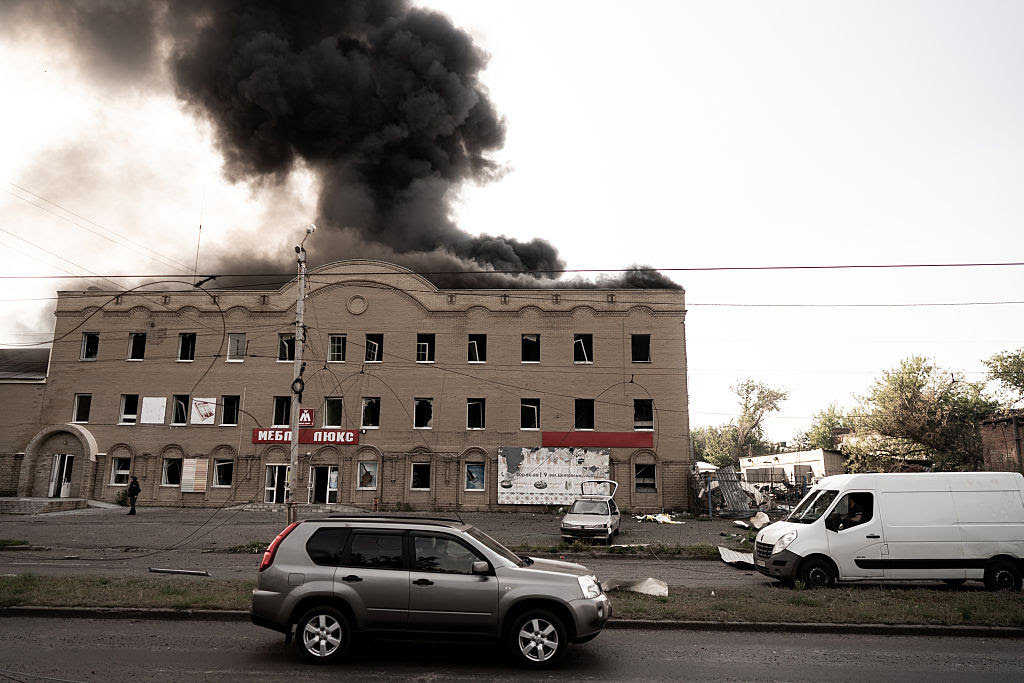
A building is seen on fire after a Russian missile strike hit the city of Sloviansk, Donetsk Oblast, Ukraine. (Vincenzo Circosta / Anadolu via Getty Images)
Russian strikes on Sumy demonstrated the expanding geographic scope of the drone campaign. Governor Oleh Gryhorov reported that Russian drones had hit critical infrastructure, leaving part of the city without power and forcing three hospitals onto backup power. The targeting of medical facilities violated international humanitarian law but reflected Russia’s strategy of terrorizing civilian populations.
Ukraine’s Adaptive Defense: Interceptor Innovation
Ukraine was adapting to the drone deluge with technological innovation. President Zelensky highlighted the “good results” of Ukrainian air defense, particularly interceptor drones that had downed “hundreds” of Russian Shaheds during the week. The technology offered a cost-effective counter to Russia’s quantity-based approach.
A dramatic example came from the Toretsk front, where troops from the Khyzhak (Predator) brigade of the Ukrainian Patrol Police destroyed a Russian ZALA reconnaissance drone using an interceptor UAV. Deputy Head of the Patrol Police Department Oleksii Biloshytskyi emphasized that intercepting reconnaissance drones required “precise coordination, the right launch timing, altitude buffer, and skilled operators.”
The development represented more than tactical innovation—it suggested a fundamental shift in air defense philosophy. Unlike traditional anti-aircraft systems, interceptor drones were significantly cheaper, capable of patrolling designated areas, and potentially reusable. The technology promised to neutralize Russia’s volume-based drone strategy through symmetric cost-effectiveness.
The Axis Tightens: Kim’s Unconditional Commitment
In Wonsan, North Korea, Foreign Minister Sergey Lavrov received what Moscow needed most: unconditional support from a reliable ally. Kim Jong Un told Lavrov that Pyongyang was “ready to unconditionally support and encourage all the measures taken by the Russian leadership as regards the tackling of the root cause of the Ukrainian crisis.”
The meeting’s significance extended far beyond rhetoric. South Korean Defense Intelligence Agency estimates suggested North Korea had already provided over 12 million rounds of 152mm artillery shells to Russia, with around 28,000 containers of weapons and ammunition delivered to date. The scale was staggering—over 2024, the majority of artillery shells used by Russian forces in Ukraine were manufactured in North Korea.
The human dimension was equally concerning. North Korea had sent around 13,000 troops to Russia, primarily to help retake Ukrainian-occupied territory in Kursk Oblast. CNN reported that an additional 25,000-30,000 soldiers were being prepared to join Russian forces, representing a massive escalation in foreign military involvement.
Lavrov thanked “heroic” North Korean soldiers during the ministerial meeting and expressed Russia’s “firm support” for North Korea’s nuclear program. The quid pro quo was explicit: artillery shells and manpower in exchange for nuclear technology and economic support. Both sides “emphasized their determination to jointly counter the hegemonic aspirations of extra-regional players,” demonstrating their shared opposition to Western influence.
Africa’s Information War: Moscow’s Media Expansion
Ukraine’s military intelligence revealed another dimension of Russian strategy: a massive expansion of propaganda operations across Africa. RT, Russia’s state media outlet, was now broadcast in more than 40 African countries in six languages, with new Portuguese-language content for Mozambique and Angola launched in June 2025. By year’s end, RT planned to launch broadcasting in Amharic for Ethiopian audiences.
The scale of expansion was impressive. Over the past two years, RT had doubled its African partner TV channels from 30 to 60. In 2024, the network had trained over 1,000 media professionals “according to Russian standards,” with full-time training beginning in Ethiopia’s capital, Addis Ababa, in June 2025.
TASS was simultaneously expanding, planning correspondent bureaus in Ethiopia, Senegal, Algeria, Congo, and other African countries. Ukrainian intelligence noted that Russia’s Federal Security Service (FSB) controlled personnel recruitment for these bureaus, indicating intelligence operations alongside media expansion.
The African campaign represented Russia’s long-term strategic thinking. While immediate resources were focused on Ukraine, Moscow was investing in future influence operations across a continent with vast natural resources and growing geopolitical importance. The investment suggested confidence in long-term conflict duration and the need for global coalition building.
Intelligence War: The SBU Strikes Back
In Kyiv, Ukraine’s Security Service (SBU) demonstrated that the war extended beyond conventional battlefields. The SBU announced it had eliminated the alleged Russian killers of SBU Colonel Ivan Voronych, who had been assassinated on July 10 in a targeted attack that bore the hallmarks of professional intelligence operations.
SBU head Lieutenant General Vasyl Maliuk revealed that the killing was carried out by two people—a man and a woman—who had been ordered by Russia’s Federal Security Service (FSB) to establish Voronych’s daily schedule and routes. The killers had retrieved weapons from a secret cache before executing their mission, demonstrating sophisticated operational planning.
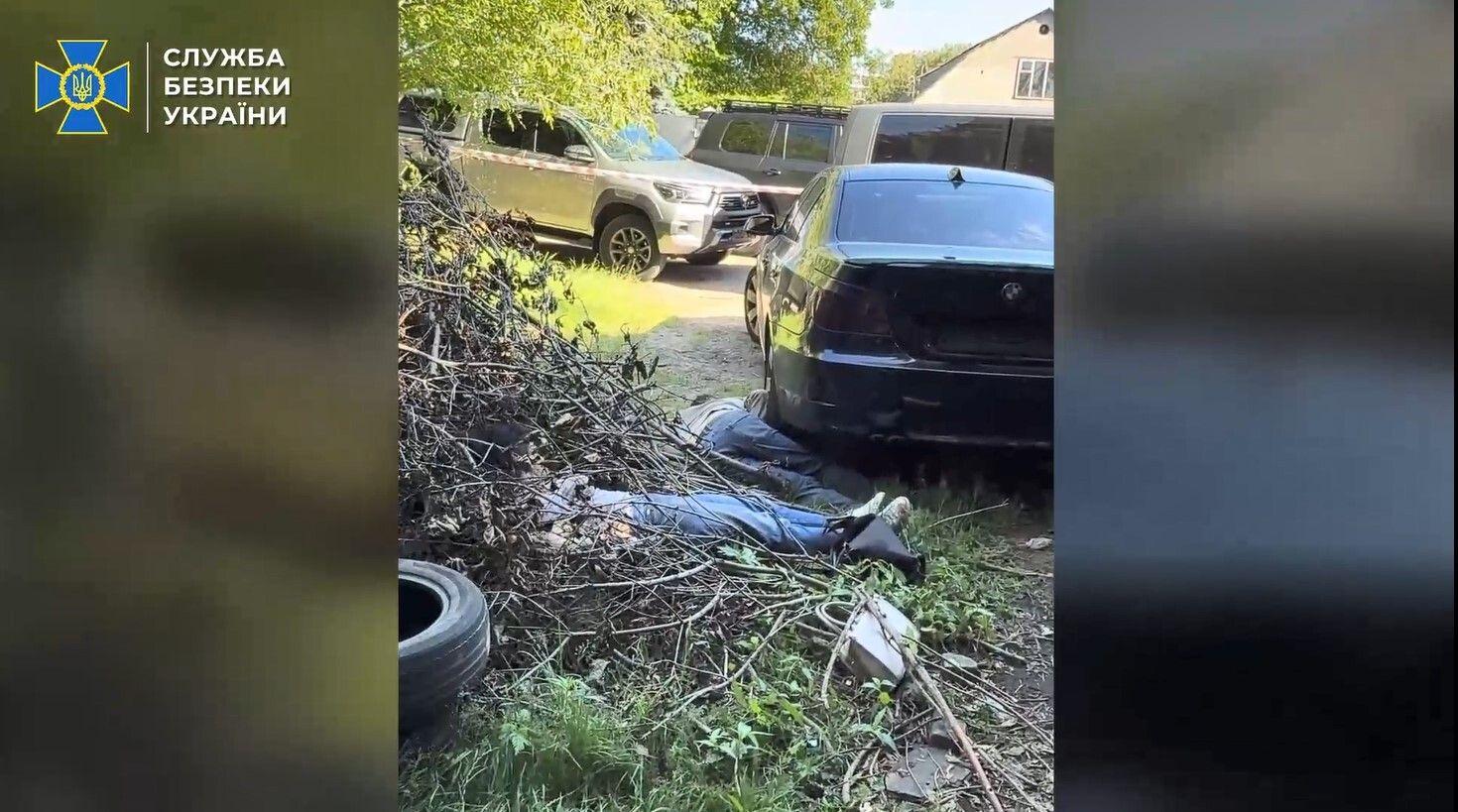
A screenshot from a video by the Security Service of Ukraine, announcing the elimination of the Russian agents that killed an SBU officer in Kyiv on July 10, published. (via Security Service of Ukraine)
The SBU’s rapid response—locating and eliminating the killers within three days of the assassination—revealed both the reality of Russian intelligence operations in Ukraine and Kyiv’s capacity to respond effectively. Maliuk’s statement that “the only prospect of the enemy on the territory of Ukraine is death” was operational doctrine rather than rhetoric.
The incident occurred around 9 a.m. local time when a man approached Voronych and fired five shots from a pistol before fleeing. The precision and planning suggested FSB training and support. The SBU’s claim to prevent 85% of similar Russian attacks indicated both the scale of the intelligence threat and Ukraine’s defensive capabilities.
Partisan Fire: Akhmat Under Attack
In occupied Mariupol, pro-Ukrainian partisans struck back at Russian occupation forces. The Atesh partisan group claimed responsibility for destroying a vehicle used by the Chechen Akhmat unit, posting images of a vehicle in flames to their Telegram channel. The sabotage operation was reportedly carried out overnight with the partisans escaping unharmed.
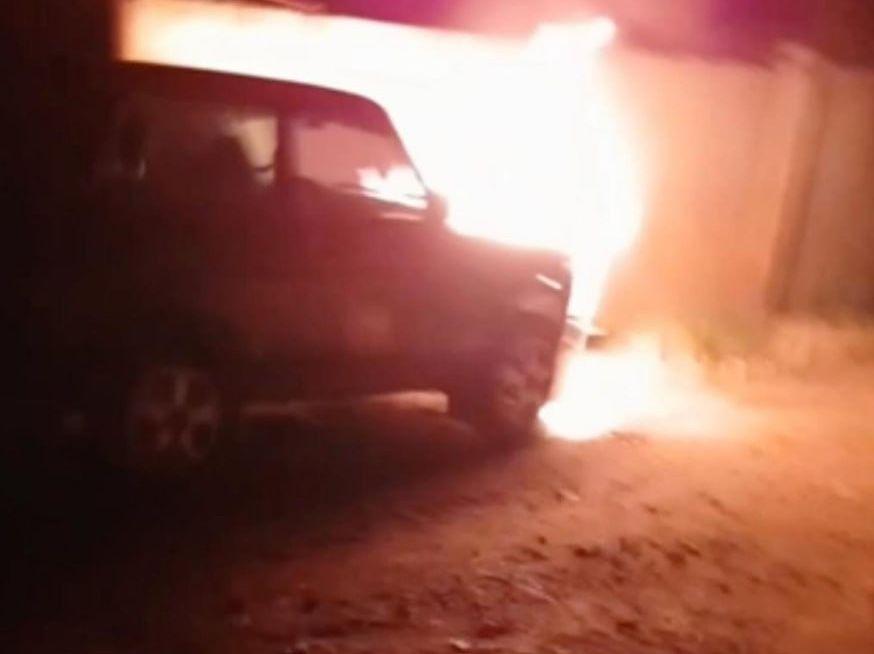
Car used by Russian-backed Chechen Akhmat unit allegedly destroyed by Atesth partisans in occupied Mariupol. (Atesh / Telegram)
“We send greetings to the kadyrovtsy,” the group wrote, referring to the notoriously ruthless troops named for Chechen strongman Ramzan Kadyrov. The message carried particular significance given Akhmat forces’ reputation for brutality and their role in suppressing resistance in occupied territories.
The attack demonstrated the continuing presence of Ukrainian resistance networks in occupied territories. Mariupol, reduced to rubble during the brutal siege of 2022, remained a symbol of Ukrainian resistance. Authorities estimated that at least 25,000 people may have been killed during the siege, though exact figures remained unknown.
The Atesh group regularly conducted sabotage attacks in Russia and Russian-occupied regions. Recent operations had included railway sabotage in Volgograd and occupied Crimea designed to disrupt ammunition supplies to the front line. The persistence of partisan operations in deeply occupied territories suggested the limits of Russian control.
Recovery and Reconstruction: The $4 Billion Promise
In Rome, Ukrainian officials provided a counternarrative to Russian destruction through the Ukraine Recovery Conference. Officials signed agreements, memorandums, and joint statements totaling 3.55 billion euros ($4.15 billion), offering tangible hope for post-war reconstruction.
Deputy Prime Minister Oleksii Kuleba highlighted specific achievements: a 100 million euro framework loan agreement with the Council of Europe Development Bank for housing certificates for displaced Ukrainians, 32.5 million euros from Italy for cultural heritage preservation in Odesa Oblast, and 134 million euros from the European Investment Bank for critical transport infrastructure reconstruction.
The conference also produced 10 agreements worth 929.3 million euros between the EU and development banks within the Ukraine Investment Framework to finance recovery, municipal infrastructure, energy, heat supply, transport, and business support. Ukraine separately secured $200 million from the World Bank over five years for large-scale reconstruction project preparation.
President Zelensky’s call for a “Marshall Plan-style reconstruction strategy” acknowledged the unprecedented scale of required rebuilding. “Rebuilding Ukraine is not just about our country. It’s also about your countries, your companies, your technology, your jobs,” he told conference participants, framing reconstruction as mutual benefit rather than charity.
Diplomatic Momentum: The Balkans Rally
In Dubrovnik, Croatia, southeastern European countries formally endorsed Ukraine’s “irreversible path to full Euro-Atlantic integration, including NATO membership.” The joint declaration, signed by ministers from Ukraine, Croatia, Kosovo, Moldova, Montenegro, Albania, North Macedonia, Romania, and Slovenia, stated that NATO membership remained “the best cost-effective security option for Ukraine.”
The declaration’s language was uncompromising: “Neither Russia nor any other state that is not a NATO member has the right to veto the Alliance’s enlargement.” The statement directly challenged one of Russia’s core justifications for the war—preventing NATO expansion near its borders.
The timing carried particular significance. Croatia’s Foreign Minister signed despite opposition from the country’s Russian-friendly president Zoran Milanovic, who had been re-elected on a platform critical of Western aid to Ukraine. The ministerial decision suggested that institutional support for Ukraine transcended individual political preferences.
For Ukraine, the Balkan endorsement provided both geographic logic and political weight. These countries understood Russian pressure and the value of Western security guarantees. Their support carried credibility precisely because it came from nations that had successfully transitioned from Soviet influence to NATO membership.
NATO’s Washington Moment: Rutte’s Critical Visit
NATO Secretary General Mark Rutte’s visit to Washington on July 14-15 gained additional significance in light of Trump’s policy evolution. While NATO’s press service didn’t specify the visit’s purpose, Trump had revealed that the U.S. had struck a new arrangement with NATO to transfer American weapons to Ukraine, with the alliance paying for weapons “100%.”
The arrangement offered Trump political cover while increasing weapons flows. “We’re sending weapons to NATO, and NATO is paying for those weapons, 100%. So what we’re doing is the weapons that are going out are going to NATO, and then NATO is going to be giving those weapons (to Ukraine),” Trump explained, creating a mechanism that appeared to reduce direct American involvement while actually increasing support.
Rutte was scheduled to meet with Secretary of State Marco Rubio, Defense Secretary Pete Hegseth, and members of Congress. The timing coincided with reports that Trump was considering authorizing additional funding for Ukraine for the first time since taking office, potentially using Presidential Drawdown Authority or frozen Russian assets.
The convergence of Trump’s “major statement” on Russia and Rutte’s visit suggested coordinated Western policy adjustment. For months, Trump had sought to reduce American involvement while pressuring Putin toward negotiations. With that approach failing, the administration appeared ready to increase pressure through enhanced military support.
Order of Battle: Mapping Russia’s Military Machine
Intelligence reports revealed the specific Russian units engaged across multiple fronts, providing insight into Moscow’s force deployment strategy. In the northern Sumy direction, elements of the 83rd Airborne (VDV) Brigade operated alongside drone operators from the Smuglyanka Detachment and the 30th Motorized Rifle Regiment (72nd Motorized Rifle Division, 44th Army Corps, Leningrad Military District).
The Lyman direction saw deployment of the 144th Motorized Rifle Division (20th Combined Arms Army, Moscow Military District), while the Borova sector included elements of the 16th Spetsnaz Brigade from the Russian General Staff’s Main Directorate (GRU). These elite units’ presence indicated Russian prioritization of specific tactical objectives.
In the critical Pokrovsk direction, Russian forces deployed the 114th Motorized Rifle Brigade (51st Combined Arms Army), elements of the Typhoon Detachment from the 506th Motorized Rifle Regiment (27th Motorized Rifle Division, 2nd Combined Arms Army, Central Military District), and the 68th Separate Reconnaissance Battalion (20th Motorized Rifle Division, 8th Combined Arms Army, Southern Military District).
The Toretsk front showcased Russian concentration of firepower units: the 39th Motorized Rifle Brigade (68th Army Corps, Eastern Military District), 103rd Motorized Rifle Regiment (150th Motorized Rifle Division), and the 238th Artillery Brigade (8th Combined Arms Army). The artillery brigade’s presence confirmed Russian emphasis on firepower over maneuver in urban combat.
Casualty Count: The Human Price of July 13
Russian attacks across Ukraine on July 12-13 exacted a devastating toll on civilian populations, with eight killed and at least 21 injured across multiple oblasts. Donetsk Oblast bore the heaviest burden with three deaths in Sloviansk, Myrnohrad, and Bilozerske, plus seven injuries including three in Sloviansk, one in Myrnohrad, two in Pokrovsk, and one in Virivka village.
In Kherson Oblast, Russian drone and artillery attacks on 34 settlements, including the regional capital, killed one person and injured four more. An 87-year-old woman in Kherson city sustained lethal injuries, while a 75-year-old woman and 44-year-old man suffered explosive trauma, head and brain injuries, and concussions. The attacks damaged five high-rise buildings and 16 private houses, demonstrating the indiscriminate nature of Russian targeting.
Dnipropetrovsk Oblast reported one death and three injuries, with a 27-year-old woman killed in Nikopol by artillery strike. A 35-year-old man required hospitalization while two other women, including an 86-year-old, sustained injuries. Sumy Oblast saw two killed by glide bomb strike in Velyka Chernechchyna district around 13:00 on July 12, with three additional injuries in Shostka community from drone attacks.
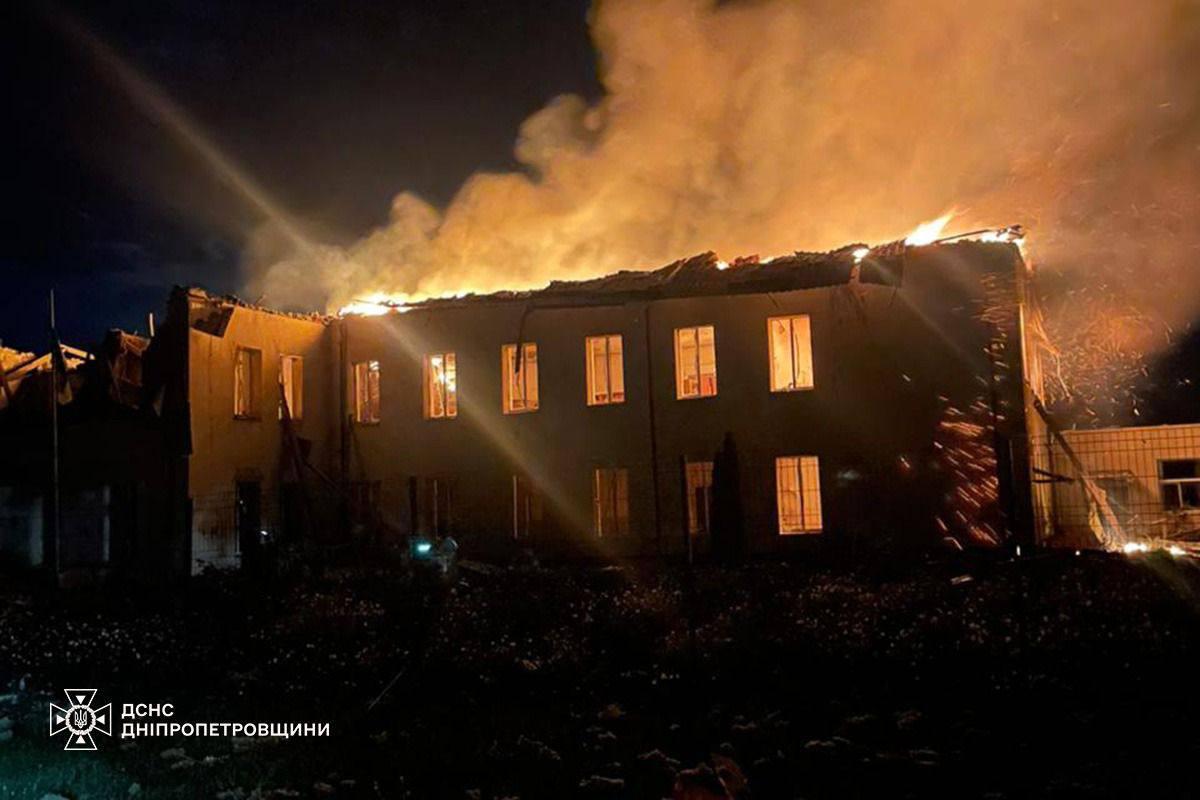
An educational facility is on fire in Mezhova, Dnipropetrovsk Oblast, as a result of Russia’s drone attack. (Ukraine’s State Emergency Service / Telegram)
Zaporizhzhia Oblast discovered a 77-year-old woman dead in destroyed Novodanylivka house, with another person potentially trapped under rubble. A 66-year-old man was injured in Polohiv district. Russian forces launched 579 strikes at 13 settlements across the oblast, while Kharkiv Oblast saw three injuries across five attacked settlements, including a 72-year-old and 69-year-old man in Kupiansk and a 67-year-old in Slobozhanske village.
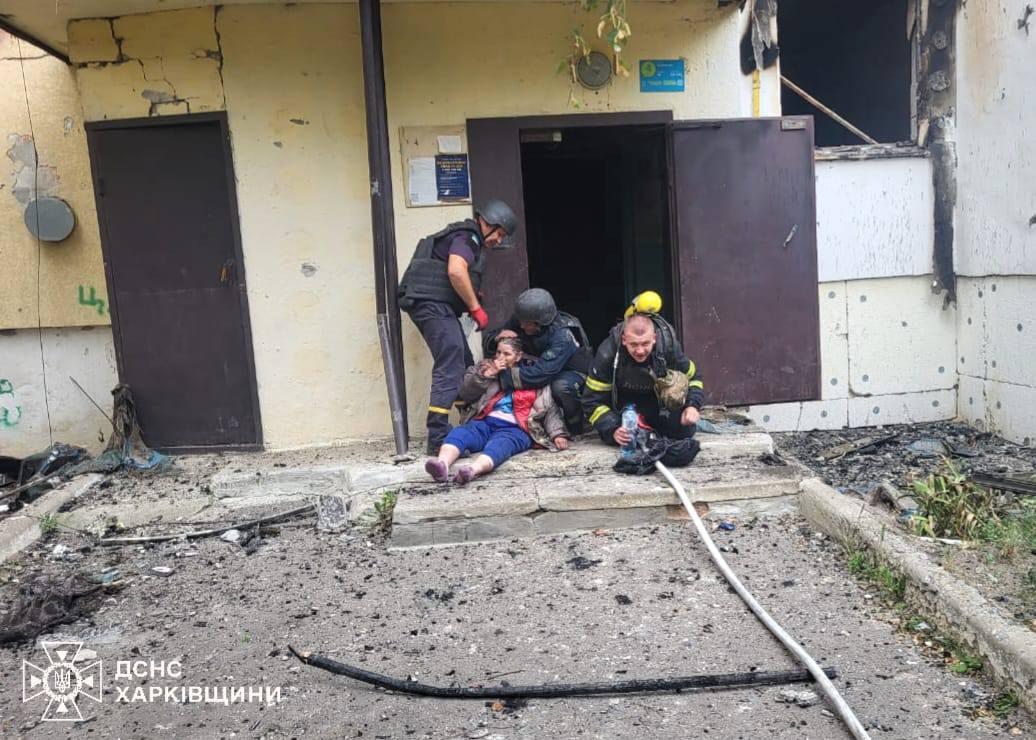
Emergency workers rescued a 82-year-old woman from a 9-story residential building in Kupiansk, Kharkiv Oblast, after a Russian drone attack caused fire during the day. The rescue operation unfolded while the attacks were ongoing. (Ukrainian State Emergency Service via Telegram)
Russian Deflection: Denying the Iran Nuclear Connection
Russia’s Foreign Ministry dismissed as “defamation” reports that Putin had privately encouraged Iran to accept a “zero enrichment” agreement regarding its nuclear program. The denial came in response to Axios reporting that Putin had “encouraged” Iran to agree to a deal with the United States that would prevent uranium enrichment.
The Russian Ministry called the report “a new political defamation campaign aimed at exacerbating tensions around Iran’s nuclear program,” while stating that Moscow “invariably and repeatedly” emphasized resolving Iran’s nuclear crisis “exclusively through political and diplomatic means.”
The denial revealed tensions within the Russia-Iran relationship. While Moscow maintained cordial relations with Tehran and provided crucial backing, Russia had not forcefully supported Iran during recent Israeli strikes. The dynamic suggested that Putin’s cultivation of closer ties with Trump might be influencing Russian positions on Iranian nuclear development.
The situation had escalated dramatically since Israel’s unprecedented attack on Iran on June 13, initiating a 12-day war that halted Tehran-Washington negotiations. U.S. strikes on June 22 had targeted underground uranium enrichment sites at Fordo, Isfahan, and Natanz, though the extent of damage remained unknown.
Looking Forward: The Convergence of Forces
As July 13 ended, multiple streams of development were converging toward what could prove a decisive moment in the war’s trajectory. Trump’s announced Patriot deliveries, combined with Germany’s confirmed purchases and long-range weapons commitments, promised significant enhancement of Ukrainian defensive and offensive capabilities.
Russia’s response was predictable: intensified attacks, diplomatic defiance, and expanded alliance building with North Korea and other partners. The construction of protective structures at Russian airbases indicated recognition of vulnerability without fundamental strategic change. Putin’s regime appeared committed to escalation rather than negotiation.
For Ukraine, the convergence offered both opportunity and challenge. Enhanced Western support promised improved capabilities, but Russia’s escalation in drone attacks and foreign military support posed new threats. The summer offensive’s failure to meet Russian expectations provided tactical breathing space, but the war’s fundamental dynamics remained unchanged.
The coming week would reveal whether diplomatic promises could translate into battlefield realities, whether Trump’s frustration with Putin would produce sustained policy changes, and whether Ukraine’s defensive successes could create space for strategic initiative. As always in this war, the gap between words and actions would prove decisive in determining whether the arsenal awakening could shift the conflict’s trajectory.