
As Ukraine Achieves Historic Robotic Warfare Breakthrough and Parliament Installs New Leadership, Russian Economic Pressures Mount While Moscow Intensifies Drone Terror Campaign
Summary of the Day – July 17, 2025
Ukraine’s military and political evolution accelerated dramatically on July 17, as the country achieved a historic milestone in robotic warfare while simultaneously reshaping its government structure for prolonged conflict. Ukrainian forces captured Russian troops using only drones and ground robots—the first such operation in military history—while parliament confirmed Yulia Svyrydenko as the new prime minister and Denys Shmyhal as defense minister. Meanwhile, Russian forces launched over 300 drones across multiple regions as leaked documents revealed catastrophic losses in Russia’s 41st Combined Arms Army, with over 26,000 troops killed, missing, or deserted. The day also witnessed major prisoner exchanges, with Ukraine repatriating 1,000 bodies under the Istanbul agreement, while economic pressures mounted on Moscow as senior Russian bankers privately discussed potential bailouts amid growing non-performing loans.
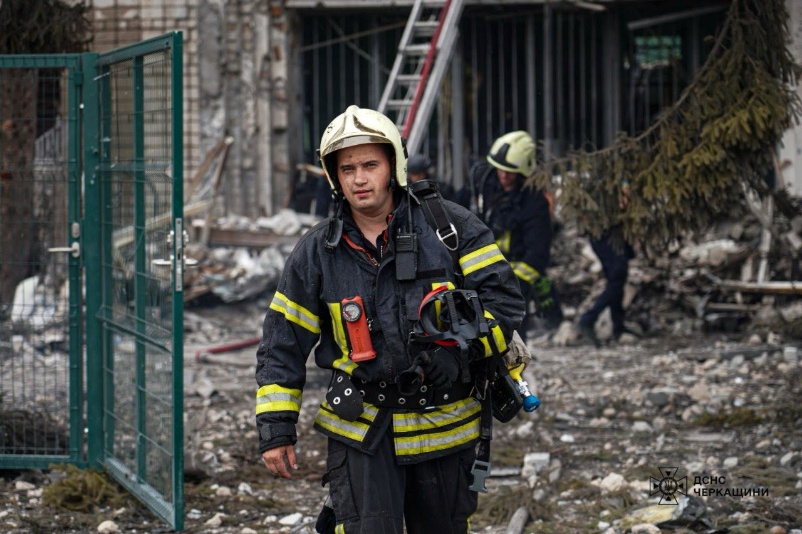
A firefighter walks away from an infrastructure facility struck by a Russian drone in Kaniv, Cherkasy Oblast. One person was injured in the attack. (Ukraine’s State Emergency Service Cherkasy/Telegram)
Historic Warfare Milestone: Ukraine Captures Troops Using Only Robots
Ukraine achieved an unprecedented military breakthrough when its forces captured Russian troops for the first time using exclusively drones and ground-based robotic systems, without deploying any infantry personnel to the battlefield. The operation marked a historic moment in modern warfare, demonstrating the evolution of unmanned combat systems.
Ukraine’s military intelligence (HUR) released footage showing the Liut robotic platform attacking Russian positions in Sumy Oblast. The system, equipped with a 7.62mm machine gun, has passed combat testing and can identify and engage targets day and night with its quiet electric motor.
“Having reached enemy positions, it destroys the Russian occupiers with dense machine gun fire. The armed and technological fight for Ukraine’s freedom continues,” HUR declared.
The achievement comes as Ukraine plans to deliver 15,000 combat robots by the end of 2025 as part of accelerated deployment of unmanned ground vehicles (UGVs). The technology addresses personnel requirements for high-risk missions including logistics, casualty evacuation, and direct combat support.
Ukrainian drone manufacturer ODIN also unveiled the “ODIN Win_Hit,” a high-speed interception drone designed to shoot down incoming Russian Shahed drones. With cruise speeds of 220 kilometers per hour and terminal attack speeds up to 300 kilometers per hour, the interceptor flies faster than the 185 kilometers per hour speed of standard Shahed drones.
Government Transformation: New Leadership Takes Charge of War Effort
Ukraine’s parliament confirmed Yulia Svyrydenko as the new prime minister with 262 votes, marking the first full government reshuffle since Russia’s full-scale invasion began. The 39-year-old economist, who previously served as first deputy prime minister and economy minister, becomes only the second woman to lead Ukraine’s government.
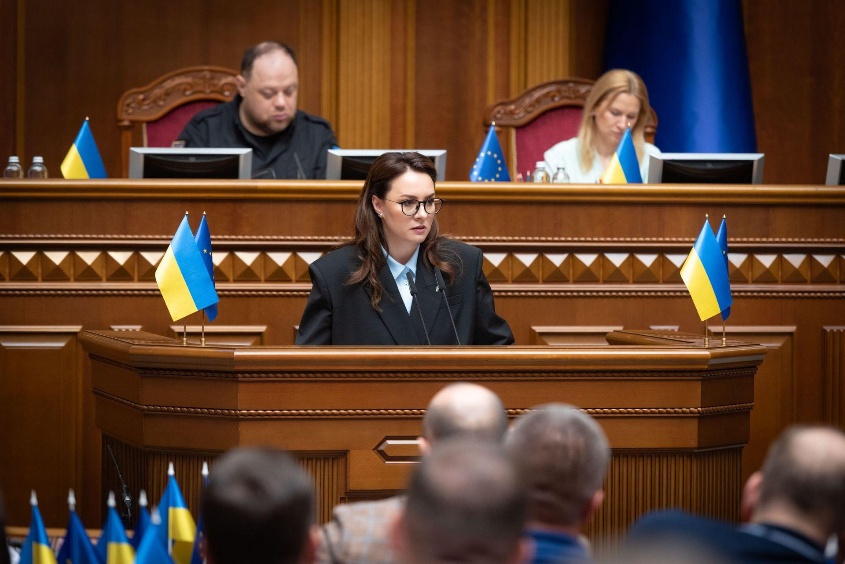
Newly appointed Prime Minister Yuliia Svyrydenko speaking to the parliament during her confirmation. (Yuliia Svyrydenko/X)
Parliament simultaneously approved Denys Shmyhal as the new defense minister, replacing Rustem Umerov after the former prime minister’s five-year tenure. Shmyhal pledged to ensure Ukrainian forces are fully equipped and to strengthen international cooperation, promising to audit all existing defense agreements with foreign partners.
The reshuffle merged several ministries to streamline wartime governance. The Economy, Ecology, and Agriculture ministries combined into a single agency led by Oleksii Sobolev, while the Strategic Industries Ministry dissolved with its responsibilities transferred to the Defense Ministry.
Mykhailo Fedorov retained his digital transformation role while becoming first deputy prime minister, reflecting the government’s emphasis on technological advancement. Foreign Minister Andrii Sybiha and Interior Minister Ihor Klymenko remained in their positions, providing continuity in key security roles.
The changes occurred as President Volodymyr Zelensky appointed Olha Stefanishyna as Ukraine’s special envoy to the United States, positioning her for eventual confirmation as ambassador to Washington during a critical period in US-Ukraine relations.
Drone Terror Escalates: Russia Launches Massive Multi-Region Assault
Russian forces conducted one of their most intensive drone campaigns, launching over 300 unmanned aerial vehicles across multiple Ukrainian regions overnight. The massive assault targeted areas from Moscow-adjacent oblasts to regions near the Polish border, demonstrating the expanded reach of Russia’s terror campaign.
Russian media and officials reported Ukrainian drones approaching across multiple regions, including Moscow and St. Petersburg. Moscow Mayor Sergei Sobyanin claimed Russian air defenses shot down three drones approaching the capital, while St. Petersburg’s Pulkovo Airport temporarily suspended operations, delaying at least 10 flights.
In Smolensk Oblast, one person was injured as 14 drones were allegedly downed, while Belgorod Oblast Governor claimed a Ukrainian drone attack killed one person and injured six in the city of Belgorod. Russian officials reported additional casualties in Voronezh, where a drone allegedly struck a residential building, injuring three children.
Russia’s Defense Ministry claimed downing 122 Ukrainian drones over various regions. The scale of the mutual attacks underscored the intensification of aerial warfare as both sides expanded their drone capabilities and operational ranges.
In Nikopol, Russian forces conducted a double-tap attack with FPV drones, initially striking a cargo truck and killing two civilians, then targeting emergency responders with a second drone, injuring three emergency workers.
Catastrophic Russian Losses: Leaked Documents Reveal Military Devastation
Internal Russian documents published by Ukraine’s “I Want to Live” project revealed catastrophic losses in Russia’s 41st Combined Arms Army fighting in eastern Ukraine. The documents, provided by Russians opposed to the war, detailed unprecedented casualty figures across four motorized infantry brigades.
As of June 1, 2025, at least 8,625 troops from the army had been killed in combat, 10,491 were listed as missing in action, and another 7,846 had deserted. The worst-hit unit, the 74th Motor Rifle Brigade from Kemerovo Oblast, lost 2,479 soldiers killed, 2,732 missing, and 2,789 deserting—more than double the brigade’s original strength.
The 35th Brigade from Altai Krai reported 1,975 killed, 3,163 missing, and 2,229 desertions, while the 55th Brigade from Tuva lost 1,430 killed, 1,467 missing, and 1,616 deserting. Desertion rates remained high, with 175 soldiers fleeing their units in a single week, nearly half the size of a typical battalion.
“It is also worth noting that the ‘V companies’ exist exclusively in motorized rifle brigades, where prisoners are used as cannon fodder,” the “I Want to Live” project stated, describing the losses as “catastrophic.”
Most of the 41st Army’s units operate near Pokrovsk in Donetsk Oblast, where Russian forces continue pressing westward despite massive casualties.
Economic Pressure: Russian Banks Contemplate Bailout Requests
Senior executives at Russia’s largest banks privately discussed seeking state bailouts within the next year if non-performing loans continue deteriorating, Bloomberg reported citing undisclosed sources and documents. The discussions reveal growing concerns about Russia’s banking sector stability despite official claims of economic resilience.
Documents indicated that three of Russia’s systemically important lenders may need to recover funds lost from non-performing loans. Non-performing loans issued by Russian banks grew by 1.2 percent in 2025 and could rise to six or seven percent from their current rate of four percent by 2026.
Russia’s Central Bank continues pursuing contradictory economic policies, simultaneously loosening monetary policy to stimulate short-term growth while expanding fiscal expenditure for military operations. The strategy weakens consumer purchasing power and threatens medium-term ruble stability.
Unsustainably high payments to soldiers and resulting domestic labor shortages further destabilize the economy. Competition between Russia’s defense industrial base and civilian enterprises raises average salaries and prices across service industries, contributing to inflationary pressures despite official claims of economic stability.
Prisoner Exchange: Ukraine Repatriates 1,000 Bodies Under Istanbul Agreement
Ukraine repatriated 1,000 bodies based on a deal concluded with Russia during Istanbul negotiations, the Coordination Headquarters for the Treatment of Prisoners of War announced. According to Russian officials, the bodies belong to Ukrainian citizens, including soldiers, while Ukraine returned 19 bodies of Russian soldiers.
The exchange represents the first major repatriation since the completion of a previous Istanbul agreement that returned 6,057 bodies to Ukraine by June 16. The ongoing exchanges demonstrate one of the few areas where Russia and Ukraine maintain functional cooperation despite broader hostilities.
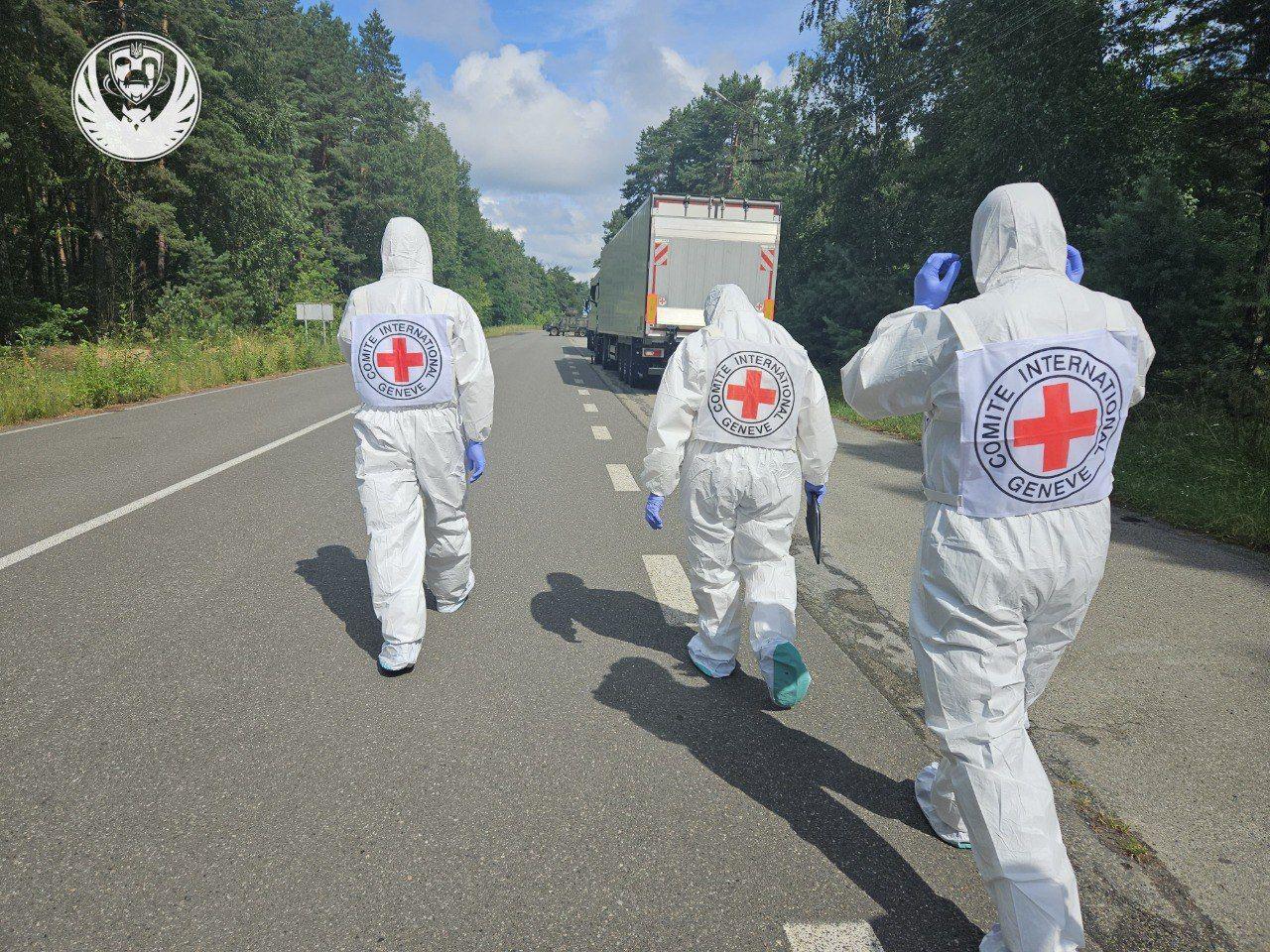
A picture of the repatriation operation released by Ukraine. (Coordination Headquarters for the Treatment of Prisoners of War)
Vladimir Medinsky, head of the Russian delegation in Istanbul, confirmed the exchange figures. The mechanism established during June negotiations in Istanbul continues functioning as both sides work to return fallen soldiers to their families.
International Weapons Testing: Ukraine Launches Battlefield Innovation Program
Ukraine’s Brave1 defense innovation cluster launched a program allowing foreign companies to test military technologies on the battlefield, First Deputy Prime Minister Mykhailo Fedorov announced. The “Test in Ukraine” initiative was unveiled during the LANDEURO conference in Germany.
The program prioritizes testing of drones, missiles, counter-drone systems, ammunition, naval drones, lasers, and electronic warfare equipment. Foreign companies can either participate directly in testing or provide online training while Ukrainian teams conduct independent evaluations.
“Ukraine creates innovations quickly, massively, and efficiently. We’re changing and evolving every day—it is R&D on the battlefield,” Fedorov stated. The initiative aims to connect foreign manufacturers with local firms and potentially incorporate foreign production into Ukraine’s defense supply chain.
Brave1 released a manual detailing import procedures for military testing, addressing practical scenarios including damaged equipment protocols. Companies can donate damaged gear to Ukraine or ship it back home after testing completion.
US-Ukraine Drone Deal: Zelensky Proposes Technology Exchange
President Volodymyr Zelensky revealed discussions with US President Donald Trump about a potential “mega deal” involving American weapons purchases in exchange for Ukrainian drone technology sales. The arrangement would see the US and Ukraine back each other in aviation and unmanned systems development.
“The people of America need this technology, and you need to have it in your arsenal,” Zelensky told the New York Post, referring to Ukraine’s combat-tested drones that have destroyed heavy Russian bombers. “I think this is really a mega deal, a win-win.”
The proposal aligns with Trump’s evolving military strategy, which prioritizes drones and long-range missiles over conventional naval and aerial assets. Ukraine has expanded drone production across all domains since 2022, with plans to manufacture 30,000 long-range drones in 2025.
Zelensky said Ukraine is prepared to share drone expertise with the US and European countries including Denmark, Norway, and Germany. The hybrid strike platforms, including the Palianytsia and Peklo missile-drones, have attracted global interest for precision strikes over extended ranges.
Patriot Confusion: Conflicting Reports on Air Defense Deliveries
Confusion emerged over US President Donald Trump’s claims that Patriot air defense missiles for Ukraine were already en route, with Germany’s Defense Ministry stating it had no knowledge of any current shipments. A ministry spokesperson said virtual Ukraine Defense Contact Group meetings scheduled for July 21 would address outstanding delivery questions.
The US State Department informed Switzerland of delays in Patriot deliveries due to prioritizing Ukraine shipments. Switzerland’s five Patriot systems, ordered in 2022 for delivery between 2027-2028, will be postponed as the US reprioritizes support for Ukraine’s air defense needs.
US Ambassador to NATO Matthew Whitaker confirmed Washington was working to accelerate weapons deliveries under Trump’s new NATO initiative, including potential sales of Patriot systems from US military stockpiles. The push follows intensified Russian aerial assaults across Ukraine requiring enhanced air defense capabilities.
European allies continue discussions about providing more than three Patriot systems to Ukraine, though coordination challenges remain evident in the conflicting public statements about delivery timelines and responsibilities.
EU Doubles Ukraine Support: 100 Billion Euro Budget Proposal
The European Commission proposed allocating 100 billion euros in aid to Ukraine from the EU’s long-term budget for 2028-2034, doubling the current Ukraine Facility budget. Commission President Ursula von der Leyen announced the package would support recovery, resilience, and Ukraine’s path to EU membership.
The broader EU budget proposal for 2028-2034 totals 1.816 trillion euros, raising the bloc’s budget ceiling from 1.1% to 1.26% of gross national income. The proposal requires unanimous approval by all 27 EU member states and passage by the European Parliament.
Negotiations are expected to unfold over the next two years as the EU demonstrates long-term commitment to Ukraine’s reconstruction and integration. The doubled funding reflects recognition that Ukraine’s recovery will require sustained, substantial international support extending well beyond the current conflict.
German Defense Commitment: Long-Range Missiles Promised
German Chancellor Friedrich Merz announced Germany will provide Ukraine with new long-range missiles “very shortly, very soon,” without specifying the weapons systems being supplied. The commitment comes as Berlin strengthens its position as Ukraine’s largest military donor in Europe.
Under a German-financed agreement, Ukraine will receive hundreds of domestically produced long-range weapon systems by the end of July, according to German Major General Christian Freuding. The weapons represent significant enhancement of Ukraine’s strike capabilities against Russian military targets.
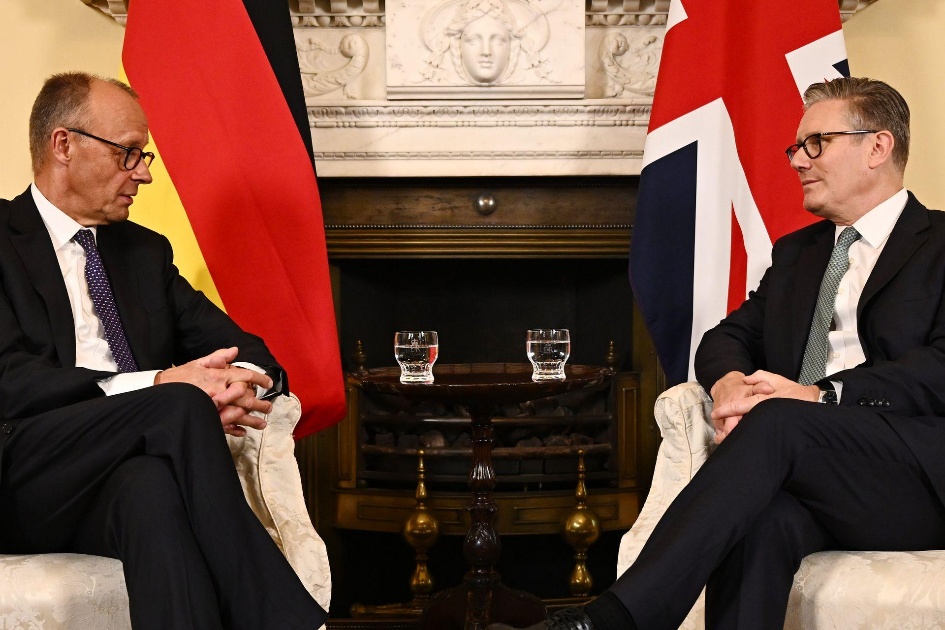
German Chancellor Friedrich Merz and U.K. Prime Minister Keir Starmer attend a meeting at 10 Downing Street, in London, United Kingdom. (Leon Neal – WPA Pool /Getty Images)
While Germany has resisted providing Taurus cruise missiles with 500-kilometer range, Defense Minister Boris Pistorius confirmed Berlin will supply additional Patriot air defense systems purchased from the US. The defensive systems complement Germany’s offensive weapons contributions.
UK-Germany Defense Pact: Historic Treaty Signed
UK Prime Minister Keir Starmer and German Chancellor Friedrich Merz signed a landmark Anglo-German defense treaty pledging mutual assistance in the event of armed attacks. The agreement represents the most significant bilateral pact between the nations since 1945.
The treaty includes joint commitment to deliver a new long-range missile system with range exceeding 2,000 kilometers within the next decade. The Deep Precision Strike capability is expected to drive substantial investment into European defense sectors.
While reinforcing existing NATO obligations, officials emphasized the treaty is not a substitute for Article 5 collective defense principles. The agreement reflects growing European concerns over Russian aggression and uncertainty about US commitments under the Trump administration.
Moldova’s Military Cooperation: NATO Exercise Participation
Moldova announced its troops will participate in the US-led Agile Spirit 25 military exercises in Georgia from July 23 to August 7. The exercises, held under NATO auspices, include personnel from Bulgaria, Georgia, Germany, Lithuania, Moldova, Poland, Romania, Turkey, Ukraine, and the United States.
The participation reflects Moldova’s growing cooperation with Western partners amid repeated warnings about Russian destabilization efforts. Prime Minister Dorin Recean previously stated Moscow intends to deploy 10,000 troops to Russian-occupied Transnistria and install a pro-Kremlin government in Chisinau.
President Maia Sandu warned Russia could instigate a Transnistria crisis ahead of Moldova’s September parliamentary elections to derail the country’s pro-European trajectory. Moldovan forces have trained under the Agile Spirit program since 2023 as part of annual defense cooperation planning.
Kaliningrad Vulnerability: NATO General Assesses Russian Enclave
US Army Europe and Africa commander General Chris Donahue stated NATO forces could capture Russia’s Kaliningrad Oblast “in a timeframe that is unheard of” if necessary. The assessment reflects new allied capabilities under the “Eastern Flank Deterrence Line” strategy.
Kaliningrad Oblast, wedged between Poland and Lithuania and surrounded by NATO territory, spans just 75 kilometers across. Donahue said allied capabilities now allow them to “take that down from the ground” faster than previously possible.
The strategy focuses on bolstering land forces, integrating defense production, and deploying standardized digital systems for rapid battlefield coordination. Russian lawmaker Leonid Slutsky warned any attack on Kaliningrad would trigger retaliatory measures including potential nuclear weapons use.
The assessment comes amid repeated Western intelligence warnings that Russia could pose military threats to NATO members within five years, making regional defense planning increasingly urgent.
US Low-Cost Drone Development: Response to Shahed Threat
The United States unveiled a new low-cost combat drone aimed at rivaling Iranian-designed Shahed-type drones that have become central to Russia’s aerial assault strategy. Defense Secretary Pete Hegseth reviewed the Low-Cost Uncrewed Combat Attack System (LUCAS) during a Pentagon demonstration.
Developed by Arizona-based Spektreworks, LUCAS features modular design enabling quick payload swaps and various launch options including vehicle deployment. The drone was designed as a flexible platform for strike, reconnaissance, and communications support missions.
The development responds to Russia’s increasing deployment of affordable Shahed-type drones in Ukraine, valued for their cost-effectiveness and substantial payload capabilities. Ukraine has concentrated on building interceptor drone fleets to counter incoming Shahed-type UAVs as anti-drone defense becomes a national security priority.
Economic Warfare Intensifies: Russia Prepares Internet Censorship Expansion
Russia prepared to fine people for searching banned content online, even when using VPNs, as part of expanding digital repression measures. Proposed Administrative Code changes would introduce fines of 3,000 to 5,000 rubles for “intentional searches” of government-deemed extremist materials.
The amendments also target VPN promotion, with advertising such software resulting in penalties up to 80,000 rubles for individuals, 150,000 rubles for officials, and 500,000 rubles for companies. Digital rights groups warn the vague language could criminalize ordinary internet use.
“This could be one of the darkest times for the Russian internet,” said Sarkis Darbinyan, co-founder of digital rights group Roskomsvoboda. The measures take effect September 1, representing escalation of Russia’s information control efforts amid wartime conditions.
Critics warn the broad definition of “extremist materials” could encompass opposition media, independent investigations, and blocked social media platforms, effectively criminalizing access to alternative information sources.
Aviation Milestone: Ukrainian An-124 Makes First Wartime Flight
A modernized Ukrainian An-124 Ruslan cargo aircraft was relocated from Ukraine to Germany in a rare wartime flight, marking the first such operation since Ukrainian airspace was closed following Russia’s full-scale invasion. The plane departed Kyiv on July 11, representing a significant achievement for Ukraine’s aviation industry under wartime conditions.
The aircraft, originally produced in 1994 and bearing serial number 0706, had logged more than 21,000 flight hours across over 5,500 flights before undergoing major overhaul. The modernization project began in 2021, focusing on replacing critical components originally manufactured in Russia with Western and Ukrainian suppliers.
Work was interrupted following the start of Russia’s invasion when the aircraft was still disassembled. Despite wartime conditions, the Antonov team resumed and completed the project in June 2025. “The relocation of the Ruslan is not just a technical achievement—it symbolizes the resilience, professionalism, and unity of Ukrainian aircraft engineers,” the company stated.
The successful flight contrasts with the destruction of the world’s largest cargo plane, the An-225 Mriya, which was destroyed during a Russian air strike on Hostomel Airport near Kyiv in the early days of the invasion. Former Antonov director Serhii Bychkov was charged with negligence for allegedly failing to evacuate the Mriya despite repeated warnings.
Baltic Defense Preparations: Lithuania Tests Anti-Artillery Bunkers
Lithuania’s armed forces conducted artillery tests on prototype bunkers to determine which designs would best withstand potential Russian attacks. The tests at the Pabradė military training area simulated blasts from standard Russian artillery shells to assess personnel protection capabilities.
Pressure, sound levels, wall vibrations inside bunkers and other indicators were measured during the testing. Promising prototype bunkers will be installed at Pabradė and a second military training area by the end of 2025 for future training exercises.
The project aims to learn lessons from Ukraine’s resistance against Russian forces. Estonia simultaneously advanced its own defensive preparations, having started testing prototypes of 600 bunkers planned for installation along its eastern border with Russia.
Three types of dummy structures were hit by 155-millimeter artillery shells in October to test impact resistance. Officials from Latvia, Lithuania and Poland observed the tests as part of the “Baltic Defense Line” initiative, with Poland’s “East Shield” implementing similar measures.
Steps already taken include acquiring mines, installing concrete blocks known as dragons’ teeth, and digging tank traps in frontier areas as Baltic states reinforce their borders with Russia and Belarus.
Trump Administration Shift: Kellogg’s Rising Influence Against Putin
US President Donald Trump began taking a tougher line on Russia following months of quiet influence by Republican foreign policy hawks, with Special Envoy Keith Kellogg playing a central role. Congressional sources reported that Kellogg has “been in the ascendancy lately” and is helping drive Trump’s strategic shift.
Initially appointed as Special Envoy for both Ukraine and Russia, Kellogg was later reassigned to focus solely on Ukraine after the Kremlin reportedly objected to his involvement in peace talks, viewing him as too pro-Ukrainian. He dealt directly with President Volodymyr Zelensky and his administration during a recent visit to Kyiv.
Kellogg’s return to influence comes after months of being sidelined in favor of real estate executive Steve Witkoff, who had taken the lead in back-channel talks with Moscow. Witkoff became a de facto US envoy to Russian President Vladimir Putin despite concerns within the administration over his informal conduct and push to lift US energy sanctions on Moscow.
The shift in Trump’s stance comes amid growing frustration over Russia’s refusal to engage meaningfully in peace efforts. Trump warned on July 14 that the US would impose “severe” secondary tariffs up to 100% on Russia unless a deal is reached within 50 days.
Kellogg met with Zelensky on July 14 in Kyiv to discuss strengthening Ukraine’s air defense and joint weapons production. While initially saying he would stay for the whole week, Kellogg left Ukraine on July 16, demonstrating the dynamic nature of ongoing diplomatic efforts.
Military Training Tragedy: Ukrainian Cadet Kills Two Instructors
A Ukrainian military cadet opened fire with an assault rifle during a training exercise in northern Chernihiv Oblast, killing two instructors on July 16. The shooting occurred at a training ground operated by the Ukrainian Ground Forces, with the cadet detained under Ukraine’s Criminal Procedure Code.
Police opened a criminal investigation under charges of premeditated murder, with the case overseen by the Security Service of Ukraine (SBU). The motive for the attack remains unknown, and authorities said the cadet fired an automatic weapon at two military instructors during a live-fire training session.
Both service members died from their injuries in the incident at the training ground in the oblast that borders Belarus and lies north of Kyiv. Chernihiv Oblast has hosted numerous military exercises since the full-scale Russian invasion began in 2022.
Initial reports of the incident emerged on social media late on July 16, though the Ground Forces Command has yet to issue an official comment beyond police statements. The investigation continues as authorities work to determine the circumstances behind the fatal shooting.
Digital Repression Escalates: Russia Targets VPN Users with New Fines
Russia prepared to implement sweeping internet censorship measures, introducing fines for people searching banned content online even when using VPNs. The proposed Administrative Code changes would impose fines of 3,000 to 5,000 rubles for “intentional searches” of materials the government deems extremist.
The amendments specifically target VPN promotion, with advertising or recommending such software resulting in penalties up to 80,000 rubles for individuals, 150,000 rubles for officials, and 500,000 rubles for companies. Digital rights groups warn the vague wording could lead to broader interpretations criminalizing ordinary internet use.
“If you have a VPN on your phone, that alone might be enough to trigger a deeper check,” said digital rights expert Sarkis Darbinyan. “Eventually, we could see criminal charges for VPN use after just one or two warnings—like with the law on foreign agents.”
The new rules are expected to take effect September 1, marking the first time Russian law would hold people responsible for what they search or read online rather than just for spreading banned content. Critics warn the vague language could allow the state to target anyone accessing opposition media, independent investigations, or blocked social media platforms.
Digital rights groups called the move “a sneaky tactic,” noting that censorship measures were quietly added to a bill originally meant to regulate the freight transport industry. “This method—slipping repressive ideas into unrelated laws—has been used many times before,” the Net Freedoms Project warned.
Battlefield Dynamics: Pokrovsk’s Final Stand
The battle for Pokrovsk entered its final phase as Russian forces closed in on the key logistics hub, threatening to cut off supply routes from the north through Dobropillia. Ukrainian soldiers from the 68th Jaeger Brigade’s drone battalion, the Hornets of Dovbush, continued their defensive operations despite mounting pressure.
The city’s transformation from a thriving rear-area hub to a front-line fortress reflects the evolving nature of the conflict. Drone warfare has made civilian evacuation increasingly dangerous, with only the bravest volunteers still making the drive to Pokrovsk due to constant aerial surveillance and attacks.
Local residents like 84-year-old Olena and 30-year-old Oleksii represent the civilian population caught between Ukrainian defensive positions and approaching Russian forces. Their experiences illustrate the human cost of prolonged siege conditions in eastern Ukrainian cities.
Ukrainian forces achieved tactical successes using fiber optic drones to strike Russian Starlink dishes and communications equipment, demonstrating technological adaptation in urban warfare. However, the strategic situation continues deteriorating as Russian forces advance on multiple flanks around the city.
The fate of Pokrovsk represents broader dynamics across the eastern front, where Ukraine’s defensive capabilities face sustained pressure from Russian advances supported by overwhelming artillery and drone superiority.
Opposition Dynamics: Belarusian Democratic Forces Debate Strategy
The Belarusian democratic opposition faced internal divisions over whether to pursue diplomatic engagement or maintain pressure on dictator Alexander Lukashenko following the release of 14 political prisoners. The debate intensified after US Special Envoy Keith Kellogg secured prisoner releases during his meeting with Lukashenko in Minsk.
Opposition leader Sviatlana Tsikhanouskaya called for Lukashenko to be held “accountable, not coddled,” while other figures including Valery Kavaleuski criticized her stance as potentially damaging to fragile negotiating processes. The rift highlighted fundamental disagreements over tactics within the opposition movement.
Some former political prisoners support negotiations as a means to secure releases, while others like activist Palina Sharenda-Panasiuk believe international pressure played the decisive role in their freedom. The disagreement reflects broader debates about prioritizing immediate humanitarian concerns versus long-term democratic goals.
Over 1,100 current political prisoners remain in Belarusian custody, with 2,800 former prisoners having been released since 2020. Eight political prisoners have died in custody, and 200 have been included on a humanitarian list of those at heightened risk of not surviving incarceration.
The debate occurs against the backdrop of institutionalized repression, with over 50 laws passed since 2020 that formalize various forms of state control and persecution of dissent.
Military Intelligence Revelations: Russian Army Degradation
Additional details emerged about the catastrophic state of Russia’s 41st Combined Arms Army, with intelligence documents revealing the extent of military degradation beyond raw casualty figures. The formation’s collapse reflects broader problems across Russian forces, including the integration of poorly trained recruits and former prisoners into elite units.
Desertion rates reached critical levels, with 42 soldiers fleeing their units on a single day in May and 175 deserting over one week. Of deserters, 28% were former prisoners recruited into penal assault units known as “V companies,” highlighting the quality degradation of Russian forces.
The documents showed that “V companies” exist exclusively in motorized rifle brigades where prisoners serve as expendable assault troops. This tactic has fundamentally altered the character of units that were previously considered professional military formations.
The intelligence also revealed that Russian commanders constantly replenish units with poorly-trained personnel, resulting in formations like the 98th Airborne Division no longer functioning as “elite” units despite retaining their designations.
Trump’s Drone Revolution: Defense Budget Prioritizes Unmanned Systems
President Trump’s draft defense budget for fiscal year 2026 prioritizes drones and long-range missiles over conventional naval and aerial assets, reflecting lessons learned from the Ukraine conflict. The strategic shift aligns with Zelensky’s proposal for a “mega deal” involving Ukrainian drone technology transfer to the United States.
The budget reorientation acknowledges the transformative impact of unmanned systems demonstrated in Ukraine, where drones have proven capable of mission types previously requiring expensive manned platforms. Ukraine’s success in destroying Russian heavy bombers with FPV drones particularly influenced American strategic thinking.
Trump’s approach represents recognition that future conflicts will likely be decided by technological superiority in unmanned systems rather than traditional force structures. The emphasis on cost-effective, scalable technologies mirrors Ukraine’s own military evolution since 2022.
The proposed weapons-for-drones exchange would benefit both countries by providing Ukraine access to advanced American systems while giving the US combat-tested drone technologies developed under extreme battlefield conditions.
Russian Economic Deterioration: Central Bank Contradictions
Russia’s Central Bank continued pursuing contradictory policies that threaten long-term economic stability while maintaining facades of growth. The bank’s June 2025 report claimed success in reducing inflation to four percent annually, but experts warned this short-term measurement disguises deeper structural problems.
The strengthened ruble temporarily reduced input costs and inflationary pressure, but secondary sanctions are likely to undercut both Russian oil revenues and cheaper imports using the stronger currency. Competition between Russia’s defense industrial base and civilian enterprises continues raising wages and prices across service industries.
Russia’s strategy of incentivizing volunteer recruitment through large payments while rapidly expanding defense production has created unsustainable fiscal pressures. The country cannot indefinitely replace forces at current casualty rates without involuntary mobilization, which President Putin has shown reluctance to order.
The Russian Central Bank’s advice to lenders to absorb bad loans rather than recognizing their full extent reflects the risky economic policies underlying Russia’s war effort. Any failure of a major Russian bank would undercut Putin’s narrative that neither the war nor Western sanctions are damaging the economy.
Russian Military Degradation: Order of Battle Analysis Reveals Unit Collapse
Detailed military analysis revealed the systematic collapse of Russian combat effectiveness across multiple fronts, with specific units identified as no longer combat effective due to heavy casualties. Ukrainian military observer Kostyantyn Mashovets reported that elements of the 200th Motorized Rifle Brigade, 155th Naval Infantry Brigade, 30th Motorized Rifle Regiment, and 1443rd Motorized Rifle Regiment operating in the Kindrativka-Oleksiivka area have lost combat effectiveness.
The 74th Motor Rifle Brigade from Kemerovo Oblast suffered the most catastrophic losses, with 2,479 soldiers killed, 2,732 missing, and 2,789 deserting—more than double the brigade’s original strength of 3,500 troops. The 35th Brigade from Altai Krai reported 1,975 killed, 3,163 missing, and 2,229 desertions.
Russian commanders continue replenishing units with poorly trained personnel, including former prisoners recruited into “V companies” that serve as expendable assault troops. A Ukrainian brigade commander operating in Chasiv Yar reported that Russian forces have sustained 5,000 casualties in that direction alone over the past year.
Elements of elite units including the 11th and 83rd separate airborne brigades, 104th, 234th, and 237th VDV regiments continue operations despite degraded capabilities. The systematic replacement of professional soldiers with recruits and prisoners has fundamentally altered the character of units previously considered elite formations.
Frontline Dynamics: Russian Advances Meet Ukrainian Resistance
Ukrainian forces achieved tactical advances near Pokrovsk while Russian forces made gains near Borova, illustrating the fluid nature of combat across the eastern front. Geolocated footage confirmed Ukrainian progress in southeastern Novoekonomichne, while Russian forces advanced northeast of Borivska Andriivka.
In the Kupiansk sector, Russian forces continued building bridgeheads west of the Oskil River, potentially threatening Ukrainian rear areas. The 1st Guards Tank Army reportedly continues operations in this direction as Moscow seeks to recapture territories lost during Ukraine’s 2022 counteroffensive.
Fighting in Kursk Oblast continued with Russian ground attacks in unspecified areas, while Ukrainian forces maintained positions in most of Kindrativka and partially encircled Russian forces near Oleksiivka north of Sumy City. Russian forces conducted attacks near multiple settlements including Ryzhivka, Bezsalivka, Varachyne, and Myropillya.
In northern Kharkiv Oblast, unconfirmed claims suggested Russian advances in central Vovchansk and potential river crossings, though Ukrainian forces continued ground attacks near Kudiivka and maintained defensive positions. Elements of the 128th Motorized Rifle Brigade and Chechen Zapad-Akhmat Battalion reportedly operate in contested areas.
Shahed Drone Evolution: Russia’s Technological Adaptations
Russia has systematically modified Iranian-designed Shahed drones to increase their destructive capability and resistance to Ukrainian countermeasures. Navigation systems evolved from four-array controlled reception pattern antennas to more resilient 8- or 16-array Kometa CRPA GNSS units, with some incorporating Chinese-made alternatives.
Newer Geran drone versions carry enhanced warheads increased from 40-50 kg to 80-90 kg, including flammable substances that cause severe incendiary effects upon detonation. Some drones feature radio transmitters for remote control or 3G/LTE modem modules connecting to cellular networks for enhanced navigation and telemetry.
Russia produces over 5,000 long-range drones monthly, split between approximately 2,700 Geran strike drones and 2,500 Gerbera decoys. The decoy drones, costing up to ten times less at around $10,000, force Ukrainian defenders to expend resources tracking them while allowing strike drones better penetration opportunities.
The systematic use of decoy drones represents tactical evolution, with Parodya and Gerbera models overwhelming Ukrainian air defenses through volume rather than individual sophistication. Built from foam plastic and plywood weighing less than 20 kilograms, decoys produce similar electronic signatures to attack drones while extending operational ranges up to 600 kilometers.
Military Production Surge: Ukraine’s Defense Industrial Expansion
Ukraine approved massive defense spending increases totaling Hr 412.4 billion ($9.8 billion), bringing total security and defense expenditure to around $50 billion or 26% of GDP. The Defense Ministry received the largest allocation at Hr 311 billion, while other security agencies including military intelligence, SBU, and State Protection received $1.5 billion in funding increases.
The budget expansion enables Ukraine’s plan to deliver 15,000 combat robots by year-end, representing unprecedented scaling of unmanned ground warfare capabilities. Over 200 Ukrainian companies work on UGV development, with government streamlining production rules and accelerating certification processes.
German defense technology company Quantum Systems acquired a 10% stake in Ukrainian robotics firm Frontline, with options to increase ownership to 25% within 12 months. The deal represents one of the largest strategic investments in Ukraine’s defense tech sector, aimed at boosting manufacturing capacity and European integration.
Frontline produces reconnaissance drones nicknamed “Ukrainian Mavics” and counter-drone systems in high demand among military units. The company has begun integrating European-sourced components to enhance battlefield performance while maintaining production flexibility under wartime conditions.
Strategic Air Defense: Patriot System Deployment Challenges
Confusion emerged over Patriot air defense system deliveries as multiple governments provided conflicting information about shipment status and coordination. Germany’s Defense Ministry stated it had no knowledge of current deliveries despite Trump’s claims that systems were already en route to Ukraine.
The US informed Switzerland of delays in five Patriot systems ordered in 2022 for delivery between 2027-2028, prioritizing Ukraine’s urgent air defense needs. Switzerland’s postponed deliveries reflect broader reallocation of defense production capacity toward Ukraine’s immediate requirements.
US Ambassador to NATO Matthew Whitaker confirmed accelerated weapons delivery efforts under Trump’s NATO initiative, including potential sales from US military stockpiles. Options under discussion include direct US sales, European countries sending existing systems to Ukraine, and replacement through Washington purchases.
European allies continue negotiations about providing more than three additional Patriot systems, though coordination mechanisms remain unclear. The complexity of multinational defense procurement under wartime urgency has created communication gaps between allied governments and military commands.
Information Warfare: Russian Propaganda Claims vs Reality
Reports of Ukrainian strikes against Moscow and St. Petersburg likely represent standard Russian disinformation tactics rather than significant escalation of Ukraine’s strike campaign. The Russian Defense Ministry claimed downing 308 aircraft-type drones over multiple oblasts including Moscow, Leningrad, Bryansk, and others.
Ukrainian strikes targeted legitimate military infrastructure including the Shchekinoazot United Chemical Plant in Tula Oblast, which manufactures ammonia, methanol, and urea supporting explosives and rocket fuel production. Additional strikes hit Rostec’s 720th Flight Support Equipment Repair Plant in Smolensk Oblast.
The geographical proximity of legitimate military targets to major Russian cities creates opportunities for propaganda mischaracterization. Ukraine’s strike campaign differs fundamentally from Russia’s approach by targeting military objectives while avoiding disproportionate civilian casualties.
Russian informational campaigns previously leveraged unsubstantiated strike claims to discredit Ukraine during ceasefire periods, potentially recycling tactics to influence Western policy discussions. The Kremlin’s pattern of exaggerating Ukrainian capabilities serves domestic propaganda while deflecting attention from military failures.
International Defense Innovation: Testing Programs Expand
Ukraine launched comprehensive battlefield testing programs for foreign military technologies through the Brave1 innovation cluster, offering real combat validation unavailable elsewhere. The initiative prioritizes drones, missiles, counter-drone systems, ammunition, electronic warfare equipment, and naval platforms.
Foreign companies can participate directly in testing or delegate operations to Ukrainian teams while providing online training. Testing occurs on equipped grounds with military participation, providing structured feedback and frontline usage data for product development.
The program aims to connect foreign manufacturers with local firms for co-production and accelerated deployment. Brave1 released detailed import procedures for military equipment testing, addressing practical scenarios including damage protocols and customs requirements.
Companies bringing drones need special permits from Ukraine’s State Service for Export Control, while non-military classified goods enter under general customs rules. The initiative potentially integrates Ukraine into global defense supply chains while providing immediate battlefield validation for emerging technologies.
Diplomatic Complexity: US-Russia Engagement Challenges
Keith Kellogg’s rising influence within the Trump administration reflects broader Republican foreign policy pressures toward tougher Russia positions. Initially appointed as envoy to both Ukraine and Russia, Kellogg’s reassignment to focus solely on Ukraine followed Kremlin objections to his involvement in peace talks.
Kellogg’s recent visit to Ukraine included meetings with President Zelensky on air defense strengthening and joint weapons production with European partners. His premature departure after initially planning to stay a full week suggests dynamic diplomatic developments requiring immediate attention.
Steve Witkoff’s previous influence as Trump’s informal Putin envoy has waned amid administration concerns over his conduct and push to lift energy sanctions on Moscow. The shift toward Kellogg represents emphasis on Ukraine-focused diplomacy rather than accommodation of Russian demands.
Congressional sources report that Kellogg and Secretary of State Marco Rubio have driven Trump’s strategic recalibration following stalled negotiations and intensifying Russian attacks on Ukrainian cities. The evolution reflects growing frustration with Putin’s unwillingness to engage meaningfully in peace processes.
Economic Intelligence: Russian Banking Sector Vulnerabilities
Bloomberg’s reporting on Russian banking sector concerns revealed systematic attempts to hide the true scale of financial instability behind official growth statistics. Senior executives at three systemically important banks privately discussed potential bailout requests if loan quality continues deteriorating.
Non-performing loans grew 1.2 percent in 2025 and could reach six to seven percent by 2026, up from the current four percent rate. The Russian Central Bank advised lenders to absorb bad loans rather than recognizing their full extent, reflecting attempts to maintain stability facades.
Russia’s strategy of paying high recruitment bonuses while expanding defense production has created unsustainable fiscal pressures that threaten long-term economic stability. Competition between defense and civilian sectors drives wage inflation across service industries while limiting economic growth potential.
Any major bank failure would undermine Putin’s narrative that neither the war nor Western sanctions damage the Russian economy. The banking sector’s dependence on state support while maintaining independence facades illustrates fundamental contradictions in Russia’s wartime economic management.
Looking Forward: The Evolution of Modern Warfare
July 17 marked a watershed moment in military history as Ukraine demonstrated the practical application of fully autonomous warfare capabilities while simultaneously adapting its governmental structures for prolonged conflict. The successful capture of enemy forces using only robotic systems represents not merely tactical innovation but a fundamental shift in how modern conflicts may be conducted.
The day’s events illustrate Ukraine’s remarkable capacity for institutional adaptation under extreme pressure, from governmental restructuring to battlefield innovation. As Russian economic vulnerabilities become increasingly apparent through leaked casualty reports and banking sector concerns, Ukraine’s technological advancement and international partnerships position it for sustained resistance.
The contrast between Ukraine’s forward-looking military innovation and Russia’s reliance on mass casualties and economic coercion highlights divergent approaches to modern warfare. While Moscow burns through personnel and financial reserves, Ukraine builds capabilities that could define the future of military conflict worldwide.