
Five Patriot systems pledged as Ukraine sets July 23 for Istanbul talks, while 450 Russian weapons rain death on cities and Moscow’s teenager-staffed drone factories churn out instruments of terror
Summary of the Day – July 21, 2025
The convergence of Western military commitment and Russian escalation defined July 21, as Germany and the United States agreed to deliver five additional Patriot air defense systems while Moscow responded with a devastating 450-weapon overnight barrage. President Volodymyr Zelensky confirmed the third round of peace talks will commence July 23 in Istanbul, even as Russian drones and missiles killed two civilians and damaged Kyiv’s metro shelter system. The day crystallized Ukraine’s reality: unprecedented Western support flowing alongside Russia’s relentless campaign to terrorize civilians, as Trump’s 50-day ultimatum ticks toward its deadline with little sign Putin will bend to diplomatic pressure.
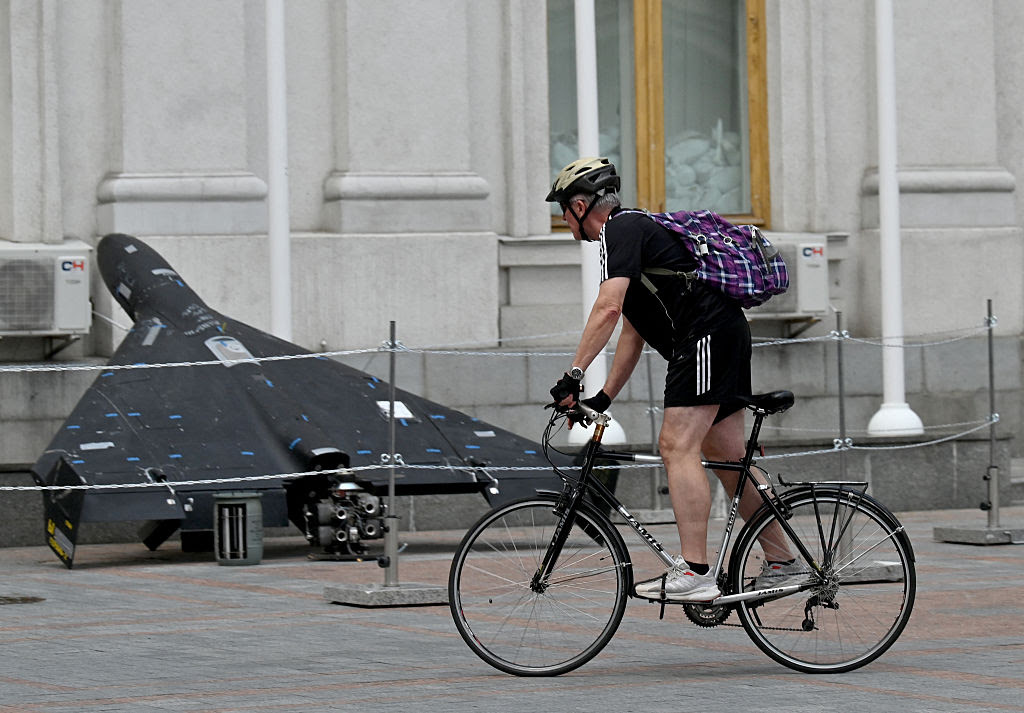
A man rides a bicycle past a Shahed 136 (Geranium-2) Iranian-made UAV drone displayed outside the Ukrainian Ministry of Foreign Affairs in Kyiv. (Sergei Supinsky / AFP via Getty Images)
Five Patriots for Freedom: Germany and America Open the Arsenal
German Defense Minister Boris Pistorius announced during the Ramstein Contact Group meeting that Berlin and Washington had agreed to deliver five Patriot air defense systems—the largest single commitment of advanced interceptors since the war began. The announcement came hours after Russian forces demonstrated precisely why such systems remain desperately needed, launching their most intensive overnight assault in recent months.
Germany will also send 200,000 Gepard shells, while Norway pledged to help finance the deliveries during Prime Minister Jonas Gahr Støre’s Berlin visit. Dutch Defense Minister Ruben Brekelmans promised substantial contributions to additional air defense systems, declaring Russia’s goal is “to bring the steadfast Ukrainians to their knees.”
The commitment nearly doubles Ukraine’s Patriot capabilities. Washington has provided three batteries, Germany contributed three more, and a European coalition supplied another. The new systems represent a dramatic expansion, though maintenance rotations mean not all operate simultaneously.
Istanbul Beckons Again: Third Round Set for Wednesday
Zelensky confirmed that National Security Council Secretary Rustem Umerov reported negotiations would resume July 23 in Istanbul, with Ukraine’s agenda limited to three priorities: prisoner exchanges, returning abducted children, and preparing for a leaders’ summit.
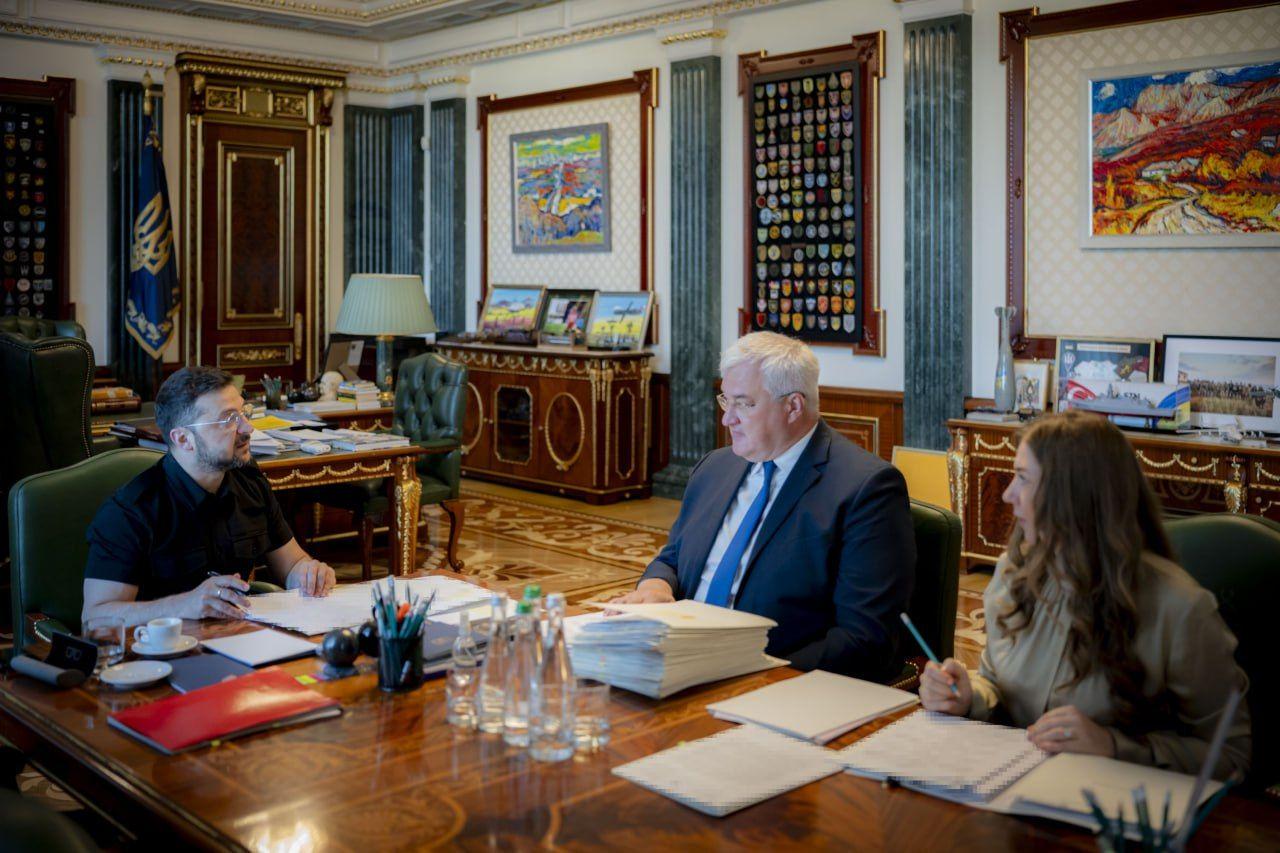
President Volodymyr Zelensky meets with Foreign Minister Andrii Sybiha and Presidential Office team at his office in Kyiv, Ukraine. (Volodymyr Zelensky / Telegram)
“The agenda from our side is clear,” Zelensky declared. “It is clear to all that truly effective talks can only take place at the level of national leaders.”
Kremlin spokesperson Dmitry Peskov confirmed Moscow’s readiness while emphasizing Putin would again send lower-level officials. Putin’s aide Vladimir Medinsky will continue leading the Russian delegation, with Foreign Minister Sergey Lavrov and other top officials remaining absent.
The talks resume after June’s Istanbul meeting concluded with only prisoner exchange agreements, as Russia refused to provide peace terms in advance. Peskov reiterated that Russia’s war goals remain unchanged and must be achieved “on the battlefield”—a stark admission of Moscow’s disinterest in genuine negotiations.
Thunder and Lightning: 450 Weapons of Terror Strike Ukraine
As diplomatic preparations accelerated, Russian forces unleashed one of their most devastating overnight barrages since the full-scale invasion began. The assault included 426 Shahed-type drones and decoys launched from multiple directions, alongside five Kh-46 Kinzhal hypersonic missiles, 14 Kh-101 cruise missiles, four Kalibrs from the Black Sea, and one Iskander-K missile.
Ukrainian forces intercepted most threats, shooting down 200 Shahed drones and 203 decoys while downing all missiles. However, 23 strike drones found their targets across three locations, killing two civilians and injuring 15 others.
In Kyiv, one died and nine were injured as explosions rocked six districts. Fires erupted at supermarkets, residential buildings, and a nursery. Most significantly, the entrance to Lukianivska metro station—where civilians sought shelter—sustained damage that briefly filled the underground space with smoke.
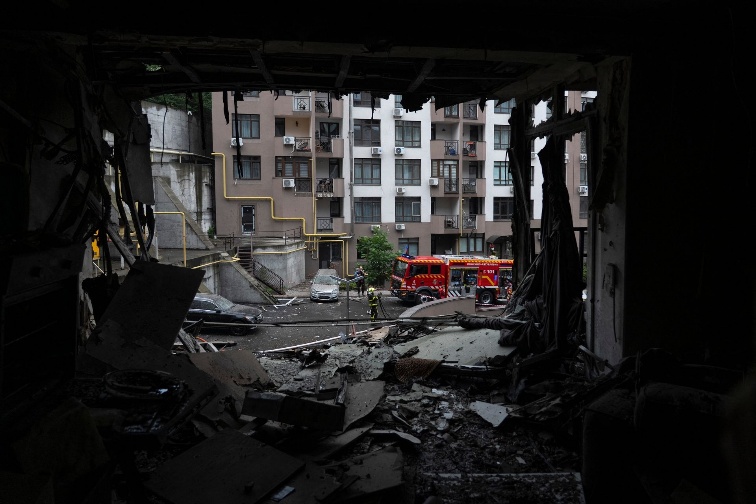
Firefighters work in a damaged residential building after a Russian attack in Kyiv, Ukraine. (Vitalii Nosach / Global Images Ukraine / Getty Images)
“This is called mocking people,” declared 65-year-old retiree Liudmyla, pointing to damaged apartments. “He [Trump] laughs at people. First he gave two weeks, now he gives 50 days.”
Western Terror in the West: Ivano-Frankivsk Bears Unprecedented Assault
Mayor Ruslan Martsinkiv described strikes on Ivano-Frankivsk as “the largest attack since the full-scale invasion” as Russian missiles and drones targeted the western city traditionally considered safe from attacks. Four people, including a child, were injured as infrastructure in three villages sustained damage.
Poland scrambled fighter jets in response to Russian missiles near its border—the second such activation in three days. The Polish response highlighted how Russian escalation continues threatening NATO territory directly.
Ramstein’s Riches: Billions Flow for Ukraine’s Defense
Beyond Patriots, the virtual meeting produced substantial military and financial commitments. Canada pledged funding for Ukraine’s defense industrial base through the “Danish model” plus 20 million CAD for tank maintenance. The Netherlands allocated 200 million euros for interceptor drone production and 125 million euros for F-16 maintenance.
Norway’s commitment proved most substantial: one billion euros for Ukrainian drone purchases in 2025, including 400 million euros specifically for Ukraine’s domestic defense industrial base. Ukrainian Defense Minister Denys Shmyhal revealed Ukraine could accommodate an additional $6 billion in defense investments.
British Defense Secretary John Healey announced a “50-day drive” to arm Ukraine and push Putin toward negotiations, seizing on Trump’s tariff threats.
French Mission to Chernobyl: Barrot’s Surprise Journey
French Foreign Minister Jean-Noël Barrot made a surprise Kyiv visit, arriving hours after the massive Russian barrage. After meetings with Ukrainian leadership, Barrot visited Chernobyl to inspect damage to the protective arch caused by a Russian drone in February.
During the inspection, Barrot became briefly stuck in an elevator but emerged unharmed. France has pledged 10 million euros to repair the arch damage. “Russia targets energy infrastructure in defiance of international law, security and nuclear safety,” Barrot declared.
The visit coincided with revelations that 80 French defense companies had visited Ukraine for 200 meetings with counterparts, exploring joint drone production. Automaker Renault, partnering with a defense firm, plans to establish drone production on Ukrainian territory.
The Crackdown Begins: Anti-Corruption Agencies Under Siege
Ukrainian law enforcement conducted at least 70 searches targeting the National Anti-Corruption Bureau (NABU) and Special Anti-Corruption Prosecutor’s Office (SAPO), opening probes against 15 NABU employees for alleged Russian links and traffic accidents.
The Security Service detained a NABU employee for suspected espionage and Ruslan Mahamedrasulov, a detective unit head, for alleged contacts with Russia. NABU reported searches conducted without warrants and physical force used against detectives.
The government simultaneously rejected Oleksandr Tsyvinsky’s appointment to lead the Bureau of Economic Security despite independent commission selection, citing alleged Russian connections through his estranged father’s passport. Tsyvinsky gave a rare public interview criticizing the decision as unlawful.
G7 Ambassadors expressed “serious concerns” and pledged to discuss developments with government leaders.
Business Breathing Room: Presidential Moratorium on Inspections
Zelensky signed a decree implementing a moratorium on business inspections by state authorities, targeting “unjustified inspections” that have plagued Ukrainian enterprises. Newly appointed National Security Council Secretary Rustem Umerov will monitor implementation.
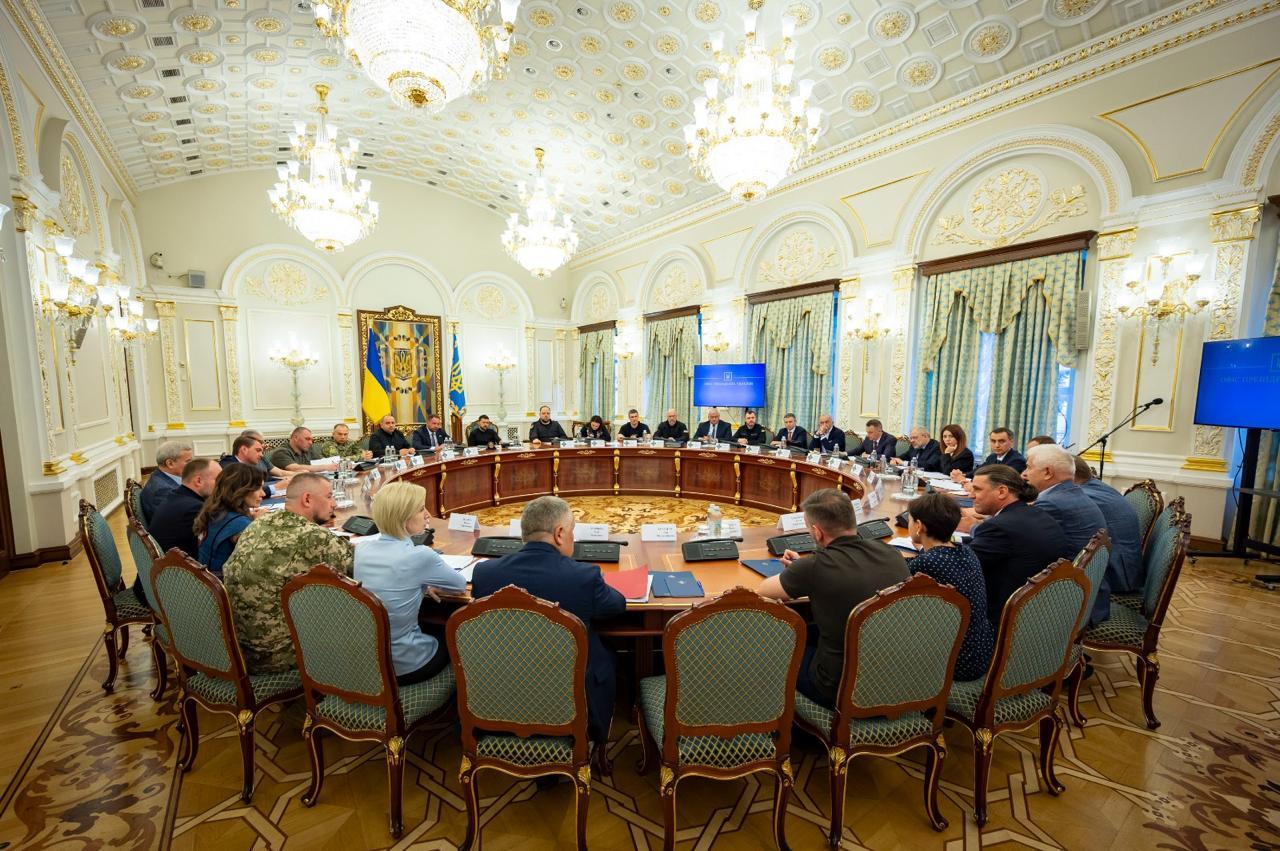
Ukraine’s National Security and Defense Council meets. (National Security and Defense Council of Ukraine)
“We are introducing a moratorium—a ban—on business inspections and any interference by law enforcement, regulatory bodies, or various state agencies in business activities,” Zelensky declared.
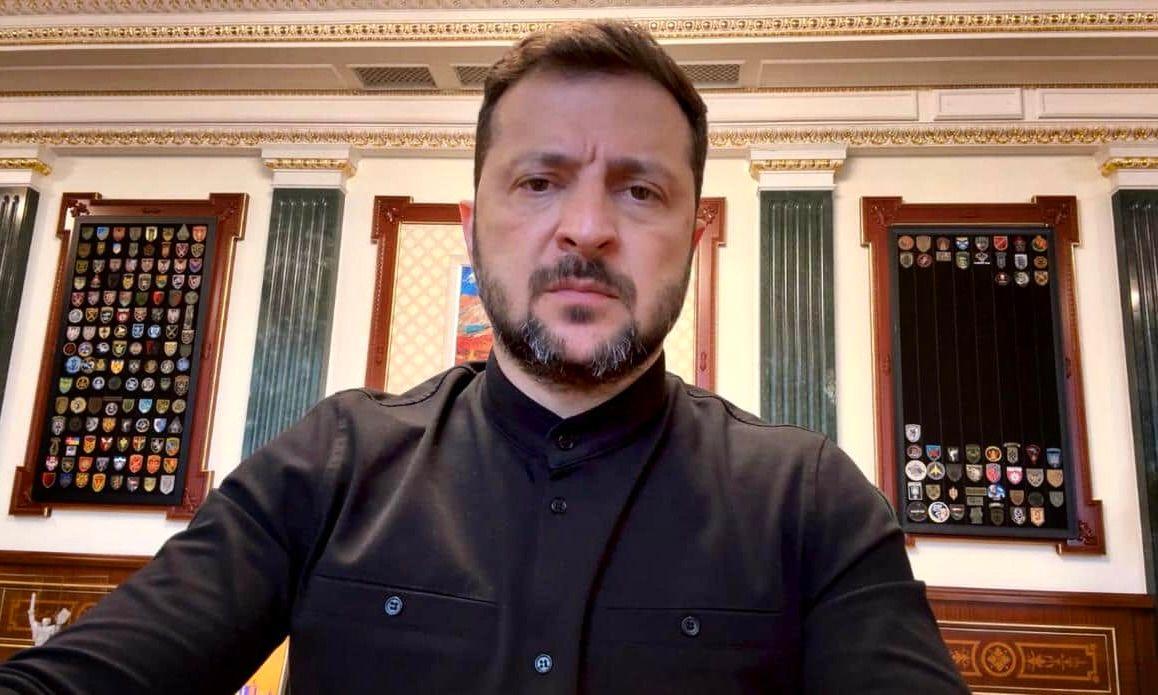
President Volodymyr Zelensky delivers his evening address in Kyiv, Ukraine. (Zelensky / Telegram)
Prime Minister Yuliia Svyrydenko announced a one-year moratorium including tax and customs checks, shifting to risk-based supervision focusing on genuine threats rather than random inspections.
Moscow’s Youth Army: Teenagers Build Tomorrow’s Terror
Russian state media showcased what officials described as the “largest and most secret” drone factory in the world, located in Yelabuga, Tatarstan. The facility employs teenagers as young as 15 from local technical colleges to assemble attack drones used against Ukrainian cities.
“This is the largest such plant in the world and the most secret,” declared Timur Shagivaliev, the facility’s CEO. Production has increased nine-fold from original plans, now churning out 5,200 Shahed-type drones monthly.
The footage revealed over 1,000 workers, with teenagers assembling drone components on brightly lit factory floors. The facility uses parts shipped from Iran via the Caspian Sea and Kama River, while facing allegations of recruiting African women under false pretenses.
Occupied Territories in Crisis: Water Becomes Weapon of War
Acting DNR chairman Andrei Chertkov announced a “critical situation with water supply” in occupied Donetsk Oblast, with residents receiving water only once every two to three days. Large areas including Mariupol’s Tsentralnyi district, Chystiakove, and Berdyansk lack running water entirely.
Occupation authorities implemented severe rationing: once every six days in Chystiakove and Torez, once every three to four days in Yenakiieve. Water prices increased from 3 to 5 rubles per liter, while officials explore using contaminated mining effluent as drinking water.
The crisis stems from Russia’s destruction of critical infrastructure, including the water main connecting the Donets River to the Siverskyi Donets-Donbas Canal. Ukrainian forces have documented Russian troops using dry water pipes as military shelters.
In occupied Simferopol, Russian authorities arrested a woman for organizing protests against water shortages.
Indoctrinating the Next Generation: DOSAAF Expands Control
Kherson Oblast occupation head Vladimir Saldo announced the transfer of water sports clubs, aeronautics facilities, and technical creativity centers to Russian DOSAAF control. The Soviet-era military-patriotic organization now targets children as young as 14 after Russia lowered admission age from 18.
Separately, Crimean occupation head Sergei Aksyonov banned distribution of media, photos, and videos containing information about Russian military positions, expanding surveillance efforts to more easily pursue “high treason” charges against Ukrainian civilians.
Spanish Shadows: Death in Familiar Complex
Former Ukrainian police officer Ihor Hrushevskyi was found dead in a Spanish swimming pool at the same residential complex where Russian defector pilot Maksim Kuzminov was assassinated in February 2024. The 61-year-old former organized crime officer was discovered June 29, bleeding from one ear, suggesting a possible stroke.
While no violence was evident, the coincidence of two Ukrainian-related deaths at the Cala Alta complex in Villajoyosa has raised questions. Hrushevskyi had recently purchased and renovated an apartment there.
Battlefield Momentum: Russian Advances Continue Despite Talks
Russian forces advanced in multiple directions despite diplomatic preparations. Geolocated footage confirmed Russian progress in western Bila Hora south of Chasiv Yar and east of Rusyn Yar northwest of Toretsk. South of Pokrovsk, Russian forces seized eastern Zvirove and the remainder of Pishchane.
Ukrainian forces countered with advances in northern Sumy Oblast, seizing Andriivka, Kindrativka, and Oleksiivka north of Sumy City. However, Russian forces simultaneously advanced in northeastern Kindrativka and southwest of Yablunivka.
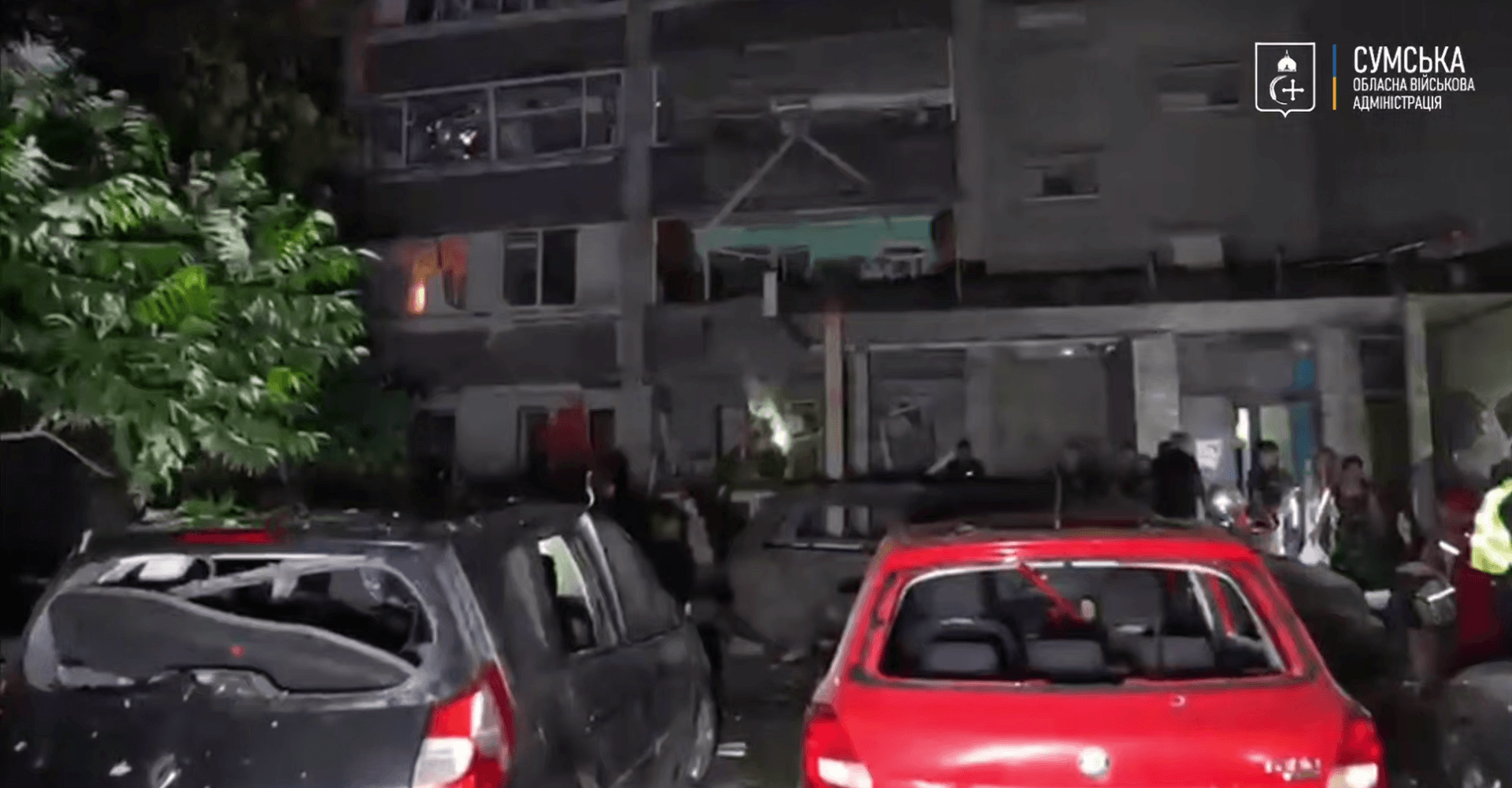
Aftermath of the Russian drone strike on Sumy Oblast. (Telegram)
The Russian military redeployed elements of the 1st and 9th motorized rifle brigades to reinforce the Pokrovsk area, suggesting preparation for intensified assaults.
Economic Warfare Intensifies: UK Targets Shadow Fleet
Britain imposed sanctions on 135 Russian oil tankers and two shipping companies linked to Russia’s shadow fleet, with vessels having transported $24 billion worth of oil since 2024. The UK also joined EU initiatives lowering Russian oil price caps to $47.6 per barrel.
U.S. Treasury Secretary Scott Bessent urged European allies to join potential secondary tariffs on Russia, with Trump threatening 100% penalties on countries continuing Russian business. “Russian oil is going to be subject to up to 100% secondary tariffs,” Bessent declared.
Meanwhile, Britain faces its own obligations under EU defense cooperation, required to pay Brussels a percentage of weapons value acquired through the 150-billion-euro Security Action for Europe project.
Sumy Under Fire: Border Strike Injures Eleven
Russian drone strikes on Sumy Oblast injured 11 people, including a 5-year-old boy, as forces targeted civilian infrastructure in the Putvyl community. Fires broke out as emergency crews worked to contain damage, demonstrating Russia’s continued willingness to target civilians while agreeing to renewed negotiations.
The Human Cost Continues: Casualties Mount on Both Sides
Ukraine’s General Staff reported Russian losses reached 1,043,160 troops since February 24, 2022, including 1,170 killed in 24 hours. Equipment losses included 11,037 tanks, 30,637 artillery systems, and 47,181 drones.
A notable casualty was Gennady Starunov, Moscow’s “Teacher of the Year” for 2022, killed while serving in the Russian military. The physical education teacher actively supported Russia’s invasion through his “Frontline Notes” blog and met with Putin in May 2025.
Ground Forces Commander Brigadier General Hennadii Shapovalov outlined priorities in his first statement, emphasizing “generation of forces” and making recruitment a conscious choice rather than forced obligation.
Personnel Shuffle: Zelensky Appoints New Diplomatic Corps
Zelensky appointed 16 new ambassadors to strengthen diplomatic representation, including Andrii Plakhotniuk to Canada, Yurii Lutovinov to Japan, Yaroslav Melnyk to Belgium, and Yuliia Sokolovska to Spain. The appointments reflect Ukraine’s strategy to enhance relationships with key partners as the war’s diplomatic phase intensifies.
Looking Ahead: The Paradox of Progress and Peril
As Istanbul approaches Wednesday, the fundamental contradiction between diplomatic theater and battlefield reality has never been starker. Russia’s 450-weapon assault hours after confirming renewed talks demonstrates Moscow’s commitment to achieving objectives through violence rather than compromise.
The Western response—five additional Patriots, billions in commitments, expanding industrial cooperation—suggests recognition that Ukraine’s capabilities must dramatically improve before meaningful negotiations become possible. Trump’s ultimatum continues ticking, but Putin’s actions indicate little interest in artificial deadlines imposed by Washington.
Whether diplomatic momentum can survive Russia’s escalating violence remains the central question as negotiators prepare for Istanbul’s conference rooms while Ukrainian cities burn under Moscow’s relentless aerial terror.