
As Ukraine’s parliament destroys a decade of reforms with 263 votes, Moscow’s troops infiltrate the strategic city while children build tomorrow’s terror drones and Pope Leo plans Vatican diplomacy with Putin’s church
Summary of the Day – July 22, 2025
July 22, 2025 will be remembered as the day Ukrainian democracy took its darkest turn since the EuroMaidan Revolution, as President Volodymyr Zelensky signed legislation effectively destroying the independence of the nation’s key anti-corruption institutions. The law, passed with 263 parliamentary votes amid nationwide protests, grants sweeping powers to the prosecutor general over NABU and SAPO—agencies created specifically to investigate high-level corruption without political interference. Meanwhile, Russian sabotage groups breached the strategic city of Pokrovsk as Moscow’s forces continue their eastern offensive, while revelations emerged of Russian children being systematically recruited into drone development programs. As Washington expresses backing for tomorrow’s Istanbul peace talks, the convergence of institutional collapse and battlefield setbacks presents Ukraine with its gravest crisis since the war began.
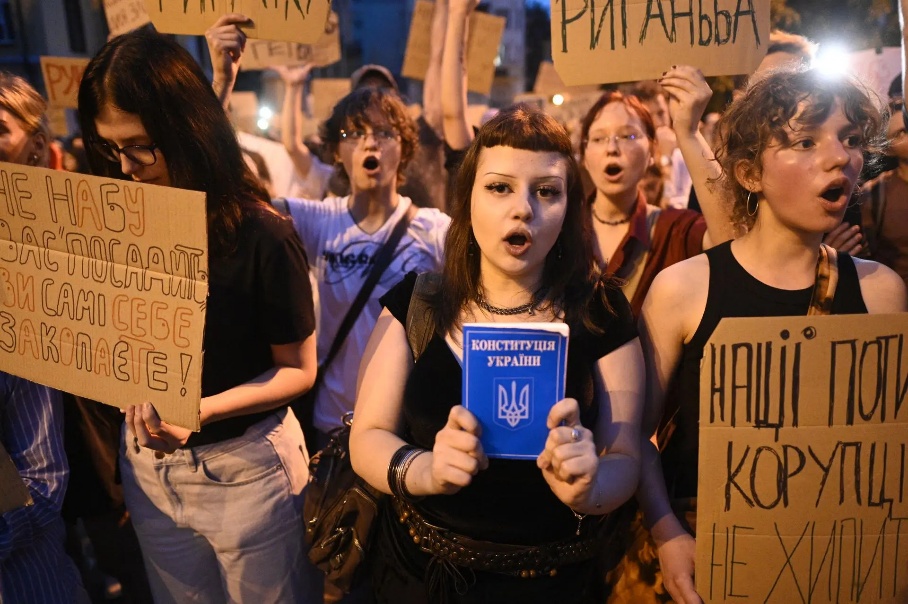
Protesters gather in response to a bill passed in Ukraine’s parliament — and later signed into law by President Volodymyr Zelensky — that strips independence from anti-corruption bodies, in Kyiv, Ukraine. (Danylo Antoniuk/The Kyiv Independent)
The Coup in Parliament: 263 Votes to Kill Reform
In a legislative blitz that lasted mere hours, Ukraine’s parliament passed and President Zelensky signed the most destructive anti-corruption legislation since Viktor Yanukovych’s era. The bill grants the prosecutor general—a presidential appointee—unprecedented authority to reassign NABU cases, issue binding instructions to investigators, and unilaterally close investigations targeting top officials.
The legislation moved with unprecedented speed: amendments were added to an unrelated bill, cleared by committee, passed by parliament, signed by Speaker Ruslan Stefanchuk, and enacted by Zelensky—all within a single day. Opposition lawmakers reported receiving the bill’s text just 15 minutes before the vote.
“What happened today in the parliamentary hall was shocking,” declared Inna Sovsun of the Holos party. “The draft law was pushed through despite clear procedural violations… It felt like a coven.”
NABU Chief Semen Kryvonos condemned the legislation as the “destruction of the independence” of anti-corruption institutions, while SAPO head Oleksandr Klymenko described it as “effectively the end of the work of two independent institutions.” Their desperate press conference pleas for a presidential veto went unanswered as Zelensky signed the law that evening.
Even some lawmakers from Zelensky’s own Servant of the People party expressed shock. One member, speaking anonymously, admitted: “Honestly, for me, it came as a shock. I was not informed. I was not in the loop before it happened. But I just hope the president knows what he’s doing.”
Streets Ablaze: First Mass Protests Since Invasion Begin
As news of the parliamentary vote spread, Ukrainians took to the streets in Kyiv, Lviv, Dnipro, and Odesa—marking the first major anti-government protests since Russia’s full-scale invasion began. Demonstrators carried signs reading “Get your hands off NABU and SAP,” “Veto the law,” and “No corruption in government.”

Ukrainians gathered in Lviv after lawmakers passed a bill that effectively destroys two of Ukraine’s main anti-corruption agencies. (Martin Fornusek / The Kyiv Independent)
War veteran Dmytro Koziatynskyi’s Facebook call for protests resonated across the country: “Take cardboard from boxes and make posters where you write everything you think about the recent onslaught.” The crowds included active-duty soldiers, veterans, and civilians who chanted “Power belongs to the people” and periodically sang the national anthem.
In Lviv, hundreds gathered around Taras Shevchenko’s statue on Svobody Avenue, raising signs urging the president to block the law. The protests continued even after news broke that Zelensky had signed the legislation, with both NABU and SAPO expressing gratitude for the demonstrators’ support.
“We were particularly impressed by the decisive stance of young people—the future of the country for which we work,” NABU declared in a social media post. “We will continue to work and defend the independence of our investigations from interference.”
European Shock: Brussels Condemns Democratic Backslide
European officials reacted with alarm to Ukraine’s institutional destruction. European Commissioner for Enlargement Marta Kos expressed “serious concern,” declaring: “The dismantling of key safeguards protecting NABU’s independence is a serious step back. Independent bodies like NABU and SAPO are essential for Ukraine’s EU path.”
EU Commission spokesperson Guillaume Mercier emphasized that “these institutions are crucial to Ukraine’s reform agenda and must operate independently to fight corruption and maintain public trust,” while noting that “Ukraine’s EU accession will require a strong capacity to combat corruption and to ensure institutional resilience.”
The timing proved particularly damaging as Ukraine’s newly appointed Prime Minister Yuliia Svyrydenko had just announced plans to seek additional IMF funding and expanded cooperation with U.S. Treasury Secretary Scott Bessent. Her Bloomberg interview, conducted hours before the parliamentary vote, highlighted Ukraine’s need for an additional $75 billion over two years—funding now threatened by the democratic backslide.
“If the baseline scenario assumes the war will continue into next year, it is very likely we will have need of a new IMF program,” Svyrydenko had told Bloomberg, unaware that her government was simultaneously destroying the anti-corruption benchmarks upon which such funding depends.
Washington’s Backing: State Department Supports Istanbul Talks
As Ukrainian democracy crumbled, the United States expressed backing for the third round of peace negotiations set to commence July 23 in Istanbul. State Department spokesperson Tammy Bruce confirmed Washington’s awareness of the upcoming talks, stating the U.S. “continues to encourage direct talks between Russia and Ukraine in pursuit of a comprehensive ceasefire and eventual negotiated peace settlement.”
Bruce referenced comments by U.S. Ambassador to NATO Matthew Whitaker, who attributed progress to “the leverage that the United States of America and President Trump continue to apply.” When questioned about Russian attacks just one week into Trump’s 50-day ultimatum, Bruce cautioned against “drawing premature conclusions,” noting that in diplomatic negotiations, “things can change rapidly.”
President Zelensky appointed National Security Council Secretary Rustem Umerov to lead Ukraine’s delegation, including representatives from military intelligence, the Foreign Ministry, and the Presidential Office. The agenda focuses on prisoner exchanges, returning abducted children, and preparing for a leaders’ summit.
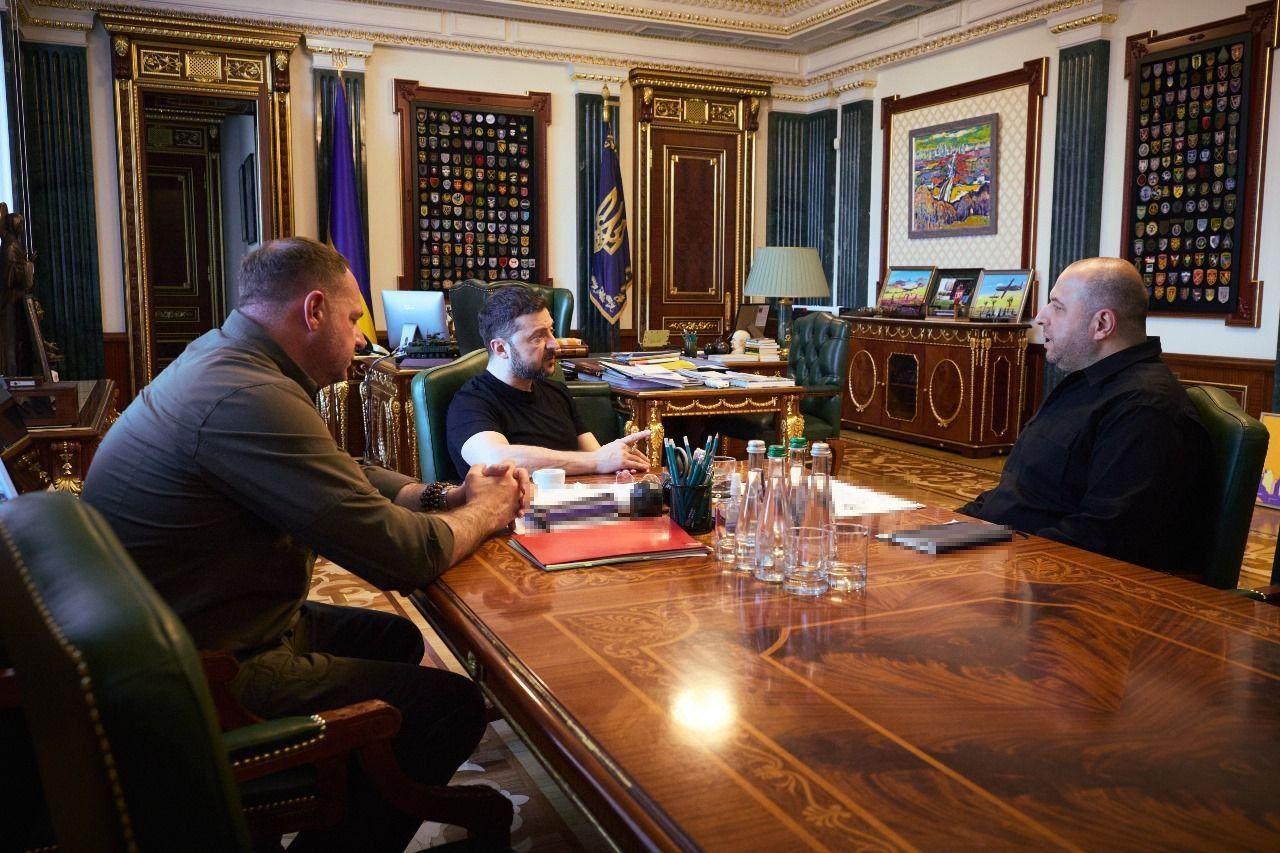
President Volodymyr Zelensky (center) meets with National Security and Defense Council Secretary Rustem Umerov (right) and head of the Presidential Office Andriy Yermak (left) in Kyiv, Ukraine. (Volodymyr Zelensky / Telegram)
“We expect several rounds of exchanges to be carried out in accordance with the agreements reached at the second meeting in Istanbul,” Zelensky declared, signaling concrete progress on humanitarian issues despite broader diplomatic stalemate.
Pokrovsk Penetrated: Russian Saboteurs Breach Strategic City
As political crisis engulfed Kyiv, military disaster struck in Donetsk Oblast where Russian sabotage groups successfully penetrated the strategic city of Pokrovsk. DeepState battlefield monitors reported that Russian forces exploited weakened Ukrainian infantry positions to infiltrate the city from the direction of Zvirove.
“Russian units attempted to entrench themselves and gain control over Defenders of Ukraine Street,” DeepState reported. “Some of them have been killed, others are still being hunted. The search and destruction of these groups is still ongoing.”
A Ukrainian drone team member, speaking anonymously, confirmed Russian soldiers had reached city limits though it remained unclear whether they had successfully established positions. The breach prompted urgent Ukrainian response operations, with reports of friendly fire incidents due to unclear intelligence on Russian movements.
Geolocated footage published July 21 showed Russian forces engaging Ukrainian troops along the E50 Pokrovsk-Pavlohrad highway, while Ukrainian military intelligence sources confirmed sabotage groups had advanced through Zvirove “a couple days ago.” Commander-in-Chief Oleksandr Syrskyi had reported July 18 that Ukrainian forces repelled a Russian reconnaissance group attempting to penetrate Pokrovsk.
The city’s fall would represent a major strategic victory for Moscow, potentially opening pathways deeper into Donetsk Oblast and threatening neighboring Dnipropetrovsk Oblast.
Moscow’s Child Soldiers: Teenagers Build Terror Weapons
Disturbing revelations emerged of Russia’s systematic recruitment of children into military drone programs through video games and educational incentives. An investigation by Russian outlet The Insider revealed how Moscow uses the Berloga video game—personally approved by Vladimir Putin—to identify and recruit talented students for defense projects.
The game offers up to 10 bonus points on Russia’s national exams to top players, who are then invited to higher-level competitions where they work directly with defense contractors. Students reported being trained to obscure military purposes by inventing civilian applications when presenting projects to judges.
“When we were defending our project in the final, we were forbidden to say that it was needed for the war,” one student revealed. “A project must always have a dual purpose, especially when you’re a school student.” One 13-year-old reportedly trained Russian soldiers in drone operation at a state facility.
The program connects to Russia’s broader militarization campaign, including the Alabuga industrial complex in Tatarstan where teenagers as young as 15 assemble Geran-2 strike drones used against Ukrainian cities. With Russia launching over 5,300 Shahed drones in June alone, these child-built weapons represent a growing threat to Ukrainian civilians.
German Major General Christian Freuding has warned that Russia aims to eventually launch 2,000 drones nightly—a capability increasingly dependent on youth recruitment and production.
Battlefield Updates: Russian Advances Continue Despite Talks
Despite diplomatic momentum, Russian forces pressed advantages across multiple fronts. In the Lyman direction, geolocated footage confirmed Russian seizure of Lypove north of Lyman and advances into eastern Torske. Ukrainian forces documented a shocking war crime as Russian troops shot and killed a civilian cyclist in Torske, with the 63rd Mechanized Brigade subsequently eliminating the three perpetrators.
In the Chasiv Yar direction, Russian forces seized southwestern Bila Hora, with elements of the 77th Motorized Rifle Regiment raising flags in the captured settlement. The Toretsk direction saw Ukrainian forces advance northwest of Dyliivka while Russian troops captured northern Popiv Yar and pushed into southern Poltavka.
Russian forces recently advanced in northern Sumy Oblast, with geolocated footage indicating seizure of southeastern Varachyne by elements of the 83rd Airborne Brigade. The advance demonstrates Moscow’s continued pressure along Ukraine’s northern border despite diplomatic overtures.
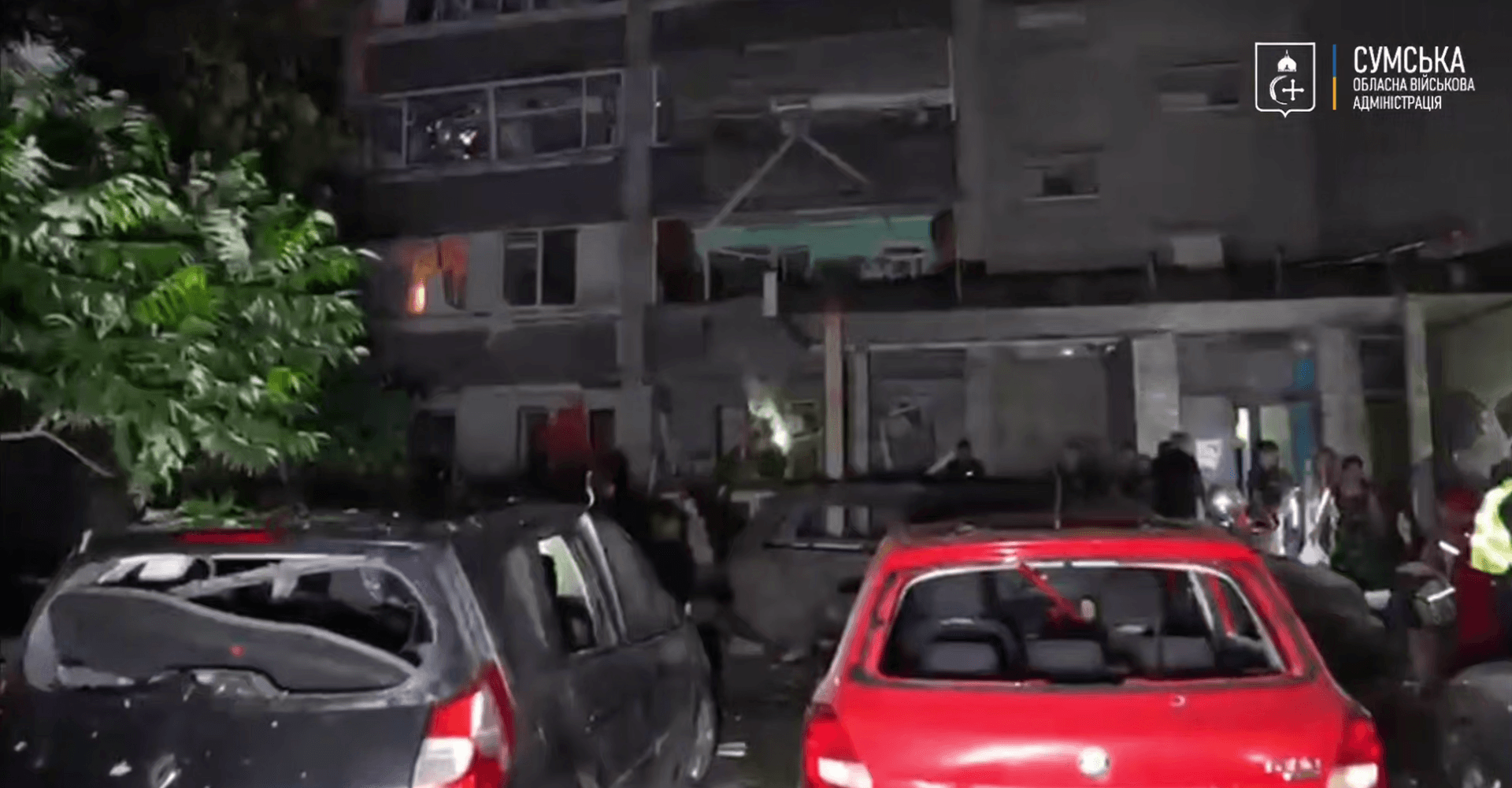
Aftermath of the Russian drone strike on Sumy Oblast. (Telegram)
In Zaporizhia Oblast, Russian forces advanced in northeastern Mala Tokmachka southeast of Orikhiv, with claims they seized the local brick factory through platoon-sized mechanized assaults.
Industrial Espionage: Ukraine Strikes Russian Defense Plants
Ukrainian forces conducted successful strikes against Russian military-industrial targets, with National Security Council official Andrii Kovalenko confirming attacks on the Novokuybyshevsk Petrochemical Company in Samara Oblast. The facility produces raw materials for explosives used in artillery shells, aerial bombs, and rockets—processing approximately one million tons annually.
Russia’s Defense Ministry claimed its air defenses intercepted 35 Ukrainian drones across various regions, including areas near Moscow. This marked the sixth consecutive night of drone attacks on the Russian capital, demonstrating Ukraine’s expanding strike capabilities despite defensive pressures.
The successful targeting of defense industrial facilities 500 kilometers from the border highlights Ukraine’s strategic shift toward degrading Russia’s production capabilities rather than purely tactical battlefield targets.
Vatican Diplomacy: Pope Leo to Meet Russian Church Officials
Pope Leo XIV will meet with Metropolitan Anthony of Volokolamsk, head of external relations for the Russian Orthodox Church, on July 26—his first audience with senior Russian clergy since ascending to the papacy. The meeting signals Vatican efforts to reopen communication channels with Moscow’s religious leadership following strained ties caused by Russia’s invasion.
The Russian Orthodox Church remains closely tied to the Russian government, with Patriarch Kirill repeatedly voicing support for Russia’s war. During a June 4 call between Pope Leo and Putin, the Kremlin urged Vatican support for the Moscow-linked Ukrainian Orthodox Church, which Kyiv has banned for continued Russian ties.
The upcoming audience comes weeks after Pope Leo met President Zelensky at Castel Gandolfo, where they discussed “the urgent need for a just and lasting peace.” The pope has reiterated offers to host Russian and Ukrainian officials for talks, though Moscow has dismissed the Vatican as a potential venue.
China in the Crosshairs: Washington Warns Beijing
U.S. Ambassador to NATO Matthew Whitaker warned that China may face consequences for supporting Russia’s war if Moscow rejects peace settlements. “I think they need to be called out for their subsidizing this killing that is happening on the battlefields in Ukraine,” Whitaker told Fox Business.
“China thinks they’re fighting a proxy war through Russia. They want to keep the U.S. and our allies occupied with this war, so that we can’t focus on our other strategic challenges,” he continued, emphasizing that secondary sanctions would significantly impact countries buying Russian oil, including China, India, and Brazil.
China remains Russia’s top crude oil buyer and major supplier of dual-use goods for Russia’s defense sector. Reports indicate Chinese Foreign Minister Wang Yi told EU officials that Beijing “cannot afford” for Russia to lose the war in Ukraine, demonstrating the depth of Sino-Russian cooperation.
Military Intelligence: Russia’s Trillion-Dollar War Machine
Ukrainian intelligence chief Kyrylo Budanov revealed that Russia plans to spend $1.1 trillion on rearmament over the next 11 years in preparation for potential large-scale war with NATO. “There is a total mobilization of politics, economy, and society of the Russian Federation to be ready for the upcoming large-scale war,” Budanov declared.
Russia has created new Moscow and Leningrad military districts while preparing additional divisions and military units. The goal extends beyond regional domination to reshaping the global order, with Moscow building proxy forces in Africa and conducting hybrid operations including cyberattacks and disinformation campaigns.
Russia’s 2024 defense spending surged 42% to $462 billion, surpassing Europe’s collective defense expenditure of $457 billion. Budanov’s revelations align with German intelligence assessments that Russia will have capabilities to attack NATO by 2030.
Tragic Loss: Mirage Fighter Crashes in Ukraine
Ukraine suffered the loss of a French-made Mirage 2000 fighter jet when technical failure forced the pilot to eject over Ukrainian territory. The Air Force reported the pilot acted competently, following emergency protocols and safely ejecting with no ground casualties reported.
“Unfortunately, we lost our combat aircraft. A French machine, very effective, one of our Mirage jets. The pilot managed to escape, and it was not shot down by the Russians,” President Zelensky confirmed in his evening address.
The Mirage 2000s, pledged by France in June 2024, arrived in February 2025 and began repelling Russian aerial attacks in March. These fourth-generation supersonic fighters have proven effective at intercepting cruise missiles and Shahed-type drones due to their rapid deployment capabilities compared to F-16s.
Daily Devastation: Russian Strikes Kill Three, Injure Dozens
Russian attacks across Ukraine killed at least three civilians and injured 45 others over the 24-hour period, with children among the casualties. In Donetsk Oblast, a guided bomb strike on a residential building in Kramatorsk killed a child and injured eight people total, bringing the oblast’s daily injury toll to 17.
Sumy Oblast bore heavy bombardment with nearly 70 attacks on 32 settlements, injuring 15 civilians including two children. Eleven people were wounded in the Putyvl community during a drone strike, while four others suffered injuries from a guided bomb attack on Sumy city. The attacks damaged houses, apartment buildings, vehicles, and a shopping center.
Kherson Oblast recorded seven injuries amid heavy drone and artillery attacks on residential neighborhoods, with multiple houses, vehicles, and a theater sustaining damage. Kharkiv Oblast saw three people injured, including victims in Kupiansk and Ivano-Shyichyne, plus a person wounded by an explosive device in Verbivka.
Russian forces launched 42 Shahed-type drones overnight, primarily from Russia and occupied Crimea, with 26 shot down and seven more suppressed by electronic warfare systems. The strikes damaged civilian infrastructure in Kharkiv and Odesa oblasts, demonstrating Moscow’s continued campaign against non-military targets.

A war crimes prosecutor documents the aftermath of a Russian drone attack in Odesa, Ukraine. (Odesa Regional Prosecutor’s Office / Telegram)
Moscow’s Purge: Regional Officials Detained for Border Failures
Russian authorities detained Bryansk Oblast Vice Governor Nikolai Simonenko on abuse of power charges related to embezzlement of funds allocated for defensive fortifications along border areas. The arrest follows a similar detention of former Belgorod Oblast Vice Governor Rustem Zainullin in June for allegedly embezzling 32 million rubles ($408,000) in border fortification funds.
The detentions represent Moscow’s continued scapegoating of local officials for larger border security failures following Ukraine’s August 2024 Kursk Oblast incursion. Russian authorities previously detained former Kursk Oblast Governor Alexei Smirnov on similar charges, while Putin dismissed Transport Minister Roman Starovoit just prior to his reported suicide.
Russian law enforcement also targeted the Telegram channel Baza, conducting raids against offices and detaining editor-in-chief Gleb Trifonov and colleagues on bribery suspicions. Baza had published transcripts of conversations during December 2024’s downing of an Azerbaijan Airlines plane, revealing Russian authorities’ refusal to allow emergency landing despite crew requests.
The crackdown represents broader Kremlin efforts to censor critical Telegram channels, using police misconduct investigations as pretexts for punishing outlets that increase tensions with Azerbaijan and expose Russian military failures.
Naftogaz CEO Serhiy Koretsky confirmed that Russia renewed attacks on Ukraine’s gas infrastructure after a relative lull since the March energy ceasefire. Russian forces launched “dozens” of drones against gas production facilities, causing “destruction” overnight.
“Such attacks occur regularly. These objects have no military significance. This is exclusively an act of terrorism, with which the enemy seeks to intimidate Ukrainians and break our will,” Koretsky declared. The attacks aim to deprive Ukrainians of heating in the upcoming winter season.
Energy Under Attack: Gas Infrastructure Targeted Again
Naftogaz CEO Serhiy Koretsky confirmed that Russia renewed attacks on Ukraine’s gas infrastructure after a relative lull since the March energy ceasefire. Russian forces launched “dozens” of drones against gas production facilities, causing “destruction” overnight.
“Such attacks occur regularly. These objects have no military significance. This is exclusively an act of terrorism, with which the enemy seeks to intimidate Ukrainians and break our will,” Koretsky declared. The attacks aim to deprive Ukrainians of heating in the upcoming winter season.
Russian strikes have allegedly deprived Ukraine of 50% of its domestic gas production, forcing increased imports from Europe for the heating season. Ukraine has since restored half its production capacity while securing 440 million cubic meters of LNG from the U.S. through Polish company ORLEN.
Dutch Commitment: Patriots and F-16 Support Pledged
The Netherlands pledged to “substantially contribute” to American Patriot air defense system deliveries to Ukraine, Dutch Defense Minister Ruben Brekelmans announced during the Ramstein Contact Group meeting. The country will also provide F-16 munitions, counter-drone technology, and radar systems from its own stockpiles.
“The Russian airborne terror campaign has reached new lows daily. The Russian goal is simple: to bring the steadfast Ukrainians to their knees. We cannot allow this to happen,” Brekelmans declared, emphasizing that Ukraine protects all of Europe from Russian aggression.
The Dutch commitment supplements Germany and America’s agreement to provide five Patriot systems, as Ukraine faces intensifying aerial bombardment from Russian forces launching hundreds of drones and missiles weekly. The Netherlands previously supplied Ukraine with 24 F-16 fighters and various air defense equipment.
Mortality and Leadership: Russian Judge Dies, Moldovan Opposition Unites
Russian Supreme Court Chair Irina Podnosova died in Moscow at age 71 after battling cancer for over a year. Appointed by Putin in April 2024 as the only candidate, Podnosova had led Russia’s chief judiciary body since the death of her predecessor Vyacheslav Lebedev, who served since 1991.
Human rights experts note that Russia’s judicial system remains tightly controlled by the government, often used to repress political opponents. Podnosova’s death creates leadership uncertainty within Russia’s court system during wartime.
In Moldova, four left-wing and center-left parties announced formation of a pro-Russian electoral bloc for September 28 parliamentary elections. The Socialist Party, Communist Party, Heart of Moldova, and Future of Moldova parties will jointly contest elections as pro-Western President Maia Sandu seeks to preserve her parliamentary majority.
Former president Igor Dodon declared the consolidation fulfills wishes “many have been waiting for over the years.” Moldova gained EU candidate status in 2022, with Sandu’s government aiming for full membership by 2030 despite Russian pressure through the occupied Transnistria region.
Looking Ahead: The Point of No Return
As July 22 ends, Ukraine faces its darkest democratic moment since independence. The destruction of anti-corruption institutions represents more than legislative maneuvering—it signals a fundamental shift toward authoritarianism that mirrors the very system Ukrainians died fighting against in 2014.
The convergence of institutional collapse, battlefield setbacks, and diplomatic uncertainty creates unprecedented challenges. Tomorrow’s Istanbul talks offer potential humanitarian progress through prisoner exchanges, but cannot address the deeper crisis of democratic legitimacy now consuming Ukraine from within.
European partners face a stark choice: condition continued support on democratic restoration or watch their investments in Ukrainian reform evaporate. As protesters declared in Kyiv’s streets, “Power belongs to the people”—but whether that principle survives Ukraine’s current crisis remains the defining question of this war’s next phase.