
As Ukrainian and Russian delegations meet for the third time in Istanbul, Zelensky’s controversial anti-corruption law sparks nationwide protests and threatens EU membership aspirations while battlefield exchanges continue across multiple fronts
Summary of the Day – July 23, 2025
Ukraine found itself at a critical juncture on July 23, caught between the promise of peace negotiations and the peril of democratic backsliding. While Ukrainian and Russian delegations conducted their third round of talks in Istanbul—lasting less than an hour but producing agreements on prisoner exchanges—domestic turmoil erupted over President Volodymyr Zelensky’s decision to sign legislation that effectively dismantles the independence of Ukraine’s premier anti-corruption institutions. The law triggered nationwide protests and sharp criticism from European partners, threatening Ukraine’s EU accession prospects even as the country continues to defend itself on multiple fronts where Russian forces maintain pressure despite suffering significant casualties.
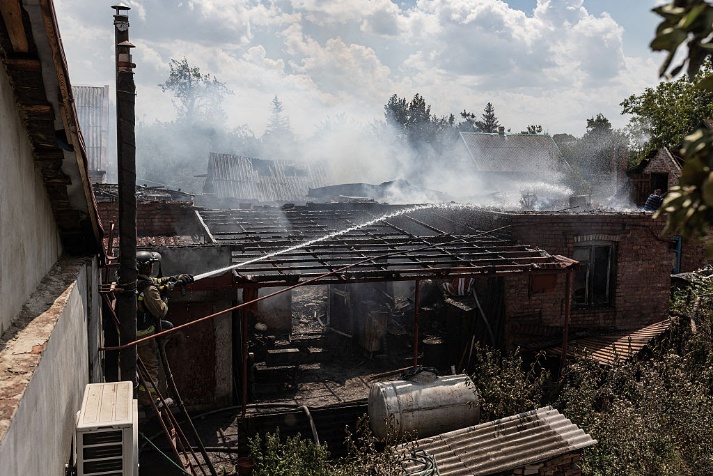
Ukrainian emergency service workers extinguish a fire in a house after a Russian shelling with a FPV drone, in the city of Kostiantynivka, Ukraine. (Diego Herrera Carcedo/Anadolu via Getty Images)
The Istanbul Gambit: An Hour of Diplomacy, Years of Division
Ukrainian and Russian delegations sat across from each other in Istanbul for less than an hour on July 23, their third meeting in a series that began in May. National Security and Defense Council Secretary Rustem Umerov led the Ukrainian delegation alongside Presidential Office head Andriy Yermak, First Deputy Foreign Minister Sergiy Kyslytsya, and deputy military intelligence chief Vadym Skybytskyi, proposing a summit between Zelensky and Putin before the end of August.
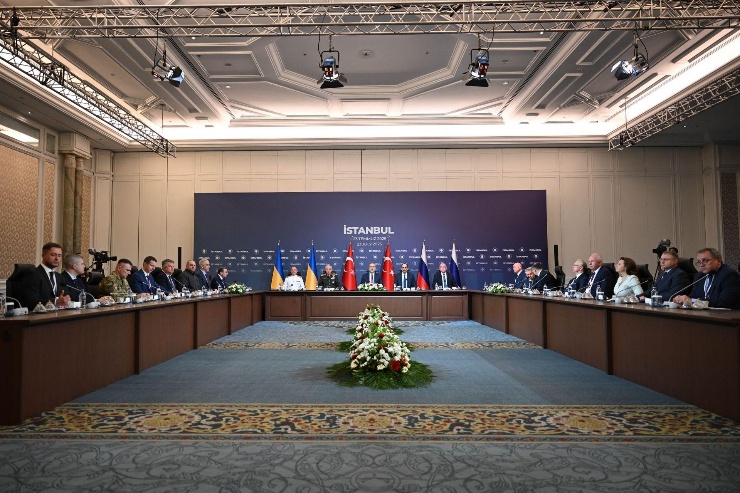
Turkish Foreign Minister Hakan Fidan chairs the third round of renewed Russia-Ukraine talks in Istanbul. (Muhammed Abdullah Kurtar / Anadolu via Getty Images)
Before the main talks, Umerov’s team met with Turkish President Recep Tayyip Erdogan in Ankara. The Ukrainian team stated their priorities: “People, ceasefire and meeting of leaders,” as Umerov said. Ukraine pushed for a comprehensive ceasefire, an end to strikes on civilian infrastructure, and “silence” along the entire front line.
Vladimir Medinsky, Putin’s aide who has led all three Russian delegations, proposed three working groups to meet online and address political, military, and humanitarian issues separately. Russia suggested brief 24-48 hour ceasefires to retrieve wounded soldiers and bodies of the fallen. They offered to hand over remains of 3,000 Ukrainian soldiers via the Red Cross, while claiming around 30 Russian civilians from Kursk Oblast remain unaccounted for in Ukrainian territory.
The talks produced an agreement to conduct a humanitarian exchange involving more than 1,200 people, building on eight previous prisoner swaps conducted since the May negotiations began. The most recent exchange on July 4 returned over 100 Ukrainians, including injured service members and civilians under 25.
The Children’s Shadow: Moscow’s Claims About Ukrainian Children
The most contentious moment in the talks came when Medinsky addressed the issue of Ukrainian children forcibly taken to Russia. He claimed Russian authorities had completed work on the list of Ukrainian children submitted during previous negotiations, stating these children were “under state supervision, well provided for, and safe in appropriate childcare institutions.”
Ukraine has documented over 19,000 cases of child deportation, with international courts calling it a war crime. As Yermak noted afterward, “It is clear that Russia is still not ready to end the war—but there is still time to reconsider and put an end to this madness.”
The Price of Victory: 80,000 Russians and the Kursk Calculation
Commander-in-Chief Oleksandr Syrskyi revealed the staggering human cost of Russia’s attempts to reclaim territory in Kursk Oblast: 80,000 Russian soldiers killed and wounded. The figure, shared in an interview with the Washington Post on his 60th birthday, represented the bloodiest single chapter in Moscow’s campaign to reverse Ukraine’s August 2024 cross-border incursion.
The 60-year-old general, who masterminded the original Kursk operation, defended the strategic gamble that initially seized 1,300 square kilometers of Russian territory. The operation was designed to divert Russian forces from eastern Ukraine and disrupt Moscow’s plans to invade Sumy Oblast. While Russia has reclaimed most of the territory—aided by 12,000 North Korean troops—the cost has been extraordinary.
“We have highly motivated and courageous soldiers who can advance,” Syrskyi told the Washington Post, “but they need modern, reliable means of protection.” The comment encapsulated Ukraine’s broader challenge: tactical success undermined by resource constraints and the grinding arithmetic of attrition warfare.
Democracy’s Darkest Hour: The Anti-Corruption Betrayal
Even as Ukrainian soldiers died defending democracy on the battlefield, their president struck a blow against it at home. The controversial law Zelensky signed on July 22—granting sweeping new powers to the prosecutor general over the National Anti-Corruption Bureau (NABU) and the Specialized Anti-Corruption Prosecutor’s Office (SAPO)—triggered the first nationwide protests since Russia’s full-scale invasion began.

Ukraine has brought home another group of soldiers released from Russian captivity. (Volodymyr Zelensky / Telegram)
The legislation effectively reclassifies NABU and SAPO as ordinary law enforcement agencies, stripping away the independence that allowed them to pursue high-level corruption cases without political interference. The prosecutor general can now issue binding instructions to NABU, reassign cases outside the agency, and delegate SAPO’s authority to other prosecutors.
Critics called it the “destruction of NABU and SAPO’s independence.” The timing was particularly damaging: the bill moved through committee and the legislature within hours, was signed by Parliament Speaker Ruslan Stefanchuk immediately, and received Zelensky’s signature the same day protests were underway.
The Streets Speak Truth: Protesters Defend What Politicians Abandon
Thousands of Ukrainians took to the streets in Kyiv, Lviv, Dnipro, and Odesa on July 22, carrying flags and handmade signs with messages like “Get your hands off NABU and SAP,” “Veto the law,” and “No corruption in government.” The atmosphere was spirited and defiant, with chants of “Power belongs to the people” echoing through city centers.
War veteran Dmytro Koziatynskyi helped mobilize the protests, urging citizens on Facebook to “Take cardboard from boxes and make posters where you write everything you think about the recent onslaught.” The response was swift and widespread, demonstrating that Ukraine’s civil society remains vibrant despite three years of war.
In Lviv, several hundred people gathered around a statue of Taras Shevchenko, Ukraine’s national poet, chanting “Shame!” and “Corruption is the death of the future.” The symbolism was powerful: citizens defending democratic values beneath the monument to a man who championed Ukrainian freedom and dignity.
Both NABU and SAPO expressed gratitude for the demonstrations. “We perceive this support as a sign of trust in our institution,” NABU stated, while SAPO thanked protesters for their “decisive stance” and vowed to “continue to fight for justice, integrity, and dignity.”
Europe’s Warning: Brussels Draws the Red Line
The European Union’s response was swift and unforgiving. European Commission President Ursula von der Leyen personally contacted Zelensky to express “strong concerns” over the legislation, demanding an explanation for the move that could derail Ukraine’s EU membership aspirations.
European Commissioner for Enlargement Marta Kos had tried to prevent the law’s passage, warning deputy prime minister Taras Kachka that it would violate commitments tied to Ukraine’s candidate status. “The dismantling of key safeguards protecting NABU’s independence is a serious step back,” Kos declared publicly.
German Foreign Minister Johann Wadephul stated bluntly: “Limiting the independence of Ukraine’s anti-corruption agency hampers Ukraine’s way towards the EU.” Czech Foreign Minister Jan Lipavsky reminded Ukrainian leadership that “support has never been and will not be a blank check.”
According to European Pravda, the EU had planned to use a technical loophole to circumvent Hungary’s veto and start accession talks on July 18—a plan that stalled partly due to concerns about Ukraine’s commitment to anti-corruption reforms. Some European officials now worry that EU accession is no longer a priority for Kyiv.
The Corruption Connection: Parliamentary Vote on Anti-Corruption Law
According to public records, 31 sitting or former members of parliament are suspected of corruption by NABU. Of those lawmakers named in corruption probes, 18 voted in favor of the law dismantling the bureau’s independence, two abstained, and five were absent.
Fifteen of the 31 suspects belong to Zelensky’s Servant of the People party. Opposition lawmaker Yaroslav Zhelezniak of the Holos party began collecting signatures to challenge the law in the Constitutional Court, stating that parliamentary procedures were violated during its passage.
The Prisoner’s Return: Hope Amid the Darkness
Even as democracy faced assault at home, Ukraine achieved a humanitarian victory through the continuation of prisoner exchanges negotiated in the Istanbul talks. The ninth phase of exchanges brought home another group of Ukrainian soldiers, with Zelensky announcing that more than 1,000 people had been freed through all iterations of the recent Istanbul agreements—a figure representing profound relief for families across the country.
Among the released were critically ill and severely wounded defenders, some captured during the defense of Mariupol and held for over three years in Russian captivity. The group included the last remaining defender of Zmiinyi (Snake) Island, a Border Guard Service member whose liberation carried deep symbolic weight as the island became synonymous with Ukrainian resistance early in the war.
The ages of freed soldiers ranged from 27 to 66, representing veterans from every major front in the conflict: Donetsk, Zaporizhzhia, Luhansk, Kherson, Kharkiv, Sumy, and Chernihiv directions. Many had been seriously wounded or prosecuted by Russia for crimes they did not commit, according to Zelensky.
Since the beginning of the full-scale war, 3,956 Ukrainians have returned from Russian captivity, with 1,358 released in 2025 alone. For a thousand families, as Zelensky noted, this represented “a profound opportunity to embrace their loved ones once more.”
American Aid in a New Era: Bradley Vehicles and Congressional Approval
The Trump administration allocated its first security assistance for fiscal year 2025 to Ukraine: $9 million from the Security Assistance Initiative to BAE Systems for refurbishing Bradley fighting vehicles. The allocation represents the administration’s first new military aid commitment beyond inherited Biden-era programs.
The U.S. State Department simultaneously approved two major military packages: a $172 million Foreign Military Sale for Ukraine’s HAWK Phase III missile system sustainment, including refurbishment of air defense fire units, spare parts, tool kits, test equipment, and technical support from RTX Corporation, Sielman Corporation, and PROJECTXYZ. An additional $150 million package covered Bradley infantry fighting vehicles and their maintenance, repair, and overhaul capabilities.
Congressional discussions suggest an additional $400 million to $500 million for USAI in the fiscal year 2026 base budget. Trump announced a new NATO aid mechanism following an Oval Office meeting with Secretary General Mark Rutte, whereby NATO allies will finance purchases of U.S.-built Patriots and other weapons, with European countries bearing costs while American contractors backfill alliance stockpiles.
The Technology War: Chinese Engines, Russian Lies
Intelligence reports revealed how Beijing continues to circumvent Western sanctions by shipping Chinese-made drone engines to Russian manufacturers, labeling them as “industrial refrigeration units” to avoid detection. The deception has enabled Russia’s IEMZ Kupol to boost production of Garpiya-A1 attack drones from 2,000 in 2024 to over 6,000 planned for 2025.
European security officials and documents reviewed by Reuters showed the intricate supply chain: Beijing Xichao International Technology and Trade supplies L550E engines produced by Xiamen Limbach Aviation Engine Co. to Russian front companies, which then forward them to weapons manufacturers. The engines travel from Beijing to Moscow to Izhevsk, where Kupol operates its facilities.
The Garpiya drone, meaning “harpy” in Russian, incorporates Chinese technology including engines, control systems, and navigation equipment. Russia deploys approximately 500 units monthly against Ukrainian civilian and military targets, making this supply chain a critical vulnerability in Ukraine’s air defense challenge.
The timing was particularly significant as China’s commerce minister lodged “solemn representations” with his EU counterpart over two Chinese banks’ inclusion in the bloc’s latest sanctions package on Russia. The protest came as EU leaders Antonio Costa and Ursula von der Leyen prepared for talks with Chinese President Xi Jinping and Premier Li Qiang on July 24, highlighting Beijing’s growing irritation with Western efforts to curb its support for Moscow’s war machine.
Russian Information Warfare: Weaponizing Ukrainian Democracy
As Ukrainians took to the streets to defend their anti-corruption institutions, Russia seized the moment to advance its long-standing narrative campaign designed to undermine Ukraine’s legitimacy and discourage Western support. Kremlin officials, propagandists, and mouthpieces weaponized the domestic protests to portray the Ukrainian government as corrupt and illegitimate.
Kremlin Spokesperson Dmitry Peskov claimed Ukrainian authorities had stolen significant amounts of money from the United States and European Union. Russian State Duma deputies spoke to state media outlets, falsely claiming that Ukrainians protesting the law were actually protesting against the war itself, against Zelensky, and against the government broadly.
The central Russian narrative—that Ukrainian officials embezzle Western military assistance—deliberately ignores the reality that very little of Western funds allocated to Ukraine are actually spent by Ukraine itself. The vast majority of U.S. funds are spent within the United States, while much European assistance funds training and intelligence support for NATO and Ukraine.
These Russian claims aim to exploit ongoing policy discussions and deter additional Western aid, fitting Putin’s articulated theory of victory that relies on outlasting Western assistance while making incremental battlefield gains.
The Fencing Triumph: Excellence Amid Adversity
Even as political turmoil gripped the nation, Ukrainian excellence shone through in international competition. Vlada Kharkova won individual gold at the Fencing World Championship in Tbilisi, Georgia, defeating Estonia’s Katrina Lehis 15:14 on priority in women’s individual epee.

Vlada Kharkova of Ukraine reacts after her victory against Katrina Lehis of Estonia in the Women’s Epee final match during the FIE Fencing World Championships, in Tbilisi, Georgia. (Levan Verdzeuli/Getty Images)
Kharkova, who belongs to the Central Sports Club of Ukraine’s Armed Forces, had previously earned team gold at the European Championship in June 2025 and individual gold in 2022. Her victory marked Ukraine’s second gold medal in women’s individual epee at the World Championship, a reminder that Ukrainian talent continues to flourish despite the war’s devastation.
The triumph came at a moment when Ukraine desperately needed positive news, offering a brief respite from the political crisis engulfing Kyiv and serving as a symbol of Ukrainian resilience and determination.
Energy Security in Winter’s Shadow: The Gas Gambit
Ukraine’s preparation for the upcoming heating season took on new urgency as Naftogaz borrowed Hr.4.7 billion ($113 million) from PrivatBank, the largest loan by Ukraine’s biggest bank since its 2018 nationalization. The loan will help accumulate necessary gas reserves in underground storage facilities for the 2025-2026 heating season.
The borrowing reflected Russia’s systematic attacks on Ukraine’s gas production infrastructure, posing serious concerns about winter energy security. Naftogaz CEO Sergii Koretskyi expressed gratitude to PrivatBank management for their “quick response” while continuing work with international financial institutions and partner countries.
Ukraine has secured 140 million cubic meters of liquefied natural gas from the United States, transported by Polish company ORLEN, bringing total shipped LNG to 440 million cubic meters ahead of the heating season. The European Bank for Reconstruction and Development provided an additional €270 million loan for emergency gas purchases, with €138.6 million funded as a grant from the Norwegian government.
The Trans-Balkan gas transportation route through Bulgaria, Romania, and Moldova promises an alternative supply path, while Ukraine needs to accumulate at least 13 billion cubic meters by November 1, with just over 9 billion stored as of mid-July.
Legal Victories and Defeats: The Gazprom Decision
In a setback for Ukrainian efforts to seek compensation through international courts, a Dutch court overturned seizure orders on Russian energy giant Gazprom’s local assets. The ruling, involving lawsuits filed by Ukrainian agricultural companies Slavutich-Invest and Zhniva, cited the principle of state immunity—that foreign states cannot be taken to court without consent.
The September 2024 seizure had frozen Gazprom’s shares in Dutch gas producers Wintershall Noordzee and Gazprom International Projects B.V., initially valued at 344 million euros for a 50% stake and subsidiary shares. The court’s decision highlighted the complex legal challenges Ukraine faces in seeking compensation for war damages through foreign judicial systems.
Digital Warfare: The Kyiv Independent Under Siege
The Kyiv Independent faced a coordinated distributed denial-of-service attack reaching over 10,000 requests per second, coinciding with its coverage of the controversial anti-corruption law. The attack targeted key website functions including member login, contact forms, and newsletter integrations, utilizing randomized headers and user agents to evade security measures.
While the public-facing content remained largely accessible due to Content Delivery Network protections, the timing was telling—occurring as the publication released critical editorial coverage of Zelensky’s assault on democratic institutions. No user data was compromised, but the attack represented another front in the information war surrounding Ukraine’s democratic future.
Battlefield Arithmetic: Advances and Attrition Across Multiple Fronts
Military operations continued across multiple sectors, with Russian forces maintaining pressure despite heavy casualties. In northern Sumy Oblast, Russian forces advanced in central Kindrativka north of Sumy City, while conflicting reports emerged about control of Varachyne, with some Russian sources claiming seizure and others insisting fighting continues.
North Korean reinforcements arrived to bolster Russian operations, with roughly a battalion’s worth of troops reaching Rylsk in Kursk Oblast. A Russian milblogger reported these forces would initially relieve Russian units rather than participate directly in combat, allowing redeployed forces to join frontline operations.
Ukrainian forces achieved tactical success in the Chasiv Yar direction, with geolocated footage showing advances along Zlahody Street in southwestern Chasiv Yar. The commander of a Ukrainian fire support company noted Russian tactical adaptation: forces now conduct daytime assaults using increased summer foliage for concealment rather than limiting attacks to dawn and dusk periods of decreased visibility.
Russian forces advanced in western Zaporizhia Oblast, seizing central Plavni west of Orikhiv, while elements of the 247th Airborne Regiment established positions between Kamyanske and Stepnohirsk. The complex military picture reflected the war’s current phase: incremental gains and tactical adjustments rather than breakthrough operations.
Russia’s Security State Expansion: FSB Powers Grow
Putin signed a decree authorizing the Federal Security Service to create autonomous pre-trial detention facilities for individuals accused of crimes under FSB jurisdiction, effective January 1, 2026. The expansion aligns with the Kremlin’s broader strategy of diversifying its security apparatus to tighten control over the Russian populace.
The FSB’s new detention powers complement its existing responsibilities for border patrol and domestic law enforcement, potentially targeting Russian citizens attempting to evade military registration or desert from service. International observers have documented FSB use of existing detention facilities to abuse and torture Ukrainian prisoners of war and civilians, raising concerns that expanded powers will worsen systematic violations.
Belarus Integration Deepens: Cross-Border Voting Rights
Putin signed into law a protocol allowing Belarusian citizens permanently residing in Russia to vote and run in local Russian elections, with reciprocal rights for Russians in Belarus. The March 13 agreement, ratified by the Russian Federation Council on July 16, advances formal Russian-Belarusian integration through the Union State framework.
Belarusian President Alexander Lukashenko had codified similar provisions into Belarusian law in January 2025, reflecting deepening political coordination between Moscow and Minsk that extends beyond military cooperation to institutional merger.
The Drone War’s Toll: Infrastructure Under Siege
Russian forces launched 71 attack drones overnight from the directions of Kursk City, Millerovo in Rostov Oblast, Primorsko-Akhtarsk in Krasnodar Krai, and occupied Cape Chauda in Crimea, targeting energy infrastructure across Ukraine in attacks that left two civilians dead and 30 injured, including children. Air defenses shot down 27 drones while electronic warfare systems suppressed or intercepted 18 others. The remaining 26 drones struck 14 locations, with debris falling in 5 additional areas.
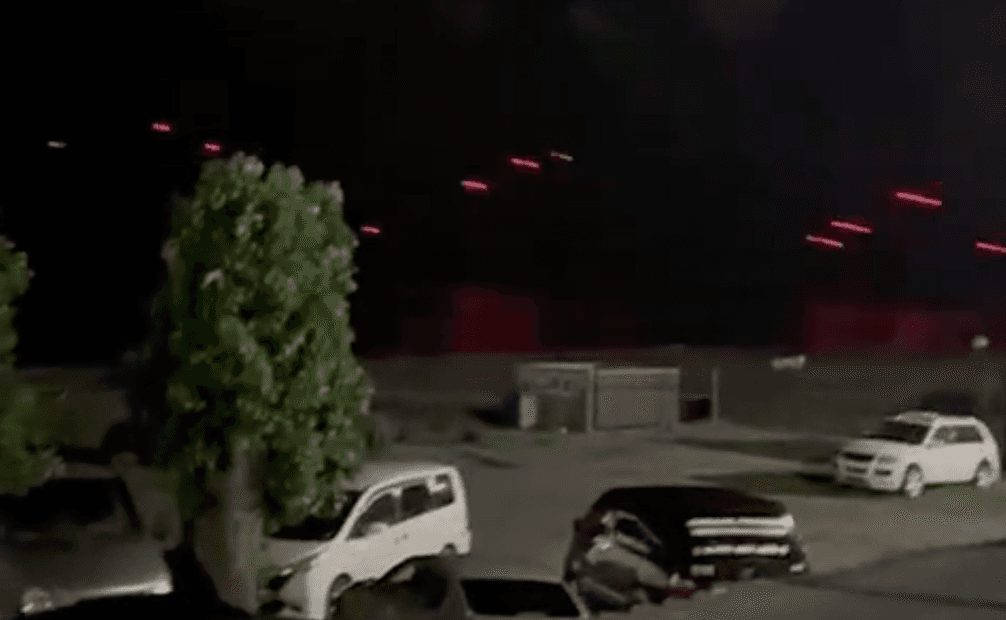
What appear to be Ukrainian drones and Russian air defense missiles in the Sirius Federal Territory of Russia’s Krasnodar Krai. (Screenshot/Astra/Telegram)
In Sumy Oblast, one person was killed and 12 others injured as widespread drone and artillery attacks targeted the Sumy, Mykolaivka, and Seredyna-Buda communities. The strikes damaged residential buildings, a school, a hospital, administrative offices, shops, and vehicles, leaving more than 220,000 customers without electricity—affecting “hundreds of thousands of Ukrainian families,” according to Zelensky.
Ukrainian Railways confirmed direct attacks on its energy infrastructure in Sumy and Poltava oblasts, with drones striking a hospital in Sumy Oblast and a railway power system in Dnipropetrovsk Oblast, causing a fire. When railway crews arrived to respond, Russian forces launched a second strike on the same location. Power was restored to most lines and train schedules maintained despite the targeted assault on transportation infrastructure.
In Kharkiv Oblast, five people were injured in drone and missile attacks on Kharkiv city, Izium, Kupiansk, and Velykyi Burluk, with explosions damaging houses, a post office, a medical base, commercial infrastructure including vehicles, and a warehouse.
Kherson Oblast suffered one death and nine injuries, including two children wounded by a drone strike in Zorivka village. Russian forces targeted over 30 settlements with drones and artillery, damaging residential buildings, apartment blocks, a car, and critical infrastructure. Donetsk Oblast recorded four injuries from shelling and drone attacks across the Kramatorsk, Pokrovsk, and Bakhmut districts, with strikes damaging dozens of houses, administrative buildings, vehicles, and utility lines in several communities.
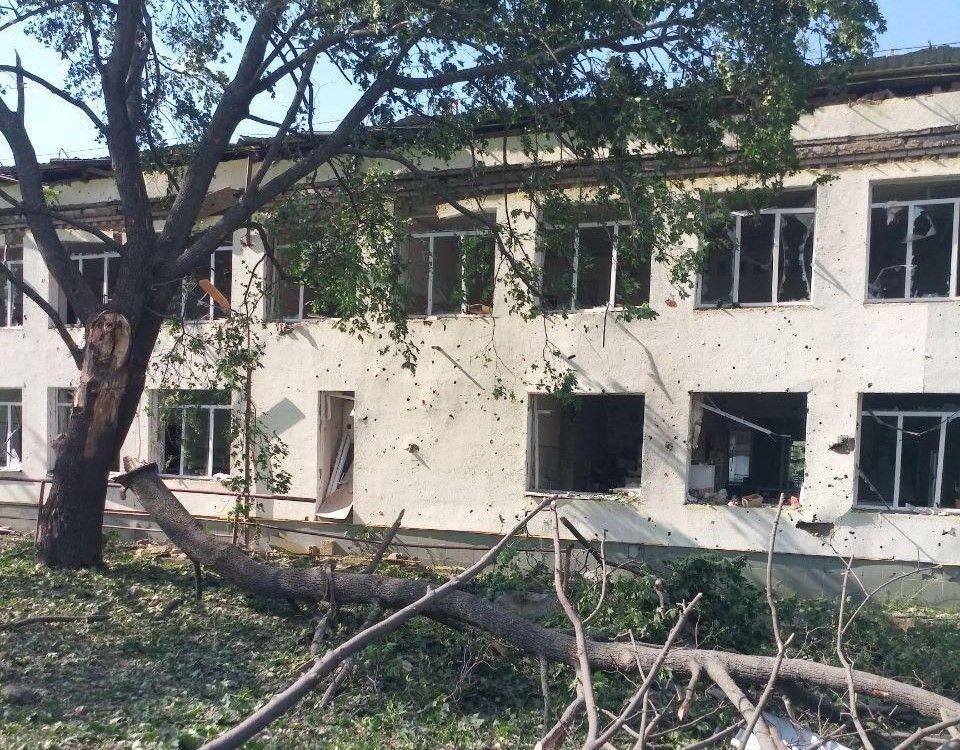
A building damaged by a Russian drone strike in Donetsk Oblast, Ukraine. (Vadym Filashkin / Telegram)
Strikes on Russian Territory: Oil Infrastructure Targeted
Ukrainian forces demonstrated their growing capability to strike deep into Russian territory, attacking an oil depot in Krasnodar Krai that killed one person and injured another. The strike on the facility on Tavricheskaya Street in the Sirius Federal Territory began around 1 a.m. local time and continued until 3 a.m., with explosions also reported in Sochi.
Temporary flight restrictions were imposed at Sochi airport during the drone attack, while utility and emergency services responded to fires at the targeted refinery. The systematic targeting of Russian energy infrastructure reflected Ukraine’s strategy of degrading Moscow’s war-making capacity through long-range strikes against military and economic targets.
The Fallen Commander: Honor in the Midst of Political Chaos
Colonel Maksym Kazban, commander of Ukraine’s “Liut” (Fury) Assault Brigade of the National Police, was killed in a car crash in Donetsk Oblast on July 22, representing the kind of loss that transcends political divisions. Kazban was a veteran officer who had fought since 2014, beginning his military career with the 79th Air Assault Brigade and participating in key battles during Russia’s initial invasion of eastern Ukraine.
Kazban later joined the “A” Special Operations Center of the Security Service of Ukraine, where he participated in numerous combat missions against Russian proxy forces in 2015. He played a leading role in a special operation near Chornobaivka in Kherson Oblast in 2022 that caused significant losses to Russian forces, becoming part of the legendary battlefield where Ukrainian forces repeatedly struck Russian positions.
After becoming first deputy commander of the Liut Brigade in July 2023, Kazban organized numerous assault missions and oversaw operations that led to the liberation of Klishchiivka in Donetsk Oblast. Appointed Liut commander in September 2024, he led the brigade in some of the war’s fiercest battles, including being among the first to fight Russian forces in the Toretsk sector without surrendering “a meter of ground.”
His death was mourned across party lines, with President Zelensky calling him “a strong warrior, devoted to Ukraine and its defense.” Kazban had received numerous awards including the Order of Bohdan Khmelnytskyi (2nd and 3rd class), the Medal “For Military Service to Ukraine,” the SBU Badge “For Bravery,” and the Commander-in-Chief’s “Steel Cross.”
The timing of Kazban’s death—amid political turmoil over anti-corruption legislation—served as a stark reminder of the sacrifices being made by those defending Ukraine while politicians in Kyiv made decisions that threatened the very democratic values soldiers like Kazban died protecting.
Looking Forward: Presidential Promises and Parliamentary Challenges
As the day ended, Zelensky promised to present a joint action plan within two weeks, meeting with law enforcement and anti-corruption institutions to develop coordinated reforms. The president stated that leaders agreed to develop measures to restore public trust and ensure accountability.
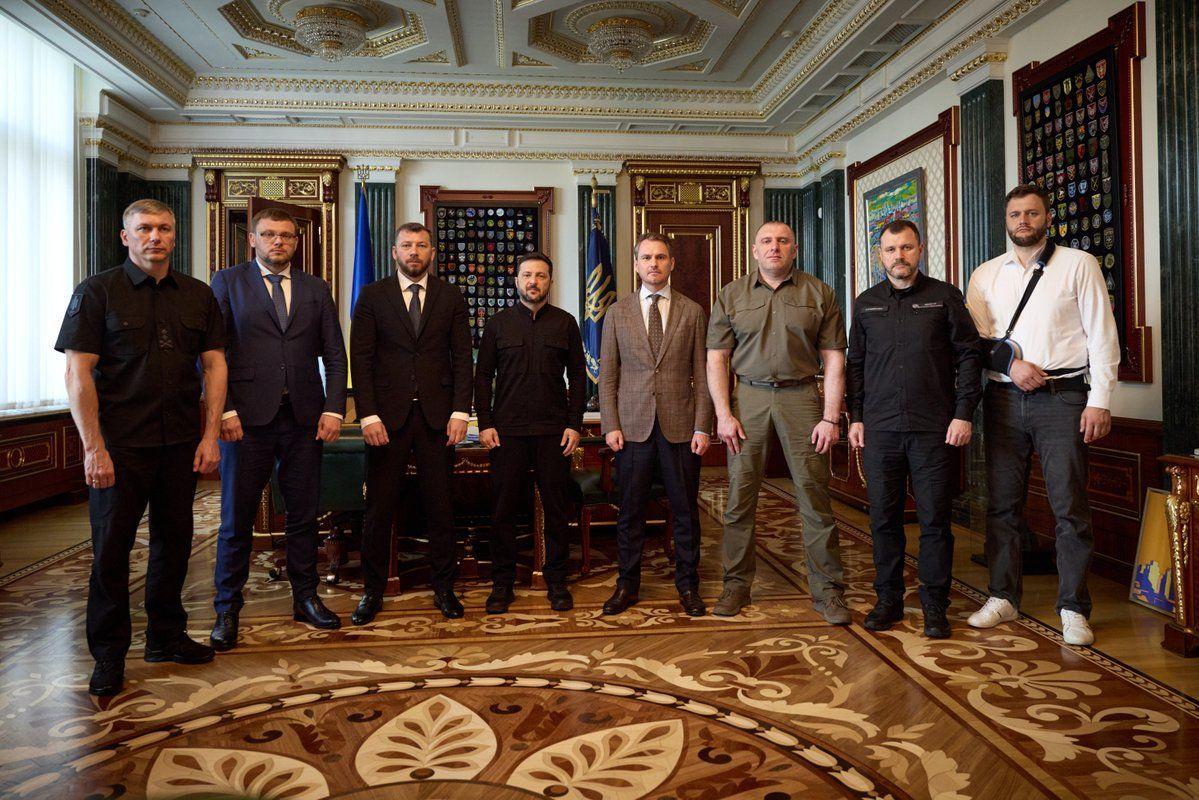
President Volodymyr Zelensky poses with heads of Ukraine’s law enforcement and anti-corruption agencies following a high-level meeting in Kyiv, Ukraine. (Volodymyr Zelensky/Telegram)
Opposition lawmakers continued efforts to reverse the legislation through the Constitutional Court, while civil society groups maintained pressure for the law’s repeal. The EU warned that the legislation threatens Ukraine’s membership aspirations, with European Commission President von der Leyen personally contacting Zelensky to express concerns.
Ukrainian soldiers continued operations across multiple fronts as the political crisis unfolded in Kyiv. The contrast between battlefield sacrifices and political decisions remained evident as Ukraine navigated both external aggression and internal institutional challenges.