
As Moscow dismisses the 10-day deadline and continues systematic deportation of Ukrainian children, deadly strikes kill 23 civilians while Ukraine faces military training losses and diplomatic pressure over anti-corruption reforms
Summary of the Day – July 29, 2025
The Kremlin delivered its most defiant response yet to American pressure on July 29, with officials categorically rejecting President Trump’s compressed 10-day deadline while reaffirming Russia’s commitment to achieving all its war objectives. The stark dismissal came as Russian forces demonstrated their contempt for peace overtures through devastating attacks that killed 23 civilians across Ukraine, including a prison strike that left 16 inmates dead and a missile attack on a Ukrainian military training facility that killed 3 soldiers and wounded 18. Against this backdrop of escalating brutality, Ukrainian intelligence revealed the systematic nature of Russia’s colonial project, with thousands of deported Ukrainian children being mobilized into Russian military formations, while Trump announced Ukrainian refugees could remain in the United States until the war ends and European officials warned of frozen aid unless anti-corruption reforms are implemented.
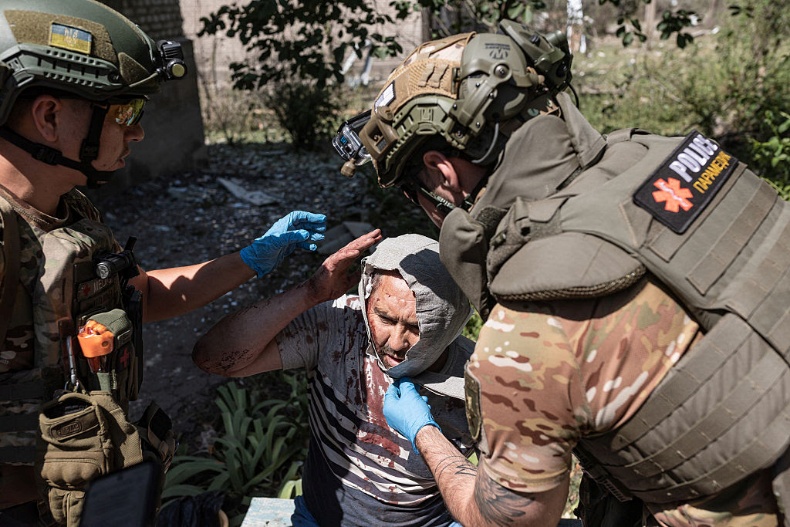
Ukrainian paramedics treat civilians injured after a Russian air strike on a house in Kostiantynivka, Donetsk Oblast. (Diego Herrera Carcedo/Anadolu via Getty Images)
Moscow’s Unequivocal “No”: Kremlin Rejects Trump’s Ultimatum
Russian officials delivered their most categorical rejection yet of American diplomatic pressure, with Kremlin spokesperson Dmitry Peskov dismissing Trump’s 10-day deadline while affirming Russia’s determination to continue its “special military operation” until achieving all objectives. The response revealed Moscow’s fundamental miscalculation of Trump’s evolving position and growing impatience with Russian intransigence.
“We have taken note of President Trump’s statement yesterday. The SVO (special military operation) continues,” Peskov declared, using Russia’s euphemistic term for its full-scale invasion of Ukraine. His statement came after Trump had confirmed the 10-day ultimatum, telling reporters aboard Air Force One, “Ten days from today. And then we’re gonna put on tariffs and stuff.”
Security Council Deputy Chairman Dmitry Medvedev escalated the confrontational rhetoric, claiming that negotiations would only conclude when Russia achieved its maximalist demands, including regime change in Ukraine, alterations to NATO’s open-door policy, and Ukraine’s complete demilitarization. His position directly contradicted any possibility of compromise, revealing the Kremlin’s fundamental unwillingness to engage in genuine peace negotiations.
Peskov’s concurrent complaints about the “slowdown in the process to normalize Russian-American relations” demonstrated Moscow’s attempt to leverage unrelated issues, including arms control negotiations, to extract concessions on Ukraine. Despite claims of continued interest in peace, Russian actions on the battlefield told a different story entirely.
America Doubles Down: State Department Affirms Trump’s Seriousness
The U.S. State Department delivered a stark message reinforcing Trump’s credibility, with spokesperson Tammy Bruce declaring that “President Trump has proven that he should be taken seriously, because he’s a serious man.” Her comments came as the administration clarified that a range of economic measures, including secondary sanctions targeting countries purchasing Russian oil, were being actively considered.
“What’s been discussed regularly are sanctions, and the president also brought up the issue of sanctions, and even secondary sanctions, as certain countries are benefiting from buying Russian oil,” Bruce explained during a daily briefing. The secondary sanctions could impose severe financial penalties on nations continuing business relationships with Russia, significantly expanding the scope of economic pressure.
Bruce’s pointed warning that “the time for misinterpretation is now over” signaled the administration’s determination to move beyond diplomatic niceties toward concrete action. Her assertion that Trump “has been patient, and that may have been misinterpreted by some people” suggested growing frustration with Moscow’s pattern of promising dialogue while escalating military operations.
The State Department’s forceful stance represented a significant escalation in American rhetoric, moving from conditional threats to seemingly inevitable implementation of punitive measures as the August 8 deadline approaches.
The Killing Fields: 23 Civilians Dead in Russian Terror Campaign
Russian forces demonstrated their contempt for peace negotiations through a systematic campaign of terror that killed 23 civilians and injured 54 others across Ukraine on July 29. The attacks, targeting everything from prisons to maternity hospitals, revealed Moscow’s strategy of maximizing civilian suffering to pressure Ukrainian resistance.
The most shocking assault occurred at the Bilenkivka Correctional Facility in Zaporizhia Oblast, where Russian forces struck with four FAB bombs, killing 16 prisoners and injuring nearly 100 more. The prison attack violated fundamental principles of international humanitarian law, as prisoners retain their civilian status and right to protection regardless of their incarceration.
UN Human Rights Monitoring Mission head Danielle Bell condemned the prison bombing as a potential serious violation of international humanitarian law, noting that “prisoners are civilians, and they must be protected.” The structural damage and widespread blast effects visible in photographs were consistent with Russia’s use of powerful air-dropped glide bombs against civilian targets.
In Dnipropetrovsk Oblast’s Kamianske district, Russian missiles struck a maternity hospital, killing three people including 23-year-old pregnant woman Diana. The attack on medical facilities constituted a clear war crime, deliberately targeting infrastructure essential for civilian survival and wellbeing. Two people remained in critical condition, including another pregnant woman and a medical specialist.
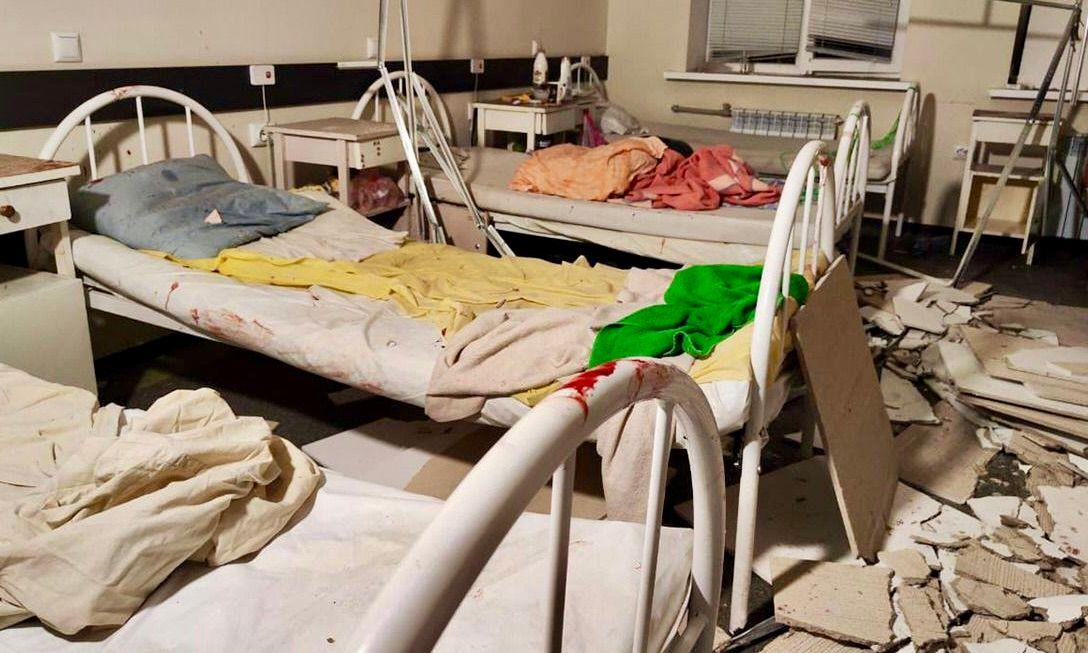
As a result of Russian attacks a maternity hospital and several hospital wards were damaged in Dnipropetrovsk Oblast, Ukraine. (State Emergency Service / Telegram)
The Kharkiv Oblast witnessed perhaps the most cynical attack when Russian forces used multiple rocket launchers to strike civilians gathered to receive humanitarian aid in Novoplatonivka village, killing five people and injuring three others. The deliberate targeting of aid distribution points represented a calculated effort to terrorize civilians and disrupt humanitarian assistance.
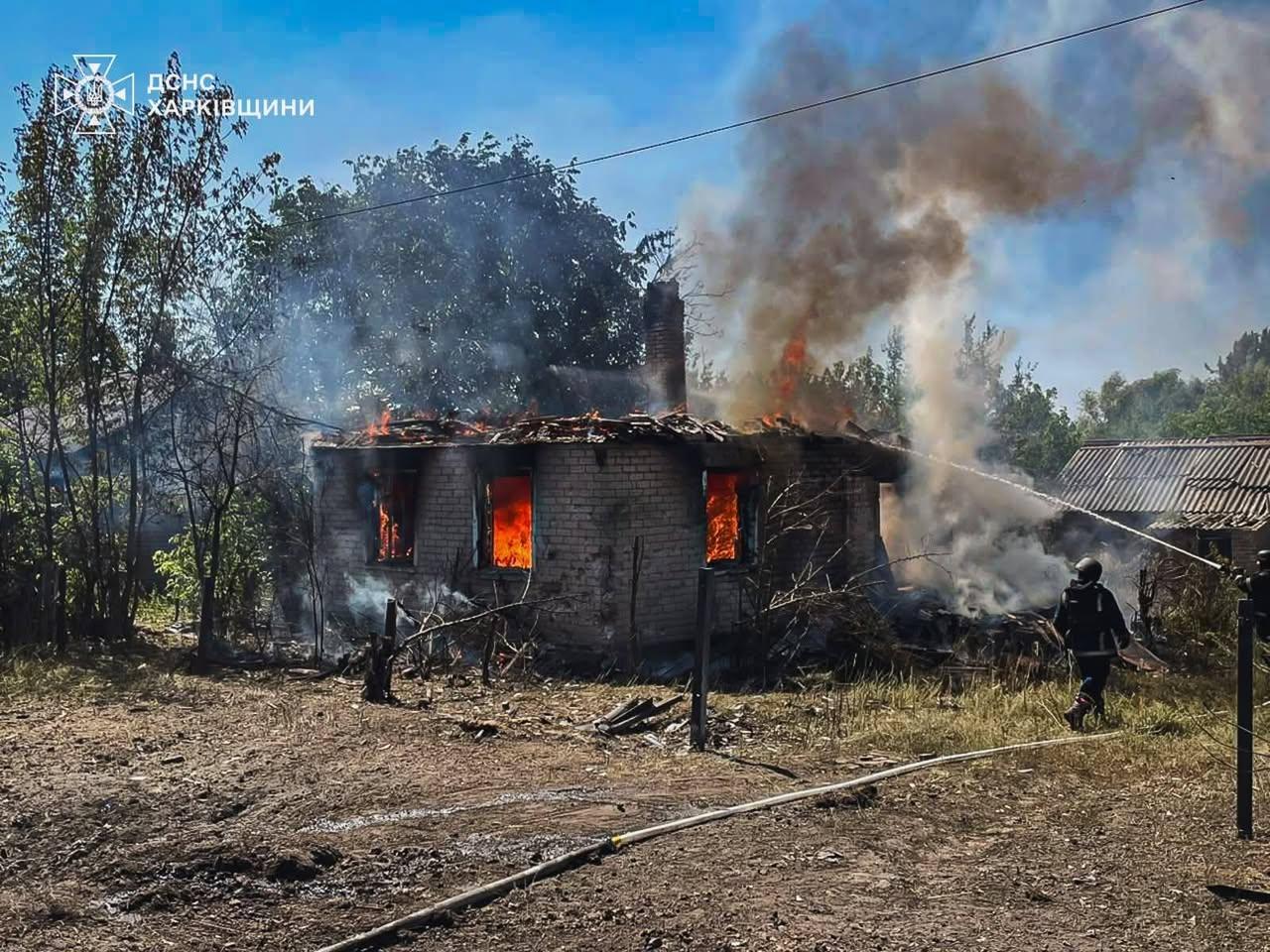 A firefighter works to extinguish a burning home after a Russian rocket strike in Kharkiv Oblast, Ukraine. (State Emergency Service of Ukraine in Kharkiv Oblast / Facebook)
Additional casualties occurred across Donetsk Oblast (2 injured), Sumy Oblast (4 injured), and Kherson Oblast (1 killed, 3 injured), demonstrating the geographic scope of Russian attacks against civilian populations.
Military Training Under Fire: 3 Soldiers Killed in Russian Strike
Russian forces launched a missile attack on a Ukrainian Ground Forces training facility on July 29, killing at least three soldiers and injuring 18 others in the latest assault on military educational infrastructure. The attack highlighted Russia’s systematic targeting of facilities designed to prepare Ukrainian personnel for combat operations.
“Despite the security measures taken, unfortunately, it was not possible to completely avoid casualties among the personnel,” Ukraine’s Ground Forces reported, announcing the launch of an official investigation into the causes of personnel losses. A commission led by the head of the Military Law Enforcement Service was established to investigate the attack and determine accountability.
The strike followed a pattern of Russian attacks on Ukrainian military training facilities throughout 2025, including devastating strikes in March, May, and June that resulted in dozens of casualties. A June 1 attack on a training ground killed 12 soldiers and wounded 60, leading to the resignation of then-Ground Forces Commander Mykhailo Drapatyi.
Military leadership announced implementation of “additional security measures” to safeguard soldiers’ lives during Russian strikes on training grounds and centers. However, the continued success of such attacks raised questions about the adequacy of protective measures and the vulnerability of fixed training installations.
The targeting of training facilities represents Russia’s broader strategy of degrading Ukrainian military capabilities by attacking the infrastructure necessary to prepare new personnel for frontline operations.
The Refugee Lifeline: Trump Permits Ukrainians to Stay Until War Ends
In a surprising announcement that contradicted his administration’s restrictive immigration policies, President Trump declared that Ukrainian citizens who fled to the United States would be permitted to remain until the conflict concludes. The decision provided crucial relief to over 240,000 Ukrainians who had benefited from the “Uniting for Ukraine” humanitarian parole program.
“We will. We have a lot of people who came in from Ukraine, and we’re working with them,” Trump stated during a brief interaction with reporters at the White House. The announcement came despite earlier reports suggesting the administration was considering revoking temporary legal status for many Ukrainians, potentially placing them on a fast track to deportation.
The decision represented a dramatic shift from previous signals, including an erroneous Department of Homeland Security email in April that mistakenly informed some Ukrainian refugees their parole was being terminated. The administration had also paused new applications for the program in January while conducting broader reviews of humanitarian parole initiatives.
Policy advocate Doug Klain of the organization Razom welcomed Trump’s statement, emphasizing the crucial link between supporting Ukraine’s defense and enabling refugees to eventually return home. “By giving Ukraine the tools it needs to defend itself against Russia, he can make sure the war ends sooner so they can go home to rebuild,” Klain explained.
The announcement provided much-needed certainty to Ukrainian families who had begun rebuilding their lives in America while facing uncertainty about their long-term status under the Trump administration’s immigration policies.
The Children’s Army: Russia Mobilizes Deported Ukrainian Youth
Investigations revealed the systematic nature of Russia’s campaign to transform deported Ukrainian children into soldiers for Moscow’s imperial ambitions. According to The Times investigation, Russia has mobilized “thousands” of deported young Ukrainians, sending them to fight in Russian military formations once they reach adulthood.
The practice violates multiple mandates of international law, constituting both illegal deportation and forced military conscription of occupied populations. Ukrainian Presidential Administration Chief of Staff Andriy Yermak confirmed that Ukraine has already found bodies of young Ukrainians on battlefields, providing grim evidence of the program’s implementation.
Russia’s approach involves deporting Ukrainian boys to military training camps to prepare them for future service in Russian armed forces, building on a systematic campaign to militarize Ukrainian youth. The process complements broader efforts to eradicate Ukrainian identity through comprehensive indoctrination programs disguised as educational and recreational activities.
Dmitry Medvedev personally organized trips for naval cadet classes from occupied Kherson Oblast to St. Petersburg for Russian Navy Day celebrations, while the Russian Ministry of Natural Resources provided vouchers for children from occupied territories to visit national parks, with officials declaring such visits “necessary because love for the Motherland (Russia) begins with small things.”
The “Helping Ours” foundation, working in coordination with Russian medical agencies, has facilitated the deportation of 1,200 people from occupied Donetsk and Luhansk oblasts since 2023, bringing children to Moscow-area facilities for “rehabilitation” and indoctrination under the guise of medical treatment.
Ukrainian partisan sources emphasized that camps in occupied Crimea are forcing Ukrainian children to sing the Russian national anthem, highlighting how Russia uses these facilities as control mechanisms to target Ukrainian youth and eliminate their national identity.
The Colonization Campaign: Russian Settlers Replace Ukrainian Populations
Russia’s systematic effort to replace Ukrainian populations with Russian citizens reached new levels of coordination, with Moscow allocating 33 billion rubles ($406 million) through 2030 for programs incentivizing Russian professionals to relocate to occupied territories. The “Zemsky” programs offer substantial financial incentives while serving broader goals of demographic transformation and cultural russification.
Deputy Prime Minister Dmitry Chernyshenko announced expansion of the “Zemsky Coach” program, offering Russian sports coaches one-time payments of 2 million rubles ($25,000) to teach in occupied Ukraine. The “Zemsky Doctor” program received similar funding to relocate Russian medical personnel, addressing catastrophic shortages created by Russia’s own invasion.
Deputy Prime Minister Tatyana Golikova confirmed that Russian authorities will allocate the substantial funds to the medical program, which has offered Russian personnel significant incentives to move to occupied Ukraine since 2023. Additional programs target teachers, with Luhansk and Kherson occupation officials reporting attempts to recruit Russian educators, though with limited success due to security concerns.
These labor shortages reflect the direct consequences of Russian aggression, with 4.6 million Ukrainians internally displaced within Ukraine and over 5.6 million Ukrainian refugees abroad as of July 1. Ukrainian specialists fled rather than collaborate with occupation authorities, creating the workforce gaps Russia now seeks to fill with imported personnel.
Occupied Kherson Oblast suffers from shortages of over 450 teachers, while occupied Donetsk Oblast has 52 percent of doctor positions unfilled. Russian officials have proposed staffing medical facilities with first-year medical students, demonstrating the desperation created by their own policies while maintaining commitment to demographic transformation.
The Information War: Russia Consolidates Media Control in Occupied Territories
Russia’s campaign to “manufacture consensus” in occupied territories reached new sophistication through comprehensive media consolidation efforts designed to create the impression of popular support for occupation. The systematic approach involves both creating pro-Russian content and eliminating Ukrainian information sources.
The Russian Military Historical Society, video platform RuTube, and Nikolai Danilevsky Film Studio announced opening a “content creator and blogger space” in occupied Melitopol, facilitating production of materials glorifying Russian history and occupation policies. Such initiatives make Ukrainians complicit in creating propaganda supporting their own subjugation.
Russian occupation authorities in Kherson Oblast organized media rallies as part of the “Youth and Children” federal project, teaching Ukrainian children to create content showcasing occupied territories as thriving under Russian control. Rally administrators trained children in media production techniques specifically designed to portray Russian restoration efforts as evidence of improvement over Ukrainian governance.
Simultaneously, Russia implements measures to eliminate Ukrainian media access, with Kherson Oblast occupation head Vladimir Saldo announcing complete removal of remaining “Gorynych” satellite dishes that provided access to Ukrainian broadcasts. The systematic removal of Ukrainian media infrastructure isolates occupied populations from alternative information sources.
The European Court of Human Rights ruled on July 21 that Russia is committing a “systematic purge of the Ukrainian media sphere,” providing legal recognition of Moscow’s comprehensive information warfare campaign designed to eliminate Ukrainian perspectives and narratives from occupied territories.
The Business of War: Putin Codifies Investment Incentives for Occupation
President Putin signed legislation on July 25 codifying business incentives for investing in Russia’s occupation of Ukraine, expanding the definition of eligible investment projects to include restoration and repair of fixed assets in occupied territories. The law demonstrates Moscow’s commitment to creating permanent economic structures supporting long-term occupation.
The Russian Territorial Development Fund praised the legislation for increasing “investment attractiveness” of occupied areas, reflecting Moscow’s strategy of using private capital to subsidize occupation costs while creating economic interests in maintaining control. The fund’s endorsement indicates institutional support for transforming occupied territories into profitable investment destinations.
Russian restoration projects serve as core components of occupation strategy, supporting curated images of occupied areas as productive parts of the Russian Federation rather than territories under military control. The investment incentives create financial stakeholders in continued occupation while reducing fiscal burden on the Russian state.
The legislation reflects Russia’s recognition that occupation is expensive, with federal government channeling potentially billions of rubles into maintaining presence in occupied territories. Private investment provides crucial diversification of cash flow supporting occupation while establishing facts on the ground that complicate future territorial settlements.
The Prosecution Project: Russia Expands Retroactive “Justice” System
Russian occupation authorities expanded their campaign of retroactive prosecution, investigating residents of occupied Ukraine for “anti-Russian” activities that occurred before the 2022 invasion. The Zaporizhia Oblast occupation prosecutor’s office announced investigating a resident of occupied Yamykivka for “extremist statements” posted on social media in 2014.
The case establishes precedent for prosecuting any resident of occupied Ukraine for any activity occupation authorities deem “anti-Russian,” regardless of when such activity occurred. Russian officials fined the individual 10,000 rubles ($123) and forced removal of the social media post, creating mechanisms for ongoing surveillance and punishment.
This approach opens pathways for Russia to prosecute any Ukrainian for virtually any past expression of Ukrainian identity or criticism of Russian policies. The systematic nature of such prosecutions creates climate of fear while providing pretexts for eliminating potential resistance leaders or simply terrorizing populations into compliance.
The prosecution system complements broader occupation strategies by creating legal frameworks for punishing Ukrainian identity while rewarding collaboration. Combined with media control, economic incentives, and demographic replacement, such measures constitute comprehensive colonial project designed to erase Ukrainian statehood and national consciousness.
Ukraine Strikes Back: Intensified Campaign Against Russian Logistics
Ukrainian forces demonstrated growing sophistication in targeting Russian military-industrial infrastructure, conducting what appeared to be an intensified long-range strike campaign against transportation networks supporting Moscow’s war effort. The systematic approach focused on railway infrastructure connecting Russian defense industrial facilities with frontline operations.
Ukrainian Center for Countering Disinformation Head Lieutenant Andriy Kovalenko reported that Ukrainian forces struck a railway station and Russian resource base in Salsk, Rostov Oblast, disrupting a crucial logistics hub used to transfer resources, fuel, ammunition, and cargo to frontline units in Donetsk and Zaporizhia oblasts and occupied Crimea.
A Ukrainian reserve officer reported that Ukrainian forces highly likely struck a train carrying fuel at the Salsk railway station, while Russian sources posted footage of fires at the facility. Russian officials claimed their forces repelled drone strikes against Rostov Oblast overnight, but the successful infrastructure damage demonstrated Ukrainian penetration of air defenses.
The Frontelligence Insight organization reported that July 29 marked the third consecutive day of Ukrainian drone strikes against Russian railway and industrial hubs, inflicting “tangible” logistical setbacks on transportation lines linking military industrial centers in Volgograd and Rostov-on-Don with occupied territories.
Ukrainian forces have recently targeted electrical substations, fuel tanks, and station buildings in Orlovsky, Rostov Oblast, and Zhutovo, Volgograd Oblast, both located along railways connecting Russian defense industrial facilities with occupied Donetsk and Luhansk oblasts.
The Diplomatic Standoff: European Aid at Risk Over Anti-Corruption Crisis
European officials intensified pressure on Ukraine to resolve the anti-corruption crisis, with reports indicating the EU warned Kyiv through diplomatic channels that some financial assistance would be frozen unless legislation restoring anti-corruption agencies’ independence is passed by July 31. The warnings encompassed multiple funding streams vital to Ukraine’s economic stability.
EU sources indicated that failure to roll back controversial legislation would halt funding under the G7’s Extraordinary Revenue Acceleration loan program, a $50 billion initiative covered by frozen Russian assets. The EU shoulders approximately $20 billion of this commitment, making the threat particularly significant for Ukrainian finances.
European Investment Bank and European Bank for Reconstruction and Development funding would also reportedly be paused, though Ukraine Facility program funds might continue flowing despite the next tranche being reduced from 4.5 billion euros to 3.05 billion euros due to other reform delays.
President Zelensky held conversations with Canadian Prime Minister Mark Carney and Danish Prime Minister Mette Frederiksen, both expressing support for new legislation restoring anti-corruption agencies’ independence while emphasizing urgent need for parliamentary action on July 31. The international pressure demonstrated the global stakes involved in Ukraine’s domestic governance decisions.
“Mark and I share the same view: it is now essential that the Verkhovna Rada adopt this bill in full on July 31,” Zelensky said after his call with Carney, while thanking Canada for continued military and financial assistance. His conversation with Frederiksen similarly emphasized the urgent timeline for parliamentary action.
The Military Balance: Russian Advances Meet Ukrainian Resistance
Military operations continued across multiple fronts with Russian forces achieving incremental territorial gains while Ukrainian forces demonstrated continued ability to conduct successful counterattacks and strategic strikes. The pattern reflected ongoing attrition warfare with neither side achieving decisive breakthrough capabilities.
Russian forces advanced in southern and central Chasiv Yar in the Donetsk direction while making gains in northern Kolodyazi in the Lyman sector. Additional Russian advances occurred southeast of Volodymyrivka in the Pokrovsk direction and in fields northwest of Oleksiivka in the Novopavlivka direction.
Ukrainian forces countered with advances into northeastern Yablunivka in the Toretsk direction, demonstrating continued offensive capabilities despite overall defensive posture. The successful Ukrainian operation contradicted Russian claims of total tactical dominance in contested areas.
The most significant Russian achievement occurred in eastern Zaporizhia Oblast, where Moscow’s forces captured Temyrivka northeast of Hulyaipole. The Russian Ministry of Defense credited the 127th Motorized Rifle Division with the victory, while Russian milbloggers claimed the 394th Motorized Rifle Regiment advanced over five square kilometers during the operation.
Ukrainian forces conducted successful special operations, including a “daring landing” on the Russian-occupied Tendra Spit in the Black Sea that eliminated Russian positions and personnel while destroying a “Zont” electronic warfare complex and “Rosa” radar station. The operation demonstrated Ukrainian special forces’ continued ability to conduct amphibious assaults despite Russian coastal defenses.
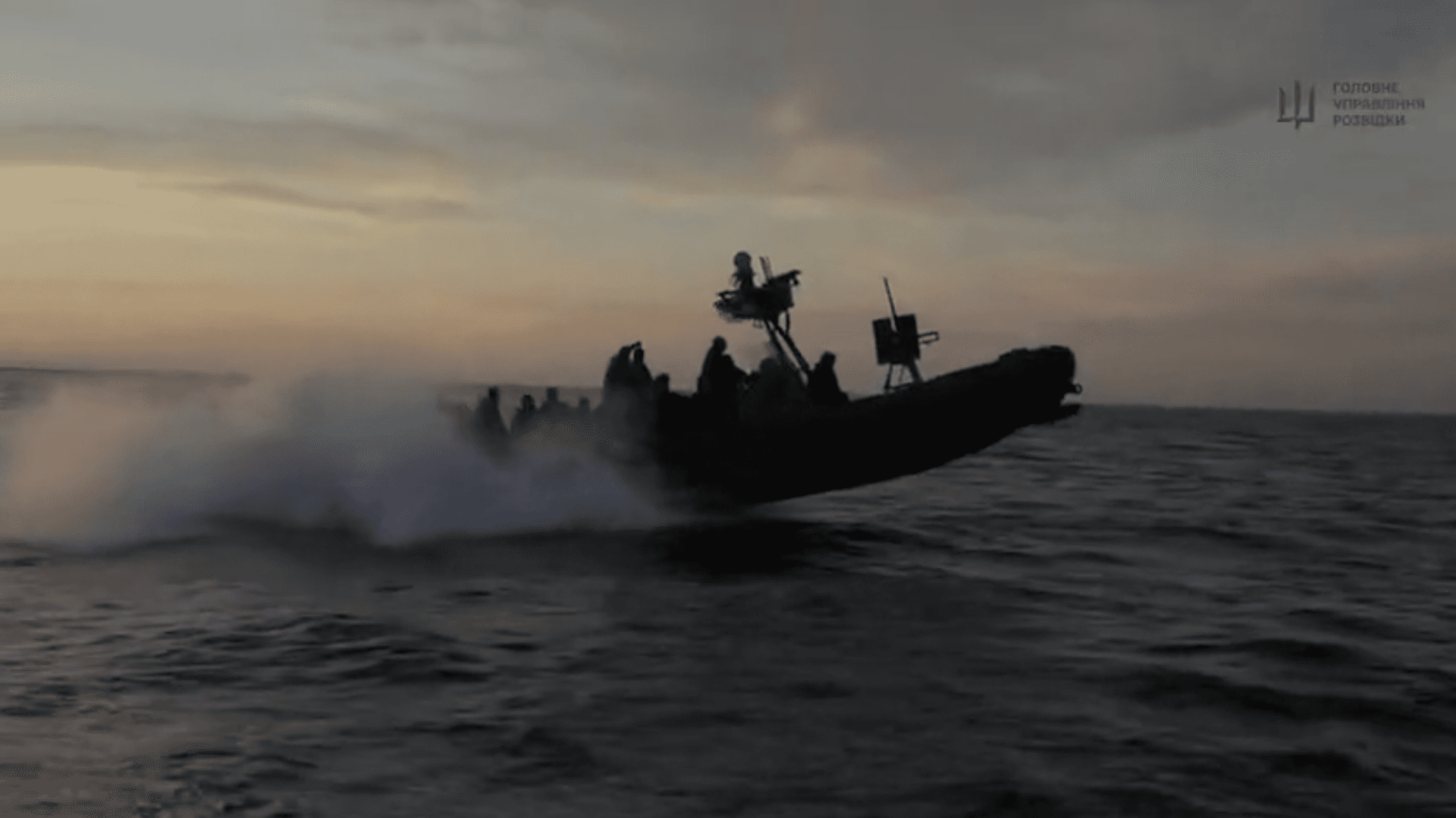
A boat carries Ukrainian special forces conducting a raid on the Russian-occupied Tendra Spit in the Black Sea. (Screenshot / HUR / Telegram)
The Technology War: Maritime Drones and Ground Innovations
Ukrainian military intelligence revealed new dimensions of technological warfare through exclusive footage showing the country’s first deployment of first-person-view drones in maritime operations. The September 2024 operation off occupied Crimea demonstrated evolution of Ukrainian naval capabilities beyond traditional surface vessels.
FPV drones launched from boats in open waters targeted Russian forces on the Petro Hodovalets gas production platform, which Moscow had converted from civilian energy infrastructure into military positions. The operation showcased Ukrainian ability to project power across significant distances while minimizing risk to personnel.
Ground drone manufacturer Robotic Complexes unveiled the Threeminer mine-laying drone at an international defense exhibition in Istanbul. The system costs approximately $3,000 to produce and can carry three mines weighing up to 35 kilograms, with mines incorporated into the wheel structures themselves.

Ukrainian ground drone manufacturer Robotic Complexes showcased the new Threeminer mine-laying drone at the international defense exhibition IDEF-2025 in Istanbul, Turkey, which ran from. (Robotic Complexes/Facebook)
The Threeminer’s innovative three-wheel design lowers the center of gravity while enabling transformation into logistics or kamikaze configurations depending on mission requirements. The drone operates remotely using standard batteries with a 10-kilometer range and includes night vision capabilities for around-the-clock operations.
The modular construction enables rapid assembly and repair without welding, making production and maintenance faster and cheaper. Such innovations demonstrate Ukraine’s evolution into a defense technology center, with domestic manufacturers rapidly developing solutions to immediate battlefield challenges while building long-term industrial capabilities.
The Cyber Warfare Continues: Aeroflot Disruptions Persist
Russia’s largest airline continued experiencing significant disruptions for a second consecutive day following the devastating cyberattack claimed by pro-Ukrainian hacker groups Silent Crow and Cyber Partisans BY. Aeroflot canceled 22 departing flights from Moscow’s Sheremetyevo Airport and 31 incoming flights, maintaining pressure on Russian civilian aviation infrastructure.
The hackers claimed to have spent a year infiltrating Aeroflot’s corporate network before launching their comprehensive assault on 7,000 physical and virtual servers while accessing 20 terabytes of data. They alleged serious security lapses, including CEO Sergey Alexandrovsky’s unchanged password since 2022 and widespread use of outdated Windows XP systems.
While Aeroflot reported that 93% of scheduled flights resumed on July 29, disruptions continued across Moscow’s primary aviation hub. The attack demonstrated sustained Ukrainian cyber capabilities while highlighting vulnerabilities in Russian critical infrastructure despite years of warnings about cybersecurity threats.
The cyber offensive complemented broader Ukrainian efforts to disrupt Russian logistics and transportation networks, creating multiple pressure points across Moscow’s war-supporting infrastructure. Flight restrictions due to Ukrainian drone threats have affected 43 Russian airports at least 489 times since January, compounding aviation sector challenges.
The Accidental Bombing Campaign: Russia’s Self-Inflicted Casualties
Russian forces have accidentally bombed themselves or areas they occupied over 100 times in 2025, according to independent Russian media outlet Astra. The incidents typically stem from failed deployments of wing kits attached to aerial bombs, causing them to fall short of Ukrainian targets and land inside Russia or occupied territories.
Astra documented five new cases in the past month alone, including FAB-250 and FAB-500 bombs falling in Belgorod region villages, with one landing near a residential building and another on a street in Bershakovo. Additional accidental drops occurred in occupied Donetsk region, with bombs landing next to residential buildings and a children’s boarding school.
The systematic documentation of these incidents reveals the scale of Russian military incompetence while highlighting dangers posed to civilian populations in both Russia and occupied territories. Russian authorities have attempted to frame some accidental bomb drops as Ukrainian attacks, demonstrating willingness to lie to their own citizens about military failures.
The incidents result from a combination of inadequate training, faulty arming procedures, poor mission execution, and crew fatigue, according to UK Ministry of Defence assessments. The conversion of Soviet-era “dumb bombs” into guided weapons through improvised wing kits and GPS systems has created additional technical challenges that Russian forces struggle to manage effectively.
The Historical Recognition: Ukraine Acknowledges Polish Deportations
President Zelensky signed legislation on July 29 recognizing Ukrainians forcibly resettled from communist Poland between 1944 and 1951 as deported citizens of Ukraine. The law addresses historical injustices while providing compensation for material and moral damages incurred by deportation victims and their descendants.
Under agreements with the Soviet Union, the Polish communist regime expelled around 700,000 Ukrainians from their homes, with the largest phase being Operation Vistula in 1947 that relocated 140,000 Ukrainians to northern and western Poland. The new law recognizes these expulsions from the Lemko, Nadsyany, Kholm, Southern Podlaise, Lyubachiv, and Western Boyko regions as illegal and criminal acts.
The legislation took years of debate, revisions, and parliamentary hearings before entering force, reflecting the sensitive nature of Polish-Ukrainian historical relations. Former National Memory Institute head Anton Drobovych praised the development, noting it added “legal and historical clarity to these issues, and most importantly, without scandals and politicization of history.”
The law’s passage comes only weeks after Poland established July 11 as the National Day of Remembrance for Polish victims of the Volyn massacres, highlighting ongoing efforts by both countries to address painful historical chapters while maintaining their current alliance against Russian aggression.
The Governmental Transition: New Culture Minister Appointed
Ukraine’s government appointed former Deputy Economy Minister Tetiana Berezhna as interim culture minister, Prime Minister Yuliia Svyrydenko announced on July 28. The appointment was part of Ukraine’s first full wartime government reshuffle, ensuring stable leadership at the ministry amid ongoing reforms.
“This decision guarantees manageability, financial capacity, and effective dialogue with the cultural community,” Svyrydenko explained, emphasizing Berezhna’s “strong background in public policy, international projects, and working with partners.” The appointment followed criticism of previous culture minister Mykola Tochytskyi’s tenure and policies regarding cultural heritage.
Berezhna will be tasked with auditing the cultural sector’s needs, attracting additional resources, and boosting cooperation with international donors and partners. Born in 1989, she practiced law for over a decade before entering public service, earning recognition from international legal rankings for her tax law expertise.
As deputy economy minister, Berezhna oversaw labor and employment reforms, including veteran reintegration and refugee return programs. In 2025, she served as Ukraine’s Commissioner General at EXPO-2025 in Japan, leading the country’s representation and overseeing national pavilion preparations.
The Sabotage Investigation: Poland Arrests Colombian Arsonist
Poland’s Internal Security Agency announced the arrest of a 27-year-old Colombian national accused of carrying out arson attacks in Warsaw and Radom on behalf of Russian intelligence services. The suspect allegedly set fire to construction warehouses on May 23 and May 30, demonstrating Russia’s use of Latin American recruits for European sabotage operations.
Polish Prime Minister Donald Tusk revealed that authorities have detained 32 people suspected of cooperating with Russian services, including Poles, Russians, Ukrainians, Belarusians, and Colombians. The group allegedly carried out acts of diversion or assault under Russian direction, with more arrests potentially forthcoming.
According to ABW spokesperson Jacek Dobrzynski, the Colombian suspect received detailed instructions from a Russian intelligence handler, including techniques for constructing Molotov cocktails. After completing attacks in Poland, the man traveled to the Czech Republic where he attempted to torch a Prague bus depot before being detained by local authorities.
The case demonstrates Russia’s systematic recruitment of Latin Americans with military experience for sabotage operations across Europe, with recruits contacted primarily via Telegram and tasked with arson, reconnaissance, and damage documentation. ABW officers report that Russia has been actively targeting such individuals to conduct operations that European nationals might be reluctant to perform.
The Aerospace Paradox: Russian Space Chief Visits NASA
Roscosmos head Dmitry Bakanov arrived in Houston for the first direct talks between Russian and American space agency leaders since 2018, highlighting the paradoxical persistence of technical cooperation amid comprehensive diplomatic rupture. The visit occurred as broader U.S.-Russian relations deteriorated following Trump’s ultimatum and growing American frustration with Russian intransigence.
Bakanov’s agenda includes meetings with acting NASA Administrator Sean Duffy to discuss International Space Station operations, planned deorbiting procedures, and cross-flight agreements between the agencies. He will also visit Johnson Space Center and Boeing facilities producing the CST-100 Starliner spacecraft, demonstrating continued technical collaboration despite sanctions.
The space agency head plans to meet the crew of NASA’s Crew-11 mission, including Russian cosmonaut Oleg Platonov scheduled to depart no earlier than July 31. Such personnel exchanges continue despite the broader freeze in diplomatic relations following Russia’s invasion of Ukraine.
Space exploration remains one of few areas where U.S.-Russian cooperation persists, reflecting both practical necessities of ongoing ISS operations and strategic calculations about maintaining technical dialogue channels. However, the timing of Bakanov’s visit amid escalating tensions underscores the increasingly precarious nature of even limited cooperation areas.
The Sanctions Extension: Serbian Oil Company Gets Another Reprieve
Serbian oil company Naftna Industrija Srbije (NIS), partly owned by Russian gas giant Gazprom, received its fifth temporary reprieve from U.S. sanctions, allowing continued operations through August 27. The extension highlights ongoing challenges in implementing comprehensive sanctions against Russian energy assets while managing impacts on allied countries.
The company announced that the U.S. Treasury Department’s Office of Foreign Assets Control issued a special license on July 28, postponing full sanctions implementation for another month. NIS noted it had submitted a formal application in March to be removed from the U.S. Specially Designated Nationals list while continuing cooperation with American authorities.
Serbian Energy Minister Dubravka Djedovic Handanovic confirmed the extension but noted that longer delays were not possible, according to Reuters reporting. She emphasized that Serbia’s priority remains ensuring stable oil derivative supplies while working toward removing NIS from sanctions lists.
Gazprom Neft holds a 44.9% stake in the Serbian company while Gazprom owns 11.3%, with the Serbian government retaining 29.9%. The U.S. Treasury initially imposed sanctions on Russia’s oil sector on January 10, giving Gazprom Neft 45 days to divest from NIS, but repeated extensions have delayed implementation.
The Infrastructure Warning: Europe Unprepared for Rapid Military Deployment
EU Transport Commissioner Apostolos Tzitzikostas warned that European rails and roads are inadequate for rapid troop deployment in case of war with Russia, proposing 17 billion euros in spending to restructure transportation infrastructure. The assessment highlights critical vulnerabilities in European defense preparedness amid mounting concerns about potential Russian aggression.
“The reality today is that if we want to move military equipment and troops from the western side of Europe to the eastern side, it takes weeks and in some cases months,” Tzitzikostas told the Financial Times. Current obstacles range from bureaucratic red tape during border crossings to physical infrastructure unable to support moving armor.
The commissioner’s proposed strategy, coordinated with NATO and set for unveiling later this year, aims to upgrade 500 infrastructure projects across four military corridors. The initiative responds to growing concerns that European countries remain ill-prepared for prolonged conflict after decades of disarmament.
The warning comes as the Trump administration plans to reduce military presence in Europe while pushing European allies to assume greater responsibility for their own defense. NATO’s agreement to raise common defense spending from 2% to 5% of GDP by 2035 reflects recognition of these challenges, but infrastructure limitations could negate increased spending without coordinated improvement efforts.
The Military Expansion: Ukraine Allows 60+ Volunteers to Serve
President Zelensky signed legislation on July 29 allowing Ukrainian citizens over age 60 to voluntarily enlist in military service during martial law, expanding the recruitment pool amid continued manpower shortages. The measure enables older volunteers to serve in non-combat and specialized roles where their experience and expertise can contribute to the war effort.
Under the new law, people over 60 may sign one-year contracts for military service if they pass medical commissions and receive approval from unit commanders. Officer candidates must also receive clearance from the General Staff or relevant military authorities, ensuring appropriate placement based on qualifications and health status.
Each new recruit will undergo a two-month probationary period, with contracts subject to early termination if individuals prove unfit for service. The law establishes no maximum age limit but provides that all contracts will be automatically voided once martial law ends.
The legislation addresses staffing gaps in technical, logistical, and support units where experienced professionals are in high demand. Ukraine has faced serious manpower shortages amid heavy Russian offensives, leading to efforts to broaden the mobilization pool through various incentives and eligibility expansions.
The Assassination Plot: Security Service Foils Commander’s Murder
Ukraine’s Security Service foiled a Russian plot to assassinate Serhii Filimonov, commander of the 108th Separate Mechanized Battalion “Da Vinci Wolves,” through false-flag tactics and psychological manipulation of a Ukrainian national. The FSB used deceptive methods to recruit the would-be assassin by posing as SBU personnel.
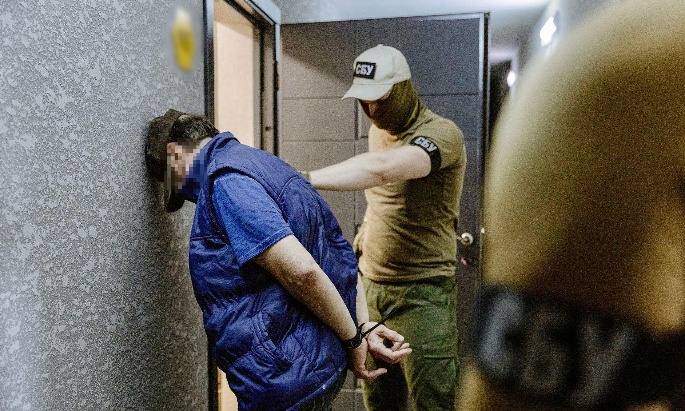
Ukraine’s Security Service (SBU) has detained a man responsible for planning to assassinate Serhii Filimonov, commander of the 108th Separate Mechanized Battalion “Da Vinci Wolves,” as shown in a photo published. (SBU/Website)
The FSB enlisted a resident of Dnipropetrovsk Oblast by convincing him he was working for Ukrainian interests while actually directing him to kill a decorated Ukrainian commander. Russian intelligence falsely claimed the man had purchased medicine from a company financing the Russian military and threatened prosecution for treason unless he “cooperated.”
To avoid fabricated charges, the suspect was offered assistance with surveillance operations, with FSB handlers convincing him that Filimonov was a “traitor” responsible for Russian missile strikes on Kyiv. The man rented an apartment near Filimonov’s residence, tracked his vehicle, and sent regular photo updates to his handler.
SBU operatives arrested the suspect before he could carry out the assassination using a Kalashnikov rifle obtained from a weapons cache on Kyiv’s outskirts. Investigators recovered the weapon and communications with his FSB handler from the suspect’s phone, providing evidence of the elaborate deception operation.
The Aerial Incident: Belarus Downs Armed Drone Over Minsk
A drone carrying explosives was intercepted over the Belarusian capital early on July 29, with authorities reporting the unmanned aircraft crashed into an apartment building before striking a parked car. The incident raised new concerns about regional airspace security amid escalating tensions between Belarus and neighboring countries.
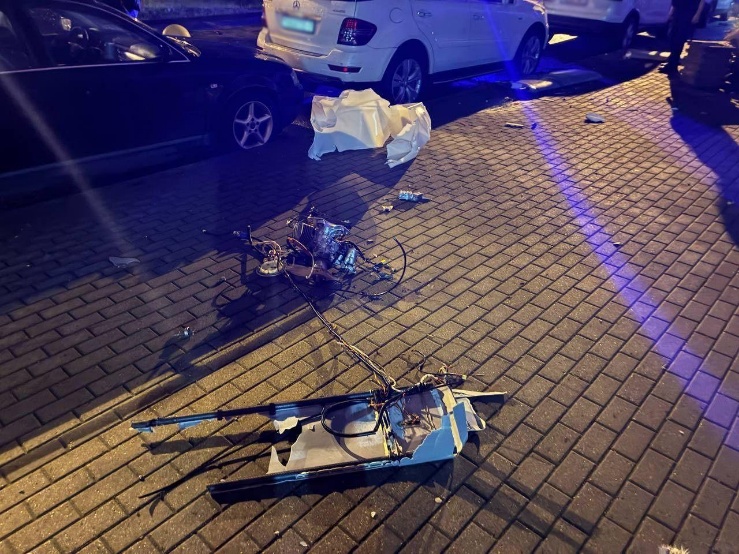
An unidentified drone after being down in Minsk, Belarus. (Belarusian Defense Ministry/Telegram)
The Belarusian Defense Ministry said air defense forces detected the drone around 2 a.m. local time and brought it down using electronic warfare systems. Belarus’s Investigative Committee determined the drone carried a warhead filled with TNT and numerous metal ball projectiles, indicating potentially lethal intent.
Photos released by the Defense Ministry showed remnants of the destroyed drone but did not identify its model or origin. Belarusian independent media outlet Zerkalo reported that residents heard buzzing followed by a loud explosion and debris hitting the ground, with police arriving more than 20 minutes after the blast.
The July 29 crash marked the first time Belarusian authorities described such an incident in the capital with detailed information about the drone’s weaponization. Previous incidents involved stray Russian drones shot down by Belarusian forces, but this case involved an apparently deliberate attack on the capital city.
The Human Cost: Russian Military Losses Surpass One Million
Russia has lost around 1,051,300 troops in Ukraine since beginning its full-scale invasion on February 24, 2022, according to Ukraine’s General Staff. The milestone figure includes 1,050 casualties Russian forces suffered over the previous day, demonstrating the sustained rate of personnel losses despite nearly three years of warfare.
The casualty count encompasses killed, wounded, and missing personnel, reflecting the comprehensive human cost of Putin’s imperial ambitions. Additional Russian losses include 11,065 tanks, 23,064 armored fighting vehicles, 56,687 vehicles and fuel tanks, and 30,865 artillery systems, according to Ukrainian military reporting.
Russian equipment losses also encompass 1,451 multiple launch rocket systems, 1,202 air defense systems, 421 airplanes, 340 helicopters, 48,585 drones, 28 ships and boats, and one submarine. The systematic documentation of losses provides insight into the scale of military degradation resulting from sustained combat operations.
The one million casualty milestone represents unprecedented losses for Russia since World War II, exceeding Soviet casualties in Afghanistan by orders of magnitude while demonstrating the human cost of Putin’s decision to launch unprovoked aggression against Ukraine.
Looking Forward: The August 8 Reckoning Approaches
As Trump’s final ultimatum expires in nine days, the fundamental contradictions between Russian maximalist demands and international expectations have become impossible to ignore. Moscow’s categorical rejection of compromise while escalating civilian attacks demonstrates Putin’s calculation that Western resolve will eventually crack under pressure of prolonged conflict.
The systematic nature of Russian colonial policies—from child deportation to media control to retroactive prosecutions—reveals long-term strategies designed to permanently transform occupied territories regardless of diplomatic outcomes. These comprehensive efforts suggest Moscow’s commitment to achieving imperial objectives through persistence rather than negotiation.
Ukrainian technological innovations and strategic strikes demonstrate continued resistance capabilities while highlighting warfare’s evolution toward drone-dominated operations that favor defensive forces with superior technology and tactical flexibility. The development of domestic defense capabilities provides strategic autonomy that reduces dependence on Western weapons supplies.
European financial pressure regarding anti-corruption reforms illustrates complex relationships between wartime governance and international integration, with Ukraine forced to balance immediate security needs against long-term membership aspirations. The crisis’s resolution will significantly impact both European prospects and Western financial support sustainability.
The approaching deadline will test whether Trump’s ultimatum represents genuine inflection point or diplomatic theater that Moscow can safely dismiss. Russia’s defiant response suggests fundamental miscalculation of American resolve, potentially creating conditions for more dramatic escalation as diplomatic options exhaust themselves and economic pressure intensifies.