
As Russia unleashes its most devastating attack on Kyiv in recent weeks, killing 27 and wounding 159, Ukraine’s parliament restores anti-corruption independence while Moscow claims victory in Chasiv Yar
Summary of the Day – July 31, 2025
Vladimir Putin’s response to Donald Trump’s diplomatic ultimatum came written in blood and fire across Kyiv’s skyline. Russia launched its most devastating attack on the Ukrainian capital in recent weeks, deploying 309 drones and eight cruise missiles that killed at least 27 people and wounded 159 others, including a record 12 children. The assault featured Russia’s newest rocket-powered Shahed drones, marking a dangerous escalation in Moscow’s aerial terror campaign. Yet amid the carnage, Ukraine demonstrated remarkable institutional resilience as parliament voted overwhelmingly to restore the independence of key anti-corruption agencies while approving nearly $10 billion in additional defense spending. The day also saw Moscow claim the capture of the strategic fortress town of Chasiv Yar, Ukrainian forces strike deep into Russian territory, and a growing international chorus demanding accountability for Russia’s systematic campaign of terror.
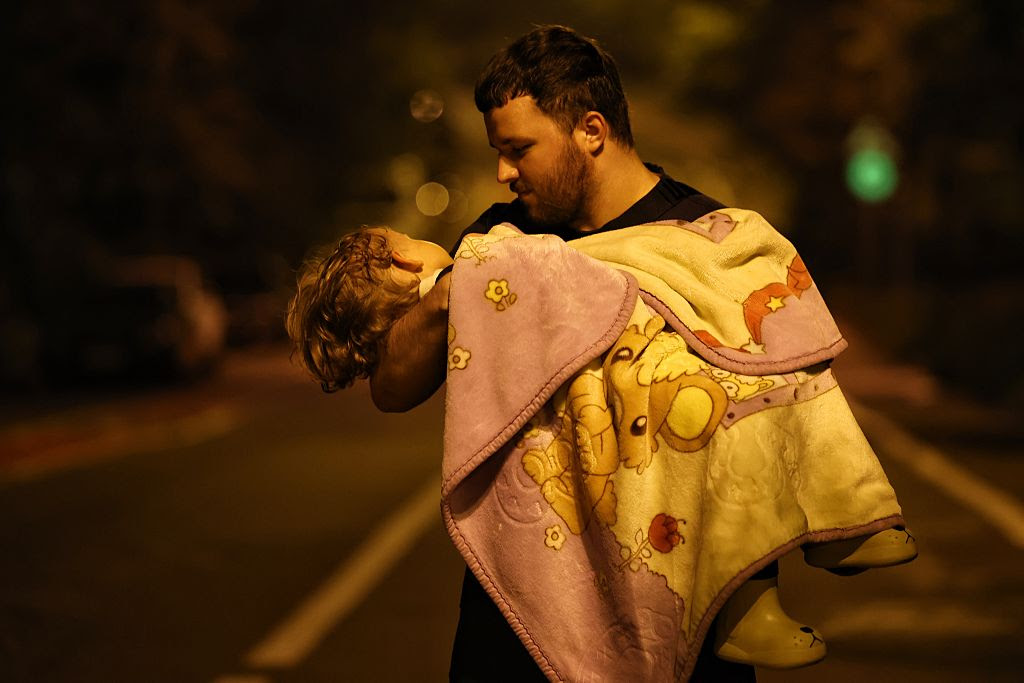
A man carries a child at residential district after a massive Russian drone and missile attack in Kyiv, Ukraine. At least 16 people were killed and over 130 injured, with children among the casualties. (Yan Dobronosov/Global Images Ukraine via Getty Images)
Dawn of Terror: Russia’s Deadliest Kyiv Attack in Weeks
The nightmare began in the pre-dawn darkness of July 31, when Russian forces unleashed one of their most devastating barrages against Kyiv since the early months of the war. The assault combined 309 Shahed-type attack and decoy drones with eight Iskander-K cruise missiles, creating a symphony of destruction that would leave 27 dead and 159 wounded by day’s end.
“I woke up, and I couldn’t hear anything,” 66-year-old grandmother Kateryna Naralnyk told reporters outside her destroyed apartment building in the Sviatoshynskyi district. “It was the end of the world for me.” Her daughter and two grandsons, aged 21 and 17, remained trapped beneath the rubble as rescue operations continued into the evening.
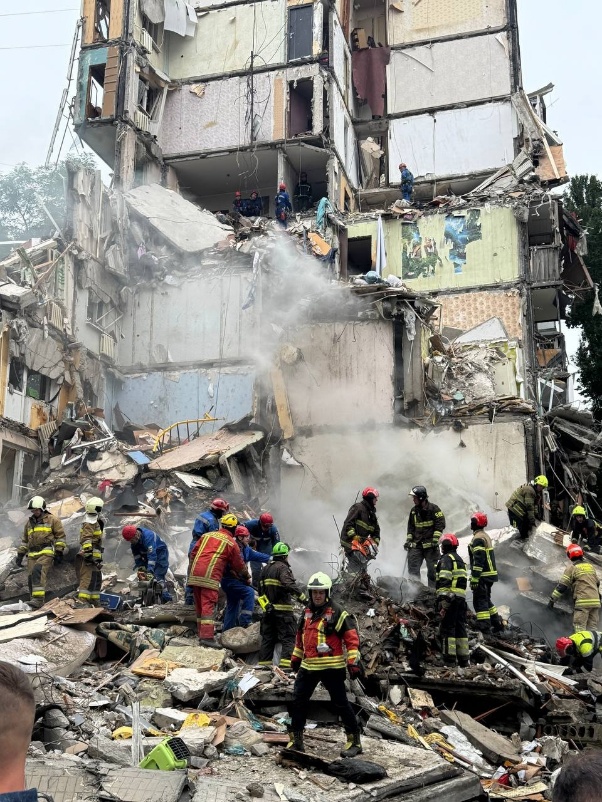
The aftermath of Russia’s latest drone and missile attack on Kyiv overnight. (Interior Ministry / Kyiv City Military Administration / Telegram)
The attack marked a sinister milestone: the highest number of children injured in Kyiv since the beginning of the full-scale invasion. Twelve young victims bore witness to Russia’s expanding campaign of terror against civilian populations, their injuries serving as a grim testament to Moscow’s rejection of international calls for restraint.
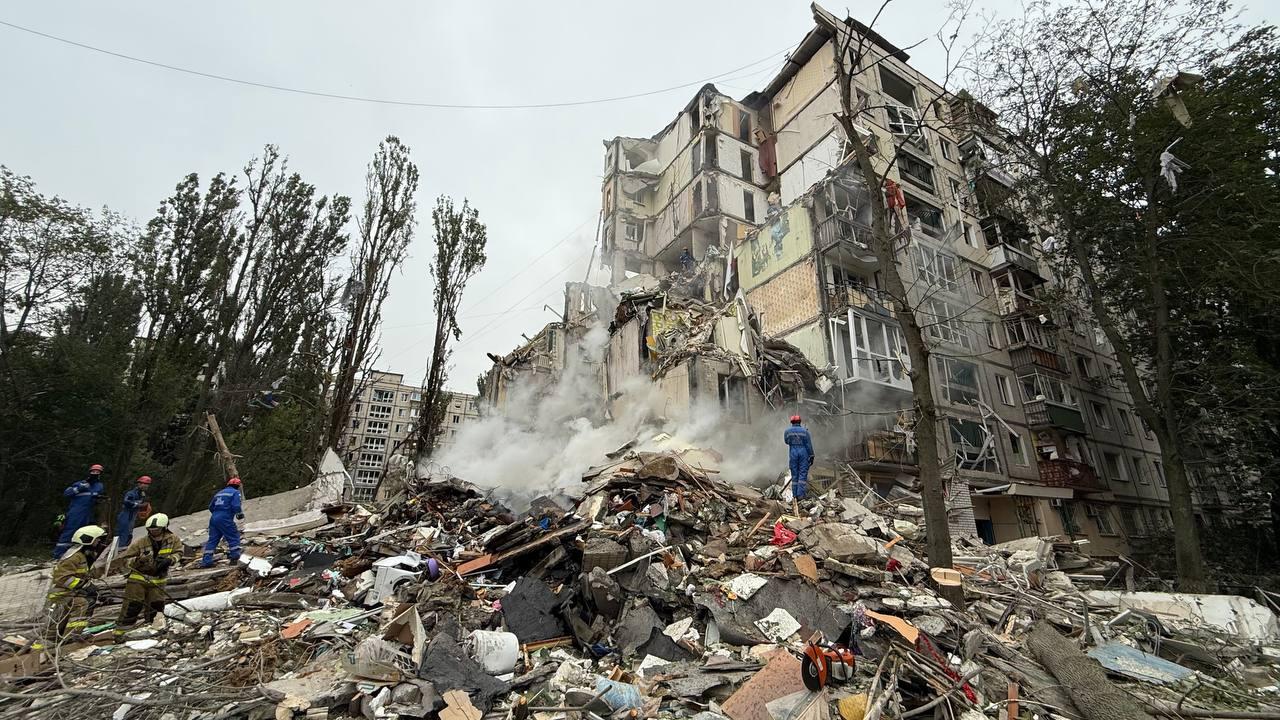
First responders work at the site of Russian drone, missile attack in Kyiv in the early hours. (Interior Ministry / Telegram)
Among the dead was senior police lieutenant Liliia Stepanchuk, a patrol officer who had served Kyiv’s police force since 2017. Her body was recovered from the rubble during rescue operations that stretched across 27 separate impact sites throughout the capital. The randomness of death struck hardest in residential areas, where entire apartment entrances collapsed and families vanished beneath concrete and steel.
Interior Minister Ihor Klymenko revealed that Russia had deployed rocket-powered Shahed-type drones in the assault—weapons capable of reaching speeds of 520 kilometers per hour while carrying 50-kilogram warheads. These upgraded variants represent Moscow’s latest adaptation in its systematic campaign to overwhelm Ukrainian air defenses and terrorize civilian populations far from the battlefield.
The Phantom Victory: Russia Claims Chasiv Yar as Ukraine Denies
As rescue workers pulled bodies from Kyiv’s rubble, Russia’s Defense Ministry orchestrated a carefully choreographed propaganda campaign, claiming its forces had completed the capture of Chasiv Yar—the strategic fortress town that has anchored Ukrainian defenses west of Bakhmut for over a year. Videos showed Russian soldiers raising tricolor flags amid the devastated urban landscape, but Ukrainian officials flatly rejected the assertions as sophisticated disinformation.
“There were Russian fakes today, as you have seen, (information about occupation) of Chasiv Yar is Russian disinformation,” President Zelensky declared in his evening address. “Ukrainian units are defending our positions and we are repelling every Russian attempt to advance in Donetsk, Sumy and Kharkiv oblasts.”
Viktor Trehubov, spokesperson of the Khortytsia group of forces, dismissed the Russian claims as deliberate misinformation designed to spread through media refutations. Yet open-source monitoring suggested Russian forces control the vast majority of the pulverized city, with Ukrainian defenders potentially holding only scattered positions in the western outskirts.
The 26-month battle for Chasiv Yar has exacted a horrific toll on Russian forces. After capturing Bakhmut in May 2023, Moscow’s armies have managed to advance just 11 kilometers westward at enormous human cost. Ukrainian intelligence sources estimated Russia sustained roughly 4,880 casualties in Chasiv Yar itself between April 2024 and February 2025—a staggering price for a city reduced to rubble.
Dmytro Zaporozhets, spokesperson of the OTU Luhansk, characterized the flag-raising videos as “performances” carried out for Russian “internal propaganda,” noting that Russian soldiers were “risking their own lives for the sake of the promised vacation”—reportedly the reward offered for participating in such spectacles.
Democratic Resilience: Parliament Restores Anti-Corruption Independence
In a stunning demonstration of Ukraine’s democratic institutions under wartime pressure, parliament voted 237-2 to restore the independence of the National Anti-Corruption Bureau (NABU) and Specialized Anti-Corruption Prosecutor’s Office (SAPO) on July 31. President Zelensky signed the legislation the same day, ending a week-long constitutional crisis that had triggered the first major protests since Russia’s invasion began.
“Ukraine is a democracy that listens to the voice of its population,” Zelensky declared after signing the bill that reversed his own administration’s earlier attempt to subordinate the anti-corruption agencies to political control. The vote represented a remarkable turnaround for a governing coalition that typically struggles to secure the 226 votes needed for major legislation.
The successful restoration came after protesters again gathered across Ukrainian cities on the eve of the parliamentary session, holding signs supporting the anti-graft agencies and demanding governmental accountability. The crisis had exposed the fragility of Zelensky’s Servant of the People party, which despite holding 231 seats on paper, typically provides fewer than 200 votes due to inconsistent attendance and internal divisions.
“By my estimate, we’re currently in the 220-230 range, but that’s a very risky zone,” a Servant of the People lawmaker had confided to the Kyiv Independent before the vote, referring to the precarious arithmetic of Ukraine’s wartime parliament. The overwhelming support for restoration suggested that even lawmakers who had initially backed the agencies’ subordination recognized the political and international costs of undermining anti-corruption institutions.
The vote coincided with parliament’s approval of a Hr 412.3 billion ($9.8 billion) increase in defense spending, raising total military expenditure to an estimated $50 billion—26% of Ukraine’s GDP. The funding ensures military salaries can be paid in August while prioritizing domestic drone production and weapons procurement, demonstrating Ukraine’s ability to maintain both democratic governance and military effectiveness under extreme pressure.
Deep Strike Retaliation: Ukraine Hits Russian Defense Infrastructure
Even as Russian missiles fell on Kyiv, Ukrainian forces demonstrated their expanding capability to strike deep into enemy territory. Security Service of Ukraine (SBU) drones hit the JSC Radiozavod plant in Penza, a sanctioned facility owned by the Russian state-owned Rostec defense corporation, causing at least 11 explosions and a massive fire at the military electronics facility.
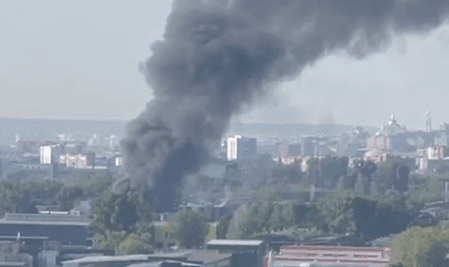
A fire broke out following Ukrainian drone attack in Russia’s western city of Penza. (SBU source)
The Radiozavod plant specializes in equipment for mobile command units, automated combat control systems, and military-grade radio stations used across multiple Russian military branches. “It is a key enterprise of the Russian military-industrial complex,” declared Andrii Kovalenko, head of Ukraine’s Center for Countering Disinformation.
Located roughly 625 kilometers southeast of Moscow, the successful strike demonstrated Ukraine’s growing ability to project power far beyond traditional front lines. The attack targeted critical infrastructure supporting Russia’s command and control capabilities, potentially disrupting communications systems essential to coordinating military operations across multiple theaters.
Simultaneously, Ukrainian drones struck transportation and energy infrastructure in Volgograd Oblast, cutting gas supplies to 65 homes and forcing temporary restrictions on train traffic near the Tinguta station. Russian officials claimed their air defenses intercepted 31 Ukrainian drones across six regions, though the successful strikes on strategic targets suggested many projectiles reached their intended destinations.
The deep strike campaign reflects Ukraine’s evolving strategy of forcing Russia to defend vast territories far from the primary battlefield, stretching Moscow’s resources and disrupting the industrial base supporting its war effort. Each successful attack on Russian infrastructure demonstrates Kyiv’s determination to carry the consequences of aggression back to the aggressor’s homeland.
Congressional Rebellion: Republicans Demand Sanctions Revolution
Despite President Trump’s shifting stance toward Russia, a powerful faction of Congressional Republicans pushed for the most comprehensive sanctions overhaul since the Cold War. The Republican Study Committee (RSC), led by National Security Task Force Chair Zach Nunn and RSC Chairman August Pfluger, sent a letter to House Speaker Mike Johnson and Senate Majority Leader John Thune demanding sweeping economic warfare against Moscow.
“President Trump just put Putin on the clock. Now it’s up to Congress to deliver the tools needed to hit the Russian war machine if he refuses to come to the table,” declared Nunn. The proposed measures would grant Trump extensive authority to use sanctions as strategic negotiation tools while implementing a total freeze on Russian government assets and imposing secondary sanctions on Chinese and North Korean entities supporting Moscow.
The RSC’s initiative represents a dramatic shift from current targeted, conduct-based sanctions to comprehensive, economy-wide measures. The proposal includes mechanisms to gradually reduce oil price caps to zero, sanction foreign entities supporting Russian financial systems, and target Russia’s “shadow fleet” of tankers evading international restrictions.
The conservative coalition demanded acknowledgment of what it termed the “failures of the Obama administration and the Biden administration” in deterring Russian aggression, arguing that Ukraine suffered its greatest territorial losses under Democratic leadership. The timing of the letter, coinciding with Trump’s shortened ultimatum to Putin, suggested growing Republican impatience with diplomatic half-measures.
Simultaneously, the U.S. Senate Appropriations Committee defied Trump’s previous pledges to reduce Ukrainian aid by approving $1 billion in support for Kyiv. The 26-3 vote on an $852 billion Defense Department budget included $800 million for the Ukraine Security Assistance Initiative, highlighting growing congressional resistance to abandoning Ukrainian allies despite changing White House priorities.
Emergency Diplomacy: International Community Mobilizes
Ukraine’s Foreign Minister Andrii Sybiha called for an urgent UN Security Council meeting in response to Russia’s devastating attack on Kyiv, scheduled for August 1 in New York City. The emergency session was convened “in response to Russia’s latest escalation of terror,” as Moscow’s assault demonstrated its continued rejection of international peace efforts.
“Putin rejects peace efforts and wants to prolong his war,” Sybiha declared. “And the world has the necessary strength to stop him—by united pressure and principled position in favor of a full, immediate, and unconditional ceasefire.” The diplomatic mobilization came as senior American diplomat John Kelley told the Security Council that Trump wants a comprehensive peace deal by August 8.
President Zelensky seized the moment to issue his most direct challenge yet to Western allies, calling for regime change in Russia during a conference marking 50 years since the signing of the Helsinki Final Act. “If the world doesn’t aim to change the regime in Russia, that means even after the war ends, Moscow will still try to destabilize neighboring countries,” he warned in his virtual address.
The Ukrainian president demanded that Western partners move beyond freezing Russian assets to outright confiscation, insisting that “every frozen Russian asset, including the stolen wealth of corruption” be deployed in Ukraine’s defense. His call for regime change represented the most explicit challenge yet to the West’s cautious approach to confronting Putin’s regime.
In a separate diplomatic development, Zelensky held his first phone conversation with Polish President-elect Karol Nawrocki, who emphasized that future cooperation must be based on “mutual respect and genuine partnership.” While confirming continued Polish support against Russian aggression, Nawrocki stressed the need for Ukraine to address “important and so far unresolved historical issues” regarding the Volyn massacres of 1943-1944.
Humanitarian Catastrophe: Crisis in Occupied Donetsk
Behind the front lines, residents of Russian-occupied Donetsk faced a mounting humanitarian catastrophe as water shortages reached critical levels. Citizens received tap water only once every three days, queuing for hours at mobile tanks while relying on unsanitary sources including basement wells and contaminated mine water.
Pro-Russian bloggers published an open letter to Putin signed by Donetsk residents describing the situation as “a humanitarian and environmental catastrophe.” The letter, distributed through Telegram channels with nearly half a million followers, indicated growing frustration even among Moscow’s supporters in occupied territories.
“I believe you are wise and strong, Uncle President! Please give us the simplest miracle—water in our homes,” pleaded one child in a video appeal to Putin. “Water is such a simple thing, but for us—it’s a luxury. We, children, should be running and laughing, not waiting for water deliveries.”
The crisis stems from Ukraine’s control of the Seversky Donets-Donbas Canal, severely damaged during fighting in 2022. Russia’s replacement Don-Donbas pipeline, overseen by now-arrested Deputy Defense Minister Timur Ivanov for corruption, covers only 45% of the region’s water needs despite officials declaring it operational in 2024. The water that does arrive is often undrinkable—yellow, cloudy, and foul-smelling.
Genocidal Rhetoric: Russian State Media Escalates Hate Speech
Russian state-run media outlet RIA Novosti published a column titled “There is no other option: no one should be left alive in Ukraine” on July 30, marking a dangerous escalation in genocidal war propaganda that continued to resonate throughout July 31. Columnist Kirill Strelnikov described Ukrainians as “laboratory rats,” denied their humanity, and claimed they were “ready to die” for what he derisively called “the best army in the world.”
The article repeated core Kremlin propaganda lines portraying Ukraine as a “military training ground” for the West and Ukrainians as mere pawns of the U.S. and Europe. Strelnikov dismissed Western military analyses recognizing Ukraine’s battlefield achievements and derided American and British generals for praising Ukrainian forces.
This rhetoric reflects Russia’s increasingly genocidal framing of the conflict, echoing prior statements by state officials that deny Ukraine’s right to exist as a sovereign nation. The timing of the publication, coinciding with Trump’s ultimatum and subsequent deadly attack on Kyiv, suggested a coordinated campaign to justify escalating violence against Ukrainian civilians.
Meanwhile, a Russian court sentenced journalist and former Alexey Navalny volunteer Olga Komleva to 12 years in prison on charges of participating in “extremist” activities and spreading “false information” about Russian military actions. The 46-year-old had volunteered for Navalny’s banned party and covered Russia’s war against Ukraine for independent outlet RusNews, representing the Kremlin’s escalating crackdown on independent voices.
Military Innovation: Ukraine Adapts to Evolving Threats
Ukraine’s National Guard 1st Azov Corps announced the formation of a dedicated “anti-Shahed” drone unit designed to detect, triage, and intercept long-range Russian drones using specialized interceptor aircraft. The development came as Russia increasingly deployed rocket-powered Shahed variants capable of overwhelming traditional air defense systems through speed and maneuverability.
Kyiv also implemented a localized air raid alert system to reduce disruption to civilian life and economic activity amid escalating aerial attacks. The system, successfully tested in Kherson Oblast, provides targeted warnings based on actual threat proximity rather than region-wide alerts that had been paralyzing business operations.
According to the European Business Association, 41% of companies had reported operational limitations due to frequent region-wide alerts, with some losing up to 50% of working hours. The new system represents Ukraine’s attempt to balance security requirements with the economic imperatives of maintaining a functioning society under constant attack.
Ukraine also moved to strengthen its legal framework against Russian economic warfare by implementing sanctions against vessels and aircraft involved in Moscow’s “shadow fleet” operations. President Zelensky signed legislation enabling restrictions against ships and aircraft deemed threats to Ukraine’s national security, territorial integrity, and sovereignty.
European Security Concerns: Border Tensions Rise
Security concerns mounted across Europe as Lithuania considered partially closing its airspace amid an ongoing search for a drone suspected of entering from Belarus on July 28. Defense Minister Dovile Sakaliene announced military reinforcements at the border, warning that upcoming Zapad-2025 military exercises involving 13,000 Russian and Belarusian troops increase the likelihood of incidents.
UK defense intelligence reported that Russia had commenced construction of hardened aircraft shelters at airfields near the Ukraine border, including Millerovo, Kursk Vostochny, and Hvardiske, in response to successful Ukrainian drone strikes. The shelters feature dome-shaped rooftops, thick blast doors, and earth covering designed to protect valuable aircraft from precision attacks.
The defensive measures reflected Russia’s growing vulnerability to Ukrainian long-range strikes, forcing Moscow to invest substantial resources in protecting strategic assets previously considered safe from retaliation. At Millerovo Air Base, situated just 17 kilometers from the Ukrainian border, eight newly constructed drive-through aircraft shelters were nearing operational readiness alongside hardened facilities.
Economic Warfare: Sanctions Begin to Bite
The International Monetary Fund’s assessment of Russia’s deteriorating economic prospects gained additional credibility as European and U.S. sanctions appeared to degrade Moscow’s oil revenues significantly. Indian refineries were diversifying crude imports away from Russian sources, while the Russian-backed Nayara Energy refinery operated at only 70-80 percent capacity due to European restrictions.
These developments vindicated the IMF’s dramatic downgrade of Russia’s 2025 growth forecast to just 0.9%—more than four times lower than 2024’s 4.3% expansion. The revision represented the steepest downgrade among major economies, with growth projected to remain sluggish at 1% in 2026 as war costs mount and sanctions effects compound.
Trump’s threat to impose 25% tariffs on Indian imports, specifically targeting New Delhi’s continued purchases of Russian military equipment and energy, demonstrated growing American impatience with countries enabling Moscow’s war effort. “I don’t care what India does with Russia,” Trump posted on Truth Social. “They can take their dead economies down together, for all I care.”
International Isolation: Nicaragua’s Dangerous Gambit
Russia’s desperate search for international legitimacy received a boost from an unlikely source as Nicaragua’s President Daniel Ortega signaled potential recognition of Moscow’s claims over four Ukrainian oblasts. The Central American leader sent a letter to Putin expressing support for Russia’s “heroic battle against Ukrainian neo-Nazism,” language that mirrors Kremlin propaganda narratives precisely.
Ukraine’s Foreign Ministry warned that such recognition would constitute “a gross violation of international law” and promised proportionate responses to “unprecedented unfriendly actions.” If formalized, Nicaragua would become the first country to officially recognize Russia’s illegal 2022 annexation of Donetsk, Luhansk, Zaporizhzhia, and Kherson oblasts—territories Moscow claims despite not fully controlling any of them.
The potential Nicaraguan recognition highlighted Russia’s increasing reliance on a shrinking coalition of authoritarian allies, including Venezuela, North Korea, and Syria. These relationships provide Moscow with diplomatic cover at international forums while demonstrating the regime’s growing isolation from the democratic world.
The Systematic Campaign: Children as Weapons of War
Ukrainian military intelligence (HUR) revealed additional evidence of Russia’s systematic deportation campaign through a successful cyber operation against Russian occupation administration servers in Crimea. The retrieved files documented the organized removal of children from Russian-occupied areas in Kherson, Zaporizhzhia, Donetsk, and Luhansk oblasts.
The cache included thousands of documents revealing personal profiles of abducted children, illegal guardianship appointments assigning Russian citizens as caretakers, relocation addresses, and records of children resettled throughout Russian-controlled areas. According to Ukraine’s official Children of War database, at least 19,546 Ukrainian children have been confirmed forcibly removed since February 2022, with only 1,468 brought back home.
Russia’s investment in eradicating Ukrainian children’s identities reached staggering proportions, with 67 billion rubles ($825 million) allocated to indoctrination programs in occupied territories. Over 615,000 school-aged children live under occupation, with 100,000 forced to participate in Russian youth organizations designed to eliminate their Ukrainian identity and instill pro-Russian values.
Looking Ahead: August 8 and the Collision Course
As Trump’s August 8 deadline approaches with just one week remaining, the events of July 31 crystallized the fundamental dynamics that will determine the war’s next phase. Russia’s massive attack on Kyiv, timed precisely to coincide with international pressure for peace, demonstrated Putin’s calculated rejection of diplomatic solutions in favor of escalating violence.
Ukraine’s successful restoration of anti-corruption independence while approving massive defense spending increases showed a nation capable of maintaining democratic governance under extreme pressure. The $9.8 billion budget increase, prioritizing domestic drone production and military salaries, signals Kyiv’s preparation for a protracted conflict regardless of diplomatic outcomes.
The growing international mobilization, from congressional Republicans demanding comprehensive sanctions to UN Security Council emergency sessions, suggests the global community is beginning to grasp the existential nature of the challenge Putin’s regime represents. Zelensky’s call for regime change in Russia, once considered diplomatically impossible, now appears increasingly mainstream as Moscow’s genocidal rhetoric and systematic war crimes destroy any pretense of reform potential.
For Putin, the collision course with Trump’s ultimatum presents an impossible choice: genuine negotiation would expose the regime’s fundamental weakness, while continued escalation risks triggering economic measures that could destabilize Russia’s already fragile war economy. The dictator’s response—more violence, more terror, more defiance—suggests he has chosen to double down on military solutions even as his strategic position deteriorates.
The phantom promises of ceasefires continue to be answered with the documented reality of chemical attacks, precision strikes targeting children, and systematic campaigns designed to eliminate Ukrainian identity itself. As the bodies are pulled from Kyiv’s rubble and the evidence of genocide mounts, the international community faces a moment of truth about whether democratic nations possess the resolve to confront evil in its most naked form.
The next week will determine whether Trump’s economic weapons can succeed where military aid has provided only stalemate, whether Europe’s defense mobilization can create genuine deterrence, and whether the civilized world has learned the lessons of the 1930s about the costs of appeasing genocidal regimes. For Ukraine, the challenge remains constant—defending democracy against tyranny while the world watches and, perhaps finally, acts.