
Hours Before Alaska Summit, Russian Forces Test Dobropillia Defenses While Ukrainian Intelligence Reveals Massive North Korean Military Deployment to Support Moscow’s War Effort
Summary of the Day – August 12, 2025
Three days before the Trump-Putin summit in Alaska, the battlefield dynamics shifted dramatically as Russian sabotage and reconnaissance groups infiltrated Ukrainian defenses east and northeast of Dobropillia, while Ukraine’s military intelligence revealed that North Korea had deployed 11,000 soldiers to Russian training grounds. The tactical penetration near Dobropillia, involving small groups hiding in basements and forests, represented Russia’s most significant advance in the direction since its protracted 17-month campaign began. Meanwhile, Ukrainian forces demonstrated their long-range strike capabilities by hitting drone storage facilities in Tatarstan and a helium production plant in Orenburg—critical infrastructure located over 1,200 kilometers from the front lines. As diplomatic preparations intensified for the Alaska meeting, smoke was observed at the occupied Zaporizhzhia Nuclear Power Plant, adding another layer of concern to an already volatile situation.
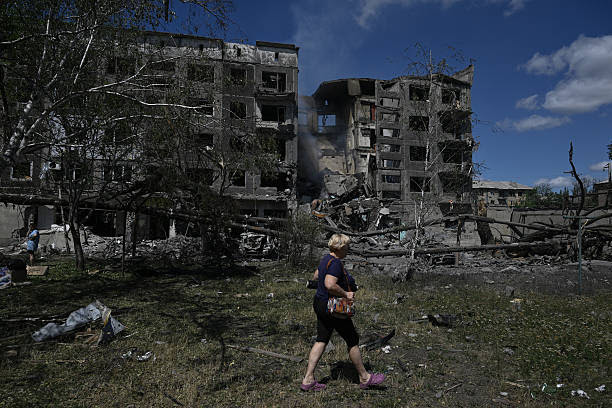
A woman walks past a heavily damaged residential building following a Russian strike in the town of Bilozerske, Donetsk Oblast. People in Bilozerske are evacuating as Russian troops make gains in the region. (Genya Savilov/AFP via Getty Images)
The Dobropillia Gambit: Russian Infiltration Tests Ukrainian Defenses
Russian forces continued their tactical penetration east and northeast of Dobropillia using limited sabotage and reconnaissance groups, with Ukrainian intelligence reporting infiltrations in Vesele, Rubizhne, Kucheriv Yar, and Vilne. President Zelensky acknowledged the complexity of the situation, stating that Russian forces operating without mechanized equipment had advanced about 10 kilometers deep into Ukrainian territory.
The Ukrainian General Staff reported that several small Russian groups bypassed Ukrainian positions and attempted to advance toward Zolotyi Kolodyaz, with Ukrainian forces already destroying some of these infiltration units. The military command allocated additional forces and resources to counter the penetration, recognizing the potential threat to broader defensive positions.
Russian milbloggers claimed advances in Nove Shakhove, Rubizhne, Ivanivka, Dorozhie, and areas near Bilytske, characterizing the Russian forces as limited sabotage and reconnaissance groups hiding in basements, windbreaks, and forests. The infiltration tactic relies on small fireteams finding weak points in Ukrainian defenses, waiting for reinforcements to accumulate before attempting to establish footholds.
Military Units Redeployment: Russian Command Shuffles Forces
The Russian military command conducted significant unit rotations across multiple sectors. Elements of the 119th Airborne Regiment and 83rd Separate VDV Brigade redeployed to Yunakivka to relieve elements of the 104th, 234th, and 237th VDV regiments from the 76th VDV Division. The command left elements of the 51st VDV Regiment stranded near Sadky following a failed evacuation attempt for wounded personnel.
Ukrainian forces controlled Novokostyantynivka north of Sumy City as of August 12, while Russian forces continued attacks across multiple directions. Drone operators from the 106th VDV Division, 83rd Separate VDV Brigade, Rosgvardia Special Forces, and 155th Naval Infantry Brigade struck Ukrainian positions throughout Sumy Oblast.
The Chechen Akhmat Spetsnaz Salyut Group operated along the border between Kharkiv and Sumy oblasts, while elements of the 352nd Motorized Rifle Regiment continued operations near Stepova Novoselivka. The 12th Tank Regiment from the 4th Tank Division successfully seized Zelenyi Hai east of Borova.
Skeptical Voices: Russian Milbloggers Question Moscow’s Ability to Exploit Gains
In an unusual display of battlefield realism, several Russian milbloggers expressed caution about Moscow’s ability to exploit the tactical penetration near Dobropillia. A former Storm-Z instructor warned that Russian forces had infiltrated Ukrainian defenses in a “splayed” manner, with the depth of penetration threatening Russia’s ability to secure its flanks.
The milblogger complained that Russian forces had not adequately integrated strike drone units with assault groups, relying instead on Russia’s “usual” highly attritional, infantry-led assaults. Another source claimed the penetration had significantly stretched the frontline and that Russian forces would only succeed if they possessed enough manpower to introduce operational reserves and advance “correctly and in time.”
These concerns highlighted the inherent risks of infiltration missions, where infantry far from the front can only receive supplies via drones, and main forces cannot support isolated groups. The skepticism from typically optimistic Russian sources suggested genuine doubts about Moscow’s ability to mature tactical advances into operational breakthroughs.
Civilian Evacuations: 144 Residents Remain in Contested Area
Only 144 people remained in the Shakhove community as Russian forces approached, with the largest concentration of 44 residents in Zolotyi Kolodiaz. Serhii Sazhko, head of the village military administration, confirmed the evacuation challenges as the front line moved closer to populated areas.
The small remaining civilian population highlighted the dangers of evacuation from contested territories, with Russian forces repeatedly accused of targeting non-combatants attempting to flee active combat zones. The concentration of residents in Zolotyi Kolodiaz made their situation particularly precarious given reported Russian attempts to advance toward the settlement.
Massive Equipment Losses: Russian Campaign Costs Mount
Russian forces lost well over five divisions’ worth of armored vehicles and tanks in Pokrovsk region since beginning their offensive operation to seize Avdiivka in October 2023. The staggering losses occurred during 17 months of protracted campaigning, with Russian forces advancing 55 kilometers in depth from their original positions west of Avdiivka.
The equipment attrition rate demonstrated the enormous costs of Russian offensive operations, even as Moscow continued pouring resources into the Pokrovsk direction. The losses represented one of the highest concentrations of Russian materiel destruction during the conflict, highlighting the intensity of fighting in the sector.
Political Messaging: Russian Officials Frame Battlefield Gains
Russian State Duma deputies Alexei Zhuravlev and Nikolai Buduev claimed negotiations must account for “realities on the ground,” referencing frontline positions to demand Ukrainian concessions. Zhuravlev characterized eastern Ukraine as a “treasure trove of minerals” and emphasized the strategic importance of maintaining a land corridor to occupied Crimea.
Buduev argued that freezing the current frontline would only provide a temporary solution, leaving “root causes” of the war unresolved. Deputy Head Alexei Chepa similarly claimed any peace settlement must address war “causes” to prevent future Russian military activity, reiterating Moscow’s maximalist demands for regime change in Kyiv.
Kremlin-affiliated academic Dmitry Suslov published an op-ed in Kommersant claiming any ceasefire from the Alaska summit would be based “primarily on the Russian approach,” while Liberal Democratic Party Head Leonid Slutsky declared that additional Western military aid would not change the battlefield situation.
Union State Integration: Russia-Belarus Deepen Institutional Ties
Putin appointed Russian Deputy Foreign Minister Alexander Grushko to serve simultaneously as Russia’s Special Representative for the Agreement on Security Guarantees for the Union State. Belarusian President Lukashenko had previously appointed Deputy Foreign Minister Igor Sekreta as Belarus’ special representative on July 15.
The appointments demonstrated continued efforts to formalize the Russia-Belarus alliance structure, potentially providing Moscow with additional strategic depth and enhanced logistical support for operations against Ukraine while strengthening institutional integration between the two states.
North Korean Escalation: 11,000 Soldiers Deploy to Support Russian War Effort
Ukrainian military intelligence revealed a significant escalation in international support for Russia’s war effort, with North Korea deploying approximately 11,000 soldiers to Russian training grounds, primarily in western Russia including Kursk Oblast. Major General Vadym Skibitskyi reported that the Russian military command had defined North Korean forces’ areas of responsibility as Kursk and Belgorod oblasts.
The deployment includes plans for North Korean troops to support reconstruction efforts in Kursk Oblast, with the first contingent of approximately 1,200 soldiers expected to arrive soon. This development cohered with Russian Security Council Secretary Sergei Shoigu’s June 2025 announcement and South Korean intelligence assessments predicting such deployments in July or August.
The Russian military command likely aims to leverage North Korean troops to pin Ukrainian forces to the border area as part of efforts to establish a buffer zone in northern Sumy and Kharkiv oblasts. This would prevent Ukraine from redeploying manpower to reinforce defensive positions in other priority areas, effectively freeing up Russian forces for deployment elsewhere along the front.
Operation Spiderweb Revealed: Ukraine’s Audacious Strike on Russian Bomber Fleet
Ukraine’s Security Service chief Vasyl Maliuk provided detailed revelations about Operation Spiderweb, one of the war’s most audacious missions that destroyed between 13 and 21 Russian heavy bombers. The operation involved establishing a secret base just a block from Russia’s Federal Security Service headquarters in Chelyabinsk region, using the premises to stage the multi-phase strike.
The sophisticated operation relied on smuggling first-person-view drones thousands of kilometers into Russia, hidden inside retractable roofs of wooden hunting cabins equipped with EcoFlow batteries and solar panels. These autonomous systems could operate in minus 40-degree weather, with roofs remotely retracted to launch drones directly at bombers stationed at four Russian air bases.
The targeted Tu-95 and Tu-22M3 bombers represented key assets for launching long-range missile barrages on Ukrainian cities, making their destruction a significant blow to Russia’s strategic capabilities. Maliuk noted that President Zelensky maintained regular contact with the operation’s organizers and frequently pushed for acceleration of the mission timeline.
Long-Range Precision: Ukrainian Strikes Hit Critical Russian Infrastructure
Ukraine continued its long-range drone campaign with strikes on multiple strategic targets deep inside Russia. The Security Service confirmed a second attack on the Shahed drone warehouse in Kyzyl Yul, Tatarstan, following a previous strike on August 9. The facility, located 43 kilometers from the Alabuga Special Economic Zone, stored Shahed drones and foreign-sourced components critical to Russia’s drone production capabilities.
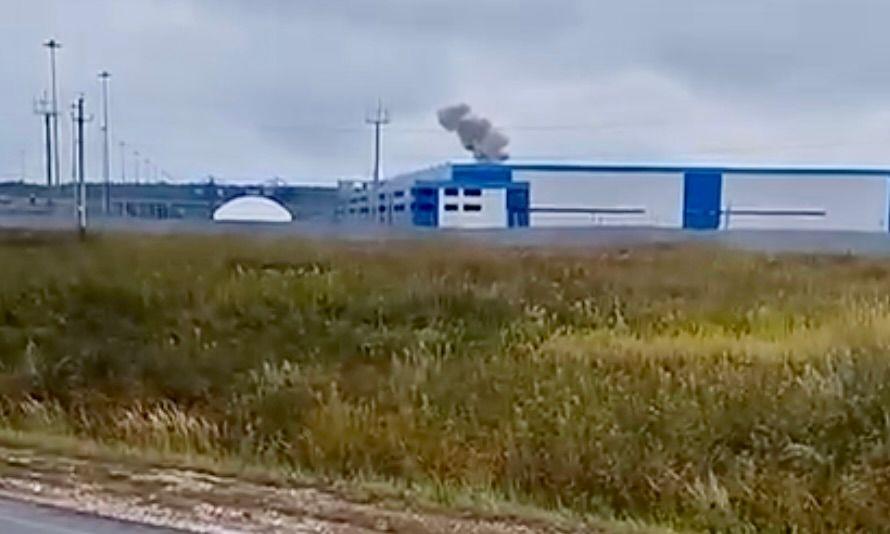
Ukraine hit a storage facility in Russia’s Tatarstan Republic that housed Shahed-type drones.
Ukrainian military intelligence conducted a simultaneous strike against the Orenburg Helium Plant, described as Russia’s only facility producing helium—a critical component in missile production, space industry, and aviation sector applications. The plant, located 1,200 kilometers from the front line, processes 15 million cubic meters of natural gas annually and represents a vital link in Russia’s military-industrial complex.
The strikes demonstrated Ukraine’s expanding deep-strike capabilities and determination to degrade Russian military production capacity even as diplomatic pressure mounted for territorial concessions.
Nuclear Concerns: Smoke Observed at Zaporizhzhia Power Plant
Smoke was observed in the area of the cargo port at the Russian-occupied Zaporizhzhia Nuclear Power Plant, prompting urgent warnings from Ukraine’s Energy Ministry about potential “unpredictable and catastrophic consequences for the entire continent.” The ministry condemned Russia’s continued deployment of troops and military equipment at Europe’s largest nuclear facility.
International Atomic Energy Agency Director General Rafael Grossi reported no radiation increase or nuclear safety impact, but the incident highlighted ongoing risks associated with military activities around the facility. The port lies outside the plant’s protected perimeter, though the exact cause and location of the smoke remained unclear.
The incident occurred amid U.S. proposals to return control of the plant to Ukraine before transferring management to American oversight—a suggestion Moscow immediately rejected based on its illegal annexation of Zaporizhzhia Oblast.
Alaska Summit Preparations: Trump Describes Meeting as “Listening Exercise”
White House Press Secretary Karoline Leavitt characterized the August 15 Trump-Putin meeting in Anchorage as a “listening exercise” for the U.S. president, suggesting the talks might not produce immediate results. The summit, to be held at Joint Base Elmendorf-Richardson military facility, will mark Putin’s first visit to the United States in a decade.

White House press secretary Karoline Leavitt takes a question from a reporter during the daily press briefing at the White House, in Washington, DC. (Andrew Harnik/Getty Images)
Secretary of State Marco Rubio emphasized that “a meeting is not a concession,” noting that negotiations would be difficult given the war’s importance to both sides. Rubio cited figures suggesting 60,000 Russian soldiers were killed in combat during the previous month, highlighting the conflict’s intensity.
The characterization of the meeting as exploratory rather than decisive aligned with Trump’s earlier description of the talks as a “feel-out meeting” to assess Russian readiness for peace negotiations.
EU Financial Support: €1.6 Billion from Frozen Russian Assets
The European Union channeled €1.6 billion in interest from frozen Russian central bank assets to Ukraine, with 95% of the latest tranche earmarked to help Kyiv repay loans from G7 partners. This represented the third such transfer, following earlier disbursements in July 2024 and April 2025.
The funds originated from approximately €200 billion of Russian central bank assets frozen in 2022, with about 90% held by Belgium-based Euroclear. The latest distribution shifted 95% to the Ukraine Loan Cooperation Mechanism, providing non-repayable funds to cover G7 loan repayments, while 5% continued supporting military aid through the European Peace Facility.
The EU estimated frozen Russian assets would generate €2.5-3 billion annually in interest, ensuring Ukraine receives critical support without adding to its debt burden while maintaining economic pressure on Moscow.
Military Casualties: Russian Strikes Kill Ukrainian Servicemembers
Russian forces conducted a missile attack on a Ukrainian military training facility overnight, killing one servicemember and injuring 11 others. The Ground Forces reported that cluster munitions struck a group of soldiers heading for shelter after alarms sounded, with 12 additional servicemembers seeking medical assistance for acoustic trauma and shock.
The attack continued a pattern of Russian strikes on Ukrainian training facilities, highlighting ongoing vulnerabilities in rear-area military infrastructure. Ukraine’s Armed Forces faced increasing scrutiny over soldier safety at training grounds, with previous attacks leading to command changes and pledges for improved safety standards.
Azov Deployment: Elite Unit Reinforces Pokrovsk Sector
The 1st Azov Corps of the National Guard took up defensive positions in the Pokrovsk sector to block attacking Russian forces, arriving in the area “several days” earlier. The unit described the situation as “complex and dynamic,” with Russian troops attempting advances while reportedly suffering significant personnel and equipment losses.
Azov’s deployment represented a significant reinforcement for Ukrainian defenses in one of the war’s most contested sectors. The corps, formed earlier in 2025 as part of broader military reforms, traced its roots to the original Azov Brigade that played crucial roles in defending Mariupol and other strategic locations.
Battlefield Advances: Russian Forces Gain Ground Across Multiple Sectors
Beyond the Dobropillia infiltration, Russian forces achieved confirmed advances across several front sectors. Geolocated footage showed Russian advances in eastern Rodynske and central Udachne in the Pokrovsk direction, while elements of the 12th Tank Regiment seized Zelenyi Hai east of Borova.
In the Kharkiv direction, Russian forces advanced south of Milove northeast of Velykyi Burluk, demonstrating continued pressure along the northeastern front. Ukrainian sources reported counterattacks near several locations, indicating active defensive efforts to contain Russian gains.
The Ukrainian General Staff reported over 110 combat engagements across the front, with Russian forces attempting to penetrate defenses through small infantry units operating between Ukrainian lines. The military emphasized that infiltrating groups faced destruction when encountering Ukrainian defenders.
Training Facility Strike: Russian Missiles Target Military Personnel
Russian forces conducted a missile attack on a Ukrainian military training facility overnight, using cluster munitions that killed one servicemember and injured 11 others. The attack occurred as soldiers headed for shelter after air raid sirens sounded, with 12 additional personnel seeking medical assistance for acoustic trauma and shock.
The Ground Forces reported the strike as part of ongoing Russian efforts to target military training infrastructure in Ukraine’s rear areas. The attack highlighted continuing vulnerabilities at training facilities despite previous command pledges to improve safety standards following earlier deadly strikes.
Crimean Militarization: Russia Expands Youth Indoctrination Programs
Russian occupation authorities in Crimea launched the “Align with Heroes” program, targeting children aged 12-16 whose parents fought in the Russian military against Ukraine. The program involves Russian veterans and psychologists teaching military disciplines, shooting, medicine, and conducting psychological training.
The initiative represents part of broader Russian efforts to militarize and indoctrinate children in occupied territories, with participants engaging in team games, classes, and excursions designed to prepare them for future military service. The program specifically targets children of forcibly mobilized servicemembers from occupied Crimea.
International Diplomacy: Turkish Offer and European Concerns
President Zelensky spoke with Turkish President Recep Tayyip Erdogan, who offered to host future peace talks between Ukraine and Russia in Turkey. Erdogan emphasized that “any negotiations without Ukraine will not bring lasting peace” and expressed readiness to host a summit involving Ukraine, the United States, Russia, and Turkey.
The Turkish proposal came as European leaders sought to maintain influence in the peace process ahead of the Alaska summit. A joint EU statement affirming support for Ukraine and stressing that “international borders must not be changed by force” received backing from 26 member states, though Hungary notably refused to sign.
EU foreign policy chief Kaja Kallas announced preparations for a 19th package of sanctions against Russia, stating that “as far as Russia has not agreed to a full and unconditional ceasefire, we should not even discuss any concessions.” The announcement demonstrated continued European commitment to economic pressure despite diplomatic developments.
Polish Deportations: 63 People Expelled After Concert Violence
Polish Prime Minister Donald Tusk announced that 63 people, including 57 Ukrainians and six Belarusians, would be forced to leave Poland following riots at a Belarusian rapper’s concert in Warsaw. The August 9 concert of Max Korzh at the National Stadium descended into chaos after concertgoers fought with security guards.
The controversy intensified when an attendee displayed a red and black flag associated with the Ukrainian Insurgent Army, sparking public backlash in Poland. A Ukrainian man later apologized, explaining he intended to remind people about Russian aggression and soldier safety, not to promote any political regime.
Tusk warned against Russian attempts to “sow discord between Kyiv and Warsaw” as resolution of the Ukraine war approached, describing anti-Polish gestures by Ukrainians and anti-Ukrainian sentiments in Poland as “Putin’s scenario, orchestrated by foreign agents and local idiots.”
Alaska Protest Planned: Local NGO Organizes Counter-Demonstration
Stand Up Alaska NGO announced plans to hold a protest ahead of the Trump-Putin meeting, scheduling a rally for August 14 in Anchorage to oppose the “presence of an international war criminal” and show solidarity with Ukraine. The organization declared “Alaska opposes tyranny!” in its statement.
Alaska Governor Mike Dunleavy previously welcomed hosting the meeting, calling it “historic” and emphasizing Alaska’s strategic location “at the crossroads of North America and Asia.” The governor noted that only two miles separate Russia from Alaska, making no other location more vital for national defense and Arctic leadership.
Russian Market Surge: Stocks Hit Three-Month High on Peace Hopes
Russian stocks climbed to their highest level in over three months amid hopes that the Trump-Putin meeting might bring Moscow and Kyiv closer to a ceasefire. The Moscow Exchange index surged 8.3% since Thursday, adding roughly 465 billion rubles in market capitalization.
Shares of sanctions-affected companies led gains, with titanium giant VSMPO-AVISMA jumping 10%, steel corporation Severstal rising 4.4%, and Aeroflot gaining 3.3%. State energy giant Gazprom’s shares soared 16% over the past week as traders anticipated potential sanctions relief.
Border Policy Considerations: Zelensky Proposes Easing Travel Restrictions
President Zelensky instructed the government and military command to consider easing border-crossing restrictions for Ukrainians under age 22, addressing concerns over declining student populations and potential brain drain. The proposal aimed to help young Ukrainians maintain ties with their homeland while pursuing education.
Current martial law restrictions bar most men aged 18-60 from leaving the country, leading many teenagers to depart before their 18th birthday. Student enrollment in higher education institutions dropped to just 197,000 in 2024—the lowest figure in nine years—sparking fears of long-term talent loss.
Economic Pressure: Russian Fuel Crisis Deepens
The Russian government scheduled an emergency meeting with top oil companies for August 14 to address soaring fuel prices, with gasoline costs jumping nearly 50% since the start of 2025. Officials weighed measures to prevent retail prices from outpacing inflation, including increasing fuel sales quotas on exchanges.
The crisis followed Russia’s sweeping gasoline export ban through August and continued Ukrainian drone strikes on oil refineries. The Saratov refinery halted oil intake after an August 10 strike, joining the Ryazan and Novokuibyshevsk facilities in reducing operations, demonstrating the cumulative impact of Ukraine’s energy infrastructure campaign.
Defensive Industry Cooperation: Ukrainian-Estonian Partnership
Ukrainian defense company Frontline partnered with Estonian manufacturer Milrem Robotics to integrate weapon systems with unmanned ground vehicles, conducting successful test firings in Ukraine. The collaboration reflected growing cooperation between Ukrainian and European defense manufacturers, combining battlefield experience with advanced technology development.
Live-fire tests demonstrated the effectiveness of Frontline’s Burya 40mm automatic grenade launcher turret mounted on Milrem’s THeMIS unmanned ground vehicle platform at distances exceeding 1,100 meters. The combined system showed stable operation and accurate target engagement, with further testing planned across different scenarios.
Continental Security: European Defense Expansion Accelerates
European defense factories expanded at triple speed since Russia’s full-scale invasion, with analysis revealing 7 million square meters of new industrial development across 150 facilities and 37 companies. The most extensive expansion occurred at a Hungarian ammunition production site—a joint project between N7 Holding and German firm Rheinmetall.
The expansion included 20 sites supported by the EU’s Act in Support of Ammunition Production program, allocated 500 million euros for boosting ammunition production. The industrial surge reflected European efforts to strengthen defense capabilities while supporting Ukraine’s resistance against Russian aggression.
Finland’s Legal Action: Criminal Charges for Cable Sabotage
Finland filed criminal charges against the captain and two officers of the Baltic oil tanker Eagle S for severe damage to undersea cables in December 2024. Prosecutors accused the three officers of aggravated criminal mischief for allegedly dragging the ship’s anchor more than 90 kilometers across the Gulf of Finland, severing five electricity and telecom cables and causing nearly $70 million in damages.
The Cook Islands-registered tanker, believed part of a “shadow fleet” transporting Russian oil in violation of sanctions, had departed from a Russian port carrying oil products when the incident occurred. The case represents Finland’s effort to hold shadow fleet operators accountable while avoiding formal attribution to Moscow.
Military Cooperation: Russia-Belarus Plan Joint Exercises
Russia and Belarus announced plans to conduct the combined Zapad-2025 military exercise from September 12-16, leveraging the Union State’s Regional Grouping of Forces. Belarusian International Military Cooperation Department Head Valery Revenko confirmed the exercise but did not specify the total number of participants.
The announcement demonstrated continued military integration between Moscow and Minsk, potentially providing Russia with additional strategic depth and logistical support for operations against Ukraine.
Kursk Operations: Fighting Continues in Occupied Russian Territory
Fighting continued in Kursk Oblast on August 11-12, with Russian forces conducting offensive operations in unspecified areas. Ukrainian forces maintained their positions in the region occupied since August 2024, with Russian milbloggers claiming Ukrainian counterattacks toward Tetkino southwest of Glushkovo.
The continued Ukrainian presence in Kursk Oblast provided Kyiv with a significant bargaining chip ahead of the Alaska summit, representing the only Russian territory under foreign military control since World War II.
Economic Warfare: European Defense Industry Expansion Accelerates
Analysis of satellite data revealed European defense factories expanding at triple speed since Russia’s full-scale invasion, with 7 million square meters of new industrial development identified across 150 facilities and 37 companies. The most extensive expansion occurred at a Hungarian ammunition production site—a joint project between N7 Holding and German firm Rheinmetall.
The expansion included 20 sites supported by the EU’s Act in Support of Ammunition Production program, allocated 500 million euros for boosting ammunition production. Most companies declined to comment, citing security concerns, but the data demonstrated Europe’s commitment to strengthening defense capabilities.