
As Ukrainian Forces Strike Deep into Russia and Clear Eastern Villages, Zelensky Declares Territorial Negotiations Must Begin at Current Front Lines While European Leaders Prepare for White House Showdown
Summary of the Day – August 17, 2025
The diplomatic chess game ahead of the pivotal Washington summit intensified dramatically as President Zelensky arrived in Brussels declaring that negotiations must begin at current front lines while Ukrainian forces demonstrated their continued offensive capabilities through successful strikes deep into Russian territory. Even as Secretary of State Marco Rubio acknowledged Putin had offered insufficient concessions for peace, Ukrainian troops cleared multiple villages in Donetsk Oblast and wounded a senior Russian general in Kursk, providing tactical victories to strengthen Kyiv’s negotiating position. Meanwhile, Russia launched devastating overnight attacks killing civilians across Ukraine just hours before the scheduled White House talks, underscoring Moscow’s strategy of military pressure during diplomatic engagement.
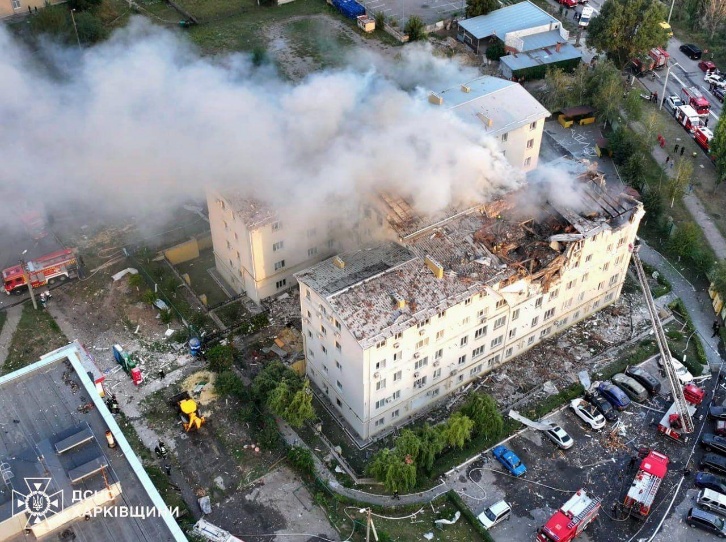
Russian forces attacked the city of Kharkiv with drones in the early hours, damaging several apartment buildings and killing at least three people, (State Emergency Service / Telegram)
Rubio’s Reality Check: Putin’s “Couple” of Concessions Fall Short
US Secretary of State Marco Rubio delivered the Trump administration’s most candid assessment of Putin’s Alaska Summit performance during multiple television interviews on August 17, stating that the Russian leader had offered “a couple” of unspecified concessions but “did not offer enough concessions to reach a just peace agreement immediately.”
Speaking on CBS’s Face the Nation, Rubio emphasized that “if one side gets everything they want, that’s called surrender,” while acknowledging the emotional difficulty of negotiations for Ukraine. “It’s very difficult because Ukraine obviously feels, you know, harmed, and rightfully so, because they were invaded,” he stated.
Rubio’s assessment contradicted more optimistic portrayals from other administration officials, revealing internal disagreements about the summit’s achievements. He confirmed that “both Russia and Ukraine need to make concessions in order to achieve a peace agreement” while reiterating that “the United States is not in a position to accept or reject a deal on behalf of Ukraine.”
The Secretary of State defended the administration’s decision not to impose new sanctions, arguing that “the moment the president puts those additional sanctions, that’s the end of the talks.” He described the conflict as a “meat grinder” where Russia was willing to “churn through” its soldiers, noting that 20,000 Russian soldiers were killed in July alone.
Putin’s Expanded Demands: Russian Language and Church Control
New details emerged about Putin’s territorial demands during the Alaska Summit, with The New York Times, Reuters, and BBC reporting that the Russian leader had asked Trump for guarantees that Russian would become an official language again in parts or all of Ukraine. Putin also demanded that Ukraine end its “persecution” of the Ukrainian Orthodox Church Moscow Patriarchate.
These linguistic and religious demands represented Putin’s attempt to control Ukrainian domestic affairs beyond territorial concessions. The Ukrainian Orthodox Church Moscow Patriarchate functioned as the Kremlin-controlled Russian Orthodox Church’s subordinate element in Ukraine, serving as part of Russia’s hybrid warfare toolkit to promote Russian nationalist ideology.
Putin’s insistence that any peace agreement must address the war’s “root causes” included these demands related to Russia’s security, Russian language use in Ukraine, and conditions for the Moscow Patriarchate. The complexity of these demands reinforced the difficulty of reaching rapid agreements as Trump desired.
Special Envoy Steve Witkoff stated that Putin had agreed Russia would “legislatively enshrine” promises not to invade any other territory in Ukraine or elsewhere in Europe. However, Putin’s history of constitutional manipulation and previous violations of international agreements, including the 1994 Budapest Memorandum, undermined the credibility of such promises.
Zelensky’s Constitutional Stand: Negotiations at Current Lines
President Zelensky delivered his strongest statement yet on territorial negotiations during his Brussels visit, declaring that “negotiations can begin where the front line currently stands” and that “Ukraine’s Constitution makes it impossible to give up territory or trade land.”
Speaking after meetings with the “coalition of the willing,” Zelensky emphasized that European leaders agreed with Kyiv’s assessment that “the line of contact is the best line for negotiations.” His constitutional argument provided legal grounding for rejecting territorial concessions while maintaining openness to diplomatic engagement.
“Russia is still unsuccessful in Donetsk region. Putin has been unable to take it for 12 years and the constitution of Ukraine makes it impossible to give up territory or trade land,” Zelensky stated during his joint press conference with European Commission President Ursula von der Leyen.
The Ukrainian president stressed that territorial decisions “should be discussed only by the leaders of Ukraine and Russia at a trilateral Ukraine-United States-Russia meeting,” explicitly rejecting bilateral negotiations between Washington and Moscow about Ukrainian territory.
Ukrainian Strike Wounds Russian General in Kursk
Ukrainian forces achieved a significant tactical victory on August 17 when a drone strike severely wounded Russian Northern Group of Forces Deputy Commander Lieutenant General Esedulla Abachev. Ukraine’s Main Military Intelligence Directorate reported that the strike on the 38K-040 Rylsk-Khomutovka highway required arm and leg amputations for the senior Russian commander.
Geolocated footage showed at least three damaged and burned Russian transport vehicles along the highway south of Zhuryatino, just north of Rylsk. The successful targeting of such a high-ranking officer demonstrated Ukrainian intelligence capabilities and the vulnerability of Russian command structures even in supposedly secure rear areas.
The strike occurred as a Russian milblogger reported increasing desertion rates among two companies of the Russian 346th Motorized Rifle Regiment operating near Tetkino. The combination of successful Ukrainian strikes and declining Russian morale highlighted the deteriorating situation for Moscow’s forces in Kursk Oblast.
Deep Strike Campaign: Ukrainian Forces Hit Voronezh Railway Hub
Ukrainian military intelligence, the State Border Guard Service, and other Armed Forces units conducted a coordinated drone strike against the Lisky railway station in Voronezh Oblast, disrupting critical Russian military logistics. The operation successfully damaged infrastructure at what Ukrainian sources described as a key transportation hub supplying Russian forces in occupied Ukraine.
The strike halted the supply of ammunition and personnel through the strategic rail junction, with Russian officials confirming that 14 trains were delayed by drone debris. Voronezh Oblast Governor Aleksandr Gusev reported at least six drones were involved in the attack, which damaged a power line and injured a railway worker who required hospitalization.
Russian opposition outlet Astra published footage showing explosions and subsequent fires at the Lisky station, confirming the operation’s impact on Russian military supply chains. The strike demonstrated Ukrainian forces’ continued ability to project power deep into Russian territory despite diplomatic discussions.
European Leaders Rally: Von der Leyen’s Article 5 Promise
European Commission President Ursula von der Leyen provided the strongest European backing yet for Ukrainian security guarantees, stating that “international borders cannot be changed by force” and promising “Article 5-like security guarantees” to make Ukraine “a steel porcupine, indigestible for potential invaders.”
During her joint press conference with Zelensky in Brussels, von der Leyen welcomed Trump’s potential willingness to contribute to security guarantees while emphasizing that “decisions about Ukraine’s territory cannot be taken without Ukraine at the table.” Her language directly challenged any attempt to negotiate Ukrainian territorial concessions without Kyiv’s participation.
The European Commission President announced that a 19th sanctions package against Russia was expected in early September, demonstrating continued European commitment to economic pressure. She pledged that “as long as the bloodshed in Ukraine continues, Europe will maintain diplomatic and economic pressure on Russia.”
Von der Leyen confirmed she would join the extensive European delegation traveling to Washington, including German Chancellor Friedrich Merz, French President Emmanuel Macron, Italian Prime Minister Giorgia Meloni, British Prime Minister Keir Starmer, Finnish President Alexander Stubb, and NATO Secretary-General Mark Rutte.
Macron’s Blunt Assessment: Russia Seeks Surrender, Not Peace
French President Emmanuel Macron delivered perhaps the most direct European criticism of Russian intentions, stating after the coalition of the willing meeting that “I don’t believe Putin wants peace. I believe he wants Ukraine’s surrender.”
Macron’s assessment directly challenged Trump’s more optimistic portrayal of the Alaska Summit while acknowledging that “Trump wants peace.” The French president emphasized that European allies sought “a robust, lasting peace, preceded by the return of prisoners, of innocent people, and one that respects the sovereignty and territorial integrity of all countries.”
His statement reflected broader European skepticism about Russian negotiating positions and concerns that the Alaska Summit had provided Putin with diplomatic legitimacy without meaningful concessions. Macron’s participation in the Washington talks would bring this skeptical perspective directly to the White House discussions.
The Coalition of the Willing: Brussels Summit Coordinates European Position
President Zelensky participated in the seventh meeting of the Coalition of the Willing on August 17, co-chaired by French President Emmanuel Macron, British Prime Minister Keir Starmer, and German Chancellor Friedrich Merz. The teleconference aimed to coordinate Ukraine’s and Europe’s positions before Zelensky’s White House visit, bringing together leaders from over 30 nations including presidents and prime ministers from Finland (Alexander Stubb), Lithuania (Gitanas Nausėda), Romania (Nicuşor Dan), Cyprus (Nikos Christodoulides), Japan (Shigeru Ishiba), Italy (Giorgia Meloni), Norway (Jonas Gahr Støre), Denmark (Mette Frederiksen), Estonia (Kristen Michal), Canada (Mark Carney), Ireland (Micheál Martin), Latvia (Evika Siliņa), Australia (Anthony Albanese), Luxembourg (Luc Frieden), Netherlands (Dick Schoof), Portugal (Luís Montenegro), Croatia (Andrej Plenković), Sweden (Ulf Kristersson), Austria (Christian Stocker), Belgium (Bart De Wever), Bulgaria (Rossen Jeliazkov), Czech Republic (Petr Fiala), Iceland (Kristrún Frostadóttir), Montenegro (Milojko Spajić), and Turkey’s Vice President (Cevdet Yılmaz).
European Commission President Ursula von der Leyen, European Council President António Costa, NATO Secretary-General Mark Rutte, and Polish Deputy Prime Minister Radosław Sikorski also participated. Coalition participants emphasized their “clear support for Ukraine’s independence and sovereignty,” agreeing that “state borders cannot be changed by force.”
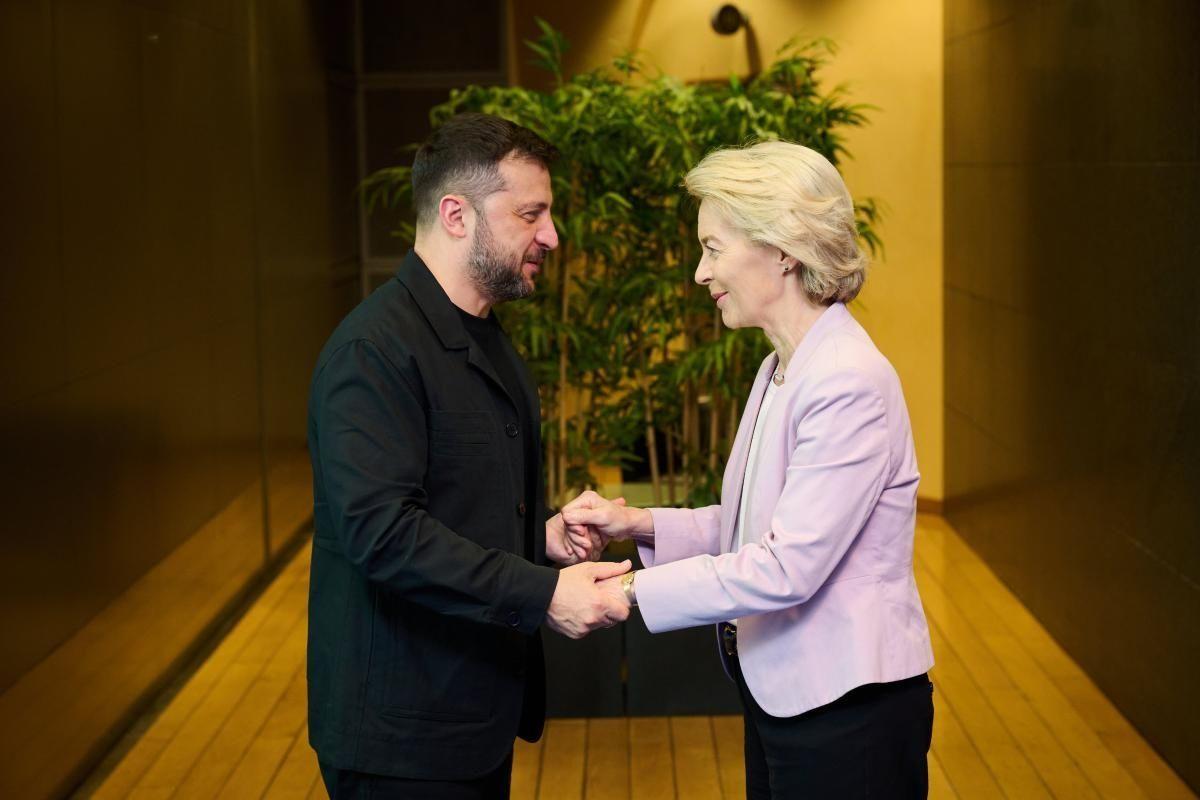
President Volodymyr Zelensky meets European Commission President Ursula von der Leyen in Brussels, Belgium. (European Comission / Audiovisual Service)
The partners shared the position that key issues must be resolved “with Ukraine’s participation in a trilateral format: Ukraine, the United States, and the Russian Federation.” The leaders welcomed “the decision of the United States on its readiness to take part in security guarantees for Ukraine,” while Zelensky stressed that such guarantees “must be practical, providing protection on land, in the sky, and at sea, and be developed with Europe’s participation.”
Trump’s Truth Social Ultimatum: Surrender or Fight Alone
Hours before Zelensky’s arrival in Washington, Trump escalated pressure through a Truth Social post declaring that the Ukrainian president could end the war “almost immediately” if he chose, or “continue to fight” while being clearly informed that Ukraine would not be permitted to join NATO or reclaim Crimea as part of any potential deal with Moscow.
The public ultimatum represented Trump’s most direct pressure yet on Ukrainian territorial concessions, delivered through social media rather than diplomatic channels. The timing—just before their scheduled meeting—appeared designed to weaken Zelensky’s negotiating position by publicly limiting his options.
Trump’s post suggested a binary choice: accept his deal terms immediately or face continued war without prospects for NATO membership or Crimean recovery. The strategy echoed his business background of creating pressure through public statements designed to force quick decisions.
Extensive Battlefield Operations: Attacks Across Multiple Fronts
Fighting continued across the sprawling front line with varying intensity. In the Sumy direction, Russian forces attacked north of Sumy City near Oleksiivka, Novokostyantynivka, and Varachnye, and northeast of the city near Yunakivka. Russian sources claimed Ukrainian counterattacks near Sadky and Novokostyantynivka.
Elements of the Russian 83rd Separate Airborne Brigade operated near Sadky, while the 106th VDV Division, including its 137th VDV Regiment, continued operations in the Sumy direction. Ukrainian forces demonstrated continued offensive capabilities through confirmed advances near Novomykolaivka and reported advances near Yablunivka.
In the Kharkiv direction, Russian milbloggers claimed advances toward Tykhe and west of Synelnykove, both northeast of Kharkiv City. Russian forces attacked near Vovchansk, Vovchanski Khutory, and Synelnykove, while Ukrainian forces reportedly counterattacked near Vovchanski Khutory and Synelnykove.
Melitopol Ammunition Depot Destruction
Ukraine’s Main Military Intelligence Directorate reported successfully destroying a Russian ammunition depot near the Korvatskyi passage in occupied Melitopol on August 16. The operation killed at least six Russian naval infantrymen and eliminated a Chechen Vostok-Akhmat Battalion drone crew.
The strike demonstrated Ukrainian capabilities to project force deep into occupied territory, targeting critical logistics infrastructure that supported Russian operations across the southern front. The elimination of specialized Chechen units represented a significant tactical achievement given their enhanced training and equipment.
Detailed Order of Battle: Russian Unit Identifications
Ukrainian forces identified numerous specific Russian military units across multiple sectors. In the Kupyansk direction, elements of the Russian 352nd Motorized Rifle Regiment and drone operators of the 27th Motorized Rifle Brigade continued operations. Russian forces were attacking in small infantry groups while sabotage and reconnaissance teams of three to five soldiers attempted infiltration.
In the Lyman direction, drone operators of the Russian 16th Spetsnaz Brigade struck Ukrainian positions near Vovchiy Yar. A Ukrainian servicemember reported that Russian forces relied heavily on sabotage and reconnaissance groups accompanied by drone operators, with some personnel required to transport supplies on foot up to 30 kilometers.
The Siversk direction saw elements of the Russian 7th Motorized Rifle Brigade and 85th Motorized Rifle Brigade operating. Ukrainian 11th AC Spokesperson Lieutenant Colonel Dmytro Zaporozhets reported that Russian forces were accumulating troops at the Lysychansk Oil Refinery in occupied Verkhnokamyanske, preparing for mass assaults with equipment by the end of August.
Russian Air Defense Claims: Geographic Spread of Ukrainian Operations
Russia’s Defense Ministry claimed its air defenses shot down 46 Ukrainian drones overnight across multiple regions: 16 over Belgorod Oblast, 14 over Nizhny Novgorod Oblast, nine over Voronezh Oblast, three over Bryansk Oblast, and one each over Kursk, Oryol, Kaluga, and Smolensk oblasts. The extensive geographic spread demonstrated Ukrainian capabilities to conduct simultaneous strikes across eight different Russian regions.
The pattern of Ukrainian drone operations suggested coordinated attacks on military and logistics infrastructure rather than random targeting. The concentration of intercepts over Belgorod and Nizhny Novgorod oblasts indicated these regions hosted significant military assets supporting Russian operations in Ukraine.
Voronezh Oblast Governor Aleksandr Gusev separately reported fires at a market, store, and gas pipeline in addition to the confirmed railway strike, suggesting some Ukrainian drones had successfully evaded Russian air defenses to strike multiple targets within the region.
Ukrainian Military Gains: Villages Cleared, Territory Reclaimed
Ukrainian forces achieved significant tactical successes across multiple fronts, with the General Staff confirming the clearing of six settlements in Donetsk Oblast from August 4-16: Hruzke, Rubizhne, Novovodiane, Petrivka, Vesele, and Zolotyi Kolodiaz. The operations resulted in 910 Russian personnel killed, 335 wounded, and 37 captured.
Ukrainian troops also destroyed substantial Russian equipment including eight tanks, six armored fighting vehicles, over 100 vehicles and motorcycles, one multiple launch rocket system, 18 artillery pieces, and 91 drones. The 7th Air Assault Corps reported additional clearing operations around Pokrovsk, while six Russian soldiers surrendered to Ukrainian units on August 16.
In Sumy Oblast, Ukrainian forces advanced up to one kilometer near Yablunivka along the northern border with Russia. Geolocated footage confirmed Ukrainian advances near Novomykolaivka north of Sumy City, demonstrating continued offensive capabilities despite diplomatic pressure.
Near Toretsk, Ukrainian forces achieved marginal advances southeast of Nelipivka, confirmed by geolocated footage published on August 16. Stabilization operations continued around Dobropillya, where Ukrainian forces maintained pressure against Russian penetration attempts.
Russian Advances and Tactical Claims
Russian forces achieved their own tactical gains, with geolocated footage confirming advances west of Novoekonomichne northeast of Pokrovsk. Russian milbloggers claimed forces had seized Kucheriv Yar northeast of Pokrovsk and Dobropillya, though these claims remained unconfirmed by Ukrainian sources.
In the Kharkiv direction, Russian milbloggers claimed advances toward Tykhe and west of Synelnykove, both northeast of Kharkiv City. Russian forces maintained offensive operations near Vovchansk, Vovchanski Khutory, and Synelnykove, though Ukrainian forces reportedly conducted counterattacks in these areas.
Russian forces continued attacking multiple settlements across the Pokrovsk direction, including near Pokrovsk itself, northeast areas around Nove Shakhove, Zapovidne, Novoekonomichne, and Volodymyrivka, and various positions south and southwest of the city. A Ukrainian reserve officer noted that the intensity of Russian assaults was “not sustainable” due to force quality, attrition, and fatigue factors.
Russian Casualties and Tactical Struggles
Russian forces continued suffering significant losses across multiple fronts, with Ukrainian commanders reporting increased Russian activity but limited effectiveness. In the Kupyansk direction, Ukrainian brigade officials noted that Russian forces were attacking in small infantry groups while small sabotage and reconnaissance teams attempted to infiltrate Ukrainian positions.
A Ukrainian servicemember in the Lyman direction reported that Russian forces relied heavily on sabotage and reconnaissance groups to reach Ukrainian rear areas, with drone operators accompanying these teams. Russian logistics proved increasingly difficult, with some personnel required to transport supplies on foot up to 30 kilometers.
Russian milbloggers acknowledged tactical challenges, with one complaining that the penetration near Dobropillya was “not sustainable because it is too narrow and vulnerable to Ukrainian interdiction efforts.” The admission revealed Russian difficulties in consolidating territorial gains even during successful operations.
Witkoff and Rubio Contradictions: Security Guarantee Confusion
Contradictory statements from US officials about security guarantees highlighted confusion within the Trump administration about Alaska Summit outcomes. Special Envoy Steve Witkoff claimed Putin had agreed to “robust security agreements that I would describe as game changing,” including “Article 5 protection from the United States” and legislative commitments not to attack other European countries.
Secretary of State Rubio provided a more cautious assessment, stating that “there’s going to have to be some security guarantees as part of a peace deal” but emphasizing that “how that’s structured, how that’s built, and what our role will be, that will be the kinds of things we’ll have to work through.”
The contradictions reflected broader uncertainty about what Putin had actually agreed to during the Alaska Summit. Zelensky expressed concern about the lack of detail, stating that “there are still no details on how this will work — what America’s role will be, what Europe’s role will be, and what the EU can do.”
Russian Missile Terror: Civilian Deaths Hours Before Talks
Russian forces launched a devastating overnight attack on August 17-18, killing four civilians including a 1.5-year-old girl and 16-year-old boy in Kharkiv while injuring at least 18 others. The timing, just hours before Zelensky’s scheduled Washington meeting, demonstrated Moscow’s strategy of maintaining military pressure during diplomatic engagement.
In Kharkiv, missiles struck residential buildings in the Industrialnyi district, damaging over a dozen apartment buildings and destroying more than 1,000 windows. Rescue operations continued as of 8 a.m. local time, with regional governor Oleh Syniehubov reporting extensive damage to civilian infrastructure.
The attacks extended to Sumy Oblast, where a missile struck near an educational institution, and to Odesa, where explosions were reported around 11:40 p.m. Russian forces also struck the border village of Nova Sloboda with a guided aerial bomb, injuring a 57-year-old woman and damaging 10 houses.
Ukraine’s Expanding Sanctions: Targeting Russian Drone Industry
President Zelensky signed a decree imposing sanctions on 39 Russian nationals and 55 companies from Russia, China, and Belarus involved in drone production using artificial intelligence. The measures targeted entities providing electronic components for unmanned aerial vehicles and research centers focused on AI-based drone technologies.
Sanctioned companies included Russian defense developers Zala Aero, Smart Birds, and Vostok Design Bureau, as well as Chinese and Belarusian firms providing dual-use technologies. The sanctions provided for asset freezes, trade bans, exclusion from state procurement, and technology access restrictions, with most measures set for 10 years.
The Ukrainian Presidential Office stated that the country was working with international partners to synchronize sanctions across global jurisdictions, reflecting broader efforts to pressure China’s role in enabling Russian military capabilities.
Domestic Weapons Development: Flamingo Missile Production
Ukraine’s domestically developed long-range Flamingo cruise missile entered serial production, according to Associated Press photojournalist Efrem Lukatsky, who was granted access to photograph the weapon at an undisclosed Fire Point company workshop on August 14. The missile reportedly had a range of 3,000 kilometers, though official technical specifications remained classified.
The development represented a significant milestone in Ukraine’s defense industrial capabilities, complementing previous domestic weapons including the Sapsan ballistic missile and Palianytsia missile-drone. President Zelensky had previously announced that over 40% of weapons used on the front line were now produced domestically, including over 95% of battlefield drones.
Battlefield Casualties: Russian Attacks Claim Five Lives
Russian attacks across Ukraine killed five civilians and injured 11 others over the previous 24 hours, according to local authorities. In Donetsk Oblast, Russian shelling killed two people each in Raihorodok and Sviatohorivka, plus one in Kostiantynivka, while injuring four others across the region.
Kherson Oblast suffered drone and artillery strikes on more than 30 settlements, damaging houses and civilian vehicles while injuring two people. In Kharkiv Oblast, Russian missiles, guided bombs, and drones targeted multiple communities, injuring five people and damaging residential buildings in Vilshany, Nova Kozacha, and Prykolotne.
The Ukrainian Air Force reported intercepting 40 of 60 Russian Shahed-type drones and decoys launched overnight, along with one Iskander-M ballistic missile. The attacks primarily targeted frontline areas but extended to civilian infrastructure across multiple oblasts.
Zelensky’s Security Guarantee Vision: EU Membership as Protection
During his Brussels meetings, Zelensky outlined his vision for comprehensive security guarantees that would include EU membership as a fundamental component. “We need security that will function in practice, like NATO’s Article 5,” he stated, while adding that Ukraine “considers EU membership to be part of security guarantees.”
The Ukrainian president expressed concern about the lack of detail in American security guarantee proposals, stating that “there are still no details on how this will work—what America’s role will be, what Europe’s role will be, and what the EU can do.” His emphasis on practical implementation reflected skepticism about vague promises without enforcement mechanisms.
Zelensky noted that “we heard from President Trump that both America and Putin see it the same way” regarding EU membership as part of security architecture, suggesting potential common ground between Washington and Moscow on this issue. He stressed that territorial decisions “should be discussed only by the leaders of Ukraine and Russia at a trilateral meeting,” warning that if Moscow refused such talks, “new sanctions must follow.”
Looking Ahead: The Washington Crucible
As Zelensky departed Brussels for Washington carrying European backing and constitutional arguments against territorial concessions, the stage was set for the most consequential diplomatic encounter since the war’s beginning. His arrival coincided with fresh Russian civilian casualties and tactical Ukrainian victories that would strengthen his negotiating position.
The contradictory assessments from US officials about security guarantees and the extent of Putin’s concessions highlighted the uncertainty surrounding the Washington talks. European leaders’ unified presence would provide Zelensky with crucial support against potential American pressure for territorial compromises.
The timing of Russian attacks just hours before the summit demonstrated Moscow’s confidence that military pressure would enhance its diplomatic position. For Ukraine, the challenge would be leveraging recent tactical successes and European support into sustainable security guarantees while resisting territorial concessions that would legitimize Russian aggression.
With Trump’s Truth Social ultimatum limiting Ukrainian options on NATO membership and Crimean recovery, and Putin’s demands for Russian language rights and church protections extending far beyond territorial issues, the fundamental contradictions between Russian maximalist positions and Ukrainian constitutional constraints appeared more irreconcilable than ever. The Washington meeting would test whether diplomatic engagement could bridge these gaps or whether military outcomes would ultimately determine the war’s resolution.