
As Zelensky and European Leaders Rally in the White House, Russian Missiles Continue Their Deadly Symphony Across Ukraine
Summary of the Day – August 18, 2025
High-stakes diplomacy in Washington collided with battlefield realities as President Volodymyr Zelensky, supported by seven European leaders, confronted Donald Trump while Russian missiles killed eight Ukrainian civilians. The day’s central tension: peace talks proceeded as bombs fell on Kharkiv and Zaporizhzhia, killing children hours before Trump announced arrangements for a Putin-Zelensky summit. Ukraine’s $90 billion weapons proposal, massive counterattacks near Pokrovsk, disrupted Russian oil pipelines, and Syrsky’s comprehensive military assessment revealed a war far from any diplomatic resolution.
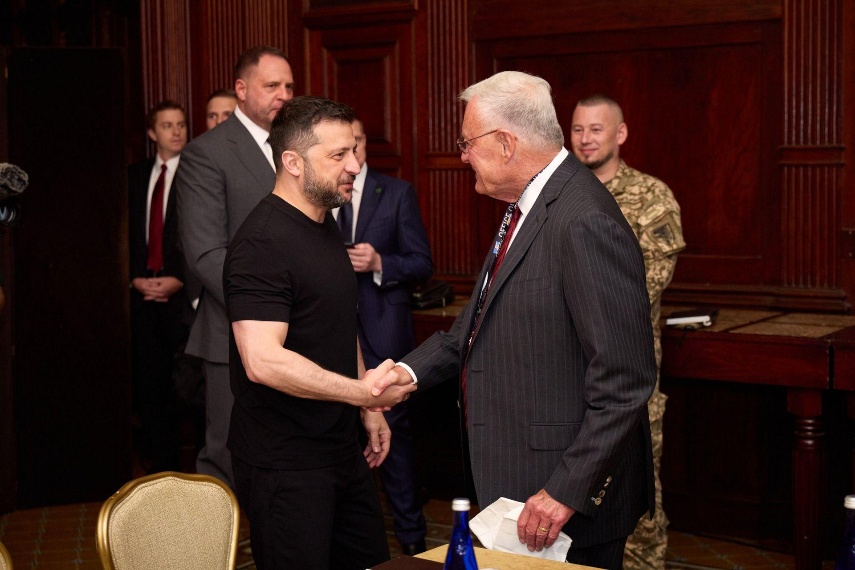 President Volodymyr Zelensky meets with U.S, Special Envoy Keith Kellogg, ahead of talks in Washington DC. (Volodymyr Zelensky / X)
The Dawn Assault: Russia’s Diplomatic Sabotage Campaign
Hours before Zelensky was scheduled to shake hands with Trump, Russian forces launched a devastating wave of 140 Shahed drones and four Iskander-M ballistic missiles across Ukraine. The timing was no coincidence—it was a calculated message from Moscow that peace talks mean nothing while Ukrainian cities burn.
In Kharkiv, the northeastern city that has endured nearly four years of relentless bombardment, seven people died and 18 were wounded when missiles slammed into residential buildings. Among the dead: a 1.5-year-old girl and a 16-year-old boy, their lives extinguished as their president prepared to discuss their country’s future 4,000 miles away. A dozen apartment buildings sustained damage, their shattered windows reflecting the fragility of any diplomatic progress.
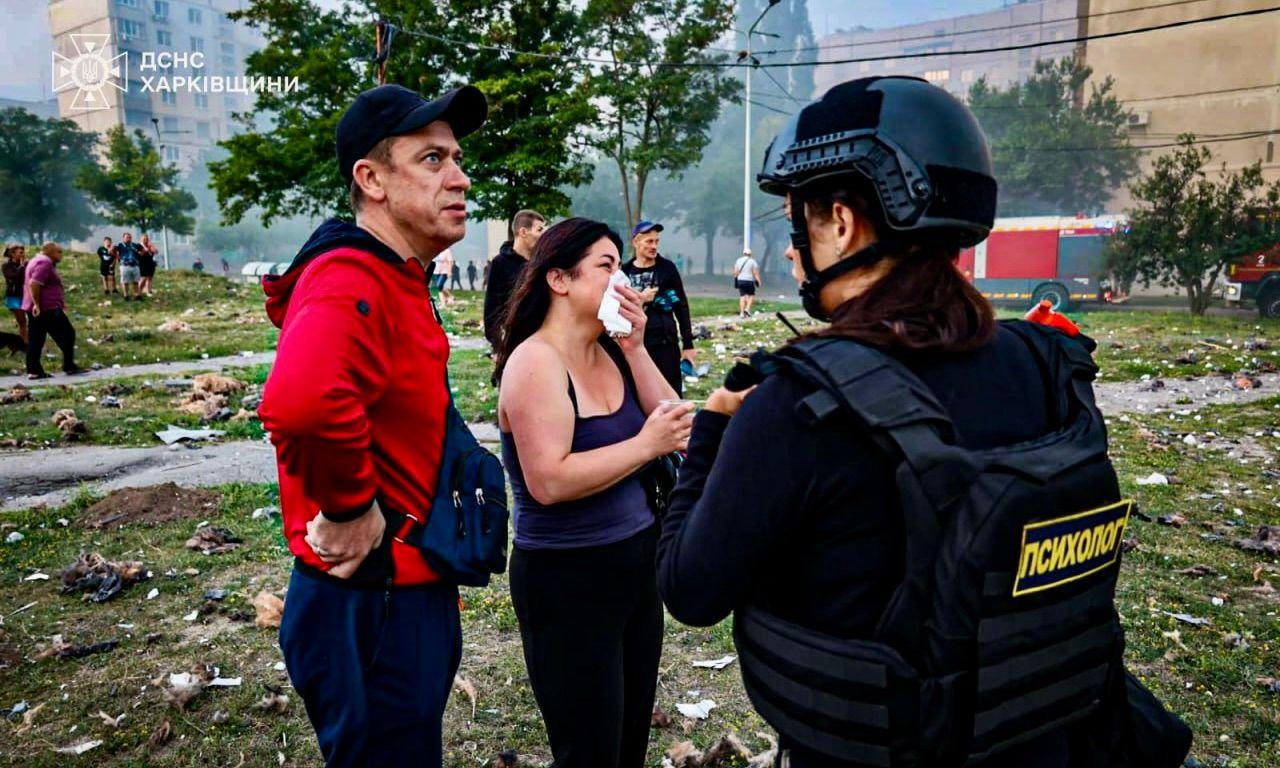 People evacuated from a building while firefighters work to extinguish the fire caused by a Russian attack on Ukraine’s Kharkiv Oblast. (State Emergency Service / Telegram)
Zaporizhzhia bore similar scars—three killed, 30 wounded, including a 17-year-old boy fighting for his life in surgery. In Sumy Oblast, two civilians were injured in strikes on Nova Sloboda and Myropillia villages. The overnight carnage left eight dead and 35 injured across Ukraine, a grim prelude to the day’s diplomatic theater.
“Russia knows that today there is a meeting in Washington to end the war,” Zelensky declared before departing for his White House summit. “Putin will kill demonstratively in order to continue putting pressure on Ukraine and Europe and to undermine diplomatic efforts.”
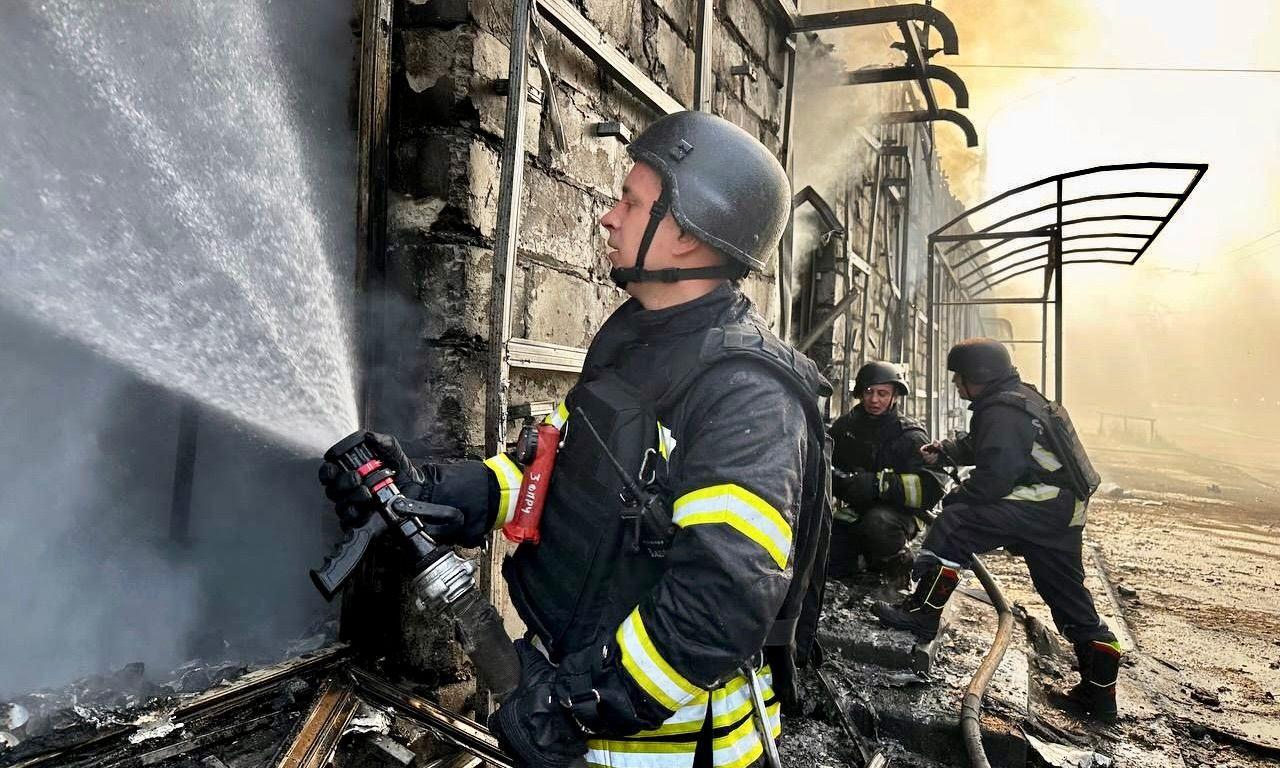 Firefighters extinguish a fire that broke out after a Russian attack on Ukraine’s Zaporizhzhia. (State Emergency Service / Telegram)
Syrsky’s Battlefield Assessment: Triumph in Sumy, Struggle Near Dobropillya
Ukrainian Armed Forces Commander-in-Chief Oleksandr Syrsky delivered a comprehensive assessment of the military situation, revealing both Ukrainian victories and Russian gains in an extensive interview with RBC-Ukraine. His candid evaluation painted a complex picture of a war in constant flux.
In Sumy Oblast, Syrsky declared Russian forces had “suffered defeat,” with Moscow’s elite units—paratroopers, marines, and motorized rifle forces—failing to achieve any success over the past two months. “On the contrary, Russia has lost several settlements,” he stated, noting that the last Russian attempt to advance in Stepne and Novokostyantynivka areas “ended in complete failure. They were eliminated, thrown back across the border.”
However, Syrsky acknowledged Russian tactical gains near Dobropillya in Donetsk Oblast, where enemy forces advanced 10-12 kilometers toward several Ukrainian settlements. He attributed this success to challenging terrain filled with ravines and rivers that allowed concealed movement, compounded by the absence of a continuous front line.
The commander revealed that Russia’s “victorious mood quickly shifted to despair” once Ukrainian reinforcements arrived. “Their publications on social media initially had the tone of ‘forward, victory,’ and now—’surrounded. The end,'” Syrsky observed.
The Drone Evolution: Russia’s Technological Arms Race
Syrsky exposed the escalating technological sophistication of Russia’s drone warfare, revealing that Iranian-made Shaheds now carry advanced defensive systems that make them increasingly difficult to destroy. The drones are equipped with optical guidance systems, 12-16-channel antennas resistant to interference, and fire and collision avoidance sensors enabling automatic defensive maneuvers.
Most ominously, all Russian long-range drones now carry self-destruct mechanisms designed to kill anyone who approaches a downed aircraft. “So that this drone cannot be captured after it falls and to destroy all those who approach. You have to be very careful: when such a drone falls, it can explode,” Syrsky warned.
Ukraine’s response has been equally innovative. Syrsky revealed that Ukrainian helicopters equipped with machine guns have shot down more than 3,200 Shahed-type drones from August 2024 to August 2025—”impressive numbers” that demonstrate the effectiveness of adapted conventional aircraft against modern drone swarms.
The commander disclosed Ukraine’s ambitious robotic warfare plans: 15,000 ground robotic platforms will be deployed in 2025, including strike systems with machine guns, logistics platforms, and medical evacuation units. Aerial platforms for wounded evacuation are already being tested.
The Loss Ratios: Ukraine’s Defensive Advantage
In a rare disclosure of casualty figures, Syrsky revealed the devastating cost of Russian offensives, claiming loss ratios heavily favoring Ukrainian forces. During the eight-month defense of Bakhmut in 2023, the ratio was “at least 1 to 7 in favor of Ukraine”—meaning Russian forces suffered seven times more casualties than Ukrainian defenders.
Wagner Group leader Yevgeny Prigozhin himself admitted losing 20,000 fighters in Bakhmut, according to Syrsky, though Ukrainian estimates put the figure closer to 23,000 killed and 40,000 total casualties including wounded. “Wagner as a structure was no longer restored,” Syrsky noted.
The Kursk operation showed similar ratios, with Russian losses exceeding Ukrainian ones by 5.5 times. “That is, in the offensive we suffered losses five times less than the enemy. This is also the best indicator during a full-scale war,” Syrsky stated.
SOCAR Destroyed: The Second Strike on Azerbaijani Energy
Russian forces struck an oil depot operated by Azerbaijan’s state-owned energy company SOCAR in Odesa Oblast, marking the second devastating attack on the facility in less than a month. The strike destroyed tanks with a combined capacity of more than 16,000 cubic meters, according to regional authorities and Azerbaijani media.
Ukrainian energy consultant Sergiy Kyun reported that the SOCAR oil depot was “completely destroyed,” with damage to storage tanks, pump station buildings, operator facilities, and the perimeter fence. The facility was struck multiple times directly, following an August 8 attack that injured four SOCAR employees and damaged the diesel fuel pipeline.
Both attacks targeted infrastructure linked to the newly launched Trans-Balkan gas corridor, designed to help Ukraine alleviate its energy deficit ahead of the 2025-2026 winter season. President Ilham Aliyev has allocated $2 million in humanitarian aid to Ukraine and indicated he could review Baku’s arms embargo on Kyiv if Russian attacks continue.
The Pokrovsk Counteroffensive: Ukrainian Forces Reclaim Territory
Ukrainian infantry assault groups backed by drones scored significant victories in the strategically critical Pokrovsk sector, liberating the settlements of Zolotiy Kolodyaz and Petrivka while inflicting heavy Russian casualties. The 79th and 82nd Air Assault Brigades led the assault operations, capturing prisoners and destroying enemy equipment.
Video evidence showed Ukrainian forces using NATO-standard tactics to clear buildings while bomber drones dropped munitions on Russian positions and first-person-view drones struck individual soldiers. The 93rd Mechanized Brigade “Kholodny Yar” separately reported clearing the villages of Gruzke and Vesele.
Joint Forces Dnipro revealed the scope of the operation: from August 4-17, Ukrainian forces cleared multiple settlements including Hruzke, Rubizhne, Novovodyan, Petrivka, Vesele, and Zolotiy Kolodyaz. The counterattack reportedly resulted in 984 Russian casualties, 355 wounded requiring substantial medical treatment, and 37 prisoners captured, along with destruction of 11 tanks, eight armored vehicles, 112 automobiles, 23 artillery systems, and 106 UAVs.
Europe’s United Front: A Continent’s Leaders March to Washington
In an unprecedented show of unity, seven of Europe’s most powerful leaders accompanied Zelensky to Washington—a diplomatic convoy that spoke volumes about the continent’s determination to shape Ukraine’s future. French President Emmanuel Macron, German Chancellor Friedrich Merz, Italian Prime Minister Giorgia Meloni, British Prime Minister Keir Starmer, Finnish President Alexander Stubb, NATO Secretary-General Mark Rutte, and European Commission President Ursula von der Leyen transformed what could have been a bilateral meeting into a transatlantic summit.
The European presence served as both support for Zelensky and subtle pressure on Trump, who had emerged from his August 15 Alaska summit with Putin claiming they had “made headway” while offering few concrete details. The Europeans’ message was clear: any deal that fails to secure Ukraine’s long-term security threatens the stability of the entire continent.
“If we want to reach peace and if we want to guarantee justice, we have to do it united,” declared Italian Prime Minister Giorgia Meloni. Finnish President Alexander Stubb reinforced the message, adding that “it’s team Europe and team United States helping Ukraine.”
The Kellogg Briefing: Special Envoy’s Pre-Summit Strategy Session
President Zelensky met with Donald Trump’s Special Envoy Keith Kellogg ahead of the crucial White House summit, focusing on battlefield situations, Ukraine’s diplomatic efforts, and pathways to peace. The meeting gained particular significance given Kellogg’s notable absence from Trump’s Alaska summit with Putin.
“I thank General Kellogg for the meeting and for the joint work with our team,” Zelensky wrote on social media. “President Trump invited Ukraine and other European countries to Washington today—this is the first meeting in such a format, and it is very serious.”
U.S. officials reportedly considered Kellogg’s presence at the Alaska summit “counterproductive” because Moscow views him as sympathetic to Ukraine. European officials privately voiced concern about his absence from the Putin meeting, calling him the American figure with the deepest understanding of what terms Ukraine might consider in a peace deal.
The $90 Billion Proposal: Ukraine’s Strategic Investment Gambit
As diplomats gathered in the East Room, Ukraine unveiled its most ambitious counter-proposal yet: a $90 billion weapons purchase plan designed to anchor American commitment to Ukrainian defense while feeding the U.S. defense industry. The proposal represented sophisticated diplomatic strategy—transforming Ukraine’s security needs into an American economic opportunity.
“There is indeed a package with our proposals for $90 billion,” Zelensky confirmed during his Washington briefing. “This is the second part of the security guarantees for us. The third part is our drone production.”
The plan includes a separate $50 billion agreement for drone production partnerships with Ukrainian companies, capitalizing on Ukraine’s battlefield-tested innovations in unmanned warfare. Zelensky revealed that when Ukraine opens drone exports, “they will buy Ukrainian drones. This is important for us. This will finance our domestic production of drones.”
By framing defense assistance as investment rather than aid, Kyiv hoped to appeal directly to Trump’s “America First” instincts while ensuring long-term U.S. commitment to Ukrainian security.
The Washington Summit: Trump’s Optimistic Projections
The White House meeting produced Trump’s most optimistic assessment yet of peace prospects, with the U.S. president declaring “there will be a reasonable chance of ending the war” and promising “everlasting peace.” Speaking alongside Zelensky and European leaders, Trump emphasized that “we’re going to have a lasting peace” and insisted “we’re not talking about a two-year peace, and we end up in this mess again.”
Trump credited Putin with potential cooperation: “I believe Vladimir Putin wants to see it ended,” while acknowledging Ukrainian suffering. When asked about redrawing maps to meet Russian demands, Zelensky stated his readiness for three-way peace negotiations: “We are ready for trilateral talks, as the president said.”
The summit featured a touching moment when Zelensky offered Trump a letter from First Lady Olena Zelenska to Melania Trump, paralleling Melania’s earlier letter to Putin that Trump described as “very well received.”
Trump refused to answer questions about potentially sending American troops to support any peace deal, saying “We’ll let you know that maybe later today,” while hinting at continued outreach to Moscow: “I just spoke to President Putin indirectly and we’re going to have a phone call right after the meetings today.”
Zelensky’s Peace Framework: Territory, Security, and Conditions
Zelensky outlined Ukraine’s approach to potential peace negotiations, declaring readiness for unconditional talks while reserving the most sensitive issues for direct leader-to-leader discussion. “The question of territory is a question that we will leave between me and Putin. Security guarantees will probably be negotiated with our partners,” he stated.
The Ukrainian president emphasized that some territories were occupied “not because one army pushes the other” but without mass hostilities, specifically citing Crimea. This distinction, he argued, should be considered in peace negotiations since Russia cannot claim military victory in all occupied areas.
Zelensky revealed that over 30 countries in the “coalition of the willing” are ready to provide security guarantees, with some prepared to deploy peacekeeping forces while others will provide intelligence, sea security, or air defense. “Someone will probably be ready to talk about presence. Someone will talk about intelligence. Someone will talk about the sea. Someone will talk about the safety of the sky.”
Ukraine’s New Government Strategy: Svyrydenko’s 12-Point Plan
Prime Minister Yulia Svyrydenko presented Ukraine’s comprehensive development strategy, outlining 12 priorities built on four pillars: Security, Dignity, Economy, and Recovery. The plan represents the new government’s roadmap for navigating wartime challenges while preparing for post-conflict reconstruction.
Defense and security top the priority list, with the government aiming to direct at least 50 percent of budget spending on arms toward local technologies. European integration ranks second, with plans to open all six EU accession clusters and accelerate digital reforms aligned with EU requirements.
The anti-corruption agenda centers on transparency through digitalization, including e-Court online services and e-Excise electronic tracking systems. Social policy allocates Hr.25 billion ($600 million) in 2025 and more than Hr.50 billion ($1.2 billion) in 2026 for internally displaced persons.
Business environment reforms include a five-year moratorium on inspections, faster privatization, and new investment funds with U.S. and EU participation. The recovery pillar centers on the U.S.-Ukraine Recovery Fund signed in May, with operations expected to begin by the end of 2025.
The Midnight Call: Trump Arranges Putin-Zelensky Meeting
Following his Washington consultations with Zelensky and European leaders, Trump announced he had initiated arrangements for a direct meeting between the Ukrainian and Russian presidents. In a midnight phone call to Putin, the U.S. president briefed the Russian leader on the day’s discussions and began planning what would be an unprecedented three-way summit.
“At the conclusion of the meetings, I called President Putin and began the arrangements for a meeting, at a location to be determined, between President Putin and President Zelensky,” Trump wrote on Truth Social. “After that meeting takes place, we will have a Trilat—the two Presidents plus myself.”
According to Russian foreign policy advisor Yuri Ushakov, the call took place after midnight Moscow time, with Putin reportedly telling Trump he was ready to meet with Zelensky. Trump praised the progress, writing that “this was a very good, early step for a War that has been going on for almost four years.”
The Propaganda War: Russian Symbols on American Weapons
In a provocative display that underscored Moscow’s psychological warfare tactics, Russian propaganda outlet RT published footage allegedly showing a U.S.-made M113 armored personnel carrier bearing both Russian and American flags attacking Ukrainian positions in Zaporizhzhia Oblast. The vehicle, originally supplied to Ukraine by Western allies, had apparently been captured and repurposed by Russian forces.
Andriy Yermak, head of Ukraine’s Presidential Office, condemned the imagery as “the height of insolence,” writing on Telegram: “Russians are using the symbols of the United States in their own terrorist, aggressive war involving the killing of civilians.”
The footage appeared just days after Trump praised his Alaska summit with Putin as “10 out of 10,” despite failing to secure any ceasefire agreement. Russian media increasingly portrays Trump as a pragmatic peacemaker while casting Ukraine and its European allies as obstructionist.
General Abatchev’s Wounds: High-Value Russian Target Eliminated
Ukrainian forces scored a significant tactical victory with the serious wounding of Lieutenant General Essedoulla Abatchev, deputy commander of Russia’s Leningrad Military District. Ukrainian military intelligence confirmed that Abatchev, who holds the title of Hero of Russia, lost an arm and leg in a Ukrainian strike on a Russian convoy in Kursk Oblast.
Dagestan head Sergei Melikov confirmed that Abatchev was “seriously wounded” in one of Russia’s border regions. The attack represented another blow to Russian military leadership, adding to the BBC’s tally of at least 10 generals and 524 colonels and lieutenant colonels killed since the full-scale invasion began.
Abatchev, a native of Dagestan, had previously served in senior military posts in Chechnya and Dagestan and was awarded his Hero of Russia title by Putin in 2022. The Security Service of Ukraine accused him in September 2022 of participating in Russia’s war of aggression and violating Ukraine’s territorial integrity.
Russia’s Energy Crisis: Historic Gasoline Price Surge
Wholesale gasoline prices in Russia surged to “historic highs” after Ukrainian drone strikes forced at least three major refineries to halt production, according to the Moscow Times. On the St. Petersburg International Mercantile Exchange, Ai-92 gasoline reached 71,500 rubles ($888) per ton, while Ai-95 climbed to 80,430 rubles ($999) per ton.
Prices rose by up to 2.2% in a single day and have jumped 38% and 49% respectively since the start of 2025. Since early August, Ukrainian drones have struck multiple refineries, including Rosneft’s plants in Novokuybyshevsk and Saratov, as well as Lukoil’s Volgograd refinery—the largest in southern Russia.
In occupied Crimea and parts of Zabaykalsky Krai, Ai-95 gasoline has reportedly disappeared from most filling stations or is being sold only by coupons to enterprises. Ukraine’s military claimed that long-range strikes in 2025 have caused losses worth 4.11% of Russia’s annual GDP, or approximately $74.1 billion.
The Druzhba Disruption: Pipeline Strike Halts European Oil Flows
Ukrainian drones delivered a strategic blow to Russian energy exports, striking the Nikolskoye oil pumping station in Tambov region and halting crude oil flows through the Soviet-era Druzhba pipeline to Hungary and Slovakia. Robert “Madyar” Brovdi, head of Ukraine’s Unmanned Systems Forces, confirmed that drones from the 14th Regiment executed the operation.
Hungarian Foreign Minister Peter Szijjarto called the strike “outrageous and unacceptable,” but Ukrainian Foreign Minister Andrii Sybiha offered little sympathy. “Hungary can now send complaints and threats to Moscow, not Kyiv,” Sybiha wrote on social media. “It is Russia, not Ukraine, who began this war and refuses to end it.”
The pipeline disruption coincided with the Washington summit, demonstrating Ukraine’s expanding capabilities to disrupt Russian revenue streams while pressuring European allies who continue purchasing Russian energy. Hungary imports most of its crude oil through the Druzhba pipeline, with Russia supplying about 95,000 barrels per day through this route in 2024.
Zaporizhzhia Under Siege: Russia Prepares New Offensive
Commander-in-Chief Syrsky revealed that Russia is redeploying troops to Zaporizhzhia Oblast to launch a new offensive campaign in the partially occupied southeastern region. Moscow currently controls about 70% of Zaporizhzhia Oblast, including the crucial nuclear power plant, while the regional capital remains under Ukrainian control.
“The goal is to break through our defenses and advance deep into territory. Their goal, of course, is occupying the entire region,” Syrsky explained. The Russian buildup represents continuation of Putin’s strategic objectives to capture all territory Moscow claims to have annexed in 2022.
The commander described current operations as “low-intensity” but warned that Russian forces are preparing “a powerful blow, which was initially planned a year ago.” Priority areas for Russian attacks include the Pokrovsk area in Donetsk Oblast, Zaporizhzhia Oblast, the Novopavlivka area in Dnipropetrovsk Oblast, and around Lyman in Donetsk Oblast.
The Evening Strike: Kremenchuk Under Fire
Hours after Zelensky concluded his Washington talks, Russia launched a fresh wave of ballistic missiles and drones against Ukrainian cities, targeting Kremenchuk in Poltava Oblast. The attack on energy infrastructure demonstrated Moscow’s determination to maintain pressure even as diplomatic discussions intensified.
The timing was deliberate—coming just hours after Trump announced progress on security guarantees and arranged future Putin-Zelensky meetings. The strike reinforced the pattern of Russian escalation during peace negotiations, using violence to gain leverage at the bargaining table.
Hungarian Opposition Challenges: Magyar Demands Russian Non-Interference
Hungarian opposition leader Peter Magyar demanded that Russia guarantee it would not interfere in Hungary’s domestic politics, responding to Moscow’s claims that the EU seeks to unseat Prime Minister Viktor Orban. Magyar’s statement addressed allegations from Russia’s Foreign Intelligence Service that the European Commission mobilized resources to support his challenge to Orban’s government.
“I demand a clear assurance that Russia will refrain from any act that could be classified as interfering in Hungary’s internal political processes, including disinformation campaigns, cyber operations, or intimidation of political figures and citizens,” Magyar wrote on Facebook.
Magyar has emerged as Orban’s primary challenger, promising to reset Hungary’s foreign policy and end its isolation from Western partners. He visited Ukraine in July 2024, delivering humanitarian aid, and has promised “pragmatic relations” with Moscow while rejecting Kremlin interference.
The Territory Statistics: Russia’s Minimal Gains
Battlefield monitoring group DeepState reported that Russia has occupied less than 1% of Ukrainian territory over 1,010 days of full-scale war. Since November 2022, Russian forces have captured only 5,842 square kilometers—accounting for about 0.97% of Ukraine’s landmass.
As of August 17, 2025, 114,493 square kilometers of Ukrainian territory remains under Russian occupation, compared to 108,651 square kilometers as of November 12, 2022. The statistics underscore the limited nature of Russian territorial gains despite massive casualties and resource expenditure.
Overall, together with territories occupied since 2014, about 20% of Ukrainian land currently remains under occupation, though Russia’s rate of advance has slowed dramatically since the initial invasion phases.
European Unity Conference: Costa Convenes Emergency Session
European Council President Antonio Costa convened a video conference of EU leaders for August 19 to discuss the outcome of the Washington meetings. “Together with the U.S., the EU will continue working towards a lasting peace that safeguards Ukraine’s and Europe’s vital security interests,” Costa wrote on social media.
The emergency session reflects European determination to maintain unity and coordination as peace negotiations potentially accelerate. Several EU leaders expressed interest in the debrief, particularly those not present in Washington, ensuring continent-wide alignment on Ukraine policy.
Looking Forward: The Trilateral Summit Horizon
As August 18 drew to a close, the diplomatic landscape had shifted dramatically. Trump’s midnight call to Putin and arrangements for a Putin-Zelensky meeting represented the most concrete progress toward high-level negotiations since the war began. Yet the fundamental contradictions remained: Russia demands territorial concessions Ukraine cannot accept, while Ukraine seeks security guarantees Russia may not recognize.
The day’s events crystallized the central paradox of any peace process: as diplomats speak of ceasefires and security guarantees, the war’s brutal reality continues to unfold in Ukrainian hospitals, shattered apartment buildings, and burning refineries. The evening strikes on Kremenchuk, coming just hours after Washington’s diplomatic optimism, served as a stark reminder that Putin’s bombs speak louder than any peace proposals.
With European leaders united behind Ukraine’s position and Trump claiming Putin’s readiness for direct talks, the stage appears set for the most significant diplomatic gambit since the war began. Whether that momentum can overcome the weight of Russian missiles and Ukrainian resistance remains the defining question of this conflict’s uncertain trajectory toward peace.
The Washington gambit of August 18 revealed both the possibilities and limitations of great power diplomacy in the face of an intractable war. As Ukrainian children died under Russian fire even as their president shook hands with world leaders, the day embodied the cruel mathematics of modern conflict—where diplomatic breakthroughs must compete with battlefield realities for the attention of history.