
As Lavrov Dismisses Trump’s Peace Timeline and Questions Zelensky’s Legitimacy, Ukrainian Forces Score Precision Victories While NATO Chief Promises Unbreakable Security Guarantees
Summary of the Day – August 22, 2025
August 22 shattered Trump’s diplomatic optimism as Russia delivered a definitive rejection of bilateral talks. Foreign Minister Sergey Lavrov told NBC that no Putin-Zelensky meeting was planned while questioning Zelensky’s legitimacy, backed by multiple Russian officials who denied Ukraine’s democratic government. Behind closed doors, Kremlin sources revealed Putin feared reputational damage. Ukrainian forces demonstrated growing prowess—killing five elite Russian naval divers, striking drone facilities, advancing territorially, and shooting down Russia’s first “mother drone.” NATO’s Rutte arrived promising security guarantees so strong Putin would “never attack again,” while Trump’s handwritten fury over pipeline strikes and Russia’s “not my enemy” propaganda campaign revealed deepening complications.
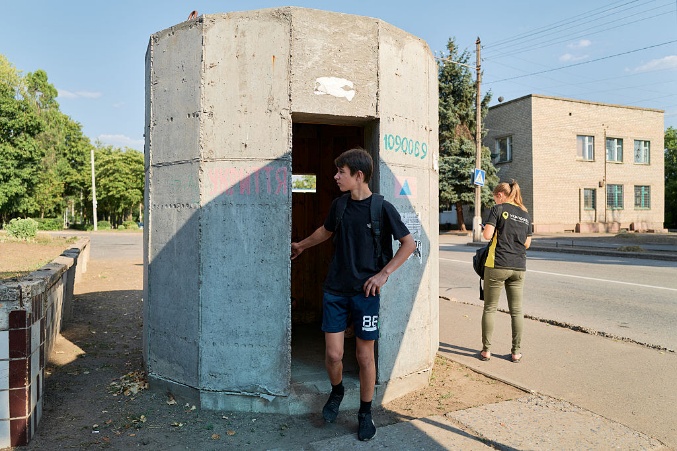
Residents hide in a bunker during an attack by Russian invading forces using missiles, cluster bombs, and Shahed drones in Kramatorsk. The city is located in Donetsk Oblast, a Ukrainian region cited in peace-talk discussions involving U.S. President Donald Trump and Russian President Vladimir Putin over a potential frontline freeze and territorial exchanges. (Pierre Crom / Getty Images)
“No Meeting Planned”: Lavrov Crushes Trump’s Peace Timeline
Russian Foreign Minister Sergey Lavrov delivered a devastating blow to President Trump’s peace efforts, flatly telling NBC News that no Putin-Zelensky meeting was planned despite the American president’s two-week timeline. “Putin is ready to meet with Zelensky when the agenda is ready for a summit, and this agenda is not ready at all,” Lavrov declared.
The Russian diplomat went further, fundamentally questioning Ukraine’s legitimacy: “How can we meet with a person who is pretending to be a leader?” Lavrov’s assault on Zelensky’s democratic mandate was echoed by multiple Russian officials, including State Duma International Affairs Committee First Deputy Head Alexei Chepa, Deputy Head Andrei Klimov, and Defense Committee Chairperson Alexei Zhuravlev, who all rejected Zelensky’s legitimacy and questioned any peace agreement he might sign.
Lavrov accused Zelensky of rejecting “several principles” including no NATO membership and “discussion of territorial issues”—despite Zelensky’s explicit August 18 statement that he was prepared to discuss territory directly with Putin. “Zelensky said no to everything,” Lavrov claimed, fundamentally misrepresenting the Ukrainian president’s actual positions.
Behind the Kremlin Walls: Putin’s Reputational Fear
Russian opposition outlet Verstka, citing sources within the Kremlin, revealed the true reason behind Putin’s reluctance: fear of reputational consequences from appearing to negotiate with Ukraine’s president. A political strategist working in the Kremlin told the outlet that Putin and his advisors worried about domestic backlash.
A source familiar with the Kremlin’s domestic political projects described Presidential Aide Yuriy Ushakov’s August 18 statement about “raising the level” of negotiating delegations as “more like a polite refusal” to Trump’s proposed summit. The revelations exposed Putin’s fundamental contradiction—balancing domestic audiences conditioned to expect total victory with international pressure for negotiated settlement.
The Kremlin’s position highlighted Russia’s ongoing struggle to justify three years of devastating war while maintaining Putin’s strongman image. Meeting Zelensky as an equal would implicitly acknowledge Ukraine’s legitimacy and potentially undermine the entire Russian narrative justifying the invasion.
Security Guarantees Take Shape: Rubio-Yermak Intensive Negotiations
Secretary of State Marco Rubio led high-level American discussions with Presidential Office Chief Andriy Yermak, with both sides planning to finalize their comprehensive security model by week’s end. The negotiations involved high-ranking American generals alongside national security advisers from Britain, France, Germany, Italy, and Finland, plus representatives from NATO and the European Commission.
The talks operated through two distinct teams: political negotiations led by Yermak focusing on legal frameworks, and military discussions headed by Commander-in-Chief Oleksandr Syrskyi and National Security Council Secretary Rustem Umerov. Sources indicated the military component was approaching completion, involving weapons deliveries, financial support, intelligence sharing, and joint military exercises.
Yermak aide Oleksandr Bevz outlined Ukraine’s vision: “a system of bilateral binding agreements ratified by the parliaments of the respective countries” that would create “an algorithm that must have both a time frame and specific dimensions: financial, military, intelligence, etc.” The arrangements would go beyond simple Article 5 duplication to create concrete, measurable commitments.
Rutte’s Promise: NATO Chief Delivers Unbreakable Guarantees
NATO Secretary General Mark Rutte arrived in Kyiv for a surprise visit, promising security guarantees “of such a level that Vladimir Vladimirovich Putin sitting in Moscow will never try to attack Ukraine again.” His appearance coincided with intensive negotiations to finalize comprehensive security arrangements that could reshape European defense architecture.
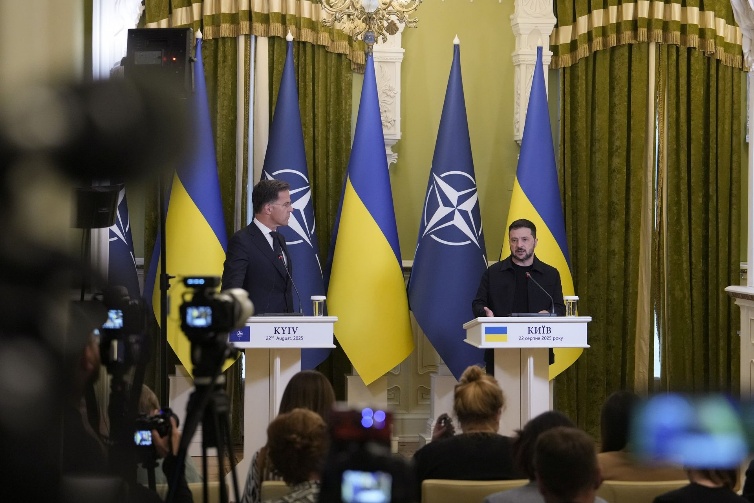
Ukraine’s President Volodymyr Zelensky (R) and NATO Secretary General Mark Rutte (L) at a news conference in Kyiv, Ukraine. (Andrew Kravchenko/Bloomberg via Getty Images)
According to Rutte, the security guarantee agreement would consist of two layers: strengthening Ukraine’s army and securing commitments from the United States and Europe aimed at deterring future Russian aggression. “It’s still too early to say who might provide troops, who will contribute intelligence, who will be present at sea, and who—in the air,” Zelensky noted, highlighting the complex negotiations underway.
The discussions about deploying foreign troops remained ongoing, with Rutte acknowledging it was “too early to say what will be the outcome.” The arrangements represented potential NATO involvement without formal membership, creating new precedents for alliance engagement with partner nations facing existential threats.
Trump’s Handwritten Fury: Presidential Anger Over Pipeline Strikes
A handwritten note from President Trump to Hungarian Prime Minister Viktor Orban revealed the American leader’s growing frustration with Ukrainian tactics. After Orban complained about Ukrainian drone strikes on the Druzhba pipeline, calling them a “very unfriendly move,” Trump scrawled directly on the letter: “Viktor, I do not like hearing about this—I am very angry about it. Tell Slovakia you are my great friend.”
Orban’s note complained that “Hungary supports Ukraine with electricity and petrol, in return they bomb pipeline that supply us,” highlighting tensions within the Western alliance. The pipeline strikes represented Ukraine’s systematic campaign to degrade Russian revenue streams, with disruption at the Unecha station cutting about 5% of Russia’s daily oil exports and costing Moscow nearly $15 million daily.
Slovakia’s Foreign Ministry separately sent a complaint to the European Commission calling Ukraine’s pipeline attacks “completely unacceptable” and demanding action to guarantee energy supply security. The episode demonstrated growing friction between Ukrainian military necessity and allied economic interests.
Five Elite Divers Dead: Ukrainian Naval Drone’s Fatal Trap
Ukrainian military intelligence scored a devastating victory against Russia’s most elite naval forces when a Ukrainian naval drone killed five commando frogmen in Novorossiysk Bay. The operation began when the drone lost connection with central control due to Russian electronic warfare and began drifting.
Russian commanders, believing they had captured valuable intelligence, ordered five naval reconnaissance divers to retrieve the drone for inspection. Ukrainian intelligence identified the victims as members of Russia’s commando frogmen—an elite unit receiving top-level training, significant funding, and advanced equipment.
“While handling a Ukrainian naval drone, it detonated—the explosion resulted in the elimination of all five elite Russian underwater saboteurs,” military intelligence reported. The operation demonstrated Ukraine’s evolving tactics, using apparent electronic warfare vulnerabilities to create deadly traps for Russian special forces.
Novorossiysk has become increasingly important for Russia’s Black Sea Fleet after successful Ukrainian strikes on occupied Crimea forced Moscow to relocate naval assets, making the loss of five elite divers in a single operation a significant degradation of specialized underwater capabilities.
Precision Strikes Across Multiple Fronts: Ukrainian Military Excellence
Ukrainian forces conducted multiple precision operations demonstrating increasingly sophisticated military capabilities. The General Staff reported coordinated missile, artillery, and aviation strikes on a Russian command post of the Rubikon Center for Advanced Unmanned Technologies and a large ammunition depot in occupied Donetsk Oblast, with geolocated footage confirming successful strikes east of occupied Novotoretske, northeast of Pokrovsk.
The Ukrainian Navy struck a Russian drone base at Khersones Airbase in occupied Sevastopol, destroying three Iranian Mohajer-6 drones and two Forpost reconnaissance drones used to monitor Black Sea surface activity. The timing and precision disrupted Russian surveillance capabilities during intensified Ukrainian naval operations.
Ukrainian anti-aircraft gunners achieved another first by downing a Russian Orlan reconnaissance drone carrying two FPV drones under its wings. The 118th Separate Mechanized Brigade claimed this marked the first destruction of a “mother drone” carrying other UAVs, representing evolution in drone warfare tactics as Russia develops more sophisticated delivery systems.
Territorial Dynamics: Gains and Losses Across Multiple Sectors
Ground operations on August 22 demonstrated the fluid nature of front lines, with both Ukrainian and Russian forces achieving tactical advances in different sectors. Ukrainian troops advanced in western Udachne in the Pokrovsk direction and successfully retook Zelenyi Hai village in the Novopavlivka area, with geolocated footage showing Ukrainian soldiers raising their flag in the settlement’s center.
In Sumy Oblast, Ukrainian forces liberated Varachyne settlement northeast of Sumy City, as Russian artillery strikes against Ukrainian positions within the town indicated Russian forces no longer held positions there. However, Russian forces achieved tactical gains, advancing into northern Temyrivka in eastern Zaporizhia Oblast and making progress in eastern and southern Yunakivka in Sumy Oblast.
Russian forces also advanced northwest of Chasiv Yar in Donetsk Oblast while maintaining pressure through multiple attack vectors. Fighting continued in Kursk Oblast where Russian forces attacked unspecified areas on August 21-22, while Ukrainian forces counterattacked near Tetkino southwest of Glushkovo. Russian VDV and VKS elements concentrated near Novyi Put, potentially preparing for unspecified operations.
The Daily Grind of War: Attacks Across Multiple Directions
The Institute for the Study of War documented extensive Russian offensive operations across multiple directions without confirmed advances in most sectors. Russian forces conducted attacks in Kharkiv Oblast directions near Vovchansk, Synelnykove, Khatnie, and Ambarne, while Ukrainian forces counterattacked near Vovchansk and along the Vovcha River.
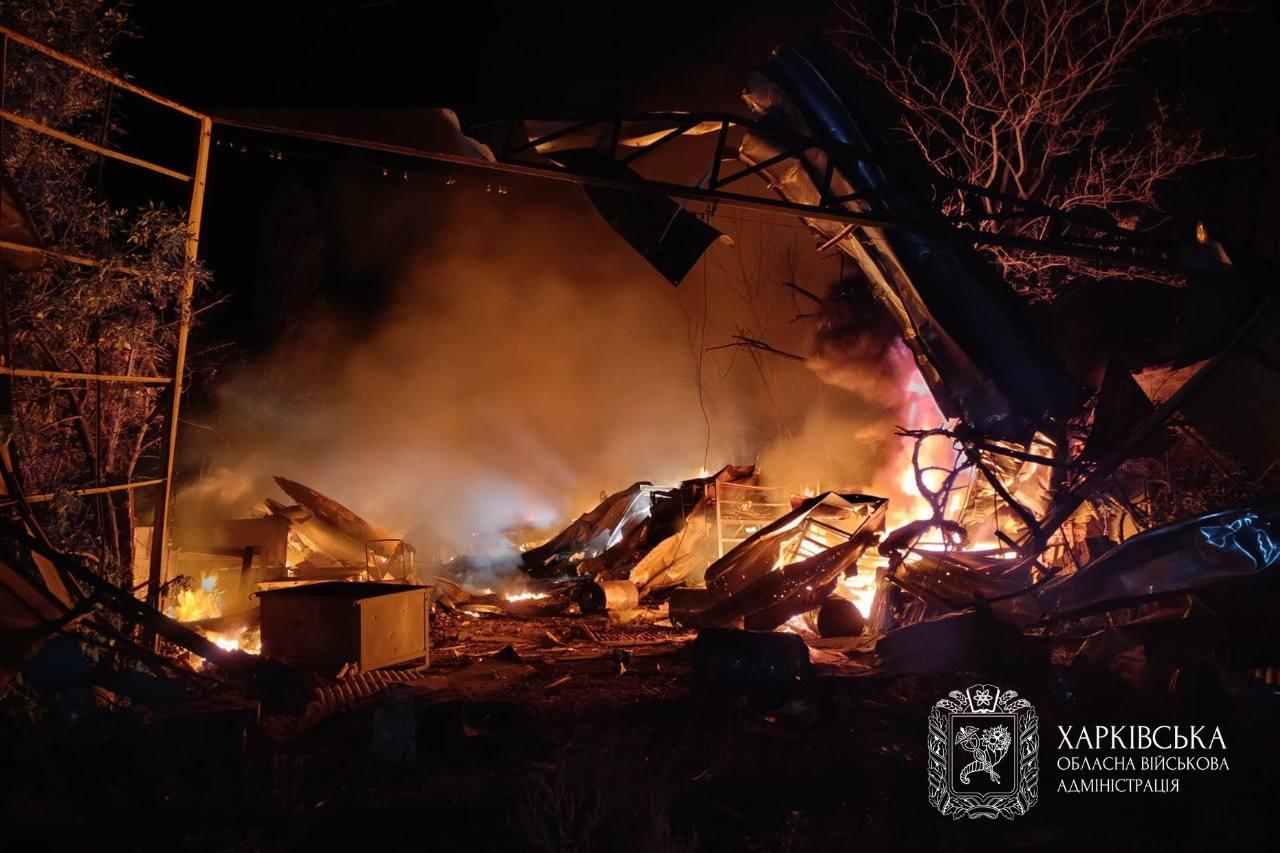
The aftermath of a Russian attack on Kharkiv Oblast overnight. (Kharkiv Regional Military Administration)
In the Kupyansk direction, Russian forces attacked near the city itself, northwest near Myrove, north near Zapadne and Holubivka, and southeast near Stepova Novoselivka, with Ukrainian counterattacks reported near Synkivka and Petropavlivka. Russian forces conducted FAB glide bomb strikes on a bridge crossing over the Oskil River.
The Lyman direction saw Russian attacks northwest near Serednie, north near Karpivka, northeast near Kolodyazi, east near Torske, and southeast toward Yampil, with Ukrainian counterattacks near Ridkodub. Similar patterns emerged in Siversk and Toretsk directions, demonstrating the grinding, attritional nature of current operations across multiple fronts.
Innovation in Warfare: New Russian Tactics Emerge
Business Insider reported that Russian forces constructed several long-range Shahed drone launch sites at the destroyed Donetsk Airport, fewer than 24 miles from the frontline. Maxar satellite imagery showed construction began between late May and early June 2025, representing Russian adaptation to bring launch capabilities closer to targets while reducing Ukrainian air defense reaction time.
Geolocated footage revealed Russian forces using an Orlan-10 reconnaissance drone as a “mothership” to transport FPV drones south of Mala Tokmachka. Ukrainian electronic warfare expert Serhiy “Flash” Beskrestnov reported multiple Ukrainian units observing Russian Orlan-10 drones operating as carrier platforms to extend FPV drone range by bringing them closer to frontlines.
These innovations demonstrated Russian adaptation to Ukrainian air defense improvements, with Moscow seeking technical solutions to maintain strike capabilities despite growing Ukrainian countermeasures. The evolution of drone tactics showed both sides’ continuous adaptation in an increasingly sophisticated technological conflict.
The Human Cost: Daily Casualties Mount
Russian attacks on August 22 killed two civilians and injured 24 others across multiple oblasts, underscoring the war’s continued toll. A 59-year-old man died in a Russian attack on Kurhanne village in Kharkiv Oblast, with two women aged 53 and 60 suffering injuries. Another 45-year-old man was injured in Mytrofanivka in the same oblast.
Ukraine’s Air Force reported downing 46 of 55 Russian Shahed-type drones launched overnight, with the remaining nine striking four unspecified locations. Russian attacks included seven Shahed drones, two FPV drones, and three unspecified UAVs targeting civilian infrastructure in Kharkiv Oblast.
In Kherson Oblast, Russian forces targeted 31 settlements including the regional center, killing one person and injuring 17 others. Additional casualties were reported across Zaporizhia (one woman injured near Polohy), Sumy (man born 1964 injured in Seredyna-Buda), and Donetsk oblasts (two injured in Kostiantynivka and Zolotyi Kolodiaz).
65 Civilians Freed: Ukraine Rescues Deportees from Border Abandonment
Ukrainian authorities successfully returned 65 Ukrainian civilians whom Russian forces had deported and abandoned without documents, food, or water at the Verkhny Lars border checkpoint between Russia and Georgia. Foreign Minister Andriy Sybiha and Internal Affairs Minister Ihor Klymenko announced the humanitarian operation’s success.
The civilians, including eight seriously ill individuals, had spent approximately three months in a basement at the border checkpoint designed for only 20 people. Non-profit organization Volunteers Tbilisi and Russian opposition outlet Vazhnye Istorii provided details about the deportees’ ordeal in overcrowded, inhumane conditions.
The abandoned civilians included residents of Russian-occupied areas who had refused to cooperate with occupation authorities or accept Russian passports during forced Russification campaigns. Their abandonment represented another example of Russia’s systematic abuse of occupied populations and violation of international humanitarian law governing treatment of civilians.
Estonia Steps Forward: Baltic Peacekeeping Commitment
Estonian Prime Minister Kristen Michal announced his country’s readiness to contribute up to one company of troops for potential peacekeeping operations in Ukraine during a press conference with Finnish Prime Minister Petteri Orpo. The commitment demonstrated Baltic state solidarity with Ukrainian security needs.
“Putin’s goals have not changed. He wants all of Ukraine and a revision of the current security system in Europe. Estonia will never recognize changes to borders by force of arms,” Michal declared. The Estonian leader emphasized that EU support for Ukraine would increase significantly in future budget cycles, with the next draft long-term budget substantially boosting European defense capabilities and Ukrainian assistance.
The pledge represented growing European willingness to provide concrete military commitments for Ukrainian security, even as the United States signaled reluctance to deploy ground forces. Estonia’s offer reflected Baltic states’ understanding that Ukrainian security directly impacts their own survival against Russian imperial ambitions.
Putin’s Nuclear Theater: Sarov Visit Sends Strategic Message
Russian President Vladimir Putin visited the closed nuclear city of Sarov, home to Russia’s Federal Nuclear Center, accompanied by top military leadership including Chief of General Staff Valery Gerasimov. The highly choreographed visit came one day after Trump criticized Biden for not allowing Ukraine to “fight back, only defend.”
Putin’s entourage included Deputy Prime Minister Denis Manturov, Rosatom Chief Alexey Likhachev, Deputy Chief of Staff Sergei Kiriyenko, and Nizhny Novgorod Governor Gleb Nikitin. The visit involved meetings with nuclear industry employees and laying flowers at a monument to the chief designer of the first Soviet atomic bomb.
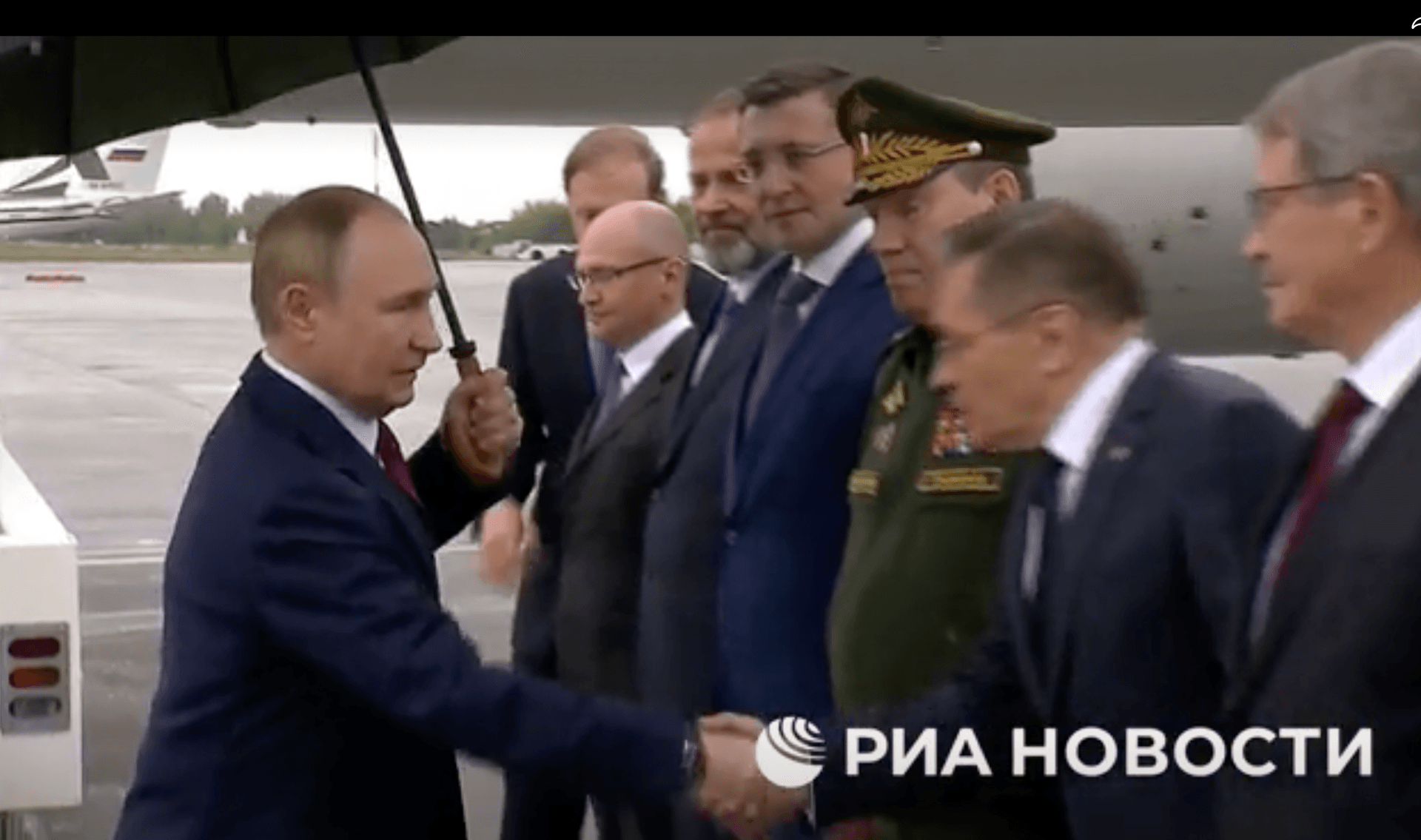
Russian President Vladimir Putin is greeted by top military and political officials upon arriving in the closed city of Sarov, Nizhny Novgorod Oblast. (RIA Novosti / Kremlin Pool)
The timing appeared designed to remind Western audiences of Russia’s nuclear capabilities as diplomatic pressure mounted for peace negotiations. Sarov houses key facilities for nuclear weapons development, production, storage, and deployment decisions, making Putin’s visit a clear signal about Russia’s strategic deterrent amid escalating international pressure.
Regional Proxy Networks: Iran-Belarus Military Cooperation
Ukrainian Foreign Intelligence reported that Iran sought Belarusian assistance in restoring air defense and electronic warfare systems damaged during its recent conflict with Israel. The request came during Alexander Lukashenko’s meeting with Iranian President Masoud Pezeshkian in Minsk on August 20.
“Unlike Russia, Belarus is less restricted by sanctions in the military-technical sphere and could become a channel for restoring Iran’s defense capabilities,” Ukrainian intelligence noted. Iran also sought help addressing shortages of power generation equipment and agricultural machinery, planning to use Belarus as another channel for accessing sanctioned goods.
The cooperation demonstrated how authoritarian regimes coordinate to evade Western restrictions while maintaining military capabilities. For Minsk, the arrangement offered prospects for lucrative defense contracts and sanctions evasion opportunities, while Tehran gained access to critical military-technical support through a less sanctioned intermediary.
Information Warfare: “Russia Is Not My Enemy” Campaign
Russia launched a propaganda campaign across Europe under the slogan “Russia is not my enemy,” with stickers appearing in Romania, France, and Italy. Ukraine’s Center for Countering Disinformation reported the campaign reached Romania as part of the Kremlin’s hybrid operations aimed at creating illusions of “peaceful partnership.”
“Through such tools of influence, Russia seeks to portray itself as a peacemaker, downplay its own crimes, and sow discord within European societies,” the center stated. Similar actions had been recorded in France and Italy through pro-Russian organizations, representing systematic efforts to undermine European unity.
The campaign’s purpose involved undermining citizens’ trust in rule of law and democratic institutions, casting doubt on Euro-Atlantic courses, and discrediting support for Ukraine. The coordinated nature across multiple European countries demonstrated Russia’s sophisticated approach to information warfare targeting Western solidarity.
Military Preparations: Zapad 2025 Scaled Down
Lithuanian intelligence reported the upcoming Zapad 2025 joint Russian-Belarusian military exercises would include fewer troops than in previous years. “Up to 30,000 troops are expected to participate, significantly fewer than in previous exercises. Around 6,000-8,000 will be stationed in Belarus, with several thousand in Russia’s Kaliningrad exclave,” the assessment noted.
The reduced scale likely reflected Russia’s massive personnel losses—over 1,074,320 troops since the full-scale invasion began—and reliance on North Korean forces to maintain operations in Kursk Oblast. Lithuania and NATO allies planned their own military exercises while monitoring the Russian-Belarusian drills.
Ukraine’s Foreign Ministry condemned the upcoming exercises and warned Belarus against provocations, noting that when Zapad drills were last held in 2021, Russian troop buildup preceded the February 2022 invasion. The ministry stated Moscow-Minsk cooperation posed “immediate threat not only to Ukraine, but also to Poland, the Baltic states, and all of Europe.”
Lukashenko’s Diplomatic Input: Strikes Moratorium Proposal
Belarusian President Alexander Lukashenko held a phone call with President Trump, discussing the war in Ukraine and proposing that a strikes moratorium should precede any ceasefire and peace agreement. Lukashenko stated he told Trump that Ukraine and Russia must agree to a ceasefire before pursuing comprehensive peace arrangements.
The proposal aligned with Russian preferences for limiting Ukrainian long-range strike capabilities while maintaining Moscow’s ability to target Ukrainian civilian infrastructure. Any strikes moratorium would prevent Ukraine from continuing its campaign against Russian defense industrial facilities and energy infrastructure while offering no equivalent restrictions on Russian attacks.
The Lukashenko intervention demonstrated Belarus’s role as Russian proxy in diplomatic initiatives, providing alternative channels for Moscow’s positions while maintaining plausible distance from direct Russian advocacy.
Looking Forward: Diplomatic Deadlock and Military Evolution
August 22 crystallized the fundamental contradiction in current peace efforts—Trump’s desire for rapid diplomatic resolution met Putin’s determination to avoid political risks from negotiation. Lavrov’s flat rejection of bilateral talks while questioning Zelensky’s legitimacy revealed Russia’s preference for military solution over diplomatic compromise.
Ukrainian military successes, from killing elite Russian divers to territorial advances and innovative drone warfare, demonstrated growing capabilities that could influence Russian calculations. However, Putin’s nuclear facility visit and continued rejection of talks suggested Moscow remained committed to military pressure rather than genuine negotiation.
The day’s events highlighted the complexity of achieving peace when one side refuses basic diplomatic engagement while the other builds increasingly sophisticated military capabilities. NATO’s promise of unbreakable security guarantees and European peacekeeping commitments offered potential deterrence, but only if Russia eventually proved willing to respect negotiated settlements rather than viewing them as temporary pauses before renewed aggression.