
As Moscow’s Troops Enter Villages Near Administrative Borders, US Prepares Strategic Enablers for European Peacekeeping While Diplomatic Maneuvers Intensify
Summary of the Day – August 26, 2025
Russian forces entered Dnipropetrovsk Oblast for the first time during the conflict, attempting to seize villages near administrative boundaries while Ukrainian forces disputed the extent of territorial losses. The United States expressed willingness to provide intelligence, air defense, and command assets to support European-led peacekeeping forces in postwar Ukraine. Meanwhile, international diplomatic pressure mounted as Poland’s deputy prime minister declared Ukraine cannot join the EU without recognizing the Volyn tragedy as genocide, while Estonian authorities discovered a Ukrainian drone that crashed on their territory after Russian electronic warfare interference. The day witnessed Ukrainian Special Operations Forces strikes in Crimea, administrative changes allowing young Ukrainian men to travel abroad, and continued combat operations across multiple front sections.

US President Donald Trump during a cabinet meeting at the White House in Washington, D.C., U.S. (Aaron Schwartz/CNP/Bloomberg via Getty Images)
Breakthrough Into Dnipropetrovsk: Russian Forces Open New Front
Ukrainian military leadership acknowledged for the first time that Russian forces entered Dnipropetrovsk Oblast, a central region previously spared from major ground battles. Viktor Trehubov, spokesperson for the Dnipro Operational Strategic Group of Forces, told AFP “Yes, they have entered, and fighting is ongoing as of now.”
Russian forces attempted to capture Zaporizke and Novoheorhiivka, villages located near administrative borders between Dnipropetrovsk, Donetsk, and Zaporizhzhia oblasts. The DeepState monitoring group initially reported Russian occupation of both settlements, marking the first time battlefield monitors reported Russian territorial control in the central-eastern region.
The Ukrainian General Staff refuted claims of complete Russian control on August 26, stating Ukrainian forces continue controlling Zaporizke despite Russian capture efforts. Colonel Viktor Trehubov reported that Russian forces entered both villages but are attempting to gain footholds rather than having secured territories completely.
Trehubov described this as “the first attack of such a large scale” in Dnipropetrovsk Oblast, speaking to the BBC. Russian milbloggers claimed advances west of Voskresenka, south of Ternove and Zaporizke, and near Komyshuvakha, all southeast of Velykomykhailivka.
US Strategic Support Framework: Washington Backs European Peacekeeping
The United States expressed willingness to supply supporting assets to European-led peacekeeping forces as part of postwar security guarantees for Ukraine. The Financial Times reported on August 26 that senior US officials told European counterparts Washington would provide “strategic enablers” including intelligence, surveillance, reconnaissance, command and control, and air defense assets.
The proposed US support would include aircraft, logistics, and ground-based radar supporting a European-enforced no-fly zone and air shield for Ukraine. Officials stated such support is contingent on European states committing “tens of thousands” of troops to postwar Ukraine.
A rough security framework involves a demilitarized zone monitored by neutral peacekeeping troops from countries agreed upon by both Russia and Ukraine. Beyond that zone, Ukrainian forces trained by NATO militaries would defend stronger borders, while European peacekeepers would monitor deeper territories as a third line of defense. US assets would support these forces from the rear.
Ukrainian Chief of Staff Andriy Yermak told the Financial Times that current security discussions focus on several European brigades “on the ground, provided by coalition of the willing, plus ‘strategic enablers’ from the U.S.” He called recent meetings “a breakthrough point,” noting “a big change from the spring.”
Mining Incident: Russian Attack Kills Worker, Traps Miners
A Russian attack against a Ukrainian mine killed one worker and injured three while trapping 146 miners underground during a power outage. DTEK energy company reported on August 26 that the attack damaged enterprise buildings and equipment, causing electricity disruption at the facility.
Trade union leader Mykhailo Volynets reported that Russian forces shelled a mine in Dobropillyskyi Hromada, cutting electricity and trapping 148 miners underground. The mine successfully extracted all miners, but one worker died and three sustained injuries during the attack.
All miners were brought to the surface by 2:30 p.m. local time according to updated reports from Volynets. The attack highlighted continued Russian targeting of civilian infrastructure in industrial areas of Donetsk Oblast, which faces daily attacks against civilian infrastructure and residential areas.
Border Policy Revolution: Travel Restrictions Eased for Young Men
Ukraine’s government updated border crossing procedures on August 26 to allow men aged 18-22 to travel abroad freely during martial law. Prime Minister Yulia Svyrydenko announced the decision applies to all citizens of the relevant age, including those currently abroad for various reasons.
President Volodymyr Zelensky confirmed the revision after meeting with Svyrydenko, stating “all details have been agreed with military command.” The change addressed concerns about young Ukrainians maintaining ties with Ukraine and realizing their potential primarily within the country.
Men between ages 18 and 60 were previously prohibited from traveling abroad unless in exceptional circumstances during martial law, even though only those aged 25 and above could be drafted. The revision aimed to help young people maintain family ties and homeland connections while preventing abuse of departure rights to avoid constitutional duties.
Multiple Citizenship Launch: First Countries Announced
Ukraine’s new multiple citizenship law will first apply to Germany, Poland, and the Czech Republic, President Zelensky announced on August 26 during a Ukrainian World Congress meeting. The legislation, passed by parliament in June, allows Ukrainian citizens to hold foreign passports under specified conditions.
Multiple citizenship will subsequently extend to Canada and the United States. The law applies to foreigners from specified countries applying for Ukrainian citizenship and Ukrainian citizens applying for citizenship in these countries, as well as Ukrainian spouses of foreign citizens.
The legislation establishes new grounds for losing citizenship, including receiving Russian passports or serving in Russian Armed Forces. The law excludes Russian citizens or citizens of countries not recognizing Ukraine’s territorial integrity. Zelensky called the measure “a step toward even greater unity of Ukrainians around the world.”
Crimean Operations: Special Forces Strike Russian Logistics
Ukrainian Special Operations Forces struck Russian logistical facilities in occupied Crimea on August 26, disabling installations supporting Russian army operations and combat supply. The operation “disabled logistical facilities that support the operations and combat supply of Russian army units,” according to military statements.
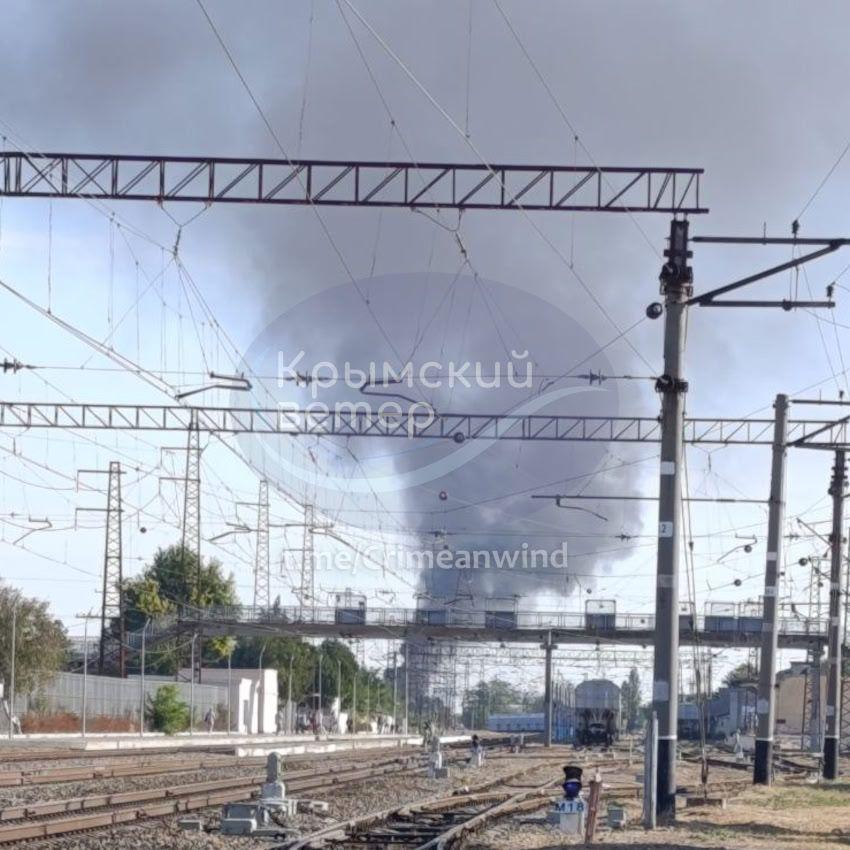
A plume of smoke rising above a railway station in Krasnohvardiiske in Russian-occupied Crimea, Ukraine. (Crimean Wind/Telegram)
Geolocated images published on August 26 showed smoke after drone strikes against Urozhaina railway station in occupied Kurman, Crimea. Occupation energy enterprise Krymenergo reported emergency power outages in Kurmanskiy raion following the strikes.
Russia’s Defense Ministry claimed intercepting eight Ukrainian drones over Crimea between 7:00-7:30 a.m. local time while disclosing no information about damage. The strikes continued Ukraine’s systematic campaign against Russian military facilities and logistics throughout the occupied peninsula.
Combat Operations: Multiple Front Engagements
Russian forces continued offensive operations across multiple fronts on August 26 but achieved limited confirmed advances. In the Kupyansk direction, Russian sources claimed advances within Kupyansk and near Petropavlivka, though milbloggers noted the area around Kupyansk remains a contested “gray zone.”
Ukrainian forces recently advanced in the Borova direction, with geolocated footage showing elements of the Russian 3rd Motorized Rifle Division striking Ukrainian positions north of Novoyehorivka, indicating Ukrainian territorial gains in the area.
In the Lyman direction, Russian milbloggers claimed advances southwest of Kolodyazi and in Zarichne east of Lyman, with sources claiming Russian forces almost cleared the entire Serebryanske forest area. Ukrainian forces reportedly counterattacked near Novomykhailivka.
A non-commissioned officer of a Ukrainian drone battalion operating in the Pokrovsk direction reported on August 26 that Ukrainian forces are eliminating the recent Russian penetration near Dobropillya while Russian forces try to consolidate and bring reserves to the area.
Daily Casualty Toll: Attacks Across Multiple Regions
Russian attacks killed one civilian and injured 15 others across Ukraine over the past day, regional authorities reported on August 26. Ukrainian forces downed 47 out of 59 drones launched by Russia overnight, including Shahed-type attack drones and decoys from multiple launch sites.
A 66-year-old woman was injured in a Russian attack on Saltyne village in Kharkiv Oblast. One person was killed in Yampil village in Donetsk Oblast, with six more people suffering injuries in the region over the past day.
Russian forces targeted 32 settlements in Kherson Oblast, including the regional center of Kherson, injuring four people. Three people were injured in Russian drone attacks on Sumy Oblast: a 77-year-old man and women aged 51 and 63. A man was injured near Zaporizhzhia city during Russian targeting operations.
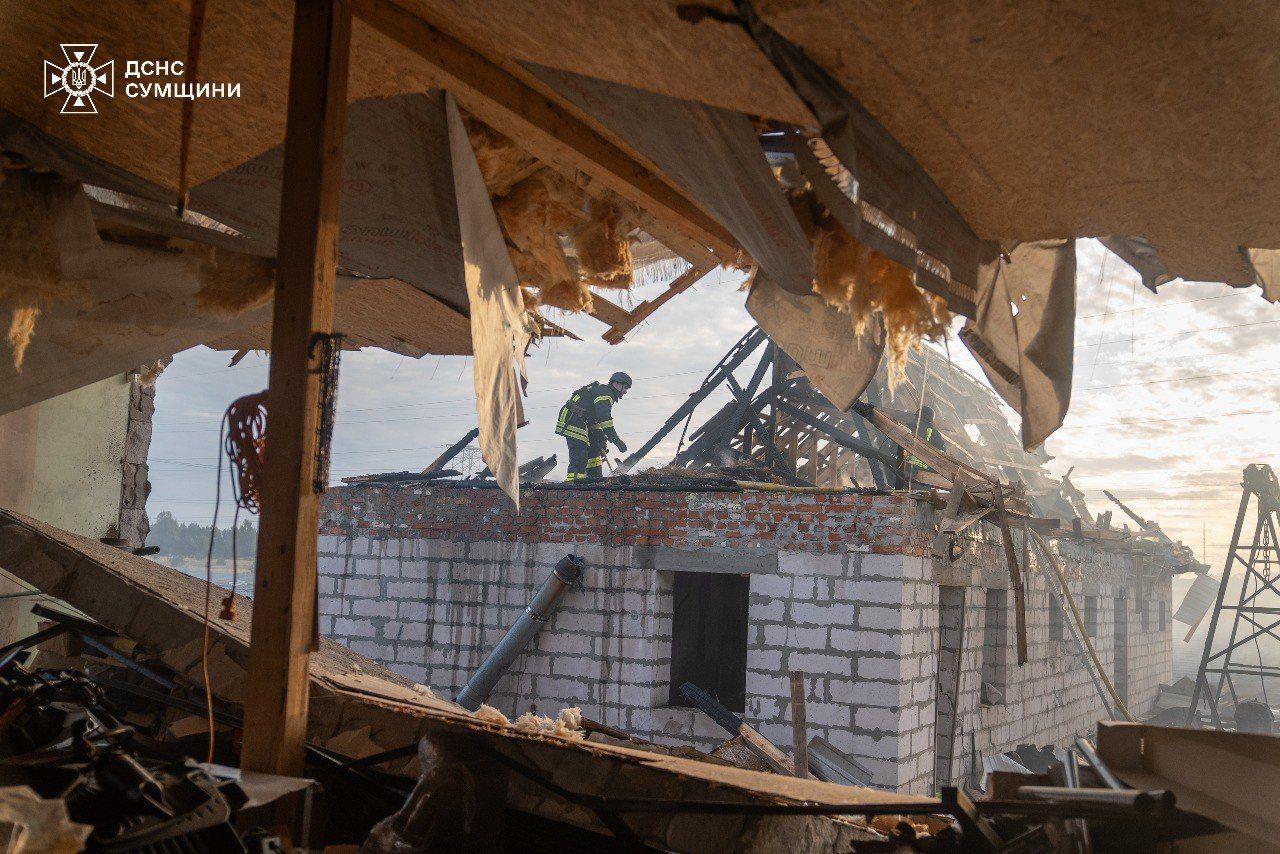
The aftermath of a Russian attack on Sumy Oblast, Ukraine, overnight. (State Emergency Service)
Criminal Justice Statistics: Military Desertion Cases Surge
More than 250,000 criminal cases have been opened for soldiers’ absence without leave and desertion since the beginning of Russia’s full-scale invasion in 2022, Ukrainska Pravda reported on August 26 citing the Prosecutor General’s Office.
From 2022 to July 2025, 202,997 unauthorized military unit abandonment cases were opened, with 15,564 people officially charged with the crime. The Prosecutor General’s Office reported 50,058 desertion cases in the same period, with 1,248 individuals charged with desertion.
The statistics emerged as Ukrainian Armed Forces face manpower shortages while struggling to hold back Russian advances at the front. Under martial law, men aged 25 to 60 can be conscripted into the armed forces.
Polish-Ukrainian Relations: EU Membership Conditions Set
Ukraine “will have no chance” of joining the European Union until it recognizes the Volyn tragedy as a genocide, Polish Deputy Prime Minister Wladyslaw Kosiniak-Kamysz said at a press conference on August 26. “If Ukraine does not come to terms with the genocide in Volyn, if there is no exhumation or commemoration, it will have no chance of joining the European Union.”
However, Kosiniak-Kamysz added that “refusing to support Ukraine at war is contrary to the security interests of the Polish state” and that “helping Ukraine at war also means building a secure Poland.”
The 1943 Ukrainian Insurgent Army massacre of Poles in Nazi-occupied Volyn killed an estimated 60,000 to 90,000 Polish victims, with 10,000 to 20,000 Ukrainians killed in retaliation. The issue remains the Achilles’ heel of Ukrainian-Polish relations and is now used as a political weapon by Polish politicians.
Kyiv Prayer Breakfast: US Envoy Stresses Trump’s Peace Commitment
Kyiv hosted its second National Prayer Breakfast on August 26, drawing more than 1,000 participants from over 50 countries, with US envoy Keith Kellogg stressing President Donald Trump’s commitment to peace. Kellogg’s presence signaled Washington’s continued support amid Russia’s ongoing war.
Kellogg said Trump “is truly a president of peace” who seeks to end destruction and loss of life during the event at Mystetskyi Arsenal. He stated that work toward peaceful settlement of Russia’s war against Ukraine is ongoing.
The gathering brought together clergy, senior Ukrainian officials, military personnel, families of fallen soldiers, international guests, and charitable organizations. Representatives of the Ukrainian Orthodox Church (Moscow Patriarchate) did not join the common prayer despite invitations.
Estonian Discovery: Ukrainian Drone Crashes After Russian Jamming
Estonia discovered what could be a Ukrainian drone that crashed on Estonian territory after being jammed and diverted by Russia, Estonian public broadcaster ERR reported on August 26. The drone was armed with explosives that detonated, leaving a crater at the crash site in Tartu County.
Initial findings suggest the drone may have been intended to strike targets within Russian territory. Estonian police say Russian electronic warfare, including GPS jamming, could have diverted the aircraft off course, causing it to stray into Estonian airspace.
Estonian Defense Minister Hanno Pevkur said the discovery is a consequence of Russia’s ongoing war against Ukraine, emphasizing that Ukraine has a right to defend itself. The drone could have entered Estonia either from Russia or Latvia, with investigation ongoing.
Hollywood Controversy: Ukrainian Ministry Condemns Woody Allen
Ukraine’s Foreign Ministry on August 26 condemned American director Woody Allen’s participation in the Moscow International Film Week, calling it “a disgrace” amid Russia’s ongoing war. The ministry called Allen’s participation “a disgrace and an insult to the memory of Ukrainian actors and filmmakers who have been killed or injured by Russian war criminals.”
Russian media reported that Allen appeared via videoconference at the Moscow film festival on August 24, sharing thoughts on cinema’s future and praising Russian filmmaking. Allen later told The Guardian he believes “strongly that Vladimir Putin is totally in the wrong” but doesn’t feel “cutting off artistic conversations is ever a good way to help.”
The ministry stated that “culture should never be used to whitewash crimes or serve as a tool of propaganda,” adding that Allen is “deliberately turning a blind eye to the atrocities that Russia has been committing in Ukraine every day for 11 years.”
Privatization Launch: Odesa Plant Sale Begins
The Ukrainian government launched the sale of the Odesa Portside Plant, one of the nation’s largest chemical-industrial enterprises, Prime Minister Yuliia Svyrydenko announced on August 26. The state-owned company will be put up for open electronic auction with a starting price of 4.5 billion UAH (around $108 million).
Located in Yuzhne town, Odesa Oblast, OPZ is a major ammonia and urea producer that has operated only in non-core areas since February 2022, producing oxygen and nitrogen and handling grain transport due to missile strike risks on ammonia storage facilities.
Svyrydenko stated “the enterprise must resume full-scale operations” which is “only possible through private owner involvement and investments.” The sale aims to replenish the budget, create new jobs, and provide Ukrainian farmers access to domestic fertilizers.
Real Estate Access Battle: NGOs Oppose Transparency Restrictions
Several non-governmental organizations called on President Zelensky to veto a bill restricting public access to real estate registers, Ukrainska Pravda reported on August 26. The NGOs argue restrictions will obstruct corruption exposure and journalistic investigations.
Parliament approved the bill on August 21 with 263 votes in favor, seeking to ban public access to registers linked to national security and defense during martial law and one year after it ends. The legislation would also ban access to real estate location and cadastral number information for all legal entities.
NGOs demand restricting access only for defense industry enterprises, not all legal entities. Anti-Corruption Center MEZHA head Martyna Bohuslavets noted that corrupt properties often register to legal entities associated with officials’ inner circles.
Diplomatic Venue Planning: Multiple Country Contacts
Ukraine will contact several countries that could serve as platforms for negotiations with Russia, President Zelensky announced on August 26. “This week, there will be contacts with Turkey, with the Gulf countries, and with European countries that could serve as platforms for talks with Russia.”
Zelensky emphasized that “from now on, everything will depend solely on the will of world leaders, primarily the United States, to put pressure on Russia. New steps and new pressure are needed: sanctions, tariffs – all of this must be on the table.”
Switzerland, Austria, Turkey and Hungary have been floated as possible hosts for peace talks. Turkey earlier this year hosted multiple rounds of negotiations among US, Russian, and Ukrainian delegations in Istanbul, though no actual date for direct Zelensky-Putin talks has been set.
Technological Warfare: Russian Counter-Drone Systems Evolve
Elements of the Russian Rubikon Center for Advanced Unmanned Technologies recently arrived in the Lyman direction, with systematic Russian reconnaissance cooperation with glide bomb, artillery, and drone strikes weakening Ukrainian positions in the area.
Ukrainian brigade spokespeople reported on August 26 that Russian forces are trying to disrupt Ukrainian logistics using drones that wait alongside roads before ambushing Ukrainian forces. Some attacking Russian personnel only signed Defense Ministry contracts about a month ago, according to Ukrainian sources.
A Ukrainian drone unit commander in the Novopavlivka direction stated that Russian forces continue conducting infantry assaults but are adapting tactics, including using hexacopters for tactical operations.
German Support Confirmed: Klingbeil Visits Kyiv
German Vice Chancellor and Finance Minister Lars Klingbeil pledged continued support for Ukraine during an unannounced visit to Kyiv on August 26. Klingbeil confirmed Germany plans to allocate 9 billion euros in aid to Kyiv across 2025 and 2026.
Standing alongside President Zelensky, Klingbeil stated “As long as this war continues, we will stand by Ukraine’s side.” He emphasized that Germany “will not duck its responsibility” in supporting Ukraine and reiterated Berlin’s position as Ukraine’s second-largest backer globally and largest within Europe.
During the visit, Klingbeil visited memorial sites with Finance Minister Serhiy Marchenko to honor soldiers who died in Russia’s war. He called for security arrangements ensuring “Ukraine is no longer attacked and that Putin no longer dares to attack Ukraine.”
Norwegian Aid Commitment: $8.45 Billion for 2026
Norway announced plans to allocate $8.45 billion in aid to Ukraine in 2026, Prime Minister Jonas Gahr Store announced during a visit to Kyiv on August 26. Store emphasized that the most important security guarantee would be providing Ukraine with strong defense capabilities.
Store stated “The key thing is for the United States to remain engaged in these discussions,” adding that Oslo is also involved in security guarantee discussions. Norway will participate in training Ukrainian troops and contribute to protecting Ukraine’s airspace by providing air defense systems.
The commitment underscores Norway’s growing role in supporting Ukraine’s defense as Western partners work toward finalizing security guarantees amid ongoing peace negotiations.
Cyber Warfare: Ukrainian Hackers Infiltrate Russian Television
Russian “cyber partisans” hacked a Russian TV provider on August 26, broadcasting footage revealing the country’s battlefield situation and internal problems, a Ukrainian military intelligence source confirmed. The video aired simultaneously on 116 television channels.
The broadcast showed Russia’s fuel crisis, water shortages in occupied Donetsk Oblast, Ukrainian strikes on oil refineries, and Russia’s military losses. At least 50,000 viewers in Moscow and other regions watched over three hours of footage on apps via Apple Store, Google Play, Smart TVs, and cable networks.
The source claimed “local cyber partisans” blocked access for the provider’s administrators, making interruption of the unauthorized broadcast more difficult. The hack occurred on Ukraine’s Independence Day as part of ongoing cyber operations.
Polish Clarification: Starlink Access Secure
Polish President Karol Nawrocki’s head of office, Zbigniew Bogucki, clarified on August 26 that the president’s veto will not cut Ukraine’s access to Starlink communications. Bogucki refuted Deputy Prime Minister Krzysztof Gawkowski’s claims that the veto would end Polish Starlink support for Ukraine starting October 1.
Bogucki stated “President Nawrocki’s veto does not disconnect Ukraine from the Starlink Internet, as connectivity costs are funded based on currently applicable law.” He clarified the bill submitted by Nawrocki preserves current arrangements, requiring only parliamentary approval next month.
Since Russia’s invasion began, Ukraine received over 50,000 Starlink terminals, with Poland providing nearly 30,000 – the largest contribution by any single country.
Czech Warning: Russian Ambitions Beyond Ukraine
Czech Prime Minister Petr Fiala warned on August 26 that Russia’s expansionist ambitions extend beyond Ukraine, stating that even if ceasefire is reached, Moscow will be ready to pursue further regional aggression within years. Fiala stressed the importance of acting promptly to strengthen continental defense architecture.
Speaking at a briefing with Czech ambassadors, Fiala stated “Russian ambitions do not stop at the borders of the Donetsk and Luhansk regions in eastern Ukraine. Even if some kind of ceasefire is achieved now, if the right steps are not taken, Russia will be ready for further expansion within a few years.”
Fiala emphasized there is no response to Russian threats other than consistent deterrence and strengthening defensive resilience. He stressed the need for concrete security guarantees for Ukraine.
Ramstein Summit: September London Meeting Set
The upcoming Ukraine Defense Contact Group meeting in Ramstein format will be held September 9 in London, Germany’s Defense Ministry spokesman confirmed. The meeting is expected to be held in person, though the agenda remains undisclosed.
The Ramstein summit will occur as Washington tries to organize peace talks between Ukrainian and Russian presidents while Kyiv awaits proposed security guarantee frameworks from partners. Leadership over Ramstein transitioned following Trump’s inauguration, with Pentagon chief Pete Hegseth relinquishing chairmanship to the UK and Germany.