
As Belousov Reveals Russia’s Military Transformation and Ukrainian Forces Strike Deep, Diplomatic Efforts Intensify While Death Toll from Kyiv Attack Climbs to 25
Summary of the Day – August 29, 2025
The fog of diplomatic theater lifted on August 29 as Russian Defense Minister Andrei Belousov delivered a comprehensive assessment of Moscow’s military evolution, revealing a war machine fundamentally transformed by three and a half years of combat. While Ukrainian forces continued their relentless campaign against Russian infrastructure—striking diesel pumping stations and oil refineries across multiple regions—the day’s events painted a complex picture of escalating military action alongside intensifying diplomatic efforts. The United States approved hundreds of millions in additional military aid, European defense ministers moved toward concrete security guarantees in Copenhagen, and the death toll from the previous night’s Russian assault on Kyiv climbed to 25, including four children. Meanwhile, Ukrainian drones sparked fires near Putin’s palace, and Hungarian opposition politicians directly challenged their government’s Russia-friendly stance.
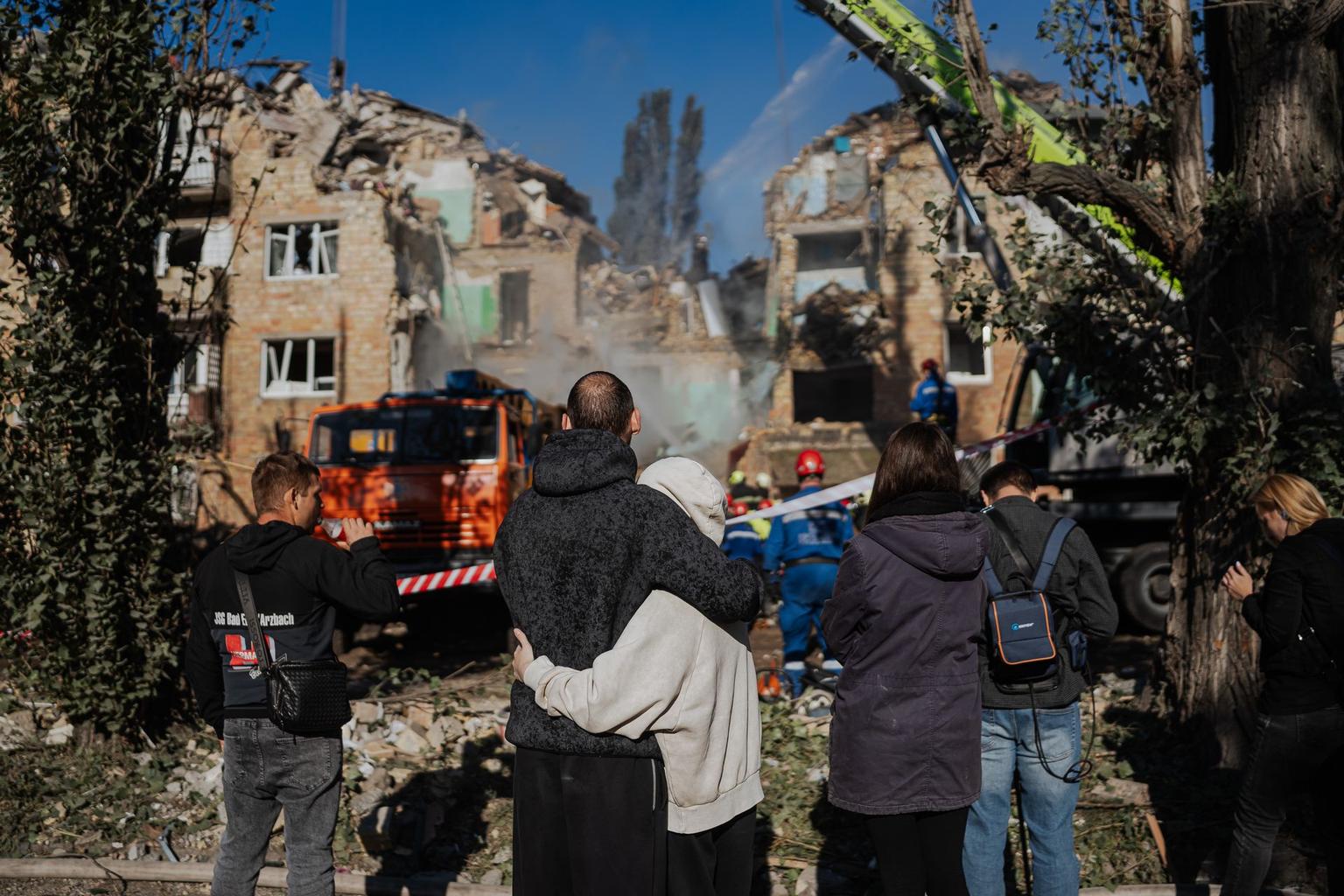
People gather near a residential building partially destroyed by a Russian missile strike, waiting for search and rescue operations to be completed in Kyiv, Ukraine. (Valentyna Polishchuk/Global Images Ukraine)
The Minister’s Moment: Belousov Reveals Russia’s War Machine Transformation
Russian Defense Minister Andrei Belousov’s comprehensive address to the Russian Ministry of Defense Collegium on August 29 provided the most detailed public assessment of Moscow’s military evolution since the invasion began. Speaking with the confidence of a man overseeing what he portrayed as a successful campaign, Belousov painted a picture of Russian forces seizing 600-700 square kilometers of Ukrainian territory monthly—a significant increase from the 300-400 square kilometers claimed at the year’s beginning.
Yet the reality behind these boastful statistics tells a different story. Independent analysis reveals Russian forces actually seized approximately 500 square kilometers in August 2025—far below Belousov’s inflated claims. More tellingly, these advances come at an extraordinary cost: Ukrainian General Staff reporting indicates Russian forces suffered an average of 938 personnel casualties per day throughout August, a staggering price for gains in “open fields and areas with minimal fortifications.”
Belousov’s admission that 97 percent of wounded servicemembers return to frontlines “after being wounded” inadvertently revealed the desperation underlying Russian tactics—a military command so pressed for manpower it sends injured soldiers back into attritional, infantry-led assaults rather than allowing proper recovery.
Light Wheels for Heavy Losses: The Motorcycle Revolution
Perhaps the most illuminating aspect of Belousov’s presentation was his emphasis on Russia’s dramatic shift toward light vehicles over traditional armored platforms. The defense minister claimed Russia had procured and delivered 22,725 motorcycles, all-terrain vehicles, and buggies to frontlines, with plans to deliver an additional 12,186 such vehicles by month’s end.
This tactical revolution—from tanks to motorcycles—speaks to a fundamental problem Moscow faces but cannot publicly acknowledge. Ukrainian drone operations have made traditional armored vehicles increasingly vulnerable, forcing Russian commanders to embrace cheap, maneuverable alternatives that offer speed over protection. Previous reports suggested Russia purchased over 40,000 Chinese-made motorcycles in 2024 alone, with plans to acquire up to 200,000 motorcycles and 60,000 other light vehicles in 2025.
The shift represents more than tactical adaptation—it reveals Russia’s acknowledgment that it cannot adequately protect its armored vehicles against Ukrainian drone strikes, while simultaneously facing declining tank and armored vehicle stockpiles from its Soviet inheritance.
Digital Mobilization: Moscow’s Administrative Evolution
Belousov’s presentation also revealed Russia’s intensive focus on digitalizing its recruitment processes—a less glamorous but potentially more consequential development than battlefield tactics. The defense minister highlighted completion of the “State System of Unified Military Registration,” creating what he described as a “unified digital environment” for military administration.
This digitalization effort extends far beyond simple administrative efficiency. It represents Russia’s attempt to create the bureaucratic infrastructure necessary for sustained, large-scale mobilization throughout the year rather than only during traditional semi-annual reserve call-ups. Recent legislation introduced by Russian State Duma Defense Committee Chairperson Andrei Kartapolov would facilitate year-round processing of mobilized personnel, potentially eliminating bureaucratic bottlenecks that have complicated Russia’s ability to conduct massive involuntary conscription.
Flames Across the Frontier: Ukrainian Strikes Penetrate Deep
Even as Belousov spoke of Russian advances, Ukrainian forces demonstrated their expanding reach with coordinated strikes across multiple Russian regions. The most significant target was a diesel fuel pumping station near Naytopovychi in Bryansk Oblast—a critical facility with an annual capacity of 10.5 million tons that supplies fuel directly to Russian forces through main petroleum pipelines.
The joint operation, conducted by Ukraine’s missile forces, Unmanned Systems Forces, Special Operations Forces, and Security Service, resulted in massive fires visible in footage released by the Ukrainian General Staff. Located approximately 50 kilometers north of the Russia-Ukraine border, the facility’s destruction represents another blow to Russia’s logistical capabilities.
Ukrainian drones also struck oil refineries in Russia’s Krasnodar Krai and Samara Oblast, with commander Robert “Magyar” Brovdi confirming his forces targeted the Krasnodar Oil Refinery and Syzran Oil Refinery. Both facilities combine for 4.1% of Russian oil production and help supply the Russian Armed Forces with aviation fuel and other petroleum products.
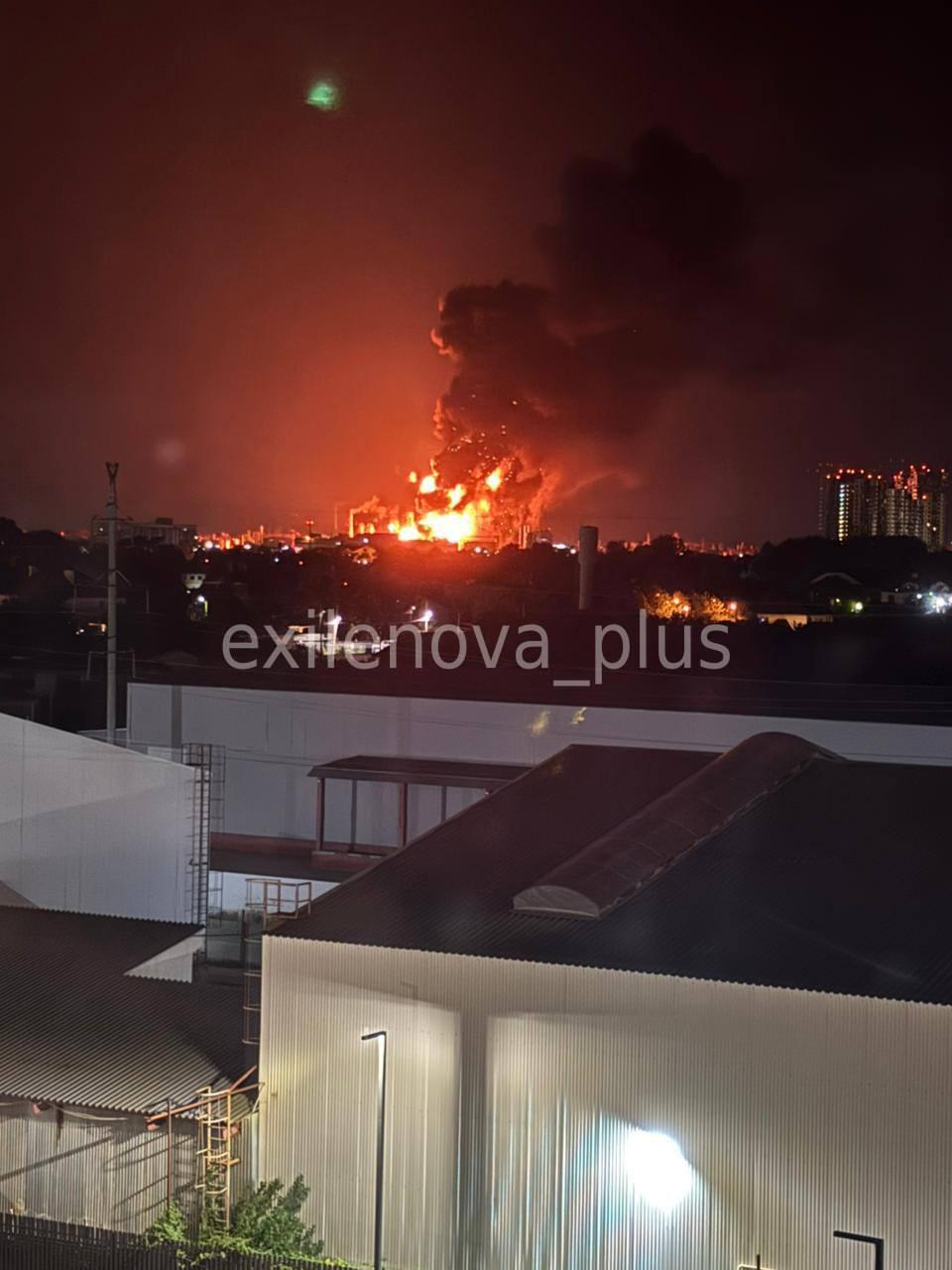
A purported image of a fire at a local oil refinery in Russia’s Krasnodar Krai following a Ukrainian drone attack on the region. (Exilenova_plus/Telegram)
Fire at the Palace: Drones Reach Putin’s Domain
In a dramatic demonstration of Ukrainian operational reach, parts of a Ukrainian drone fell near Vladimir Putin’s Black Sea palace and winery, causing forest fires that grew to 41.5 hectares by morning. The attack near Gelendzhik occurred just 3-4 kilometers from Putin’s infamous Idokopas Palace—the lavish compound exposed in Alexey Navalny’s 2021 investigation that sparked major protests across Russia.
The palace complex, built between 2005 and 2010, has undergone significant changes since the invasion began, with entertainment zones eliminated and replaced by military-themed halls and a luxurious chapel dedicated to Saint Vladimir. The proximity of Ukrainian drones to this symbol of Putin’s power represents both tactical success and potent symbolism.
The Crimean Connection: GUR Forces Strike Air Defenses
Ukraine’s Main Intelligence Directorate reported successful strikes against Russian air defense systems in occupied Crimea, targeting a Buyan-M radar system belonging to an S-400 air defense complex overnight on August 28-29. The strike represents part of Ukraine’s systematic campaign to degrade Russian air defenses, creating corridors for deeper penetration strikes.
Additional sabotage operations reached the Tver railway station between Moscow and St. Petersburg, where pro-Ukrainian actors reportedly planted and remotely detonated explosives under railway fuel tanks, causing massive fires at a critical logistics hub used to supply Russian forces with fuel, ammunition, and personnel.
America’s Arsenal: $329 Million in New Military Aid
The United States demonstrated continued commitment to Ukrainian defense capabilities with approval of $329.1 million in new military sales on August 29. The package includes $179.1 million for Patriot air defense system sustainment—spare parts, maintenance support, software updates, and contractor training essential for maintaining Ukraine’s most advanced air defense systems.
An additional $150 million was allocated for extending Starlink terminal support services, ensuring continued satellite communications capabilities that Ukraine relies on for both humanitarian purposes and military operations, including drone piloting, artillery targeting, and battlefield communications.
This followed earlier approval of an $825 million sale of Extended Range Attack Munition (ERAM) air-launched missiles, with up to 3,350 missiles and navigation systems equipped with anti-spoofing modules funded by Denmark, Norway, the Netherlands, and U.S. Foreign Military Funding.
European Commitment: Belgium Joins PURL Initiative
Belgium announced an additional 100 million euros in military aid through NATO’s Prioritized Ukraine Requirements List mechanism, bringing its total military assistance to over 1 billion euros. The PURL initiative, designed to shift financial responsibility for Ukrainian aid from the United States to European partners, has now gathered contributions from multiple NATO allies.
Belgian Defense Minister Theo Francken confirmed that the country’s promised F-16 fighter jets would be “delivered as soon as possible,” with Foreign Minister Maxime Prevot indicating delivery could begin within months. “Russia is increasing its deadly attacks. We stand with Ukraine and must respond to this in unity,” Francken declared.
Copenhagen Consensus: EU Ministers Agree on Military Instructors
In Copenhagen, EU defense ministers reached nominal agreement to deploy military instructors to Ukraine after a hypothetical future ceasefire, with EU top diplomat Kaja Kallas welcoming “broad support” for expanding the EU military mission mandate. The meeting came just one day after an EU mission building was damaged in the Russian strike on Kyiv, adding urgency to discussions about robust security guarantees.
“We are the largest provider of training to Ukraine’s military. We have trained over 80,000 soldiers so far, and we must be ready to do more,” Kallas declared, emphasizing that security guarantees for Ukraine “must be robust and credible.” The agreement represents a significant step toward concrete European security commitments, even as the details of implementation remain unclear.
The New York Negotiations: Witkoff’s “Productive” Talks
White House Special Envoy Steve Witkoff held extensive talks with Ukrainian officials in New York City on August 29, describing the discussions as “very productive and constructive.” Meeting with Presidential Office Head Andriy Yermak and Deputy Foreign Minister Sergiy Kyslytsia, Witkoff received status updates on the war and Russia’s latest large-scale attack on Kyiv.
Ukrainian officials invited Witkoff to visit Kyiv in the future, while reaffirming Ukraine’s readiness for peace negotiations, including at the heads-of-state level. The meetings were characterized by Trump administration officials as both progress reports and reaffirmation of efforts to bring Ukraine and Russia to the negotiating table for an eventual peace deal.
UN Security Council: Emergency Session on Kyiv Attack
The United Nations Security Council convened at Ukraine’s request on August 29 to discuss the deadly Russian attack on Kyiv. The emergency session, backed by Denmark, France, Greece, South Korea, Slovenia, and the United Kingdom, provided a forum for the Ukrainian delegation to brief the international community about the scale of destruction and urge immediate ceasefire and civilian protection.
The session coincided with top Ukrainian officials’ presence in New York for talks with U.S. representatives, highlighting the parallel tracks of diplomatic engagement and international condemnation of Russian actions.
Hungarian Defiance: Opposition Challenges Government Line
Hungarian opposition politician Marton Tompos made a pointed gesture of defiance against his government’s Russia-friendly stance by donating 414 euros to Ukrainian commander Robert “Magyar” Brovdi’s drone unit. The donation directly challenged Budapest’s ban on the ethnic Hungarian officer responsible for strikes on the Druzhba oil pipeline.
“The government is not the same as the country,” Tompos wrote on Facebook, calling on fellow Hungarians to prove that “it is not Ukrainians, but the Hungarian government that poses a threat to Hungary’s energy security.” The gesture highlighted growing tensions between Hungary’s official pro-Russian position and opposition voices supporting Ukraine.
Zelensky’s Security Framework: Three Pillars Outlined
President Volodymyr Zelensky outlined his vision for Ukraine’s security guarantees in three key pillars during discussions with journalists. The first concerns maintaining Ukrainian Armed Forces at current strength with consistent arms supplies from Ukrainian, European, and U.S. manufacturers. The second involves agreements with NATO member states on their readiness to support Ukraine against renewed Russian aggression. The third focuses on sanctions against Russia and using frozen Russian assets for post-war reconstruction.
These discussions occurred as Ukrainian officials emphasized their country’s European Union membership path as an additional security guarantee, while noting that any peace negotiations must include direct talks at the heads-of-state level.
The Human Cost: Memorial and Mourning
The human dimension of the conflict remained starkly visible as the death toll from the August 28 Russian assault on Kyiv climbed to 25. Among the victims were 24-year-old Nadiia Yakymenko and her 2-year-old daughter Anhelina—a child who had been born under Russian shelling in October 2022 and died from Russian shelling in August 2025.
“An absolutely despicable attack that demonstrates Putin’s true intentions—to continue killing rather than take steps towards peace,” Zelensky declared. The attack damaged numerous civilian and international facilities, including the offices of Radio Free Europe/Radio Liberty, Ukrainska Pravda, and the EU mission to Ukraine, while 63 people including 11 children were injured.
War Crimes Continue: The Myrolyubivka Executions
The Ukrainian Donetsk Oblast Prosecutor’s Office opened an investigation into the brutal torture and execution of seven Ukrainian prisoners of war near Myrolyubivka in August 2025. One survivor crawled to safety over five days, his injuries so severe that he could only provide his account in writing rather than verbally.
The executions represent part of a sharp increase in credible reports of Russian forces systematically killing Ukrainian POWs throughout 2024 and 2025, violations of international law that military commanders appear to be either complicit in or directly enabling.
Battlefield Dynamics: Grinding Advances at Enormous Cost
Across multiple fronts, Russian forces continued offensive operations while Ukrainian forces demonstrated both defensive resilience and offensive capability. Russian forces made confirmed advances in the Pokrovsk direction, seizing the settlement of Leontovychi through small-group assaults supported by artillery and drone cover.
Yet even these tactical successes came at extraordinary cost. A Russian milblogger affiliated with the Northern Grouping of Forces admitted that Russian forces had been “bogged down in attritional fighting” in Yunakivka for over a month despite daily claims of incremental gains, noting that “the presence of individual Russian soldiers does not indicate that Russian forces seized the settlement.”
Ukrainian forces demonstrated their continued capability for territorial recovery in northern Kharkiv Oblast, while conducting successful counterattacks in multiple directions according to various front-line reports.
Intelligence Warnings: Moscow’s Autumn Plans Exposed
German intelligence sources revealed that Ukrainian officials warned on August 13 of Russian plans to leverage diplomatic negotiations to “play for time” ahead of a potential October or November 2025 offensive. The reports align with recent Ukrainian assessments that Russia may transfer significant troop numbers to the Zaporizhia, Pokrovsk, and Novopavlivka directions to intensify operations.
These intelligence warnings suggest that while diplomatic theater continues, Moscow’s fundamental war aims remain unchanged—a reality reinforced by Russian forces’ exploitation of previous diplomatic pauses to stockpile weapons and conduct devastating strikes on civilian targets.
The Gasoline Crisis: Ukraine’s Economic Warfare Success
Ukraine’s sustained campaign against Russian oil infrastructure continued to demonstrate measurable impact on Russia’s domestic economy. Sources reported that damage from Ukrainian strikes on the Ust-Luga port would force operations at about half capacity in September, while the Kuibyshev refinery suspended operations after recent drone attacks damaged key equipment.
With approximately 20 percent of Russian crude oil processing capacity offline due to Ukrainian strikes and resulting fires, market observers noted gasoline shortages and price spikes as far away as the Russian Far East—tangible evidence that Ukraine’s strategy of attacking economic targets is creating genuine pressure on the Russian population.
Looking Forward: The Autumn of Consequences
As August 29 drew to a close, the day’s events painted a picture of a conflict entering a potentially decisive phase. Russia’s military transformation—from tank-heavy forces to motorcycle-mounted infantry, from periodic mobilization to year-round recruitment—reveals a nation preparing for prolonged conflict rather than negotiated settlement.
Ukraine’s expanding strike capabilities, demonstrated by attacks reaching from Crimea to Putin’s palace doorstep, suggest Kyiv’s ability to impose costs on Moscow will only grow. European commitment to military instructors and security guarantees, combined with continued American military aid, indicates sustained Western support despite diplomatic efforts.
The intelligence warnings of Russian autumn offensive preparations, combined with Moscow’s continued rejection of meaningful ceasefire proposals, indicate that diplomatic efforts may face their greatest test in the coming months. For now, the machinery of war grinds on, transforming both nations and reshaping the European security landscape with each passing day.