
Moscow’s Military Chief Declares Continued Offensive Operations While European Leaders Plan Troop Deployments and Ukrainian Defenses Hold Against 142-Drone Assault
Summary of the Day – August 31, 2025
The final day of August crystallized the war’s grim trajectory as Russian Chief of the General Staff Valery Gerasimov declared that Moscow would continue offensive operations indefinitely, effectively ending months of diplomatic speculation about peace negotiations. Despite launching attacks across six major fronts, Russian forces failed to achieve confirmed territorial gains, while Ukrainian air defenses successfully intercepted 126 of 142 Russian drones in overnight strikes. As Russia doubled down on military conquest, European Commission President Ursula von der Leyen revealed “pretty precise plans” for deploying tens of thousands of European troops to Ukraine as security guarantees, while German Chancellor Friedrich Merz prepared his nation for a protracted conflict. Meanwhile, a major fire erupted at a chemical facility near Moscow, Ukraine liberated positions near Kupiansk, and Hungary’s foreign minister formally blocked Ukraine’s EU accession talks, highlighting the complex web of military, diplomatic, and political pressures shaping the conflict’s evolution.
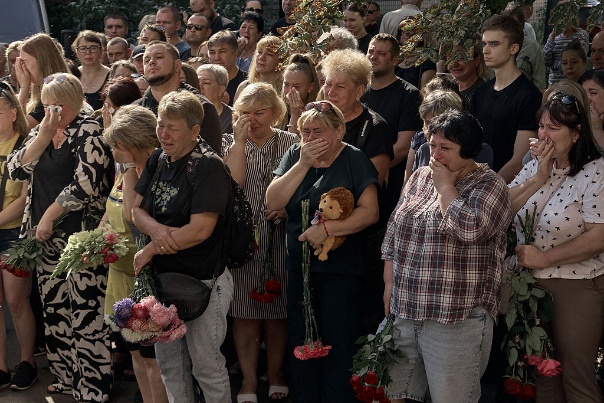
A funeral procession takes places during a service for 24-year-old Nadiia and her 2-year-old daughter Angelina killed recently in a Russian missile strike in Kyiv. The mother and daughter were killed on Aug. 28th when a Russian missile hit their home in the capital. (Kostiantyn Liberov/Libkos/Getty Images)
The General’s Ultimatum: Moscow Chooses War Over Diplomacy
Russian Chief of the General Staff Army General Valery Gerasimov delivered the most definitive rejection yet of diplomatic efforts to end the war, announcing on August 30 that Russian forces would continue offensive operations regardless of international pressure. “The implementation of the tasks of the full-scale invasion of Ukraine by the Joint Group of Troops will continue by conducting offensive actions,” Gerasimov declared in comments that reverberated through the conflict’s final August day.
His statement represented a direct rebuff to U.S. President Donald Trump’s peace initiatives, coming just as another diplomatic deadline approached without result. “Today we will clarify the tasks of the troop groups in the directions for the autumn period,” Gerasimov added, making clear that Russia viewed the coming months as an opportunity for renewed military pressure rather than negotiated settlement.
The Russian general also confirmed that “targeted massive fire strikes continue,” referring to the regular bombardment campaigns against Ukrainian cities and infrastructure. Despite claiming these strikes target only military facilities, Russian missiles and drones consistently hit civilian targets, including the devastating August 28 attack on Kyiv that killed 25 people, including four children.
The Drone Storm: Ukrainian Defenses Triumph Against Mass Assault
Russian forces launched their most intensive drone attack in recent weeks overnight on August 30-31, deploying 142 Shahed-type attack drones and decoys from staging areas across Russia and occupied territories. The Ukrainian Air Force reported launches from Kursk City, Millerovo in Rostov Oblast, Primorsko-Akhtarsk in Krasnodar Krai, and occupied Cape Chauda in Crimea.
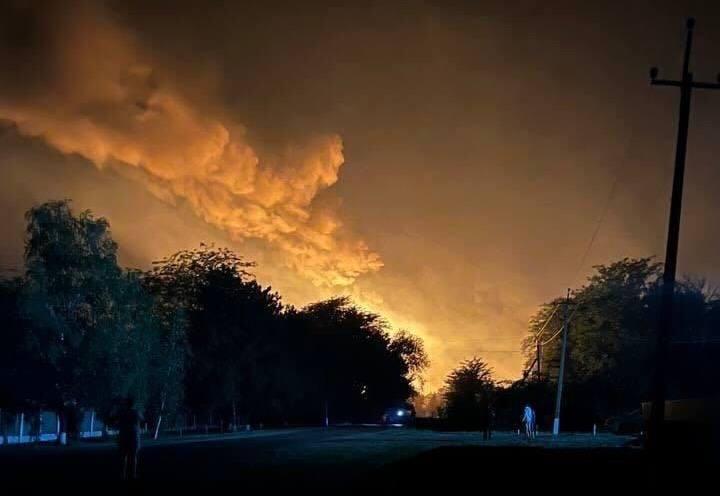
Photo for illustrative purposes only: Russia’s Krasnodar Krai region pictured last year. (Courtesy)
Ukrainian air defenses demonstrated remarkable effectiveness, downing or suppressing 126 of the 142 drones—an 89% success rate that highlighted both the growing sophistication of Ukraine’s defensive systems and the persistence of Russian mass attack tactics. Only 16 drones successfully struck targets at 10 locations, with debris from intercepted drones falling at six additional sites.
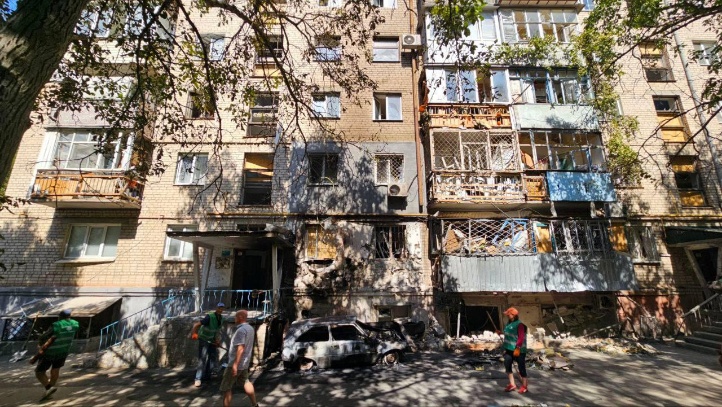
Russian attack on Kherson. (Governor Oleksandr Prokudin/Telegram)
The infrastructure damage proved significant despite the defensive success. In Chernihiv Oblast, strikes on critical infrastructure in Nizhyn left over 30,000 households without electricity. Odesa Oblast suffered even greater impact, with attacks on four energy facilities in Chornomorsk cutting power to more than 29,000 customers and injuring one civilian.
Fire Near the Kremlin: Chemical Warehouse Erupts in Moscow Region
A massive fire erupted at a chemical warehouse in Balashikha, just 14 kilometers east of Moscow, sending thick plumes of black smoke across the industrial zone. Russia’s Emergency Service reported the blaze spanning 4,000 square meters on Zvezdnaya Street, requiring over 80 specialists and 30 pieces of equipment, including Mi-8 and Ka-32 helicopters, to extinguish.
The fire occurred in an industrial area housing the Balashikha Experimental Chemical Plant, with explosions heard during the incident according to Russian independent outlet Astra. While Ukrainian drones were not reported in the area and the cause remained unclear, the incident highlighted the vulnerability of Russian infrastructure even in the Moscow region.
No casualties were reported, but the dramatic images of smoke covering several blocks in Russia’s most densely populated region outside Moscow itself served as a stark reminder of the war’s potential to reach deep into Russian territory.
Europe’s Military Commitment: von der Leyen Reveals Troop Deployment Plans
European Commission President Ursula von der Leyen disclosed that European capitals have developed “pretty precise plans” for deploying tens of thousands of troops to Ukraine as part of postwar security guarantees. Speaking to the Financial Times during a tour of eastern EU states, she confirmed the plans carried full U.S. support and represented concrete commitments rather than theoretical discussions.
“Security guarantees are paramount and absolutely crucial. We have a clear road map and we had an agreement in the White House… and this work is going forward very well,” von der Leyen stated. The plans envision “a multinational troop deployment and the backstop of the Americans,” with European-led personnel supported by U.S. command-and-control systems, intelligence, and surveillance assets.
Defense chiefs from participating nations met the previous week and “worked out pretty precise plans,” including detailed discussions about equipment and logistics needed for troop deployment. Von der Leyen emphasized that while “deploying troops is one of the most important sovereign decisions of a nation,” European leaders felt “the sense of urgency is very high… it’s moving forward. It’s really taking shape.”
The arrangements were reportedly agreed during last month’s Washington meeting between Trump, President Volodymyr Zelensky, and senior European leaders, with a follow-up session scheduled for September 4 in Paris.
Germany’s Grim Assessment: Merz Prepares for Extended Conflict
German Chancellor Friedrich Merz acknowledged the likelihood of prolonged warfare, telling German broadcaster ZDF that he expects Russia’s war in Ukraine to “last a long time.” His assessment came as most wars historically end through military defeat or economic collapse—scenarios he doesn’t anticipate for either combatant in the near term.
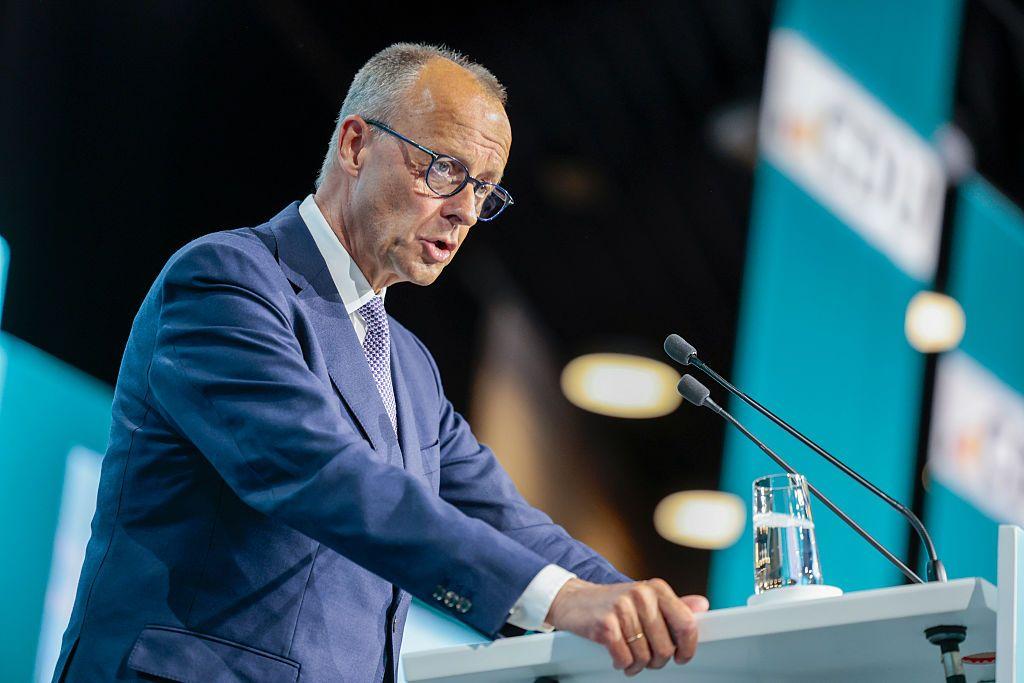
German Chancellor Friedrich Merz speaks at the state party conference of the CDU North Rhine-Westphalia. (Photo by Thomas Banneyer/picture alliance via Getty Images)
“I am preparing myself inwardly for this war to last a long time,” Merz declared, speaking just before another Trump peace deadline expired without progress. The German leader emphasized that peace cannot come “at the price of Ukraine’s capitulation,” warning that Russian success would inevitably target other European nations.
“The day after tomorrow it will be us,” Merz added, reflecting broader European concerns about Russian expansionism beyond Ukrainian borders. His remarks came amid Germany’s broader recognition that it is “already in conflict with Russia” due to Moscow’s hybrid operations and sabotage efforts across Europe.
Budapest’s Blockade: Hungary Formally Rejects Ukraine’s EU Path
Hungarian Foreign Minister Peter Szijjarto delivered a definitive rejection of Ukraine’s European Union accession process, announcing that Budapest would not permit opening the first round of membership negotiations. Speaking after an informal meeting of EU ministers in Copenhagen on August 30, Szijjarto claimed Ukraine’s membership “would destroy Hungarian farmers, Hungary’s food security, and allow the Ukrainian mafia to enter Hungary.”
“That is why we will not allow the substantive part of the accession negotiations, i.e., the specific rounds of the negotiations, to be opened,” Szijjarto declared. As an EU member, Hungary holds veto power over Ukraine’s accession progress, effectively blocking the process indefinitely without policy changes in Budapest.
The Hungarian minister also alleged that Europe seeks to prolong rather than end the war, positioning Hungary as the sole EU supporter of Trump’s peace efforts. Szijjarto claimed only an agreement between the United States and Russia could lead to settlement, dismissing European involvement in peace processes.
Hungary’s opposition extended to financial support, with Szijjarto vowing to block approximately 2.5 billion forints ($6.76 million) in European Peace Fund contributions and any sanctions against energy companies important for Hungarian energy security.
Maritime Perils: Civilian Ship Strikes Explosive Device in Black Sea
The ongoing maritime security crisis in the Black Sea claimed another victim when the cargo ship NS Pride, flying a Belize flag, struck an unidentified explosive device near Chornomorsk port close to Odesa. The vessel remained afloat with no casualties among crew members, though damage occurred to the hull.
Ukrainian Navy spokesperson Dmytro Pletenchuk acknowledged the persistent maritime threat: “Unfortunately, as a result of the actions of the Russian occupiers, a large number of explosive objects remain in the sea. And it is impossible to predict 100% such situations in the sea, where there is constant movement.”
Reports suggested the explosion resulted from debris of a previously downed Russian Shahed drone detonating beneath the ship, though drifting mines remained another possibility. The incident underscored how Russia’s invasion has transformed the Black Sea from Ukraine’s primary commercial route into a hazardous obstacle course of unexploded ordnance.
Military Exercises Begin: CSTO Forces Gather in Belarus
The Russian-led Collective Security Treaty Organization commenced annual military exercises in Belarus on August 31, launching “Interaction-2025,” “Search-2025,” and “Echelon-2025” exercises at the Lepelsky training ground in Vitebsk Oblast. Forces from Kyrgyzstan, Kazakhstan, Russia, Tajikistan, and Belarus began training with more than 2,000 military personnel and 450 pieces of weapons and equipment.
Belarusian Chief of the General Staff Major General Pavel Muraveiko announced that the ongoing CSTO exercises and upcoming Zapad-2025 bilateral Russian-Belarusian drills would include planning and practicing the use of nuclear weapons, including tactical nuclear weapons. The exercises will continue until September 6, involving nine aircraft and helicopters plus over 70 drones.
The timing of nuclear weapon exercises coincided with Russia’s declared intention to continue offensive operations in Ukraine, raising concerns about potential escalation in the region.
Pokrovsk Under Pressure: Zelensky Confirms Hottest Front
President Volodymyr Zelensky confirmed that Pokrovsk remains the conflict’s most intense battlefield following a briefing by Commander-in-Chief Oleksandr Syrsky. The Ukrainian stronghold in Donetsk region has endured intensified Russian assaults in recent weeks, with Moscow concentrating its “greatest efforts” on the strategic city.
Despite Russian pressure, Zelensky emphasized that “the situation remains under control” while highlighting the enormous cost of Moscow’s offensive. “Across the front, in just the first eight months of this year, the Russians have lost more than 290,000 soldiers killed and severely wounded,” Zelensky wrote on social media.
The president specifically noted that Russian losses were heavily concentrated in Donetsk region, where Moscow “failed to achieve any of their strategic objectives” despite mounting casualties. His remarks served as a direct rebuke to suggestions that Ukraine should cede Donetsk region for peace, which would hand Moscow one of its stated war goals without major concessions elsewhere.
The Stalemate Continues: Six Fronts, Zero Russian Gains
Despite launching coordinated attacks across multiple directions on August 31, Russian forces failed to achieve confirmed territorial advances on any front. From the northern Sumy Oblast border to southern Zaporizhzhia, Russian assaults met determined Ukrainian resistance that prevented meaningful breakthroughs.
Ukrainian forces continued clearing operations near Pokrovsk, with Dnipro Group Spokesperson Colonel Viktor Trehubov reporting success in eliminating Russian penetrations near Dobropillya. Trehubov noted that small Russian infantry groups continued attempting to infiltrate Pokrovsk from multiple directions, particularly from the southwest, but these efforts were being systematically defeated.
In the Toretsk direction, Russian forces achieved limited advances, seizing Rusyn Yar and advancing southeast of Sofiivka according to geolocated footage. However, these minor gains came at enormous cost, with Russian forces continuing to rely primarily on motorcycle-based assaults rather than armored vehicle operations due to heavy equipment losses.
The pattern repeated across other fronts, with Russian attacks in the Lyman, Siversk, Chasiv Yar, Pokrovsk, Kupyansk, and Zaporizhzhia directions failing to achieve meaningful territorial changes despite sustained pressure.
Looking Forward: The Architecture of Endless Conflict
As August concluded with Gerasimov’s promise of continued offensive operations and European preparations for military involvement, the conflict’s trajectory appeared set for prolonged attrition. Russia’s commitment to military solution despite mounting casualties and minimal gains established the framework for autumn warfare, while Ukraine’s defensive success and European security planning suggested Moscow’s objectives remain distant.
The convergence of Russian military declarations, European troop planning, and Hungarian diplomatic obstruction created a complex matrix of competing pressures that virtually guaranteed continued conflict. With over 290,000 Russian casualties in eight months producing minimal territorial gains, and European leaders preparing for scenarios measured in years rather than months, the war’s fundamental dynamics appeared increasingly entrenched rather than approaching resolution.