
As Moscow launches its most massive aerial assault with 526 targets while Putin courts allies in Beijing, Ukraine’s air defenses prove their mettle amid growing European solidarity and deepening corruption scandals
Summary of the Day – September 3, 2025
The third day of September witnessed Russia’s most ambitious aerial assault of recent months—526 drones and missiles launched in a coordinated barrage that tested Ukraine’s air defense capabilities to their limits. Yet as Ukrainian forces intercepted an extraordinary 451 of those projectiles, Vladimir Putin played diplomatic theater in Beijing, joining Xi Jinping and Kim Jong Un at a military parade while discussing immortality and thanking North Korean forces for their “heroic” sacrifices in Kursk Oblast. Simultaneously, Ukraine’s internal challenges surfaced through corruption allegations involving fortification contracts worth $5 million, while international support crystallized through new British sanctions targeting Russian child deportation networks and European leaders advancing concrete security guarantees in Paris.
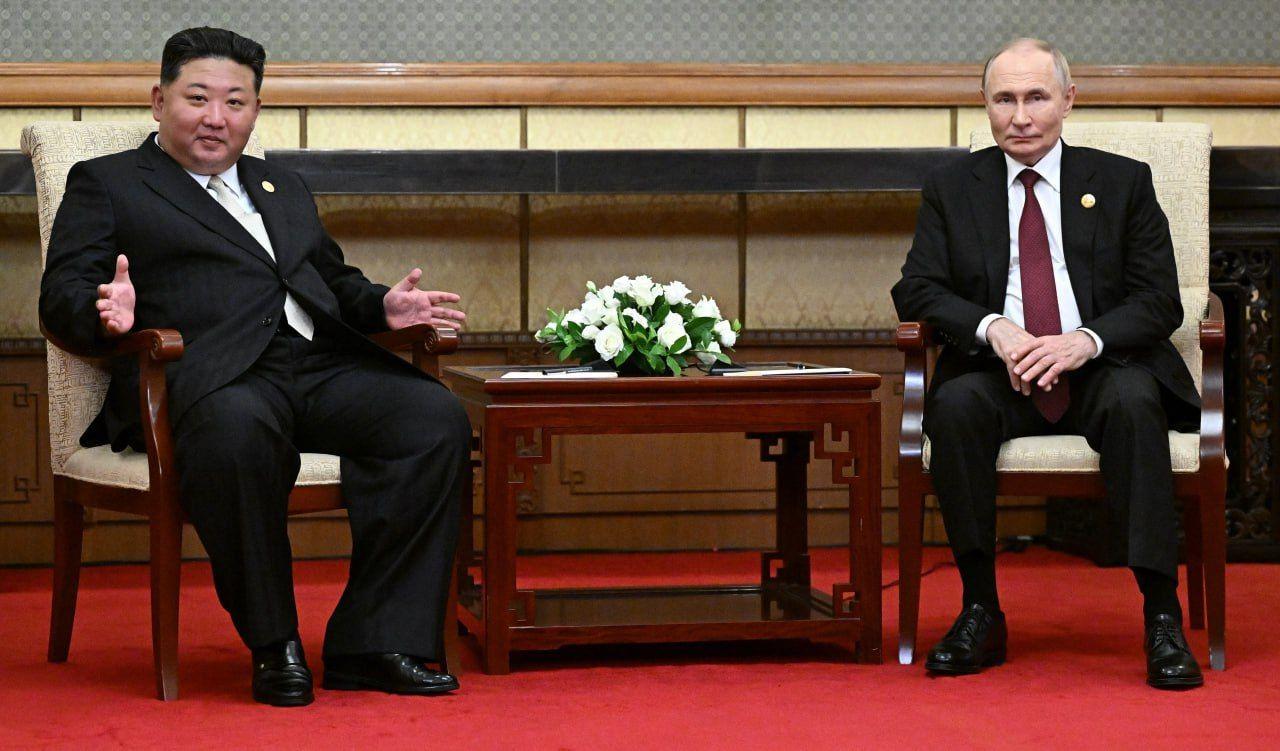
Russian President Vladimir Putin held talks with North Korean dictator Kim Jong Un in Beijing. (Kremlin/Telegram)
The Mathematics of Destruction: Russia’s Largest Assault Meets Ukrainian Defenses
In the early hours of September 3, Ukraine’s radar screens lit up with 526 aerial targets—502 Shahed drones and decoys launched from Russian territory and occupied Crimea, 16 Kalibr cruise missiles from the Black Sea, and eight Kh-101 cruise missiles from strategic bombers over Saratov and Krasnodar regions. Ukrainian air defenses intercepted 451 targets, including 430 drones, 14 Kalibr missiles, and seven Kh-101s.
The remaining weapons struck targets across 14 locations, deliberately targeting Ukraine’s energy grid as winter approaches. In Chernihiv Oblast, nearly 30,000 households lost power after Russian forces struck critical infrastructure, while Ivano-Frankivsk suffered fires at infrastructure facilities covering 9,000 square meters. Ukrainian Railways reported strikes on railway infrastructure in Kirovohrad Oblast caused delays of up to seven hours, with four railway workers hospitalized.
Poland scrambled aircraft and placed ground-based air defense systems on full alert, with Dutch F-35 fighter jets helping patrol Polish airspace as the massive barrage unfolded.
Civilians Under Fire: Terror Across Multiple Regions
The day’s human toll painted a grim portrait as Russian forces deliberately targeted civilian areas across multiple regions, killing at least two civilians and injuring at least 35, including children.
In Kostiantynivka, Donetsk Oblast—now surrounded on three sides by Russian forces—artillery and drone strikes claimed nine civilian lives between 10:30 a.m. and 11:50 a.m. The victims, five men and three women, were killed at home, on the street, and inside a store. Later, first-person-view drones struck two civilian vehicles, killing a 36-year-old woman. The attacks underscored the looming “humanitarian catastrophe” facing the city, which has been without stable electricity, gas, and water supply since June.
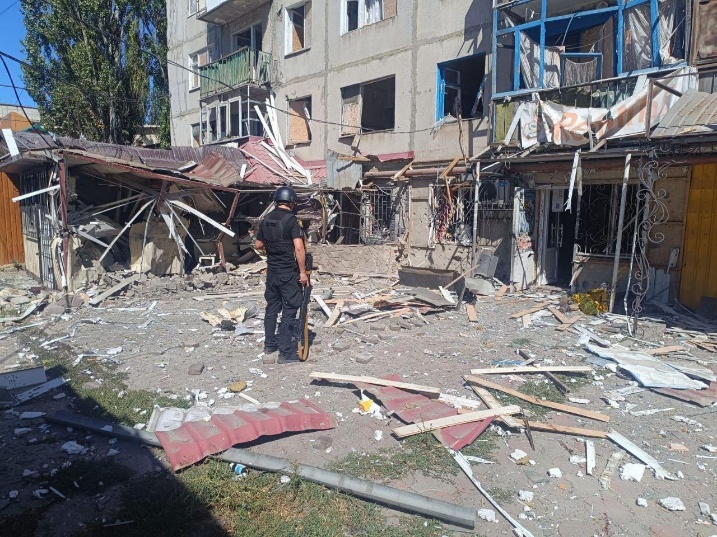
The aftermath of the Russian attack against the town of Kostiantynivka in Donetsk Oblast. (Donetsk Oblast Military Administration)
Khmelnytsky Oblast suffered the overnight drone assault that killed a local resident and caused extensive damage to residential buildings, an educational institution, and public transport infrastructure. Kirovohrad Oblast reported five people injured in Znamyanka, where 28 buildings were destroyed. Donetsk Oblast saw 14 wounded in Druzhkivka, including a 16-year-old girl, while Kherson Oblast reported 14 injured from Russian strikes on residential buildings.
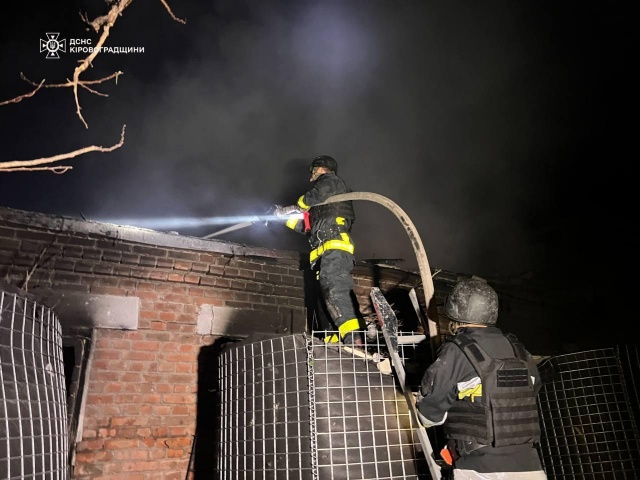
Firefighters working at the scene of a Russian attack in Znamianka, Kirovohrad Oblast, Ukraine, overnight. (State Emergency Service/Telegram)
Beijing’s Theater of Immortality: Putin Courts Xi While Ukraine Burns
While Ukrainian cities burned under Russian missiles, Vladimir Putin stood in Beijing’s Tiananmen Square attending a military parade marking the 80th anniversary of Japan’s surrender. In a surreal moment caught by hot microphones, the 72-year-old Russian president discussed biotechnology’s potential to extend human life indefinitely with Xi Jinping, musing about organ transplants allowing humans to “live younger and younger, and perhaps even achieve immortality.”
The parade showcased over 10,000 troops, advanced weaponry including nuclear-capable DF-61 intercontinental ballistic missiles, and hypersonic weapons. It marked the first public appearance of Putin, Kim Jong Un, and Xi together—a triumvirate that U.S. President Donald Trump sarcastically addressed on Truth Social: “Please give my warmest regards to Vladimir Putin, and Kim Jong Un, as you conspire against The United States of America.”
During bilateral talks at Beijing’s Diaoyutai State Guesthouse, Putin offered unprecedented public acknowledgment of North Korean military assistance, thanking Kim for dispatching troops to help recapture Kursk Oblast. “Your special forces took part in the liberation of Kursk Oblast at your initiative,” Putin told Kim, praising North Korean warriors who “fought bravely and displayed heroism.” Kim responded by calling North Korea’s military support a “fraternal duty,” cementing a partnership that has provided Russia with artillery, missiles, and an estimated 20,000 to 30,000 soldiers.
Lavrov’s Ultimatum and Zelensky’s Rejection: The Territorial Deadlock Hardens
As diplomatic theater played out in Beijing, Russian Foreign Minister Sergei Lavrov delivered Moscow’s most explicit territorial demands yet, declaring that “durable peace” requires international recognition of Russia’s annexations of five Ukrainian regions—Donetsk, Luhansk, Kherson, Zaporizhzhia, and the Crimean Peninsula.
Ukrainian Foreign Minister Andriy Sybiha denounced the demands as “a new set of old ultimatums,” while Zelensky dismissed territorial concessions as “unreasonable” during his joint press conference with Danish Prime Minister Mette Frederiksen. “If someone supports this crazy idea, who can guarantee that Putin will not continue the war? No one can give guarantees,” Zelensky said, noting that even after years of fighting, Russian forces have failed to take full control of Donetsk Oblast, claiming Russia has lost over 100,000 troops while controlling less than 30% of the region.
Foreign Ministry Spokesperson Heorhii Tykhyi reinforced this assessment, noting that “Russia seized four Ukrainian administrative centers in 2014, while Ukraine retained control of 23; this figure remains the same today after 3.5 years of full-scale invasion.” According to Ukraine’s General Staff, Russia has lost 1,084,570 troops since the full-scale invasion began, including 780 casualties on September 3 alone.
European Unity and American Uncertainty: Security Guarantees Take Shape
President Zelensky embarked on a crucial diplomatic tour, beginning in Denmark with the Nordic-Baltic Eight—countries that have consistently supported Ukraine—before arriving in Paris for critical meetings with European leaders on concrete security guarantees.
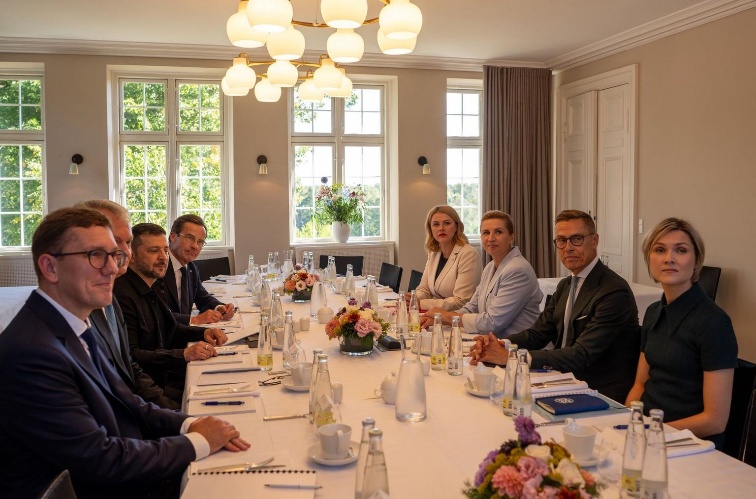
President Volodymyr Zelensky (3L) meets leaders of the Nordic-Baltic Eight during a visit to Denmark. (Danish Prime Minister’s Office/X)
During bilateral talks with French President Emmanuel Macron, the French leader reaffirmed European commitment: “We are ready to provide political support for these agreements,” referring to security guarantees formalized once a peace agreement is reached. The discussions centered on the “Coalition of the Willing”—over 30 countries spearheaded by France and Britain—preparing a multinational “reassurance force” for post-conflict deployment.
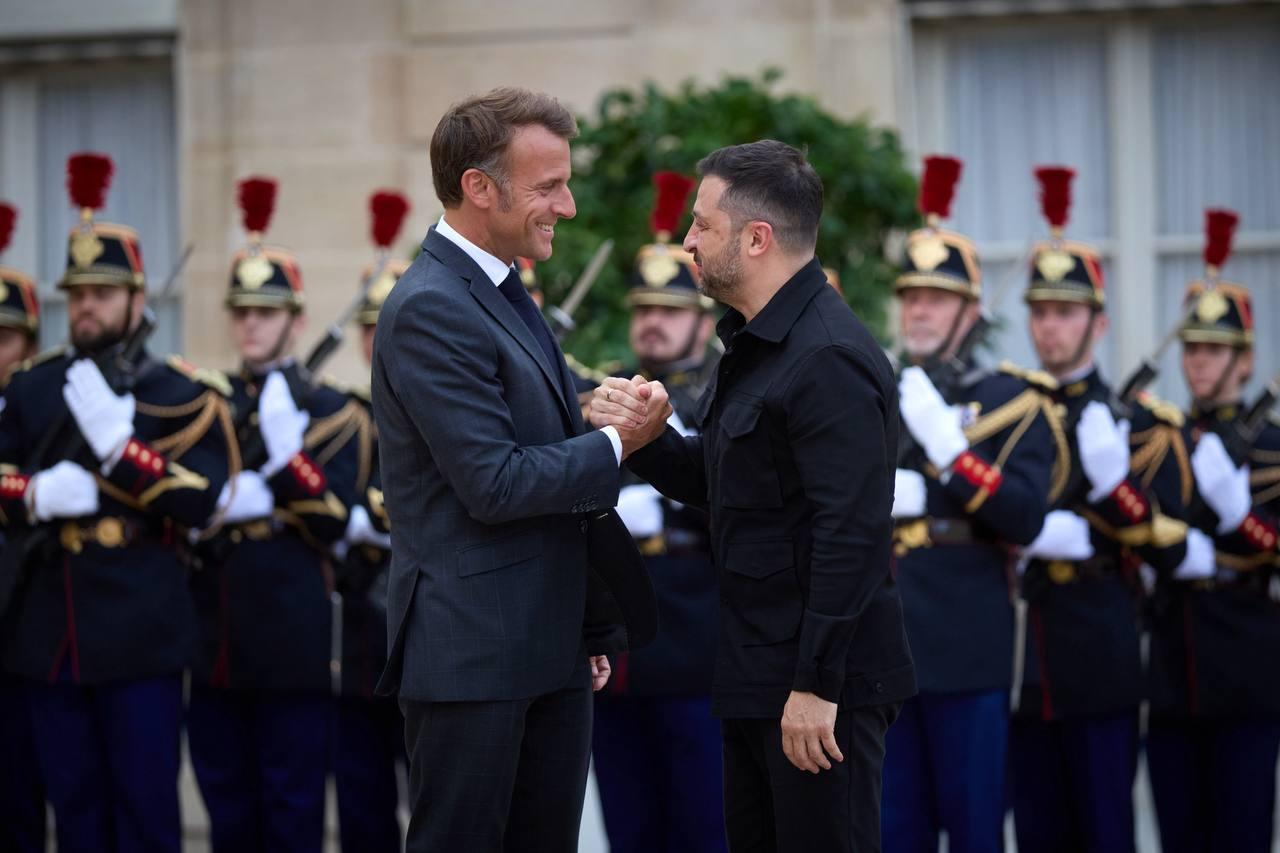
President Volodymyr Zelensky greets French President Emmanuel Macron in Paris. (Presidential Office)
However, significant divisions emerged within European leadership as German Chancellor Friedrich Merz dismissed European Commission President Ursula von der Leyen’s comments about having “pretty precise plans” for troop deployments, stating there are no such concrete plans “at least not in Germany.” Defense Minister Boris Pistorius reinforced this skepticism, declaring the EU “has no responsibilities and no competences when it comes to deploying troops.”
Meanwhile, U.K. Defense Secretary John Healey arrived in Ukraine for coordination ahead of the September 9 Ramstein summit in London, with Ukrainian Defense Minister Denys Shmyhal announcing preparations for “important bilateral decisions that will strengthen defense capabilities.”

U.K. Defense Secretary John Healey arrived in Kyiv, Ukraine. (Denys Shmyhal / Telegram)
Trump’s disappointment with Putin became public as he told the Scott Jennings Radio Show “I’m very disappointed in President Putin,” marking his strongest criticism since taking office. Simultaneously, Trump proposed sending additional American troops to Poland during an Oval Office meeting with Polish President Karol Nawrocki, saying “We will put more there if they want.”
Britain Targets Russian Child Trafficking: Sanctions Hit Deportation Networks
The United Kingdom imposed sanctions on eight individuals and several organizations linked to the forced deportation and indoctrination of Ukrainian children, representing one of the most targeted responses to Russia’s systematic campaign of cultural genocide. The sanctions targeted figures including Aymani Kadyrova, mother of Chechen dictator Ramzan Kadyrov, and organizations including “Movement of the First” and “Volunteers of Victory.”
Foreign Secretary David Lammy characterized the Kremlin’s policy as demonstrating “the depths of depravity that President Putin will reach to erase Ukrainian language, culture, and identity.” Since the start of the full-scale war, at least 19,546 Ukrainian children have been confirmed as forcibly removed according to Ukraine’s Children of War database, with only 1,592 brought back home.
The Prisoner Exchange: 175 Ukrainian Defenders Return Home
In one of the conflict’s largest prisoner swaps, 175 Ukrainian soldiers returned home through a one-for-one exchange mediated by the United Arab Emirates, with an additional 22 severely wounded servicemembers returned outside the main swap. The returnees represented the breadth of Ukraine’s resistance: defenders of Mariupol’s Azovstal steel plant and veterans of battles across multiple oblasts.
Since February 2022, 3,956 Ukrainians have returned from Russian captivity, with 1,358 released in 2025 alone. The timing suggested potential momentum in humanitarian aspects of negotiations even as territorial discussions remained deadlocked.
The Poltava Fortification Scandal: $5 Million Corruption Allegations
Ukraine’s internal governance faced scrutiny as lawmaker Yaroslav Zhelezniak published allegations that at least 200 million hryvnias (nearly $5 million) were embezzled from fortification contracts in Poltava Oblast. The alleged scheme involved inflated prices for barrier pyramids, timber, and other materials while avoiding value-added tax through fictitious contracts.
The Poltava regional administration refuted the claims as “incomplete, inaccurate, and manipulative,” asserting that 375 million hryvnias ($9 million) were spent legitimately on fortification construction. Parliament summoned both former governor Filip Pronin—now head of the State Financial Monitoring Service—and current regional head Volodymyr Kohut in reaction to the allegations.
Military Operations Continue: Naval Strikes and Railway Warfare
Ukrainian forces demonstrated evolving strategic capabilities across multiple domains. The Ukrainian Navy destroyed a Russian speedboat attempting to land airborne troops on Tendra Spit, killing seven sailors and injuring four in a drone-directed strike. This marked the latest success in Ukraine’s systematic campaign that has destroyed or disabled what Kyiv claims represents one-third of Russia’s Black Sea Fleet.
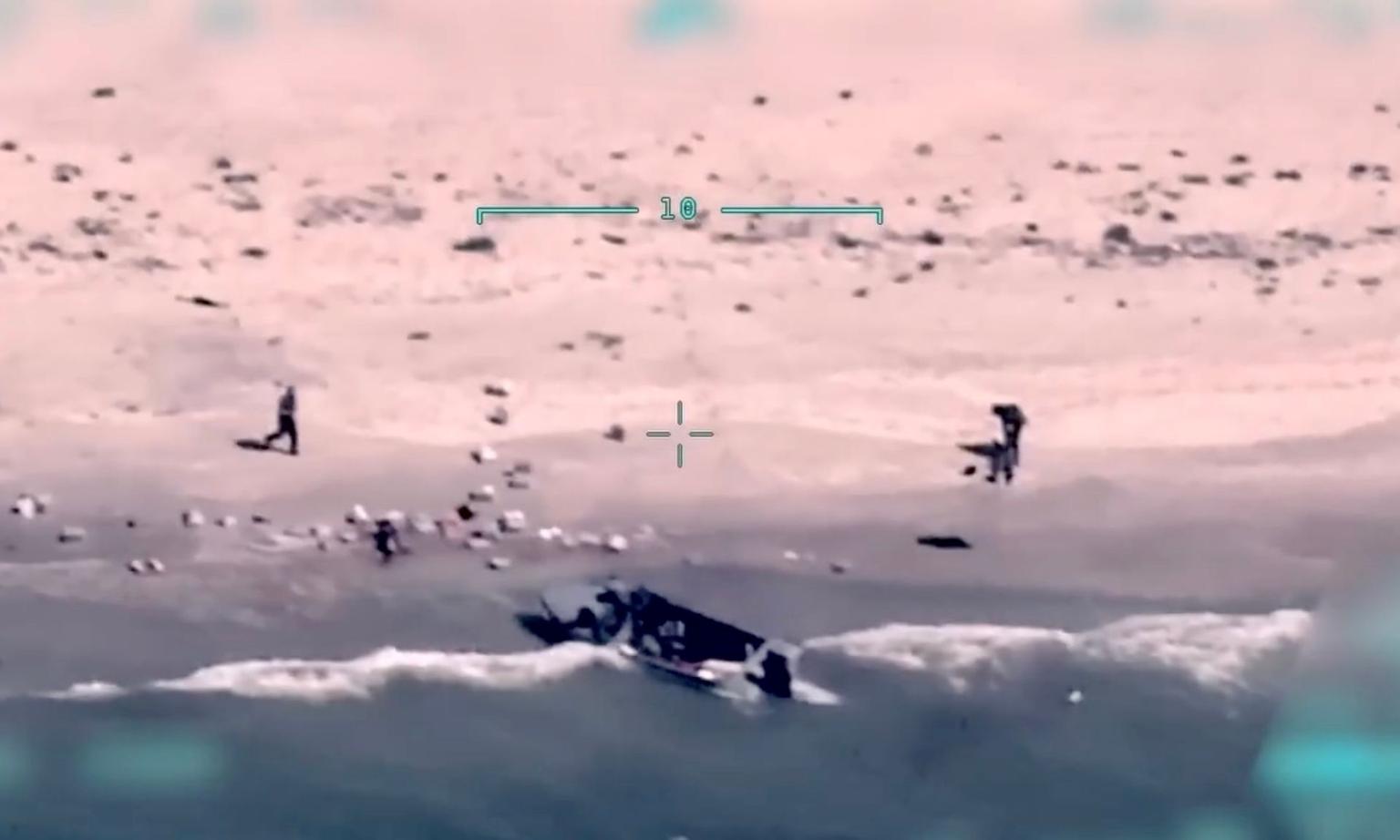
Ukrainian Navy destroys a speedboat of Russia’s Black Sea Fleet in footage published. (Ukrainian Navy / Telegram)
Ukrainian drones struck railway infrastructure in Russia’s Rostov Oblast, causing delays to 26 passenger trains and forcing evacuation of the Kuteinikovo station. Defense expert Viktor Kevliuk characterized the systematic targeting as creating “significant disruption to Russian supply lines” through “small but constant strikes.”
Simultaneously, Russia’s judicial system sentenced four Ukrainian POWs to 26-28 years in prison for alleged sabotage operations, including strikes on the Shaykovka military airfield housing strategic bombers. In their final statements, all four maintained they were defending Ukraine, with Lieutenant Colonel Andrii Antonenko declaring “I do not consider myself a terrorist” and characterizing the proceedings as “cosplay of justice.”
Domestic Reforms: Military Personnel and Economic Innovation
Ukraine advanced multiple internal reforms amid wartime pressures. Deputy Chief of Staff Pavlo Palisa announced that benefits from “18-24” contracts—offering volunteers one million hryvnias ($24,000) for one-year service—may extend to older age groups and existing servicemembers as personnel shortages continue challenging military capabilities.
Parliament passed in first reading comprehensive legislation to legalize virtual assets markets and establish taxation frameworks. The bill addresses Ukraine’s significant cryptocurrency ownership—approximately 16% of the population held crypto assets before the full-scale invasion—with taxation set at 18% income tax and 5% military tax on transactions, providing potential revenue for the war effort.
Ukraine’s State Service for Ethnopolitics and Freedom of Conscience filed a lawsuit to terminate activities of the Ukrainian Orthodox Church of the Moscow Patriarchate (UOC-MP), following conclusions that the church remains affiliated with the Russian Orthodox Church despite claims of independence.
Looking Forward: Testing Diplomatic Resolve
The coming days will test whether diplomatic momentum can overcome territorial deadlocks and whether European security commitments can provide meaningful deterrence as Ukraine continues addressing internal governance challenges alongside the ongoing conflict.