
A day when soldiers crawled through gas pipes, princes visited war zones, and nations scrambled jets over drone-filled skies
The Story of a Single Day
On September 13, 2025, the war in Ukraine revealed its strangest and most far-reaching character yet. Russian soldiers emerged from gas pipelines like something from a spy thriller. A British prince stood in a missile-damaged government building discussing veteran recovery. Fighter jets from five nations scrambled across Eastern Europe as mysterious drones crossed borders. And deep in Russia, oil refineries burst into flames from Ukrainian drones that had traveled farther than most people drive on vacation.
This was the 933rd day of a war that had started with tanks rolling across borders and evolved into something unrecognizable—a conflict fought in underground tunnels and cyberspace, in financial markets and diplomatic conferences, with weapons that didn’t exist when the fighting began.
Four Days in the Dark: The Pipeline Soldiers
Imagine crawling through a gas pipeline for four days straight. Not walking, not even crouching—crawling. In complete darkness, using electric scooters and wheeled stretchers to move through a tube barely wide enough for a human body. This is what Russian soldiers did to reach the Ukrainian city of Kupyansk, emerging like phantoms from underground after a journey that took them 100 hours to complete.
The operation began in the occupied village of Lyman Pershyi, where Russian troops entered the pipeline from a wooded area. They traveled eight kilometers beneath the Oskil River, emerging near Radkivka on Kupyansk’s outskirts. From there, they dispersed into the city itself, setting up drone control positions while Ukrainian forces scrambled to figure out how enemy soldiers had appeared behind their lines.
This wasn’t the first time Russian forces had tried this underground approach. They’d done it twice before—in Avdiivka and Sudzha—but now the tactic was spreading to different units across the front. It was like a deadly game of Telephone, where instead of whispered messages, armies were sharing techniques for infiltrating enemy territory through buried infrastructure.
Ukrainian forces eventually discovered the infiltration route and damaged the pipeline, trapping any remaining Russians inside. Their counter-operations killed 395 Russian personnel, including 288 confirmed dead. But the psychological impact lingered: if soldiers could emerge from underground pipes, where else might they appear?
The pipeline crawlers represented something new in warfare—the complete adaptation to an environment where drones ruled the sky and every movement above ground risked detection. The war had literally gone underground.
When Drones Cross the Line: NATO’s Wake-Up Call
At precisely the moment Romanian air traffic controllers lost the signal from a Russian drone 20 kilometers southwest of Chilia Veche village, something irreversible happened. The small aircraft had crossed from Ukrainian airspace into NATO territory, and in doing so, triggered the largest coordinated military response along Europe’s eastern frontier since the war began.
Within hours, Romanian F-16s were airborne, Polish airports were closing, and French transport planes were landing in Poland carrying weapons for Rafale fighter jets. What started as a single drone violation had become Operation Eastern Sentry—NATO’s answer to Russia’s escalating provocations.
The September 10 incident that triggered this response was unprecedented: at least 19 Russian drones had penetrated Polish airspace in a single night. Polish F-16s engaged Russian military assets for the first time since 2022, shooting down several drones with Sidewinder missiles that cost $400,000 each. It was an expensive way to swat flies, but these were flies that could explode.
The alliance’s response was swift and overwhelming. Czech helicopters, Danish F-16s and naval frigates, French Rafales, and German Eurofighters—a multinational force that would have seemed impossible to coordinate just months earlier. Even Britain, still smarting from Brexit complications, pledged support.
Estonia, sensing the changing winds, quietly implemented its own precautions. The Baltic nation banned flights along its eastern border during nighttime hours, when most drone activity occurred. It was a small measure, but it spoke to a larger truth: the war was no longer contained to Ukraine. The entire region was adapting to a new reality where aerial vehicles could appear anywhere, at any time.
The irony wasn’t lost on military planners. Russia’s attempt to intimidate NATO through drone incursions had achieved exactly the opposite—the alliance was now more present and more coordinated along its eastern flank than at any time since the Cold War.
The President’s Empty Threat: Trump’s Calculated Bluff
Donald Trump’s social media post on September 13 read like a masterclass in diplomatic theater: “I am ready to do major sanctions on Russia when all NATO nations have agreed, and started, to do the same thing, and when all NATO nations stop buying Russian oil.”
The statement sounded tough, decisive, presidential. It was also a carefully crafted escape hatch that Trump knew would never close. By conditioning his sanctions threat on unanimous NATO compliance—including Hungary and Slovakia’s abandonment of Russian energy—Trump had essentially guaranteed he would never have to follow through. It was political genius disguised as righteous indignation.
Viktor Orbán’s Hungary had built its entire energy strategy around Russian gas, constructing pipelines and signing long-term contracts that made immediate diversification economically catastrophic. Slovakia faced similar constraints, with Russian energy flowing through the Druzhba pipeline representing not just economic necessity but political leverage that Moscow had cultivated for decades. Trump’s advisors certainly knew this. The president almost certainly knew this.
The beauty of Trump’s gambit was its superficial reasonableness. Who could argue against demanding that allies stop funding the enemy before America imposed its own costly measures? The position allowed Trump to claim moral high ground while knowing that Hungary and Slovakia’s energy dependence made compliance impossible—at least in any timeframe that mattered for current events.
Secretary of State Marco Rubio’s simultaneous equivocation about Russian drone incursions provided another layer of diplomatic cover. While Trump threatened sanctions, Rubio publicly questioned whether Russian violations of Polish airspace were intentional, suggesting the administration remained reluctant to escalate confrontation with Moscow.
“The drones were intentionally launched,” Rubio told reporters, “but the question is whether the drones were targeted to go into Poland specifically.” It was a distinction that infuriated European allies who saw obvious Russian provocation, but it served American interests in maintaining plausible deniability about escalation.
The entire performance reflected Trump’s approach to international relations: appear strong while avoiding commitments, demand action from others while preserving flexibility for yourself, and above all, never paint yourself into a corner where you might have to damage relationships with useful partners—even adversarial ones.
For European observers, the calculation was transparent and troubling. Trump’s “friend” Putin could continue receiving revenue from European energy purchases while America avoided the economic and diplomatic costs of comprehensive sanctions. It was burden-shifting dressed up as leadership, leaving Europeans to choose between energy security and alliance solidarity while America preserved its options.
From Weapons Recipients to Arms Dealers: Ukraine’s Technological Revolution
Keith Kellogg’s admission at the Yalta European Strategy conference in Kyiv was remarkable for an American military official: “We in the United States are behind. I think a lot of nations are behind, and I think to the credit of the Ukrainians, they picked up on that, and they’re the world leaders in it.”
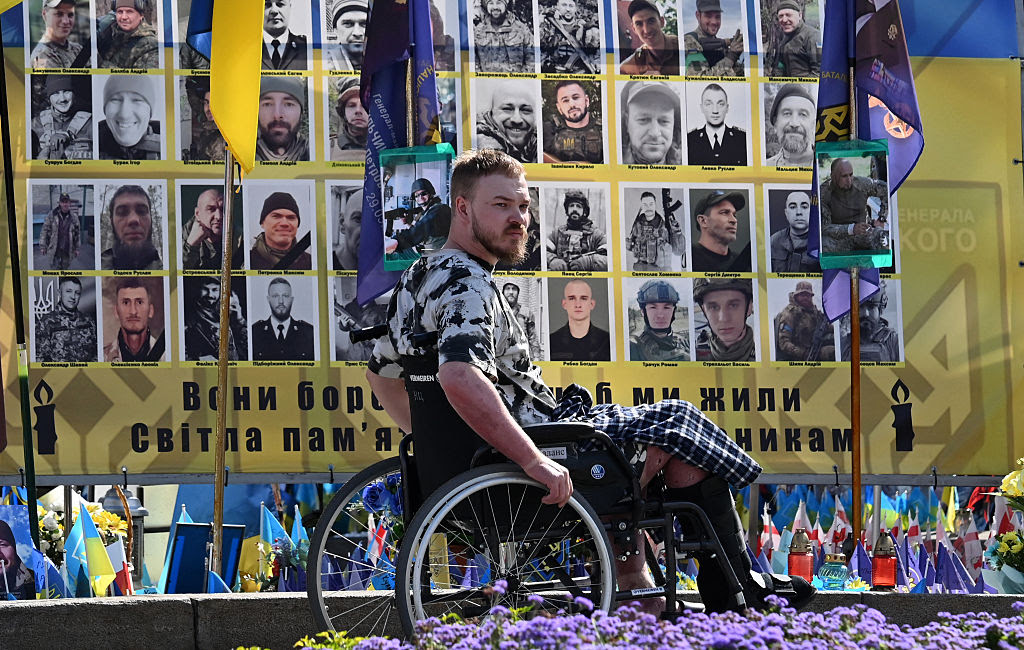
A wounded Ukrainian serviceman rides in a wheelchair at a makeshift memorial for fallen Ukrainian and foreign soldiers on Independence Square in Kyiv. (Sergei Supinsky / AFP via Getty Images)
He was talking about drone technology, but he might as well have been describing the complete transformation of Ukraine’s relationship with the world. Two and a half years ago, Ukraine had been pleading for basic weapons to defend itself. Now American officials were acknowledging Ukrainian technological superiority and discussing contracts worth $30 billion.
The reversal was stunning. Ukraine was planning to manufacture 30,000 long-range drones in 2025. Its innovations in aerial warfare had forced military establishments worldwide to reconsider their assumptions about modern combat. The country under invasion had become the teacher, and its former mentors had become students.
“Ukraine seems now to be a world leader in defense technology,” Kellogg noted. “It’s, in itself, a pretty good argument for making it a member of the European Union.”
Kellogg also offered a blunt assessment of Russian battlefield performance that contradicted Moscow’s propaganda about inevitable victory. “Russia is, in fact, losing this war,” he said. “Now, they may make movements and say, well, they’re advancing in the Donbas region and Donetsk. But if you consider advancing moving by meters, not miles, well then, okay, that’s successful. But the cost they’re having, it’s enormous.”
The transformation was visible everywhere. Ukrainian drones were striking targets 2,000 kilometers inside Russia. Ukrainian military innovations were being studied by NATO planners. Ukrainian resilience had become a global brand, exemplified by Prince Harry’s visit to discuss bringing the Invictus Games—the international competition for wounded veterans—to Ukraine itself.
Fire in the Russian Heartland: The Long Reach of Ukrainian Drones
The orange glow visible across Ufa that night came from the Bashneft-Novoil Oil Refinery, where Ukrainian drones had found their target after a journey of 1,500 kilometers. For residents of the Bashkortostan capital, the flames represented something unthinkable just months earlier: the war had come home.
The strike was part of a coordinated campaign that demonstrated Ukraine’s evolving capability to project force deep into enemy territory. Ukrainian intelligence confirmed successful attacks on three major facilities in a single day: the Bashkortostan refinery, the Kirishi oil facility in Leningrad Oblast (800 kilometers from Ukraine), and the Metafrax Chemicals plant in Perm Krai (1,800 kilometers away).
Each target told a story. The Bashkortostan refinery processed oil that funded Russia’s war machine. The Kirishi facility was one of Russia’s largest refineries, handling 17 million tons annually. The chemical plant in Perm Krai produced urea—officially an agricultural fertilizer, but also a component in explosives manufacturing.
Local authorities suspended airport operations and cut mobile internet services as cities across Russia grappled with a new reality. Geographic distance no longer guaranteed safety. The war that had seemed safely contained to Ukraine’s borders was now reaching deep into the Russian heartland, forcing ordinary Russians to consider air raid alerts and evacuation procedures.
For Ukrainian planners, the strikes represented more than military success—they were psychological warfare on a massive scale. Every refinery fire, every evacuated airport, every interrupted internet service reminded Russian citizens that their government’s war had consequences that reached far beyond distant battlefields.
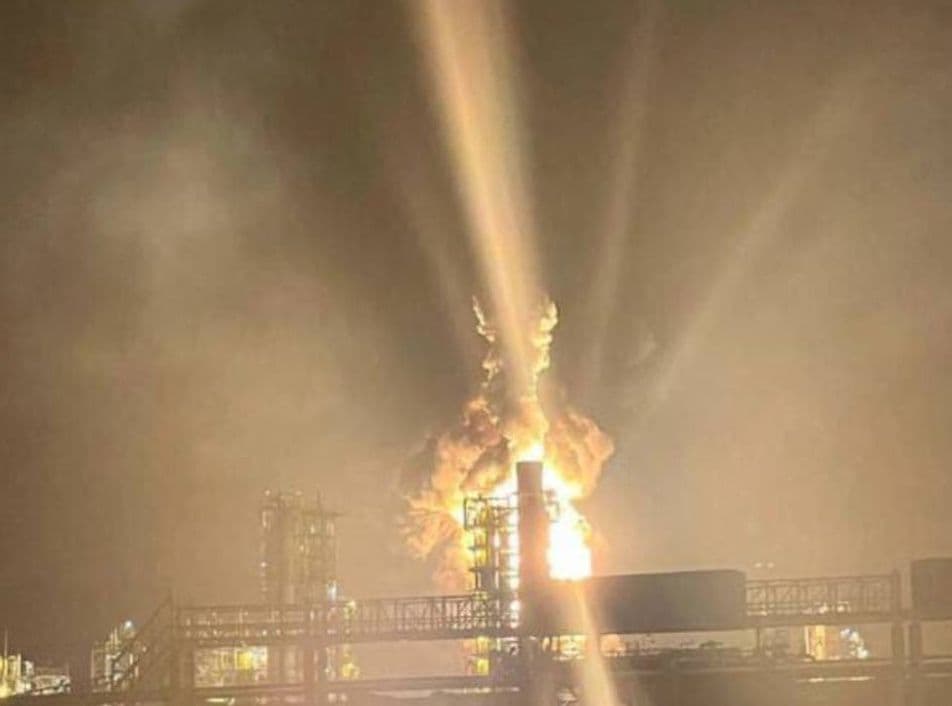
Fire erupts from the Kirishi oil refinery in Russia’s Leningrad Oblast after a reported Ukrainian drone strike. (Astra)
Blood on the Rails: Sabotage in the Russian Rear
The explosion that killed two Russian National Guard officers along the Maloarkhangelsk-Glazunovka railway line was more than a tragic incident—it was a symbol of Russia’s growing inability to protect its vast infrastructure network. The blast delayed ten trains and disrupted the crucial Moscow-Kursk corridor that supplied Russian forces at the front.
Regional Governor Andrey Klychkov’s acknowledgment that explosive devices had been discovered during track inspection suggested careful planning rather than random violence. Someone had studied the railway schedules, identified vulnerable points, and placed charges with precision timing. It was the work of professionals, whether Ukrainian special forces or pro-Ukrainian partisans operating behind Russian lines.
The railway attack highlighted a fundamental challenge for any country the size of Russia: you cannot guard everything. Thousands of kilometers of track, bridges, signal stations, and fuel depots created an impossible security problem. Every soldier assigned to guard infrastructure was one less soldier available for the front lines.
The human cost was immediate and personal. Two officers who had probably joined the National Guard expecting to handle domestic security found themselves dying in defense of railway infrastructure against an invisible enemy. Their deaths transformed routine rail workers and guards into frontline combatants in a war that recognized no rear areas.
Strategic Patience Pays Off: The Liberation of Filia
The Ukrainian flag that units of the 425th Skelya Regiment raised over Filia village on September 13 might have been a small piece of cloth, but it represented something significant: proof that Russian territorial gains could be reversed through careful planning and precise execution.
“The occupiers had planted their rag of a flag,” announced Oleksii Bielskyi, spokesperson for the Dnipro Operational Strategic Group. “Two units from the 425th Skelya Regiment struck swiftly, throwing grenades, firing on the enemy, capturing prisoners and bringing in reinforcements to hold the ground.”
The counterattack itself unfolded with remarkable speed—Ukrainian forces cleared Russian positions and secured the village in a matter of hours once the operation began. But this swift action came after twenty days of careful preparation since Russian forces had claimed Filia on Ukraine’s Independence Day, August 24, as part of their effort to establish a “buffer zone” in Dnipropetrovsk Oblast.
The timing suggested strategic patience rather than hasty reaction. Ukrainian commanders had allowed Russian forces to settle into positions, study their defenses, and plan a comprehensive assault that would not only reclaim the village but ensure it could be held. The 425th Regiment’s video footage showed Ukrainian soldiers systematically clearing Russian positions with the efficiency of seasoned professionals.
For strategic planners, Filia’s liberation demonstrated that Ukrainian forces retained the ability to choose their moments carefully, allowing Russian advances to consolidate before striking with overwhelming local force. The operation reflected improved coordination and intelligence capabilities that had developed through nearly three years of constant combat, showing that even temporary Russian gains remained vulnerable to well-planned counterattacks.
The Changing Russian Mind: When Support Begins to Crack
The Levada Center poll released in September revealed numbers that would have seemed impossible at the war’s beginning: only 27% of Russians still favored continuing the fight, while a record 66% preferred peace negotiations with Kyiv. The shift represented the most dramatic decline in war support since February 2022.
Behind the statistics lay human stories. Fifty-eight percent of respondents reported being directly affected by the war. Thirty percent said a relative or acquaintance had been killed. Twenty-eight percent had a family member or friend currently serving. In total, approximately 17% of Russians surveyed had lost someone close to them, while another 16% knew someone still fighting.
The war had stopped being an abstraction on television and become a presence at kitchen tables across Russia. Every funeral, every wounded veteran, every family receiving a military death notification created ripples of doubt about the conflict’s purpose and sustainability.
The demographic breakdown revealed the fault lines in Russian society. Women, young people under 24, and rural residents showed higher support for peace talks. Men, older Russians, and Moscow residents were more likely to support continued fighting. Those who disapproved of Putin’s presidency overwhelmingly favored negotiations, as did people who relied on YouTube rather than state television for information.
The paradox was striking: despite declining support for continuing the war, overall approval for the military campaign remained high at 78%. Russians increasingly wanted the fighting to end while still supporting its original justification. It was the psychology of a society growing weary of costs while unwilling to admit mistakes.
A Prince Among the Ruins: Harry’s Mission of Hope
The missile damage to the Ukrainian government building where Prince Harry met Prime Minister Yuliia Svyrydenko told its own story. Russian Iskander strikes had left visible scars on the seat of Ukrainian democracy, but the building still functioned, and the government still governed. It was a metaphor for the entire country’s resilience.
“We talked about the work on rehabilitation and recovery of veterans,” Svyrydenko reported after showing Prince Harry the destruction. “I thanked the Prince for supporting our Ukrainian servicemen after their service on various platforms, including the Invictus Games.”
The conversation highlighted Ukraine’s remarkable journey in international veteran rehabilitation programs. Since 2017, Ukraine had sent increasingly large delegations to the Invictus Games—the international sporting competition for wounded veterans that Prince Harry founded in 2014. The most recent team included 35 participants, each representing countless others still recovering from physical and psychological wounds.
“Now our dream is that the Invictus Games should also come to Ukraine,” Svyrydenko emphasized. “We have all the opportunities for this. All the more so because resilience is a synonym for the Ukrainian spirit. And our defenders demonstrate it every day.”
The proposal carried deeper meaning than sporting achievement. Hosting the Invictus Games would represent Ukraine’s transformation from aid recipient to rehabilitation leader, capable of inspiring wounded warriors from around the world. The country that had learned to treat trauma on an industrial scale could teach others about recovery and resilience.
Prince Harry’s visit demonstrated how Ukraine’s experience with catastrophe had become expertise that others could learn from. The nation under attack had become a teacher of survival.
Voices from the West: Johnson’s Impatience and Kallas’s Warning
Boris Johnson’s frustration with European caution boiled over during his Kyiv visit: “If they don’t want foreign troops on Ukrainian soil, I’ve got a brilliant idea—they bog off.”
The former British Prime Minister’s blunt language captured a sentiment shared by many Western leaders tired of waiting for Moscow’s permission to support Ukraine. Johnson dismissed what he called the “ridiculous chicken and egg situation” where European security guarantees remained contingent on a ceasefire that Russia showed no intention of accepting.
“Just get on with it,” Johnson said when asked about deploying European troops to Ukraine immediately. His logic was straightforward: if Russia insisted on determining which foreign forces could enter Ukraine, then Ukraine’s allies were already conceding Moscow’s authority over Ukrainian territory.
Johnson envisioned European troops providing training and logistics rather than combat roles, partly because “Ukrainians are much better than Western Europeans at fighting the war.” But the political message would be unmistakable—the West’s commitment to Ukrainian independence was no longer conditional on Russian approval.
Meanwhile, EU foreign policy chief Kaja Kallas issued her own warning about territorial concessions, calling discussions of Ukrainian land transfers a “trap” that Europe must avoid. “The Russians want us to discuss what Ukraine must give up for peace, while completely ignoring the fact that the Kremlin itself has not made any concessions so far,” she told German media.
Kallas outlined Russia’s negotiation pattern: demand territories never controlled, issue ultimatums and threats, then watch the West prepare to concede to maximalist demands. The cycle had repeated throughout the conflict, with Russia demanding full control of four Ukrainian regions it only partially occupied.
Her warning gained urgency from reports about Putin’s Alaska summit proposal, which would involve Ukraine ceding unoccupied territory in exchange for Moscow’s written promise not to invade again. That Trump had reportedly supported the proposal as the fastest path to peace raised European concerns about American willingness to pressure Ukraine into concessions.
Financial Engineering: The EU’s Creative Solution
The European Commission’s latest proposal for leveraging frozen Russian assets read like something from a financial thriller: replace 210 billion euros in frozen central bank deposits with EU-backed bonds, using the interest-generating Russian cash to guarantee a “Reparations Loan” for Ukraine.
The mechanism would function as a sophisticated IOU system, allowing Brussels to provide immediate financial support while avoiding the legal complications of outright asset seizure. By issuing zero-coupon EU bonds guaranteed collectively by member states, the Commission hoped to address Ukraine’s expected 8-billion-euro budget shortfall while sidestepping accusations of unlawful confiscation.
“Ukraine will only pay back the loan once Russia pays for the reparations,” Commission President Ursula von der Leyen explained. “The money will help Ukraine already today.”
The proposal emerged from behind-closed-doors discussions reflecting the EU’s continuing struggle to balance legal constraints with Ukraine’s urgent funding needs. With donor fatigue growing and national budgets under pressure, Brussels sought new mechanisms to sustain support without requiring fresh appropriations.
The plan’s success would depend on unanimous approval from EU countries—the same requirement that had derailed similar efforts before. But with almost all frozen assets held by Brussels-based clearing house Euroclear, the proposal offered a potential pathway to mobilize Russian funds without technically seizing the underlying capital.
Death from Above: The Daily Cost of War
The artillery bombardment of Kostiantynivka lasted nearly an hour, with Russian forces employing both conventional artillery and Smerch multiple rocket launchers against residential districts. When the barrage ended, three civilians lay dead, seven were wounded, and fourteen homes bore the scars of high-explosive impacts.
The attack reflected the grinding reality of a city surrounded on three sides by Russian forces. In neighboring Kharkiv Oblast, a combined strike using guided bombs and rocket launchers killed one man and injured two others in their seventies in Borova village, just five kilometers from Russian positions.
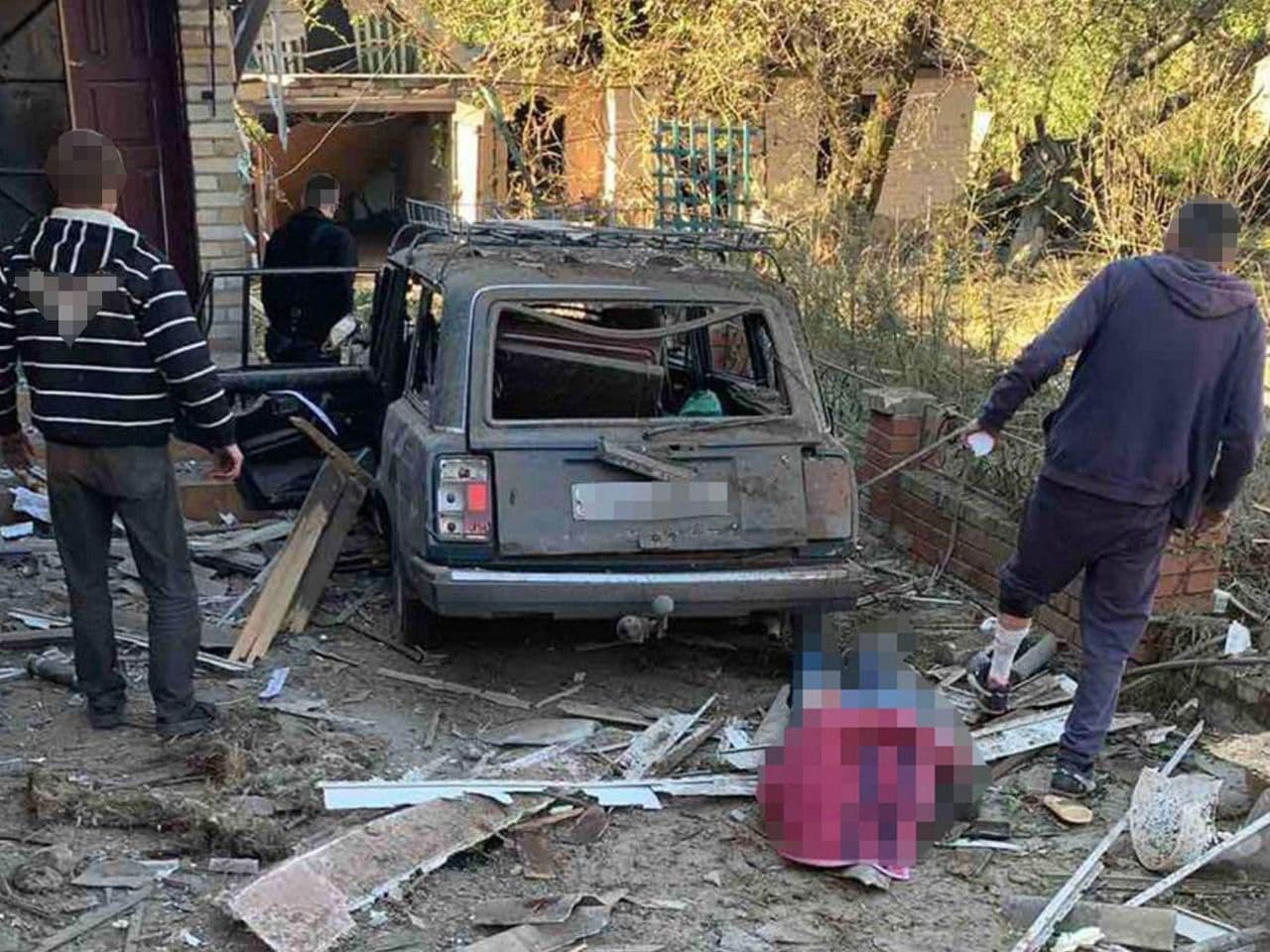
A body lies next to a damaged car and building after a Russian strike on Kostiantynivka, Donetsk Oblast. (Donetsk Prosecutor’s Office/ Telegram)
These attacks occurred as Russian forces employed increasingly creative tactics, including using ropes attached to drones to tangle Ukrainian aerial vehicles midair. The innovation reflected the war’s technological evolution, where new adaptations appeared weekly, and civilians paid the price for weapons designed for military targets but deployed with devastating imprecision.
Tightening the Screws: European Visa Restrictions
The European Commission’s preparation of new guidelines restricting Russian visa access reflected mounting pressure from border nations that had experienced Moscow’s aggression firsthand. With over 600,000 Russians securing Schengen visas in 2024—an increase of more than 80,000 from the previous year—Brussels faced demands for action.
The proposed restrictions would build on the 2022 termination of the visa facilitation agreement that had already made Russian travel more difficult and expensive. Countries like Finland and the Baltic states had implemented strict rules, while France, Spain, and Italy maintained more relaxed policies—a disparity the new guidelines aimed to address.
The visa restrictions formed part of the EU’s broader 19th sanctions package, targeting Russia’s shadow fleet, banning reinsurance for Russian tankers, and imposing limitations on major oil companies. The measure reflected recognition that individual mobility could serve strategic purposes in Moscow’s broader confrontation with the West.
The Day’s Meaning: When Everything Changes at Once
September 13, 2025, revealed a war that had evolved far beyond its original boundaries. Russian soldiers crawled through gas pipelines while Ukrainian drones struck targets across a continent. NATO jets scrambled over drone-filled skies while diplomats argued about territorial concessions and financial engineering. A British prince discussed veteran rehabilitation in a missile-damaged building while Russian public opinion slowly turned against continuing the conflict.
The pipeline infiltrators who emerged near Kupyansk after four days underground had demonstrated Moscow’s capacity for tactical innovation. But they had also revealed the war’s fundamental character: a grinding conflict where every meter gained came at enormous cost, where every adaptation triggered counter-adaptation, and where victory remained elusive for both sides.
The underground war had become a metaphor for the conflict itself—dark, dangerous, and leading toward an uncertain destination. But above ground, the world was changing in ways that neither side had anticipated when the first tanks crossed the border on February 24, 2022. The invaded had become innovators. The defenders had become teachers. The local conflict had become a global transformation.
The question was no longer how the war would end, but how the world would function when it did. On this single day in September, that future looked very different from anything anyone had imagined when the fighting began.