
A weekend when Ukrainian drones traveled 1,800 kilometers into Russia, NATO scrambled jets over drone violations, and economic reality finally confronted the Kremlin
The Story of Two Days
On the night of September 13-14, 2025, the war in Ukraine demonstrated its capacity to reshape geography itself. Ukrainian drones struck targets so deep inside Russia that they traveled farther than the distance from London to Rome. NATO fighter jets scrambled across Eastern Europe as Russian drones deliberately violated alliance airspace. Railway explosions in Russia killed soldiers trying to defuse mines planted by Ukrainian intelligence. And in Moscow’s gleaming financial towers, the country’s most powerful banker dared to tell Vladimir Putin that the Russian economy had entered stagnation—a conversation that revealed how completely the war had consumed the nation’s future.
These 48 hours marked a turning point in a conflict that had long since burst its original boundaries. What began as tanks rolling across borders had evolved into something far more complex: a war fought in cyberspace and financial markets, with weapons that could strike across continents, conducted by soldiers who crawled through gas pipelines and planted explosives on railway tracks thousands of kilometers from the front lines.
The question was no longer whether this was still a regional conflict—it was how far the war’s reach would ultimately extend.
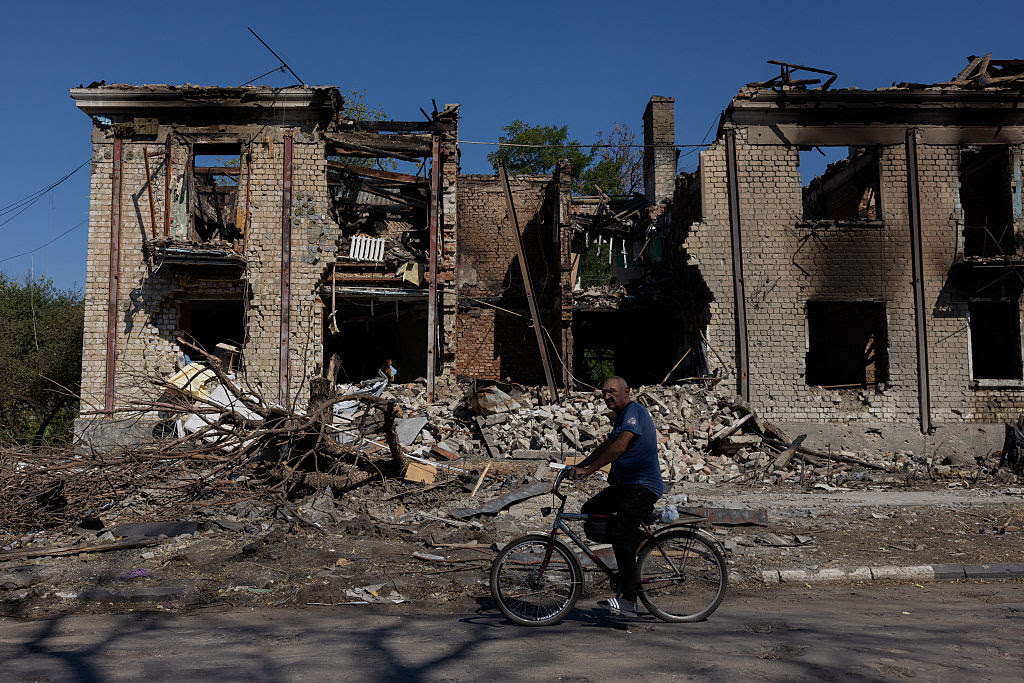
A man rides a bicycle past a damaged residential building in Novodonetske, Donetsk Oblast. (Tetiana Dzhafarova / AFP via Getty Images)
Fire Across a Continent: The 1,800-Kilometer Strike
At 9:20 p.m. local time on September 13, an explosion lit up the Metafrax Chemicals plant in Gubakha, a city so deep inside Russia that few Ukrainians could have found it on a map before the war began. The Ukrainian drone that struck the facility had traveled 1,800 kilometers from the border—a journey equivalent to flying from Ukraine to the Atlantic coast of Portugal.
The target wasn’t chosen randomly. The Metafrax plant produced urea, officially an agricultural fertilizer but also a key component in explosives manufacturing. Its destruction represented something unprecedented in modern warfare: the ability to strike militarily relevant targets at distances that rendered traditional concepts of “rear areas” meaningless.
Ukrainian military intelligence sources confirmed that the strike damaged equipment essential for urea production, crippling a facility that had invested heavily in expanding capacity just two years earlier. The plant’s new Ammonia-Urea-Melamine production line, launched in 2023, had produced 300,000 tons of ammonia in its first eight months—chemicals that could flow into Russia’s defense industrial complex.
For residents of Perm Krai, the explosion represented an almost incomprehensible shift in their relationship to the conflict. The war that Moscow’s propaganda had portrayed as a distant special operation in Ukraine had arrived in their backyard, 1,800 kilometers from the supposed front lines.
The strike was part of a coordinated campaign that night. Ukrainian forces simultaneously hit the massive Kirishi oil refinery in Leningrad Oblast—Russia’s second-largest refinery, processing 17.7 million metric tons annually. Located over 800 kilometers from Ukraine, the facility represented 6.4% of Russia’s total refining capacity.
Video footage from the Kirishi attack showed flames rising from the refinery’s primary oil distillation unit, the heart of the facility’s operations. Though Russian air defenses claimed to have intercepted three drones, the wreckage from at least one crashed directly onto the refinery site, igniting fires that took hours to extinguish.
The psychological impact extended far beyond the immediate damage. Every successful strike at such distances forced ordinary Russians to confront an uncomfortable truth: if Ukrainian drones could reach Perm Krai and Leningrad Oblast, they could reach anywhere. Geographic distance no longer provided security in a war where the front lines existed wherever drones could fly.
Rails of War: Death Comes to the Logistics Network
The explosion that killed two Russian National Guard soldiers on the Oryol-Kursk railway line was more than a tactical success—it was a symbol of Ukraine’s evolving capability to strike the arteries that kept Russia’s war machine functioning. The blast occurred when a specialized engineering unit attempted to defuse Ukrainian mines planted along the Maloarkhangelsk-Glazunovka section, a critical supply route for Russian forces operating in the Kharkiv and Sumy directions.
Ukrainian military intelligence sources described the operation as “uniquely complex,” involving coordination between the Main Intelligence Directorate (HUR) and Special Operations Forces. The precision required to plant explosives along active railway lines deep inside Russian territory spoke to capabilities that had developed far beyond what anyone imagined when the war began.
The human cost was immediate and personal. The two soldiers who died had joined the National Guard expecting to handle domestic security, not explosive ordnance disposal on railway tracks under enemy attack. Their deaths transformed routine infrastructure protection into frontline combat, blurring the distinction between military and civilian targets in Russia’s rear areas.
The timing wasn’t coincidental. The railway blast occurred simultaneously with a second explosion on the Saint Petersburg-Pskov line, where Ukrainian operatives derailed a locomotive and destroyed 15 fuel tankers. The coordinated nature of the attacks suggested careful planning and intelligence gathering that extended deep into Russian territory.
Russian Railways confirmed that the Oryol-Kursk incident delayed 17 trains, disrupting supply chains that stretched from Moscow’s industrial centers to front-line positions in Ukraine. Every delayed shipment of ammunition, fuel, or equipment represented a small victory in Ukraine’s broader campaign to degrade Russian logistical capabilities.
For Russian military planners, the railway attacks highlighted an impossible challenge: protecting thousands of kilometers of track, bridges, and signal stations against an enemy that could strike anywhere, at any time. Every soldier assigned to guard railway infrastructure was one less soldier available for offensive operations.
NATO’s Wake-Up Call: When Drones Cross the Line
The Romanian pilot who tracked the Russian drone across his country’s airspace for 50 minutes on September 13 was witnessing the deliberate expansion of the war beyond Ukraine’s borders. The unmanned aircraft had penetrated 10 kilometers into NATO territory during a Russian attack on Ukrainian infrastructure, forcing two F-16 fighter jets to scramble from the 86th Air Base near Fetești.
Romanian Defense Minister Ionuț Moșteanu’s assessment was blunt: “Romania faces provocations from Russia nearly every week.” The September 13 incident marked the 11th time Russian drones had violated Romanian airspace since the full-scale invasion began, with an additional 30 occasions when drone debris had fallen on Romanian territory.
The pilot’s decision not to shoot down the drone reflected complex rules of engagement that NATO was still developing. Romanian legislation authorized the military to destroy unauthorized aircraft in peacetime, but enforcement procedures remained unfinalized. The result was a dangerous game where Russian provocations tested alliance responses while European leaders struggled to balance measured reaction with credible deterrence.
The incident came just days after an even more serious violation: 19 Russian drones had entered Polish airspace on September 10, forcing Polish F-16s to engage Russian military assets for the first time since 2022. The Polish response was swift and decisive—at least three drones were shot down using Sidewinder missiles that cost $400,000 each.
President Volodymyr Zelensky’s reaction cut to the heart of the matter: “Russian military personnel know exactly where their drones are headed and how long they can stay in the air. The routes are always calculated. This cannot be an accident, a mistake, or the initiative of some lower-level commanders. It is a deliberate expansion of the war by Russia.”
NATO’s response was unprecedented in its scope and coordination. Operation Eastern Sentry deployed Czech Mi-171S helicopters, Danish F-16s and naval frigates, French Rafales, and German Eurofighters across Eastern Europe. Even Britain, despite post-Brexit complications, pledged support for the alliance’s eastern flank.
The irony wasn’t lost on military analysts: Russia’s attempt to intimidate NATO through drone incursions had achieved exactly the opposite effect. The alliance was now more present and more coordinated along its eastern frontier than at any time since the Cold War.
Stagnation and Denial: The Economic Reality Putin Didn’t Want to Hear
The confrontation between Vladimir Putin and Sberbank CEO German Gref at the Eastern Economic Forum revealed a truth that Russia’s leadership had tried desperately to avoid: the war economy that had sustained three years of conflict was finally collapsing under its own weight.
Gref’s carefully worded assessment was devastating in its implications: “The second quarter can practically be considered technical stagnation.” Russia’s GDP growth had slowed to near zero in July and August after a sharp decline in the April-June quarter. The war-fueled expansion that had characterized 2024 was over.
Putin’s pushback was immediate and defensive: “Ask Gref. Has lending stopped? No. The pace has just slowed.” The president’s insistence that the slowdown represented merely “a soft landing” to stabilize prices revealed how completely divorced Russia’s political leadership had become from economic reality.
The numbers told a different story. Russia’s GDP grew just 1.1% year-on-year in the second quarter, down from 1.4% in the first quarter and far below the 4.3% and 5.4% growth rates of the same periods in 2024. Some analysts suggested the situation was even worse: VTB Bank had recorded two consecutive quarterly contractions of 0.6%, indicating technical recession rather than mere stagnation.
Behind the statistics lay a fundamental transformation of Russian society. Defense spending had reached 7.2% of GDP—the highest level since the end of the Cold War. Military expenditures consumed resources that civilian sectors desperately needed, creating an economy that could sustain war but not prosperity.
The budget deficit had reached 4.19 trillion rubles ($49.4 billion) by the end of August, already exceeding the government’s annual target. With international financial markets closed due to sanctions, the Kremlin faced limited options for covering the shortfall. Reuters reported that officials were considering increasing the Value-Added Tax from 20% to 22%—a measure that would generate an additional trillion rubles annually while imposing the cost directly on Russian consumers.
Central Bank Governor Elvira Nabiullina found herself caught between impossible pressures. Gref argued that interest rates should fall to 12% to “create hope for an economic recovery,” but Nabiullina warned that easing monetary policy too quickly would trigger runaway inflation, already running at 8.1%—well above the bank’s 4-5% target.
The public clash between Putin and Gref represented more than an economic dispute—it revealed the growing disconnect between Russia’s political leadership and financial reality. As economist Oleh Pendzin observed, “The current Russian leadership is not economically oriented. They continue the full-scale war against Ukraine and say, ‘We don’t care about anything else, we just want to fight, period.'”
Black Sea Blues: The Sevastopol Strike
The Ukrainian Navy’s attack on Russia’s Black Sea Fleet communications center in occupied Sevastopol demonstrated how completely the balance of power had shifted in the Black Sea. The strike on the 184th Research and Testing Facility, which coordinated operations for fleet units across the region, occurred on the night of September 10-11, but its strategic significance extended far beyond the immediate damage.
Satellite imagery published after the attack showed damage to two buildings at the communications center, disrupting coordination capabilities that had taken decades to build. The facility represented the nerve center of Russian naval operations in a region where Moscow had once enjoyed unchallenged dominance.
The Sevastopol strike was part of Ukraine’s systematic campaign to degrade Russian naval capabilities in the Black Sea. Since 2022, Ukrainian forces had destroyed several major vessels, including the Caesar Kunikov landing ship, the Sergei Kotov patrol ship, and the Ivanovets missile corvette. Each successful attack forced Russia to reduce its naval presence in Crimean waters.
The shrinking Russian presence in Sevastopol reflected a broader strategic retreat. Ukrainian drones had struck Black Sea Fleet facilities in Novorossiysk, Krasnodar Krai, forcing Moscow to disperse its naval assets across multiple locations. The fleet that had once projected power throughout the Black Sea was now struggling to protect its own bases.
For Ukrainian naval planners, the communications center represented a particularly valuable target. Modern naval operations depended on real-time coordination between ships, aircraft, and shore-based facilities. Disrupting these communication links degraded the entire fleet’s operational effectiveness, regardless of how many ships remained afloat.
Precision Strike: The Buk System Destruction
The destruction of a Russian Buk-M3 air defense system near Oleksandrivka in occupied Zaporizhzhia Oblast represented both tactical success and strategic signaling. Ukrainian Special Operations Forces had eliminated one of Russia’s most sophisticated air defense platforms—a system worth $40-50 million that could track and engage up to 36 targets simultaneously.
The Buk-M3 represented the latest evolution of a system that had gained worldwide infamy with the 2014 downing of Malaysia Airlines Flight MH17. Manufactured by Russia’s Almaz-Antey defense company, the platform was designed to provide multi-layered protection against aircraft, helicopters, cruise missiles, and drones.
Its destruction in Zaporizhzhia Oblast highlighted Ukraine’s growing capability to penetrate Russian air defenses and strike high-value targets. The operation required precise intelligence about the system’s location, careful planning to approach undetected, and coordination with other Ukrainian forces to ensure the strike succeeded.
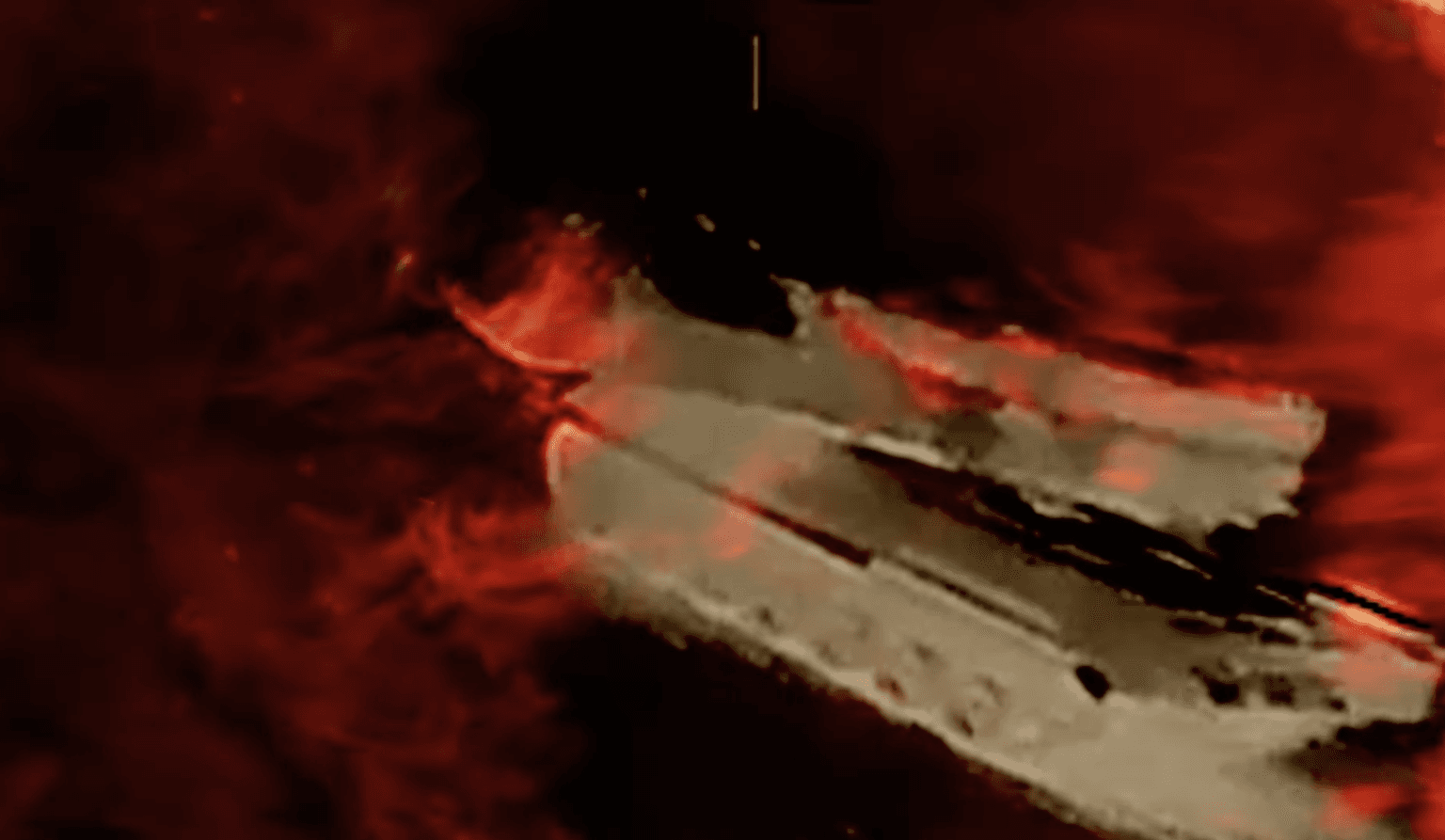
For Russian military planners, the loss represented more than expensive equipment—it created gaps in air defense coverage that Ukrainian aircraft and drones could exploit. Every destroyed air defense system made it easier for future Ukrainian operations to penetrate deeper into occupied territory.
The timing wasn’t coincidental. The Buk system’s destruction occurred as Ukrainian forces continued their campaign of long-range strikes against Russian industrial and military targets. Degrading Russian air defenses was essential preparation for sustaining such operations over time.
Train Wreck in Kyiv Oblast: When Munitions Explode
The explosion that damaged railway infrastructure near Boyarka, just 20 kilometers south of Kyiv, served as a stark reminder that war’s dangers extended far beyond front-line combat zones. The incident occurred when munitions being transported on a military supply train detonated, forcing the evacuation of 240 passengers from the Kharkiv-Przemysl service and disrupting international rail connections across Ukraine.
Prime Minister Yuliia Svyrydenko’s confirmation that the explosions were not linked to a Russian attack raised different concerns about the challenges of maintaining supply chains during wartime. Transporting military supplies through civilian infrastructure created risks that extended to ordinary travelers and railway workers throughout the country.
The incident highlighted the complex logistics of sustaining a war effort while maintaining civilian transportation networks. Ukrainian railways carried both military supplies to the front lines and civilians seeking to escape conflict zones. The explosion near Boyarka demonstrated how these overlapping functions created vulnerabilities that affected both military and civilian operations.
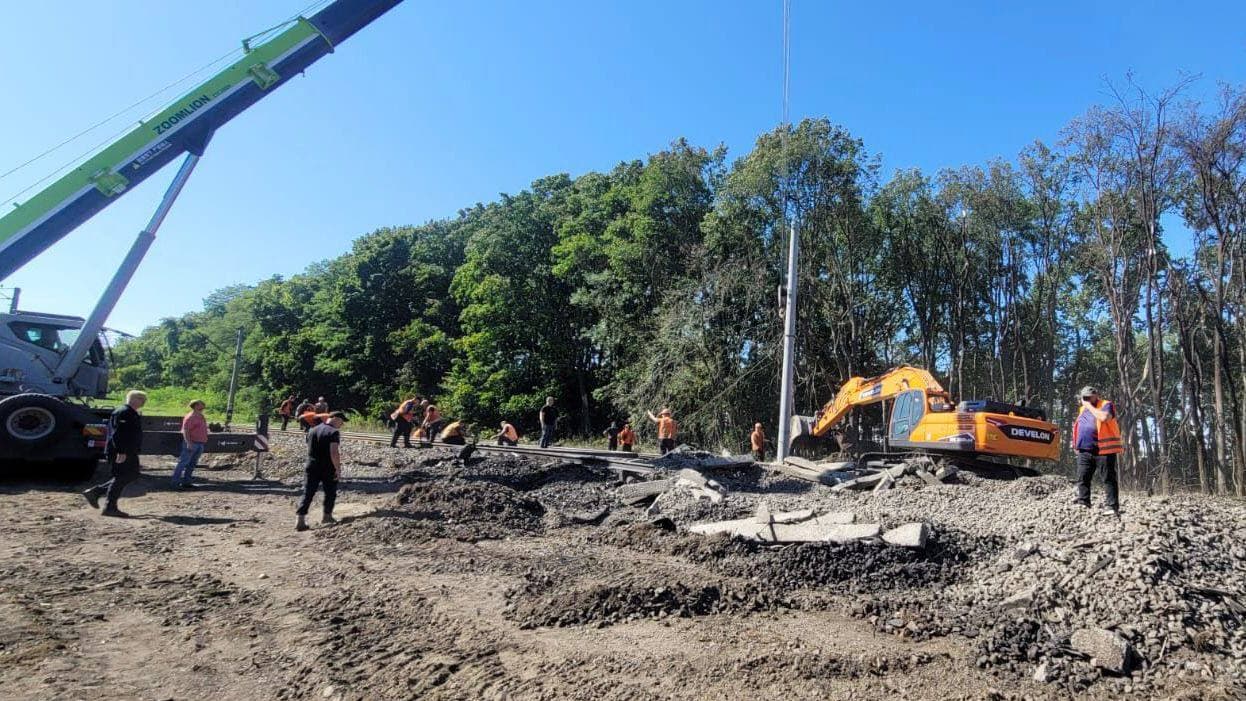
Railway CEO Oleksandr Pertsovskyi’s decision to continue the journey with most passengers still aboard reflected the pragmatic approach that characterized Ukrainian crisis management. Despite the risks, civilian transportation had to continue functioning, even as military supply chains moved through the same infrastructure.
The investigation into the explosion’s cause would likely focus on safety protocols for transporting munitions through areas with civilian traffic. As the war extended into its fourth year, such incidents served as reminders that the line between military and civilian infrastructure had become increasingly blurred.
Budget Deficit Blues: The Price of Endless War
The Kremlin’s consideration of increasing the Value-Added Tax from 20% to 22% represented a fundamental admission: Russia’s war economy was consuming resources faster than the country could generate them. The tax increase would generate an additional trillion rubles annually while directly imposing the war’s costs on ordinary Russians through higher prices for goods and services.
The budget deficit of 4.19 trillion rubles by the end of August had already exceeded the government’s annual target, forcing officials to seek new revenue sources. With international financial markets closed due to sanctions, domestic taxation remained the only viable option for covering the shortfall.
The proposed VAT increase would reverse any progress the Russian Central Bank had made against inflation while simultaneously removing money from the domestic economy. When Russia last increased the VAT in 2019, from 18% to 20%, the Central Bank reported that inflation rose by 0.55 to 0.7 percentage points.
The timing couldn’t have been worse for Russian consumers. A June survey by the independent Levada Center found that 58% of Russians listed rising prices as their top concern, while only 33% cited the war against Ukraine. Increasing the VAT would worsen the very problem that already dominated public attention.
Central Bank Governor Elvira Nabiullina faced an impossible balancing act. She had gradually lowered interest rates from 21% to 18% since June, responding to signs that previous counter-inflationary measures were succeeding. But a VAT increase would likely force her to reverse course, raising rates again to combat price increases triggered by higher taxes.
The paradox revealed the war economy’s fundamental contradictions. Military spending had reached 7.2% of GDP, consuming resources that civilian sectors needed for growth and investment. The result was an economy that could sustain conflict but not prosperity—a machine designed for destruction rather than development.
Baltic Reinforcements: Operation Eastern Sentry Expands
The arrival of three Czech Mi-171S helicopters at Polish bases on September 14 marked another expansion of NATO’s Operation Eastern Sentry, the alliance’s response to Russian drone violations of member state airspace. The deployment demonstrated how quickly NATO could coordinate multinational responses when members faced direct threats.
The Czech helicopters joined an increasingly impressive international force: Danish F-16s and naval frigates, French Rafales, German Eurofighters, and Polish air defense systems, all coordinated to protect the alliance’s eastern frontier. The operation represented the largest NATO deployment along the Russian border since the Cold War’s end.
Estonian Defense Minister Hanno Pevkur’s announcement of over 100 million euros in military aid to Ukraine for 2026 provided context for the broader alliance commitment. Estonia’s pledge to maintain 0.25% of GDP for Ukrainian assistance demonstrated how completely the war had reshaped European defense priorities.
The multinational character of Operation Eastern Sentry sent a clear message to Moscow: deliberate provocations would trigger coordinated responses that strengthened rather than weakened alliance cohesion. Russian attempts to test NATO resolve through drone incursions had backfired spectacularly.
For Polish President Karol Nawrocki, authorizing additional NATO reinforcements represented both defensive necessity and strategic opportunity. The drone violations had provided justification for alliance deployments that would enhance Polish security while demonstrating NATO’s commitment to collective defense.
Death in the Villages: The Daily Cost of Aggression
The death of a 57-year-old man in Borova, Kharkiv Oblast, represented the war’s grinding human toll that continued regardless of strategic developments or diplomatic initiatives. Russian forces had struck the village with guided bombs and rocket launchers, killing one civilian and injuring two others in their seventies—victims whose only crime was living near Russian positions.
In Kostiantynivka, Donetsk Oblast, Russian artillery and rocket attacks killed four civilians and wounded 10 others during a bombardment that lasted nearly an hour. The strikes employed both conventional artillery and Smerch multiple rocket launchers against residential districts, reflecting the deliberate targeting of civilian areas that characterized Russian tactics throughout the conflict.
The attacks on Zaporizhzhia Oblast demonstrated the war’s expanding use of first-person-view (FPV) drones for targeted assassination. Russian forces used such a drone to kill a 72-year-old man and later targeted a minibus carrying civilians, injuring a 60-year-old passenger. The precision of FPV strikes transformed them into tools of terror against ordinary citizens.
Across the front lines, 58 Russian drones and one ballistic missile struck Ukrainian territory during the night of September 13-14, part of a pattern that had continued for nearly three years. Ukrainian air defenses successfully intercepted 52 drones, but the six that reached their targets were enough to kill seven civilians and injure 34 others.
The human cost extended beyond immediate casualties. Every successful attack forced communities to adapt to life under constant threat, with children learning to recognize air raid sirens and adults timing daily activities around bombing schedules. The war had transformed ordinary existence into a constant calculation of risk and survival.
Zapad-2025: War Games with Real Implications
The Russian-Belarusian Zapad-2025 military exercises unfolding across multiple theaters served as both training opportunity and strategic signal. Russian milbloggers described the exercises as preparation for war against NATO—an assessment that aligned with the deployment of Iskander-M ballistic missile systems just 35 kilometers from the Polish border in Kaliningrad Oblast.
The exercises demonstrated capabilities that extended far beyond Ukraine. Russian and Belarusian forces practiced emergency naval rescue, long-range transport flights behind enemy lines, and coordination between Ka-52M and Mi-28NM combat helicopters. The inclusion of MiG-31 interceptors carrying Kinzhal ballistic missiles suggested preparation for conflicts involving peer adversaries.
The training scenarios reflected lessons learned from nearly three years of combat in Ukraine. Forces practiced counter-sabotage operations, drone warfare, and defense against river crossings—all tactical problems that had emerged from real battlefield experience. The exercises served as a mechanism for transmitting Ukrainian war lessons to other potential theaters.
For NATO planners, the exercises provided insight into Russian operational concepts and force structures. The permanent deployment of Iskander systems to Kaliningrad, combined with their prominent role in Zapad-2025, demonstrated Moscow’s commitment to maintaining escalatory options against alliance territory.
The timing of the exercises, coinciding with Russian drone violations of Polish and Romanian airspace, suggested coordination between provocative actions and military preparations. The message was clear: Russia remained capable of threatening NATO territory while simultaneously preparing for larger conflicts.
The Economics of Resistance: Estonia’s Continuing Commitment
Estonian Defense Minister Hanno Pevkur’s pledge of over 100 million euros for Ukrainian military aid in 2026 represented something remarkable in international relations: a small nation’s sustained commitment to principles that transcended immediate self-interest. Estonia’s promise to maintain 0.25% of GDP for Ukrainian assistance demonstrated how completely the war had reshaped European strategic thinking.
The commitment gained additional significance from Estonia’s geographic position. As a Baltic state sharing borders with Russia, Estonia understood that Ukrainian success directly affected its own security. The investment in Ukrainian defense capabilities represented enlightened self-interest disguised as international solidarity.
Estonia’s approach contrasted sharply with donor fatigue evident in larger European nations. The country’s total military aid since 2022—over 500 million euros, amounting to 1.4% of GDP—ranked among the highest in the world by percentage of national wealth. Such contributions represented genuine sacrifice for a nation of 1.3 million people.
The Estonian commitment extended beyond financial assistance to practical training and technology transfer. Tallinn’s focus on IT solutions for defense applications reflected the country’s expertise in digital innovation, providing Ukraine with capabilities that traditional military powers couldn’t match.
Prime Minister Kristen Michal’s willingness to consider peacekeeping roles in Ukraine demonstrated Estonia’s readiness to translate financial commitment into physical presence. The offer suggested confidence in Ukrainian eventual success and recognition that post-conflict reconstruction would require sustained international engagement.
The Grinding Front: Meters Gained, Lives Lost
While drones flew across continents and diplomats scrambled jets, the war’s most brutal reality continued to unfold in the trenches and villages along hundreds of kilometers of front lines. Russian forces pressed forward in multiple directions, gaining territory measured in meters rather than kilometers, while Ukrainian defenders fought to hold positions that had been contested for months.
The Pokrovsk direction witnessed confirmed Russian advances east of Kozatske, where geolocated footage showed Russian forces pushing through fields under constant artillery fire. The advance represented tactical success bought with enormous casualties—a pattern that had characterized Russian operations throughout the eastern front. Ukrainian defenders responded with precision drone strikes, disabling a Russian TOS-1A thermobaric artillery system six kilometers behind the front line and forcing its withdrawal for repair.
Near Kupyansk, Russian forces continued their attempts to expand positions after the underground pipeline infiltration operation revealed new tactical possibilities. Ukrainian forces maintained fire control over the pipeline exit points, flooding three of four available routes to prevent future infiltration attempts. The 10th Army Corps reported ongoing counter-sabotage operations as both sides adapted to a battlefield where soldiers could emerge from beneath the earth.
The Kostyantynivka area saw some of the heaviest fighting, with Russian forces conducting 21 separate strikes using guided bombs, rocket launchers, artillery, and drones. The bombardment killed four civilians and wounded 10 others, but failed to dislodge Ukrainian defenders from key positions. Russian claims of advancing to the southeastern outskirts remained unconfirmed, suggesting that tactical gains remained limited despite massive firepower expenditure.
In Zaporizhia Oblast, geolocated footage confirmed Russian advances within eastern Stepnohirsk, west of Orikhiv. The gain represented months of grinding combat in an area where both sides had committed significant resources. Russian forces also attempted to expand positions near Novoivanivka, northeast of Hulyaipole, but faced continued Ukrainian resistance that prevented consolidation of tactical gains.
The pattern across all sectors remained consistent: Russian forces could advance under overwhelming firepower but struggled to hold territory against Ukrainian counterattacks. Every meter gained came at enormous cost in personnel and equipment, creating tactical successes that contributed to strategic exhaustion. As one Russian milblogger noted, the military command needed more manpower just to seize individual villages—a requirement that suggested Russian offensive capabilities were approaching their limits.
The frontline battles of September 13-14 demonstrated the war’s fundamental character: a grinding attritional conflict where tactical gains rarely translated into operational advantages. Russian forces continued advancing by meters while Ukrainian forces focused on inflicting maximum casualties for every meter lost. The result was a battlefield where geography mattered less than the balance of forces, and where every small victory came at prices that neither side could sustain indefinitely.
Two Days, One Message
September 13-14, 2025, revealed a war that had fundamentally altered the nature of international conflict. Ukrainian drones traveling 1,800 kilometers demonstrated that geographic distance no longer provided security. NATO’s coordinated response to airspace violations showed how regional conflicts could trigger global realignments. Russia’s economic stagnation proved that military aggression ultimately consumed the resources needed for genuine prosperity.
The weekend’s events connected seamlessly: industrial strikes in Perm Krai, railway explosions in Oryol Oblast, naval attacks in Crimea, and economic disputes in Moscow—all manifestations of a conflict that had grown far beyond its original boundaries. The war that began with tanks crossing borders had become something unprecedented: a genuinely global confrontation between different visions of international order.
Russian attempts to expand the conflict through drone provocations had triggered exactly the NATO response that Moscow claimed to fear. Ukrainian long-range capabilities had made every Russian industrial facility a potential target. Economic pressures had forced the Kremlin to consider tax increases that would directly impact ordinary citizens.
The question was no longer whether this remained a regional conflict—it was how far the transformation would ultimately extend. On this single weekend in September, the answer seemed to be: as far as drones could fly, railways could reach, and economic pressures could spread. The war had become global not through deliberate escalation, but through the simple logic of modern warfare in an interconnected world.
The pipeline crawlers who had emerged near Kupyansk months earlier had been harbingers of something larger: a conflict that recognized no boundaries, acknowledged no rear areas, and accepted no limits on the tools of warfare. By September 2025, that transformation was complete. The local war had become a global confrontation, and the world was still adjusting to the implications.