
As Trump Administration Approves Historic NATO-Financed Weapons Package and Putin Loses a Peace Advocate, European Parliament Plants Permanent Flag in Kyiv
Summary of the Day – September 17, 2025
September 17 marked a watershed moment in the war’s financing architecture as the Trump administration approved its first weapons aid package funded entirely by NATO allies, with President Zelensky confirming Ukraine will receive Patriot missiles and HIMARS rockets. The day brought news of deputy chief of staff Dmitry Kozak’s resignation from Putin’s inner circle—one of the few officials who opposed the 2022 invasion. European Parliament President Roberta Metsola arrived in Kyiv to announce permanent EU parliamentary representation, while Ukraine’s parliament ratified landmark agreements and approved military oversight reforms. Russian forces maimed their own deserters to prevent fleeing, partisans struck deep in Russian territory, and verified battlefield footage showed both sides achieving tactical gains across contested fronts.
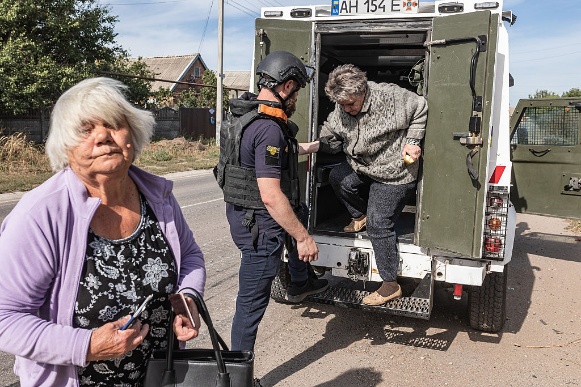
Emergency service workers evacuate civilians in the city of Kostiantynivka, where Russian attacks have intensified over the past week. (Diego Herrera Carcedo / Anadolu via Getty Images)
The PURL Revolution: Allies Fund America’s Arsenal
The Trump administration’s approval of its first NATO-ally-funded weapons package represented a revolutionary shift in war financing, as President Volodymyr Zelensky confirmed during a September 17 Kyiv press conference that Ukraine will receive “Patriot and HIMARS missiles” through the Prioritized Ukrainian Requirements List mechanism.
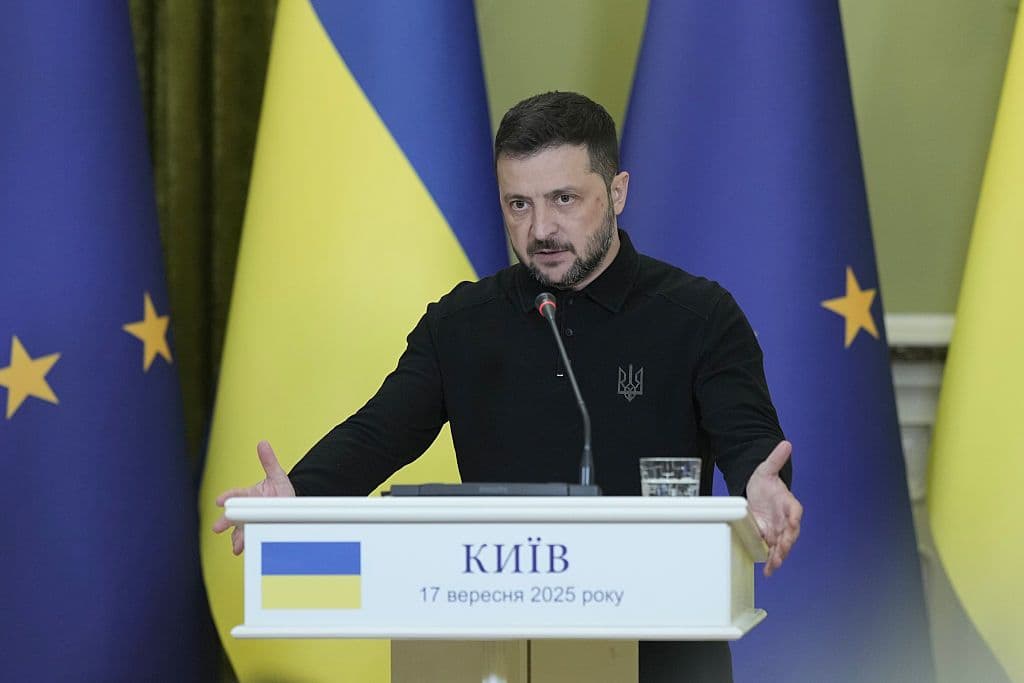
Ukrainian President Volodymyr Zelensky speaks at a press conference in Kyiv, Ukraine. (Photo by Andrew Kravchenko/Global Images Ukraine via Getty Images)
Ukrainian Foreign Ministry spokesperson Heorhii Tykhyi, speaking at a September 17 briefing, called the development “very good, mutually beneficial cooperation for us, for our European partners, and for the United States.” The Ukrainian Foreign Ministry received notification of the decision through Ukraine’s Washington embassy on September 16.
Two shipments worth up to $500 million each received approval from Undersecretary of Defense for Policy Elbridge Colby, with sources describing packages containing “the stuff they’ve been asking for. A lot of stuff.” The mechanism allows NATO members to pool contributions for purchasing American weapons from U.S. stockpiles, addressing Trump’s demands for greater allied burden-sharing.
Kozak’s Exit: Putin’s Last Dove Departs
Russian state media outlet RBK reported on September 17 that Dmitry Kozak, Putin’s deputy chief of staff and one of the few senior officials who opposed the 2022 Ukraine invasion, had “resigned” from his position over the weekend. Multiple sources confirmed Kozak was the sole participant in the February 21, 2022, Security Council meeting who opposed launching the full-scale invasion.
RBK reported Kozak is considering business opportunities as he leaves government service entirely. The departure eliminates one of the last moderate voices from Putin’s inner circle, with deputy head Sergei Kiriyenko absorbing Kozak’s responsibilities for occupied Ukrainian territories and Moldova policy.
Metsola’s Mission: Europe Plants Its Flag in Kyiv
European Parliament President Roberta Metsola arrived in Kyiv on September 17, announcing the establishment of a permanent European Parliament representative position in the Ukrainian capital. Speaking at the EU Delegation building—its windows still damaged from Russian shrapnel three weeks earlier—Metsola declared her message of “solidarity, full commitment and steadfast support for Ukraine.”

European Parliament President Roberta Metsola welcomed by Ukrainian Parliament Speaker Ruslan Stefanchuk as she arrives in Kyiv, Ukraine. (European Parliament President Roberta Metsola/X)
The new position, staffed by Maximilan Schröder, will strengthen cooperation between the European Parliament and Ukraine’s Verkhovna Rada. Metsola addressed the Ukrainian parliament on September 17, emphasizing that “peace must be permanent, it must be based on justice, and it must be based on dignity.”
Parliament Speaker Ruslan Stefanchuk welcomed Metsola’s fourth visit since the full-scale war began, as she wrote on social media: “1,300 days since the start of the aggression, I am in Ukraine with [the European Parliament’s] strong message of support.”
Parliamentary Milestones: Military Oversight and UK Partnership
Ukraine’s parliament achieved two significant institutional advances on September 17. The military ombudsman bill received approval with 283 votes and 18 abstentions, creating formal mechanisms for addressing service member rights violations. The legislation outlines the ombudsman’s authority to investigate misconduct and provide legal assistance to military personnel.
The 100-year UK partnership agreement ratification garnered 295 votes, guaranteeing at least 3.6 billion British pounds ($4.9 billion) annually until 2030/2031 “and thereafter as needed.” Parliament Speaker Stefanchuk characterized the agreement as “an alliance for the century, strengthening our defense, development, and peaceful future in Europe.”
Children’s Return: Sixteen Freed from Occupation
Presidential Office head Andriy Yermak announced on September 17 that Ukraine successfully returned 16 children from Russian-occupied territories. Among those returned was a 15-year-old boy whose parents and older brother face lengthy prison sentences on fabricated charges, and a 10-year-old boy who narrowly escaped Russian child welfare services removal.
“Today, they are all safe in Ukraine, receiving psychological support, restoring their documents, and taking their first steps toward a peaceful new life,” Yermak stated. The successful returns add to the documented 19,546 Ukrainian children abducted since February 2022.
The Kenyan Revelation: Moscow’s Deceptive Recruitment
Ukrainian forces captured a Kenyan citizen serving in the Russian army near Vovchansk, with the 57th Motorized Infantry Brigade releasing video testimony on September 17. Evans, identifying himself as a civilian athlete, described fraudulent conscription beginning with tourist travel to Russia.
“I ended up in Russia without knowing that I had been enlisted in the Russian army. I had never served before. I didn’t go to Russia for that,” Evans explained. His testimony detailed how a Russian host offered a “job” with documents that turned out to be military contracts, followed by passport and phone confiscation.
After minimal training, Evans found himself in chaotic military conditions and fled to Ukrainian forces, describing fellow recruits including Russians, Belarusians, Tajiks, and other Africans.
Warsaw’s Airspace Incident: The Ukrainian Deportation
A 21-year-old Ukrainian faced deportation from Poland and a five-year Schengen area ban on September 17 following unauthorized drone flights over central Warsaw’s government buildings and presidential residence on September 15. Polish outlet RMF FM reported Polish authorities found no evidence linking him to foreign intelligence services.
The man received a 4,000-zloty ($1,115) fine and escort to a border checkpoint for removal to Ukraine. Poland’s Internal Security Agency confirmed the absence of espionage connections after examining his mobile devices.
Economic Foundations: The $150 Million Commitment
Economy Minister Oleksii Sobolev announced on September 17 that Washington and Kyiv will each invest $75 million to kickstart the Ukraine reconstruction investment fund. The U.S. International Development Finance Corporation will provide Washington’s contribution, while Ukraine splits its share between this year’s budget and next year’s allocation.
“This is definitely enough to make the first proper large-scale investments,” Sobolev stated, though companies cannot submit projects until late November pending administrative preparations. American interest focuses particularly on Ukraine’s critical raw materials like lithium and gas projects.
Military Justice: Russia Maims Its Own Deserters
Ukraine’s military intelligence released an intercepted phone call on September 17 revealing Russian forces’ systematic brutalization of troops who attempt to flee. The recording detailed punishment of a Russian serviceman captured near occupied Mariupol after attempting desertion.
“We caught a bastard near Mariupol. Soon you will receive a soldier with broken legs,” the Russian soldier explained, adding the man would arrive with “broken arms and legs.” The speaker described sending the maimed soldier back to frontlines “lying around like bait for the Ukrainians.”
Sabotage in Siberia: Partisans Strike Railway
Atesh partisans claimed responsibility on September 17 for sabotaging railway infrastructure in Yekaterinburg, disrupting military logistics across strategic directions. The Ukrainian-founded partisan group published footage of a burning relay cabinet at a marshalling yard, part of the 7,150-kilometer Sverdlovsk Railway network.

Purported footage of a railway cabinet set ablaze by Atesh partisans, published. (Atesh/Telegram)
“Ammunition, armored vehicles, fuel, and personnel bound for the front—as well as shipments to factories and depots in the north and east—passed through this junction,” Atesh stated. The sabotage occurred nearly 1,600 kilometers from the nearest Ukrainian border.
The Rubikon Revelation: Inside Russia’s Drone Command
Radio Free Europe/Radio Liberty published detailed intelligence on September 17 identifying Russia’s Rubikon Center for Advanced Unmanned Technologies. Colonel Sergei Viktorovich Budnikov commands the center from headquarters in the Patriot Convention and Exhibition Center near Moscow.
The investigation revealed published destruction cases of Ukrainian Baba Yaga drones increased more than 20-fold to over 440 cases between February and August 2025. The unit operates across multiple fronts and has evolved from primarily striking ground targets to engaging Ukrainian drones.
CSTO Exercises Begin: Central Asian Military Cooperation
The Collective Security Treaty Organization launched Rubezh-2025 command and staff military exercises in Kyrgyzstan on September 17, featuring 1,200 personnel and 500 pieces of military equipment from Kazakhstan, Kyrgyzstan, Russia, and Tajikistan. The four-day exercise runs through September 20.
Russia’s Central Military District core contingent includes elements from the 201st Military Base in Tajikistan. Aircraft, helicopters, unmanned aerial vehicles, and combat boats participate in the multinational exercise.
Diplomatic Horizons: UN Week and Polish Cooperation
Ukrainian Foreign Ministry spokesperson Heorhii Tykhyi announced on September 17 that President Zelensky will lead a delegation to New York for the UN General Assembly’s high-level week, focusing on securing continued international support and addressing Russia’s deportation of Ukrainian children.
Simultaneously, Tykhyi confirmed expectations for a “high-level” Polish military delegation to arrive this week for studying Ukraine’s air defense experience. The cooperation follows Poland’s September 10 engagement with Russian drones—the first confirmed instance of Polish forces shooting down Russian aircraft during the conflict.
Post-Exercise Withdrawal: Russian Forces Leave Belarus
Ukraine State Border Guard Service spokesperson Andrii Demchenko reported on September 17 that Russian troops began departing Belarusian training grounds following the Zapad-2025 exercises that concluded September 16.
“I can’t say right now that they have all left Belarus, but I hope they will continue moving in the right direction,” Demchenko stated, acknowledging incomplete departure while expressing optimism about continued withdrawal from the exercises that involved about 100,000 personnel.
Battlefield Verification: Advances and Counter-Advances
Russian Chief of Staff General Valery Gerasimov toured frontline positions on September 17, claiming Moscow’s forces advanced “in practically all directions” with heaviest fighting around Pokrovsk. Geolocated footage published September 17 provided concrete evidence of battlefield dynamics.
Confirmed Russian advances included seizure of Troyanda, just south of Pokrovsk, and positions within southern Pokrovsk itself. Additional verified progress occurred within southern Prymorske, west of Orikhiv in Zaporizhia Oblast, demonstrating multi-front offensive capabilities.
Ukrainian forces achieved tactical successes with geolocated footage confirming recent advances in southwestern Chasiv Yar, northeast of Kostyantynivka. These counter-advances demonstrate Ukrainian forces’ ability to exploit tactical opportunities while maintaining defensive cohesion.
The Human Cost: Three Dead, Dozens Wounded
Russian forces killed at least three civilians and wounded 54 others across Ukraine during overnight strikes from September 16-17. The assault included 172 Shahed-type drones, an Iskander-M ballistic missile, and an S-300 air defense missile launched from multiple Russian territories and occupied Crimea.
Ukrainian air defenses intercepted 136 drones, but 34 drones and two missiles struck 13 locations. Regional casualties included one death and 23 injuries in Zaporizhzhia Oblast, one death in Donetsk Oblast’s Kostiantynivka, six wounded in Kharkiv Oblast, and one death with 15 injuries in Kherson Oblast.
The attacks specifically targeted railway infrastructure, forcing Ukrzaliznytsia to operate trains on alternative routes while conducting repairs.
Looking Forward: New Architecture Takes Shape
September 17 demonstrated the emergence of revolutionary support mechanisms while revealing internal Russian discord. The PURL weapons transfer system shows European willingness to assume greater Ukrainian defense responsibility through innovative financing. Kozak’s departure signals the Kremlin’s increasing isolation from moderate voices, while evidence of systematic brutalization of Russian deserters indicates growing desperation to maintain battlefield cohesion.
The convergence of allied-funded weapons systems, permanent European institutional presence, successful partisan operations deep in Russian territory, and verified battlefield successes creates foundations for sustained Ukrainian resistance extending beyond immediate tactical dynamics.