
Moscow’s intelligence service sets the stage for future provocations while Ukraine advances toward EU membership, European leaders pledge billions for drone defense, and Russian strikes kill civilians across multiple regions as diplomatic tensions escalate
The Story of a Single Day
September 30, 2025, revealed a war that had long transcended the traditional boundaries of armed conflict. Russia’s Foreign Intelligence Service released allegations so transparently designed as preemptive cover for future operations that they seemed to insult the intelligence of their intended audience. In Brussels, Ukrainian officials completed a crucial bureaucratic milestone on the path to European Union membership—even as Hungary’s Viktor Orbán continued blocking the next steps while simultaneously claiming readiness to shoot down Russian aircraft. European Commission President Ursula von der Leyen announced two billion euros for Ukrainian drone production as Czech authorities banned Russian diplomats from entering the country. President Trump repeated his increasingly frustrated calls for a Zelensky-Putin meeting that Moscow continued refusing. Ukrainian military intelligence revealed an assassination operation deep in Russia’s North Caucasus that had occurred three days earlier. And across Ukraine’s cities and villages, Russian drones and artillery killed at least nine civilians and injured dozens more, including children, while Europe’s largest nuclear power plant entered its seventh consecutive day without grid electricity.
This was the 1,315th day of a conflict where diplomatic maneuvering mattered as much as artillery barrages, where intelligence operations struck hundreds of kilometers behind enemy lines, where the distinction between peacetime and wartime had blurred across an entire continent, and where the question was no longer whether Russia’s aggression would reshape Europe—but how profoundly and for how long.
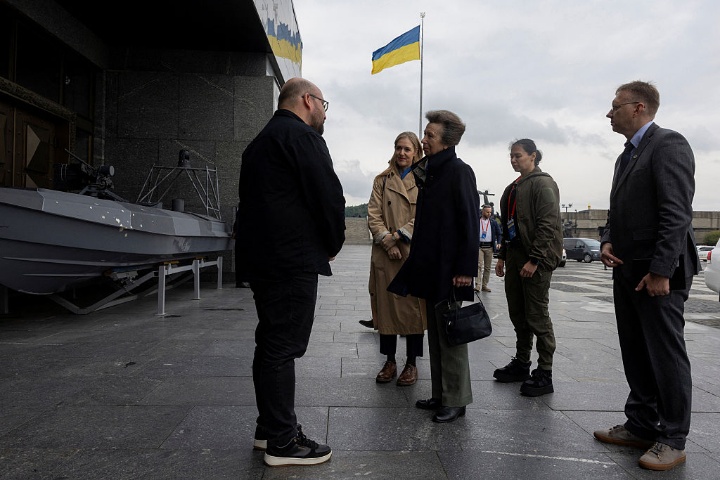
Anne, Princess Royal, daughter of Queen Elizabeth II, visits a World War II museum in the base of the Motherland Monument during a visit to the Ukrainian capital. (Thomas Peter – Pool/Getty Images)
Moscow’s Preemptive Alibi: The False Flag That Hasn’t Happened Yet
The Russian Foreign Intelligence Service’s statement released on September 30 represented either breathtaking cynicism or a remarkably clumsy attempt at information warfare—possibly both. The SVR claimed that Ukraine was preparing to conduct a false flag attack against critical Polish infrastructure, deploying fighters from the Freedom of Russia Legion and Kastuś Kalinoŭski Regiment who would pose as Russian and Belarusian special forces after Polish security services “captured” them.
According to Moscow’s narrative, Ukraine’s Main Military Intelligence Directorate would coordinate with Polish intelligence to stage the entire operation. The captured fighters would then appear at a press conference blaming Russia and Belarus for the incident. Ukraine would simultaneously conduct an “attack” on Polish critical infrastructure to “heighten public outcry,” all designed to inflame anti-Russian sentiment in Poland, accelerate escalation in the war, and incite European countries to intervene militarily on Ukraine’s behalf.
The Kremlin had ordered the SVR to release this statement for one obvious reason: to create plausible deniability for Russia’s own future sabotage operations against Poland. The pattern was familiar to anyone who had watched Russian information operations throughout the war—accuse your adversaries of planning exactly what you intend to do yourself, then point to your earlier “warning” when you get caught.
Ukraine’s Center for Countering Disinformation responded with appropriate skepticism. Alina Alieksieieva, the center’s deputy head, called the Russian narrative “a classic false-flag operation” serving as an “information alibi” for possible future Russian actions. The main goals were transparent: testing NATO’s reaction, sowing fear in European societies, and reducing support for Ukraine. Any Russian attempt to use sabotage groups or probe the Polish border would only strengthen NATO’s resolve, she noted.
Recent weeks had provided ample context for Moscow’s latest deception. Poland shot down Russian drones over its territory on September 10—the first time NATO forces had engaged Russian assets over allied airspace since the invasion began. Romania scrambled F-16s after detecting Russian drone violations on September 13. Three Russian MiG-31 jets entered Estonian airspace over the Gulf of Finland, prompting Tallinn to invoke Article 4 consultations. Each incident raised tensions and tested Western resolve while Russia attempted to muddy attribution.
The SVR’s September 30 statement appeared designed to muddy attribution for incidents that hadn’t yet occurred. If Russian or Belarusian operatives were eventually caught conducting sabotage in Poland, Moscow could point to this earlier “warning” and claim Ukraine had executed exactly the false flag operation Russia had predicted. The transparency of the deception almost didn’t matter—the statement would circulate in Russian media and among sympathetic voices in the West, creating just enough confusion to prevent consensus on appropriate responses.
In modern information warfare, you don’t need to convince everyone—just enough people to prevent unified action. The SVR’s September 30 statement served that purpose perfectly, even as its obvious falsity revealed the Kremlin’s calculations about European gullibility.
Brussels Breakthrough, Budapest Blockade: Ukraine’s EU Journey Hits Familiar Obstacles
Ukraine completed its bilateral screening process with the European Commission on September 30, marking a significant milestone that demonstrated Kyiv’s commitment to European integration even while fighting for survival. EU Enlargement Commissioner Marta Kos, visiting Ukraine on a three-day trip, praised the achievement as completing the screening “at record speed” in “the most difficult circumstances.”
The screening process, launched in July 2024, had required examining each policy field across six negotiation clusters and assessing Ukraine’s compliance with European legislation. The European Commission’s statement emphasized the remarkable nature of the accomplishment: “Achieving this in the midst of Russia’s war of aggression against Ukraine is a remarkable demonstration of the country’s resilience and determination.”
Marta Kos captured the significance on social media: “Today marks an important step on Ukraine’s path to the EU. In the most difficult circumstances, Ukraine has completed the screening process of its entire legislation at record speed, laying the foundations for its European future. We now need to maintain momentum for reform.”
The screening results would serve as the foundation for opening negotiation clusters—the six thematic groupings of EU law chapters that candidate countries must align with during the accession process. Traditionally, Cluster 1—dealing with rule of law, democratic institutions, and fundamental rights—opens first and closes last, setting the tone for the entire accession process.
But completing the screening immediately highlighted the obstacle that had blocked progress for months: Hungary’s continued veto of opening any negotiation clusters. Despite Ukraine formally launching accession talks in June 2024, Budapest had prevented all forward movement. Viktor Orbán, Moscow’s closest ally within the European Union, wielded his veto like a club, serving Russian interests while claiming to defend Hungarian sovereignty.
European Council President Antonio Costa was exploring ways to circumvent Hungary’s obstruction. According to diplomatic sources, Costa proposed changing the voting rules so that opening negotiation clusters would require only a qualified majority rather than unanimity. The final closure of clusters would still require consensus, preserving each member state’s ultimate veto power, but the reform would allow Ukraine to make progress despite individual opposition.
The proposal faced its own seemingly insurmountable hurdles. Changing the EU’s accession rules themselves required unanimity—meaning Hungary, the Netherlands, and Bulgaria, which had already opposed the idea, could block even this procedural reform. Some diplomats, speaking anonymously to reporters, expressed bafflement at Costa expending political capital on a proposal that appeared “dead on arrival.”
European leaders planned to discuss the issue during an informal summit in Copenhagen on October 1, but few expected breakthroughs. The situation exemplified Europe’s broader dilemma: how to support Ukraine’s integration into Euro-Atlantic institutions while working around members actively aligned with Moscow’s interests. Hungary’s position wasn’t mere euroscepticism or concerns about sovereignty—it was deliberate obstruction serving Russian strategic objectives.
The bureaucratic battles in Brussels mattered as much as battlefield victories in Donetsk. Ukraine’s future depended not just on defeating Russian forces but on navigating the complicated politics of European integration while one member state actively worked to keep Ukraine permanently outside the bloc.
Two Billion Euros for the Drone Revolution: Europe Invests in Ukrainian Innovation
European Commission President Ursula von der Leyen announced on September 30 that the European Union would commit two billion euros for drone production in Ukraine—a striking acknowledgment that the invaded nation had become the teacher and Europe the student in modern aerial warfare.
“We have agreed with Ukraine that a total of 2 billion euros will be spent on drones now,” von der Leyen said ahead of a European Commission Defense College meeting. “This allows Ukraine to scale up and to use its full capacity. And of course, it will also allow the EU to benefit from this technology.”
The announcement came as European leaders grappled with developing a “drone wall” along the EU’s eastern borders—a network of detection systems, countermeasures, and defensive capabilities designed to protect critical infrastructure from aerial incursions. Ukraine’s nearly four years of combat experience had generated innovations that European militaries desperately needed as Russian provocations escalated.
Von der Leyen emphasized the need to bolster military support for Ukraine while advancing the Eastern Flank Watch initiative. The “drone wall” concept reflected Europe’s recognition that traditional air defense systems designed to intercept manned aircraft and missiles struggled against small, cheap, numerous drones. Ukraine had developed countermeasures through necessity, creating expertise that NATO members now sought to acquire.
NATO Secretary General Mark Rutte, standing alongside von der Leyen at the briefing, framed the support in strategic terms. “We are helping the Ukrainians, because this is about our values, but also about, indeed, the first line of defense—our collective safety,” Rutte said, describing Ukraine as NATO’s forward defensive position against Russian aggression.
President Zelensky confirmed on September 30 that Ukrainian military specialists had deployed to Denmark to share front-line experience in countering drone threats. “Ukraine’s experience is the most relevant in Europe right now, and it is our experience, our specialists, and our technologies that can become a key element of the future European ‘drone wall’—a large-scale project that will ensure safety in the skies,” Zelensky said.
The president added that outcomes from the Danish mission would establish foundations for broader European cooperation on drone defense. The deployment marked Ukraine’s transformation from recipient of Western military expertise to provider of combat-tested knowledge that NATO countries couldn’t obtain elsewhere.
Zelensky also revealed on September 30 that discussions with the United States were advancing on fifth and sixth weapons packages through NATO’s Prioritized Ukrainian Requirements List initiative. Ukraine’s goal was receiving one billion dollars worth of weapons monthly through PURL—the program launched in July 2025 that funded NATO purchases of American-made weapons for Ukraine. Countries including the Netherlands, Denmark, Sweden, Norway, Germany, and Canada had contributed over two billion dollars through PURL.
The financial commitments illustrated how the war had become embedded in European security architecture. What began as emergency aid had evolved into systematic, institutionalized support mechanisms designed to sustain Ukraine’s defense indefinitely. The two billion euro drone investment particularly demonstrated Europe’s recognition that Ukraine wasn’t just defending itself—it was developing technologies and tactics that would protect the entire continent.
Prague Slams the Door: Czech Republic Bans Russian Diplomats
Czech Foreign Minister Jan Lipavsky announced on September 30 that Prague had banned entry for Russian diplomats and official passport holders lacking specific national accreditation from Czech authorities. The measure, implemented at international airports, represented the latest and perhaps most comprehensive European effort to counter Russian espionage and sabotage operations conducted under diplomatic cover.
“Sabotage operations are on the rise and we will not risk agents operating under diplomatic cover,” Lipavsky wrote on social media, making no attempt to soften the accusation that Russia was using diplomatic privileges to conduct hostile operations. “We are setting an example for other countries and I will continue to strive for the most consistent measures at the level of the entire Schengen Area. We will defend Czechia.”
The ban applied to Russian diplomats and official passport holders who lacked accreditation specifically from Prague—a crucial distinction that closed loopholes allowing Russian intelligence officers to enter Czech territory using diplomatic credentials issued by other countries. The measure reflected growing frustration among Eastern European NATO members that Western European nations remained insufficiently vigilant about Russian intelligence activities.
Lipavsky positioned the Czech decision as a model for other countries and pledged to pursue consistent measures across the Schengen Area. The timing carried particular significance given Prague’s historical experience with Russian intelligence operations—including the 2014 Vrbětice ammunition depot explosions that Czech authorities attributed to Russian military intelligence—and its current role as a major supporter of Ukraine.
The ban came amid escalating tensions over Russian intelligence operations across Europe. Poland had arrested a Belarusian spy in early September and expelled a Belarusian diplomat accused of aiding Minsk’s hostile activities. Estonia had declared a senior Russian diplomat persona non grata in August for allegedly attempting to undermine the Baltic nation’s constitutional order and legal system. Since February 2022, European countries had expelled dozens of Russian embassy officials, accusing them of subversive activities or working as intelligence officers under diplomatic cover.
Russia and Belarus had intensified espionage efforts across Europe, targeting Ukraine’s partners while escalating hybrid operations designed to destabilize Kyiv’s supporters. The Czech ban represented a more aggressive approach than simple expulsions—it prevented Russian intelligence officers from even entering the country under diplomatic pretexts.
For Prague, the decision reflected both practical security concerns and political calculations. The Czech Republic had emerged as one of Ukraine’s strongest supporters, providing military aid and advocating for tougher European policies toward Russia. Lipavsky’s announcement served dual purposes: protecting Czech security while demonstrating leadership among Eastern European nations demanding more aggressive countermeasures against Russian hybrid warfare.
The measure also highlighted the growing divide within Europe about how seriously to treat Russian intelligence threats. While Eastern European nations with recent experience of Soviet domination took aggressive stances, some Western European countries maintained more permissive policies—a disparity that Russian intelligence services exploited by using more tolerant countries as bases for operations throughout the Schengen Area.
Orbán’s Double Game: Ready to Shoot, Refusing to Support
Hungarian Prime Minister Viktor Orbán asserted Hungary’s readiness to shoot down Russian aircraft violating Hungarian airspace while simultaneously downplaying the seriousness of Russian threats to other European countries—a characteristic balancing act that allowed him to appear strong domestically while serving Moscow’s interests regionally.
“We are stronger in every dimension,” Orbán declared. “I’ve never understood why, if we are the stronger ones, we speak as if we were weak. Russia is weak compared to us, militarily weak, economically weak, and numerically weak.” Hungary was “not afraid” to shoot down Russian drones if they breached Hungarian airspace, he emphasized.
The statement seemed designed to project strength while undermining European unity in responding to Russian provocations. Orbán criticized what he called the “posture of Western Europeans” regarding Russian threats—suggesting that concern about Russian drone incursions and airspace violations represented weakness rather than prudent threat assessment.
The comments came after President Zelensky revealed that reconnaissance drones likely belonging to Hungary had violated Ukraine’s airspace along the border. While Hungarian Foreign Minister Péter Szijjártó dismissed the accusations, Orbán had argued that even if true, it wouldn’t matter since “Ukraine is not an independent country”—referring to Kyiv’s reliance on Western support as somehow negating Ukrainian sovereignty.
The Hungarian leader’s position reflected calculations that served multiple audiences. To domestic Hungarian voters, Orbán appeared strong on national security and unafraid of Russia. To European partners, he projected confidence about European superiority while undercutting urgency about Russian threats. To Moscow, he provided valuable services by blocking Ukraine’s EU accession, questioning Ukrainian sovereignty, and undermining European unity on security policy.
Orbán’s rhetoric about shooting down Russian drones cost him nothing—Hungary faced minimal risk of Russian airspace violations given Budapest’s friendly relationship with Moscow. But his continued obstruction of EU support for Ukraine, blocking of sanctions against Russia, and maintenance of Hungarian energy dependence on Russian supplies provided tangible benefits to the Kremlin.
The Hungarian position exemplified how one member state could exploit EU decision-making structures to serve adversarial interests. Orbán wielded veto power like a weapon, blocking Ukraine’s path to membership while claiming to defend Hungarian sovereignty. The contradiction between his tough talk about defending Hungarian airspace and his accommodation of Russian aggression against Ukraine revealed the performance underlying his foreign policy.
Kellogg’s Candid Confession: Using Lukashenko to Reach Putin
U.S. Special Envoy to Ukraine Keith Kellogg offered remarkably frank explanations on September 30 about why Washington had engaged with Belarusian dictator Alexander Lukashenko, lifting sanctions on Belarusian flag carrier Belavia after the regime released 52 political prisoners in September.
Speaking at the Warsaw Security Forum, Kellogg acknowledged that maintaining communication channels to Putin through Lukashenko was the primary American goal—not the prisoner releases, though those provided useful political cover for the engagement.
“We are not sure what he says, but we know that he talks to him,” Kellogg said, referring to Lukashenko’s communications with Putin. “What we did, we established a relationship to ensure the lines of communication were open so we could make sure all of our messaging was being passed to President Putin.”
The candor was unusual for an American official discussing diplomatic strategy. Kellogg made clear that the engagement aimed “to find a resolution to the best way we can to the war between Ukraine and Russia” rather than primarily to secure prisoner releases. He acknowledged American realism about Lukashenko’s regime: “if he releases one, he probably picks up two more.”
The sanctions relief allowed Belavia to repair its aircraft fleet using American-made components. Washington had made clear the planes couldn’t be used for criminal purposes or to transport migrants to Europe—referring to Lukashenko’s 2021 campaign of weaponizing migration by facilitating Middle Eastern migrants’ passage to the Polish and Lithuanian borders.
Kellogg’s explanation revealed the sometimes unsavory calculations required in wartime diplomacy. The United States needed communication channels to Moscow, and Lukashenko—despite allowing Russian forces to use Belarusian territory to attack Ukraine—provided that access. The prisoner releases created positive optics while the real benefit was maintaining dialogue that might eventually contribute to ending the war.
For Ukrainian observers, Kellogg’s comments highlighted persistent concerns about American diplomatic priorities. Washington’s willingness to engage Lukashenko’s regime despite its role in enabling Russian aggression suggested flexibility in American policy that could cut multiple directions. The same pragmatism that allowed dealing with Lukashenko to reach Putin might eventually translate into pressure on Kyiv to accept unwanted compromises.
The approach reflected American recognition that ending the war would require negotiations with actors whose behavior Washington found reprehensible. But it also raised questions about where American pragmatism ended and pressure on Ukraine to accommodate Russian demands might begin.
Trump’s Frustration Mounts: The Meeting That Putin Refuses
President Donald Trump repeated his call on September 30 for Presidents Zelensky and Putin to meet, expressing mounting frustration that his efforts to broker peace had yielded no results despite months of American diplomatic pressure.
“We have to settle it up” and “get it done” after months of heavy losses on both sides, Trump told a room of American generals. “The only way we can do that is through strength. If we were weak, they wouldn’t even take my phone call. Zelensky’s got to get them together and get it done.”
Trump’s formulation placed responsibility on Zelensky to arrange the meeting—a framing that ignored the fundamental reality that Putin had repeatedly refused such encounters. Zelensky had publicly stated his readiness to meet Putin, but the Russian leader continued refusing direct talks without Ukraine first accepting Moscow’s conditions: abandoning NATO membership aspirations and discussing territorial concessions that would legitimize Russian conquest.
The American president repeated his claim that Russia and Ukraine were losing “5,000 to 7,000 soldiers a week,” calling the fighting “the worst war since World War II.” He asserted he had recently ordered a U.S. nuclear submarine near Russian waters, boasting that “we’re 25 years ahead of Russia and China in submarines.”
Trump expressed disappointment with Putin for prolonging the war, claiming he had once warned the Russian leader that fighting for years “doesn’t look good” and “you’re a paper tiger.” The comments suggested Trump believed personal pressure on Putin should have produced results—revealing either naiveté about Putin’s calculations or posturing for domestic audiences.
The Wall Street Journal had reported on September 24 that Trump’s views on Ukraine’s ability to defeat Russia had shifted following briefings from American officials on battlefield situations and potential Ukrainian offensives. Yet Trump’s September 30 remarks suggested his fundamental approach remained unchanged: pressure both sides to negotiate while positioning himself as the strong leader capable of ending the conflict through force of personality.
The strategy had failed for months, but Trump showed no signs of modifying it. His frustration was palpable—the deal-maker president couldn’t make the deal, and the longer the war continued, the more his claims about quickly ending the conflict looked like empty promises.
For Ukraine, Trump’s rhetoric raised concerns about what American frustration might eventually produce. If Trump couldn’t secure a meeting or negotiations, would he begin pressuring Kyiv to make concessions simply to achieve some diplomatic outcome he could claim as success? The question hung over Ukrainian-American relations as the war entered its fourth year.
China’s Careful Dance: Sympathy Without Attribution
Chinese Ambassador to Ukraine Ma Shengkun delivered remarks on September 30 at a reception marking the 76th anniversary of the People’s Republic of China that exemplified Beijing’s carefully calibrated approach to the war—expressing sympathy for Ukrainian suffering while meticulously avoiding any criticism of Russia.
“China fully understands the hardships currently faced by the Ukrainian people and will continue its efforts to achieve a ceasefire and reach a just and lasting peace agreement as soon as possible,” Ma said, maintaining China’s position of supporting peaceful negotiations and political resolution to the conflict.
The ambassador noted that China consistently maintained an “objective and fair stance,” actively called for peaceful negotiations, and supported political resolution. China was ready to work with the international community to continue making constructive efforts toward a ceasefire and swift achievement of a just, lasting, and binding peace agreement, he emphasized.
Ma stressed that China and Ukraine were strategic partners who, over 33 years of diplomatic ties, had adhered to principles of mutual respect and mutual benefit, ensuring steady growth in bilateral cooperation. He pointed out that China remained Ukraine’s largest trading partner, with both economies working in close synergy. China was ready to work with Ukraine to broaden horizons of mutually beneficial cooperation for the good of both nations, he concluded.
What the ambassador didn’t say was as significant as his carefully chosen words. He never mentioned Russia as the country that launched the brutal war against Ukraine—the very “hardships” he referenced. He avoided using even China’s official term “Ukrainian crisis” for describing Russia’s aggression. The omissions preserved China’s position of nominal neutrality while avoiding any statement that might displease Moscow.
The performance was notable for what journalists observed: the head of the Chinese Embassy did not mention Russia as the aggressor that launched the war against Ukraine, nor did he use the term “Ukrainian crisis,” which remained China’s official terminology for Russia’s aggression.
For Ukrainian officials, China’s stance remained frustratingly consistent. Beijing expressed sympathy for Ukrainian suffering while refusing to identify or condemn the Russian aggression causing that suffering. The ambassador’s speech exemplified China’s broader strategy—maintaining economic relationships with Ukraine, positioning itself as a potential mediator, and expressing concern about the conflict’s humanitarian costs, all while carefully preserving its strategic partnership with Russia.
The carefully calibrated approach served Chinese interests on multiple levels. It maintained Beijing’s relationship with both parties, preserved China’s claim to neutral mediation, avoided antagonizing Russia, and allowed China to present itself as a responsible global power concerned about peace—all without taking any positions that might impose costs or risks on Chinese interests.
Death in the Caucasus: Ukrainian Intelligence Strikes Deep
Ukrainian military intelligence announced on September 30 that its agents, supported by the Caucasus Liberation Movement, had assassinated three Russian servicemembers near Tambukan in Russia’s Stavropol Krai on September 27—revealing the operation three days after its execution for maximum psychological impact.
The operation killed a Rosgvardia lieutenant colonel commanding an Avangard Spetsnaz Detachment, along with his assistant and driver. Ukrainian intelligence released footage showing surveillance of the officer from a distance and the explosion that destroyed his vehicle on a road leading to a training ground. The video demonstrated the careful planning behind the strike—patient observation followed by precise execution.
The targeted officer commanded the Avangard unit of Russia’s National Guard—paramilitary forces tasked with maintaining public order and combating what Moscow termed terrorism and illegal armed groups. Rosgvardia served primarily as internal security forces, suppressing dissent and maintaining control in volatile regions rather than fighting on external battlefields.
Tambukan lies in southwestern Russia, approximately 80 kilometers north of the Georgian border and roughly 650 kilometers from Ukraine’s front lines. The North Caucasus represented one of Russia’s most volatile regions, with decades of insurgency, radicalism, and ethnic tensions that Moscow had struggled to control despite heavy-handed security operations and enormous security expenditures.
The assassination demonstrated several strategic realities. Ukrainian intelligence had maintained operational capability deep inside Russian territory despite Moscow’s security apparatus. The ability to surveil a senior officer, track his movements, and execute a precision strike hundreds of kilometers from Ukraine revealed either Ukrainian infiltration of Russian security structures or collaboration with local networks hostile to Moscow.
The choice of target was significant. By killing a National Guard commander rather than conventional military personnel, Ukrainian intelligence struck at forces used for internal repression. The message was clear: Ukrainian operations could reach officers anywhere in Russia, not just near front lines or in contested territories.
The timing of the announcement—three days after the operation—suggested careful consideration of when to reveal such actions. Ukrainian intelligence could have kept the operation secret or announced it immediately. Instead, they waited, potentially to confirm details, assess Russian reactions, or choose the optimal moment for psychological impact.
Ukrainian intelligence credited the Caucasus Liberation Movement with supporting the operation, though details about this group remained scarce. The North Caucasus had produced numerous resistance movements over decades, and Ukrainian intelligence had increasingly cultivated relationships with groups opposed to Moscow’s control. Whether the Caucasus Liberation Movement represented a significant organization or a cover designation for Ukrainian operations remained unclear.
For Russian security services, the assassination raised uncomfortable questions. If Ukrainian operatives could identify, surveil, and eliminate a senior National Guard officer in the North Caucasus, what other targets might be vulnerable? The paranoia such operations generated had strategic value beyond eliminating individual commanders—every Russian officer now had to consider whether Ukrainian intelligence was watching them.
Nuclear Nightmare: Seven Days Without Grid Power
President Zelensky issued an urgent warning on September 30 that the Russian-occupied Zaporizhzhia Nuclear Power Plant had been cut off from the electrical grid for seven consecutive days—the longest such outage since Russia’s full-scale invasion began and a situation unprecedented in the facility’s history.
“It is now the seventh day—by the way, it is something that has never happened before—of an emergency situation at the Zaporizhzhia Nuclear Power Plant. The situation is critical,” Zelensky said in his evening address, his tone conveying the gravity of a crisis that could produce catastrophic consequences extending far beyond Ukraine’s borders.
Europe’s largest nuclear power plant was relying solely on diesel generators to maintain cooling systems and safety functions after Russian strikes severed its connections to Ukraine’s electrical grid. The facility, located in the Russian-occupied city of Enerhodar on the Dnipro River near front lines, had operated in various states of precarious safety since Russia seized it in March 2022.
“The generators and the plant were not designed for this, and have never operated in this mode for so long,” Zelensky explained. “And we already have information that one generator has failed.” The president accused Moscow of deliberately obstructing repair of transmission lines through continued shelling of the surrounding area.
“And this is a threat to absolutely everyone,” Zelensky emphasized. “No terrorist in the world has ever dared to do to a nuclear plant what Russia is doing right now.” He had ordered Ukraine’s government and diplomatic corps to bring maximum international attention to the crisis.
International Atomic Energy Agency Director General Rafael Grossi issued a statement confirming the gravity of the situation while attempting to prevent panic. “While the plant is currently coping thanks to its emergency diesel generators—the last line of defence—and there is no immediate danger as long as they keep working, it is clearly not a sustainable situation in terms of nuclear safety,” Grossi said.
The IAEA remained “in constant contact with the two sides with the aim to enable the plant’s swift re-connection to the electricity grid,” Grossi noted, though the statement offered little confidence that reconnection would occur quickly given Russian obstruction of repair efforts.
The Zaporizhzhia situation exemplified how Russia’s war had created nuclear safety risks without precedent in the atomic age. The plant’s six reactors had been shut down since Russia’s occupation, but the facility still required electricity to maintain cooling systems that prevented nuclear fuel from overheating and potentially melting down. Diesel generators represented the last line of defense—backup systems never designed for extended operation.
That one generator had already failed after just seven days raised terrifying questions about what might happen if the situation continued for weeks. The generators required fuel deliveries, maintenance, and perfect operation to prevent disaster. Any interruption could trigger events that would make Chornobyl and Fukushima look manageable by comparison.
Russia’s seizure of the plant in 2022 had generated repeated safety concerns including power outages, shelling in the vicinity, and staffing shortages. Ukrainian engineers continued operating the facility under Russian military occupation—working under impossible conditions where their professional judgment was subordinated to military imperatives and any mistake could produce catastrophe.
The seven-day disconnection represented a new escalation. Previous outages had lasted hours or at most days before power was restored. This extended crisis suggested either that Russian strikes had caused more extensive damage to transmission infrastructure or that Moscow was deliberately preventing repairs—using Europe’s largest nuclear power plant as a hostage to European security.
The Daily Toll: Nine Dead, Dozens Wounded Across Multiple Regions
Russian forces killed at least nine civilians and injured dozens more on September 30 in attacks that demonstrated the war’s continuing costs for Ukrainian population centers far from active fighting. The casualties came from drone strikes and artillery bombardments across multiple oblasts, painting a picture of violence deliberately targeting civilian areas.
In Dnipro, a Russian drone attack killed one person and injured at least 28 others, including a 10-year-old boy and a 17-year-old girl. The strike damaged a medical center, children’s dental clinic, and Dnipro National University, causing multiple fires across the city center. Twelve of the injured required hospitalization, while the rest recovered at home. One hospitalized victim in serious condition later died from their injuries.
“I was at home when I heard the explosion,” a student named Yelyzaveta told local journalists at the scene. “The explosion was quite strong, as I usually don’t hear any explosions unless they are close. I saw it happened in the city center, so I decided to come here and help. There was a lot of smoke here. Windows were broken in some university buildings, and the wind made the fire even worse. It’s just hell.”
The Dnipro attack formed part of a massive Russian drone campaign on the night of September 29-30. Ukrainian Air Force reported that Russia launched 65 Shahed-type drones and decoys from Kursk, Bryansk, Orel, Millerovo, Primorsko-Akhtarsk, and occupied Crimea. Ukrainian air defense and electronic warfare systems intercepted 46 drones, while 19 reached their targets in six locations. Debris from intercepted drones fell on two additional locations.
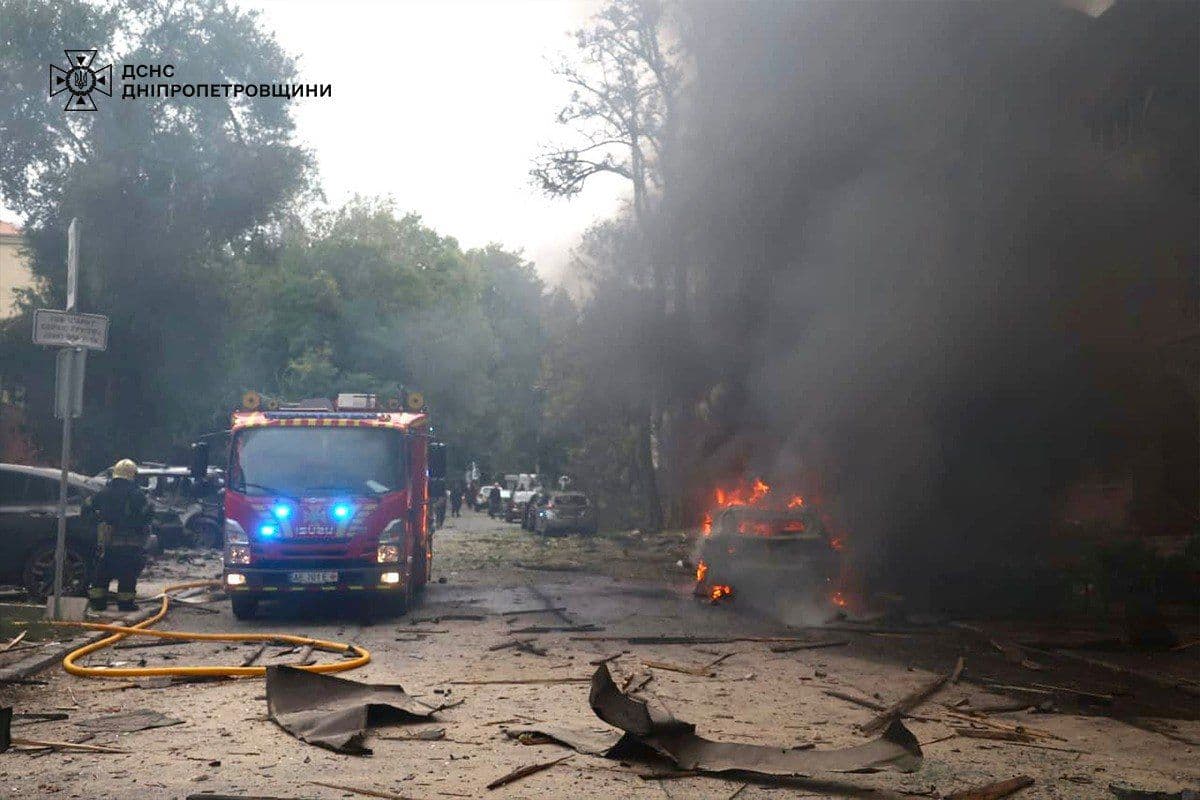
The aftermath of the Russian drone attack on the city of Dnipro, Ukraine. (Volodymyr Zelensky/ Telegram)
In Sumy Oblast near the Russian border, Russian drones killed four civilians including two children in Chernechchyna, Krasnopilska Hromada. The attack killed an entire family—a 35-year-old man, 26-year-old woman, and their children aged six and four. In separate attacks, Russian forces killed a 60-year-old woman in the Shalyhyne community and injured a 23-year-old man in Myropillia. Russian drones damaged energy and civilian infrastructure across Chernihiv, Dnipropetrovsk, Kharkiv, and Sumy oblasts.
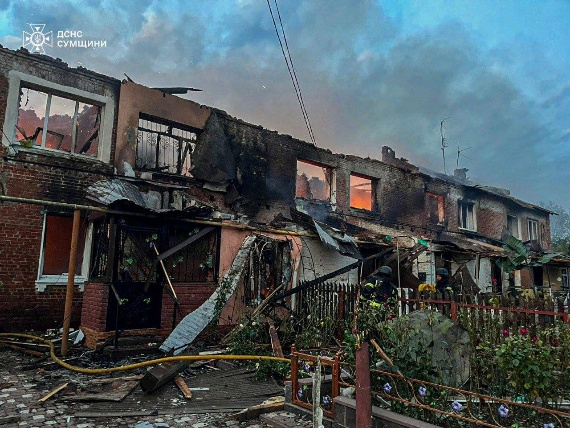
Aftermath following the Russian overnight strike on Ukraine’s Sumy Oblast. (Ukraine’s Emergency Service)
In Donetsk Oblast, Russian attacks killed three people—two in Kostiantynivka and one in Druzhkivka—while injuring eight others. The strikes reflected the relentless bombardment of cities and towns near front lines that Russian forces had maintained for months, grinding down civilian populations through constant threat of sudden death.
In Kherson Oblast, Russian forces targeted 29 settlements including the regional capital, killing one person and injuring four. The southern region had experienced daily shelling since Ukrainian forces liberated the west bank of the Dnipro River, with Russian artillery firing from occupied positions on the east bank.
In Dnipropetrovsk Oblast, Russian forces attacked Synelnykove and Mezhova communities, injuring two women aged 49 and 59. In Chernihiv Oblast, drone strikes targeted energy infrastructure in Nizhyn district, leaving approximately 26,000 residents in Bobrovytsia and nearby settlements without electricity as winter approached.
The accumulated casualties illustrated the daily civilian cost beyond front-line combat. Russian forces continued striking population centers with drones and artillery, using weapons designed for military targets against civilian infrastructure and residential areas. Each attack created ripples of trauma extending far beyond immediate casualties—families destroyed, communities terrorized, and infrastructure damaged in ways that would require years to fully repair.
The Grinding Front: Meters Gained, Lives Lost
Russian and Ukrainian forces continued offensive operations across multiple sectors on September 30, with both sides making tactical gains measured in streets and treelines rather than kilometers. The fighting reflected the war’s current character—grinding attrition where advances came at enormous cost and front lines shifted incrementally rather than dramatically.
In northern Kharkiv Oblast, Russian forces attacked northeast of Kharkiv City near Vovchansk and Synelnykove on September 29-30 but made no confirmed advances. In the Kupyansk direction, Russian forces continued assaults near and in Kupyansk itself, northeast near Kamyanka, north near Radkivka, southeast near Stepova Novoselivka, and south near the Kupyansk-Vuzlovyi Railway Station in southern Kupyansk-Vuzlovyi.
In the Borova direction, Russian forces maintained pressure southeast of Borova near Hrekivka and Olhivka. In the Lyman direction, Russian forces continued assaults north of Lyman near Novomykhailivka and Stavky; northwest near Karpivka, Serednie, Shandryholove, and Novoselivka toward Drobysheve; northeast near Kolodyazi, Yampolivka, and Torske; and southeast near Yampil and in the Serebryanske forest area.
A spokesperson of a Ukrainian brigade operating in the Lyman direction stated on September 30 that Russian forces were using Lancet and Molniya loitering munitions to support offensive operations. Russian forces were using Molniya drones as “motherships” to transport first-person view drones into Ukrainian near rear areas—a tactical innovation that extended the effective range of short-range FPV drones by carrying them closer to targets before launching.
In the Siversk direction, Russian forces attacked northwest near Dronivka, northeast near Serebryanka, east near Novoselivka, and southwest near Fedorivka. In the Kostyantynivka-Druzhkivka tactical area, Russian forces attacked near Kostyantynivka itself; northeast near Zaliznyanske and Minkivka; east near Predtechyne; south near Shcherbynivka, Katerynivka, and Pleshchiivka toward Ivanopillya; southeast near Toretsk, Bila Hora, Oleksandro-Shultyne, and Dyliivka toward Stepanivka; southwest near Yablunivka; south of Druzhkivka near Rusyn Yar and Poltavka; and southwest near Volodymyrivka and Sofiivka.
A Ukrainian battalion commander operating in the Pokrovsk direction reported that Russian forces continued attacking in small groups of one to two infantrymen, supported by drone cover, who probed and attempted to infiltrate Ukrainian defenses to create chaos. Russian forces employed anti-thermal imaging cloaks to avoid detection by Ukrainian drones, moved to new positions at night or dusk, and attacked during the day. Russian forces used Molniya loitering munitions as motherships for first-person view drones to increase their range over 20 to 25 kilometers and had intensified use of artillery and mortar strikes, including MLRS, guided bombs, fiber optic drones, and sleeper drones.
In the Pokrovsk direction, Russian forces attacked near Pokrovsk itself; northwest toward Hryshyne; north near Rodynske; northeast near Krasnyi Lyman and Novoekonomichne; east near Myrnohrad, Myrolyubivka, and Promin toward Kozatske and Balahan; southeast near Novopavlivka and Lysivka; southwest near Kotlyne, Udachne, Molodetske, and Zvirove; and west toward Serhiivka.
In the Novopavlivka direction, Russian forces attacked toward Novopavlivka itself; southeast near Dachne and Horikhove; south near Filiya; and southwest of Filiya near Hrushivske, Novokhatske, and Zelenyi Hai. In the Velykomykhailivka direction, Russian forces attacked northeast near Piddubne; east near Oleksandrohrad, Novoselivka, and Sichneve; southeast near Komyshuvakha, Sosnivka, Berezove, Ternove, Zaporizke, Vorone, and Novomykolaivka; south near Kalynivske toward Orestopil; and southwest near Verbove toward Oleksiivka.
In western Zaporizhia Oblast, Russian forces continued assaults southwest of Orikhiv near Stepove and Kamyanka and northwest near Stepnohirsk, Plavni, and Prymorske. Ukrainian Southern Defense Forces Spokesperson Colonel Vladyslav Voloshyn stated on September 30 that Russian forces were accumulating troops ahead of renewed assaults near Mala Tokmachka southeast of Orikhiv, Novodanylivka south of Orikhiv, and Novoandriivka west of Orikhiv.
In the Kherson direction, Russian forces continued assaults on September 29-30 but did not advance. In northern Sumy Oblast, Russian forces continued offensive operations on September 30 but did not make confirmed advances, attacking in unspecified areas of Sumy and Kursk oblasts on September 29-30.
The tactical descriptions revealed a war of constant adaptation where both sides continuously developed new methods and countermeasures. The emphasis on drone warfare—both offensive and defensive—reflected how unmanned systems had become central to operations at all levels. Russian use of Molniya drones as motherships for FPV drones demonstrated continuing tactical innovation designed to overcome Ukrainian electronic warfare capabilities.
Striking Crimea: Degrading Russian Air Defenses
Ukrainian Special Forces reported on September 30 that Ukrainian drone operators had struck the radar station of a Russian S-400 air defense system in an unspecified part of occupied Crimea on the night of September 29-30. The strike demonstrated Ukraine’s capability to target Russian air defense infrastructure even in territories Russia had controlled since 2014.
The S-400 system represented one of Russia’s most advanced air defense platforms, designed to detect and engage aircraft, cruise missiles, and ballistic missiles at extended ranges. Striking its radar components degraded Russian ability to detect and engage Ukrainian aircraft and missiles operating over or near Crimea—potentially preparing conditions for future operations requiring air superiority.
The operation reflected Ukraine’s systematic campaign to degrade Russian air defense capabilities in occupied territories. Each successful strike against radar stations, command posts, or missile launchers created gaps in Russian defensive coverage that Ukrainian forces could exploit. The strikes also imposed costs on Russia, forcing the deployment of replacement systems or acceptance of reduced air defense coverage.
That Ukrainian forces could reach targets in Crimea—a peninsula Russia had occupied for over eleven years and heavily fortified—demonstrated the evolution of Ukrainian strike capabilities. The distances involved, the need to penetrate Russian air defenses, and the precision required to hit specific components of air defense systems all indicated sophisticated operational planning and capable weapons systems.
Gaza Evacuation: Ukraine’s Humanitarian Reach Despite War
Ukraine evacuated 57 people from Gaza on September 29-30, including 48 Ukrainian citizens and nine Palestinian nationals, Foreign Minister Andrii Sybiha announced on September 30. The operation, coordinated with Ukrainian military intelligence, took place amid active fighting that significantly complicated the evacuation process.
Among the evacuees were two wounded people—a Ukrainian citizen and a Palestinian—who received medical assistance from Ukrainian military medics during the operation. The group was flown to Chisinau, Moldova, where they would continue their journey home. Sybiha expressed gratitude to officials in Israel, Jordan, and Moldova for helping secure transit routes and resolve logistical and permit issues.
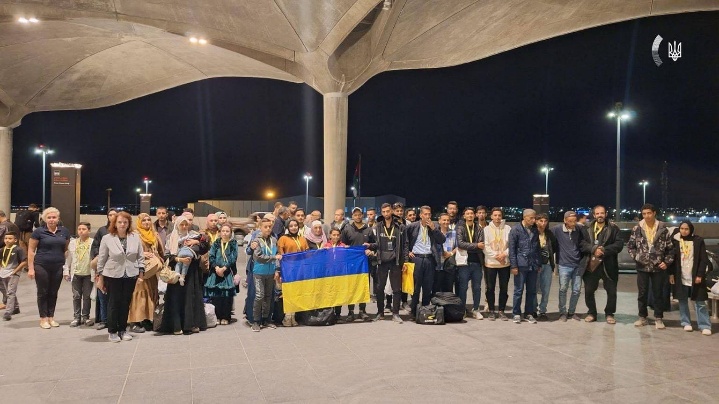
Ukrainian citizens and their families stand in front of the airport holding the Ukrainian flag after being evacuated from the Gaza Strip. (Ministry of Foreign Affairs/ Telegram)
“This stage of evacuation was carried out on the direct instruction of the president of Ukraine to ensure the safety of our citizens from dangerous regions of the Middle East,” Sybiha said in a statement released by the Foreign Ministry.
The evacuation represented the latest in a series of Ukrainian operations to protect citizens in the Middle East despite the war consuming enormous resources and attention at home. That Ukraine could coordinate complex evacuations from active conflict zones while fighting for survival demonstrated both the professionalism of Ukrainian diplomatic and intelligence services and the priority Kyiv placed on protecting citizens abroad.
The operation also highlighted Ukraine’s continuing international engagement despite the war. Ukrainian military intelligence coordinated with Israeli, Jordanian, and Moldovan authorities to move people through multiple countries and conflict zones—a logistical achievement requiring diplomatic access and operational capabilities that many countries would struggle to match.
Swedish Ambiguity: Gripen Jets Still Under Discussion
Swedish authorities confirmed on September 30 that discussions about supplying Gripen fighter jets to Ukraine had been ongoing but emphasized that no definite agreement had been reached. The statement came after Ukrainian Deputy Defense Minister Ivan Havryliuk hinted to the BBC that Kyiv was “expecting” additional deliveries of Western aircraft, including Gripens.
“Practically, you named the nomenclature correctly, but I won’t go into detail about when, what, or which,” Havryliuk had said when asked whether Ukraine expected Mirage and Gripen jet deliveries along with new F-16s.
Adam Schelin, a spokesperson for Swedish Defense Minister Pål Jonson, confirmed that talks had occurred but cautioned against premature conclusions. “There have been ongoing talks between Sweden and Ukraine for some time about the export/sale of Gripen E,” Schelin said. “But nothing is clear yet.”
Discussions about supplying Swedish-made Saab JAS 39 Gripen jets to Ukraine had persisted for years as Kyiv sought to modernize its Air Force with Western aircraft. Ukraine currently operated U.S.-made F-16 fighter jets provided by Denmark and the Netherlands, as well as French Mirage 2000 aircraft.
Swedish authorities had indicated last summer that Gripen plans were on hold to prioritize F-16 deliveries but could be revived once those transfers were complete. The September 30 statements suggested discussions continued but remained at early stages without firm commitments about numbers, timelines, or terms.
For Ukraine, diversifying its Western fighter fleet would provide operational advantages—reducing dependence on single aircraft types, expanding maintenance and weapons integration options, and potentially acquiring capabilities that different aircraft offered. The Gripen’s reputation for operating from austere conditions and requiring minimal ground support infrastructure made it potentially attractive for Ukrainian operations.
But the lack of firm commitments reflected broader patterns in Western military support—lengthy discussions, cautious commitments, and gradual deliveries that often lagged behind Ukrainian needs. Whether Swedish Gripens would eventually reach Ukrainian skies remained uncertain as discussions continued without definite conclusions.
Ukrenergo Drama: Court Halts Leadership Purge
A Kyiv court halted the dismissal of Vitaly Zaichenko, head of Ukraine’s state-owned energy grid operator Ukrenergo, less than a week after his sudden removal along with members of the company’s management board. The court action, following a request from the Energy Ministry, injected legal uncertainty into leadership of a critical state enterprise as winter approached.
Ukrenergo’s supervisory board had fired Zaichenko and three management board members on September 26, just three months after appointing him—prompting questions about tensions between government and the board or possible attempts to seize control of the company. This marked the second time in just over a year that Ukrenergo had seen its chief removed.
Volodymyr Kudrytskyi had been dismissed in September 2024 on grounds of allegedly failing to protect energy infrastructure amid Russian missile strikes—accusations flatly rejected by former supervisory board members who characterized his removal as politically motivated.
Ukraine’s National Energy Regulator launched a review of the latest dismissals, calling the leadership shake-up a potential “violation” that “threatens to undermine the trust of international partners and jeopardize electricity imports ahead of the heating season.” The regulator’s concern reflected the stakes involved—Ukrenergo managed Ukraine’s high-voltage power transmission network and held membership in the European Network of Transmission System Operators for Electricity, coordinating electricity transmission across Europe.
The court ruling barred all state registrars from acting on the supervisory board’s September 26 dismissal decision, creating a legal standoff about who legitimately led the company. The supervisory board had attributed the dismissals to its “loss of confidence” due to unspecified events over recent weeks and to a September 5 decision by the National Securities and Stock Market Commission ruling there had been procedural violations in appointing three management board members.
Two competing narratives emerged about the dismissals. Sources indicated some board members viewed Zaichenko as too close to the government and fired him to curb political interference and rein in allegedly corrupt interests. An alternative narrative positioned Oleksiy Brekht, a long-term Ukrenergo employee appointed as acting CEO, as having orchestrated Zaichenko’s removal with possible backing from the President’s Office.
Zaichenko had told reporters on the day of his dismissal that he believed his removal illegal because reasons weren’t explained to him and because it allegedly left Ukrenergo without a functioning management board. The legal uncertainty about leadership came at a critical moment—Ukraine faced winter with damaged energy infrastructure and heightened vulnerability to Russian strikes against power systems.
The Ukrenergo drama exemplified broader governance challenges Ukraine confronted while fighting for survival. Maintaining professional management of critical state enterprises, preventing political interference, combating corruption, and ensuring accountability all remained essential for Ukraine’s viability—but achieving these goals amid wartime pressures and competing power centers created constant tensions that occasionally erupted into public disputes.
Moscow’s Budget Reveals Priorities: Security Over Society
Russian budget documents revealed on September 30 that the Kremlin was preparing its sharpest increase in law enforcement and intelligence spending during the full-scale invasion, with federal spending on police, National Guard, and other security agencies set to rise 13 percent year-over-year to a record 3.91 trillion rubles (approximately $47 billion) in 2026.
Combined with military and defense industry expenditures, Russia’s overall security budget would reach 16.84 trillion rubles ($204 billion) in 2026—representing 38 percent of total federal spending. That figure would grow to 17.8 trillion rubles ($215 billion) in 2027, according to the Moscow Times reporting on budget documents.
By stark contrast, social welfare programs would receive just 7.1 trillion rubles ($86 billion) in 2026, while less than two trillion rubles ($24 billion) would be allocated for education and healthcare combined. Security services would receive nearly eight times the combined allocation for education and healthcare—a distribution that revealed the Kremlin’s calculations about maintaining power and prosecuting the war.
The enormous increases in law enforcement spending suggested Moscow’s growing concern about domestic stability as the war’s costs accumulated. Rosgvardia, the National Guard reporting directly to Putin, would receive substantial increases—reflecting the priority placed on internal security and suppression of potential dissent.
The budget priorities illustrated how the war was transforming Russian society beyond battlefield casualties. The allocation of 38 percent of federal spending to security—rising to perhaps 40 percent by 2027—represented a militarization of the state budget unprecedented in post-Soviet Russia. The trade-offs were explicit: massive spending on security apparatus came directly at the expense of social programs, healthcare, and education that affected ordinary Russians’ quality of life.
For Russian citizens, the budget meant deteriorating public services, crumbling infrastructure outside security sectors, and declining access to healthcare and education—all to fund a war that had produced no decisive victories while generating hundreds of thousands of casualties. The Kremlin’s willingness to make these trade-offs suggested confidence that Russian society could be controlled through security forces rather than satisfied through public services.
The Day’s Meaning: Shadow Wars and Nuclear Dangers
September 30, 2025, revealed the 1,315th day of a conflict that had evolved far beyond its origins as a conventional military invasion. Russia’s Foreign Intelligence Service released preemptive cover for future provocations while Ukrainian intelligence announced an assassination deep in Russia’s North Caucasus. European leaders pledged billions for Ukrainian drone production while Hungary blocked Ukraine’s EU progress. Czech authorities banned Russian diplomats while American envoys explained their engagement with Belarusian dictators. Chinese diplomats expressed sympathy without attribution while Trump expressed frustration without results. And across Ukraine’s cities and villages, Russian drones killed civilians including entire families while Europe’s largest nuclear power plant operated on backup generators for seven unprecedented days.
The shadow war had spread across continents and through multiple dimensions—diplomatic, intelligence, economic, technological, and nuclear. The fighting in Donetsk and Kharkiv continued grinding forward in meters rather than kilometers, but the war’s center of gravity had shifted to questions about European security architecture, nuclear safety, technological innovation, and whether democracies possessed sufficient unity and endurance to defeat authoritarian aggression.
Moscow’s SVR statement about false flag operations revealed the Kremlin’s approach—accuse adversaries of planning what you intend to do, create confusion about attribution, and exploit democratic societies’ attachment to due process and burden of proof. The transparency of the deception didn’t matter if it created enough doubt to prevent unified responses.
Ukraine’s completion of EU screening demonstrated Kyiv’s commitment to European integration even while fighting for survival, but Hungary’s obstruction showed how one member state could exploit consensus requirements to serve adversarial interests. The bureaucratic battles in Brussels mattered as much as battlefield victories—Ukraine’s future depended on navigating European politics while one government actively worked to keep Ukraine outside the bloc.
The two billion euro commitment for Ukrainian drone production acknowledged what the war had demonstrated: Ukraine had become the teacher and Europe the student in modern aerial warfare. NATO members sought Ukrainian expertise developed through nearly four years of combat—a remarkable reversal from 2022 when Ukraine pleaded for basic weapons to defend itself.
The Zaporizhzhia Nuclear Power Plant crisis represented perhaps the most disturbing development—seven days without grid power, operating on backup generators never designed for extended use, with one generator already failed. The situation created nuclear safety risks without precedent, with potential consequences extending far beyond Ukraine’s borders. Russia’s willingness to create such dangers revealed either recklessness or calculated acceptance of nuclear disaster risks as tolerable costs of war.
The civilian casualties—nine dead, dozens wounded, including children and entire families—illustrated the daily costs beyond front-line combat. Russian forces continued striking population centers with weapons designed for military targets, using drones and artillery against medical centers, universities, and residential areas. Each attack created trauma extending far beyond immediate casualties.
The grinding advances on multiple fronts—measured in streets and treelines, achieved through small-unit infiltration tactics and drone warfare, sustained by artillery and loitering munitions—showed the war’s current character. Neither side could achieve breakthrough victories; both sides continued pressing forward through attrition and adaptation.
Ukrainian intelligence operations deep in Russia demonstrated capabilities that forced Russian security services to consider vulnerabilities hundreds of kilometers from front lines. The assassination of a National Guard officer in the North Caucasus sent a message that Ukrainian operations could reach targets anywhere in Russia.
Trump’s frustration, China’s careful neutrality, Sweden’s ambiguous discussions, and Kellogg’s candid explanations about engaging Lukashenko all revealed the diplomatic complexity surrounding the war. No single approach had produced results; no combination of pressure and incentives had moved Putin toward genuine negotiations; no amount of American frustration had forced either side to accept terms the other found tolerable.
The question that had defined the war from its beginning remained unanswered: which side could sustain losses, maintain support, preserve cohesion, and continue adapting longer than its opponent. On this single day at the end of September, both sides demonstrated capabilities and weaknesses suggesting the conflict’s conclusion remained distant. The shadow war had spread across Europe and beyond, touching nuclear power plants and drone production facilities, assassination targets and diplomatic receptions, budget priorities and court rulings.
The world that would emerge from this conflict looked increasingly different from the one that existed before February 24, 2022—and September 30, 2025, revealed that transformation continuing day by day, in ways both dramatic and mundane, catastrophic and bureaucratic, deadly and diplomatic. The war had become the organizing principle of European security, the driver of technological innovation, the test of democratic endurance, and the source of nuclear dangers that threatened consequences extending far beyond any battlefield.