
When Russia launched 549 projectiles in its largest strike on Lviv Oblast, Putin threatened Washington over Tomahawks, and Trump endorsed nuclear arms limits
A Day of Overwhelming Force
October 5, 2025, began with death raining from the sky. Russia launched its largest combined drone and missile strike against Lviv Oblast since the full-scale invasion began—549 projectiles including Kinzhal aeroballistic missiles, cruise missiles, and waves of Shahed drones. By dawn, at least six people were dead, including an entire family. Power grids collapsed across western Ukraine. Industrial facilities burned. And President Vladimir Putin issued a warning to Washington: Send Tomahawks to Ukraine, and watch our improving relationship crumble.
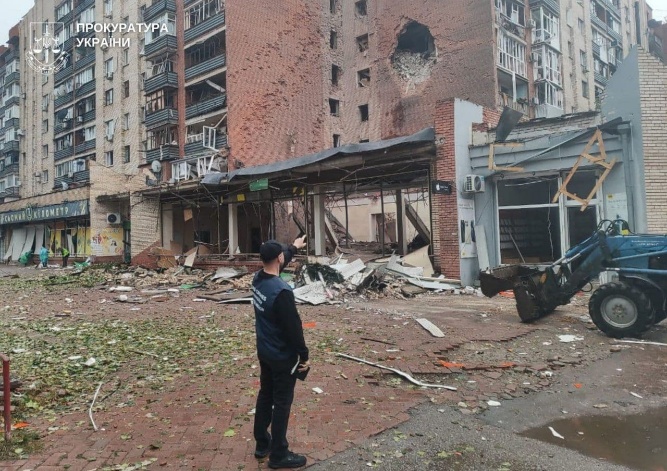
Damage to an apartment building in Sloviansk, Donetsk Oblast, following a Russian attack. (Donetsk Regional Prosecutor’s Office/Telegram)
This was the 1,320th day of Russia’s full-scale invasion—a day when Moscow demonstrated its capacity for overwhelming firepower, when Slovakia’s leader declared peace mattered more than victory, and when Cuba’s hidden contribution to Russia’s war was finally quantified at up to 5,000 fighters.
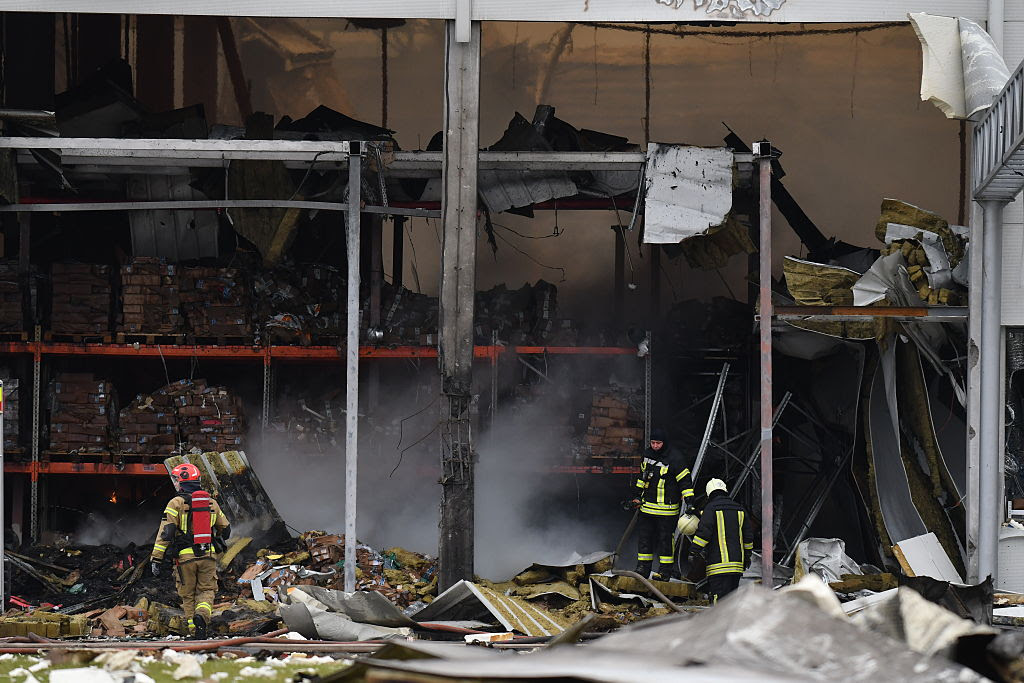
Firefighters put out a fire in Lviv, Ukraine. The city and oblast were attacked by Shahed drones and cruise missiles. As a result of the Russian strike, part of the city was left without power. (Mykola Tys/Global Images Ukraine via Getty Images)
The Inferno Over Lviv: 549 Projectiles in One Night
The assault began at 4:30 a.m. local time with Shahed strike drones. At 5:22 a.m., Kalibr cruise missiles launched from the Black Sea struck the city. Then, at 6:00 a.m., came the Kinzhals—aeroballistic missiles fired from MiG-31 fighters capable of traveling at hypersonic speeds.
The Ukrainian Air Force reported Russia had launched 53 missiles and 496 drones in a coordinated strike that targeted Lviv, Ivano-Frankivsk, Zaporizhzhia, Chernihiv, Sumy, Kharkiv, Kherson, Odesa, and Kirovohrad oblasts. The missiles included two Kh-47M2 Kinzhal aeroballistic missiles from Lipetsk Oblast airspace, 42 Iskander-K/Kh-101 cruise missiles from Samara, Kursk, and Bryansk oblasts, and nine Kalibr cruise missiles from the Black Sea.
Ukrainian forces downed 439 drones, one Kinzhal missile, 32 Kh-101/Iskander-K cruise missiles, and six Kalibr missiles—478 targets in total. But eight missiles and 57 drones broke through Ukrainian air defenses, striking 20 locations across the country. Six additional missiles were “lost in location,” likely neutralized by Ukrainian electronic warfare interference.
Lviv Oblast bore the brunt of the assault. Regional Military Administration Head Maksym Kozytskyi reported that Russian forces had launched 140 Shahed-type drones and 23 cruise missiles against the oblast specifically—the largest attack on the region since February 2022. Four civilians were killed, including an entire family with a 15-year-old girl. Eight others were injured. The Lviv Regional Prosecutor’s Office confirmed the family deaths.
Lviv Mayor Andriy Sadovyi reported that Russian strikes disrupted power supplies in the city and damaged the Sparrow civilian industrial park. “After the Russian strikes, several fires are still burning in the city, so it is important to protect yourself from possible harmful fumes and smoke,” Sadovyi warned residents. Two districts—Riasne and Levandivka—lost power completely. Public transportation shut down entirely due to the attack.
President Volodymyr Zelensky called the assault another example of Russian terror against civilians and critical infrastructure. “More protection is needed, faster implementation of all defense agreements, especially regarding air defense, to deprive this aerial terror of any meaning,” Zelensky stated. “A unilateral ceasefire in the sky is possible, and it could open the way to real diplomacy.”
In an afternoon address on October 5, Zelensky emphasized that Russia was “laughing at the West” as allies failed to issue strong responses to the attack. He called for stricter export controls after highlighting that 100,000 foreign-made components had been used in the latest drone attack, including parts from the UK, US, Germany, and Switzerland.
Ukrainian state-owned gas operator Naftogaz Board Chairman Serhiy Koretskyi noted on October 5 that Russian strikes against Ukrainian energy infrastructure were a deliberate attempt to deprive Ukrainian civilians of heating ahead of Winter 2025-2026. Gas transportation infrastructure had been among the main targets as temperatures dropped and the heating season neared.
Ukrainian Air Force Spokesperson Yuriy Ihnat stated on October 5 that Russia had modified its ballistic missiles to fly on quasi-ballistic trajectories and approach targets from multiple directions, decreasing the effectiveness of Ukraine’s Patriot air defense systems.
In Zaporizhzhia City, at least one person was killed and at least 10 were injured. Russian forces fired drones and aerial bombs at the city, hitting an industrial enterprise and residential buildings. A major energy facility was damaged, cutting off power to a significant number of consumers in the city and surrounding region.
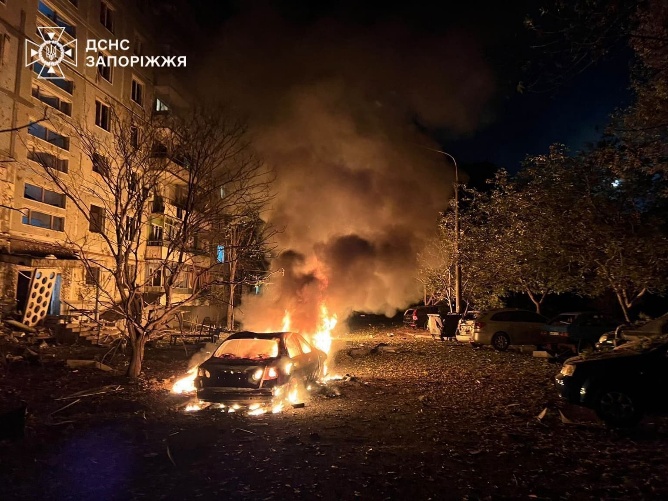
A destroyed residential area after a mass attack on Zaporizhzhia. (Volodymyr Zelensky/Facebook)
In Kherson Oblast, a 77-year-old man was killed by Russian shelling. In Vinnytsia, a Russian attack hit an industrial civilian facility with no injuries reported. Power supply in Sumy and Chernihiv oblasts remained unstable with hourly power outage schedules in effect.
Over the past day, Russian forces had carried out 702 strikes across 18 settlements in Zaporizhzhia region, including one missile strike, 13 airstrikes, 430 UAV attacks (mostly FPV drones), four MLRS attacks, and 254 artillery strikes. Authorities received 89 reports of damage to homes, vehicles, and infrastructure.
Chinese reconnaissance satellites reportedly flew over Lviv during the attack, though it was unknown whether these satellites conducted actual reconnaissance during their flights over Ukraine.
Putin’s Tomahawk Warning: Linking Missiles to Diplomacy
Russian President Vladimir Putin issued a calculated warning to Washington on October 5: Send Tomahawk missiles to Ukraine, and watch the “emerging positive trend” in US-Russian relations collapse.
“The supply of long-range missile systems, including Tomahawks, to Ukraine will lead to the destruction of the emerging positive trends in relations between Russia and the United States,” Putin told Russian TV propagandist Pavel Zarubin.
The statement came after US Vice President JD Vance confirmed on September 28 that the US was “looking at” providing Kyiv with Tomahawk missiles, which have operational ranges between 1,600 and 2,500 kilometers. This would represent a significant boost for Ukraine’s arsenal, which largely relies on drones for long-range strikes, and allow Kyiv to deliver powerful blows deep into Russian territory.
Putin’s message reflected his continuing attempts to deter the US from providing Ukraine with weapons that could strike Russia’s rear areas with precision. The Kremlin was attempting to prevent the United States from providing Tomahawks to retain the sanctuary Russia enjoys in its rear. Ukrainian forces can conduct long-range drone strikes against significant portions of Russia’s rear, but drone payloads are limited and unsuitable for destroying specialized objects.
Ukraine’s ability to launch missile strikes deep into Russia with larger payloads would allow significant damage—if not destruction—of key military assets such as the Shahed drone factory in Yelabuga, Republic of Tatarstan, or the Engels-2 Air Base in Saratov Oblast from which Russia sorties strategic bombers that fire cruise missiles at Ukraine.
Russia has significantly scaled up Shahed drone production by expanding the Yelabuga factory, allowing increasingly large and frequent long-range drone strikes against Ukraine. Russia’s nightly strike packages in September 2025 featured an average of 187 long-range drones per night, whereas similar packages in January 2025 only featured an average of 83 drones. Russia notably started launching overnight strike packages that included over 500 drones more frequently in September 2025.
At least 1,945 Russian military objects are within range of the 2,500-kilometer variant Tomahawk and at least 1,655 within range of the 1,600-kilometer variant. Ukraine likely can significantly degrade Russia’s frontline battlefield performance by targeting a vulnerable subset of rear support areas that sustain frontline operations.
Trump’s Nuclear Embrace: Accepting Putin’s Arms Proposal
US President Donald Trump on October 5 expressed openness to Russian President Vladimir Putin’s offer to voluntarily limit deployed strategic nuclear weapons. “Sounds like a good idea to me,” Trump told reporters when asked about Putin’s proposal.
Putin had proposed maintaining limits on the world’s two largest nuclear arsenals set by the New Strategic Arms Reduction Treaty (New START) if the United States does the same. The treaty, signed in 2010, is set to expire in February 2026.
New START set a limit of 1,550 deployed nuclear warheads and a combined total of 700 intercontinental ballistic missiles, submarine-launched ballistic missiles, and heavy bombers for each signatory. Russia had an estimated 5,580 nuclear warheads as of March 2024, including about 1,200 awaiting dismantlement—the largest stockpile in the world.
European Response: Kallas Calls Out Terror
EU foreign policy chief Kaja Kallas wrote on social media on October 5 that Russia was using “terror attacks” on Ukrainian civilians and infrastructure to cover up its failed summer offensive. Brussels would continue to finalize the next sanctions package, ensure financing, and provide weapons, she added.
Lithuania’s Foreign Minister Kestutis Budrys called for a total end of Russian oil and gas imports to Europe, writing that Europe was “feeding (Russia’s) imperial appetite.” While only Hungary and Slovakia continue to import Russian oil, the EU is the largest buyer of Russian liquified natural gas, despite Brussels’ pledge to wean itself off Russian energy by 2027.
Slovakia’s Fico: Peace Over Victory
Slovak Prime Minister Robert Fico stated during a televised debate on October 5 that Slovakia seeks a swift end to the war in Ukraine rather than Russia’s defeat. “The goal of the foreign policy of the Slovak Republic is not the defeat of the Russian Federation. Our goal is to end the war in Ukraine as soon as possible. These are Slavs killing each other. War is not a solution,” Fico said.
Fico criticized the European Union’s approach to Russia’s war against Ukraine, accusing the bloc of focusing on military aid instead of peace initiatives. “If the EU spent as much energy on peace as it does on supporting the war in Ukraine, the war could have been over long ago. I will never be a wartime prime minister,” he stated.
Since returning to office in 2023, Fico has ended military aid to Ukraine from Slovak army stocks and questioned EU sanctions on Russia. He has also vowed to block Kyiv’s entry into NATO and visited Moscow in December 2024, fostering closer ties with Russia both diplomatically and economically.
The Balkans Flashpoint: Dodik’s Warning
Former President of Republika Srpska Milorad Dodik claimed on October 5 that the United Kingdom, France, and Germany were planning to stage a “color revolution” in Serbia to destabilize and dismember the country. Dodik claimed that European officials were misrepresenting the recent spate of unidentified drone incursions into European airspace to discredit Russia and promote confrontation.
Dodik claimed the West was forcing Republika Srpska to hold illegitimate snap elections to undermine the US-backed Dayton Accords, which ended the 1992-1995 Bosnian War. Serbian President Aleksandar Vucic claimed on October 5 that NATO’s decision to require each member state to allocate five percent of their GDP to defense spending indicated the world was preparing for war, and stated that Serbia would like to avoid such confrontation.
Russia’s Foreign Intelligence Service recently claimed that European officials were preparing to stage a “color revolution” in Serbia, mirroring Russia’s rhetorical attempts to justify its invasions of Ukraine and aggression towards NATO members. Russia was likely leveraging its close relations with Serbia and Republika Srpska to threaten to destabilize the Balkans and undermine European cohesion.
Cuban Fighters: The Hidden Foreign Legion
Up to 5,000 Cuban fighters are actively participating in Russia’s invasion of Ukraine, Reuters reported October 5, citing an internal US State Department cable. “After North Korea, Cuba is the largest contributor of foreign troops to Russia’s aggression, with an estimated 1,000 to 5,000 Cubans fighting in Ukraine,” the cable stated.
The US circulated an unclassified October 2 cable sharing details about Cuba’s support for Russia’s war as part of its campaign to counter a United Nations resolution calling for Washington to lift its embargo on Cuba. The cable directed diplomats to urge foreign governments to oppose the resolution.
Moscow has been recruiting foreign fighters from countries such as Nepal, Somalia, India, and Cuba since the start of its full-scale invasion in 2022. Russia was offering generous payments and the promise of citizenship to Cuban fighters, despite Havana’s attempts to curb recruitment. Last year, the number of Cuban recruits was reported in the low hundreds. That figure has since grown to thousands.
According to Reuters, the US State Department declined to provide additional details on the Cuban fighters but said it was aware of reports that they were serving alongside Russian troops. Cuban fighters were being recruited due to generous payments and Russian citizenship offers. Ukrainian officials have recently warned US lawmakers about an uptick in Russia’s recruitment of Cuban mercenaries.
Cuba and Russia have maintained close ties since the Cold War. Cuba joined the Russian-led BRICS group as a partner country in October 2024.
The Eastern Front: Grinding Advances Continue
Russian forces continued offensive operations across eastern Ukraine on October 5, making incremental advances in several directions. In the Lyman area, geolocated footage published on October 4 indicated Ukrainian forces recently marginally advanced along the railway north of Yampil. Russian forces attacked multiple settlements northwest, north, northeast, east, and southeast of Lyman on October 4 and 5.
Russian forces conducted a FAB-3000 glide bomb strike against a bridge over the Siverskyi Donets River in Raihorodok on October 5, with geolocated footage showing a strike against a bridge just northeast of Raihorodok. An OSINT analyst reported that Russian forces built a makeshift bridge over the Zherebets River in the Lyman direction, allowing transfer of at least five tanks, one infantry fighting vehicle, and one self-propelled artillery system during windy weather that prevented Ukrainian reconnaissance drones from flying.
In the Siversk direction, the Russian Ministry of Defense claimed on October 5 that Russian forces seized Kuzmynivka. A Kremlin-affiliated milblogger claimed that elements of the Russian 123rd Motorized Rifle Brigade only recently seized Vyimka, refuting the Russian MoD’s claim that forces had seized the settlement in September 2024. The milblogger attributed the seizure to changes in Russian command, likely referring to the reported removal of commanders within the 3rd Combined Arms Army in late 2024 following false reports of advances. Russian forces attacked near Siversk itself and surrounding areas on October 4 and 5.
Slovyansk City Military Administration Head Vadym Lyakh reported on October 5 that Russian forces struck an apartment building and an art school in Slovyansk with three guided glide bombs on the night of October 4-5, injuring eight civilians, including a 13-year-old.
In the Kostyantynivka-Druzhkivka tactical area, geolocated footage published on October 3 indicated Russian forces recently advanced in southern Volodymyrivka. Russian forces conducted offensive operations in multiple areas on October 4 and 5.
In the Pokrovsk direction, Russian forces conducted offensive operations near and within Pokrovsk itself and surrounding areas on October 4 and 5. A spokesperson of a Ukrainian airborne assault corps operating in the Pokrovsk direction reported that Russian forces cannot conduct frontal assaults and are instead trying to strike Ukrainian ground lines of communication and attack from the flanks near Kotlyne and Rodynske.
Russian forces continued offensive operations in northern Sumy Oblast on October 5 but did not advance. Russian forces attacked southwest of Glushkovo near Tetkino; northwest of Sumy City near Bezsalivka; and north of Sumy City near Oleksiivka and Varachyne on October 4 and 5.
A Russian milblogger reportedly affiliated with the Russian Northern Grouping of Forces claimed on October 5 that Ukrainian drone strikes were impeding Russian attempts to transport infantry in small boats across the Filinshchyna River in Kindrativka to create a bridgehead. The milblogger claimed Russian forces committed elements formed from Strategic Missile Forces personnel to reinforce elements of the Russian 30th Motorized Rifle Regiment attacking near Oleksiivka, indicating Russian forces lack infantry reserves. The milblogger claimed that elements of the Russian 106th Airborne Division had been operating near Yunakivka for roughly two months without rotation or evacuation, that Russian companies with 20 to 30 servicemembers were considered at strength, and that newly arrived servicemembers were often severely wounded.
Ukraine’s Northern Group of Forces reported that Russian commanders were ordering subordinates to fire on civilians in and near Kupyansk.
An analyst in a Ukrainian battalion operating in the Kharkiv direction reported on October 5 that the Russian military command recently deployed drone crews of the Rubikon Center for Advanced Unmanned Technologies and electronic warfare systems to the battalion’s area of responsibility, and that the Rubikon drone operators’ goal was to disrupt Ukrainian ground lines of communication.
The Meaning of October 5: When Terror Becomes Strategy
October 5, 2025, revealed the war’s brutal arithmetic with unprecedented clarity. Russia demonstrated its capacity for overwhelming firepower—549 projectiles launched in a single coordinated strike that killed civilians, destroyed infrastructure, and plunged entire regions into darkness. Putin dangled the prospect of improved relations with Washington while threatening consequences if America provided weapons that could genuinely threaten Russia’s sanctuary in its rear. Trump endorsed Putin’s nuclear arms proposal without hesitation.
The day showed how Russia was weaponizing winter itself, systematically targeting energy infrastructure as temperatures dropped. European allies issued statements and explored sanctions packages. Slovakia’s prime minister declared that ending the war mattered more than victory. Cuba’s hidden contribution to Russia’s war was finally quantified—up to 5,000 fighters reinforcing Russian lines alongside North Korean troops.
The accumulated weight of 1,320 days of war became visible in the family of four killed in Lviv, in the 100,000 foreign components found in Russian drones, in the Chinese satellites flying over Ukraine during the attack, and in the makeshift bridge that allowed Russian tanks to cross rivers during windy weather. Russian forces were committing Strategic Missile Forces personnel to infantry roles, indicating severe manpower shortages. Companies with 20 to 30 servicemembers were considered at strength. Newly arrived personnel were often severely wounded.
The question wasn’t whether Russia would continue these tactics—October 5 demonstrated they would. The question was whether the international community would provide Ukraine with weapons capable of striking the sanctuaries from which these attacks originated, or whether political calculations and promises of improved relations would preserve Russia’s ability to rain fire on Ukrainian cities with impunity.