
As Putin stood before his generals declaring unstoppable progress, Russian investors fled, fuel pumps ran dry, and airliners in Europe aborted landings under drone threat — a single day that revealed how far his theory of victory had drifted from reality.
When Propaganda Collides With Reality
October 8, 2025 — the 1,323rd day of Russia’s war against Ukraine — laid bare the contradiction at the heart of Putin’s campaign. That morning, he stood before his generals, promising unstoppable momentum and inevitable victory. Yet outside the gilded halls of the Kremlin, Russia’s stock market was tumbling to three-year lows, gas stations were rationing fuel, and investors were fleeing. It was a day when illusion met exhaustion — twenty-four hours that exposed the widening gap between what Putin claimed and what Russians could no longer ignore.
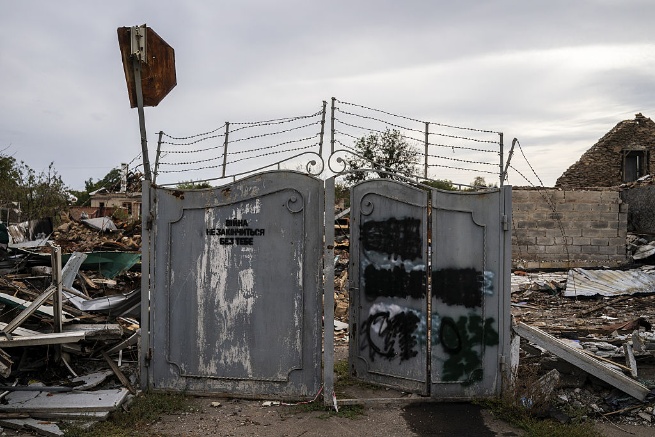
A general view of damaged areas after a Russian airstrike on Druzhkivka, Donetsk Oblast. (Jose Colon/Anadolu via Getty Images)
The Speech That Markets Didn’t Believe
In St. Petersburg, beneath the chandeliers of a marble conference hall, Vladimir Putin gathered his top brass on October 7 — defense chiefs, intelligence head Alexander Bortnikov, and the commanders leading Russia’s sprawling front lines. Cameras rolled as he proclaimed inevitable triumph. Russia, he said, had seized 4,900 square kilometers in 2025 — “roughly the size of Delaware.” Ukrainian forces, he claimed, were falling back everywhere. The defense industry was humming. The war would continue “until all objectives are achieved unconditionally.”
Beside him, Chief of the General Staff Valery Gerasimov nodded and echoed the refrain: Russian troops were advancing “in practically all directions.” It was classic Putin — the choreography of strength, the denial of weakness, the certainty that Russia’s endurance alone would grind down Ukraine and outlast the West.
But outside that ornate chamber, the façade was already cracking. Independent analysts put Russia’s territorial gains not at 4,900 square kilometers but 3,561 — about 27 percent less than Putin’s boast. The familiar pattern played out again: inflate the map, erase the losses, and claim that victory was inevitable.
By the next morning, the markets rendered their own verdict. The MOEX Russia Index plunged 4.05 percent — its lowest since September 2022. Gazprom fell 4.1 percent, Sberbank 4.9, VTB 4.7, Rosneft 2.5, Severstal 4.9, and Aeroflot 5. Rostelecom, Inter RAO, and Magnitogorsk Iron and Steel Works each lost more than 5 percent; mining giant Mechel tumbled 6.7. The cause wasn’t battlefield news — it was politics.
That same day, Deputy Foreign Minister Sergei Ryabkov admitted what investors had long feared: U.S.–Russia relations were “cracking and collapsing.” The “strong momentum” from Trump’s Alaska summit, he said, was “largely exhausted.” In trying to pressure Washington with threats, the Kremlin had accidentally told the truth — the war wouldn’t end soon, sanctions weren’t lifting, and Russia’s pain was far from over.
For many analysts, the moment crystallized the question haunting the Kremlin’s war machine: how long could Russia wage a war of attrition when its markets were crashing, its fuel supplies faltering, and its propaganda growing thinner by the day?
The Nuclear Card: Turning Treaties into Threats
While Putin was boasting of progress on the battlefield, his government was playing a subtler game — one that unfolded not in trenches but in parliament. On October 8, the Russian State Duma voted to denounce the Plutonium Management and Disposition Agreement (PMDA), moving Moscow closer to a formal withdrawal from a treaty Putin had already shelved back in 2016.
The PMDA, signed in 2000 and entering force in 2011, had once symbolized trust — a promise by both the United States and Russia to dispose of at least 34 tons of weapons-grade plutonium left from the Cold War’s nuclear stockpiles. But now that symbol was being repurposed into leverage. The Duma’s official explanation blamed “anti-Russian steps” by Washington that had supposedly “changed the strategic balance” and created “threats to stability.”
Deputy Foreign Minister Sergei Ryabkov doubled down, calling continued adherence to the treaty “unacceptable” and “inappropriate.” He insisted that U.S. conditions for resuming the pact were impossible because “the situation has radically changed.” With practiced deflection, he accused Washington of filling a “graveyard” of arms-control agreements through its own “destructive policies.”
The real intent surfaced in the fine print — and in the smirks of Duma deputies. Senior lawmaker Vyacheslav Nikonov suggested the deal could always be revisited if Washington “behaves well,” a phrase that in Moscow’s code meant give us concessions on Ukraine. Others dropped the pretense. Alexei Zhuravlev of the Defense Committee said only fools would honor outdated treaties while the West “provokes an arms race.” Speaker Vyacheslav Volodin added bluntly that those who sought to “exploit Russia must understand this is not possible.”
The pattern was unmistakable. Russia had already walked away from the Intermediate-Range Nuclear Forces Treaty in August 2025 — a deliberate revival of old threats to squeeze Washington. By pairing withdrawals like the INF and PMDA with an offer to extend the New START treaty for a single year, the Kremlin was mixing intimidation with bait, trying to lure the U.S. into talks on Moscow’s terms.
This time, the immediate aim was narrower but sharper: to block U.S. sales of Tomahawk cruise missiles to Ukraine. On October 8, Kremlin outlets claimed such weapons would require “direct U.S. participation” in strikes — a signal meant to frighten Western policymakers. State newswire TASS amplified that the Duma’s ratification of a new military cooperation pact with Cuba was a “symmetrical response,” even floating the idea of sending Iskander and Oreshnik missiles to the island.
A meeting that same day in Minsk between Belarusian Defense Minister Viktor Khrenin and Cuban Chief of the General Staff Roberto Legra Sotolongo lent the bluff a veneer of credibility.
In truth, Moscow’s withdrawal from the PMDA wasn’t about plutonium at all. It was about pressure — part of a campaign to convince the world that U.S.–Russian relations were entering a “dangerous stage,” to draw Washington’s focus away from Ukraine and back into the old arms-control dance. It was classic Putin: turning the very treaties meant to reduce nuclear peril into bargaining chips for territorial gain.
Fuel Lines and Frustration: The Home Front Cracks
By early October, even Vladimir Putin couldn’t ignore that Ukraine’s war was reaching deep into Russian soil. He admitted on October 7 that Ukrainian drones were striking refineries across the country—but brushed it off with a shrug: the attacks, he said, “will not help.” His promise to “protect civilians and energy infrastructure” sounded hollow as fuel pumps across Russia began to run dry.
The numbers told the truth his speech avoided. Industry sources told Reuters that Belarus had quietly quadrupled its rail shipments of gasoline to Russia in September—nearly 49,000 tons of fuel and another 33,000 tons of diesel. The onetime energy superpower was now relying on its smaller neighbor to keep cars moving.
By October 7, rationing had spread like a contagion. Tyumen and Sverdlovsk oblasts became the third and fourth regions to impose fuel limits, following earlier restrictions in Crimea and Chelyabinsk. Drivers in Tyumen found 30-liter caps at N-1 stations, and premium gasoline was suddenly available only for customers with special fuel cards. In Sverdlovsk, some Lukoil outlets stopped selling gasoline in cans altogether, while Bashneft stations ran out of regular fuel entirely, leaving only diesel. Others, like Tamic Energy and Varta, enforced the same 30-liter rule. Officials denied shortages, but the growing lines at pumps spoke louder than press releases.
Even loyal pro-Kremlin voices began to break ranks. A prominent military blogger accused the government of leaving refineries defenseless and revealed that Ukrainian drones were striking with surgical precision—hitting electrical desalting units and atmospheric-vacuum tubes, the beating heart of Russia’s refining system. The same blogger warned that refineries as far as 2,000 kilometers from the front were vulnerable, calling it “madness” to shift protection duties onto private companies.
By week’s end, Ukraine’s drone and missile campaign was showing tangible results: gasoline shortages, surging prices, and mounting anger in a country built on oil wealth. Putin’s confident remark that the strikes “will not help” now sounded less like defiance and more like denial—as millions of Russians waited in longer lines for smaller rations of their own fuel.
The Troop Shuffle: Reorganizing the Front
Across the battle maps of eastern Ukraine, quiet movements often tell the loudest stories. On October 8, open-source analysts spotted one of them — a significant redeployment inside Russia’s command structure. Elements of the 41st Combined Arms Army, including the 35th, 55th, 74th, and 137th Motorized Rifle Brigades, were pulling out from positions south of Pokrovsk and heading west toward Novopavlivka.
By that evening, the entire 90th Tank Division of the same army was operating near Novopavlivka and Ivanivka, while only fragments of the 15th and 30th Motorized Rifle Brigades and the 27th Motorized Rifle Division of the 2nd Combined Arms Army stayed behind south of Pokrovsk. The shift meant that nearly all of the 41st Army’s combat power was now concentrated in one place — a move designed to tighten coordination and simplify command.
Military observers read the redeployment two ways. Some saw it as rotation: worn-down units shifting to a quieter sector to rest and rebuild after months of grinding combat near Pokrovsk. Others believed it signaled preparation for a new offensive push. The area east and south of Novopavlivka had seen less action recently, but Ukrainian sources reported a sudden uptick in Russian attack tempo there. The concentration of tank and rifle brigades suggested Moscow might be preparing to flatten the Ukrainian salient, straighten the front line, and reduce the risk of counterattacks on its flanks.
There was also a broader tactical message. By thinning its forces south of Pokrovsk, Russia might be shifting away from costly frontal assaults and turning instead to a flanking strategy — surrounding the city from the north rather than battering straight through.
The shuffle looked clinical on paper — arrows and unit numbers moving across a map — but behind it lay the familiar rhythm of this war: exhaustion, recalculation, and a relentless search for some new angle of advantage.
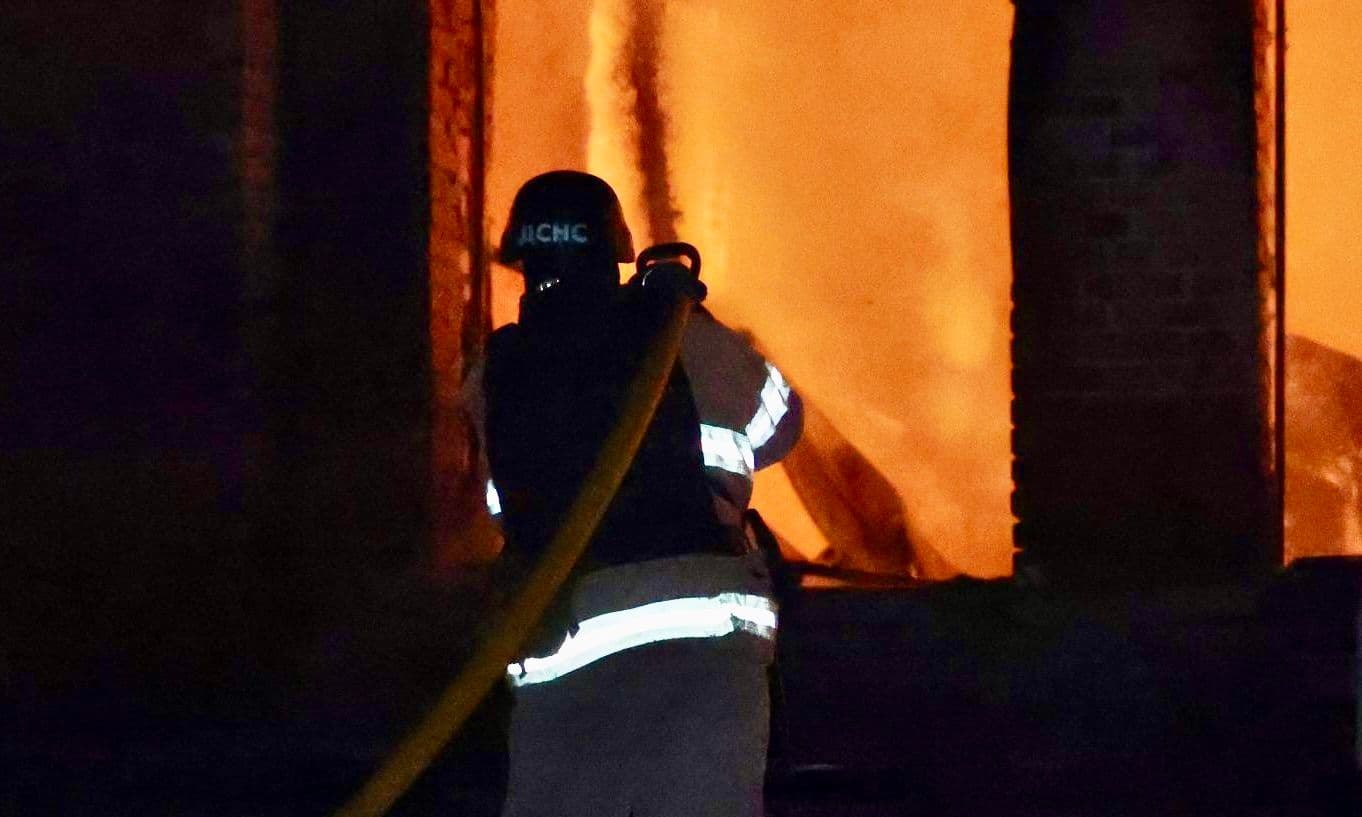
A Russian strike in Dnipropetrovsk Oblast, caused a fire. (State Emergency Service/Telegram)
Drones Over Europe: When GPS Fails and Nerves Tighten
What had long been the soundtrack of war over Ukraine — the hum of drones, the hiss of jamming — drifted westward into Europe’s skies on October 8. That morning, a Ryanair flight from Vienna to Vilnius was forced to abort its first landing when GPS interference suddenly scrambled the jet’s navigation system. The pilot circled, corrected manually, and landed safely on the second try. It was a brief disruption — but one that carried a chill. Russia’s invisible war in the air was spilling into NATO’s space.
In Belgium, the alarms sounded closer to ground level. Alain Quevrin, director for Thales Belgium, reported that drones had been flying over the company’s Liège facility — the only site in the country that assembles 70mm rockets used by Ukrainian forces. He said the flights had increased sharply in recent months. Officials stopped short of blaming Moscow, but the pattern was becoming impossible to ignore.
From Brussels, European Commission President Ursula von der Leyen spoke plainly: the incursions were “deliberate and targeted,” part of a campaign meant to unsettle European citizens. A few stray drones might be coincidence, she said, but “three to ten make a pattern.” Her warning captured a growing fear — that Russia was using small drones and invisible jammers not to win battles, but to sow doubt.
The tactics fit a playbook already familiar since 2022: drone incursions into civilian airspace, GPS jamming of commercial flights, and sabotage against defense plants supplying Ukraine. Each incident alone seemed minor; together they signaled something broader — an effort to make Europe feel vulnerable in its own skies.
In Bavaria, officials stopped waiting. On October 8, they approved new legislation giving local police the right to shoot down unidentified drones if they threatened public safety. The move came after several drone sightings had disrupted flights at Munich International Airport. “There is no need to panic, but there is cause for great caution,” said Bavarian Prime Minister Markus Söder. “Better to bring the drones down than to wait.” The bill would also create a new drone defense center for police in Erding, near Munich.
Analysts saw these incidents not as isolated acts but as part of “Phase 0” — the psychological groundwork of a longer campaign. By flooding Europe’s skies with uncertainty, Moscow wasn’t testing defenses so much as testing resolve. Every grounded plane, every false radar blip, every drone over a factory was a reminder: Russia could reach beyond the battlefield, and it wanted Europe to think twice before helping Ukraine any further.
The Battlefield: Grinding Forward, Losing Blood
On the ground, October 7 and 8 brought more of the same rhythm that has defined this war for months — a brutal back-and-forth measured not in miles but in meters. Russian troops attacked along nearly every stretch of the front, but most of their advances could be counted in the length of a football field.
In the north, near the border city of Sumy, Ukrainian troops clawed back a small piece of ground — one of the few confirmed territorial gains for Kyiv this month. Russian units nearby were running short on supplies and losing men fast, according to their own pro-war bloggers. Even seasoned paratroopers were reduced to what one called “attacking in herds,” advancing with little coordination or artillery cover.
Around Kharkiv and Kupyansk, Russia threw wave after wave of troops at Ukrainian defenses but gained almost nothing. The same story repeated across Lyman and Siversk — small skirmishes, heavy losses, and no breakthrough. Russian commanders increasingly relied on smaller assault teams of just a few soldiers each, hoping to slip through drone surveillance and pick their way into basements and trenches one at a time.
Farther south, near Pokrovsk and Novopavlivka, Russian attacks intensified, suggesting a push to straighten the front line and squeeze Ukrainian positions from the flanks. But here too, progress came at a high price. Military bloggers sympathetic to Moscow complained that many reinforcements were “older men who can’t walk fifteen kilometers with gear” and that morale was collapsing under constant Ukrainian drone fire.
Along the Zaporizhia and Kherson fronts, the picture barely changed. Russian forces continued daily strikes and small assaults but failed to make confirmed gains. Ukrainian defenses held, while Russia’s drones and missiles hit civilian targets and infrastructure far behind the lines.
Across hundreds of miles of front, the story was one of attrition without advantage — Russia trading men and machines for a few ruined villages, and Ukraine holding on through endurance and adaptation. The war was still moving, but only in slow, bloody circles.
The Drone War: A Night of Fire Across Ukraine
The night of October 7–8 brought one of the heaviest drone barrages of the war. From Bryansk, Kursk, and Crimea, waves of Shahed and Gerbera drones rose into the dark sky — 183 in all — and swept toward Ukraine.
Ukrainian air defenses managed to shoot down 154 of them, an 84% interception rate, but nearly two dozen broke through. They struck cities and power facilities in Chernihiv, Donetsk, Kharkiv, and Dnipropetrovsk oblasts, leaving more than 7,600 civilians without electricity. A thermal power plant owned by DTEK suffered serious damage, two workers were injured, and the government pleaded with citizens to conserve power as crews raced to stabilize the grid.
The attacks brought tragedy across the map.
In Kherson, three people were killed and fifteen wounded as explosions ripped through apartment blocks and houses.
In Donetsk, two died and ten were injured.
In Chernihiv, a fire department was struck.
In Kharkiv, drones and guided bombs hit several towns, injuring two.
And in Sumy Oblast, a four-year-old girl lay in critical condition after a strike on her home.
By evening, the assault on Sumy had turned into its own chapter of terror. Governor Oleh Hryhorov reported that Russian guided bombs and drones pounded six communities — Stepanivka, Mykolaivka, Velyka Pysarivka, Bilopillia, Komyshanka, and Sumy itself. Three men were killed; two others were badly wounded. Acting Mayor Artem Kobzar urged residents to take shelter as fresh waves of drones buzzed overhead and air-raid sirens echoed through the night.
The scale of the attack showed both Moscow’s persistence and its desperation — a blunt attempt to freeze Ukraine’s power grid and morale as winter approached. Yet even amid the blackouts, the vast majority of drones were stopped. The message from Ukraine’s skies was clear: the war had entered a new phase where endurance mattered as much as firepower.
The Diplomatic Chessboard: Fractures and Facades
As Russia’s stock market tumbled and its forces ground forward at ruinous cost, diplomacy on October 8 offered little relief. The day instead exposed a web of political cracks stretching from Washington to Vilnius to London—each revealing how divided the world remained over how to handle Moscow.
In Washington, Representative Anna Paulina Luna, a Florida Republican and vocal critic of U.S. aid to Ukraine, announced plans to meet with Russian envoy Kirill Dmitriev “to foster conversations of peace and trade.” Luna—aligned with the MAGA wing of Congress—said the two countries “do not need to be enemies” and that “allies in trade benefit everyone.” Her remarks drew immediate scrutiny because they came just hours after Russia’s Deputy Foreign Minister Sergei Ryabkov admitted that the so-called “momentum” from Trump’s earlier talks with Putin had “largely collapsed.” The contrast was striking: Moscow declared diplomacy dead even as an American lawmaker extended it a lifeline.
Across the Atlantic, Lithuania quietly downgraded security for exiled Belarusian opposition leader Sviatlana Tsikhanouskaya, a move that caught her team off guard and forced a temporary halt to operations. Officials insisted the threat level had lessened; critics saw fatigue in Europe’s once-fierce solidarity with those resisting authoritarian regimes on Russia’s doorstep.
Meanwhile in London, Ukraine’s ambassador and former commander-in-chief Valerii Zaluzhnyi took to Facebook to stamp out rumors that he planned to form a political party. He warned that any such claims were products of Russian disinformation meant to fracture Ukrainian unity. “I am not creating headquarters or political forces,” he wrote. “Elections have no place while the country is at war.”
Each episode revealed the same underlying tension: democratic societies straining to maintain focus as the war drags on. While Moscow worked to widen those fissures—with propaganda, contacts, and pressure—Kyiv’s allies showed how fragile unity can become when exhaustion sets in.
Economic Warfare: Sanctions, Shifts, and Survival
The war’s quiet front — the economic one — grew louder on October 8 as Europe tightened the screws and Moscow searched for escape routes.
In Brussels, EU ambassadors reached a breakthrough deal to phase out Russian gas and oil by 2028, the most ambitious energy cutoff since the invasion began. Most member states backed the plan, though Hungary and Slovakia continued to resist. The proposal now heads to ministers for a vote on October 20, where it must win support from 55 percent of EU countries representing 65 percent of the bloc’s population. If passed, each nation will be required to draft a roadmap to end Russian energy imports within three years — a direct challenge to Moscow’s most lucrative lifeline.
Even so, the details revealed how complicated that independence will be. EU officials are still debating how to verify the origin of liquefied natural gas (LNG) — a technical but vital issue, since Russian gas often slips into European markets under different flags.
While Europe looked for ways to shut Moscow out, Russia looked east. Reuters reported that traders were now asking Indian refiners to pay for Russian oil in Chinese yuan, a move that underscores Moscow’s growing dependence on Beijing. Indian Oil Corporation recently paid for two to three shipments this way, marking another quiet shift in the post-sanctions world where the yuan, not the dollar, is becoming Russia’s fallback currency.
Putin himself underscored that defiance in Tajikistan, where he arrived on October 8 to attend the Russia–Central Asia summit — despite an active International Criminal Court warrant for his arrest. Tajikistan, an ICC signatory, offered no explanation for ignoring it. Kremlin footage showed Putin descending the aircraft stairs and embracing President Emomali Rahmon, before heading into three days of meetings with Rahmon and Azerbaijan’s Ilham Aliyev. The trip served as a quiet signal: the Russian leader still moves freely where influence outweighs law.
Back in Kyiv, Ukraine fought a different kind of battle — one for economic survival through winter. Finance Minister Serhii Marchenko met with Matteo Patrone of the European Bank for Reconstruction and Development (EBRD) to secure financing for gas purchases that would carry Ukraine through the 2025–26 heating season. Russia’s escalating strikes on Naftogaz facilities have made the need urgent. Since 2022, the EBRD has provided nearly €1 billion in emergency funds to keep homes heated through four winters of war.
And on the home front, Ukraine showed signs of cleaning its own house. The country’s new Economic Crimes Bureau gathered major businesses and regulators in Kyiv, warning that the era of gray markets was over. Bureau chief Oleksandr Tsyvinsky said nearly 80 percent of iPhones sold in Ukraine were imported illegally, costing the state 20 billion hryvnias in lost revenue each year. Companies were told to come clean — to stop paying staff off the books and register employees properly — before investigators come knocking. Business Ombudsman Roman Waschuk called the effort “non-punitive but firm,” offering reform before crackdown.
From Brussels to Kyiv, the economic battlefield was shifting. Europe was cutting ties, Russia was rewriting them, and Ukraine was trying to build a cleaner economy in the middle of a war.
Political Theater and Repression Across Borders
October 7 revealed how the war’s shadow reaches far beyond Ukraine’s front lines — shaping politics, justice, and personal freedoms across Europe’s borderlands.
In Poland, a diplomatic balancing act unfolded. Ukraine’s Ambassador Vasyl Bodnar said Kyiv would not interfere in the case of a Ukrainian citizen detained by Warsaw at Germany’s request over alleged involvement in the Nord Stream pipeline sabotage. “This is simply a court case,” Bodnar said. “Everything depends on justice.” His restraint underscored how sensitive the investigation had become, even as Polish Prime Minister Donald Tusk reminded reporters that those who built Nord Stream 2 “should be ashamed,” not those accused of damaging it. Extraditing the suspect, Tusk added, would go against “Poland’s vital interests” — a clear signal of how deeply the pipeline remains a symbol of Europe’s split over Russia.
Across the border in Czechia, political winds shifted again. The populist ANO party, which recently won parliamentary elections, softened its earlier hostility toward the country’s ammunition initiative for Ukraine. Party leader Andrej Babiš, once vowing to cancel the program, now called it “a good idea in principle” and asked for greater transparency. Former defense minister Lubomír Metnar echoed him, saying ANO would not end the initiative but “review” it and possibly place it under NATO oversight. For Ukraine, it was a cautious relief — support not lost, but now filtered through politics.
In Moldova, the story tilted the other way. The pro-Russian Party of Socialists refused to recognize parliamentary election results, threatening protests if the Constitutional Court upheld them. Party leader Vlad Batrîncea alleged “violations and abuse of power,” while the ruling Action and Solidarity Party — which won just over 50 percent of the vote — prepared to continue Moldova’s push toward Europe. The Socialists vowed to “fight on all fronts — in the streets, in parliament, and on international platforms,” reviving the tension between Moscow’s orbit and the European path.
Meanwhile, in occupied Crimea, repression took a more personal form. Russian authorities began searching students’ phones for any sign of Ukrainian identity — banned apps, VPNs, even a Ukrainian-language keyboard. The searches, Ukraine’s Center for Countering Disinformation said, were “another tool of total control,” meant to root out not spies but culture itself. Families risked interrogation if their children’s phones revealed the wrong setting.
And inside Russia, the state’s reach extended further. A court in Tambov ruled to nationalize the assets of mobile operator Lanta, accusing its exiled owners, Alexander and Margarita Zaitsev, of “extremist activity” and funding Ukraine’s armed forces. The couple had left Russia in 2017, founding a non-profit in Bulgaria linked to opposition networks. Prosecutors claimed they backed the EuroMaidan movement and Alexei Navalny — accusations enough to erase their business overnight.
From courtrooms in Warsaw to classrooms in Crimea, the message was the same: power was tightening its grip. Allies debated how far to go in confronting Russia, while those living under Moscow’s shadow faced the full weight of its fear.
The Day’s Meaning: When Theory Meets Reality
October 8, 2025 — Day 1,323 of the war — laid bare the limits of Putin’s theory of victory.
He began the day boasting that Russian forces had seized 4,900 square kilometers. Independent analysts counted 3,561. Within hours, Russia’s stock market plunged to a three-year low, gas stations imposed new rationing, and even pro-Kremlin bloggers admitted that Ukrainian drones were striking deep into the country’s oil refineries. Putin conceded that the attacks had reached far inside Russia but insisted they “will not help.” For ordinary Russians waiting in line for fuel, the words rang hollow.
Diplomatically, Moscow’s moves looked desperate. The Duma’s withdrawal from the Plutonium Management Agreement and talk of missiles in Cuba were less strategy than spectacle — attempts to redirect attention from Ukraine toward arms-control brinkmanship. In Washington, Deputy Foreign Minister Sergei Ryabkov quietly acknowledged that the “momentum” from earlier U.S.–Russia talks had “collapsed,” an admission that rattled investors and underscored the Kremlin’s isolation.
Across Europe, the spillover grew harder to ignore. GPS interference forced a Ryanair jet to abort its landing in Lithuania. Drones hovered over defense factories in Belgium. Bavaria granted police authority to shoot them down. What began as hybrid warfare in Ukraine was now testing the nerves of civilians across NATO’s skies.
On the battlefield, Russia pushed forward in small, costly steps. Ukrainian forces clawed back ground near Sumy and Novomykolaivka, while Moscow rotated exhausted units and filled gaps with older, undertrained recruits. Each advance measured in meters, each loss in lives — the rhythm of a war stuck in slow motion.
In Brussels, the EU agreed to phase out Russian oil and gas by 2028, signaling that Europe’s patience was ending. Yet in Asia, India quietly paid for Russian oil in Chinese yuan, showing how sanctions were remapping the world’s trade routes. Putin’s arrival in Tajikistan, despite an active ICC arrest warrant, reminded observers that he still travels freely where influence outweighs law.
For Ukraine, the focus was endurance. Finance Minister Serhii Marchenko sought emergency financing to secure winter gas supplies, while new anti-corruption measures targeted billions lost to the black market. The country’s fight for survival now extended beyond the front — into energy, finance, and governance.
By nightfall, the pattern was clear: propaganda had outpaced reality. Putin’s theory — that time and resources would wear Ukraine and the West down — was colliding with a shrinking economy, fragile logistics, and a population starting to feel the weight of a forever war.
The fighting will continue. But after October 8, it’s harder for the Kremlin to pretend the strain isn’t showing — in the markets, at the pumps, and across the weary faces of those still waiting for victory to arrive.