
A day when Europe’s patience ran out, Putin’s excuses fell flat, and NATO moved from caution to confrontation.
October 9, 2025, marked a decisive shift in the trajectory of the war. In Brussels, the European Parliament voted overwhelmingly to authorize the shooting down of Russian drones and aircraft violating EU airspace—an extraordinary step signaling that Europe’s era of restraint was over. In Dushanbe, Vladimir Putin admitted that Russian air defenders fired the missiles that brought down an Azerbaijani airliner, twisting the truth to deflect blame. Meanwhile, NATO leaders discussed more aggressive engagement rules, and Ukrainian forces extended their reach deep into Russian territory, igniting gas plants and fuel depots. It was a day when diplomacy gave way to deterrence, and when the continent that had endured nearly four years of war decided that words alone would no longer be enough.
When Parliament Says “Enough”
The European Parliament’s patience with Russian provocations finally snapped. Lawmakers voted overwhelmingly to authorize the shooting down of unauthorized drones and aircraft violating EU airspace—transforming cautious diplomatic protests into a concrete military mandate. In one vote, Europe shifted from issuing warnings to preparing to act. Four hundred sixty-nine members said yes to using force against Russian threats, as NATO allies quietly weighed plans to arm reconnaissance drones along the Russian frontier. The divide between diplomacy and deterrence was closing fast.
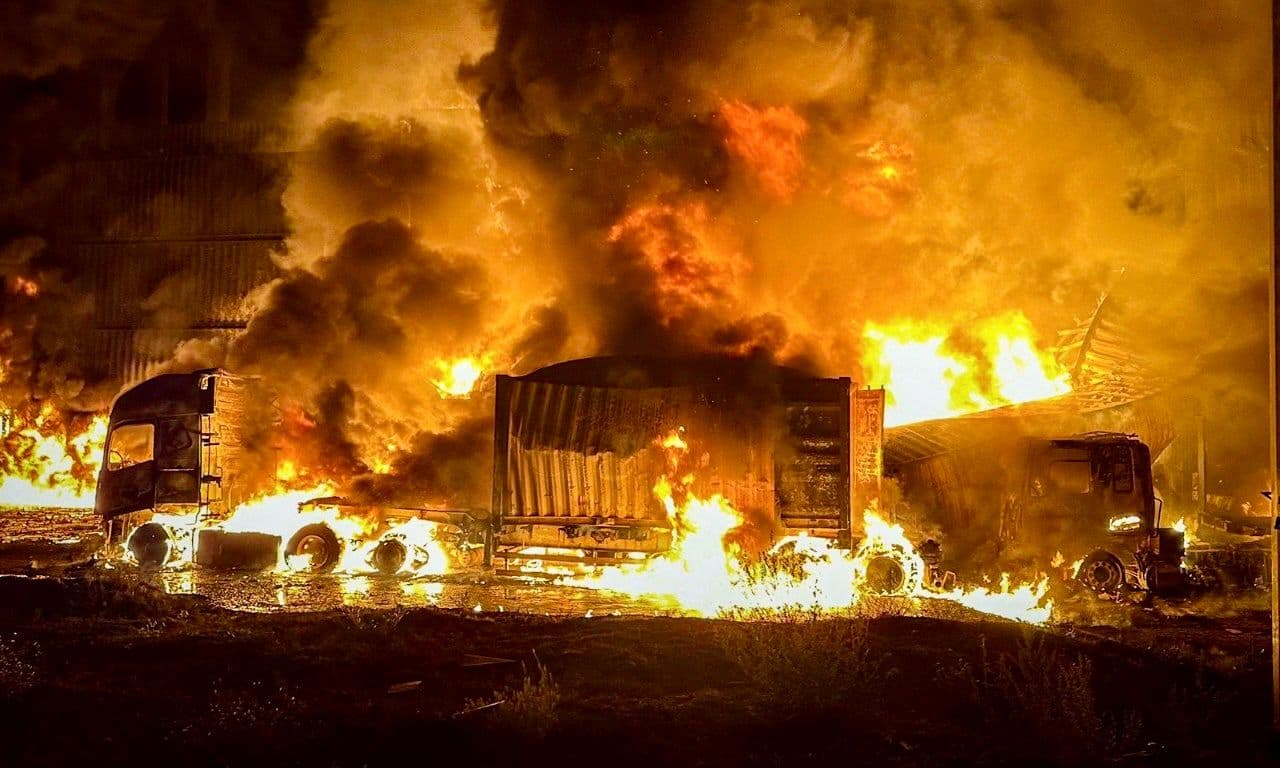
A Russian strike on port infrastructure ignited a fire in Odesa Oblast, Ukraine. (State Emergency Service/Telegram)
The resolution passed with 469 votes in favor, 97 against, and 38 abstentions—a decisive signal that Europe would no longer tolerate airspace violations over Poland, Estonia, Latvia, Lithuania, and Romania. Lawmakers condemned deliberate drone incursions targeting infrastructure in Denmark, Sweden, and Norway, though they notably omitted recent flights over Munich Airport that German officials had attributed to Russia.
The resolution urged EU states to take “coordinated, united, and proportionate action against all violations of their airspace, including by shooting down the threats.” It endorsed ambitious new security projects such as the EU’s “drone wall” and Eastern Flank Watch—initiatives that had seemed like futuristic ideas only months ago but now stood as practical responses to a mounting danger.
Members of Parliament also called for expanded sanctions against Chinese entities supplying dual-use goods vital to Russia’s drone and missile programs, and punitive measures against states abetting Moscow’s war—Belarus, North Korea, and Iran. The resolution went further than ever before, declaring that Russia’s sabotage and hybrid attacks across Europe amounted to state-sponsored terrorism, “even if they fall below the threshold of an armed attack.”
Yet the true significance of the day lay not in what the Parliament condemned, but in what it authorized. By explicitly encouraging member states to shoot down airborne threats, Europe crossed a historic line—from defensive restraint to active deterrence. Moscow’s campaign of intimidation through drone incursions and airspace violations would now face consequences measured in steel, not statements.
The Financial Times reported that NATO officials were already discussing stronger measures in response to Russia’s provocations. Proposals included arming intelligence-gathering drones, easing restrictions on pilots’ engagement rules, and expanding exercises near the Russian border. Two officials said talks aimed to standardize rules of engagement among member states—some of which still required visual confirmation before opening fire, while others permitted radar-based or threat-probability responses.
It was the clearest signal yet that NATO was no longer debating whether to respond to Russian aggression, but how fast and how forcefully to do it. After years of deliberate caution, Europe had decided that hesitation was now the greater danger.
Putin’s Non-Apology: Admitting Facts While Dodging Blame
In Dushanbe, Vladimir Putin delivered a masterclass in admitting facts without accepting fault. Meeting with Azerbaijani President Ilham Aliyev, the Russian leader finally conceded what had long been undeniable: Russian air defenders had fired two missiles at an Azerbaijan Airlines passenger jet in December 2024, causing it to crash in Kazakhstan and killing 38 of the 67 people aboard.
Putin offered what sounded like contrition but was, in reality, choreography. He expressed regret that the tragedy had “occurred in Russian skies,” a phrase crafted to sound remorseful while deflecting responsibility. He blamed a “Ukrainian drone” as the first cause and a “technical failure” of a Russian air-defense system as the second. He confirmed that Russian forces launched the missiles yet insisted they did not strike the aircraft directly—claiming they “perhaps” self-detonated nearby.
It was classic Putin deflection: admit enough to seem truthful, twist the rest to shift blame. The Ukrainian drone became the scapegoat; the missile crews became victims of equipment malfunction; the explosion that destroyed a civilian airliner became an unfortunate accident.
Putin even explained how proximity fuses work—how surface-to-air missiles detonate automatically when they approach a target—thereby confirming, almost inadvertently, that Russian weapons brought the plane down. But by cloaking the admission in technical jargon, he attempted to transform culpability into misfortune.
The Kremlin claimed it had been tracking three Ukrainian drones that day and that Putin had only learned “the full details” two days earlier. Russia, he said, would take “all necessary steps” toward compensation once its investigation concluded. Aliyev, maintaining diplomatic decorum, thanked Putin for “personally overseeing” the inquiry. The two presidents performed a ritual of reconciliation both knew was largely theatrical.
The episode came after months of rising tension between Baku and Moscow. Russian drones had targeted Ukrainian sites tied to Azerbaijani companies, while Azerbaijan retaliated by shuttering Russian propaganda outlets, canceling cultural events, detaining Russian citizens, and accusing Russian police of torturing two Azerbaijani nationals who later died in custody.
The Dushanbe meeting was thus less confession than damage control—a reluctant acknowledgment offered only when denial became untenable. Putin admitted just enough to halt diplomatic collapse, not enough to accept guilt. It was an apology forced by circumstance, not conscience.
The Kremlin’s Cuban Missile Crisis Redux
The Kremlin spent the day reviving the ghosts of 1962. In a bid to deter Washington from supplying Tomahawk missiles to Ukraine, Russian officials warned that the world could once again face a “Cuban Missile Crisis.” The message was clear: if the United States armed Kyiv with long-range weapons, Russia could respond by placing its own missiles near American shores.
First Deputy Chair of the State Duma Defense Committee Alexei Zhuravlev referenced Moscow’s recent military cooperation pact with Cuba, hinting that Russian missiles could soon appear on the island. Other officials suggested that Iskander or Oreshnik ballistic systems might be stationed there—an echo of Cold War brinkmanship meant to unsettle American policymakers and dramatize Russia’s fading leverage.
It was classic information warfare wrapped in historical theater. By invoking the memory of the 1962 confrontation that nearly brought the world to nuclear war, the Kremlin sought to frame future Tomahawk strikes as not Ukrainian actions but direct U.S. aggression. The tactic was psychological—an attempt to make Washington hesitate, to remind it of how the Cold War once teetered on catastrophe.
But the bluff revealed weakness, not strength. In 1962, the Soviet Union was a superpower capable of projecting global force. In 2025, Russia was struggling to hold territory in Ukraine, its economy battered by sanctions and its fuel production collapsing under Ukrainian strikes. Threatening missile deployments in Cuba—thousands of kilometers from the front—was a gesture of desperation, not dominance.
Zhuravlev admitted that the West was unlikely to “embrace reconciliation,” claiming U.S.–Russian relations under President Trump had fallen back to the frost of the Biden years. Kremlin spokesperson Dmitry Peskov spoke of a “serious pause” in dialogue, complaining that Moscow still awaited a reply to Putin’s offer to extend the New START Treaty beyond its February 2026 expiration. Deputy Foreign Minister Sergei Ryabkov reinforced the same narrative, asserting that communication stalled after Foreign Minister Sergei Lavrov’s meeting with U.S. Secretary of State Marco Rubio in late September.
The pattern was unmistakable. Moscow was staging a coordinated information campaign: threaten missile deployments, lament the breakdown of diplomacy, and portray the West as the reckless party driving a return to Cold War hostility. Each statement was crafted to pressure Washington and reassure Russian audiences that confrontation, not collapse, defined their nation’s role in the world.
Zelensky’s Shadow Fleet Revelation and Diplomatic Moves
President Volodymyr Zelensky revealed new intelligence linking Russia’s shadow oil fleet to recent drone incursions into European airspace. He said the clandestine network comprises more than 500 tankers, many operating under false flags, and confirmed that Russian special services were aboard the Borocay—a tanker seized by French authorities off the coast of France on October 1.
The revelation connected Moscow’s long-running sanctions-evasion scheme to its hybrid warfare operations. Ships once thought to be part of Russia’s gray-market oil trade were now identified as dual-purpose assets—commercial by appearance, military by function. Zelensky said these vessels were being used to launch or control drones, gather intelligence on European infrastructure, and probe NATO’s air defenses.
The implications were chilling. With hundreds of tankers traversing international waters, even a fraction equipped for such missions could form a mobile strike and surveillance network stretching across Europe’s maritime borders. It was a reminder that the war’s front lines no longer stopped at Ukraine’s borders—they drifted on the sea, disguised as trade.
Zelensky also embarked on a series of diplomatic engagements aimed at preserving European unity. He held a phone call with Czechia’s newly elected ANO party leader Andrej Babiš, whose populist victory had raised concerns in Kyiv about a potential softening of Czech support. Babiš had previously questioned both continued military aid and Ukraine’s EU path.
According to Zelensky, the two leaders discussed Ukraine’s pursuit of peace through cooperation with the U.S., European partners, and allied nations. “Mr. Andrej noted the courage of the Ukrainian people in our struggle against Russian aggression,” Zelensky said, adding that both sides agreed to meet soon to define the contours of future cooperation.
In a parallel diplomatic front, Zelensky announced that Prime Minister Yuliia Svyrydenko would lead a high-level delegation to Washington in the coming days. The team—joined by Andriy Yermak and Vladyslav Vlasiuk—would address key priorities: air defense systems, energy security, peace negotiations, sanctions expansion, and the fate of frozen Russian assets.
The trip came just as President Trump had approved new NATO-coordinated military support and signaled potential delivery of Tomahawk long-range missiles to Ukraine. “I believe President Trump wants us at the negotiating table,” Zelensky said, “and I believe our meeting has helped him see that Russia is selling him a fiction it can no longer deliver.”
It was a day when Ukraine’s diplomacy and intelligence converged—revealing the hidden machinery of Russia’s war at sea, while strengthening alliances that may soon define the next phase of the conflict.
Strikes Deep in Russia: The Gas Plant Burns
Ukraine’s long-range strikes reached deeper into Russian territory than ever before. On the night of October 8–9, Ukrainian forces ignited fires at multiple energy facilities in Volgograd Oblast, showcasing expanding precision and audacity.
The Korobkovsky Gas Processing Plant in Kotovo—one of Russia’s largest natural gas and petroleum facilities—was struck first. With a yearly capacity of 450 million cubic meters of gas and 186,000 tons of light hydrocarbons, it stood as a cornerstone of southern Russia’s energy infrastructure. Ukrainian outlet Militarnyi reported that much of the plant’s production was destined for export, amplifying the strike’s economic impact far beyond its immediate damage.
A second target followed: the Efimovka Line Production Control Station, another Volgograd site serving key truck and pipeline routes with a throughput capacity of 50 million tons per year. Militarnyi identified it as a vital node in the Kuybyshev–Tikhoretsk oil pipeline, which channels exports to the port of Novorossiysk on the Black Sea. The twin attacks underscored Kyiv’s growing ability to identify and disable the logistical arteries sustaining Russia’s war economy.
President Zelensky later announced that Russia was suffering a gasoline shortage of 13–20 percent as a direct result of these strikes. For a country that once sought to freeze Europe through energy leverage, the irony was striking: Ukraine, once pleading for defensive arms, was now dismantling the engine of Russia’s own supply chain.
That same night, local reports indicated another attack further south. Drones targeted an oil depot in Matveyev Kurgan, Rostov Oblast, according to Astra and regional media. Video footage showed drones flying low over Neklinovsky District before a blast sent heavy black smoke billowing skyward. Rostov Governor Yury Slyusar said air defenses shot down three drones, yet the explosions still damaged nearby homes, vehicles, and facades.
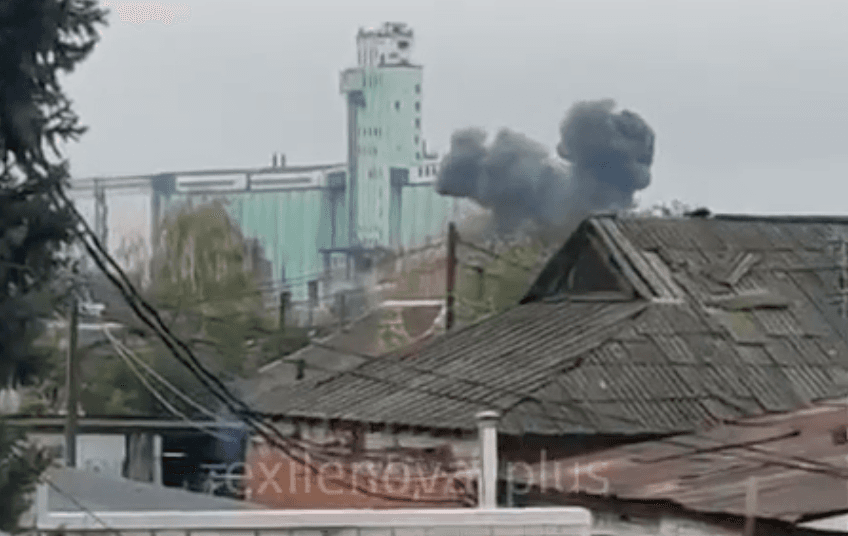
A still image from footage shared on social media showing a drone strike on the Matveyev Kurgan oil depot in Russia’s Rostov Oblast. (Exilenova+ Telegram channel)
The Matveyev Kurgan oil depot supplied both civilian and military sectors and maintained its own chain of fueling stations—making it a dual-use target whose destruction carried logistical and psychological weight. Ukraine did not confirm responsibility, but the message was unmistakable: nowhere inside Russia was beyond reach.
The Battlefield: Mashovets Reports and Tactical Shifts
Across Ukraine’s eastern front, the war moved by inches but carried the weight of exhaustion. Military observer Kostyantyn Mashovets described a battlefield where progress came not from sweeping assaults, but from constant probing—small units slipping through gaps, skirmishes erupting in ruined towns, and counterattacks fought street by street.
In the Kupyansk area, Russian troops continued their slow, grinding push, using small assault teams to infiltrate and entrench themselves behind Ukrainian lines. These units were difficult to detect and even harder to dislodge, forcing Ukrainian forces into an unending cycle of defense and counterattack. Drones hovered constantly overhead, guiding mortar fire and testing every weakness in Ukraine’s positions.
Farther south near Lyman, the pattern reversed. Ukrainian forces regained lost ground, pressing into contested areas that Moscow had already claimed as its own. The counterattacks showed that, despite relentless pressure, Ukraine retained the initiative and could still dictate the pace of battle.
Elsewhere, both sides traded minor advances and tactical blows—Ukrainian armor striking suddenly in the south, Russian troops inching forward in the east. The fighting had become a war of movement measured not in distance but in resilience, as each side tried to drain the other’s strength.
In towns like Kostyantynivka, Russian soldiers resorted to infiltration and deception, slipping behind lines disguised as civilians or hiding among the ruins. Ukrainian commanders called it what it was—perfidy, another reminder that for Russia, even the rules of war were expendable.
By day’s end, little territory had changed hands, but the balance of endurance continued to define the struggle. The front had become less about conquest than survival—a contest of stamina, innovation, and will.
The Drone War: Overnight Strikes and Casualties
The night sky over Ukraine burned again with the hum of incoming drones. Between October 8 and 9, Russia unleashed another massive wave of attacks—over a hundred drones launched from multiple directions across its border regions. Ukrainian air defenses worked through the night, intercepting most of them, yet several slipped through, striking cities and power infrastructure already battered by months of assault.
The attacks stretched from Odesa to Sumy, leaving at least 30,000 people without electricity. Fires lit up coastal districts after drones hit port facilities, warehouses, and homes. In Odesa, emergency crews fought flames sparked by explosions near a gas station and a port terminal. In Kherson and Sumy, civilian areas bore the brunt—houses shattered, lives lost, and neighborhoods plunged back into darkness.
Ukraine’s Air Force reported shooting down the majority of the drones, though the toll was still heavy: deaths in Kherson and Sumy, injuries across several regions, and fresh damage to a thermal power plant operated by DTEK, one of Ukraine’s main energy providers. The company described the overnight barrage as another strike not only on infrastructure but on the country’s morale.
By dawn, the debris of intercepted drones littered the streets of multiple cities—a familiar sight in a war now defined as much by persistence as by power. The rhythm of these nightly raids has become a kind of cruel punctuation, each explosion reminding Ukrainians that the fight for control of the skies remains as vital as ever.
War Crimes and Information Warfare
Ukraine’s Security Service uncovered another chilling act of brutality—one that captured the moral decay driving Russia’s war. Investigators identified a Russian commander who allegedly ordered his troops to execute three Ukrainian civilians at point-blank range as they tried to flee Kupyansk on October 2. According to the SBU, the soldiers had disguised themselves in civilian clothes before opening fire—an act of deception and murder that violated the most basic laws of war.
The crime fit a familiar pattern. From Bucha to Mariupol to the frontlines of the east, Russia’s commanders have blurred every line that international law was meant to protect. The shooting of unarmed evacuees was more than a single atrocity—it was a continuation of a campaign where terror itself has become a weapon.
Meanwhile, Moscow’s indoctrination machine continued to work behind the front. In occupied Henichesk, Kherson Oblast, first- and second-grade children were made to swear loyalty to a youth group called the Eaglets of Russia. The program, presented as civic education, carried the trappings of a military oath. Children learned “patriotic values” under banners bearing state symbols, marching and chanting in uniform. The organization was designed as the first step toward older militarized programs such as Yunarmia and the Movement of the First—a slow conditioning of childhood toward obedience and service.
The same day, Ukraine’s Security Service also pushed back against reports claiming it was investigating Oleksandr Klymenko, the country’s chief anti-corruption prosecutor. The agency confirmed that an investigation into a pro-Russian lawmaker was underway but dismissed suggestions that Klymenko was implicated. It was a reminder of how, even amid bombardment, information warfare continues—truth and rumor colliding in a battle for credibility.
In one day, Ukraine’s security agencies confronted the full spectrum of modern war: the brutality of occupation, the manipulation of children, and the propaganda that seeps into every open channel. It was a portrait of a conflict fought not only on battlefields, but across minds, schools, and screens.
Trump’s Contradictions: Finland and Nobel Dreams
At the White House, President Donald Trump met with Finnish President Alexander Stubb and declared that the United States would “vigorously” defend Finland if Russia ever attacked. When pressed by a Finnish reporter on what that meant in practice, Trump repeated the word—“vigorously”—without elaboration. It was classic Trump: confident, quotable, and vague all at once.
“They’re a member of NATO, they’re great people,” he said. “You have a very powerful military—one of the best—and certainly, we will be there to help.”
For Finland, the words mattered as reassurance, even if the details were missing. For Trump, they served a larger stage—an image of strength abroad paired with ambiguity at home. Stubb, for his part, expressed optimism, predicting that Ukraine would be Trump’s “next peace deal” once an Israel-Gaza ceasefire was complete.
The meeting was not only about rhetoric. The two leaders announced a joint plan to build eleven icebreaker ships—a rare, tangible outcome of U.S.-Finnish cooperation. Under the agreement, Finnish shipyards would construct four vessels, while seven would be built in the United States with Finnish technical assistance. The project aimed to reinforce Arctic security, counter Chinese and Russian influence, and demonstrate that shared interests could still produce results even amid global tension.
It was a moment of contrasts: Trump speaking in bold generalities while his administration quietly pursued practical defense partnerships. Between talk of peace deals and promises of “vigorous” defense, the day offered a glimpse of a presidency trying to balance performance with policy—and often blurring the line between the two.
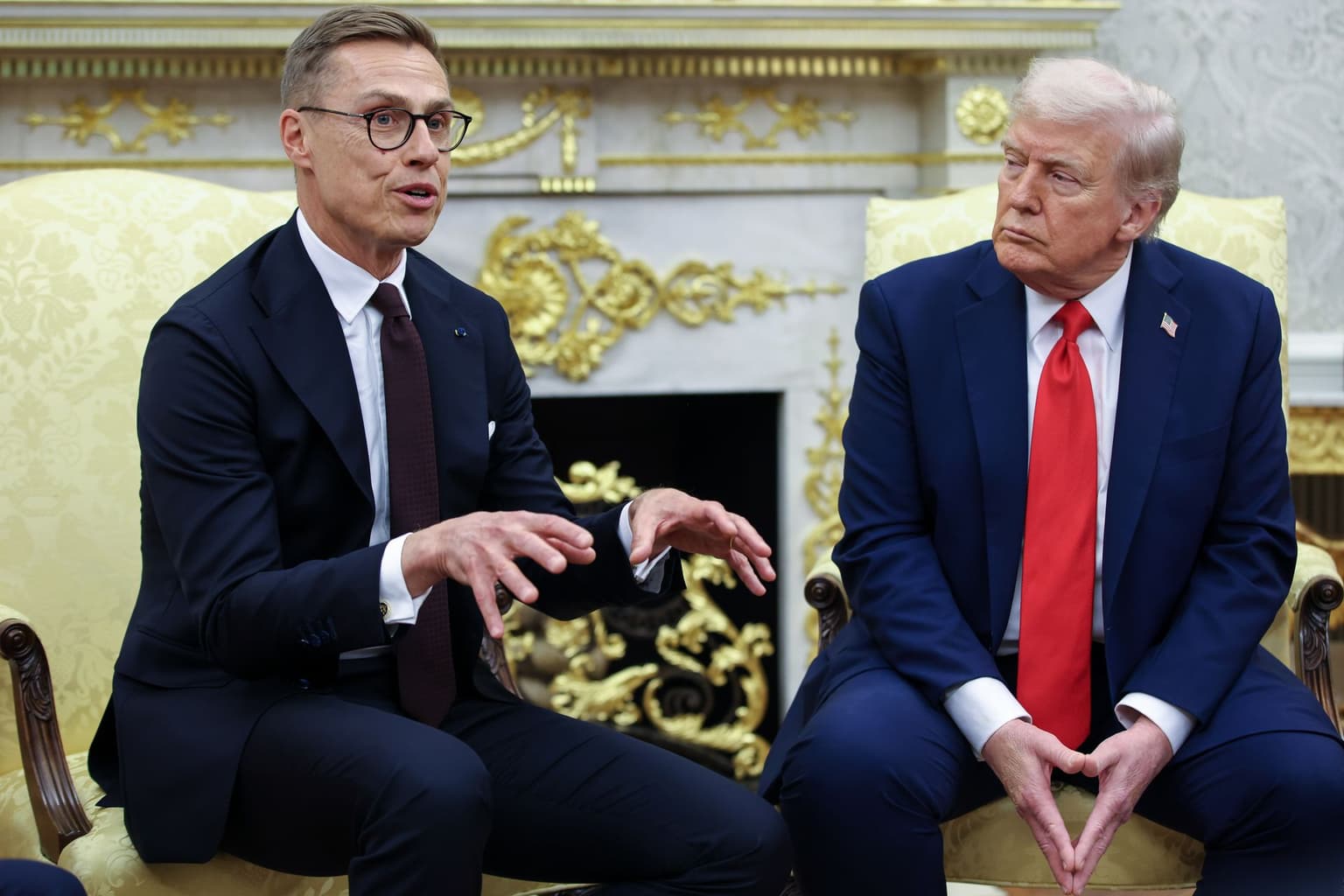
U.S. President Donald Trump meets with Finnish President Alexander Stubb in the Oval Office at the White House in Washington, D.C. (Samuel Corum/Sipa/Bloomberg via Getty Images)
The Economic Battlefield: Serbia, Oil, and Leverage
Falling oil prices dealt another quiet blow to Moscow’s war economy. On October 9, global energy markets reacted to a new ceasefire between Israel and Hamas, which eased fears of a wider Middle East conflict and reduced risk premiums on global fuel. The effect was immediate: Brent crude slipped to $65.22 a barrel and West Texas Intermediate to $61.51—small declines, but meaningful ones for a Russia already straining under sanctions and shrinking export revenue.
Analysts noted that the ceasefire, though far removed from Ukraine, indirectly undercut the Kremlin’s finances. Lower prices and stabilized shipping in the Red Sea meant fewer disruptions to Western supply routes and less profit for Russia’s heavily sanctioned oil sector. Each dollar lost per barrel eroded one of the few remaining lifelines funding the invasion.
In the Balkans, Serbia’s Naftna Industrija Srbije (NIS)—the country’s largest Russian-owned oil company—announced that its U.S. sanctions waiver had expired. Though the company claimed its operations would continue uninterrupted, the lapse symbolized Moscow’s fading reach in Europe’s energy landscape. Once a key foothold for Russian fuel influence, NIS now found itself operating on borrowed time.
Even as sanctions tightened, Serbia sought to preserve its delicate balance between Europe and Russia. Belgrade quietly sent 472 million rubles in “humanitarian aid” to Russia’s Kursk Oblast, a gesture Moscow celebrated as proof of “centuries-old brotherhood.” In truth, it exposed Serbia’s ongoing tightrope—aspiring toward EU integration while maintaining emotional and economic ties to its traditional ally.
In Brussels, the focus was on money of a different kind: Russia’s frozen assets. Belgium, which hosts the financial clearinghouse Euroclear, pushed for EU partners to share responsibility for a proposed 140-billion-euro reparations loan to Ukraine, funded by the profits of seized Russian funds. Prime Minister Bart De Wever warned that Belgium could not bear the risk alone should peace negotiations one day require those assets to be returned.
It was another front in the war’s global chessboard—where markets, sanctions, and frozen reserves shaped outcomes as decisively as any tank or missile. For Russia, every economic tremor now carried a strategic consequence.
The Day’s Meaning: When Authorization Becomes Action
Europe has crossed a line it can no longer retreat from.
The vote to authorize lethal defense against airspace violations was not simply another resolution—it was the moment Europe decided that deterrence now required action. What had once been cautious diplomacy has become open readiness to shoot down Russian drones, aircraft, and the illusion that Moscow can provoke without consequence.
The coming weeks will test how far that readiness goes. NATO discussions on arming reconnaissance drones, easing engagement rules, and conducting exercises near Russia’s borders suggest that authorization is already becoming preparation. What began as a policy debate is turning into military posture.
For Russia, the calculus has changed. The Kremlin’s reliance on intimidation, energy leverage, and psychological manipulation is colliding with a Europe that has learned from two and a half years of war. The drones that once crossed borders unchallenged may soon be met by missiles instead of memoranda. The shadow fleet that once operated in anonymity is being exposed as a tool of hybrid aggression.
Ukraine, for its part, is forcing that shift through momentum—precision strikes on Russia’s energy network, expanding partnerships abroad, and revealing the intelligence links that tie economic evasion to military threat. Every refinery that burns and every export route disrupted brings the war home to the aggressor.
The challenge ahead is one of follow-through. Authorization must turn into implementation—shared systems, unified response rules, and political will that does not fracture when the first Russian aircraft is shot down over Europe. Moscow will test that resolve. Its next provocations will not aim to conquer territory, but to divide democracies.
October 9, 2025, will be remembered not as the day Europe found its courage, but as the day it accepted its responsibility. The vote in Brussels marked the end of patience. What follows will determine whether that resolve can be sustained when deterrence becomes engagement—and when words give way to action.