
As the world watched for peace, Russia unleashed nearly 500 drones and missiles across Ukraine—turning the night sky into proof that its words of negotiation were only weapons by another name.
A Nation Wakes to Darkness
Dawn never really came on October 10, 2025. Across Ukraine, cities woke to darkness—streetlights cold, apartments silent, water pumps still. The night before, Russia had hurled nearly five hundred weapons through the air, a storm of drones and missiles that killed a seven-year-old boy, wounded dozens, and erased power for millions just as autumn began to sharpen toward winter. It was not random fury; it was intent made visible.
This was not a battle for land, but for endurance. Ukrainian air defenses intercepted most of the incoming swarm—420 of 497—but the seventy-seven that broke through struck what makes daily life possible: power stations, heating grids, water lines. The boy who died in Zaporizhzhia was not collateral damage; he was the quiet target of a doctrine built to freeze a nation into submission.
By morning, the contradictions of the wider world came into focus. In Tajikistan, Vladimir Putin spoke of peace. In Washington, Melania Trump announced the return of seven abducted Ukrainian children. And yet at that same hour, Russian drones were still burning through Kyiv’s sky. Words of reconciliation echoed against the sound of generators. The day proved again that Moscow’s diplomacy travels with missiles—and that its peace is spelled out in fire.
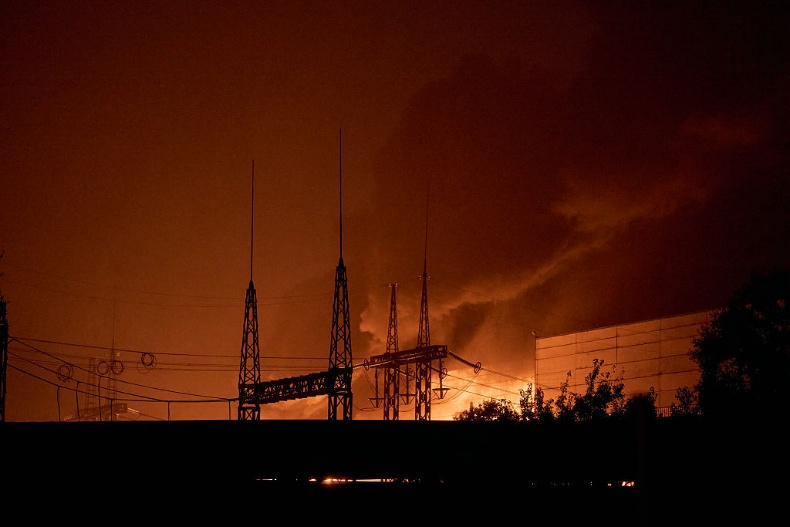
Flames rise over Kyiv as firefighters battle a blaze at a thermal power plant after a Russian Shahed-136 drone slammed into a residential building during the night assault. The attack left parts of the capital burning and half the city without power, a grim reminder that Russia’s war targets light itself. (Photo: Kostiantyn Liberov/Libkos/Getty Images)
The Arithmetic of Terror
Numbers told the story that diplomacy could not. In a single night, Russia launched nearly five hundred aerial weapons toward Ukraine—an arsenal drawn from every corner of its territory. Two Kinzhal aeroballistic missiles from Lipetsk, fourteen Iskander-Ms and twelve Iskander-K cruise missiles from Rostov, Bryansk, and occupied Crimea, four Kh-59/69s, and a staggering 465 drones—roughly two hundred of them Iranian-designed Shaheds—rose into the darkness. It was not a battle; it was arithmetic by annihilation.
Through the long night, Ukrainian air defenders fought physics itself—low cloud cover, freezing fog, and radar distortion carefully chosen to hinder them. Out of those 497 weapons, 420 were destroyed midair. One Kinzhal fell from the sky, as did nine cruise missiles and four Iskanders. Yet even that remarkable defense left thirteen missiles and sixty drones to find their marks at nineteen sites, their debris raining down on seven more.
The cost was immediate and human. In Kyiv, twelve were wounded—eight badly enough to require hospitalization—as the capital’s energy lifelines took direct hits. The entire left bank of the city fell dark; pumps failed, water vanished, six districts plunged into silence as emergency blackouts rippled outward through the oblast. Across Ukraine, the same pattern repeated like an old melody of terror: Poltava saw more than sixteen thousand homes without power; Kyiv itself counted 5,800 apartment buildings suddenly cold and unlit.
By morning, President Volodymyr Zelensky stood before reporters, the weariness of calculation in his voice. The attack, he said, had been timed to the weather—a night of low visibility, with temperatures near four degrees. The storm had not been random; it had been engineered. “They knew,” Zelensky said, estimating that fog and wind had reduced interception rates by nearly a third—precisely the margin Russia needed to turn winter into a weapon.
The symbolism was unmistakable. October 10 marked three years to the day since Russia’s first great strike on Ukraine’s energy grid in 2022. Foreign Minister Andriy Sybiha called it an “annual ritual of terror,” a deliberate autumn offensive meant to freeze morale as surely as it froze pipes. Russia wasn’t improvising—it was following its own manual, refined by cruelty and executed with precision.
The Night the War Found a Child
In Zaporizhzhia, the statistics of war found a heartbeat. Regional governor Ivan Fedorov confirmed that a seven-year-old boy, wounded in the night’s bombardment, had died in hospital. His name was withheld, but by morning his story had spread through Ukraine—a child killed not on a battlefield but in his own home, struck down by a war that targets the living instead of the armed.
Seven others were injured in the same attack, including a first responder who had run toward the fires. Gas lines ruptured, forcing officials to restrict supply as explosions echoed through the city’s industrial districts. Traffic halted across the Dnipro Hydroelectric Dam, where engineers feared a chain reaction from nearby impacts. This was the anatomy of Russia’s energy war: not just bodies wounded, but systems broken—water, light, heat, and hope collapsing together.
The boy’s death mattered because it was avoidable, because it was intentional. He died not from chance, but from design—from drones sent against transformers instead of troops, from a doctrine that prizes paralysis over conquest. Moscow no longer sought to seize Ukraine’s cities; it sought to make them uninhabitable.
And as the world’s cameras turned toward a fragile ceasefire in the Middle East, the Kremlin seized its moment. Global attention drifted toward Gaza; Russian commanders filled the silence with detonations. President Zelensky called it “a new record of Russian meanness—to intensify terrorist attacks at such a moment, to strike precisely at the lives of our people.”
That night, a child became a symbol of what this war truly is—not a conflict between armies, but an assault on existence itself.
The Theater of False Peace
Even as rescuers lifted the broken body of a seven-year-old boy from the rubble in Zaporizhzhia, Vladimir Putin stood before cameras in Tajikistan and spoke of peace. “We have an understanding,” he told reporters, referring to supposed progress toward ending the war. Behind him, the machinery of destruction still hummed—497 weapons launched in one night while their architect performed diplomacy for the world stage.
He cited his August summit with Donald Trump in Alaska, claiming the “Anchorage agreements” remained intact. “We remain committed to the basis of that discussion,” Putin said, his tone carefully measured. What he meant was clear enough: the war would continue until the West accepted Russia’s terms. Peace, in Moscow’s lexicon, meant submission.
The Kremlin’s spokesmen followed his lead. Dmitry Peskov blamed Ukraine for “stalling the Istanbul process,” even as Russia reduced power stations to ash. Presidential aide Yuri Ushakov told Kommersant that Russia had shown “willingness to make concessions,” then, in the same breath, said it would be “a mistake” to discuss any concession to Kyiv at all. Hypocrisy was not a flaw of Russian diplomacy—it was its method.
What emerged on October 10 was not a peace strategy but a performance. The Kremlin courted Washington for advantage while tightening the noose around Ukraine. The air-raid sirens that night said more than any press release: Russia’s words and weapons moved in opposite directions but served the same end.
Putin’s message to the United States was equal parts theater and threat. He warned that Russia would “strengthen its air defenses” if Washington supplied Tomahawk missiles to Ukraine, even as he hinted at unveiling a new strategic weapon—possibly nuclear—and floated the idea of resuming tests if “the West does the same.” These were not peace gestures but leverage plays, part of a larger campaign to manipulate, intimidate, and distract.
When asked again about Tomahawks, Putin waved it away with feigned casualness. “It’s showing off,” he said. “There’s an element of bluff here.” Yet the only real bluff was his own—peace on his lips, war in his hands.
The Arithmetic of Compassion
The same day a seven-year-old Ukrainian boy died beneath the rubble of Zaporizhzhia, Melania Trump stepped to a White House podium to announce that seven abducted Ukrainian children had been returned home. The symmetry was haunting—one child lost to Russian missiles; seven others released through Russian negotiation. Hope and horror shared the same hour.
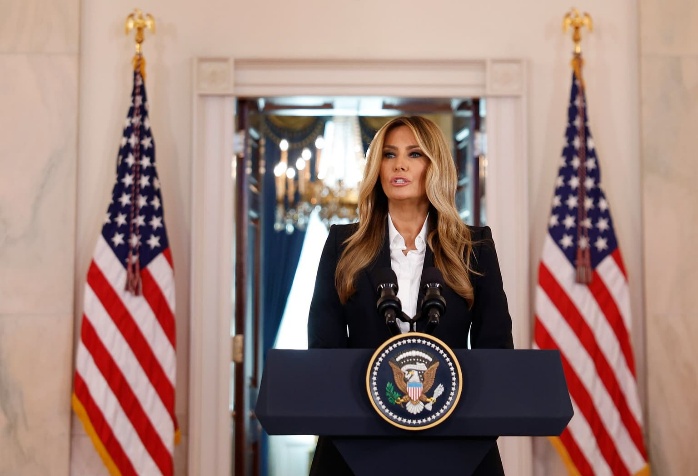
U.S. First Lady Melania Trump speaks in the White House Grand Foyer, announcing the return of seven Ukrainian children abducted by Russia—a rare moment of light on a day when Russian missiles claimed another child’s life in Zaporizhzhia. (Photo: Kevin Dietsch/Getty Images)
Trump told reporters on October 10 that her representatives had spent three months working through back channels with Vladimir Putin to secure the children’s release. “Both sides have participated in several back-channel meetings and calls, all in good faith,” she said. “Eight children have been rejoined with their families during the past twenty-four hours.”
Her announcement rippled across news feeds, amplified by Kirill Dmitriev of the Russian Direct Investment Fund—an irony in itself, since his post tacitly confirmed what Moscow has long denied: that Russia’s wartime deportations of Ukrainian children are real. The International Criminal Court has already issued arrest warrants for Putin and his children’s commissioner, Maria Lvova-Belova, for this very crime.
Trump described receiving dossiers of “biographies and photographs of each child,” verified jointly by Ukrainian and Russian officials. “It is important to note,” she said, “that the original verification report was jointly prepared by the Commissioner of the Verkhovna Rada of Ukraine for Human Rights and the Office of the Russian Presidential Commissioner for Children’s Rights.”
The numbers, however, stripped the moment of triumph. Ukraine has verified 19,546 deported children. Independent researchers at Yale’s Humanitarian Research Lab believe the figure could exceed 35,000. Russia itself once boasted of having “accepted” more than 700,000 Ukrainian minors since the full-scale invasion began in 2022. Against such figures, seven—perhaps eight—returned children amount to less than one-twentieth of one percent.
Trump expressed hope that more reunifications would follow, but the contrast was impossible to ignore. On the very day she spoke of “good faith,” Russian drones were still setting fire to Ukrainian homes. The return of seven children did not signal redemption. It only underscored the moral abyss between diplomacy and decency—between a war that steals lives and a gesture that saves too few.
Europe Steps Up While Washington Hesitates
While much of Ukraine sat in darkness on October 10, Europe moved quietly but decisively to keep its ally standing. As Russian missiles and drones tore through power plants, governments across the continent signed contracts, approved funding, and delivered weapons that might not change the night—but could change what comes after it.
Germany led with precision rather than volume. Its Ministry of Defense finalized support for the digitization of Ukraine’s defense sector—tools like the DELTA battlefield management network, the Army+ and Reserve+ systems, and the DOT-Chain Defense Marketplace. The initiative aimed to strengthen Ukraine’s ability not only to fight but to coordinate, merging real-time intelligence and logistics under cyber defense shields built for a long war.
That same day, Rheinmetall confirmed a deal to produce new Skyranger 35 mobile air defense systems on Leopard 1 tank chassis—funded, fittingly, with frozen Russian assets. Built in Italy and designed to shoot down drones at a fraction of the cost of a Patriot missile, these systems answered Ukraine’s desperate need for sustainability: to destroy cheap threats without bankrupting its defense.
In London, the United Kingdom advanced the delivery of hundreds of Lightweight Multirole Missiles—five months ahead of schedule. Compact, precise, and adaptable, they offered Ukrainian forces a way to strike ground targets without reconfiguring existing launch platforms.
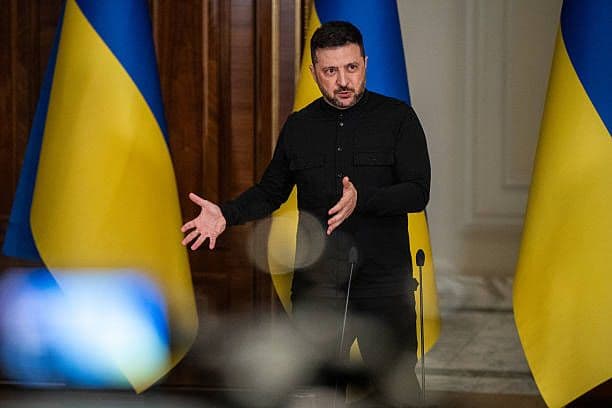
Ukrainian President Volodymyr Zelensky speaks during a press conference in Kyiv after a night of heavy Russian drone and missile attacks. (Danylo Antoniuk/Anadolu via Getty Images)
In The Hague, President Volodymyr Zelensky met Dutch Defense Minister Ruben Brekelmans to sign a memorandum on joint drone production—a symbol of Ukraine’s growing industrial partnership with Europe. “This is one of the most promising areas of our cooperation,” Zelensky said, thanking the Netherlands for nearly nine billion dollars in aid since 2022, including six hundred million through the PURL initiative.
Belgium, too, made its contribution count. Engineers at Thales unveiled a custom warhead—the FZ123, a laser-guided rocket designed to fill the sky with a 25-meter sphere of shrapnel—ideal for intercepting kamikaze drones. Ukrainian Mi-8 helicopters now hunt nightly armed with these rockets, cutting down the same drones that once swarmed their cities.
Taken together, these steps signaled a quiet shift. Europe, once a cautious partner, had become Ukraine’s engine of endurance. As Washington debated and delayed, the continent that once feared escalation was now building the tools to ensure survival.
The Promise of a Mega Deal
President Volodymyr Zelensky announced on October 10 that a Ukrainian delegation would soon travel to Washington to negotiate what he called the “Mega Deal”—a sweeping purchase plan for air defense systems and long-range weapons, potentially worth up to ninety billion dollars. The team, led by Prime Minister Yuliia Svyrydenko and joined by Presidential Office chief Andriy Yermak and sanctions commissioner Vladyslav Vlasiuk, was tasked with securing what Ukraine now viewed not as an upgrade, but as a lifeline.
“The most important thing in this Mega Deal is air defense systems,” Zelensky told reporters. “We are ready to buy this, and we are ready to use various programs. PURL is among them.” He referred to the NATO-coordinated Prioritized Ukraine Requirements List—an initiative allowing European allies to purchase American weapons for Ukraine after the Trump administration halted direct U.S. military assistance.
The urgency was unmistakable. The October 10 assault had proven that even Ukraine’s robust air defenses could not shield everything at once. Four hundred and five intercepts had saved countless lives, but seventy-seven weapons still broke through, crippling power grids and striking residential areas. “More air defense systems,” Zelensky said, “are not optional—they are existential.”
The president also revealed that his team would seek to modify ATACMS missiles and gain access to the long-sought arsenal of HIMARS, ATACMS, and Tomahawk cruise missiles. “You all know these names,” he said. “We are not afraid to say them—but we do not want the conversation to be prolonged. We expect a positive response from the United States.”
Trump had hinted publicly that Tomahawks—capable of traveling 2,500 kilometers and striking deep inside Russia—might be on the table. Yet his follow-up remarks betrayed hesitation. “I want to find out what they’re doing with them,” he said, implying that political optics still outweighed strategic clarity. Zelensky’s response cut to the core: “Tomahawks could force Russia to sober up and sit down at the negotiating table.”
For Ukraine, the Mega Deal was more than procurement—it was survival wrapped in diplomacy, a measure of whether Washington still believed that freedom was worth arming.
Kyiv’s Breaking Point
By morning on October 10, exhaustion had hardened into anger. Standing before reporters, President Volodymyr Zelensky’s voice carried an edge rarely heard in public. “I am not satisfied, for example, if we take Kyiv,” he said. “There are TPP-5 and TPP-6. We cannot use Patriot missiles against drones. What questions might I have for the mayor? I could tell you now what I think about all this, but I won’t.”
The words were as much warning as restraint. For months, tensions had simmered between Zelensky and Kyiv Mayor Vitali Klitschko over the capital’s readiness for sustained aerial assault. The President’s Office had criticized Klitschko’s management since the early days of the war—blackouts dragging too long, bomb shelters found locked or unprepared, recovery plans too slow to inspire confidence. Their rivalry, political and personal, had turned the defense of Kyiv into a quiet contest of accountability.
The October 10 attack brought that conflict into sharp relief. It marked the third strike in a week on power facilities run by DTEK, Ukraine’s largest private energy company. In total, DTEK plants had been targeted more than two hundred times since 2022, but the pace was quickening. “This is a serious escalation,” warned CEO Maksim Timchenko, “a campaign against the entire energy system—its generation capacity and its grid.”
As first responders pulled victims from the streets and hospitals flickered on generator power, the limits of Ukraine’s air defense strategy became painfully clear. A single Patriot missile costs between $600,000 and $1 million; a Shahed drone, perhaps $193,000 on the open market—or as little as $10,000 to $50,000 for Russian-produced versions. Every interception was a small victory that drained the country’s resources further.
It was an equation Zelensky knew too well: defend everything, and go bankrupt; defend selectively, and people die. That night, his anger was not directed solely at a mayor—but at the cruel arithmetic of survival itself.
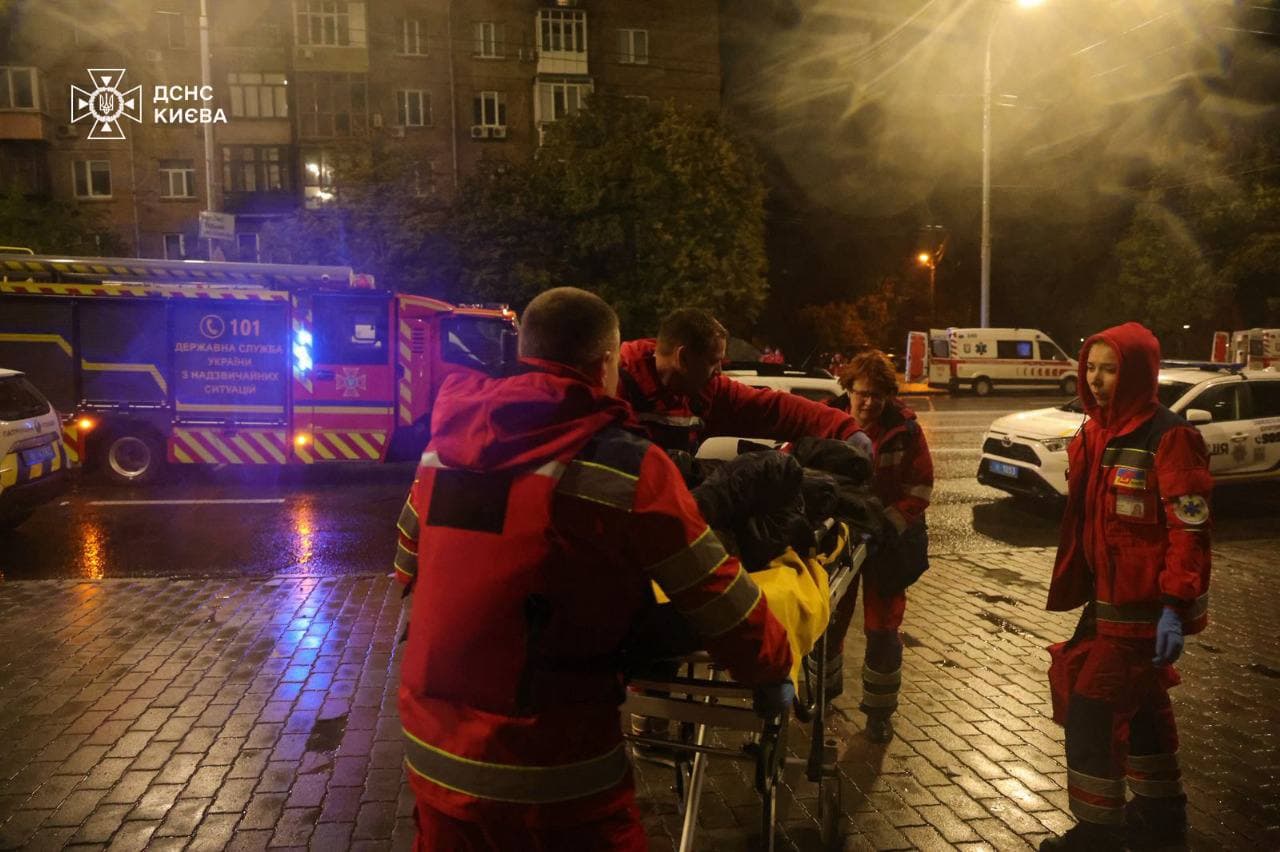
First responders evacuate a victim after the October 10 mass drone and missile assault on Kyiv. (State Emergency Service of Ukraine via Telegram)
Zelensky’s frustration reflected broader systemic challenges. Ukraine’s air defense systems, while increasingly sophisticated, faced impossible mathematics. A single Patriot missile cost $600,000 to $1 million. An Iranian-made Shahed drone cost around $193,000 for export versions and only $10,000-$50,000 for Russian-produced variants. Using premium air defense systems against cheap drones bankrupted defense budgets while depleting limited interceptor inventories.
The Ground That Would Not Yield
While missiles struck Ukraine’s cities, the land war pressed on with its own relentless rhythm. Along the 600-mile front, October 9 and 10 brought the usual mixture of progress, loss, and exhaustion—measured not in kilometers but in lives.
Near Siversk, Ukrainian troops clawed back ground west of Vyimka, retaking positions that had been contested for weeks. The gain was small but tangible, a patch of soil that mattered because it had cost so much to reclaim. Southward near Novopavlivka, geolocated footage showed Ukrainian advances southwest of Kotlyarivka—each meter won tightening control over supply routes and thinning Russian fire dominance.
Elsewhere, Russia struck back with force. In eastern Zaporizhzhia Oblast, its units reached the northern edges of Poltavka after days of artillery preparation. In the Kostyantynivka–Druzhkivka corridor, mechanized formations pushed into the southern approaches of Volodymyrivka and edged east of Ivanopillya under the cover of fog and tank fire. Ukrainian lines flexed but held.
The fighting around Dobropillya followed the same weary pattern. Russian troops inched southeast of Zolotyi Kolodyaz, while further south they gained marginal ground near Oleksandrohrad and Oleksiivka. At Lyman, the front turned fluid again—Russian forces pressing into central Yampil even as Ukrainian defenders counterattacked on its northeastern edge. Control shifted by blocks, not miles.
Near Borova, Ukrainian anti-air gunners reported Russian numerical superiority of three to one, yet local raids told another story. Ukrainian infiltrators slipped behind the lines at Hrekivka, capturing Russian soldiers in a night operation that underscored both ingenuity and desperation.
The battles of October 10 brought no decisive shift, only the steady grind of attrition that has become the war’s defining sound. Across fields cratered by shellfire and forests stripped bare by drones, men fought to hold ground their ancestors once farmed. The maps barely changed—but the resolve beneath them deepened.
The Fraying Alliance
Inside Russia’s Northern Grouping of Forces, frustration now travels faster than orders. A pro-Russian milblogger admitted on October 10 that North Korean troops, recently deployed to reinforce Moscow’s lines, have become an unexpected liability. Checkpoints manned by the North Koreans have mistakenly blocked Russian artillery convoys, confused by radio codes and unfamiliar command protocols. Hospitals treating wounded North Korean soldiers reportedly allowed them to use phones—and even fed them better meals—while Russian servicemen lay neglected, breeding resentment among units already starved of care.
The same source painted a grim picture of Russia’s own battlefield medicine. In one regiment, soldiers had built an improvised “hospital” in an abandoned building, refusing to send lightly wounded comrades to official facilities they described as death traps. Antibiotics were scarce, food often purchased out of pocket, and wounded troops were discharged before their wounds closed. Only when infection turned to gangrene did they qualify for transfer.
Leave, too, has become a privilege sold rather than granted. Artillerists from the 22nd Motorized Rifle Regiment have reportedly been banned from rest entirely; others in the 30th Regiment can take a week off only by paying a bribe of 150,000 rubles—about $1,800—for the right to breathe outside the front. Commanders justify the cruelty by invoking impossible goals: no leave until Sumy falls, a promise that grows more absurd with each passing month.
Meanwhile, Russian command continues to mass troops near Kindrativka and prepares to reinforce positions around Tetkino, though supply failures still choke their progress. The result is a front both bloated and brittle—held together by fear, graft, and propaganda, as Moscow’s alliance with Pyongyang shifts from convenience to complication.
Europe’s Costly Contradiction
Even as Russian missiles blacked out half of Ukraine, money continued flowing quietly eastward. A Reuters report released on October 10 exposed a troubling paradox: seven European Union nations actually increased their imports of Russian energy in 2025 compared to the year before. Despite official claims of a 90 percent reduction since the invasion began, the EU had still purchased more than €11 billion worth of Russian fuel in just eight months.
France led the contradiction with a 40 percent surge—€2.2 billion in Russian imports—while the Netherlands’ numbers jumped an astonishing 72 percent. Belgium, Croatia, Romania, Portugal, and Hungary all followed suit. Hungary and Slovakia alone accounted for nearly €5 billion of Europe’s remaining energy tab, their dependence bound up in old contracts and new convenience.
Most of this trade arrived not through pipelines but through liquefied natural gas—LNG shipments quietly docking in European ports while politicians promised solidarity. Giants like TotalEnergies, Shell, and Gunvor maintained long-term agreements with Russian suppliers, some extending into the 2040s, allowing Moscow to keep its war machine fueled by the very nations condemning it.
Analysts called the practice “self-sabotage.” As Vaibhav Raghunandan of the Center for Research on Energy and Clean Air explained, “Russia’s energy revenue remains its largest source of war funding.” Yet European governments, caught between energy security and moral clarity, continued to bankroll the Kremlin under the banner of necessity.
Donald Trump seized on the hypocrisy during his September speech to the UN General Assembly, urging NATO allies to “immediately cease all energy purchases from Russia.” His words may have been politically charged—but the numbers left little room for defense. Europe’s lights, still flickering with Russian gas, were illuminating the cost of its own contradictions.
Poland’s Steadfast Shadow
Under gray skies and the distant hum of generators, Polish Foreign Minister Radosław Sikorski stepped into the small village of Lapaivka—just fifty kilometers from Poland’s border, and five days removed from tragedy. The October 5 Russian strike that killed four members of one family, including a fifteen-year-old girl, had left behind a quiet ruin of charred homes and broken windows. Sikorski laid flowers where the blast had struck, joined by Lviv Governor Maksym Kozytskyi, Deputy Foreign Minister Oleksandr Mishchenko, and Polish chargé d’affaires Piotr Łukasiewicz.
“Thank you, Poland, for support and for sharing our pain in the most difficult moments,” Kozytskyi said. “This is true brotherhood.” The words carried weight—Poland’s solidarity has been more than symbolic. Since the first days of Russia’s full-scale invasion, Warsaw has served as both shield and lifeline, taking in millions of refugees and channeling Western arms across its borders to Ukrainian hands.
Sikorski’s visit came on the heels of a sharply worded guest column in The New York Times, where he warned that Moscow would only negotiate under pressure—through greater support for Ukraine and a total embargo on Russian energy. His message was clear: moral resolve means little without material strength.
That resolve had been tested in September, when roughly twenty Russian drones violated Polish airspace during a massive strike on Ukraine. For the first time, a NATO state downed Russian assets over its own territory. The incident underscored what Sikorski’s visit symbolized—Poland’s security and Ukraine’s survival are no longer separate causes but a shared frontier, defended not just with weapons, but with will.
The Prize That Wasn’t
When the Norwegian Nobel Committee announced Venezuelan opposition leader María Corina Machado as the 2025 Peace Prize laureate, the headlines should have ended there. Instead, the world found itself watching an awkward duet between Donald Trump and Vladimir Putin—one congratulating the other for a peace neither had achieved.
Putin, quick to dismiss the Nobel’s integrity, declared that the prize had “lost credibility” and praised Trump as a man “doing a lot to resolve complex crises that have dragged on for years.” Within hours, Trump reposted the compliment on Truth Social, writing, “Thank you to President Putin!” The exchange blurred the line between irony and alliance: an indicted war criminal defending an unawarded peace broker.
The White House response came curt and defensive. “The Nobel Committee proved they place politics over peace,” said communications director Steven Cheung, insisting that Trump would “continue making peace deals, ending wars, and saving lives.” Yet in Ukraine, the missiles were still falling.
By October 10, Trump’s promise to end the war “in 24 hours” had stretched into months of empty summits and rising casualties. Moscow’s Deputy Foreign Minister Sergei Ryabkov admitted that momentum in the US-led peace talks had “largely exhausted.” For Ukraine, the only thing Trump’s diplomacy had ended was the illusion that words alone could stop artillery.
In the end, the Nobel went to Machado—but the spectacle around it revealed something darker. For Putin, it was a platform. For Trump, a wound to his ego. And for Ukraine, it was just another reminder that peace was being debated by men who didn’t have to live without power, or water, or children.
The Drone That Hunts the Drone
As Russian Shaheds darkened Ukrainian skies on October 10, Kyiv and London were already sketching the blueprint for a new kind of defense—one that fights steel with silicon and wings with wings. The two nations announced negotiations to jointly produce interceptor drones, a project dubbed Octopus, aimed at flooding Ukraine’s skies with up to 2,000 agile defenders each month.
“Very shortly, we’ll be producing around 2,000 drones a month—deliberately shipping all of them to Ukraine,” said UK Defense Readiness and Industry Minister Luke Pollard. His statement carried urgency born of arithmetic as much as strategy. A single NASAMS or Patriot missile costs between $600,000 and $1 million. A Shahed drone, by contrast, costs Russia as little as $10,000. Each interception was bankrupting Ukraine faster than Russia could build.
The Octopus project promised to flip that equation. Designed for interception rather than surveillance, the lightweight drones would chase and destroy incoming enemy UAVs at comparable cost, preserving expensive air defense missiles for ballistic and cruise threats. Production would begin in the United Kingdom, drawing on its strength in rapid R&D and precision manufacturing before expanding through joint facilities.
For Ukraine, this wasn’t just innovation—it was survival through adaptation. The battlefield has become an ecosystem of drones, and Octopus could become its natural predator. In a war where every strike costs lives and every intercept buys time, the drone that hunts the drone might just change the rhythm of the night sky.
Moldova’s Quiet Alarm
While missiles thundered over Ukraine, Moldova—a nation barely the size of Maryland—took a quiet but decisive step toward its own survival. On October 10, the government approved a ten-year military strategy for 2025–2035, raising defense spending to one percent of GDP and expanding the army to 8,500 personnel. The plan’s language was blunt: Moldova must become “a modern, professional, well-equipped, and trained military institution capable of defending sovereignty, independence, and territorial integrity.”
The urgency behind those words is born of geography. Wedged between war-torn Ukraine and NATO member Romania, and shadowed by Russian troops entrenched in the breakaway region of Transnistria, Moldova lives on the edge of someone else’s war. Each Russian missile that streaks across Ukrainian skies passes uncomfortably close to Moldovan borders—a reminder that neutrality offers no shield against proximity.
Defense Minister Anatolie Nosatîi framed the new strategy as a path toward European integration and collective security, aligning Moldova’s forces with EU and NATO standards while expanding peacekeeping roles under the UN and OSCE. Prime Minister Dorin Recean was even more direct, rebuking those who resist military reform as “hysterical voices” that have long kept Moldova’s defense “in poverty and disorder”—a condition, he said, that “benefits the aggressor state.”
Moscow’s reply was swift and dismissive. Deputy Foreign Minister Mikhail Galuzin accused Chişinău of “militarizing the country” and “turning it into a supply base for the criminal regime in Kiev.” His phrasing betrayed a familiar irony: Russia condemning others for preparing against the very threat it represents.
For Moldova, the strategy is more than a budgetary document—it is an act of foresight from a nation that has watched history devour neighbors and decided, at last, to build a spine before it’s too late.
Europe’s Frozen Fortune
In a meeting room in Luxembourg, far from the blacked-out cities of Ukraine, European finance ministers debated what might become Kyiv’s most unusual lifeline—Russia’s own money. On October 10, Germany’s Finance Minister Lars Klingbeil voiced cautious optimism that the European Union would soon find “legal and sound” ways to tap into €185 billion in frozen Russian central bank assets to help fund Ukraine’s recovery.
“I am sure that in the end we will get there,” Klingbeil said. “Putin will pay for this war.”
It was more than rhetoric. Ukraine faces an external budget gap of roughly $65 billion between 2026 and 2029, a chasm too large for exhausted Western donors to fill. The proposed plan would not seize the Russian reserves outright—international law shields central bank funds—but instead channel the immobilized assets into a reparations-style loan. If Russia ever ended the war and compensated Ukraine for its destruction, Kyiv would repay the EU, and sanctions would be lifted.
The arrangement is both ingenious and fraught. Legal experts warn of precedent: if one bloc can redirect frozen reserves, so could another. Yet moral urgency has begun to outweigh caution. Across Europe, momentum is building to turn Russia’s own wealth into Ukraine’s survival fund.
As leaders prepare for the October 23 summit, the choice before them is stark. Either the frozen billions remain idle symbols of condemnation—or they become instruments of justice, transforming the assets of aggression into the currency of rebuilding.
Azerbaijan’s Delicate Bargain
Diplomacy, at times, is little more than an exchange of hostages with better manners. On October 10, Azerbaijan quietly released Igor Kartavykh, the editor-in-chief of the Russian state-run outlet Sputnik Azerbaijan, from a Baku detention facility and placed him under house arrest. The gesture followed months of tension between Moscow and Baku, strained further by a deadly plane crash neither side had wanted to discuss too openly.
Kartavykh and his deputy had been detained in June after Azerbaijani police raided Sputnik’s offices on charges of “illegal financing.” Russia, denying all accusations, demanded their release and hinted that the arrests carried political motives. Behind closed doors, the two countries negotiated a trade: Moscow freed an Azerbaijani citizen, identified by Kommersant as Mamedali Agayev, the former head of the Moscow Satire Theater, in return for Kartavykh’s partial freedom.
The détente came just one day after Vladimir Putin made a rare admission. Standing beside Azerbaijani President Ilham Aliyev in Dushanbe, Tajikistan, Putin acknowledged that Russian air defenses had indeed downed the Azerbaijani Airlines passenger jet that crashed in Kazakhstan in December 2024, killing thirty-eight of sixty-seven on board. Two Russian missiles, he claimed, had detonated near the plane during an “alleged Ukrainian drone attack” on Grozny—an explanation that raised as many questions as it settled.
For both leaders, the exchange served a purpose. For Putin, it softened the narrative around a tragic error. For Aliyev, it signaled that even in a world of shifting allegiances, Azerbaijan still knew how to dance the line between contrition and advantage.
The Daily Toll
By night’s end, the numbers told a story that statistics could never fully hold. Six civilians dead. Forty-five wounded. Among them, a child in Zaporizhzhia whose name will never appear in military briefings but whose absence will echo far longer than the war itself.
Russia’s October 10 barrage swept across the map like a cold front of fire—Donetsk, Kherson, Sumy, Dnipropetrovsk. In Donetsk Oblast, three people were killed, two in Kostiantynivka and one in Sloviansk, as rockets turned apartment blocks into twisted steel. Eleven others were wounded there. Farther south, in Kherson, a single strike leveled homes and shops, killing one and injuring six, while flames licked the shells of nine houses and a small bank.
Sumy reported three wounded; Dnipropetrovsk, five more. Each was a story half-told—people who left for work or school, unaware they would become coordinates on another morning’s report.
The official figures were only a shadow of truth. Many wounded never reached hospitals, treated in basements by volunteer medics or buried beneath debris never cleared in time. The government called it six dead. But in Ukraine, every casualty number hides a thousand ripples—families unmade, streets silenced, the geography of loss widening one crater at a time.
A Voice in the Blackout
When Swiss singer Nemo Mettler walked onto the Kyiv stage on October 10, the city was still trembling from the night before. Hours after the Eurovision 2024 winner arrived, Russia had unleashed another wave of drone and missile strikes, plunging neighborhoods into darkness and injuring at least a dozen people. For most artists, the chaos would have been reason enough to cancel. Nemo performed anyway.
“I slept in the shelter of the hotel—shelling on Kyiv the whole night,” Nemo wrote afterward. “This kind of night has become sad reality for so many of my Ukrainian friends.” The words, simple and raw, captured what the concert itself symbolized: solidarity not from a distance, but from within the fear.
Foreign concerts in Kyiv have become almost mythical—rare, brief flickers of normalcy in a city where sirens often replace applause. Nemo’s decision to go ahead with the show was personal. “I have many friends who often make this trip,” the singer told Ukrainian outlet TSN. “And I thought: if my friends can do this once a month, or even several times a month, then I’ll be fine too. I wanted to come to Kyiv and show my support for Ukrainians.”
The concert was more than a performance; it was defiance set to melody. In a war that has tried to silence joy, Nemo’s voice rose through the blackout—a reminder that courage sometimes sounds like a song in the dark.
The Road Ahead: What October 10 Revealed
October 10, 2025, did not mark a turning point—it marked a mirror. In one day, the world saw the war for what it had become: a contest of endurance fought between Ukrainian courage and global hesitation.
Vladimir Putin spoke of peace while directing the largest air assault in months—497 weapons fired at cities already bruised and blacked out. Donald Trump praised “progress” even as Ukrainian children slept in shelters without heat or light. Europe pledged solidarity while quietly increasing purchases of Russian gas. Each contradiction echoed the same truth: the world’s patience outlasts its outrage.
The attacks exposed Russia’s precision not in aim, but in timing. Moscow exploited fog and cold to cripple Ukraine’s defenses and struck while global attention drifted toward ceasefire celebrations in the Middle East. The seven-year-old boy killed in Zaporizhzhia was not collateral damage—he was the consequence of a strategy that treats suffering as leverage.
European defense announcements offered flashes of resolve—new drones, new systems, new funding—but not the scale Ukraine needs. Patriot batteries, HIMARS, ATACMS, and Tomahawks remain symbols of promises deferred. Even Trump’s so-called “Mega Deal” seemed more performance than policy, and Putin, sensing weakness behind every handshake, pressed harder.
What October 10 truly revealed was the modern paradox of deterrence: nuclear weapons have made evil safe again. The West’s fear of escalation ensures that Russia can bomb hospitals, kidnap children, and starve cities without facing more than condemnation and sanctions. Ukraine is fighting not only an army but an equation—the mathematics of risk in a world too afraid to act decisively.
And so the war grinds on. The 1,326th day looked like the 1,325th: missiles before dawn, press conferences by noon, and power outages by nightfall. The question no longer is when the world will act, but how long Ukrainians can endure while allies send just enough to keep them alive, but never enough to let them win.