
As drones ignited refineries and hackers emptied Russian accounts, world leaders traded promises and threats in a single day that revealed how the Ukraine war has become a conflict without borders.
The Day’s Reckoning
Smoke rose over a Russian oil refinery more than a thousand kilometers from Ukraine just as an 18-year-old street singer was dragged away by police in St. Petersburg. Between those two moments, the war revealed its new face — one that reached from digital vaults in Siberia to the corridors of European power.
Ukraine’s cyber warriors emptied the accounts of a major Russian provider, drones ignited Bashkortostan’s fuel reserves, and a courtroom in Bologna halted the extradition of a suspected pipeline saboteur. At the same time, India signaled a retreat from Russian oil, Germany opened its checkbook for another €2 billion in weapons, and Britain tightened the noose on Moscow’s shadow fleet.
It was a day when the frontlines stretched across continents — when keyboards, oil contracts, and protest songs became as potent as missiles. The Ukraine war no longer belonged to geography; it belonged to the world.
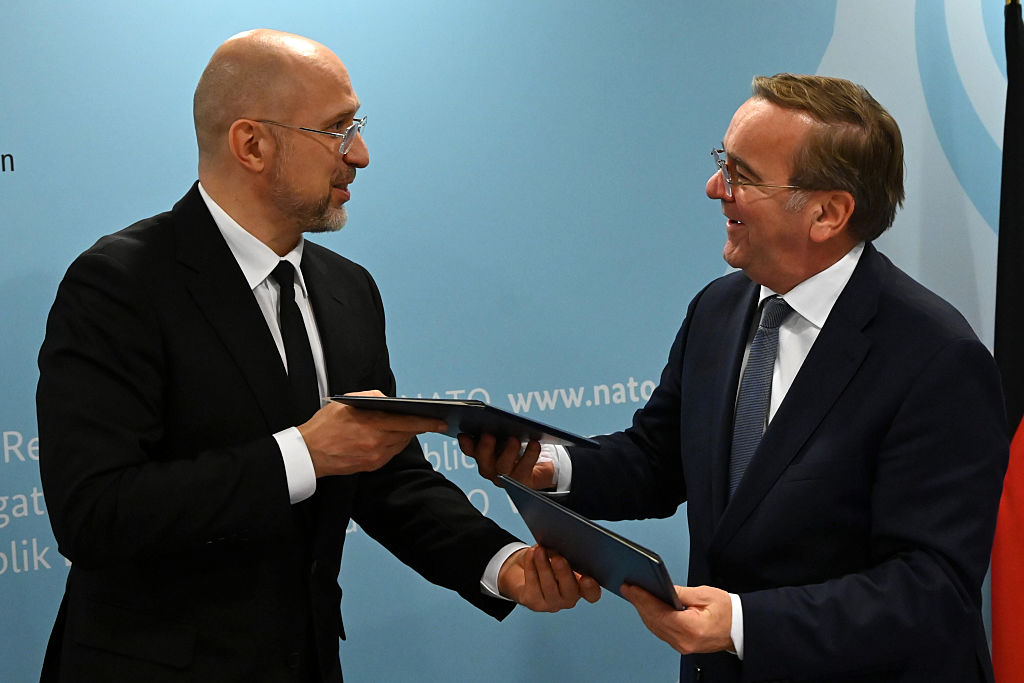
German Defense Minister Boris Pistorius and Ukrainian Prime Minister Denys Shmyhal sign a landmark defense-industry cooperation pact in Brussels — a signal that Europe’s commitment to arming Ukraine is deepening even as the war grows more global.
(Ansgar Haase / Picture Alliance via Getty Images)
The Silent Offensive: When Keyboards Replaced Missiles
At the exact moment Ukrainian cyber operatives pressed enter, 66 million rubles disappeared from the accounts of Orion Telecom — Siberia’s primary link to the outside world. What looked like a digital glitch was, in fact, a precision strike. Ukraine’s intelligence service later confirmed the June 12 operation, executed on Russia Day with deliberate irony, had drained one of Moscow’s key infrastructure arteries and exposed its hidden dependence on data.
Orion wasn’t just another internet provider. It served a closed industrial zone tied to uranium extraction — a nerve center of Russia’s military ecosystem. For several hours, the network went dark. Ukrainian officials said the disruption revealed a truth about modern war: that a keystroke can now achieve what once required a missile.
Russian investigators rushed to trace the breach, but the real damage was already done. The personal data of countless users spilled into the open, and forensic analysis suggested that Orion’s servers had doubled as channels for Russian security operations. What vanished wasn’t just money — it was secrecy. And in this new phase of warfare, exposure may be the deadliest weapon of all.
The Thousand-Mile Strike: How Ukraine Took the War Deep into Russia
While Russian investigators tallied cyber losses in Moscow, smoke curled into the sky above Bashkortostan — the visible cost of a far more physical strike. Ukrainian drones had traveled over 1,300 kilometers to ignite the Ufaorgsintez refinery, a Gazprom-linked complex that fuels both Russia’s economy and its war machine.
It was the third such strike on the region in a single month, a pattern that proved intent rather than luck. Ukraine’s drones were not just weapons; they were messengers — each explosion declaring that distance no longer guaranteed safety.
Local authorities rushed to ground flights at Ufa airport and cut mobile networks, an increasingly familiar ritual across Russia’s interior as Kyiv’s reach extended deeper than ever before. And while reports from Volgograd suggested another refinery may have burned overnight, even the fog of war couldn’t obscure the message: Ukraine had learned to strike anywhere, at any hour — and Moscow could no longer protect the vast empire it had unleashed.
Winter’s Target: Russia’s War on Heat
Ukraine’s battle for survival turned bitterly literal as Russia struck at the nation’s warmth itself. Over the span of a week, missiles and drones pounded energy facilities in Kharkiv, Sumy, and Chernihiv — part of a coordinated effort to freeze Ukraine into submission before winter could even begin.
Naftogaz CEO Serhii Koretskyi called the attacks “acts of terrorism aimed at depriving Ukraine of gas, heat, and light.” He vowed that his engineers would “restore everything,” but the figures told their own story — 60 percent of gas production capacity already lost, and winter gas reserves still far below the survival threshold.
The European Bank for Reconstruction and Development prepared a €500 million lifeline for emergency gas imports — a number dwarfed by the scale of damage. Each new strike didn’t just darken homes; it tested a nation’s endurance. And as temperatures began their slow descent, Russia’s missiles carried a single, chilling message: this war will follow you indoors.
The Saboteur’s Reprieve: Justice in the Crossfire
In a quiet Bologna courtroom, the war reached Europe’s legal heart. Judges ruled that Serhii Kuznetsov — the Ukrainian accused of orchestrating the Nord Stream pipeline explosions — would not be extradited to Germany, at least for now. Italy’s Supreme Court overturned the order, citing flaws in how the case had been defined under European law.
The decision struck like a diplomatic tremor. Kuznetsov’s defense had argued that the Nord Stream lines were legitimate wartime targets — arteries feeding the very machine assaulting Ukraine — and that as a uniformed Ukrainian, his actions fell under the laws of war, not criminal sabotage. What some saw as destruction, others saw as defense.
German prosecutors claimed Kuznetsov helped plan the mission from a rented yacht out of Rostock, laying explosives that severed the pipelines linking Russia and Europe. He insisted he had never left Ukraine. Now, the court’s ruling has bought him time — and transformed a courtroom dispute into a symbol of the moral gray zones that define modern warfare.
The Promise That Shook the Oil World
At the White House, a single remark rippled through global markets. President Donald Trump announced that India’s Prime Minister had agreed to stop buying Russian oil — a statement that, if true, could sever one of the last major financial arteries sustaining Moscow’s war.
“Modi assured me today that they will not be buying oil from Russia,” Trump said, calling it a “big step.” It was delivered with his trademark flair, but the implications were serious. India accounted for nearly forty percent of Russia’s crude exports — a lifeline that kept sanctions from biting too deep.
Behind the podium, the meaning was clear: tariff threats had done what diplomacy couldn’t. But in New Delhi, silence followed. India’s Foreign Ministry offered only the vaguest assurance that its energy policy would serve “the Indian consumer.” Analysts whispered that refiners were quietly shifting supply lines, though no one could confirm when — or if — the flow would truly stop.
For now, oil traders moved on rumor and instinct, and the world waited to see whether a passing comment in Washington had just redrawn the map of global energy.
The Ramstein Billions: Betting on a Long War
In Brussels, the air felt less like diplomacy and more like accounting at the edge of a storm. At the Ukraine Defense Contact Group, Germany’s Boris Pistorius led the charge — unveiling a €2.3 billion arsenal of Patriots, IRIS-T systems, and precision munitions. Around him, the pledges came in waves: Finland joining NATO’s new supply initiative, Lithuania adding $30 million, the Netherlands €104.7 million for drones, Norway planning nearly €7 billion for 2026.
Then came the American voice — Defense Secretary Pete Hegseth — his words sharper than the usual transatlantic caution. The United States, he warned, would “impose costs on Russia” if negotiations remained a mirage. His message to Europe was clear: give more, faster, and through NATO’s machinery.
The room knew what the numbers meant. Each billion was another declaration that peace would be earned through exhaustion, not persuasion. As leaders tallied commitments, one truth lingered in the marble corridors: the West had decided to outlast Putin — even if it took years.
Lavrov’s Game: Turning Allies into Doubters
From Moscow’s echoing halls of diplomacy, Sergei Lavrov played his favorite instrument — division. In a new interview titled “Europe Wants to Turn the Conflict in Ukraine into Trump’s War,” Russia’s foreign minister delivered another movement in his long campaign to fracture the West.
He called the proposed U.S. sale of Tomahawk missiles to Ukraine “a serious escalation,” warning it would “cause colossal damage” to relations. But the target wasn’t the missiles. It was the alliance itself.
Lavrov painted a picture of manipulation — of Europe and Zelensky supposedly “leading Trump astray,” dragging him into a conflict that wasn’t America’s to fight. It was a message aimed less at policymakers than at audiences weary of paying for a distant war.
Each word was chosen like a note in a dissonant symphony: to erode trust, amplify fatigue, and remind the West that unity, too, can be bombed — not with missiles, but with doubt.
The Shadow Fleet Under Fire
London’s sanctions landed like torpedoes in Russia’s hidden economy. On October 15, Foreign Secretary Yvette Cooper unveiled what she called the “strongest sanctions yet” — a strike aimed not at battlefields but at the black market keeping Russia’s oil afloat.
Fifty-one ships from the so-called shadow fleet were blacklisted, along with oil giants Rosneft and Lukoil — companies that together pump nearly half of Russia’s crude and feed a third of the Kremlin’s annual revenue. NATO’s Baltic Sentry operation had already been squeezing the smuggling routes, forcing Moscow to spend heavily just to keep its tankers moving.
Now Britain’s move cut even deeper. The sanctions reached across oceans, ensnaring India’s Nayara Energy, China’s National Pipeline Group, and traders in the UAE — each a vital link in the gray network sustaining Russia’s war economy. With every new name added, the circle tightened.
The missiles Ukraine launched over the border were visible; these were not. But both hit the same target — the heart of Moscow’s ability to fight.
Songs of Defiance: The Girl Who Wouldn’t Be Silent
On St. Petersburg’s Nevsky Prospect, the air carried more than music — it carried defiance. Eighteen-year-old Diana Loginova stood with her band Stoptime and began to play Swan Lake Cooperative, a banned song by exiled rapper Noize MC. Within minutes, the crowd joined her, their voices rising through the cold air: “Let the swans dance. Let the old man shake in fear for his lake.”
The lyrics, a poetic echo of Soviet coup broadcasts, had become a quiet anthem of resistance. To sing them was to risk arrest. To sing them in public was to declare that fear no longer ruled the street.
Police moved in before the final verse. Loginova was dragged away, charged with “discrediting” the Russian military and organizing an unauthorized event. Her bandmates were questioned and released, their Telegram channel going dark with a single message: “No more public locations.”
Yet the sound lingered — that fragile, fearless melody that had cut through the machinery of repression for just a few moments. It was the sound of a new generation refusing to whisper.
The Mayor’s Mirage: A Passport from Nowhere
In Odesa’s political storm, a single passport set off an earthquake. The Russian investigative outlet Insider reported that the document Ukraine’s Security Service used to strip Mayor Hennady Trukhanov of his citizenship — a Russian passport allegedly issued in 2015 — was fake. The number belonged to a woman named Tatyana who had used it for travel years earlier.
But the forgery didn’t clear Trukhanov’s name. According to Russian databases reviewed by Insider, he did hold Russian citizenship — just under entirely different passport numbers, issued in 2003 and 2011, and annulled in 2017. The fake document, investigators suggested, might itself have been planted — part of what journalist Christo Grozev called “a Russian active measure against the incumbent mayor.”
Whatever the truth, the damage was done. Zelensky had already appointed Serhii Lysak to head a new Odesa Military Administration, ending Trukhanov’s reign in everything but paperwork. The question that lingered wasn’t just who forged the passport — but who benefited from the chaos it created.
Enemies in Exile: Moscow’s War on Its Own
From behind the walls of the Lubyanka, Russia’s Federal Security Service extended its reach far beyond its borders. On October 15, the FSB charged exiled oligarch Mikhail Khodorkovsky and twenty-two members of the Russian Anti-War Committee with “violent seizure of power” and “organizing a terrorist community.”
Their real offense was words. The group’s 2023 Berlin Declaration had called Putin’s government “criminal” — enough to brand its authors as terrorists in Moscow’s lexicon. Among those targeted were chess legend Garry Kasparov and imprisoned journalist Vladimir Kara-Murza, men whose only weapons were ideas.
Former parliament member Dmitry Gudkov, also on the list, responded with weary irony: “We all have criminal cases against us. The risks have increased, but it won’t change what we do.”
The FSB’s statement accused the committee of funding “Ukrainian paramilitary units,” offering no evidence. Yet the message was unmistakable: even in exile, dissent would be hunted. Russia’s war no longer ended at its borders — it followed its critics wherever they ran.
Blood and Bridges: The Daily Price of Survival
The war’s rhythm beat on — measured not in victories, but in lives. Three civilians died and twenty-three were wounded across Ukraine, among them a baby just six weeks old. In Kherson, a drone dropped explosives beside a trolleybus, shattering its windshield but somehow sparing everyone inside. In Sumy’s quiet town of Putyvl, another drone deliberately targeted a civilian car, leaving three more injured.
Far to the south, fire still raged at the Morskoi Neftianoi Terminal in occupied Crimea — sixteen fuel tanks burning from a Ukrainian strike two days earlier, the flames visible twenty-five kilometers away. What once fueled Russian convoys now fed only the sky.
Yet the day brought movement for Moscow, too. DeepState analysts confirmed Russian forces had captured the village of Myrne in Kharkiv’s Kupiansk district and were pressing toward Ivanivka. The gains were small, the cost unseen, but each advance marked another meter in a war where progress was paid in blood, rubble, and will.
The Language War: Defending Identity with Words
In Kyiv’s parliament, language became a battlefield. Ukraine’s Ombudsman for State Language, Olena Ivanovska, proposed removing Russian from the nation’s list of protected minority tongues — a bureaucratic motion on paper, but a declaration of independence in spirit.
“Russian does not need protection,” she said. “It must be stripped of its power as a tool for Kremlin manipulation.” The legal change hinged on a technical correction to a Soviet-era mistranslation — confusing “numerical minority” with “ethnic minority” — yet the correction carried far more than linguistic weight.
By protecting Belarusian, Bulgarian, Crimean Tatar, and nine other languages while excluding Russian, Ukraine put its cultural resolve into law. On the battlefield, Ukrainians fought to reclaim territory. In parliament, they fought to reclaim their voice.
The Rebel and the Patron: Assad’s Successor in Moscow
It was a meeting that defied every logic of war. In the chandeliered halls of the Kremlin, Syrian President Ahmed al-Sharaa — the man who had led the rebellion that toppled Bashar al-Assad — sat across from Vladimir Putin, Assad’s onetime savior. Cameras captured the smiles; history captured the contradiction.
Putin praised the “friendly” ties between Moscow and Damascus, as if nothing had changed. Al-Sharaa, measured and deliberate, spoke of honoring existing agreements while defining “a new character of bilateral relations.” Behind the diplomatic phrasing lay a startling subtext: the rebel-turned-president was now negotiating with the same power that once tried to destroy him.
For Putin, the meeting was a performance of pragmatism — a signal that Russia would do business with anyone who kept its influence alive. For al-Sharaa, it was an act of necessity, proof that even revolutionaries must sometimes shake the hand that once held the knife.
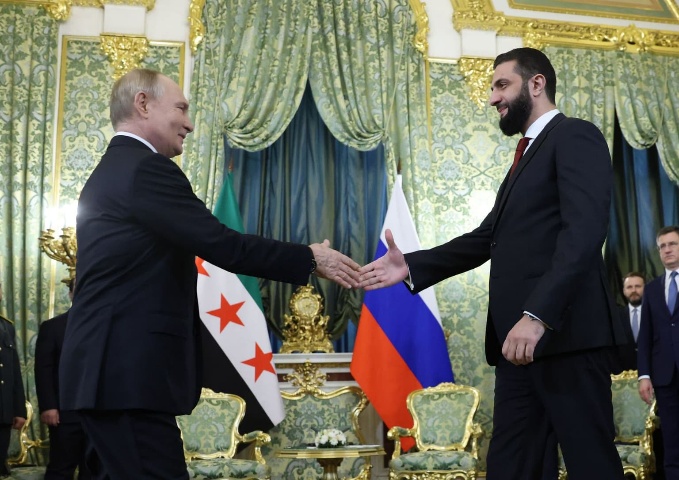
Vladimir Putin welcomes Syrian President Ahmed al-Sharaa to the Kremlin — a meeting that turned former battlefield enemies into negotiating partners, underscoring how Moscow now trades alliances as easily as it once traded arms. (Contributor / Getty Images)
The Meaning in the Mosaic
October 15 revealed a war that no longer fits its old definitions. Ukrainian hackers struck Siberia while Russian drones struck Kharkiv. Courtrooms debated acts of sabotage as oil markets shifted on presidential promises. Teenagers sang forbidden songs in St. Petersburg while European ministers wrote new checks for air defenses.
Every action fed the next. The oil India might stop buying once funded the missiles now falling on Ukraine’s power plants. The sanctions Britain imposed squeezed the tankers that carried that same oil. Germany’s weapons protected a nation defining its own language as an act of resistance. What once looked like separate arenas — military, economic, cultural — had fused into one unbroken front.
The fire still burned in Crimea that night, a column of smoke rising against the dark — not just a refinery in flames, but a world order unraveling in real time. This is what modern war looks like: fought through code and commerce, by drones and diplomats, by artists and algorithms.
The question now is no longer who wins, but what survives — and whether anyone will recognize the world that comes after.