
As Trump courted peace and Putin plotted Budapest, Ukraine faced diplomacy without power and war without end.
The Day’s Reckoning
Three men in three capitals performed a choreography of contradictions.
In Washington, Volodymyr Zelensky sat across from Donald Trump, speaking of missile exchanges while carefully avoiding the word escalation. In Moscow, Vladimir Putin courted Viktor Orbán, preparing a summit that would decide Ukraine’s future without Ukraine. And over Crimea, a Russian fighter pilot died not by enemy fire but by his own air defenses—panic made visible in the night sky.
This was a day when diplomacy and destruction moved in the same rhythm. A two-hour White House lunch could shape the path of Tomahawk missiles; a budget cut in Mari El signaled the strain of Russia’s endless mobilization; fifteen Ukrainian medics were sentenced for the crime of compassion. Every gesture toward peace carried the scent of war. Every promise of restraint masked another escalation.
The world spoke of ending the conflict, yet no one dared imagine the cost of truly stopping it.
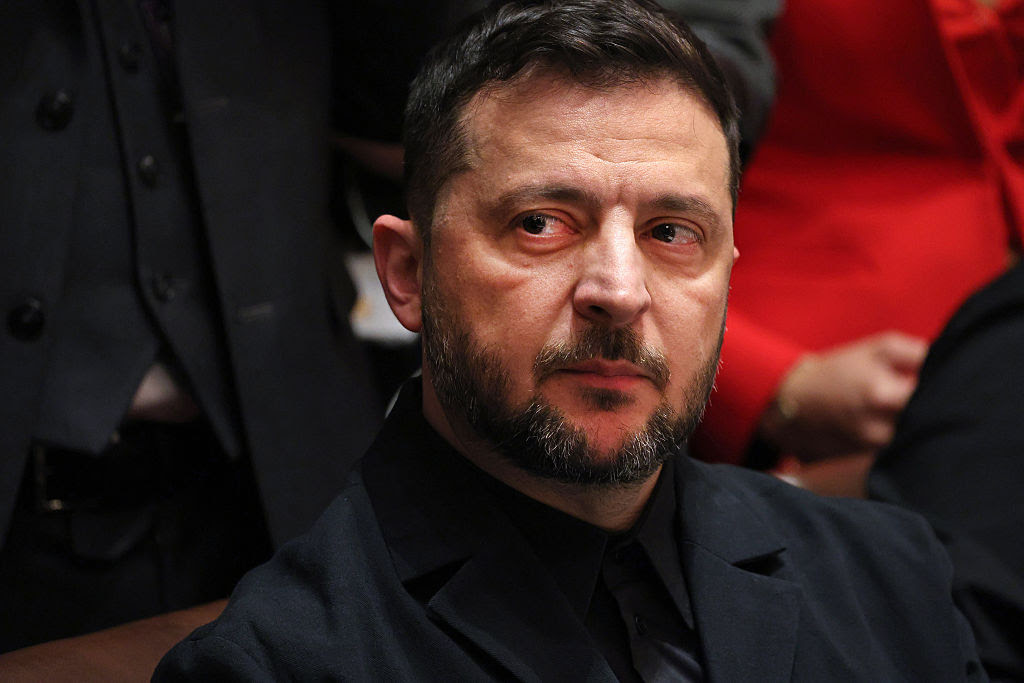
President Volodymyr Zelensky meets with U.S. President Donald Trump in the Cabinet Room of the White House, Washington, D.C. (Tom Brenner / AFP via Getty Images)
The Oval Office Dance: When Zelensky Met Trump
It began with a compliment meant to erase an insult. Donald Trump smiled across the Cabinet Room table and praised Volodymyr Zelensky’s jacket—an echo of their disastrous February meeting, when he’d mocked the Ukrainian leader for not wearing a suit. “It’s actually very stylish,” Trump said, his tone carrying the weight of reconciliation after months of tension.
But the warmth was surface-level. Beneath it ran the same cold equation: Ukraine’s desperate need for Tomahawk missiles met America’s deliberate hesitation. For more than two hours behind closed doors, the two men circled the question both knew was unspoken. Trump called the missiles “dangerous” and warned of “big escalation.” Zelensky countered with pragmatism—offering drone exchanges, thousands of battle-tested Ukrainian UAVs for a handful of American cruise missiles. It was capitalism recast as strategy; war reduced to negotiation over inventory.
Zelensky had arrived in Washington buoyed by reports of Trump’s growing frustration with Putin, hoping that anger might turn into action. But the president’s tone had shifted after his Thursday call with Moscow. The man who once spoke of liberating all Ukrainian territory now urged both sides to “stop where they are.”
“They should stop right now at the battle line,” Trump told reporters later. “Let both claim victory, let history decide.”
It was the language of exhaustion, not resolve—the sound of a superpower too weary to win and too proud to quit.
The Tomahawk Question: Missiles or Messages?
The word Tomahawk hung over every conversation like a specter. With a range of 2,500 kilometers, the cruise missile could reach deep into Russia’s heart—Tatarstan’s Shahed drone factory, Saratov’s Engels-2 airbase, even command centers in the Urals. For Ukraine, it meant leverage and survival. For Russia, it meant humiliation and danger. For Donald Trump, it had become something stranger—a bargaining chip in a diplomatic theater he wasn’t sure he wanted to perform.
Volodymyr Zelensky tried every argument. He spoke of how Russia feared the very mention of Tomahawks, how pairing them with Ukrainian drones could change the war’s trajectory, how America could gain from Ukraine’s combat-tested UAV technology in return. He even laid out a map of possible targets on the table—a blunt appeal to reason cloaked in realism.
But the outcome was already written in Trump’s cautious tone. “The United States doesn’t want escalation,” Zelensky admitted afterward. Behind closed doors, two sources confirmed what both men already knew: the missiles would not come—at least for now.
The reason was clear. Moscow’s warnings had hit their mark. Intelligence chief Sergei Naryshkin called Tomahawk deliveries a “hostile act” that threatened global security, and Putin repeated the message directly to Trump, warning it would “cause significant harm” to U.S.–Russian relations.
The pressure worked. Even as he hosted Ukraine’s president, Trump echoed Russian talking points about restraint. The missiles stayed in their silos, and the word escalation remained the most powerful weapon in the room.
The Commerce of Survival
Behind the cameras and ceremony, Volodymyr Zelensky’s Washington visit revealed war’s quieter front—the marketplace. Meetings with Lockheed Martin and Raytheon executives were less about procurement than partnership. Ukraine was no longer merely a client begging for arms; it was a proving ground offering data, designs, and hard-earned lessons to defense giants whose products had rarely faced an equal adversary.
Zelensky spoke of drones that had adapted mid-battle, of field engineers who rewired Western systems to outsmart Russian jamming. The conversations blurred the line between alliance and enterprise. What began as military aid was turning into co-production, shared patents, and contracts worth billions.
Energy carried equal urgency. With Energy Secretary Chris Wright and American power company leaders, Zelensky sought ways to keep Ukraine lit through another winter of Russian strikes. Each transformer, each megawatt of protected capacity meant survival—heat for families, power for hospitals, and the morale to keep resisting.
By the end of the visit, Ukraine was pitching a “Mega Deal” valued near $90 billion, fusing weapons purchases with drone exports—a reversal that would have been unthinkable three years earlier. The nation once pleading for bullets now offered its allies the blueprints of a new kind of warfare. The student had become the teacher, forged in fire and necessity.
Moscow’s Double Game
While Zelensky spoke of alliances in Washington, Moscow staged its own charm offensive. Kirill Dmitriev, the smooth-faced head of Russia’s sovereign wealth fund and one of Putin’s key envoys, flooded social media with English-language posts promoting joint U.S.–Russian business ventures. His message was deceptively simple: why spend fortunes on war when both sides could profit from peace?
But even as Dmitriev extended his hand, the Kremlin’s other hand clenched a fist. Russian officials warned that supplying Tomahawks to Ukraine would “threaten global stability,” framing restraint as wisdom and escalation as recklessness. It was diplomacy as psychological warfare—seductive, coercive, and precisely targeted at Western hesitation.
The results were visible before the day was over. Trump’s sudden enthusiasm for his Budapest summit with Putin, his reluctance to approve missiles, his repeated calls for both sides to “stop where they are”—all bore the fingerprints of Moscow’s two-faced strategy.
Russia had mastered the art of contradiction: threatening disaster while offering détente, undermining resolve by speaking the language of reason. It was the oldest tactic in empire-building—make the enemy believe that surrender looks like peace.
The Night Panic Claimed a Pilot
Before dawn, the skies over Crimea exploded in light. Ukrainian drones streaked toward the Gvardeyskoye airbase, and Russian air defenses answered with a frenzy of missiles and tracer fire—a frantic display visible for miles. In the chaos, a Su-30SM fighter roared upward to intercept the incoming swarm. Then, in an instant of fatal confusion, Russian radar locked on to its own aircraft.
Intercepted radio chatter later captured the pilot’s last moments—both engines ablaze, the jet spiraling helplessly toward the Black Sea. He was killed not by Ukraine but by his own side’s panic.
When daylight came, the airbase still burned. Ukrainian special forces confirmed the drones had struck their target: an oil depot whose flames sent a pillar of smoke across the peninsula. Yet the greater victory was psychological. Every Russian pilot over Crimea now carried a new fear—not of the enemy above, but of the defenses below.
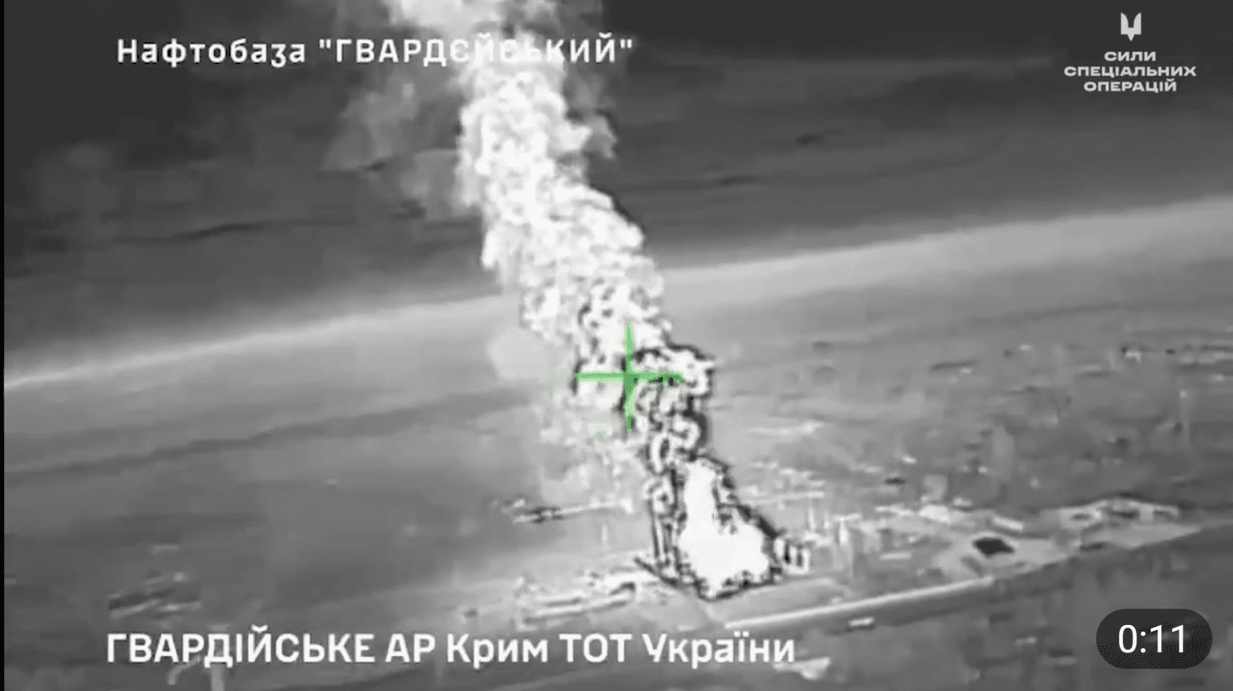
Footage released by Ukraine’s Special Operations Forces reportedly shows a drone strike on a Russian oil depot in Crimea. (Special Operations Forces / Handout)
The Breaking Point
At a base in Naro-Fominsk, west of Moscow, the war’s hidden casualties surfaced in silence and gunfire. A young conscript—trained for a conflict he never expected to fight—raised his rifle and shot a contract soldier before turning the weapon on himself. The official statement from the Moscow Military District offered a single line: “violated firearm handling rules.” It was the bureaucracy’s way of disguising despair.
The base wasn’t a backwater post. It housed elite formations—the 1182nd Guards Artillery Regiment and the famed Kantemirovskaya Tank Division—units once reserved for ceremonial pride, now worn down by the grind of endless mobilization.
That a soldier could shatter under such discipline said what Moscow would not: the strain of a war fought without end was eroding the very army meant to sustain it.
When Money Lost Its Power
Across Russia, the recruitment posters still promised glory, but the math no longer worked. In Mari El, signing bonuses dropped from three million rubles to eight hundred thousand. In Chuvashia, from 2.5 million to eight hundred thousand. In Samara Oblast, from 3.6 million to four hundred thousand. Even St. Petersburg went further, canceling bonuses already pledged to soldiers who had signed their contracts in good faith.
The numbers told a story of exhaustion. For three years, the Kremlin had tried to buy patriotism—offering life-changing sums to men who had little left to lose. But the supply of the desperate was finite. Those willing to die for money had already gone to the front, or they never returned from it.
Now the state was recalibrating. The “volunteer” model that sustained the invasion had become too expensive to maintain and too hollow to inspire. Moscow’s solution was to rebuild the BARS reserve system—not as a loose network of regional militias, but as a centrally controlled pool of manpower that could be activated at will.
The shift was quiet but revealing. Russia’s “special military operation” was shedding the last pretense of voluntarism. What began as a war of choice was turning, inexorably, into a war of conscription.
The Crime of Compassion
In a military courtroom in Rostov-on-Don, fifteen Ukrainian prisoners of war stood to hear their fate. The Russian judge read sentences ranging from fifteen to twenty-one years. Their supposed crime: membership in the Aidar Battalion, a unit Moscow had unilaterally branded “terrorist.” But the truth was simpler and darker. They were medics and drivers—punished not for killing, but for saving lives.
The charges bordered on absurdity: “sustaining the unit’s combat readiness” by treating the wounded, by driving the injured from the front. Among those sentenced were two women already freed in prisoner exchanges, their trials continuing in absentia—ghosts condemned in empty seats.
No specific acts of violence were alleged, no evidence of war crimes offered. The trial was theater, its purpose political rather than judicial. In that Rostov courtroom, international law meant nothing. Every Ukrainian soldier was a terrorist, every act of defense was extremism, and even mercy itself—binding a wound, stopping a bleed—was recast as a crime.
The Engineer Who Refused to Kneel
In occupied Enerhodar—the shadowed city beside Europe’s largest nuclear plant—justice took on a brutal new form. Ruslan Lavryk, a 55-year-old engineer at the Zaporizhzhia power station, was sentenced to sixteen years in prison for what the court called “aiding the enemy.” His real offense was patriotism.
Lavryk had donated money to buy electronic warfare gear for Ukraine’s defenders and, according to Russian prosecutors, passed along information about troop movements in his occupied city. But his deeper “crime” ran simpler: he refused to sign a contract with Rosatom, the Kremlin’s nuclear empire, after it seized the plant.
Like dozens of other Ukrainian engineers, he endured beatings, mock executions, and threats to his family—yet he would not yield. His sentence sent a message to those who remained: submit, or disappear into Russia’s prison system.
Meanwhile, the plant itself tottered on the edge of catastrophe. For twenty-five days it had been disconnected from Ukraine’s grid, surviving on diesel generators while soldiers patrolled its corridors—armed men guarding machinery they didn’t understand. The International Atomic Energy Agency could only observe from behind the glass as Russia turned a nuclear facility into a hostage, and energy into a weapon of war.
The Frontline Equation
In his morning post, Commander-in-Chief Oleksandr Syrskyi declared the enemy’s summer offensive “successfully stopped.” He pointed to the numbers: 29,000 Russian troops killed in September, 45 key enemy facilities struck since the start of the year, and only “minor advances” conceded along the line.
But maps told a subtler truth. Russia had clawed forward southeast of Kupyansk, near Pishchane; inched ahead around Shandryholove northwest of Lyman; and pressed closer to Vyimka near Siversk. Each gain measured in meters cost lives measured in thousands. The war’s grim arithmetic persisted: victory belonged to the side that could lose more and keep fighting.
Geolocated footage showed the daily grind behind the statistics—Ukrainian strikes shredding infiltration attempts near Kupyansk, Russian flags briefly raised in Pryvillya before being blasted down, armored assaults where dozens of vehicles traded fire for fields barely wide enough to matter.
It was the new face of attrition: World War I reborn through drones. Trenches, craters, and static lines stretching across the steppe. Progress that could be charted but never truly seen.
The Air War’s Relentless Toll
The night sky between October 16 and 17 turned into another battlefield. Russia launched seventy drones from multiple directions; Ukrainian air defenses brought down thirty-five, but thirty-one reached their marks across ten locations. In Sumy, a civilian died and four were wounded. Kharkiv counted four more injured. Kherson, two. Dnipropetrovsk, another two. It was the arithmetic of terror, measured not in numbers but in the sound of shattered glass and sleepless nights.
Ukraine struck back where reach allowed. Power substations in Vladimir and Samara oblasts burned through the night. The Gvardeyskoye oil depot in Crimea—already hit by earlier waves—blazed anew. Each drone sent eastward carried not only explosives but intent: to dim the energy grid that powered Russian factories, railways, and the war itself.
Yet the exchange remained cruelly uneven. Russia could plunge entire cities into darkness; Ukraine could only scar the edges of an empire. The power imbalance was literal now—measured in kilowatts and courage, in the will to rebuild faster than the next wave could destroy.
The UN’s Cold Arithmetic
The latest report from the United Nations Human Rights Office measured the war in numbers—but behind them lay faces. Civilian casualties in the first nine months of 2025 had risen thirty-one percent compared to the year before. The killers were not always missiles or glide bombs. Increasingly, they were small FPV drones—cheap, silent, and omnipresent—now responsible for twenty-nine percent of all civilian deaths and injuries: fifty-four killed, two hundred seventy-two wounded.
Along the frontlines, especially in Donetsk and Kherson oblasts, these drones had become the new instruments of terror. Russian operators hunted anything that moved—military convoys, civilian cars, ambulances, evacuation buses. What began as an experiment in Kherson City in late 2023 had evolved into a system of control. Every road became a risk, every open field a potential kill zone.
The UN report spoke in neutral language—percentages, figures, assessments—but its statistics described a new form of cruelty. Civilians now lived under invisible crosshairs, medical services stalled in fear, entire towns frozen between artillery and remote-controlled death. This was violence industrialized through technology—war conducted by operators who never heard the screams.
Europe Holds the Line
While Washington hesitated over Tomahawks, Europe moved quietly but steadily. The European Union approved 300 million euros for Ukraine’s defense industry. Finland pledged 52 million in new military equipment. Luxembourg sent tactical vehicles, drones, and night vision systems—small contributions against war’s vast appetite, yet each one carried symbolic weight as American resolve began to blur.
Europe understood what hesitation could cost. Every Russian advance pushed the front a little closer to NATO borders. Every Ukrainian city that fell sent another wave of refugees toward the west. And every day the war dragged on, the odds grew that it would no longer be contained within Ukraine at all.
The sums may have seemed modest, but together they formed something more powerful than money—a collective refusal to let fatigue decide the outcome.
The Budapest Shadow
Vladimir Putin’s call with Viktor Orbán on October 17 set in motion a summit designed to redraw the map without the people who lived on it. The Hungarian prime minister—already an outlier within the EU for his loyalty to Moscow—offered Budapest as the venue for a meeting between Trump and Putin that would decide Ukraine’s fate without Ukraine present. It was Yalta rewritten for the twenty-first century, the rhetoric of peace masking the logic of partition.
Orbán’s foreign minister promised to guarantee Putin’s safety despite the ICC warrant hanging over him. Hungary would welcome a wanted war criminal to Europe’s heart under the banner of diplomacy. The symbolism was unmistakable: an EU capital preparing to host the man who had set the continent ablaze.
For Zelensky, the news landed like betrayal wrapped in protocol. After six meetings with Trump, after showing target maps and offering drone technology, he found himself written out of the conversation that would define his country’s future. He had come to Washington seeking Tomahawks; he would leave understanding that history might soon be written without him in the room.
Day 1,332: The Reckoning
As October 17 closed, the contradictions of this war stood in plain sight. In Washington, leaders spoke of peace while withholding the weapons that might bring it. In Moscow, recruiters cut bonuses even as new mobilization orders were drafted. In occupied Ukraine, engineers were jailed for patriotism while a nuclear plant balanced on the edge of catastrophe.
The day’s numbers traced the outline of a stalemate: seven hundred thirty Russian casualties, fifteen Ukrainian medics sentenced, one Russian pilot killed by friendly fire, seventy drones launched, thirty-five destroyed. One proposed summit that would decide Ukraine’s fate without Ukraine present.
This was the face of the war’s fourth year—a struggle everyone claimed to want ended, yet no one would end. Trump urged both sides to freeze the lines, rewarding invasion with territory. Putin prepared for Budapest, where diplomacy might conceal conquest. Zelensky returned from Washington with sympathy in place of missiles.
The invasion that began with tanks rushing toward Kyiv had become something else entirely: a theater of diplomacy and attrition, where each gesture toward peace carried the shadow of surrender.
And so, the question remained, unanswered but unavoidable: how does a war end when one side will not stop attacking and the other will not give the means to win?
The truth lingered like the smoke over Crimea’s skies—this war does not end; it simply burns slower, until exhaustion replaces ambition and peace arrives not as victory, but as pause.
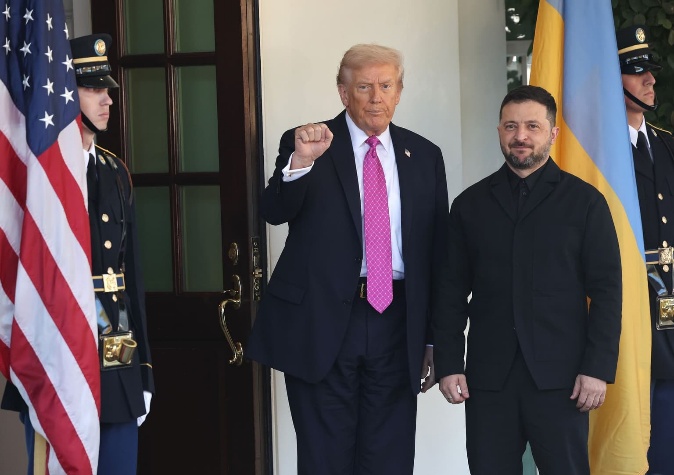
U.S. President Donald Trump greets Ukrainian President Volodymyr Zelensky at the White House in Washington, D.C. (Win McNamee / Getty Images)