
As Medvedev dismissed the Trump formula, Russia’s fuel crisis spread, Zaporizhzhia’s fate tilted toward Moscow, and new guided bombs hit Ukrainian homes.
The Day’s Reckoning
It was a day when the word no echoed from the Kremlin with unmistakable finality. As Western leaders floated fragile peace formulas, Moscow slammed the door shut and turned inward to the logic of total war. Dmitry Medvedev’s blunt rejection of compromise landed like a statement of doctrine — Russia would accept nothing short of Ukraine’s subjugation.
Yet even as the Kremlin projected defiance, the ground beneath it was shifting. Fuel shortages rippled through Russian cities, forcing drivers to queue at empty pumps while state media struggled to mask the scale of collapse. At Zaporizhzhia, a ceasefire billed as humanitarian cloaked a deeper Russian plan to pull the nuclear plant into its own grid. And across Ukraine, new precision weapons struck homes once beyond their reach.
The day revealed a war no longer searching for peace — only new ways to endure destruction.
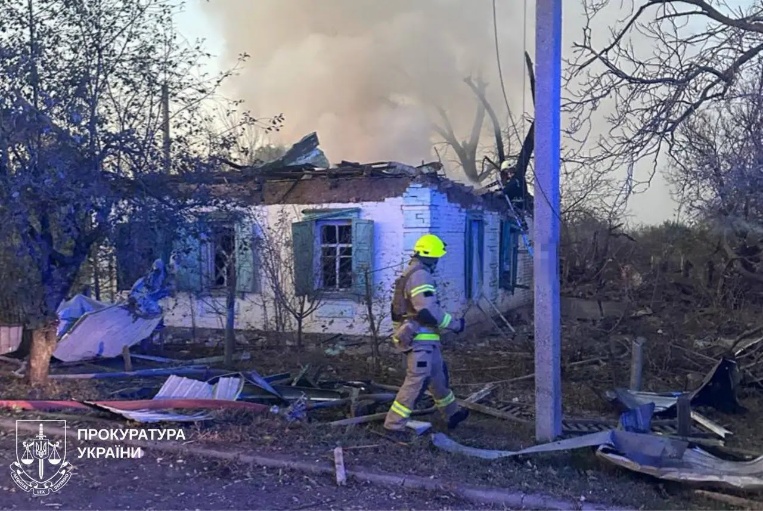
First responders dig through the wreckage after a Russian strike in Kharkiv Oblast — one of dozens that tore through civilian areas as the war’s reach widened. (State Emergency Service / Telegram)
Moscow’s Explicit Rejection — When the Kremlin Slams the Door
Dmitry Medvedev spoke with the bluntness of a man who wanted no misunderstanding. In twin posts in Russian and English, the former president and current Security Council deputy made clear that Donald Trump’s call for both sides to “claim victory” and seek settlement was meaningless to Moscow. Russia, he said, required victory “with the conditions everyone knows.”
Those “conditions” were the same demands that preceded the invasion: a pro-Russian regime in Kyiv, enforced neutrality that bars NATO membership, the abandonment of NATO’s open-door policy, and the dismantling of Ukraine’s defenses. In other words, capitulation.
What made the statement significant was not its content but its timing. Barely a day after President Zelensky returned from Washington without new weapons commitments, the Kremlin publicly shut the diplomatic door Trump had tried to open. Moscow now viewed negotiation not as opportunity but as weakness — and believed that time was working in its favor.
The Nuclear Calculation — A Ceasefire Concealing a Longer Strategy
The IAEA’s announcement sounded, at first, like progress. Ukrainian and Russian forces had agreed to a localized ceasefire so engineers could repair power lines feeding the Zaporizhzhia Nuclear Power Plant — four weeks into the longest blackout in its history. Director General Rafael Grossi praised both sides for “constructive engagement,” calling external power restoration “crucial for nuclear safety.”
But beneath the humanitarian veneer lay a deeper game. Russia had engineered the blackout itself by shelling the very lines it now pretended to help restore. During the month of darkness, Russian engineers advanced a 201-kilometer corridor designed to tie Zaporizhzhia into Russia’s grid. The crisis gave Moscow time and cover.
The “ceasefire” was no act of cooperation but an intermission — each repair Ukraine made bought Russia more time to finish its takeover. Once complete, Zaporizhzhia would cease being a hostage facility and become a captured Russian energy asset, feeding Moscow’s war economy and tightening its grip on Europe’s nuclear heart.
When Ordinary Russians Feel the War — The Gasoline Crisis Becomes Personal
What began as an abstract statistic has turned into a daily frustration for millions. A Gazeta.ru survey revealed how deeply the fuel crisis now cuts: three-quarters of Russian drivers reported steep price hikes since August, and nearly one in five had arrived at gas stations that were completely dry.
The Kremlin could no longer hide it. Ninety percent of drivers expect further increases; more than half have changed their habits, some driving less, others forced to buy low-grade gasoline that damages engines. Even China’s Geely Motors blamed Russia’s degraded fuel for mechanical failures.
The cause lies hundreds of kilometers away — in the smoking ruins of Russian refineries hit by Ukrainian drones. The strikes crippled production and forced Moscow to ration and dilute supplies. By mid-October, shortages had spread to 57 regions. For the first time since the war began, the pain of the battlefield has reached the ordinary Russian motorist — a war that once felt distant now burns at the pump.
The War Expands Its Reach — New Weapons Strike New Cities
For residents of Lozova, the sound came first — a low roar climbing into a shriek before the explosion. The guided bomb that hit their neighborhood was no ordinary munition. Investigators confirmed it as the UMPB-5R, a rocket-powered, precision-guided bomb with a 130-kilometer range.
Five civilians were wounded, and homes lay shattered in its wake. The strike marked the weapon’s first recorded use — and a new chapter in Russia’s ability to reach deep into Ukrainian territory.
Every new system extends the geography of fear. The UMPB-5R’s debut means that cities once thought beyond reach are now within flight time. The front line is dissolving not because it moves, but because the weapons do.
Battleline — The Eastern Front Grinds Forward
Across the eastern front, the war pressed on without pause but with little reward. Russian assaults surged from Kupyansk to Pokrovsk, battering towns already reduced to rubble. Infantry groups advanced on foot under drones and artillery fire — small, expendable units pushing through a landscape of craters.
In the north, attacks near Lyman and Siversk failed to breach Ukrainian defenses. Officers described a shift to “walking warfare”: men advancing in pairs or threes to avoid detection. Around Kostyantynivka and Druzhkivka, counterattacks flickered back and forth, each claiming ground measured in meters. In Pokrovsk, glide bombs replaced drones as Russian forces adjusted to Ukrainian jamming, with 121 airstrikes recorded since the start of the month.
Further south, the pattern repeated across Zaporizhzhia and Kherson — pressure without progress. Soldiers on both sides spoke more of endurance than victory. The front has become a war of attrition measured not by territory but by who can still move under the drones.
The Air War and Civilian Cost — Night of Fire and Fear
The night sky glowed with the trails of drones and interceptors as Ukraine endured one of its heaviest barrages of the month. Russia launched 164 drones; 136 were downed, but twenty-seven found their targets.
Energy infrastructure was again the focus. Power stations in Chernihiv and Kharkiv oblasts went dark, leaving 12,000 without electricity. Emergency outages rippled through Dnipropetrovsk and Poltava. A 58-year-old man was killed, and more than a dozen wounded nationwide — an elderly woman in Kharkiv, a young driver in Kherson, civilians caught in fires and collapsing homes.
In Cherkasy, seven drones were destroyed before reaching the city, yet falling debris still ignited a home. The Slovyansk administration reported more than 150 drone attacks since July — nearly matching the total of the first half of the year. Each night’s silence now feels temporary, each dawn another brief reprieve.
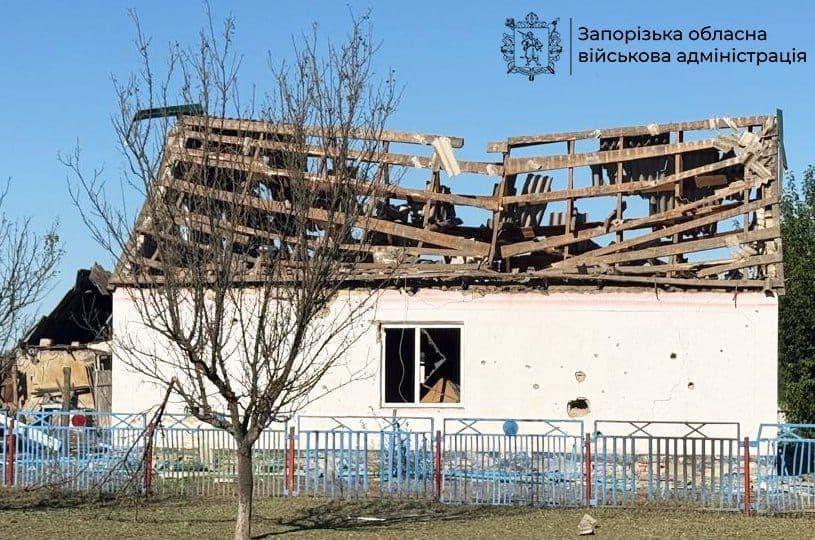 A home stands gutted in Zaporizhzhia Oblast after a Russian drone strike, its roof peeled open like paper amid the wreckage of another night’s assault. (Zaporizhzhia Oblast Military Administration / Telegram)
The European Response — Sanctions Momentum Builds
Europe’s machinery of pressure finally lurched forward. Austria dropped its resistance to the EU’s 19th sanctions package against Russia after weeks of stalling over compensation demands for Raiffeisen Bank. The reversal cleared the way for new measures — tighter financial restrictions and an accelerated ban on Russian LNG imports now scheduled for January 2027, a year earlier than planned.
Slovakia, another hesitant member, appeared ready to join after receiving assurances from Brussels. EU foreign ministers are expected to formalize the package in Luxembourg within days. The step may look procedural, but timing is the point: Europe is showing that its resolve, though slow, still moves in one direction.
Analysis and Looking Forward — A War of Converging Pressures
Every front, every crisis, fed the others. Moscow’s defiance reinforced its isolation, while Ukraine’s strikes on refineries and infrastructure pushed the war into Russia’s domestic life. The Zaporizhzhia ceasefire advanced under the pretense of safety even as it tightened Moscow’s grip on the nuclear grid. New guided bombs extended terror to cities once beyond reach.
What emerged was a war feeding on its own momentum — Russia fighting harder as its resources falter, Ukraine striking deeper as Western support thins. Escalation has replaced negotiation; pauses are now tactics, not peace. The trajectory is uncertain but unmistakable: the longer the war endures, the fewer exits remain.