
As the Kremlin backtracked on its own concessions, Ukraine struck deep into Russia’s energy heartland, redrew the map of deterrence with 1,500-kilometer precision, and won new allies through energy diplomacy and covert resistance behind enemy lines.
The Day’s Reckoning
The war’s 1,334th day began with contradiction and ended with clarity. Moscow spent the morning denying the words its own leader had reportedly spoken to Donald Trump, scrambling to assure domestic audiences that no territory was negotiable. Yet by nightfall, Ukraine had already rewritten the story—not through diplomacy, but through distance. Drones streaked more than 1,500 kilometers into Russia’s energy heartland, igniting refineries and halting one of the world’s largest gas complexes.
While the Kremlin tried to unsay itself, President Zelensky moved in the opposite direction—forward. He pitched America a new energy partnership designed to replace Russian oil and gas altogether, turning Ukraine’s survival into Europe’s energy future. At the same time, partisans struck deep in Bryansk, cutting Russian command lines and proving that occupation no longer guaranteed control.
Across the region, allies chose their sides. Poland rejected any pressure for concessions. Belarus dangled a mediation offer that rang hollow. And in Washington, Trump’s casual talk of “property lines” revealed how far detached politics had drifted from principle.
By day’s end, every actor was speaking a different language—Moscow’s denial, Kyiv’s defiance, Washington’s ambiguity, Warsaw’s resolve—but the meaning was unmistakable: Ukraine was no longer waiting for permission to shape the war’s outcome.
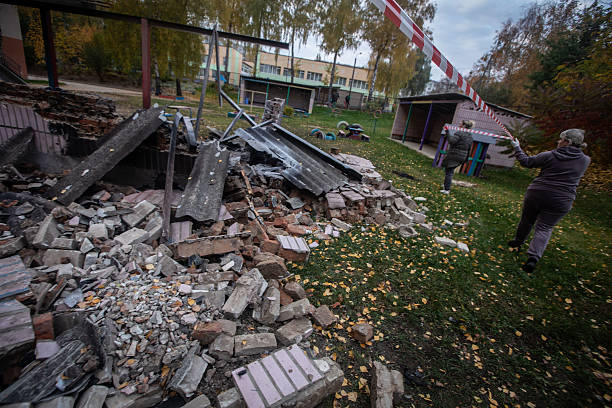
Preschool staff in Sumy rope off a playground scattered with drone debris — a reminder that in Ukraine, even places built for laughter now bear the marks of war. (Francisco Richart Barbeira / NurPhoto via Getty Images)
When the Kremlin Argued With Itself
Moscow began the day rewriting its own story. Hours after reports surfaced that Vladimir Putin had offered Donald Trump a deal trading slices of occupied Ukraine for a freeze on the war, the Kremlin’s loyalists rushed to deny it ever happened.
Alexei Chepa, first deputy head of the State Duma’s International Affairs Committee, told the state outlet Lenta that Kherson and Zaporizhzhia oblasts “are recognized regions of Russia” following the sham referenda of 2022. Any talk of concessions, he insisted, had been spoken “in a more relaxed manner”—a euphemism designed to soften, or erase, what Putin had just proposed.
The message was aimed squarely at domestic audiences. Chepa’s denial signaled that the Kremlin still claimed all of Kherson and Zaporizhzhia as sovereign Russian territory, and that Putin’s supposed offer to Trump had no official standing. But Russia’s own nationalist commentators were less diplomatic. Prominent milbloggers derided the idea as “utter nonsense,” scoffing at the thought of surrendering a “convenient defensive line” along the Dnipro River or the vital land bridge to Crimea merely to formalize control over the rest of Donetsk Oblast.
Their outrage revealed the deeper problem Putin faces: the moment he hints at compromise abroad, his base interprets it as betrayal at home. October 19 showed that even within Moscow, the war’s narrative has become a trap of its own making—one where admitting reality risks rebellion, and denial becomes the only language left to speak.
1,500 Kilometers of Fire: Ukraine’s Reach into Russia’s Energy Heart
Before dawn, the night sky above Samara and Orenburg glowed the color of burning oil. Ukraine had struck again—this time deeper than ever before.
Geolocated footage confirmed massive fires tearing through the Novokuibyshevsk oil refinery in Samara Oblast, with plumes of black smoke curling over the Volga like a second horizon. The refinery’s main processing unit took a direct hit. It was no small target: the facility refines nearly five million tons of oil a year, producing over twenty grades of fuel and industrial products vital to Russia’s energy economy.
Farther east, another explosion lit the steppe—this one at the Orenburg natural gas processing plant, one of Russia’s largest. Flames consumed part of its purification complex, halting operations at a facility that normally processes 45 billion cubic meters of gas and 6 million tons of condensate annually. Governor Yevgeny Solntsev confirmed “partial damage” but gave no numbers—an omission that spoke louder than figures could.
The effects rippled beyond Russia’s borders. Kazakhstan’s Ministry of Energy said the strike had forced the Orenburg plant to suspend intake from the Karachaganak oil and gas project, one of Kazakhstan’s top three producers. Because the plant handles both crude and gas, the disruption meant oil output itself had to be reduced—a reminder that Ukraine’s drones were now rewriting Eurasia’s energy map.
Ukrainian broadcaster Suspilne called Orenburg “the largest gas-chemical complex in the world.” Whether or not that’s technically precise, the symbolism was unmistakable: Ukraine had reached more than 1,500 kilometers into Russia’s industrial core—and proven that no corner of the empire’s energy machine was beyond its grasp.
Zelensky’s Energy Revolution: Turning Away from Moscow’s Shadow
While Russian oil fields burned, Volodymyr Zelensky was busy charting a different future. In his evening address, the Ukrainian president announced new bilateral energy proposals to the United States—projects in gas infrastructure, nuclear power, and other advanced systems meant to replace Europe’s dependence on Russian fuel altogether.
“There should be zero Russian energy resources in Europe,” he declared, his words aimed as much at Washington as at Brussels.
Zelensky revealed that the U.S. had expressed readiness to supply Europe with “as much gas and oil as is needed,” positioning Ukraine as a bridge between American energy abundance and Europe’s growing hunger for independence from Moscow. He spoke of existing pipelines, storage hubs, and nuclear expertise that could be repurposed to power an entirely new alliance—one where Ukrainian resilience became Europe’s energy engine.
Specifics remained undisclosed, and the Trump administration offered no confirmation. Yet the strategy was clear. As Russia weaponized oil and gas to fund its invasion and intimidate its neighbors, Ukraine was offering itself as the alternative—an energy hub born from defiance.
October 19 thus marked more than another day of war; it hinted at a geopolitical shift. While Moscow struggled to hold onto stolen land, Kyiv was already competing for the future’s most powerful currency: energy independence.
The Ghost Network: Partisans Strike Russia’s Nerve Lines
In the forests of Bryansk Oblast, the war came from the shadows. The Ukrainian partisan network ATESH claimed responsibility for a sabotage operation that severed Russian military communications deep behind the front. Their target: a key transmission tower coordinating border troops and occupation forces across the region.
The explosion reportedly crippled links to Russia’s Border Service, the 84th Engineering and Airfield Battalion, and a Rosgvardiya unit stationed nearby—disrupting command chains and throwing local operations into disarray. ATESH described the attack as part of a broader campaign to make Russian forces feel unsafe even in territory they believed secure.
“The enemy cannot feel safe even deep behind the front lines,” the group declared, its message spreading through encrypted channels. Moscow stayed silent, offering no acknowledgment and no denials—only the familiar void that follows a successful hit.
Each act of sabotage underscores a new dimension of Ukraine’s resistance: an invisible front stretching across occupied land and into Russia itself. It is a war not just of soldiers and drones, but of networks, whispers, and midnight detonations—fought by those who refuse to live under silence.
The Transaction of War: Trump’s Lines and Putin’s Property
On American television, the war was reduced to real estate.
In an interview with Fox News host Maria Bartiromo, Donald Trump spoke casually about Vladimir Putin’s “property” — his word — days after their October 16 phone call. When asked whether the Russian leader would accept peace without territorial gain, Trump replied, “Well, he’s going to take something. I mean, they fought and uh, he has a lot of property… he’s won certain property.”
There was no mention of sovereignty, borders, or international law — only the notion that conquest earns ownership. To Trump, the war’s moral question had become a matter of “war and guts,” as he later wrote online, suggesting Kyiv and Moscow should settle along whatever lines the fighting had carved.
He went further, framing America’s past wars as failures precisely because it had not kept what it destroyed. “We’re the only nation that goes in and wins a war and then leaves,” he said. “We blast the hell out of everybody, destroy the place, and then we leave.”
The remark revealed the transactional worldview that still shapes Trump’s foreign policy rhetoric — one in which might defines right, and territory becomes a trophy of endurance. For Ukraine, it was a chilling reminder that even its allies’ debates could blur the line between strategy and surrender.
Zelensky Draws the Line: “We Will Give Nothing to the Aggressor”
When the cameras of NBC’s Meet the Press turned toward him, Volodymyr Zelensky didn’t flinch. The Ukrainian president made it plain: no territory would be traded for peace, and no ceasefire would come under fire.
“If we want to stop this war and go to peace negotiations, urgently and in a diplomatic way, we need to stay where we stay,” he said. “Not to give something additional to Putin because he’s a terrorist.”
It was a direct rebuke to Donald Trump’s suggestion that Ukraine and Russia “define property lines by war and guts.” Zelensky’s reply carried neither anger nor hesitation—only conviction. “We will give nothing to the aggressor,” he declared later in his nightly address.
Pressed on whether a ceasefire could precede negotiations, Zelensky was firm: talks could only occur “not under missiles, not under drones.” The condition was as much moral as tactical. To sit down while Russia still bombed civilian cities, he implied, would be to legitimize terror.
He also warned that Putin’s renewed air campaign was being fueled not by battlefield success but by imports from abroad. “On the battlefield, Putin’s not winning,” he said. “That’s why he really escalates air strikes”—a nod to weapons support flowing from North Korea, China, and Iran.
On this day, Zelensky didn’t just reject an offer. He redrew the terms of courage: no deals made under duress, no peace built on fear.
When Warsaw Drew Its Own Line
From Warsaw came a voice of clarity amid the noise of compromise. Polish Prime Minister Donald Tusk broke ranks with the chorus of Western ambiguity, declaring that Ukraine must not be pressured to trade land for peace.
“None of us should put pressure on Zelensky when it comes to territorial concessions,” Tusk wrote on X. “We should all put pressure on Russia to stop its aggression. Appeasement never was a road to a just and lasting peace.”
It was more than a statement—it was a warning drawn from history. In a region that still bears the scars of shifting borders and broken promises, Poland’s message carried moral weight. Tusk’s words reminded the West that peace built on surrender is not peace at all—it is preparation for the next war.
Minsk’s Mirage: When Belarus Offered “Peace”
From across Ukraine’s northern border came an offer that sounded like diplomacy but felt like theater. Ivan Tertel, head of Belarus’s State Security Committee, appeared on state television declaring his agency ready to open a “dialogue” with Kyiv to “find a consensus” and end the war.
“Our president works as much as possible to stabilize the situation in the region,” Tertel said, boasting that Minsk had “managed to balance the interests of the parties” amid an escalating conflict. He called for “quiet and calm negotiations,” insisting that “a lot depends on the Ukrainian side.”
Kyiv, aware that Belarus remains a launchpad for Russian aggression, offered no reply. The silence spoke for itself.
For Ukraine, Tertel’s overture was less an olive branch than a reminder of Belarus’s complicity—a state whose soil hosted the missiles that once thundered toward Kyiv now claiming the role of mediator. The proposal faded as quickly as it appeared, another diplomatic mirage shimmering north of the border.
Fire from the Skies: The New Arithmetic of Terror
The night over Ukraine was once again alive with engines. From Millerovo to Smolensk, Russia launched a wave of 62 drones—Shaheds, Gerberas, and other strike types—fanning out toward Ukrainian cities like a swarm of mechanical hornets. Forty never made it. Ukrainian air defenses cut them down before they reached their marks. But nineteen slipped through.
In Shakhtarske, shattered glass and burning cars marked their path. Drones struck apartment blocks, a store, and residential streets, injuring eleven civilians—ordinary people caught in a nightly routine that has become the soundtrack of the war: the distant hum, the sirens, the impact.
President Zelensky reported that since October 12, Russia has launched 3,720 strike drones, 1,370 glide bombs, and nearly 50 missiles across Ukraine—numbers that now form a grim kind of arithmetic, where every equation ends with destruction.
The drones come from every direction—Rostov, Kursk, Oryol, Smolensk, Krasnodar—a geography of aggression that stretches across half a continent. Each night Ukraine counts the incoming and the intercepted, calculating survival in real time.
Beneath the Flames: When the Miners Waited in the Dark
The ground shook before dawn in Dnipropetrovsk Oblast, where Russia turned its war once again toward Ukraine’s energy lifeline. A missile strike tore into a DTEK coal enterprise, trapping 192 miners far below the surface.
For hours, they waited in the dark—listening to the rumble above, unsure whether rescue would come or if the tunnels would collapse around them. Then, one by one, the elevators began to move. By the day’s end, every miner had been brought safely to the surface, a small miracle carved out of catastrophe. None were injured, though their workplace burned above them.
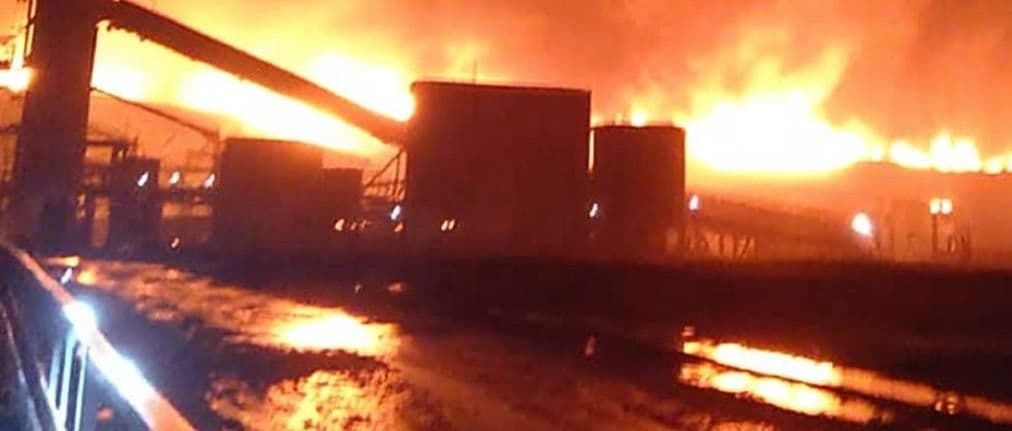
Flames engulf a DTEK coal complex in Dnipropetrovsk Oblast after a mass Russian strike, trapping nearly two hundred miners below ground before rescuers brought them to safety. (DTEK / Telegram)
It was the fourth large-scale attack on DTEK facilities in two months—a campaign aimed not at soldiers but at the foundations of Ukraine’s survival. DTEK, the country’s largest private energy company, has become a recurring target in Russia’s attempt to cripple power generation and grind down morale.
The images from that night showed a wall of fire stretching across the industrial skyline, reflected in black pools of water below. For Ukraine’s miners, it was a reminder that even in the earth’s depths, the war could still find them.
The Fractured Conversation: A War Speaking in Different Tongues
October 19 unfolded like a conversation no one could translate. Moscow denied its own words. Trump treated conquest as negotiation. Belarus played the mediator while hosting the aggressor. Poland drew a moral line. Ukraine struck oil refineries 1,500 kilometers away and proposed a new energy order built without Russia at all.
Every actor spoke a different language—of power, denial, commerce, or conviction—and none truly listened to the others. Diplomacy, warfare, and propaganda ran on parallel tracks that no longer met. The Kremlin’s internal contradictions deepened, while Ukraine’s defiance expanded outward—militarily, economically, and morally.
The pattern was unmistakable: Russia is trapped defending illusions of empire; Ukraine is building the scaffolding of a different future. The next phase of this war will turn on which of those visions the world chooses to believe—and how long denial can hold against reality.