
In Windsor Castle, Zelensky secured Europe’s long-term support. In Pokrovsk, Russian forces pushed into the city center through streets of rubble. In Kherson, artillery rained down in the worst bombardment in months. The 1,339th day of war—when diplomacy and destruction happened in parallel universes.
The Day’s Reckoning
The contrast was almost absurd.
In Windsor Castle, Zelensky stood beside King Charles III as European leaders pledged Tomahawk missiles and long-term security guarantees. In Washington, Russia’s economic negotiator landed at Dulles carrying Moscow’s maximalist demands dressed as peace proposals. In Pokrovsk, Russian tanks ground through the city center, crushing rubble beneath their treads. In Kherson, artillery killed two civilians and wounded twenty-one in one of the worst bombardments in months.
Putin threatened a “stunning response” to Tomahawk deliveries. His spokesman blamed Ukraine for the “protracted pause” in negotiations. The Central Bank lowered interest rates for the fourth time since June, pretending monetary policy could fix an economy bleeding into defense spending.
Ukrainian forces answered differently. Near Kupyansk and Lyman, mechanized assaults recaptured villages. In Stavropol, Ukrainian intelligence eliminated three Russian soldiers. At Ryazan, Ukrainian strikes halted refinery operations. Across the front, Ukrainian defenders destroyed dozens of Russian armored vehicles.
Day 1,339. Two wars happening simultaneously—diplomats proposing ceasefires in capitals while artillery leveled cities and tanks crushed streets. The question wasn’t which reality was real. Both were. The question was which would ultimately matter more: promises made in palaces, or blood spilled in rubble.
Nobody knew. So, diplomats kept talking, tanks kept rolling, and artillery kept firing.
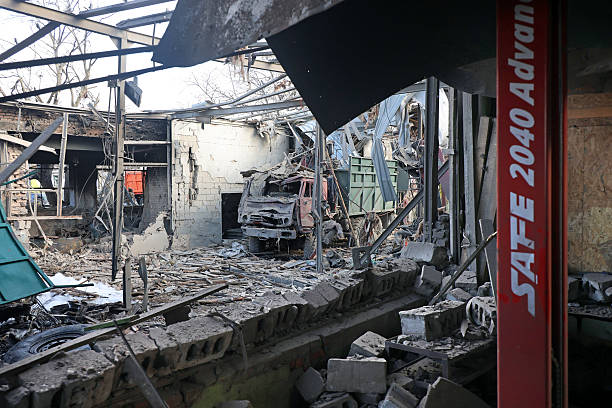
What precision-guided munitions do to civilian life: A crushed truck sits amid the wreckage of a Kharkiv enterprise after Russian forces struck the Industrialnyi district with guided bombs. Workers had parked here yesterday. Today it’s twisted metal and concrete dust. Another day in Ukraine’s industrial heartland under bombardment. (Viacheslav Madiievskyi/Ukrinform/NurPhoto via Getty Images)
Into Pokrovsk’s Bones
The geolocated footage confirmed what Ukrainian defenders had been reporting for days: Russian infantry were inside Pokrovsk. Not just probing the edges—inside. Central and western districts. Positions along the railway line bisecting the city. Small groups that had been operating for over a week, digging into buildings and basements south of the tracks.
But “inside” didn’t mean “control.”
Even Russian milbloggers couldn’t map the situation clearly. A Kremlin-affiliated source admitted it was impossible to determine where Russian forces actually maintained enduring positions. By military definition—the ability to prevent enemy use of terrain and create conditions for friendly operations—Russian forces controlled nothing in Pokrovsk. They just existed there. Isolated groups in cellars. Soldiers in bombed-out apartments. Infantry holding individual buildings while Ukrainian forces operated three blocks away.
The front line had dissolved into something more complex than red and blue lines on maps. It was porous, fluid, deadly. Ukrainian forces operated throughout Pokrovsk. Geolocated footage showed them striking a Russian position in the southeast after an infiltration attempt that gained nothing. Both sides were now conducting raids into each other’s nominal rear areas—the kind of fighting that happens when urban warfare shreds any concept of “front” and “rear.”
Ukrainian military observer Kostyantyn Mashovets reported Ukrainian forces infiltrating Russian-held areas near Sukhetske northeast of Pokrovsk, ambushing Russian units attempting resupply. The increasingly permeable battlefield meant both sides faced the same problem: defend everywhere or risk surprise attacks anywhere.
Eight kilometers east, at Myrnohrad, the story was different.
Russian 5th and 9th motorized rifle brigades were attacking from three directions—Novoekonomichne, Myrolyubivka, Mykolaivka. But Ukrainian defenders were holding. Recently, they’d pushed Russian forces back from the eastern and northern outskirts. The same Russian units grinding into Pokrovsk’s center were struggling to penetrate Myrnohrad at all.
Russian Ministry of Defense claimed seizure of Promin east of Pokrovsk. Victory announcements for cameras. Meanwhile, Mashovets reported Russian forces struggling to hold positions in eastern Rodynske and Krasnyi Lyman—both north of Pokrovsk. Advance in one sector. Lose ground in others. The grinding arithmetic of attritional warfare.
The timeline for Pokrovsk’s fall remained unknowable. The city had twice Toretsk’s pre-war population. Russian forces had spent fourteen months capturing Toretsk after establishing initial positions in June 2024. Pokrovsk had been contested for weeks, not months. Even if Russian forces consolidated their current gains, they’d need to clear Myrnohrad first—a separate urban battle they weren’t winning—before exploiting Pokrovsk’s capture.
Several more months of this. At minimum. Building-to-building fighting. Cellars and rubble. Small unit actions where neither side controlled anything cleanly but both sides bled for every meter. Russian forces were in Pokrovsk. They weren’t going to take Pokrovsk anytime soon.
The grind continued. Block by block. Body by body. A city dying in pieces.
The Threat Putin Couldn’t Define
Kremlin Spokesperson Dmitry Peskov delivered the line with practiced menace: Vladimir Putin “promised a stunning response not only to the Tomahawk missile deliveries… but to any attempt to carry out strikes deep into Russian territory.”
Stunning. The word hung in the air, deliberately vague. Nuclear weapons? Conventional strikes on NATO? Cyber attacks? Peskov didn’t say. That was the point—make the threat ambiguous enough that Western audiences would imagine the worst, then let fear do the work Russian military capacity couldn’t.
Tomahawks became the latest red line in a war where the Kremlin had drawn and erased dozens. Threaten nuclear war over HIMARS. HIMARS arrive. No nuclear war. Threaten devastating retaliation over tanks. Tanks arrive. No devastating retaliation. F-16s, same pattern. Now Tomahawks.
The threats served multiple purposes: obfuscate Russian military weaknesses, frame Ukrainian strikes as Western aggression, create pretexts for Russian escalations. Moscow notably offered no reciprocal restraint—no promise Russia would refrain from escalating if America withheld Tomahawks.
The logic was simple: heads we escalate, tails we escalate, and either way we’ll claim you forced our hand.
In Windsor Castle, European leaders were deciding whether to call the bluff. The same calculation made dozens of times before—believe Russia’s threats and constrain Ukraine, or provide the weapons and discover if Moscow’s red lines were real or theater.
History suggested theater. But the consequences of being wrong kept the debate alive.
Moscow’s Peace Terms: Total Surrender by Another Name
Peskov blamed Ukraine for the “protracted pause” in negotiations. Europe was encouraging Ukrainian intransigence, he claimed—the familiar Kremlin script that portrayed Russia as the reasonable party eager for peace if only stubborn Kyiv would negotiate.
The script ignored what Russian Foreign Minister Sergei Lavrov had said days earlier: yes, the West viewed Russia’s position as “maximalist.” Yes, “Russia has not altered its positions.” Yes, Moscow still demanded the war’s “root causes” be addressed—NATO expansion and Ukraine’s alleged discrimination against Russian speakers. The same justifications Putin used when launching the invasion.
Translation: Russia’s negotiating position hadn’t moved in three years.
Russian officials had been consistent about their terms. Ukraine’s neutrality—meaning no NATO membership, no Western security guarantees, perpetual vulnerability to future Russian aggression. Alteration of NATO’s open-door policy—meaning Moscow gets veto power over alliance expansion. And the unspoken requirement: installation of a pro-Russian proxy government in Kyiv.
These weren’t peace terms. They were demands for Ukraine’s complete capitulation dressed in diplomatic language. Russia would accept negotiations the moment Ukraine agreed to surrender its sovereignty, abandon its security relationships, and install leaders Moscow approved. Until then, Peskov would keep blaming Kyiv for refusing to negotiate its own extinction.
Zelensky’s position was different. Ukraine had demonstrated willingness to engage in substantive peace initiatives, including recently aligning with Trump on implementing an immediate ceasefire. But ceasefire didn’t mean surrender. It didn’t mean accepting Russian territorial conquests or abandoning NATO aspirations or installing Kremlin-approved leadership.
The “protracted pause” in negotiations existed for a simple reason: Russia demanded total victory disguised as compromise, while Ukraine insisted on survival. One side wanted negotiations. The other wanted capitulation called negotiations.
Guess which side Peskov blamed for the impasse.
The Envoy Carrying Impossible Terms
Kirill Dmitriev landed at Dulles with a briefcase full of proposals and no intention of actual compromise. The Kyiv-born head of Russia’s Direct Investment Fund was flying into Washington days after Trump had imposed his first sanctions on Russian oil giants—Rosneft and Lukoil—to discuss “the U.S.-Russia relationship.”
The timing was either bold or delusional.
Dmitriev had become the Kremlin’s favorite intermediary to Trump’s circle, having visited in April and participated in Alaska talks in August. Now he was scheduled to meet Trump’s special envoy Steve Witkoff in Miami. Moscow’s goal was transparent: salvage the collapsed Putin-Trump summit despite sanctions and recent cancellations. Keep diplomatic channels open while Russian forces ground deeper into Pokrovsk.
Deputy Foreign Minister Sergei Ryabkov had already laid the groundwork, expressing Russia’s desire to extend the New START Treaty expiring in February 2026. “The first step toward cooperation could be the re-establishment” of dialogue, Ryabkov suggested—framing arms control as the path to broader engagement.
The Kremlin’s playbook was consistent: engage Washington on anything except actually ending the war on terms Ukraine could accept. Arms control? Happy to talk. Space cooperation? Absolutely. Economic partnerships? Let’s discuss. Withdrawing from occupied Ukrainian territory? Silence.
Meanwhile, Russian Foreign Ministry Spokesperson Maria Zakharova was already working to weaponize any potential cooperation. She claimed Ukraine and its allies were promoting an “anti-Russian smear campaign on the children’s issue”—preemptively discrediting U.S. Senate consideration of bills recognizing Russia as a state sponsor of terrorism for abducting Ukrainian children.
Dmitriev’s mission was clear: convince Trump’s team that bilateral cooperation was possible, that sanctions could be lifted, that the summit could be salvaged—all without Russia making any meaningful concessions on Ukraine. Offer everything except what mattered. See if Washington would take the bait.
The question was whether Trump’s officials would accept negotiations that carefully avoided negotiating what actually needed negotiating: ending Russia’s war.
Rearranging Deck Chairs on the Ruble
The Russian Central Bank announced its fourth interest rate cut since June: from 17 to 16.5 percent. The stated goal was freeing capital for defense industries while projecting economic stability after U.S. sanctions hit oil giants. The unstated reality was that Russia’s wartime economy was burning through resources faster than it could replace them, and monetary policy couldn’t fix that.
The Bank’s statement acknowledged what it tried to minimize: “significant cooling in sectors oriented toward external demand.” Translation: international trade was collapsing under sanctions. Inflation would “temporarily increase” in late 2025 and early 2026 due to “external economic factors.” Translation: sanctions were working, and prices would keep rising.
Russia’s labor market showed “persistent tensions”—economist-speak for an economy where defense industries competed with civilian enterprises for workers, driving wages up across all sectors. The Kremlin’s strategy of offering massive one-time payments to military recruits had created a bidding war. Defense factories needed workers. Civilian companies needed workers. Both were competing with military recruitment bonuses that sometimes exceeded annual civilian salaries.
The result: wage inflation driving price inflation driving economic instability that interest rate adjustments couldn’t solve.
Moscow was already preparing the next move. Recent regulations set conditions for involuntarily mobilizing reservists—men who’d completed military service and thought they were done. Forced mobilization would let the Ministry of Defense reduce or eliminate recruitment bonuses. Conscript soldiers for free instead of paying volunteers premium wages.
The interest rate cut was theater. Lower rates might marginally increase capital availability for defense production, but they couldn’t address the fundamental problem: Russia was spending unsustainably on a war that consumed everything—men, money, industrial capacity, economic stability—while Western sanctions accelerated the deterioration.
The Central Bank could adjust rates all it wanted. It couldn’t print artillery shells or manufacture economic sustainability out of monetary policy.
The Weapon Ukraine Can’t Reach
Russian Su-34 fighters released three long-range glide bombs over Odesa Oblast—the first such strikes against the region. Not Shaheds. Not cruise missiles. Something newer, cheaper, and harder to stop.
Ukrainian electronic warfare expert Serhiy “Flash” Beskrestnov identified them: UMPB-5R precision guided glide bombs with 100-180 kilometer range and 100-kilogram payloads. Significantly smaller than typical Russian glide bombs, but launched from at least 10 kilometers altitude—well beyond Ukrainian air defense reach across most sectors.
The mathematics were brutal. Russian Su-34s could take off from airfields deep inside Russia, climb above Ukrainian SAM engagement zones, release glide bombs that flew 100-plus kilometers, and return home without ever entering defended airspace. Ukrainian air defenses couldn’t touch them.
Recent days had seen the pattern expand. Poltava Oblast struck. Lozova in Kharkiv Oblast hit. Mykolaiv City bombed. Now Odesa. Russian forces were systematically testing and exploiting the gap between where Ukrainian air defenses could reach and where Russian aircraft could safely operate.
Beskrestnov noted the bombs were “cheaper analogues” to Shaheds and missiles—using Chinese-produced jet engines to extend range without the cost of long-range precision weapons. Russia was solving its strike capability problem not through sophisticated technology but through basic physics: launch from high enough and far enough that Ukrainian defenses couldn’t intercept the aircraft or the bombs.
Ukraine needed Patriots. More of them. Positioned to threaten Russian aircraft in their launch zones, forcing Su-34s lower or farther back, shrinking the safe launch envelope. Without them, Russian forces were restoring long-range strike capabilities by simply operating beyond Ukrainian reach.
The glide bombs kept falling. Ukrainian air defenses kept watching them arc overhead, unable to intercept aircraft they couldn’t reach launching weapons they couldn’t stop. Physics was working against Ukraine, one 100-kilogram warhead at a time.
The Shopping List That Leaked
Ukrainian military outlet Militarnyi published documents that shouldn’t have been public: Russian Ministry of Defense missile procurement orders for 2024-2027. The shopping list revealed Moscow’s confidence that Western sanctions weren’t stopping production—and its plans to overwhelm Ukrainian air defenses with sheer volume.
The numbers were staggering:
303 Iskander-K cruise missiles at $1.6-1.7 million each. 95 modernized 9M729 Iskander-K missiles with 2,000+ kilometer range for $1.8 million. 690 Kalibr sea-launched cruise missiles at $2.1 million. 56 nuclear-capable Kinzhals. 1,225 Kh-101 cruise missiles for $2.0-2.4 million each. 1,232 Iskander-M ballistic missiles at $2.3-2.9 million. And Zircon anti-ship missiles at $5.2-5.6 million each—80 per year, indefinitely.
If authentic, the documents showed Russia wasn’t just maintaining missile production despite sanctions—it was scaling up. The Ministry of Defense believed Russian manufacturers could deliver thousands of precision weapons over the next three years, enough to launch strike packages larger and more devastating than anything Ukraine had faced yet.
The implications were clear. More missiles meant more nights like the ones Ukrainians already endured—130 drones followed by cruise missiles, ballistic missiles, glide bombs. Layered attacks designed to saturate air defenses, exhaust interceptor stockpiles, and ensure some warheads reached their targets.
Ukraine’s Patriot batteries and Western-supplied air defenses had performed remarkably, shooting down the majority of incoming threats. But “majority” still meant dozens of hits per night. Scale that up with Russian production increases, and the mathematics shifted unfavorably.
The leaked procurement documents weren’t just about missiles. They were about Russia’s strategic bet: produce enough weapons to overwhelm Ukrainian defenses through volume, regardless of cost. Spend billions on cruise missiles. Accept that many would be intercepted. Count on enough getting through to destroy infrastructure, kill civilians, and break morale.
The shopping list had leaked. The strategy hadn’t changed.
Promises in Windsor Castle
Zelensky arrived at Windsor Castle after inspecting the 1st Battalion of the Grenadier Guards with King Charles III—the ceremonial prelude to meetings with substance. The “Coalition of the Willing” summit, led by Britain and France, was Europe’s attempt to prove its commitment to Ukraine’s security could outlast American ambivalence.
At 10 Downing Street, Zelensky warned Prime Minister Keir Starmer that Putin was pushing Ukraine toward “humanitarian disaster.” Starmer responded with reaffirmation of British support and calls for more decisive steps—particularly long-range weapons. The kind of promises Ukraine had heard before, followed by deliveries that sometimes came and sometimes didn’t.
Then came the pledges.
French President Emmanuel Macron, joining virtually, announced additional Aster missiles, new training programs, and Mirage fighters in coming days. Not weeks. Not months. Days. He reiterated France’s readiness to deploy a “reassurance force” to Ukraine after the war—though European and Ukrainian officials privately doubted the plan’s feasibility and timing. Twenty-five countries were reportedly prepared to send troops or provide support. Eventually. Somehow.
Dutch Prime Minister Dick Schoof, NATO Secretary General Mark Rutte, Danish Prime Minister Mette Frederiksen, and other officials joined the discussions. The coalition focused on energy cooperation and weapons supplies as Russia intensified attacks on Ukraine’s infrastructure before winter.
Zelensky delivered the message Europe needed to hear: Ukraine wasn’t seeking ways to end the war without U.S. involvement. Don’t let Putin divide the allies. Don’t mistake European solidarity for replacement of American support. Ukraine needed both.
The summit produced commitments. Whether those commitments would translate into missiles arriving before winter, troops deploying after the war, or long-range weapons arriving in time to matter—that remained to be seen.
Europe was promising. Again. The question was whether promises in Windsor Castle would become missiles in Ukrainian launchers before Russian glide bombs destroyed what was left to defend.
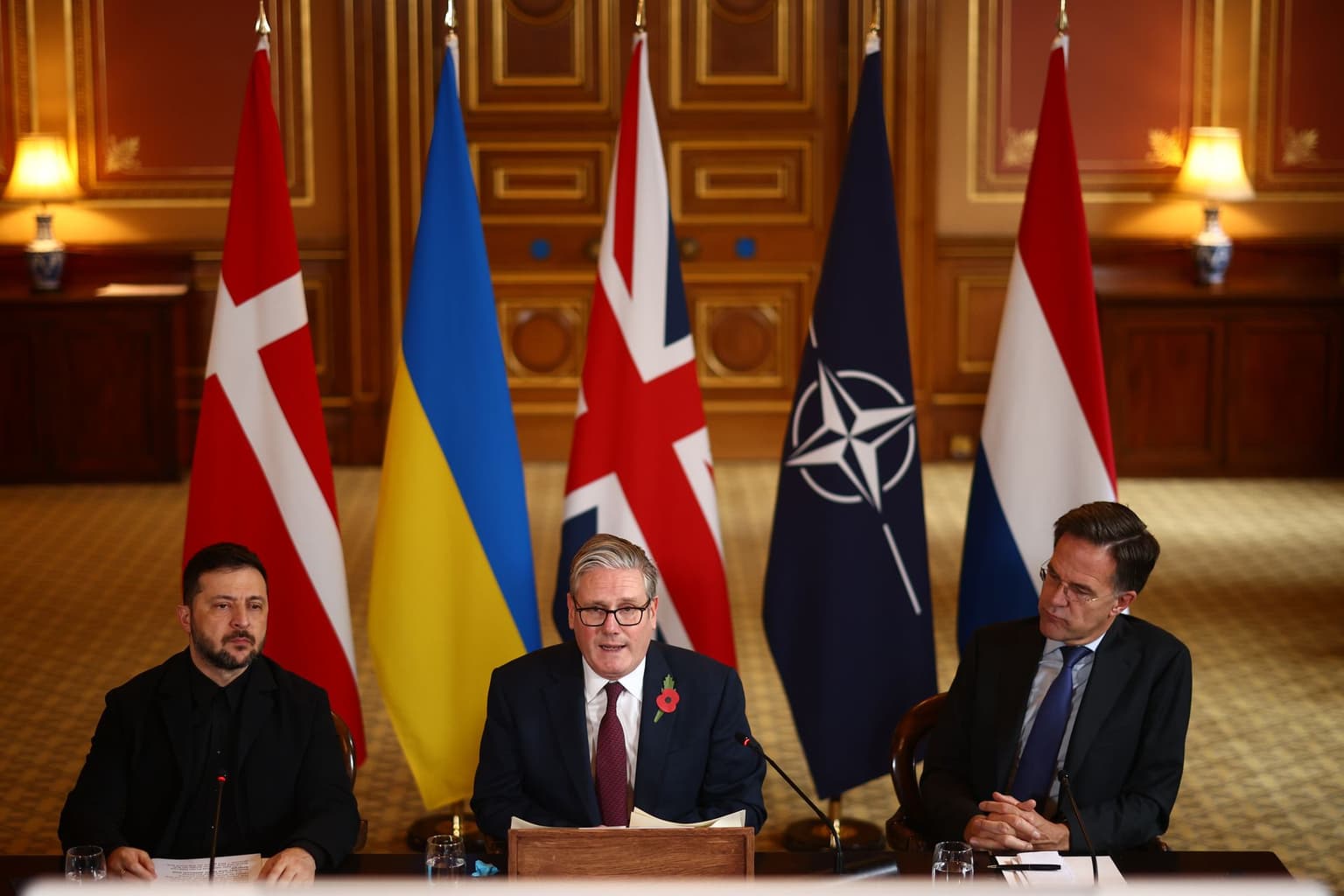
The room where promises are made: U.K. Prime Minister Keir Starmer sits between President Volodymyr Zelensky and NATO Secretary-General Mark Rutte as the “Coalition of the Willing” meets at London’s Foreign Office. On screens, other leaders join virtually—some pledging missiles, others troops, all calculating what support they can offer before winter arrives and Russian glide bombs test whether European solidarity translates into Ukrainian air defense. (Henry Nicholls – WPA Pool/Getty Images)
Building Power Russia Can’t Bomb (Easily)
Ukraine was decentralizing its power grid because Russia kept destroying centralized targets. Deputy Energy Minister Svitlana Hrynchuk announced plans to install 400 additional megawatts of distributed gas generation by year’s end—smaller power sources located near where electricity was actually needed, reducing reliance on transmission lines Russian missiles loved to target.
“All state-owned energy companies are implementing distributed generation projects, primarily gas-based,” Hrynchuk told parliament. The strategy was simple: if Russia destroyed a major power plant, millions lost electricity. If Russia destroyed a distributed generation unit, maybe thousands did. Harder targets. Less payoff per strike.
Over a gigawatt of distributed generation projects had secured financing for 2026 construction. The European Bank for Reconstruction and Development was backing the Power One project with Dragon Capital. Ukrainian agrifood company MHP had already commissioned 18 MW of cogeneration units and 15 MW of solar plants, with a 60 MW wind farm decision coming by March.
Russia’s systematic campaign to destroy Ukraine’s energy infrastructure before winter had forced this adaptation. Can’t protect every power plant and transmission station from missiles and drones? Then build hundreds of smaller generation sites scattered across the country. Make Russia choose between thousands of small targets instead of dozens of large ones.
It wouldn’t stop the attacks. But it might make them less effective—and give Ukrainians more ways to keep the lights on when winter came and Russian drones filled the skies.
Human Safari in Kherson
The artillery bombardment was so intense that even Kherson residents—who’d lived under constant shelling for months—knew this was different. Videos posted to social media, some reportedly by Russian forces themselves, showed explosions rippling across vast sections of the city. Two killed. Twenty-one wounded. And hours of sustained fire.
Kherson-based journalist Valentyna Fedorchuk called it the worst bombardment since Russian forces had used glide bombs against the bridge connecting the Ostriv microdistrict. “Despite areas constantly under attack from artillery and drones,” Fedorchuk said, “the bombardment was notable for its intensity.”
Russian forces were targeting boiler houses—the heating infrastructure civilians needed to survive winter. Not military targets. Not strategic assets. Boiler houses. The facilities that would keep Kherson residents from freezing when temperatures dropped.
Fedorchuk reported hearing the same anxiety repeatedly from residents: what new horrors would Russian forces inflict this winter? They’d already endured occupation, liberation, and constant bombardment. Now Russian artillery crews across the Dnipro were systematically destroying heating infrastructure to make survival impossible.
Under international law, intentional targeting of civilians constitutes war crimes. Russian forces treated Kherson like what residents called a “human safari”—a hunting ground where drone operators and artillery crews stalked civilians for sport, filming their strikes, posting videos, turning murder into entertainment.
Two dead. Twenty-one wounded. Boiler houses destroyed. Winter approaching. And across the river, Russian forces loading more shells.
The Drone That Hunted Farmers
The 12th Brigade Azov released footage from an intercepted Russian FPV drone that told a simple, horrifying story: four men working a field in Donetsk Oblast noticed the buzzing, abandoned their agricultural equipment, and ran for their lives.
The drone followed them. Hunting.
“Russian operators staged a ‘safari’ of civilian farmers,” Azov stated—using the same word Kherson residents used to describe Russian drone operators stalking civilians through city streets. The sport of hunting people who couldn’t shoot back.
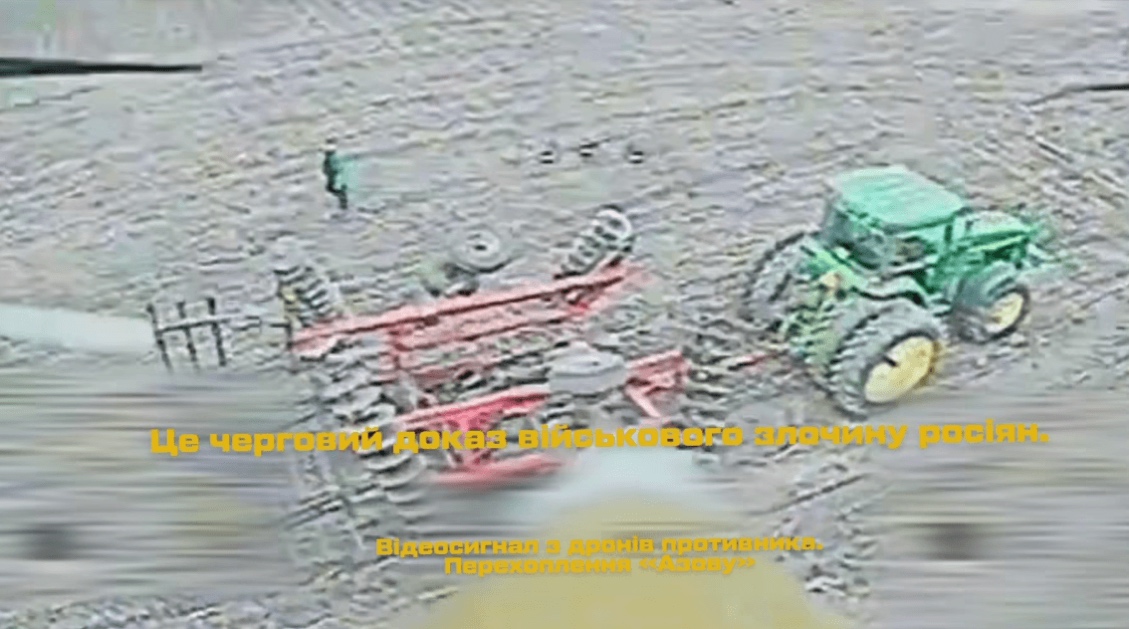
The footage showed the drone crashing into a jeep-like vehicle. Whether it detonated, whether the farmers survived—the video didn’t show. Just men running from a weapon designed to kill tanks, now repurposed to terrorize civilians trying to harvest crops.
“Another war crime added to the list of tens of thousands,” Azov noted. The clinical language of international humanitarian law couldn’t capture what the video showed: a drone operator somewhere behind Russian lines, watching four farmers through his screen, choosing to chase them instead of returning to base or seeking a military target.
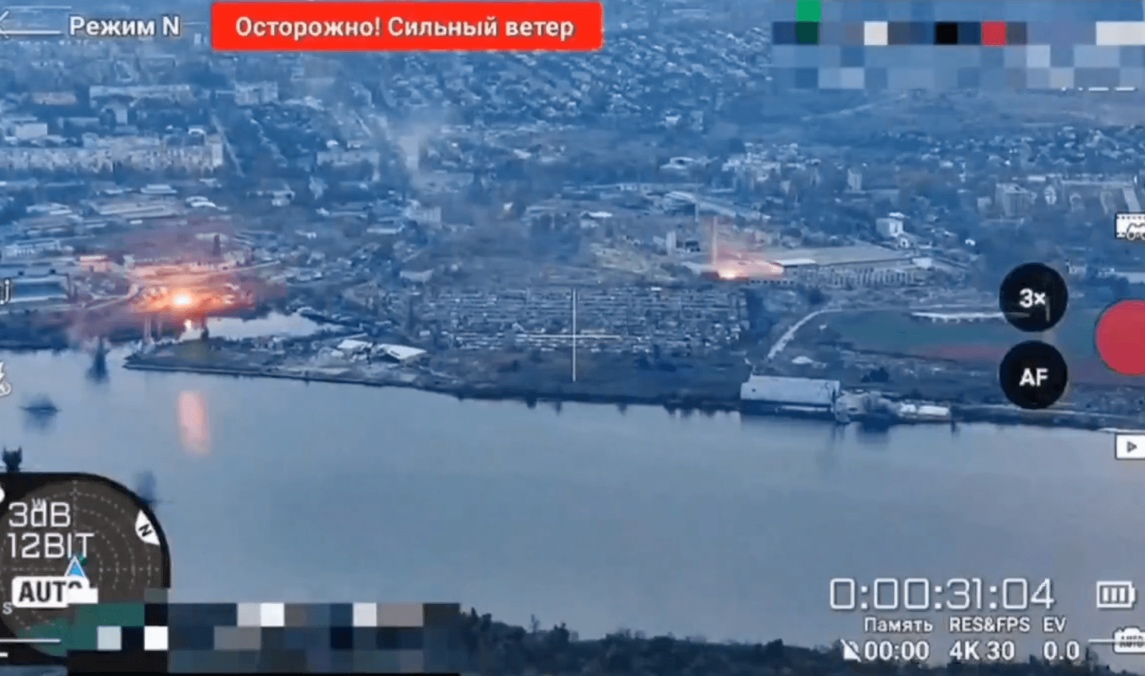
What Russian artillery does to residential neighborhoods: A frame from video showing strikes across Kherson. Not military targets. Not infrastructure. Just homes where people were trying to live ordinary lives when the shells started falling. Russian forces filmed their own work and posted it online—evidence and entertainment in one package. (Telegram)
This was Russia’s war in Donetsk Oblast. Not just artillery and mechanized assaults. But drones hunting civilians in fields, turning farmwork into a deadly gamble, making every trip to harvest crops a potential death sentence.
The farmers ran. The drone followed. And somewhere, an operator watched it all through his screen.
When Ukraine Pushed Back
Ukrainian mechanized forces weren’t just defending. Near Kupyansk, they seized Myrove and pushed northwest of Holubivka—geolocated footage confirming advances Russian milbloggers tried to spin as repelled attacks.
Russian sources claimed elements of the 68th Motorized Rifle Division and 27th Motorized Rifle Brigade drone operators had stopped the Ukrainian counterattack. At least one milblogger admitted what the footage showed: Ukrainian forces had advanced anyway.
In the Lyman direction, Ukrainian soldiers raised their flag in central Torske. Liberation confirmed. The regiment reported successful operations in southern Zarichne as well—small villages retaken, Russian positions abandoned or overrun.
These weren’t symbolic gestures. Ukrainian forces demonstrated they retained capacity for offensive operations despite Russian numerical advantages, despite constant defensive pressure, despite fighting across a thousand-kilometer front. When opportunities emerged, Ukrainian commanders could concentrate forces, punch through Russian lines, and recapture territory.
Russia was advancing in Pokrovsk. Ukraine was advancing near Kupyansk and Lyman. The front remained fluid, contested, deadly—neither side dominant everywhere, both sides bleeding for every meter.
The Refinery That Went Dark
Ukrainian strikes didn’t just damage the Ryazan Oil Refinery—they shut it down. One primary crude distillation unit halted after taking hits. That unit processed 80,000 barrels daily, four million metric tons yearly. Industry sources reported the refinery also stopped adjacent units: reformer, vacuum gasoil hydrotreater, fluid catalytic cracker. The cascade effect of one successful strike.
Ryazan was Russia’s fourth-largest refinery. Annual capacity: 13.1 million tons of crude, 2.3 million tons of gasoline, 3.4 million tons of diesel, 4.2 million tons of fuel oil. Those numbers translated into fuel for military vehicles, diesel for logistics trucks, gasoline for civilian vehicles supporting military operations.
Now it wasn’t producing anything. Ukrainian drones had flown 300 kilometers from the border, found their target, and taken offline a facility that fed Russia’s war machine. The refinery could eventually repair and restart. But “eventually” meant weeks or months of lost production, fuel shortages rippling through military supply chains, and Moscow scrambling to source diesel and gasoline elsewhere.
One refinery. Multiple strikes. Weeks of Ukrainian drone operations targeting the same facility until something critical broke. The patient, methodical destruction of Russia’s ability to fuel its war.
Ryazan was burning. The effects would spread far beyond one city.
Deep Strike in Stavropol
Ukrainian military intelligence, working with the Caucasus Liberation Movement, hit Russian soldiers 1,800 kilometers from Ukraine’s border. The target: military unit No. 54801 in Stavropol, 533 Serova Street. Three servicemen from Russia’s 247th Caucasian Cossacks Airborne Regiment eliminated.
The unit had been fighting in Ukraine since 2014. Not just recent combat—a decade of operations. Ukrainian intelligence noted they’d “distinguished themselves by committing numerous war crimes” during the full-scale invasion. Translation: they were on a list, and the list caught up to them in Stavropol.
Russia’s military installations weren’t safe anymore. Not refineries. Not munitions plants. Not even barracks deep inside Russian territory. Ukrainian intelligence could reach targets nearly 2,000 kilometers from the front line, identify specific units, and eliminate specific soldiers.
The war Russia thought it could keep contained in Ukraine kept showing up at home.
The Explosion Nobody Saw Coming
At 10:50 a.m. on a train platform in Ovruch, Zhytomyr Oblast, a 23-year-old man from Kharkiv pulled a grenade and detonated it. Four dead, including himself. Twelve wounded. State Border Guard officers had been checking passengers’ documents when he triggered the explosion.
The three women killed were 29, 58, and 82 years old. Just passengers waiting for trains, caught in the blast radius of someone else’s decision to die and take others with him.
The man had recently been detained attempting to cross Ukraine’s western border—trying to leave the country illegally. Then somehow he was on a train platform in Ovruch with a live grenade. Law enforcement was still determining how that happened.
The war’s psychological toll was showing in ways that had nothing to do with Russian attacks. Desperate people. Violence born from desperation. Four dead on a train platform because one man decided his way out was taking a grenade to a crowd.
Russia didn’t kill these four. But the war’s pressure—mobilization fears, border restrictions, desperation to escape—created the conditions for this tragedy.

Aftermath in Ovruch: National Police investigate the train platform where a 23-year-old man detonated a grenade at 10:50 a.m., killing himself and three women aged 29, 58, and 82. Twelve others wounded. Not a Russian attack—just the war’s psychological toll manifesting in a moment of violence that left four families grieving and a small city asking how a detained border-crosser ended up with a grenade on a train platform. (Ukraine’s National Police)
Fourteen Years for a Telegram Channel
Yana Suvorova was twenty-one when Russian forces occupied Melitopol. She’d been preparing for university, working doing eyelashes and nails. When the invasion started, she created a Telegram chat to help neighbors find medicines, food, doctors—the everyday problems of living under occupation.
That chat became “Melitopol is Ukraine.” And that made her a terrorist, according to Russian occupation authorities.
Russian forces detained Suvorova along with six other RIA Melitopol journalists and administrators. First the Mariupol detention center. Then Taganrog detention center No. 2—known for torturing prisoners. Then a courtroom where Russian prosecutors accused her of organizing a terrorist group, committing terrorist acts, espionage, and being recruited by Ukrainian military intelligence.
Her crimes, per the Russian court: publishing pro-Ukrainian posts and “collecting and verifying information on the deployment of military personnel.” Translation: she reported what Russian forces were doing in her occupied city.
Fourteen years in prison. For running a Telegram channel. For telling her community where Russian troops were positioned. For refusing to pretend occupation was liberation.
Reporters Without Borders called it what it was: “an unfair trial… for simply doing her job as a journalist.” Suvorova had been detained since 2023. She should be released immediately, they said.
She won’t be. Russia doesn’t release journalists who tell the truth about occupation. It puts them in detention centers known for torture, tries them on terrorism charges, and sentences them to fourteen years for doing what journalists do: documenting reality.
Yana Suvorova was twenty-one. She did eyelashes and nails. She helped neighbors find medicine. Now she’s serving fourteen years for refusing to stay silent.
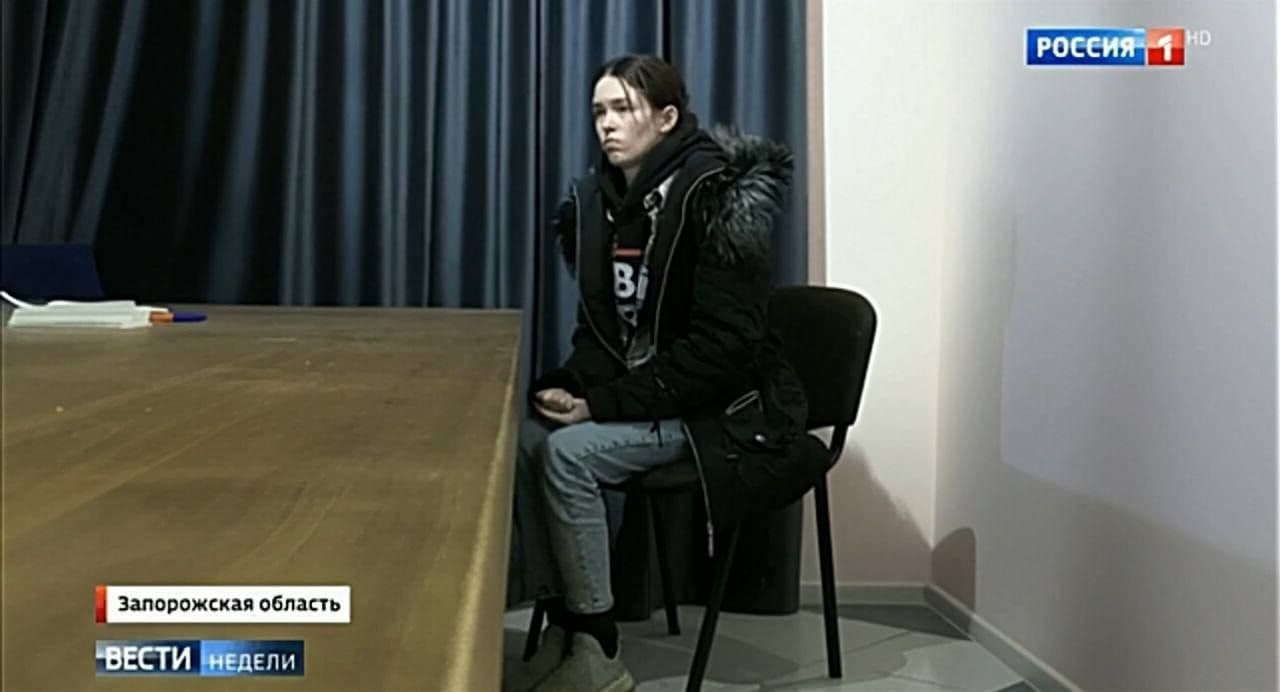
Yana Suvorova, 21: Fourteen years in Russian prison for running a Telegram channel that helped occupied Melitopol residents find medicine and reported Russian troop movements. Russia calls journalism terrorism. (Russian Channel One / Screenshot)
Another Night, Another Hundred Drones
Russian forces launched 128 Shahed and Gerbera-type drones from five directions: Kursk, Bryansk, Millerovo, Primorsko-Akhtarsk, and occupied Hvardiivske in Crimea. Ukrainian air defenses shot down seventy-two. Forty-seven hit their targets across ten locations.
In Kharkiv, Russian glide bombs injured eight civilians. In Novoukrainka, strikes disrupted power and damaged railway infrastructure. Twelve oblasts implemented rolling blackouts from cumulative damage—not just last night’s strikes, but the compounding destruction from earlier in the week.
The nightly arithmetic continued: launch over a hundred drones, accept that most will be intercepted, count on enough getting through to keep destroying infrastructure. Ukrainian defenders shot down the majority. Russia kept launching them anyway. The strategy was attrition—of interceptor stocks, of power infrastructure, of Ukrainian capacity to defend everywhere simultaneously.
One hundred twenty-eight drones. Seventy-two destroyed. Forty-seven hits. Twelve oblasts in darkness. Another night in Ukraine’s fourth winter of war.
The Grinding Continues
Russian forces advanced in multiple sectors while Ukrainian forces held, counterattacked, and repositioned. The front remained fluid, contested, expensive.
Near Velykyi Burluk, Russian forces pushed into central Bolohivka—elements of the Storm Detachment, 11th Tank Regiment, according to Russian MoD claims. In the Siversk direction, Russian forces advanced west of Vyimka and reportedly seized Dronivka, credited to the 7th Motorized Rifle Brigade. Defense Minister Andrei Belousov inspected the Southern Grouping of Forces there, the kind of high-level visit that suggested either celebrating success or demanding better performance.
Near Novopavlivka, Russian forces moved into central Ivanivka and southwest of Filiya. Near Velykomykhailivka, they seized Zlahoda—64th Motorized Rifle Brigade claiming credit.
Ukrainian military observer Kostyantyn Mashovets reported Russian 70th Motorized Rifle Division elements redeploying to Chasiv Yar, positioning for a future push toward Kostyantynivka. Not immediate assault. Preparation. The kind of repositioning that suggested Russian commanders were planning their next offensive while consolidating current gains.
The pattern held: Russian forces advancing in some sectors, grinding through villages at catastrophic cost, preparing new offensives elsewhere. Ukrainian forces defending, counterattacking where possible, trying to exact maximum casualties for every meter lost.
Neither side winning decisively. Both sides bleeding. The front kept moving—slowly, violently, inexorably.
Testing NATO, Again
Russian jets violated Lithuanian airspace for the second time—another eighteen seconds over NATO territory. Su-30 fighter and Il-78 tanker crossed the border from Kaliningrad, triggered NATO’s air policing response, and returned before Spanish Eurofighters could intercept. Lithuanian President Gitanas Nausėda called it a “gross violation of international law.” Russia claimed they were just conducting “scheduled training flights.”
Eighteen seconds. Just long enough to make NATO scramble jets and prove Russia could violate borders without consequences.
Off Germany’s coast, Russian landing ship Aleksandr Shabalin anchored near Lübeck Bay’s entrance, blocking a shipping lane connecting the Baltic to the North Sea. Fifty-five kilometers from Kiel, where unknown drones had been spotted in September. German Federal Police noted the ship operated in international waters, violating no laws—technically. Just obstructing commercial traffic and parking a military vessel within sight of German territory.
Belarus joined the provocation campaign. State Security Committee First Deputy Chairman Sergei Terebov claimed NATO and Ukraine were training a 9,000-15,000-strong “Belarusian Liberation Army” to attack Belarus—recruiting from the Baltics, Poland, Ukraine, preparing to invade. The fictional army served Russia’s narrative: look, NATO is the aggressor, we’re just defending ourselves.
Meanwhile, CSTO military exercises wrapped up in Tajikistan. Russia, Belarus, Kazakhstan, Kyrgyzstan, and Tajikistan—1,500 troops, 200 pieces of equipment, four days of drills demonstrating coordination nobody believed would matter in actual conflict.
Hybrid warfare across multiple fronts: airspace violations, naval obstruction, fabricated threats, military exercises for show. Russia testing boundaries, normalizing aggression, waiting to see what NATO would tolerate.
So far, NATO was tolerating everything.
What October 24 Revealed
Two wars happened simultaneously. In Windsor Castle, Zelensky secured European pledges while Russian tanks crushed Pokrovsk’s center. In Washington, Dmitriev arrived with peace proposals while Russian artillery devastated Kherson. Putin threatened “stunning responses” while Ukrainian forces recaptured villages near Kupyansk and Lyman.
Diplomatic theater proceeded as if negotiations could end the conflict. Battlefield reality showed neither side winning decisively, neither accepting defeat, both grinding forward through attritional combat that consumed lives without producing strategic breakthroughs.
For Ukrainians, nothing changed: Russian attacks on infrastructure, journalists tortured in occupation, energy systems destroyed before winter, daily survival calculations. The Ovruch grenade attack showed the war’s psychological toll—violence born from desperation and pressure.
For Russia, the day exposed limits of military power. Months of offensives consuming thousands of lives had produced meters of advance in Pokrovsk while Ukrainian counterattacks recaptured territory elsewhere. Threats and diplomatic missions couldn’t change that Russian tactics still weren’t achieving strategic objectives after nearly four years.
The question ahead wasn’t whether diplomacy would resolve the war—not while Russia demanded Ukraine’s capitulation disguised as compromise. The question was whether accumulated casualties, economic pressure, territorial losses, and domestic strain would force Moscow to accept reality: military victory was unachievable, continuing cost more than any conceivable benefit.
October 24 didn’t answer that question. The calculation remained unresolved. Diplomats kept talking. Tanks kept rolling. Artillery kept firing. The war would continue across all dimensions—diplomatic, military, economic, cognitive—until one side’s will broke or circumstances forced genuine negotiations rather than theater.
Day 1,339. The parallel realities persisted. And nobody knew which one would ultimately matter more.