
In Washington’s television studios, Russia’s investment fund CEO promised diplomatic breakthrough. In Pokrovsk’s ruins, infiltration teams hunted drone operators through shattered apartment blocks. In Kyiv before dawn, ballistic missiles tore through residential towers where children slept. Day 1,339 of war—when the Kremlin’s diplomacy and destruction followed the same script.
The Day’s Reckoning
The Reuters alert arrived at 5:47 a.m. Kyiv time. Ballistic missiles inbound.
Families in residential towers had seconds. The impacts killed three, wounded 31—seven of them children. Shrapnel tore through bedrooms. Glass exploded inward.
Three hundred kilometers west, Kirill Dmitriev prepared for his CNN appearance. Russia’s investment fund CEO had toured American studios the previous day—Fox News, CNN, interviews with Lara Logan. His message never wavered: Russia wanted peace. Compromise was possible. He never defined what compromise meant.
Underground in Donetsk Oblast, 496 miners waited in darkness. Russian missiles had struck infrastructure above them—the seventh such attack in two months. Power failed. Ventilation stopped. Hours, maybe a day, before oxygen ran out.
In Pokrovsk’s eastern districts, Russian infiltration teams moved through ruins hunting drone operators. Firefights erupted in apartment buildings.
At the front, a Russian assault force—16 vehicles, roughly 60 soldiers—pushed through swampy terrain. Ukrainian drones waited. FPV strikes methodically destroyed vehicles. Soldiers dismounted into mud and mines. Bodies floated.
Progress: zero meters. Cost: everything.
Two wars were happening simultaneously. In Washington’s studios, diplomats promised breakthrough while reaffirming demands unchanged since before the invasion. On Ukraine’s battlefields, missiles killed children while mechanized columns drowned in swamps. Trump called Putin’s positioning “very disappointing” and dismissed summit prospects. His administration prepared new sanctions.
The gap between Moscow’s words and Moscow’s actions had never been wider. Yet nobody could say which would ultimately matter more.
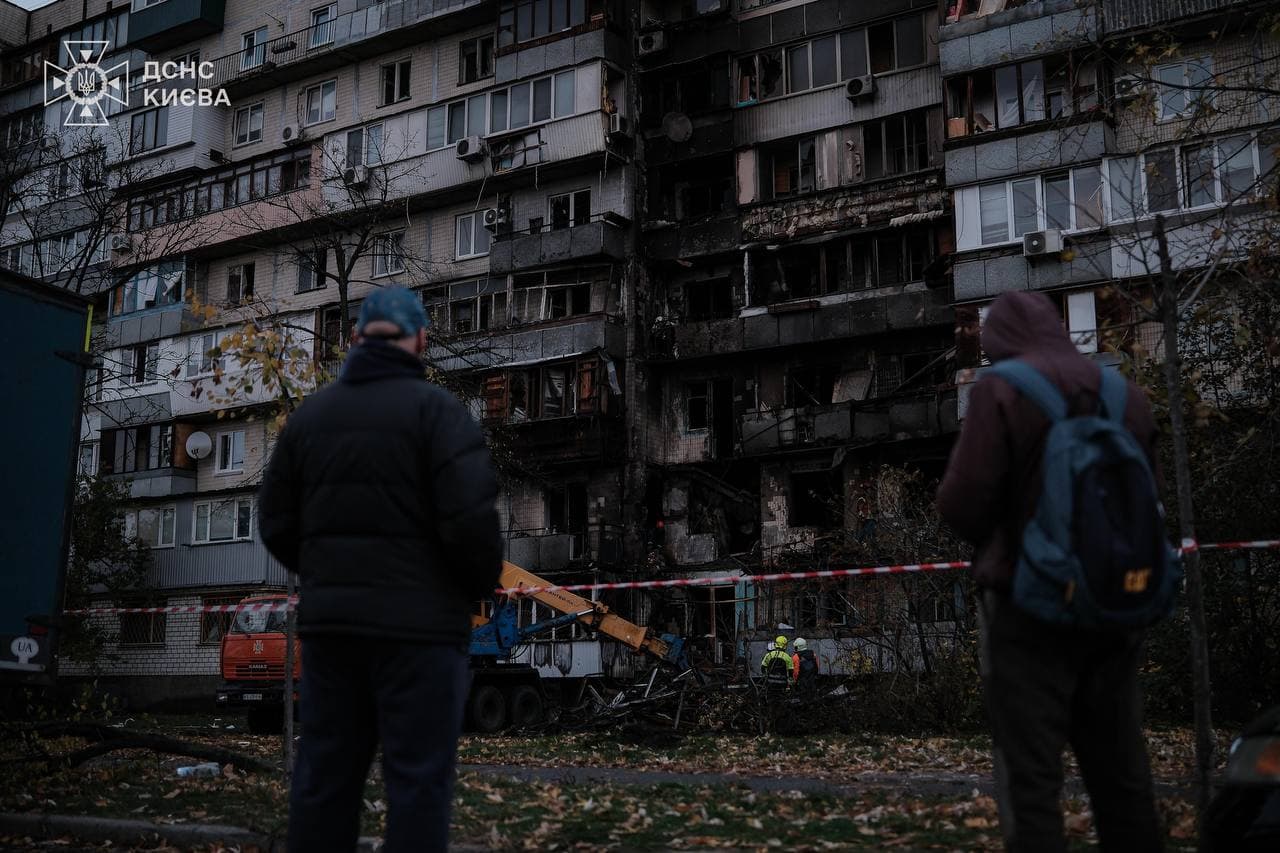
Night’s aftermath in Kyiv: Shattered glass and twisted metal litter an apartment after Russian drones struck residential buildings. Three dead, 31 injured—seven of them children. Of 101 drones Russia launched overnight, 90 were intercepted. Eleven reached their targets. This is what the 11% looks like. (State Emergency Service/Telegram)
The Salesman’s Circuit: Dmitriev’s American Tour
The timing betrayed urgency. Fresh US sanctions against Russian oil giants. Storm Shadow authorization reports. Tomahawk debates. The Kremlin deployed its investment fund CEO for a full American press tour.
Kirill Dmitriev stepped into television studios carrying Moscow’s message wrapped in businessman’s language. As Russia’s Direct Investment Fund CEO, he presented himself as an economic emissary—a dealmaker, not a general. Across CNN, Fox News, and interviews with Lara Logan, he performed a careful dance.
He acknowledged Ukraine had softened its stance by accepting ceasefire talks along current lines.
Then came the pivot.
Russia wanted a “final solution” to prevent the war’s resumption. Translation: NATO must revoke its Open Door Policy. Ukraine must accept permanent neutrality. Kyiv’s government must change to one Moscow approved.
The same maximalist demands Putin presented in December 2021 and February 2022. Nothing had changed, except now delivered by a fund manager in a suit rather than a foreign minister.
Dmitriev rejected Trump’s ceasefire proposal. Ukraine would break any ceasefire to rearm, he claimed. The August Alaska summit was never about ceasefire but “final solutions.” After Trump cancelled the Budapest summit, Dmitriev avoided explicitly listing demands to American audiences. The strategy: appeal to Trump’s interests while obscuring that Russia’s position remained capitulation or nothing.
Dmitriev praised “traditional values” and economic cooperation—a Bering Strait tunnel using Musk’s technology. But conditions applied. America must “respect” Russian interests.
The sweetener concealed thorns. Dmitriev emphasized his lack of “military background,” then warned “complete annihilation of humanity” was close.
Nuclear threats with a smile.
Back home, State Duma deputies undercut Dmitriev’s obfuscation. Chepa: Russia’s position “remains unchanged.” Zhuravlyov: US sanctions had “no effect.” The domestic audience needed reassurance Putin would continue the war—even as Dmitriev toured studios suggesting flexibility.
Russia wanted the West to believe compromise was possible while making clear only Ukraine’s capitulation would suffice.
Dmitriev was a salesman hawking an illusion.
The Grinding Machine: Pokrovsk’s Desperate Mathematics
The city was dying in increments measured by shattered apartment blocks rather than captured kilometers.
Russian forces seized Kozatska and Promin while advancing through Myrnohrad—the mining town that had become Pokrovsk’s gateway. Small groups infiltrated from the south. Forces reportedly took Krasnyi Lyman north. On maps, progress. In reality, something messier.
A Kremlin milblogger admitted the truth his commanders wouldn’t: Russian forces had not solidified control within Myrnohrad. Ukrainian drones swarmed the approaches. Infantry couldn’t mass without dying. Most of Rodynske remained a “gray zone.”
Inside Pokrovsk itself, the fighting had grown intimate.
At least 250 Russian soldiers infiltrated the city, moving through ruins hunting specific targets. Ukrainian drone operators—the soldiers whose devices had made Russian advances bleed. Russian forces re-entered in mid-August after clearing operations pushed them out in July. Now they established “staging areas” near the railway. Russian fiber optic drones—immune to jamming—watched every Ukrainian movement.
A Ukrainian spokesperson described Russian forces “seeping” into Pokrovsk in groups of two to three, exploiting rain that degraded drone operations. The city’s defenses were becoming porous.
The geometry had become bewildering. Positions “intermingled” where determining front lines proved impossible. Some Ukrainian positions sat “between Russian lines”—turning every street into crossfire. Ukrainian observer Mashovets reported forces had pushed Russian elements back from Myrnohrad’s outskirts—contradicting other reports, highlighting how confused the fighting had become.
Yet Ukrainian forces achieved small victories. Geolocated footage showed troops raising flags in Sukhetske.
Russian forces experimented with autonomous AI drones. Ukrainian brigades reported Russian soldiers disguising themselves in civilian clothing—perfidy, a war crime.
The arithmetic was brutal: Russian forces advanced but didn’t collapse Ukrainian lines. They infiltrated but couldn’t consolidate. They seized territory but couldn’t exploit it. The city was dying slowly rather than falling quickly—a distinction that mattered immensely for Ukraine’s ability to prepare defenses farther west.
The False Flag Parade: Russia’s Information War Through Infiltration
The video appeared on Russian Telegram channels at 11:43 a.m. A dozen Russian soldiers stood in Bolohivka’s central square, holding a tricolor flag. They posed for thirty seconds. Then they ran.
Within an hour, Russian military bloggers were claiming Bolohivka had fallen. Russian state media reported “liberation” of the settlement. The narrative spread: another Ukrainian position collapsed, another village captured, inexorable Russian advance.
Except Ukrainian forces still controlled Bolohivka.
The Ukrainian 16th Army Corps maintained positions throughout the settlement. The Russians had conducted a raid designed for cameras—infiltrate with up to 200 personnel operating in small groups, raise the flag, film proof, withdraw before Ukrainian forces could respond in strength.
The tactic had become a pattern. In Kostyantynivka, geolocated footage showed Ukrainian forces striking Russian infiltrators in the southeastern part of town within hours of their arrival. In Kurylivka southeast of Kupyansk, Russian servicemembers filmed themselves holding a flag in the northern settlement, then disappeared. ISW assessed these were infiltration missions that did not change the forward edge of the battle area.
Two types of infiltration were happening simultaneously. In Pokrovsk, Russian forces targeted drone operators—clear tactical purpose, setting conditions for advances by neutralizing Ukraine’s primary defensive advantage. But in Bolohivka, Kurylivka, and Kostyantynivka, the missions appeared designed primarily for cameras, generating footage Russian authorities could use to exaggerate advance pace.
The videos fed the wider Kremlin narrative: Russian victory was inevitable. Ukraine and the West should concede now rather than face the unavoidable later.
Warfare conducted for perception rather than position. Truth itself had become contested terrain.
The Swamp That Swallowed a Platoon: Russia’s Mechanized Misadventures
The rain started at dawn near Volodymyrivka. Russian commanders saw opportunity. Ukrainian drones struggled in rain and fog. Time to move armor.
Five armored vehicles pushed forward from Novotoretske carrying a reinforced platoon. The timing seemed perfect—weather hindering Ukrainian eyes in the sky. The column advanced through swampy terrain.
Then physics asserted itself.
Three vehicles became mired in mud. Treads spun uselessly. The transports began sinking. Russian infantry disembarked—not for assault but survival—splashing into water as their vehicles disappeared.
Ukrainian forces, even with degraded drone operations, still had eyes. FPV strikes came methodically. All five vehicles were disabled or destroyed.
Geolocated footage told the story: three Russian APCs stuck in the Kazennyi Torets River like monuments to miscalculation. A fourth partially submerged. A damaged APC within Novotoretske itself. An analyst reported Ukrainian forces destroyed at least 16 vehicles in the area—the platoon was merely one wave of a larger, ill-fated attack.
The pattern repeated across the front. Ukrainian spokespeople confirmed weather temporarily complicated drone operations and that Russian forces exploited these windows. But “exploited” was generous. “Attempted to exploit” was more accurate.
The October 25 attack was the latest in weeks of renewed assaults. Reinforced company near Pankivka around October 6. Reinforced battalion south of Shakhove on October 9. Reinforced company near Shakhove on October 13. Reduced battalion toward Volodymyrivka on October 16.
Geolocated evidence indicated only the October 9 attack achieved any advance.
Russian forces continued suffering vehicle losses grotesquely disproportionate to limited gains. The arithmetic was brutal: Russia possessed more armor than Ukraine but was burning through it faster than advances justified. Every sunken APC represented industrial capacity Moscow could not easily replace, soldiers lost to drowning or strikes, and tactical failures that accumulated into strategic attrition.
Children in Trenches: Russia’s Militarization of Occupied Youth
Oksana was 16 when they took her to Volgograd. She learned to dig trenches, operate drones, mine areas, and use grenades and firearms. She was not a volunteer. She was a Ukrainian teenager from occupied southern Ukraine, forcibly subjected to military training at a camp run by the Warrior Center for Military and Patriotic Education—created in 2022 by Putin’s direct order.
The Kyiv Independent’s War Crimes Unit investigation revealed the system’s architecture. Teenagers underwent training at the Avangard Defense and Sports Camp through “Time of Young Heroes,” explicitly designed to prepare youth for service in Russia’s Armed Forces. Harsh discipline. Combat drills. Supervision by high-ranking officers and veterans of Russia’s wars in Chechnya, Syria, Crimea, and Ukraine.
The Warrior Center’s supervisory board was headed by Viktor Vodolatsky, a State Duma deputy who held a medal for Russia’s “liberation” of occupied Crimea. His deputy, Colonel Andranik Gasparyan, was a veteran of wars in Chechnya, Syria, and Crimea. From the invasion’s first days, his unit participated in southern Ukraine’s occupation.
Ukrainian prosecutors issued indictments against Gasparyan’s subordinates for war crimes including beatings, abductions, killings, mock executions, and rape of a minor.
At least 25 instructors trained Ukrainian children in Volgograd, most having participated in Russia’s war against Ukraine. Among them: Yegor Sokov, a former Wagner Group fighter who battled in Soledar and Popasna, now teaching radio communications to children from occupied territories.
In 2024 alone, 1,290 Ukrainian children from occupied territories went through militarization programs. Oksana’s testimony described a system designed to transform Ukrainian children into soldiers for Russia’s army.
The practice violated international humanitarian law, constituted a war crime, and represented one of the conflict’s most insidious dimensions: Russia was attempting to erase Ukrainian identity by militarizing the next generation and turning children against their homeland.
The Hunt for Full Autonomy: Ukraine’s Quest for Self-Flying Drones
The holy grail sat just beyond reach: drones that could fly, find targets, and strike without human intervention. The vision promised to compensate for Russia’s 3-to-1 manpower advantage.
“We’re not going along the route of full autonomy,” Andriy Chulyk, co-founder of Sine Engineering, explained. “Tesla, having enormous resources, has worked on self-driving for ten years and still hasn’t made a product a person can be sure of.”
The comparison cut to the problem. Consumer AI hid computing power in distant data centers. Drone autonomy was most useful when connections died—when jamming severed links. Delegating life-or-death decisions to computers a drone could carry remained distant.
Commander-in-Chief Syrskyi acknowledged AI was “in use virtually everywhere” but cautioned it “can make mistakes.” Kate Bondar at CSIS: AI’s “main role will be supportive rather than replacing humans.”
Current Ukrainian AI enhanced rather than replaced pilots. “Last-mile targeting” allowed pilots to select targets while maintaining video. The drone zoomed toward targets even after connection faltered. Not revolutionary.
Yaroslav Azhnyuk, founder of Fourth Law, produced AI vision modules for FPV drones—$70 each. His innovations held targeting even when vehicles drove through shadows. One brigade boosted hit rates from 20% to 80%. Progress, but not autonomy.
Full autonomy in demonstrations would be feasible, Azhnyuk said, but “massive deployment” remained nowhere in sight. Ukraine’s deep-strike drones spent too much time flying over Russian cities and civilians.
The broader challenge was data quality. Ukrainian drones accumulated enormous visual data from “mostly analog, cheap cameras.” The AI could distinguish tanks from humans. Not more. Distinguishing Russian from Ukrainian soldiers, or soldiers from civilians, remained unsolved.
Bondar suspected much AI talk was marketing. “War’s also a business. AI-enabled software sounds cool and sexy.”
Full autonomy remained distant because execution under battlefield conditions with limited computing power was not yet achievable at scale.
Fishing Nets Against Flying Machines: Brittany’s Unconventional Aid
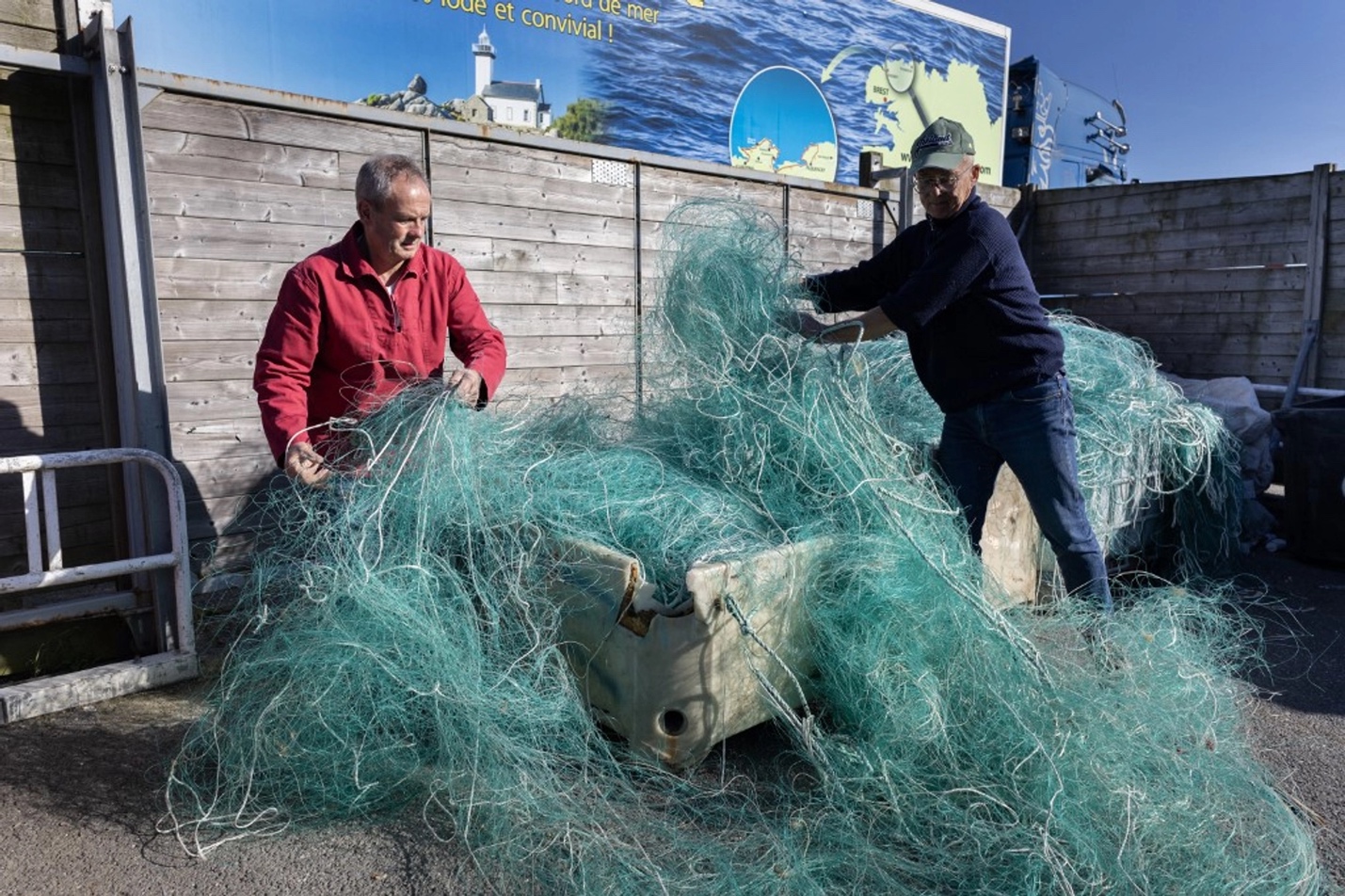
Roscoff port: Christian Abaziou, 70, and Gerard Le Duff, 63, sort fishing nets bound for Ukraine. The nets, once used to catch fish in Atlantic waters, now stretch across Ukrainian roads to trap Russian drones. Centuries-old technology defending against 21st-century warfare. (Fred TANNEAU / AFP)
The smell hit first—rotten fish clinging to green netting that had spent years at sea. Christian Abaziou, 70, and Gerard Le Duff, 63, joked about it as they stuffed giant bags into a truck in Roscoff port, western Brittany. The nets, once used to scoop fish from Atlantic waters, were finding new purpose 2,000 kilometers east.
They were going to stop Russian drones.
Russia’s drones included small commercial devices equipped with explosives, striking more than 25 kilometers from front lines. Ukrainians covered roads with nets mounted on poles, stretching for hundreds of kilometers. As drones approached, they became trapped like insects in spider webs.
Low-tech solution to high-tech warfare.
When Abaziou learned of the tactic, he contacted a retired fisherman. “Within 48 hours, I had all the fishing nets I needed.” Jean-Jacques Tanguy, 75, explained fishermen “are proud their used equipment is going to help save lives.” Fishing nets, replaced annually, piled up along Breton ports.
In early October, the two men transported 120 kilometers of nets to Ukraine. A second truck carrying 160 kilometers departed from nearby Treflez. “When we started humanitarian convoys three years ago, drones weren’t part of the picture,” Gerard said. “But now it’s a drone war.”
The nets transferred to Ukrainian trucks at the Polish border. The first convoy headed to Zaporizhzhia. The second aimed for Kherson, facing daily drone threats.
A Frenchman living in Ukraine facilitated exchanges. “There’s a huge need for nets here,” he told AFP. “When you tell any Ukrainian that Breton volunteers would send kilometres of fishing nets to save lives… they’re moved to tears.”
The image crystallized the war’s strange poetry: centuries-old technology from French fishing villages defending against 21st-century Russian drones. Sometimes the most effective defense was woven fiber stretched across roads, waiting for machines to fly into ancient traps.
Balloons Over Vilnius: Belarus Wages Hybrid War
The balloons appeared over Vilnius again at dusk. Not missiles. Not drones. Just balloons drifting across the border from Belarus, carrying contraband cigarettes and forcing Lithuania’s government to shut down its largest airport and close its last two operational border crossings.
For the second time in 24 hours.
Air traffic at Vilnius Airport halted until 2 a.m. local time. Borders remained closed until the same hour. Prime Minister Inga Ruginiene announced “smuggling balloons” launched from Belarus prompted temporary suspension of operations at Vilnius and Kaunas airports.
“The State Border Guard Service has closed the Salcininkai and Medininkai border crossing points,” Ruginiene wrote on Facebook.
The latest incident marked the fourth such violation in a month. On October 5 and 21, Lithuanian authorities closed airspace above Vilnius, canceling dozens of flights. Belarus—ruled by dictator Lukashenko since 1994, one of Moscow’s closest allies—shared a 680-kilometer border with Lithuania. The balloons kept coming.
The closure followed a surge in suspicious aerial incidents across Europe. Munich International Airport faced two consecutive disruptions in early October over suspected drone activity. Similar incidents briefly grounded flights in Oslo and Copenhagen. In September, Polish forces shot down several Russian drones violating its airspace. Romania reported a Russian drone crossed its border but chose not to engage.
The pattern was deliberate: Russia and its Belarusian proxy testing European responses, creating disruption without crossing thresholds that would trigger Article 5 collective defense. Balloons carrying contraband became weapons of economic disruption and psychological pressure, forcing governments to close borders and airports, demonstrating vulnerability without firing shots.
Hybrid warfare’s essence: attacking beneath the threshold of conventional conflict, exploiting the gray zone where democratic nations struggled to formulate proportionate responses. Every closed border crossing, every canceled flight represented small Russian victories in a conflict fought through proxies, plausible deniability, and weaponization of civilian infrastructure.
When India Says No: Trump’s Sanctions Find Their Target
The shockwave hit global energy markets within days. Trump’s first sanctions against Russia since taking office targeted the jugular—Rosneft and Lukoil, Russia’s two largest oil companies. The measures froze all US-based assets and opened the door to secondary sanctions against foreign institutions handling transactions with blacklisted entities.
India blinked first. The country’s biggest refineries prepared to reduce purchases from Rosneft and Lukoil to virtually zero, Bloomberg reported. Then China. State-owned oil companies suspended purchases of seaborne Russian crude, fearing secondary sanctions, according to Reuters.
The squeeze had begun.
Trump’s administration was preparing to go further. Reuters reported US officials prepared new sanctions if Putin showed no interest in meaningful negotiations. Additional sanctions targeted Russia’s banking sector and oil supply infrastructure. Ukrainian officials proposed cutting all Russian banks from the US dollar system.
Two sources told Reuters that US officials informed Europe they supported the EU’s plan to use Russian frozen assets to buy American weapons for Kyiv. The EU had frozen about $300 billion of Russia’s central bank reserves in February 2022.
The move signaled a tougher stance after Putin’s negotiating position led to cancelling the planned Trump-Putin summit. Trump: “I did not want a wasted meeting.”
Meanwhile, Kirill Dmitriev toured American television studios dismissing the sanctions. “We do not believe these sanctions will have significant impact because oil prices will rise and Russia will sell fewer gallons at a higher price,” he told Fox News.
The claim ignored basic economics: if major buyers like India and China were reducing or eliminating Russian oil purchases, Moscow couldn’t simply redirect those volumes at higher prices to nonexistent customers.
The sanctions might not collapse Russia’s economy overnight, but they squeezed revenues funding the war machine. Every barrel of Russian oil left unsold, every transaction forced through workarounds, every foreign institution avoiding secondary sanctions represented costs Moscow hadn’t anticipated.
The Ryazan Refinery Burns: When Drones Strike 200 Kilometers Deep
The drones arrived at Ryazan refinery in darkness. Two hundred kilometers into Russia. They found their target—the CDU-4 primary processing unit with capacity of 80,000 barrels per day.
Fire broke out. The unit shut down. The fire spread, forcing suspension of neighboring units: a reformer, vacuum gasoil hydrotreater, and catalytic cracker. Russia’s fourth-largest oil processing facility was burning.
The Ryazan refinery had already shut down part of its capacity in February and again in September. Located roughly 200 kilometers southeast of Moscow, the plant processed 13.1 million tons of oil last year and accounted for 5% of Russia’s total refinery capacity. Now it was burning again.
Ukrainian forces also struck Russian energy infrastructure in Volgograd Oblast overnight. Ukrainian Center for Countering Disinformation Head Lieutenant Andriy Kovalenko stated forces hit the Balashovskaya 500 kV substation—a key facility supplying defense industrial facilities and transport energy hubs on the Saratov-Voronezh route. Russian opposition outlet Astra reported the substation ensured electricity transit from the Volga Hydroelectric Power Station to central Russia.
Volgograd Oblast Governor Andrei Bocharov claimed Ukrainian drone debris struck the substation and caused fire. The standard Russian excuse: not a direct hit, just debris. The fire burned regardless.
Ukrainian strikes had targeted at least 16 of Russia’s 38 oil refineries since August 2025, according to the Financial Times, pushing Russian diesel exports down to their lowest level since 2020. The campaign forced Russia to divert air defense resources to protect industrial sites and degraded its ability to fund continued military operations.
The pattern was strategic: while Dmitriev toured American studios claiming sanctions would have no impact, Ukrainian drones were physically removing Russian oil processing capacity from the market. Words versus deeds. Propaganda versus fire. The gap between Russian messaging and battlefield reality had never been wider.
Miners in the Dark: Russia’s War on Energy
The explosion came from above. Four hundred ninety-six coal miners working underground in Dnipropetrovsk Oblast felt the tremor through rock and earth. Russian missiles had struck the facility. Again.
Power failed. Ventilation stopped. In the darkness, men who’d descended that morning to extract coal now waited to learn if they’d see daylight again.
This was the seventh attack on DTEK coal enterprises over the past two months. The second in a week targeting facilities while workers labored below. On October 19, a similar strike trapped 192 employees underground. Moscow was intensifying its campaign against Ukraine’s energy infrastructure as winter approached.
“Engineering teams are working to minimize damage in order to restore operations as soon as possible,” DTEK reported. All mine workers were brought to the surface safely. None were injured. But the pattern was clear.
DTEK was Ukraine’s largest private energy company. Its facilities had been targeted in multiple Russian strikes, forcing production halts and disrupting residential heating supply. The attacks formed Russia’s broader strategy: ramp up strikes against Ukraine’s energy system heading into colder seasons, hit critical infrastructure, leave hundreds of thousands of households without power.
The miners’ wait in darkness—listening to explosions above, uncertain whether rescue would come or tunnels would collapse—captured the war’s essence. Russia wasn’t merely fighting Ukrainian soldiers. It was systematically attacking infrastructure sustaining civilian life, weaponizing winter’s approach, attempting to break popular morale through cold and darkness.
President Zelensky described Russia’s tactics as not only killing people but terrorizing civilians by weaponizing cold weather. Ukrainians were bracing for another winter of blackouts as Russia aimed to impose what Zelensky called an “energy disaster” across the country.
The Night the Capital Burned: Kyiv Under Missiles
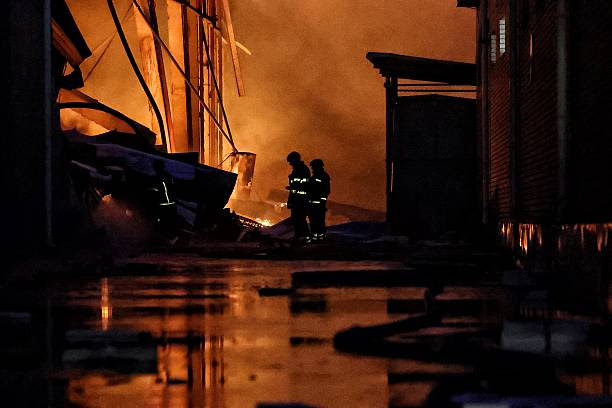
Dawn in Kyiv: Firefighters battle flames at an enterprise struck by Russian Iskander-M ballistic missiles. The attack killed two people and injured 12 others. No military targets. No ammunition depots. Just residential buildings and civilian infrastructure burning in the capital’s pre-dawn darkness. (Yan Dobronosov/Global Images Ukraine via Getty Images)
The Iskander-M ballistic missiles arrived just before 4 a.m. on October 25. Explosions echoed across Kyiv. At least two people died. Twelve were injured. One victim initially survived, then died in the hospital.
“No ammunition, no military production,” Tymur Tkachenko, head of Kyiv City Military Administration, wrote. “Russian terrorists are hitting our civilian and residential infrastructure with ballistic missiles. All we see is pure terror.”
Russia launched nine Iskander-M missiles and 62 Shahed-type drones overnight. Air defenses intercepted 50 drones and four missiles. But 12 drones and five missiles struck four locations.
Fires broke out across the city’s left bank. A nine-story residential building was struck. A 16-story residential facility caught fire, shattering windows between the 1st and 9th floors. Drone debris fell on apartment buildings. A kindergarten was damaged.
The pattern extended across Ukraine. Kherson: three killed, 29 injured including three children. Dnipropetrovsk: two killed, seven injured. Donetsk: one killed, five injured. Kharkiv: 13 injured, 25,000 without power.
Eight civilians killed and 67 injured across Ukraine over that 24-hour period.
The next night, October 26, Russia launched another drone attack. Three more killed, 31 injured—seven of them children. Of 101 drones Russia launched, 90 were downed.
President Zelensky reported Russia launched more than 50 missiles, nearly 1,200 strike drones, and more than 1,360 guided bombs against Ukraine that week. “These are attacks on residential buildings, on our people, on children, on civilian infrastructure. These are the most important targets for the Russians.”
The two-night barrage demonstrated Russia’s commitment to terror bombing Ukrainian cities even as its negotiator sat in American studios claiming Moscow sought diplomatic resolution. While Dmitriev spoke of economic cooperation and traditional values, Russian missiles were tearing through apartment buildings where children slept.
The gap between Russia’s words and actions had become a chasm.
Violating the Skies: Russia Tests Japan’s Patience
The alert came on October 24. Russian aircraft approaching Japanese airspace. Jets scrambled. Two Tu-95 strategic bombers escorted by two Su-35 fighter jets flew toward Japan’s Sado Island along the western coast over the Sea of Japan. Then they turned northward.
Maybe they crossed the line. Maybe they didn’t. The Japanese Ministry of Defense reported the violation. The Russian Ministry of Defense acknowledged “foreign countries” escorted its jets during a “routine” flight patrol over alleged neutral waters. Routine.
Japanese Minister of Defense Shinjiro Koizumi stated Russia conducts daily military operations around Japan. Just hours before the incident, Japanese Prime Minister Sana Takaichi had pledged to accelerate Japan’s defense buildup.
The timing wasn’t coincidental.
The incident revealed Russia’s global posture: while mired in Ukraine, bleeding equipment and soldiers into swamps and mechanized assaults that gained nothing, Moscow still projected military power across multiple theaters. Testing adversaries’ responses. Demonstrating its strategic bomber fleet remained operational despite sanctions and war costs.
Every such probe forced democratic nations to scramble expensive assets, disrupted civilian air traffic, and reminded populations that Russia remained a threat beyond Ukraine’s borders.
It was another dimension of the multi-front strategy: keep adversaries reactive, divided, uncertain whether the next provocation would escalate or fade, unable to focus full attention on any single crisis because multiple crises demanded simultaneous response.
The Front Line’s Brutal Arithmetic: Advances and Casualties
The front lines churned. Ukrainian forces liberated Tyshchenkivka near Kupyansk and pushed east of Sobolivka. Russian forces claimed advances in central Kupyansk. Neither side holding. Both grinding forward.
Russian forces attacked within Kupyansk and northeast near Kamyanka. Ukrainian forces counterattacked near Solobivka and Kindrashivka. Russian milbloggers struggled to supply forces across the Oskil River under Ukrainian strikes.
In Lyman, Russian forces advanced north of Novoselivka and claimed they seized the settlement. Eastern Lyman remained a “gray zone.” In Siversk, Russian forces advanced southwest of Serebryanka during a platoon-sized assault.
Near Novopavlivka, Russian forces advanced east of Filiya and in eastern Ivanivka. A Ukrainian commander reported Russian infiltrations with fireteams of two to three soldiers and motorized assaults of three to five motorcycles. Groups were often underequipped, lacking water and food—Ukrainian strikes on logistics yielding results.
Near Velykomykhailivka, Ukrainian forces advanced in southern Oleksandrohrad while Russian forces advanced in southeastern Yehorivka. Both attacking. Both counterattacking.
In Zaporizhia, Russian forces continued offensives near Zlahoda, Okhotnyche, and Pavlivka. A Russian milblogger claimed glide bomb strikes against Kamyanske from roughly 150 kilometers—long-range strikes with modified glide bombs, operating aircraft beyond Ukrainian air defense ranges.
In Kherson, Russian forces conducted limited attacks east of the city. Russian milbloggers claimed VDV elements were clearing Karantynnyi Island. ISW assessed the Kremlin was falsely portraying this as a west bank bridgehead—cognitive warfare.
The front’s geography revealed war’s grinding nature: advances measured in settlements and blocks, gains reversible, territory changing hands. Attrition warfare where success was measured in kilometers gained, forces degraded, and lines held against overwhelming pressure.
Trump’s Disappointment: When Reality Intrudes on Dealmaking
The quote came aboard Air Force One. “I’m not going to be wasting my time,” President Trump told reporters. He would not meet Putin unless he saw a clear path to peace. “I’ve always had a great relationship with Vladimir Putin, but this has been very disappointing.”
Very disappointing. The words revealed more than Trump intended.
He’d expected this to be easy. Easier than Middle East peace. Easier than India and Pakistan. “Almost any one of the deals I’ve already done, I thought would have been more difficult than Russia and Ukraine. But it didn’t work out that way.”
What Trump discovered: Putin wasn’t interested in deals.
Two days earlier, Press Secretary Leavitt said a summit remained “not completely off the table.” Trump had seen “not enough interest” from Russia. Translation: Russia had shown no interest at all.
The comments followed Washington imposing its first sanctions on Moscow since Trump took office. Treasury Secretary Bessent: “Now is the time to stop the killing.”
But Trump was learning what European leaders already knew. Putin wasn’t a business partner seeking mutual profit. He was an autocrat committed to restoring Russian imperial glory who viewed compromise as weakness.
Russia’s position—unchanged since December 2021—demanded Ukraine’s capitulation, NATO’s rollback, and recognition of Russian spheres of influence. Not negotiable terms. Ultimatums disguised as diplomacy.
The gap between expectations and reality was widening. Trump’s administration prepared sanctions while acknowledging the cancelled summit demonstrated Russia remained the impediment. Yet Trump still spoke of his “great relationship” with Putin, unable to reconcile personal feelings with adversarial actions.
The tension would define coming months: would disappointment harden into resolve? Or would desire for a signature deal lead to pressuring Ukraine toward surrender?
Russia’s calculation was clear: keep talking about peace while escalating military pressure, betting Western unity would crack before Ukrainian defenses collapsed.
A War of Contradictions
October 24-25 crystallized the war’s fundamental pattern with unusual clarity. Russia sent its economic envoy to American television promising diplomatic solutions while its missiles killed Ukrainian children in their beds. Moscow claimed sanctions had no effect while India and China reduced oil purchases. Russian forces achieved local advances while suffering vehicle losses grotesquely disproportionate to gains. Trump expressed disappointment with Putin’s positioning while his administration prepared new sanctions.
The contradictions multiplied: salesman-diplomats delivering ultimatums, infiltration tactics serving propaganda more than strategy, mechanized assaults drowning in swamps, children trained for war in camps named for heroes, fishing nets stopping flying machines, and capitals debating peace terms while missiles destroyed apartment buildings.
Two strategies collided. Russia bet it could outlast Ukraine through sheer willingness to accept unlimited casualties and economic damage—terrorize civilians through infrastructure attacks, grind down forces through mechanized assaults, divide Western support through diplomatic theater while maintaining maximalist demands. Ukraine bet it could make resistance sustainable through technological innovation and Western support—maintain defensive lines, strike Russian economic infrastructure deep inside Russia, leverage drones to offset numerical disadvantages, demonstrate resilience, refuse territorial concessions.
The war had become a conversation where every participant spoke different languages—power, denial, commerce, conviction—and none truly listened to others. Diplomacy, warfare, and propaganda ran on parallel tracks that no longer met.
The question was which reality would ultimately prevail: Russia’s illusion of inevitable victory or Ukraine’s demonstration that resistance remained viable. October 24-25 didn’t resolve that question. It merely illustrated it with unusual starkness, revealing a war where words meant nothing, actions meant everything, and the gap between the two had become a chasm neither diplomacy nor violence could yet bridge.