
Russian encirclement claims in Kursk crumble as Moscow’s own milbloggers accuse their generals of lying. Ukraine liberates settlements Russia claimed to control—another day where Kremlin propaganda meets ground truth.
The Day’s Reckoning
October 27, 2025, marked the 1,342nd day of Russia’s full-scale invasion of Ukraine.
Vladimir Putin wore military dress uniform for only the third time since the invasion began. Before his assembled commanders, Chief of the General Staff Valery Gerasimov announced the encirclement of thousands of Ukrainian troops in Kursk Oblast. Strategic towns had been seized. Victory was at hand.
The Russian military bloggers didn’t believe him.
Within hours, the same pro-war commentators who chronicle Moscow’s campaigns began posting evidence that contradicted every major claim. Ukrainian forces weren’t encircled—they were advancing, liberating settlements in areas Gerasimov claimed Russia controlled.
In Kyiv, a Russian drone killed a mother and daughter in their apartment. Over Moscow, Ukrainian drones turned the night sky orange as they struck oil depots deep inside Russia.
The gap between what the Kremlin claimed and what actually happened on the battlefield had grown so wide that even Russia’s own supporters could no longer bridge it.
The General Nobody Believes
Valery Gerasimov stood before his maps, uniform decorated, delivering triumph to Putin. Russian forces had encircled 5,500 Ukrainian troops near Pokrovsk, he announced. The 2nd and 51st Combined Arms Armies had completed a double envelopment, trapping thirty-one battalions. Near Kupyansk, the 68th Division seized river crossings, encircling eighteen more battalions. Seventy percent of Vovchansk was under Russian control. Settlements fell—Yampil, Dronivka, Pleshchiivka.
It was masterful: unit designations, tactical details, the appearance of precision.
Russia’s own military bloggers knew it was fiction.
Within hours, the backlash began. Not from Ukrainian sources or Western analysts—from Russian citizens who followed the war obsessively, who had contacts on the front lines, who wanted to believe but couldn’t stomach obvious lies.
“Gerasimov is lying,” one prominent blogger wrote. A multi-kilometer corridor remained open near Pokrovsk. Fire control over supply routes wasn’t an encirclement. Ukrainian forces faced difficulties but weren’t trapped.
The bloggers described chaos. Russian troops had infiltrated between Ukrainian positions, creating an intermingled mess. One called it “100 percent chaos,” noting Ukrainians still held settlements Russia claimed cleared.
One observer assessed Gerasimov was “getting ahead of himself again”—Russian forces would have to actually accomplish what he’d already announced as completed. The exaggerated claims served a purpose: convince Trump that collapse was imminent.
Putin had made identical encirclement claims in Kursk last October, then March. Never achieved. Now Gerasimov recycled the same playbook.
Putin justified slow progress by claiming concern for safety. Russian forces “historically always treated defeated enemies with mercy,” he said.
The words rang hollow. Drone strikes deliberately targeting Kherson civilians. Murders in Pokrovsk. Executions of surrendering prisoners.
State television broadcast Gerasimov’s claims unchallenged. But in digital spaces where Russians discussed the war, credibility had collapsed.
The Kremlin’s own supporters had stopped believing their generals.
The Mother and Daughter: Death Comes Before Dawn
The explosion came in the hours before dawn on October 26, one of multiple detonations echoing through Kyiv as Russian Shahed drones slipped past air defenses. In Desnianskyi district, a nine-story residential building absorbed a direct hit. The blast destroyed entire floors. Fires climbed the facade in the darkness.
A mother and her nineteen-year-old daughter died together in their home. A third victim died elsewhere in the district as fragments from destroyed drones rained on sleeping neighborhoods. Thirty-two were wounded, including seven children. Two children were serious enough to require hospitalization.
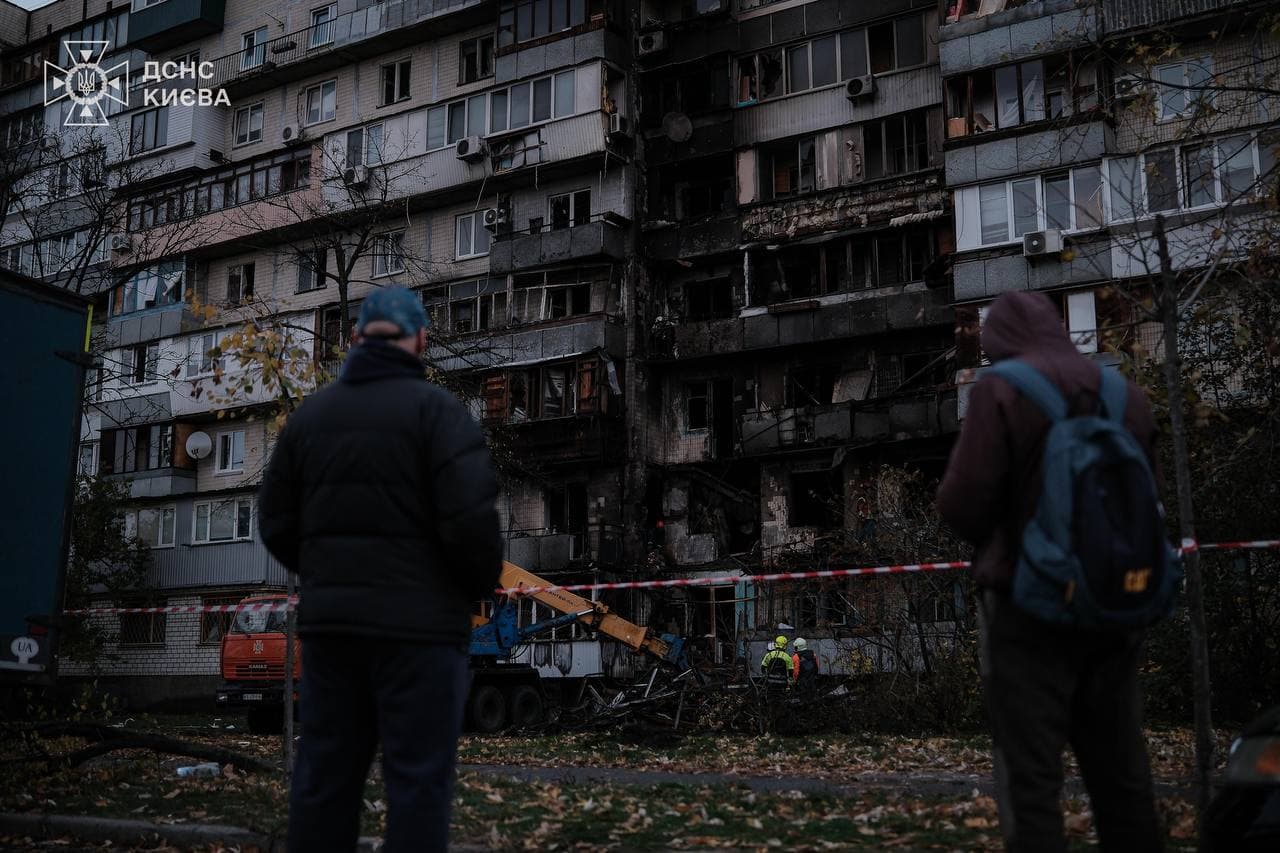
The wreckage of someone’s home. (State Emergency Service/Telegram)
Rescue workers navigated smoking rubble as residents emerged in nightclothes, disoriented, searching for family. Drone fragments struck another nine-story block where five people were pulled from damaged apartments. In Obolonsky district, debris hit a sixteen-story tower, shattering windows and sending glass cascading onto streets below.
Ukrainian air defenses had shot down or jammed ninety of the 101 drones launched from Russian territory. The attacks came from multiple directions—Kursk, Oryol, Bryansk, Primorsko-Akhtarsk, occupied Crimea. About sixty were Shaheds, Iranian-designed weapons that had become Russia’s primary tool for terrorizing cities.
But air defense is never perfect. Eleven drones penetrated the shield. That was enough to kill three people and maim dozens more. The mathematics are cruel: defenders must succeed every time, attackers need succeed only occasionally.
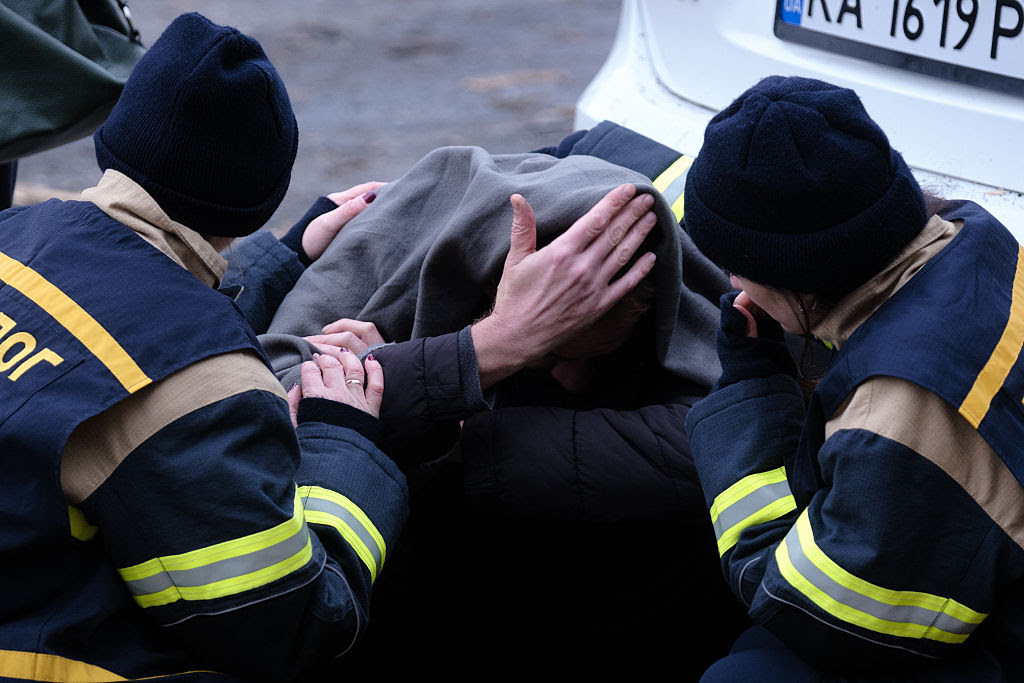
A mother and daughter died here. Psychologists comfort survivors in the courtyard where a Russian drone ended two lives in an instant. (Vitalii Nosach/Global Images Ukraine via Getty Images)
President Zelensky stated Russia had launched more than fifty missiles, nearly 1,200 strike drones, and over 1,360 guided bombs against Ukraine during the week. “These are attacks on residential buildings, on our people, on children. These are the most important targets for the Russians.”
German Economy and Energy Minister Katherina Reiche spent the night in a Kyiv bomb shelter with her delegation. “For us, it was a unique and depressing experience,” she told reporters. “Unfortunately, for Ukrainians, this is a bitter everyday life.”
The Liberation That Wasn’t Supposed to Happen
While Gerasimov spoke of encircling Ukrainian forces near Pokrovsk, those supposedly trapped troops were liberating territory.
Ukrainian units had recaptured Kucheriv Yar and Sukhetske over ten days—two villages thirty kilometers north of Pokrovsk. Since August 21, they’d regained nine settlements and cleared nine more of Russian sabotage groups. The numbers told a story opposite to Gerasimov’s narrative: 185.6 square kilometers liberated, another 243.8 cleared. Over ten days, 1,756 enemy troops eliminated, seventy-five pieces of equipment destroyed.
The broader accounting was devastating. Over two months in Ocheretyne sector: 15,700 Russian personnel killed; 1,364 pieces of equipment destroyed. Thirty-six tanks. 121 armored fighting vehicles. 162 artillery systems. 4,689 drones. These were the forces supposedly encircling Ukrainian defenders.
Inside Pokrovsk itself, the situation was difficult. Russian forces had infiltrated approximately 200 troops using small groups that exploited gaps between Ukrainian positions. Small-arms fighting echoed through streets. Counter-sabotage actions prevented Russians from pushing deeper or consolidating.
But infiltration is not control. Russian forces operating inside faced constant harassment from Ukrainian drones, elimination whenever they tried to consolidate positions. When Russians attempted mechanized assaults on October 25, Ukrainian defenders destroyed everything—two armored personnel carriers, two motorcycles. All of them.
Near Volodymyrivka, Russian forces exploited heavy rain that grounded Ukrainian drones. Fifteen heavy armored vehicles rolled forward. Ukrainian forces struck one tank and thirteen other vehicles. About fifty Russian servicemembers tried escaping the burning wreckage.
Russian milbloggers contradicted their own military’s claims. Small Ukrainian groups still operated in Pleshchiivka—refuting Defense Ministry announcements from weeks earlier. Ukrainian forces operated south of Kleban-Byk Reservoir. Russian troops who entered Kostyantynivka were sabotage groups, not occupation forces.
The encirclement existed only in Gerasimov’s briefing room.
Moscow Burns
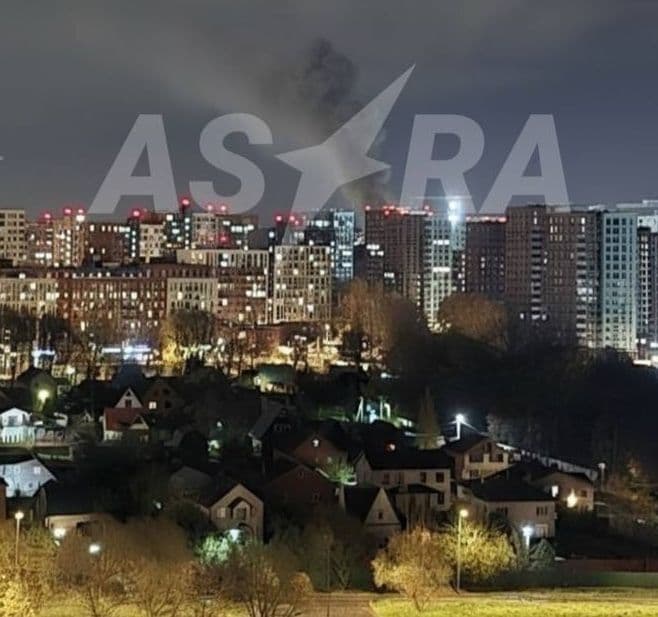
Moscow burns. (Astra)
The explosions began after midnight. Tracer fire streaked across Moscow’s sky as air defense batteries opened up, hunting targets in the darkness. Residents grabbed phones, filming from balconies as interceptor missiles climbed upward and drones tumbled from the sky trailing fire.
One hundred ninety-three Ukrainian drones swept across western Russia that night—at least that’s what the Defense Ministry claimed. Forty targeted Moscow Oblast. Thirty-four aimed at the capital itself.
In Kommunarka, someone heard the impact before they saw the flames. Smoke billowed from forested areas where debris had crashed. By the time emergency vehicles arrived, fires were visible from nearby roads, orange against the black treeline.
Mayor Sergey Sobyanin’s phone wouldn’t stop buzzing. He posted update after update throughout the night—each message revealing how the authorities struggled to track what was happening in their own airspace. At Domodedovo Airport, passengers watched departure boards flicker and change. Flights suspended. Zhukovsky too. The drones had closed the skies over Moscow.
North in Kursk region, flames erupted near a power substation in Rylsk. Outbuildings near houses caught fire, close enough to electrical infrastructure that firefighters worked frantically to contain the spread.
In Serpukhov, an oil depot exploded into flame that evening. Local officials issued a statement that conspicuously avoided explaining why. Russian Telegram channel Astra didn’t need an explanation—eyewitness footage showed the sky turning orange.
Across Russia that week, electrical panels had been combusting. Railway relay cabinets. Communication towers. Ukrainian military intelligence tracked the pattern: fires in multiple cities, including Moscow. Some were arson. Some were sabotage. All sent the same message.
The war had come home. Moscow’s sky burned orange, and every Russian looking up could see it.
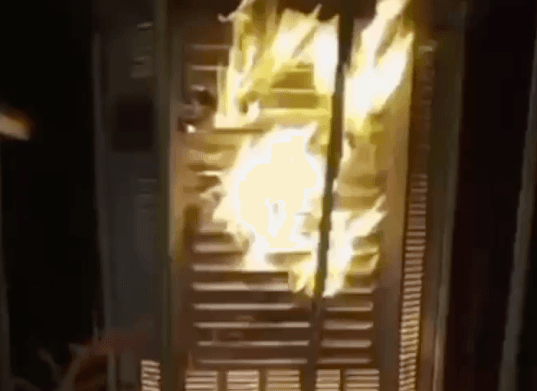
Russians burning Russia. Saboteurs recruited by Ukrainian intelligence torch infrastructure inside their own country. (HUR/Handout)
The $45 Million Target
The “Black Forest” brigade had been hunting it for days. Somewhere in the operational zone, a Russian Buk-M3 anti-aircraft missile system worth $45 million was repositioning, its radar scanning Ukrainian skies for targets. The system could track and engage thirty-six targets simultaneously—planes, helicopters, cruise missiles, drones. Overlapping coverage that made Ukrainian aerial operations extraordinarily dangerous.
Then the brigade found it.
Ukrainian Land Forces reported on October 26 that the advanced Russian air defense platform had been detected and destroyed. Video footage showed the strike, though the location remained undisclosed. One moment the Buk was operational. The next, flames consumed $45 million of Russian air defense capability.
The Buk-M3 traced its lineage to Soviet designs from the 1970s, but decades of upgrades had transformed it into a formidable system. Self-propelled, mobile, constantly repositioning to avoid Ukrainian counter-battery fire. Finding one required signals intelligence to detect radar emissions, satellite or drone reconnaissance to confirm location, and rapid strike capabilities to hit before it moved again.
The Black Forest brigade had done all three.
The Buk gained worldwide infamy in July 2014 when a Russian-operated system shot down Malaysia Airlines Flight MH17 over eastern Ukraine. Two hundred ninety-eight people died. Now Ukraine was systematically destroying them—a Buk-M3 in occupied Zaporizhzhia Oblast in September, another eliminated by Special Operations Forces in May.
Each loss forced Russian commanders to make impossible choices. Spread remaining systems thinner, accepting reduced coverage. Or leave some areas undefended entirely.
The Black Forest brigade had just made that calculation more painful. Somewhere in Ukraine, a gap had opened in Russia’s air defense shield. Ukrainian pilots would find it.
The Economic Cracks
The phone calls started going out to regional recruitment offices across Russia in recent months. Cut the bonuses. We can’t afford them anymore.
US Treasury Secretary Scott Bessent saw it happening from Washington. On October 26, he stated that US sanctions were biting into the Russian economy. India had stopped purchasing Russian oil. Many Chinese refineries had done the same. Russia’s economy existed in a wartime state with virtually no growth. Inflation exceeded twenty percent—despite the Central Bank’s insistence it was only 8.2 percent.
Russian oil profits were down twenty percent year-on-year. Bessent estimated US sanctions could slash them by another twenty to thirty percent. That mattered because oil and gas revenues accounted for roughly thirty percent of Russia’s federal budget—the money funding the war. Finance Minister Anton Siluanov had already acknowledged the share from oil and gas would fall by thirty percent in 2026.
The strain appeared where Moscow couldn’t hide it: at recruitment centers.
Radio Free Europe reported that regional authorities had been quietly slashing one-time payments to Russians signing military contracts. In Nizhny Novgorod, Ulyanovsk, Tatarstan, Mari El, Bashkortostan, Chuvashia, Yamalo-Nenets—across Russia’s regions, bonuses dropped by over two million rubles. Roughly $25,000 per recruit, gone.
The math was simple and brutal. Russia couldn’t afford to keep paying volunteers. The Central Bank lowered its key interest rate on October 24, desperately trying to free capital for military spending. Regional governments cutting recruitment incentives signaled what came next: compulsory recruitment of reservists. Western sanctions and unsustainably high soldier payments were destabilizing the economy.
Kremlin officials kept insisting inflation was manageable, that sanctions weren’t working, that the economy remained stable.
But recruitment officers opening their budgets could see the truth. The money was running out.
Dmitriev’s Honesty
Kirill Dmitriev posted on Telegram and the Kremlin-controlled platform MAX on October 26. The Russian Direct Investment Fund CEO and key Kremlin negotiator wanted to make something clear: Russia hadn’t changed its demands. Not since 2021. Not since 2022. Russia still wanted all of Luhansk, Donetsk, Zaporizhia, and Kherson oblasts.
Any peace settlement must address the “root causes” of the war, Dmitriev wrote—NATO’s eastward expansion, Ukraine’s alleged discrimination against Russian speakers. He referenced Putin’s June 2024 speech to the Foreign Affairs Ministry directly. Ukrainian forces must “completely withdraw” from Ukrainian-controlled territory in those four oblasts. Ukraine must abandon joining NATO. Only then could Russia agree to a ceasefire and negotiations.
The statement underscored Russia’s unchanged position. No compromise on maximalist demands. It also revealed that Russia’s recent offers to cede parts of southern Ukraine in exchange for all of Donetsk Oblast were theater. Disingenuous proposals meant to appear reasonable while demanding the impossible.
Dmitriev had notably avoided discussing Russia’s uncompromising position during recent statements to US media outlets. The difference was stark—one narrative for Russian domestic audiences, another for Americans.
Gerasimov echoed the same demands during his October 26 meeting with Putin. He opened his report by stating Russian forces continue carrying out tasks to seize Donetsk, Luhansk, Zaporizhia, and Kherson oblasts. All four illegally annexed regions. Complete occupation. Putin’s longstanding demand, repeated again.
The message was consistent. The war aims unchanged. Russia would accept nothing less than territorial conquest and Ukrainian capitulation.
The question was whether anyone in Washington was listening closely enough to hear what Dmitriev was actually saying.
Putin’s Nuclear Theater
Putin stood before cameras on October 26 and talked about the Burevestnik. The nuclear-powered cruise missile with “unlimited” range. Gerasimov backed him up, claiming “guaranteed accuracy against highly protected targets at any distance.”
Russia had just concluded its annual Grom exercises—all three components of the strategic nuclear triad on display. Putin emphasized the “reliability of Russia’s nuclear shield,” claiming Russia’s nuclear deterrent forces “exceed” the abilities of all other nuclear states. Russia’s strategic forces were capable of “fully ensuring” the national security of Russia and Belarus, he said.
Russian Direct Investment Fund CEO Dmitriev claimed he’d relayed information about the Burevestnik tests to US officials. Making sure Washington knew. Making sure they understood what Russia possessed.
It was theater. Another performance in Russia’s ongoing nuclear saber-rattling campaign. Dmitriev had issued oblique nuclear threats during interviews with US media outlets on October 24 and 25. Now Putin and Gerasimov highlighted the missile’s alleged technical capabilities, amplifying the message.
The pattern was familiar. Whenever Western pressure on Russia intensified, whenever support for Ukraine strengthened, the nuclear threats emerged. Reminders of Russia’s arsenal. Warnings about red lines. Suggestions that continued support for Ukraine risked escalation.
Putin wanted the West deterred. He wanted wavering voices in Washington questioning whether Ukraine was worth the risk. He wanted doubt seeded in minds asking if Russian nuclear threats should be taken seriously.
The Burevestnik announcement served that purpose. Whether the missile worked as advertised mattered less than the fear it might generate. Whether it had “unlimited range” mattered less than making American officials wonder if Putin believed it did.
The performance continued. The message remained consistent. Russia wanted the West to blink first.
Germany’s Promise
Katherina Reiche spent the night of October 25 in a Kyiv bomb shelter with her delegation, listening to explosions echo across the city. The next morning, Germany’s Economy and Energy Minister stood beside Ukrainian Energy Minister Svitlana Hrynchuk and made a promise.
“We will not leave Ukrainians in trouble.”
Winter was coming. Russian strikes had been systematically destroying Ukraine’s energy infrastructure for months. Reiche had seen the damage. She’d spent the night sheltering from drones targeting the capital. Now she promised further assistance to restore what Russia kept destroying.
Germany had already helped provide heat and electricity to more than a million Ukrainians, transferring 32,000 units of equipment. But attacks on the eve of heating season posed greater danger. “It is obvious to me that we must provide support,” Reiche said. Russia was purposefully attacking energy infrastructure.
Germany had pledged nine billion euros annually over the coming years. Sustained, long-term support. “The Patriot systems are already on the way, and you know it,” Reiche stated. “And we hope for cooperation between German and Ukrainian arms manufacturers.”
She announced the creation of a working group to restore Ukraine’s energy infrastructure. Practical, focused assistance.
Germany had provided three Patriot batteries since February 2022. In August 2025, the Defense Ministry announced it would soon transfer two more systems after reaching an agreement with Washington—Berlin would be first to receive new systems in return. Defense Minister Boris Pistorius had announced delivery of the first launchers at the September Ramstein meeting.
The Patriots were moving. The money was pledged. The working group would convene.
Reiche had spent one night in a Kyiv shelter. Ukrainians would spend the winter under bombardment. Germany’s promise was that they wouldn’t face it alone.
Lithuania Closes Its Border
The balloons came again on the night of October 26. Floating across from Belarus into Lithuanian airspace. Heading toward Vilnius International Airport.
Airport officials suspended operations for several hours. Passengers waited as incoming flights diverted. It was the third night in a row. The fourth time that week airspace violations had halted air traffic in Lithuania.
Lithuania’s National Crisis Management Center announced the next step on October 27: border crossings with Belarus closed for “an indefinite period.” Not temporarily this time. Indefinitely.
Lithuanian Prime Minister Inga Ruginiene had first announced the balloon incidents on October 24. A large group of “smuggling balloons” launched from Belarus toward Lithuania. The following night, they came again. Air traffic halted. Lithuania temporarily closed its last two operational border crossings with Belarus.
The balloons carried contraband cigarettes. On October 5 and 21, authorities had been forced to close airspace above Vilnius, grounding dozens of flights. Now the provocations continued.
Lithuania shared a 680-kilometer border with Belarus. In September, after a Russian drone incursion into Polish airspace, Interior Minister Vladislav Kondratovic had said Lithuania was prepared to close the border immediately if provoked.
Belarus had just provided the provocation. Three nights in a row.
The border crossings stayed closed. Lithuanian authorities weren’t reopening them until Belarus stopped sending balloons across the frontier. Whether those balloons carried cigarettes or simply represented deliberate harassment didn’t matter anymore.
The message from Vilnius was clear: keep sending balloons, keep the border closed. Lithuania had 680 kilometers of frontier to defend. Belarus had just lost its access points across it.
The balloons kept floating. The gates stayed shut.
The Ukraine Action Summit
Conference rooms filled in Washington on October 26 as the Ukraine Action Summit convened. Advocates, activists, lawmakers gathered to discuss one question: How do we keep America supporting Ukraine?
“We bring people together to learn, to educate themselves and to use their voices to speak to their elected officials,” explained Marianna Tretiak, Chair of the American Coalition for Ukraine Board.
The summit focused on four key advocacy issues.
First: asset seizure. Bills that would make Russia pay with seized funds. Make the aggressor finance Ukraine’s defense and reconstruction with its own confiscated money.
Second: the Sanctioned Russia Act. The legislation had gained at least twenty-five to thirty new co-sponsors since the last summit. A tool to push Russia toward peace talks through economic pressure.
Third: the return of Ukraine’s children. Several bills addressed this issue. Russia had abducted thousands of Ukrainian children since the invasion began. Ukraine regularly worked to return them—sixteen children brought back from Russian-occupied territories on September 17 alone. But thousands more remained.
Fourth: security guarantees for Ukraine as Kyiv and its allies pushed for a ceasefire. “There’s no legislation, but it’s really important,” Tretiak said. “Security guarantees for Ukraine. Really speaking about Ukraine as an asset, as an ally, as a country you want to be a partner with, because they’ll help you improve your defense.”
Ukraine and its allies had been developing potential security guarantees in recent months. Working to secure a ceasefire or peace deal that wouldn’t leave Ukraine vulnerable to another invasion the moment fighting stopped.
While Kyiv burned from Russian drone strikes, Washington talked. The summit attendees understood the disconnect. Their job was bridging it—turning American sympathy into sustained American support.
The advocacy continued. The bills moved forward. The question remained whether talk would translate to action before Ukraine’s next winter under bombardment.

While Kyiv burns, Washington talks. (Tatiana Bessmertnaya/American Coalition for Ukraine)
The Glide Bomb Reaches Farther
The Russian aircraft never crossed into range of Ukrainian air defenses. It didn’t need to.
A Russian milblogger claimed on October 25 that elements of the Aerospace Forces launched a glide bomb strike against Kamyanske in Dnipropetrovsk Oblast from roughly 150 kilometers away. The next day, Kryvyi Rih Mayor Oleksandr Vilkul reported another guided glide bomb strike against his city.
Russian forces were operating their aircraft farther from the frontline, exploiting Ukraine’s scarcity of air defense systems. The tactic was brutally simple: fly beyond the range of Ukrainian interceptors, release modified bombs with glide kits, let physics do the rest.
The weapons coasted toward targets using satellite guidance and control surfaces. No need to risk pilots or aircraft penetrating defended airspace. Just launch from safe distance and watch the bombs glide toward Ukrainian cities.
For Ukrainian air defense operators, it created an impossible problem. They could see the bombs coming but couldn’t reach the aircraft launching them. The glide kits extended range enough that Russian pilots stayed outside interceptor envelopes, launching their payloads and turning back toward Russian airspace before Ukrainian systems could engage.
Each successful strike demonstrated the calculus Ukrainian defenders faced. Not enough air defense systems to cover everywhere. Not enough interceptors to stop everything. Russian forces probing constantly, finding the gaps, exploiting the geometry of range and coverage.
The bombs kept gliding. The aircraft stayed safely distant. Ukrainian cities absorbed the impacts.
Civilian Toll: Nine Dead Across Ukraine
The accounting came in throughout October 26 as regional governors tallied the previous day’s dead. At least nine civilians killed. Forty-five injured. The numbers arrived in reports from across Ukraine.
Kyiv’s overnight drone attack accounted for three deaths and thirty-two injuries, including seven children. The mother and daughter in Desnianskyi district. Another victim elsewhere as drone fragments rained down.
In Donetsk Oblast, four civilians killed and one injured, regional governor Vadym Filashkin reported. Russian artillery and drones working systematically through towns and villages.
In Kharkiv, one person killed and seven injured, including two children, said regional governor Oleh Syniehubov. In Zaporizhzhia Oblast, another death in heavily shelled Huliaipole, governor Ivan Fedorov reported. One person killed, another wounded.
In Dnipropetrovsk Oblast, a sixty-three-year-old woman injured, governor Vladyslav Haivanenko said. In Kherson Oblast, Russian attacks wounded three people, governor Oleksandr Prokudin reported.
In Sumy Oblast, Russian forces struck a civilian truck on the outskirts of Bilopilska Hmromada. A man transporting groceries was injured, said Sumy Oblast Military Administration Head Oleh Hryhorov.
Nine dead. Forty-five injured. Children hospitalized. A mother and daughter killed together. A grocer wounded delivering food. An elderly woman struck in her home.
The toll arrived in bureaucratic reports from regional governors doing the grim mathematics of occupation and bombardment. Each number represented someone who woke up on October 25 not knowing it might be their last morning. Someone buying groceries. Someone sleeping in their apartment. Someone’s mother. Someone’s daughter.
Nine dead across Ukraine over one day. Tomorrow the governors would file new reports with new numbers.
The accounting never stopped.
The Frontline Grinds On
Russian forces kept attacking on October 26. The dramatic breakthroughs Gerasimov claimed to Putin didn’t materialize on the ground. What happened instead was the usual grinding attrition across multiple sectors.
In northern Sumy Oblast, Russian forces continued attacks but made no confirmed advances. Fighting occurred north of Sumy City near Kindrativka and Kostyantynivka, northeast near Yunakivka and Oleksiivka. Probing. Testing. Finding no weak points.
In northern Kharkiv Oblast, Russian forces attacked north toward Lyptsi, northeast near Vovchansk and Vovchanski Khutory. They didn’t advance. East of Velykyi Burluk near Bolohivka, more attacks. No gains.
Ukrainian forces maintained or recently advanced positions in the Kupyansk direction. Geolocated footage published October 26 showed Ukrainian troops held positions east of Pishchane—an area Russian sources previously claimed Russia controlled. Russian forces attacked near and within Kupyansk itself, northeast, east near Petropavlivka, southeast near Pishchane. Ukrainian positions held.
In Borova direction, geolocated footage from October 25 showed Ukrainian forces held positions east of Kopanky, contradicting Russian claims. The pattern repeated: Russian sources announced advances, geolocated evidence showed Ukrainian troops still there.
The Lyman direction presented chaos. Geolocated footage showed Russian forces recently advanced along the Lyman-Druzhelyubivka highway north of Stavky. Ukrainian Joint Forces Task Force spokesperson Colonel Viktor Trehubov stated on October 26 there was no clear frontline due to frequent infiltration missions on both sides. Both armies operating in the same spaces simultaneously.
Russian forces made small advances in Siversk direction. Geolocated footage from October 25-26 showed movement in northern Dronivka and southeast of Siversk. In Kostyantynivka-Druzhkivka area, footage from October 26 indicated Russian advances northwest of Rusyn Yar during a mechanized assault. Kramatorsk City Military Administration reported Russian strikes had destroyed thirty-six apartment buildings and damaged over 1,000 residences since January 2025.
In Pokrovsk direction, Russian forces continued offensive operations despite infiltrating troops into the city but made no confirmed advances. Those 200 infiltrated troops Gerasimov mentioned weren’t occupying—they were surviving, harassed constantly by Ukrainian drones.
Novopavlivka direction: Russian offensive operations, no confirmed gains. Velykomykhailivka direction: attacks continuing, no territorial advances. Hulyaipole direction: same pattern. Western Zaporizhia Oblast: offensive operations maintained, no breakthroughs. Kherson direction: limited ground attacks, no advances.
The frontline ground forward in meters, sometimes. Mostly it stayed where it was, absorbing attacks, holding against pressure. Gerasimov’s encirclements and strategic victories existed in briefing rooms. On the ground, troops fought over tree lines and ruined buildings, advancing house by house when they advanced at all.
The Day’s Reckoning: When Narrative Meets Reality
October 26, 2025 exposed the fundamental gap between Russian propaganda and battlefield reality. Putin and Gerasimov staged their performance of encirclement and triumph. Russia’s own military bloggers systematically dismantled every claim within hours.
Ukrainian forces liberated territory in sectors where Russia claimed control. Russian economic statistics revealed mounting strain from sanctions and unsustainable wartime spending. Regional recruitment offices slashed bonuses by $25,000 because Moscow couldn’t afford to keep paying.
A mother and daughter died in their Kyiv apartment—civilians targeted by drones designed to terrorize rather than achieve military objectives. Ukrainian air defense destroyed ninety drones. But 193 Ukrainian drones struck targets across western Russia. Neither side could achieve air dominance. Both could inflict punishment.
Lithuania closed its border over smuggling balloons, revealing how thoroughly the conflict had poisoned normal relations between Russia and the West. German ministers slept in Kyiv bomb shelters, illustrating Western leaders’ growing personal connection to Ukrainian suffering. American activists pushed for continued support in Washington, showing the ongoing diplomatic struggle to maintain Western unity.
The war had entered its fourth year without resolution. But October 26 demonstrated that Russian victory remained as distant as ever despite Moscow’s grand claims. Gerasimov’s encirclements existed primarily in propaganda. Russian economic foundations showed stress fractures. Ukrainian forces retained capacity to liberate territory even while defending against daily bombardment.
The gap between Putin’s narrative and ground truth had grown so wide that even Russia’s own military commentators refused to pretend otherwise.
In that divergence lay perhaps the day’s most significant development: the slow collapse of credibility that precedes the collapse of regimes.