
As flames consumed Russian oil infrastructure 1,500 kilometers from the front, Ukrainian forces fought block by block to hold their eastern stronghold—while Trump wavered, Germany delivered, and the war’s arithmetic of terror claimed soldiers and children alike.
The Day’s Reckoning
November 1 arrived with fire in two directions. In the west, Ukraine’s drones found their marks across Russia’s southern oil empire—igniting tankers at Tuapse’s Black Sea port, severing fuel pipelines outside Moscow, and plunging substations into darkness across three oblasts. The strikes reached farther than ever before, demonstrating a reach that now threatens Russia’s energy lifelines from the Caucasus to the capital.
But in the east, the war contracted to its most desperate geometry. In Pokrovsk, the logistics hub that has anchored Ukraine’s Donbas defense for over a year, Russian forces broke through in hundreds. They infiltrated from the north, pushed into residential neighborhoods from the southeast, and probed the city’s perimeter hunting for the routes that might collapse the pocket. Ukrainian special forces launched a daring helicopter raid to reopen supply lines. Russia claimed every raider was killed. Ukraine denied it. The truth remained obscured somewhere between the propaganda and the smoke.
Across six oblasts, Russian missiles and drones killed at least fifteen civilians and an unknown number of soldiers. Two children—eleven and fourteen years old—died in Dnipropetrovsk Oblast. An entire region went dark when strikes severed Donetsk’s power grid. In Chernihiv, where attacks have surged in recent weeks, blackouts spread as Russia intensified its campaign against the north.
Meanwhile, the war’s diplomatic theater played out in contradictions. Trump ruled out Tomahawk missiles for Ukraine but suggested letting the war “fight out.” The Kremlin said there was “no need” for a Putin-Trump meeting. Germany delivered Patriot systems that Zelensky had been promised. And Turkey’s refineries quietly began turning away from Russian oil, bowing to American sanctions that finally carried teeth.
By day’s end, the pattern was unmistakable: Ukraine strikes where it can reach, defends where it must hold, and survives on the weapons others choose to send—while Russia burns its reserves, spends its soldiers, and pretends that conquest still means victory.
Flames on the Black Sea: When Ukraine Found Tuapse
The drones arrived after dark, crossing hundreds of kilometers of Russian airspace to find the oil terminal at Tuapse—a vital node in the Kremlin’s energy export machine. Five strikes hit the port complex in rapid succession. An oil tanker erupted in flames. Four berths used for loading and unloading crude went dark. Buildings collapsed. Port infrastructure buckled under the assault.
Tuapse matters. The terminal processes seventeen million tons of crude annually and handles twenty percent of Russia’s seaborne oil exports. It serves as the primary outlet for petroleum products from Rosneft refineries in Tuapse, Achinsk, and Samara—feeding the global shadow fleet that finances Putin’s war. Three of those shadowy tankers sat moored at the terminal when Ukraine’s drones found them.
Geolocated footage verified the devastation. Fires burned across the berth complex, black smoke spiraling into the night sky above the Black Sea. A Security Service of Ukraine source delivered the message plainly: “The SBU continues to strike at Russia’s oil refining infrastructure, which provides the enemy with resources for aggression against Ukraine. As long as the war continues, flames will continue to burn brightly at Russian oil refineries.”
Russian officials confirmed the attack—unusual candor born of fires too large to hide. Krasnodar Krai authorities admitted that drone debris had damaged a tanker and terminal infrastructure. They claimed no casualties; a refrain that has grown familiar as Ukraine’s long-range campaign intensifies.
Ukrainian Navy Spokesperson Dmytro Pletenchuk noted the strategic significance: “At least three Russian shadow fleet tankers were moored at the Tuapse terminal at the time of the strike.” Each tanker represented another link in the chain that converts Russian crude into dollars, yuan, and rupees—the currencies that keep the war machine fed.
The Ring Pipeline Burns: Cutting Fuel from Moscow’s Backyard
While Tuapse burned on the coast, another fire ignited in Moscow Oblast—this one underground. Ukraine’s military intelligence struck the Koltsevoy pipeline, known in Russian as the Ring, a 400-kilometer fuel artery that pumps gasoline, diesel, and jet fuel to Russian forces across the western theater.
HUR’s operation targeted all three major fuel lines simultaneously near Ramensky district, southeast of the capital. Despite anti-drone nets and armed security stationed at the site, the strike severed the pipeline’s ability to transport up to three million tons of jet fuel annually, along with millions of tons of diesel and gasoline drawn from refineries in Ryazan, Nizhny Novgorod, and Moscow itself.
“A serious blow to Russia’s military logistics and its economy in Moscow Oblast,” HUR announced, a calculated understatement for an operation that reached into the heart of Russia’s fuel distribution network.
The strike was part of a broader campaign. Robert “Madyar” Brovdi, commander of Ukraine’s Drone Systems Forces, had promised exactly this outcome. Writing on Facebook hours before the pipeline burned, he warned that Russian regions would soon adapt to “ongoing disruptions in power supply.” Blackouts, he wrote, “are not scary. They’re just a bit inconvenient.”
His message concluded with a threat wrapped in dark humor: “The Free Ukrainian Birds promise you a rapid, if somewhat forced, adaptation.” By morning, Moscow Oblast and multiple other regions were experiencing exactly that—widespread power outages linked to Ukrainian strikes on energy infrastructure.
Five Substations, Three Oblasts: The Promise of Russian Blackouts
The campaign against Russia’s electrical grid unfolded in parallel. Ukrainian forces struck five substations overnight, including one near Gryazi in Lipetsk Oblast. Fires erupted at substations in Kursk and Lipetsk oblasts and consumed a thermal power plant in Oryol Oblast.
Madyar claimed joint responsibility, crediting both the Unmanned Systems Forces and Ukraine’s Special Operations Forces for the coordinated assault. Andriy Kovalenko, head of Ukraine’s Center for Countering Disinformation, implied the strikes had caused the cascading failures—though he stopped short of explicit confirmation, a tactical ambiguity Ukraine often employs when targeting infrastructure deep inside Russia.
The timing aligned with Madyar’s earlier warning. He had described Russian fuel shortages as “becoming more frequent,” while gas and oil reserves were “burning fast.” The strikes on electrical substations compounded the pain, demonstrating that Ukraine’s long-range capabilities now extended to multiple categories of strategic infrastructure.
For Russians living in the affected oblasts, the war’s consequences arrived not as distant headlines but as darkened homes and silent factories. Madyar’s mockery—”blackouts are not scary”—captured Ukraine’s shifting posture. If Russian cities could no longer shelter behind distance, then perhaps their populations would begin questioning the war’s sustainability.
Pokrovsk’s Desperate Hours: When Infiltration Became Invasion
In the east, the war’s calculus turned medieval. Pokrovsk, the logistics hub that has anchored Ukraine’s Donbas defense for over a year, finally began to crack under relentless Russian pressure. Geolocated footage confirmed what Ukrainian soldiers had feared: Russian forces had advanced in southeastern Pokrovsk, pushing into residential areas that defenders had held since the offensive began.
Commander-in-Chief Oleksandr Syrskyi described the battle in stark terms. Ukrainian forces were fighting to repel “a large Russian grouping attempting to infiltrate residential areas in Pokrovsk and sever supply routes.” He emphasized: “There is no encirclement or blockade of the cities. We are doing everything possible to maintain logistics.”
But the situation was dire. Russian forces had broken through in multiple directions—from the north, the east, and the southeast. Ukrainian military sources and Russian milbloggers both confirmed that Russian soldiers were infiltrating into northern Pokrovsk, a development that suggested the city’s defensive perimeter was collapsing in real time.
The Institute for the Study of War assessed the situation clinically: Russian forces were conducting “infiltration missions” that had not yet changed the control of terrain but represented probing attacks designed to find weaknesses. Russian milbloggers went further, claiming advances in northeastern, central, and southern Pokrovsk, as well as in neighboring Myrnohrad.
Syrskyi described consolidated groups from the Special Operations Forces, Military Law Enforcement Service, Security Service, and military intelligence all active in the city—a roster suggesting that Ukraine had committed its elite units to what was becoming an urban meat grinder. He added that additional troops, weapons, and drone systems were being deployed to reinforce the defense.
“The enemy is paying the highest price for trying to fulfill the Kremlin dictator’s order to seize Donbas,” Syrskyi said. The phrase captured both defiance and desperation—a recognition that while Russia’s casualties mounted, so too did the pressure on Ukraine’s last major stronghold in the region.
The Black Hawk Gambit: Special Forces and the Fog of War
Amid Pokrovsk’s chaos, a daring operation unfolded—or perhaps merely a claim wrapped in propaganda. Reports emerged that Ukrainian military intelligence had launched a helicopter-borne raid involving airborne assault units, landing special forces behind Russian lines in areas the enemy claimed to control.
Reuters reported that the raid began earlier in the week when Ukrainian special forces disembarked from a Black Hawk helicopter in open terrain compromised by Russian drone activity. Video footage appeared to show at least ten soldiers landing in a field, though the location and date could not be independently verified.
Sources within Ukraine’s Defense Forces told Suspilne that assault units had entered areas of Pokrovsk that Russian commanders previously claimed to control—an operation designed to reopen key logistics lines and challenge Russia’s grip on the city’s outskirts.
Russia’s Defense Ministry responded with a definitive claim: “All 11 personnel who landed from the helicopter were killed.” The statement appeared on Telegram hours after the first reports surfaced. Ukraine denied the claim outright, offering no details but rejecting Russia’s narrative completely.
Additional geolocated footage published the same day showed Ukrainian forces striking two Russian soldiers in northern Pokrovsk during what ISW assessed was an infiltration mission that did not change control of terrain. The footage suggested that both sides were conducting small-unit operations in contested areas, probing for weaknesses and attempting to exploit gaps in the other’s defenses.
The truth remained obscured by the fog of war. What was clear: Pokrovsk had become a close-quarters battlefield where helicopter raids, infiltration missions, and urban combat unfolded simultaneously—each side claiming success while the city’s control hung in the balance.
The Assault Tactics Killing Thousands: Russia’s Pokrovsk Strategy
Behind Pokrovsk’s headlines lay a brutal arithmetic. A Ukrainian non-commissioned officer operating in the sector described Russian assault tactics that prioritized finding bypass routes rather than overwhelming strongpoints. Russian units would search for paths around Ukrainian defensive positions, infiltrating into the rear while other forces—drone operators, artillery crews, or lesser-quality infantry—worked to destroy the strongpoint itself.
The tactic relied on human waves. Russian commanders sent untrained soldiers on assaults designed to draw Ukrainian drone and artillery fire, revealing the positions of Ukrainian crews. Once those positions were exposed, trained Russian assault infantry would attempt close combat engagements.
A battalion commander in the Pokrovsk direction confirmed that Russian forces regularly attacked along the same routes despite heavy casualties. “Russian forces send untrained soldiers on assaults to draw fire,” the commander said, describing a system that treated personnel as expendable sensors rather than soldiers.
The casualty rate proved catastrophic. Ukrainian-focused Telegram channels published images showing high concentrations of Russian dead near Rodynske, north of Pokrovsk, attributing the toll to Ukrainian drone strikes. The spokesperson of a Ukrainian brigade reported that elements of the Russian 155th Naval Infantry Brigade had sustained such heavy losses that they were now combat ineffective and withdrawing. Elements of the 108th Motorized Rifle Regiment and 68th Tank Regiment were moving in to replace them.
The Crimea-based partisan group Atesh reported similar conditions in other Russian units. Sources within the 74th Motorized Rifle Brigade described heavy casualties and high rates of desertion, exacerbated by the brigade receiving no rest and failing to evacuate wounded from the battlefield. “The brigade is getting no rest and not evacuating wounded,” Atesh noted, “which both contribute to the high casualty rate.”
Russian forces were constantly committing new units to battle and sending reinforcements to the area, the battalion commander observed—a sign that Moscow had prioritized Pokrovsk’s capture regardless of cost. The offensive showed no signs of relenting, even as entire brigades were ground down in the effort.
Counterattack in the Dobropillya Pocket: Ukraine Reclaims Ground
Not all the news from the east carried defeat. Geolocated footage revealed that Ukrainian forces had recently advanced west of Shakhove in the Dobropillya tactical area, pushing back Russian positions that elements of the 1st Slovyansk Motorized Rifle Brigade had formerly held.
A Russian milblogger published a map showing Ukrainian advances in western Nove Shakhove, acknowledging the loss with the clinical detachment characteristic of Russia’s better military analysts. The advance represented a tactical counteroffensive—small in scale but significant as evidence that Ukrainian forces retained the capability to retake territory even as pressure mounted elsewhere.
The Ukrainian General Staff reported recapturing 400 square meters in an unspecified area of the Pokrovsk direction, likely referring to tactical counterattacks north and northwest of Pokrovsk. The figure seemed modest, but in urban warfare where every street and building matters, even 400 square meters could represent a critical strongpoint or supply route.
The counterattacks demonstrated that Ukraine had not conceded the initiative entirely. While Russian forces infiltrated Pokrovsk from multiple directions, Ukrainian units were simultaneously probing Russian positions, exploiting gaps, and reclaiming terrain where the opportunity presented itself. The battle remained fluid; its outcome unresolved.
The Arithmetic of Terror: Fifteen Dead, Including Two Children
While Pokrovsk consumed elite units and international attention, the war’s daily terror claimed its most helpless victims. Russian forces launched two Iskander-M ballistic missiles and seventy-nine attack drones across Ukraine overnight. Ukrainian air defenses intercepted sixty-seven drones, but twelve reached their targets in six different locations.
At least fifteen civilians died in the attacks. In Dnipropetrovsk Oblast, a Russian strike hit a store in Samarivskyi Raion, killing four civilians including an eleven-year-old and a fourteen-year-old. Six others were injured. Governor Vladyslav Haivanenko confirmed the toll, the children’s ages a stark reminder that Russia’s targeting made no distinction between military and civilian infrastructure.
In Odesa Oblast, an overnight drone strike killed two civilians and injured three others when it hit civilian infrastructure, igniting five trucks—four empty, one carrying soybeans. In Kherson Oblast, Russian forces launched drone, artillery, and air strikes on over twenty settlements, killing one person and injuring two others while damaging four apartment buildings, twelve houses, and vehicles.
The strikes also targeted energy infrastructure with calculated precision. Russian attacks knocked out power to the entire Donetsk Oblast, plunging cities and towns into darkness. Zaporizhia Oblast lost electricity for nearly 58,000 subscribers. Partial outages spread to Kharkiv and Chernihiv oblasts, where 6,996 consumers went dark.
Ukrainian state electricity transmission operator Ukrenergo announced it would restrict energy consumption to unspecified oblasts due to ongoing Russian strikes on energy infrastructure—a euphemism for blackouts imposed by bombs rather than bureaucracy.
President Zelensky reported the week’s toll: Russian forces had launched nearly 1,500 strike drones, 1,170 guided glide bombs, and over 70 missiles against Ukraine during the week of October 27 to November 2. Each statistic represented not just metal and explosives but destroyed homes, severed power lines, and lives interrupted or ended.
When Soldiers Died in Their Rear: The Dnipropetrovsk Strike
Among the civilian casualties, another toll emerged—one the Ukrainian military acknowledged with somber brevity. Ukrainian soldiers had been killed in Russian missile and drone strikes on Dnipropetrovsk Oblast. The strikes hit several settlements including Nikopol, Pishchansk, Pokrovsk, Marhanets, and Chervonohryhorivsk—areas in the deep rear and close to the line of combat.
The Operational Task Force “East” confirmed casualties and injuries among Ukrainian military personnel but declined to specify numbers. Law enforcement agencies launched an investigation focusing on whether local military units had followed the General Staff’s directives regarding air alert warnings, restrictions on open-area gatherings, and the correct use of shelters.
The phrasing suggested that the strike had caught soldiers in vulnerable positions—perhaps gathered in open areas during an alert or sheltering inadequately when the missiles arrived. “Russian systematic attacks on populated areas in the deep rear and in areas close to the line of combat continue,” the task force said, a statement that acknowledged the war’s expanding geography.
“We express our deepest condolences to the families and loved ones of the fallen defenders of Ukraine,” the statement concluded. “The Russian aggressor will pay dearly for this crime.” The promise carried the weight of grief and the hollowness of words that could not resurrect the dead.
Chernihiv Under Siege: The Northern Front Intensifies
In Ukraine’s north, a quieter escalation unfolded. Andriy Demchenko, spokesman for the State Border Service, reported a significant spike in Russian strikes against Chernihiv Oblast—a region that borders both Russia and Belarus and had seen relative calm since the war’s opening months.
“The attack is not decreasing—the enemy, on the contrary, is increasing the number of its strikes by various means on the border of Ukraine within the Chernihiv, Sumy, and Kharkiv regions,” Demchenko said. “Recently, the number of attacks on the Chernihiv region has significantly increased, because before that, most of the shelling occurred precisely within the Sumy and Kharkiv regions.”
The shift represented a tactical evolution. Russia had increasingly relied on drones—including fiber-optic models resistant to jamming and inexpensive first-person-view drones produced en masse. While long-range kamikaze drones like Shaheds remained Moscow’s weapon of choice for striking deep into Ukraine, Demchenko noted that the Chernihiv campaign involved multiple weapon types.
Recent strikes painted a pattern of systematic targeting. In September, an international demining mission funded by Denmark was hit by a Russian missile. Later that month, a “double-tap” strike targeted first responders as police and rescue teams attended the scene. A Russian missile then ripped through a military training center. Blackouts and water disruptions followed as Russia began targeting the energy grid.
Governor Vyacheslav Chaus reported that Russian forces had carried out fifty-three attacks across Chernihiv Oblast, injuring one civilian and damaging civilian and critical infrastructure. In the Koriukivka district, a Russian ballistic missile struck an agricultural enterprise—another example of strikes that blurred the line between military and economic targets.
Demchenko added that as of September, Russia had no spare troops to launch a new invasion from Belarus—a reassurance that addressed lingering fears of a renewed northern offensive. But the spike in strikes suggested Russia was probing for weaknesses, testing defenses, and keeping Ukrainian forces dispersed across multiple fronts.
Trump’s Tomahawk Refusal: “Not Really… Things Can Change”
From Washington came a message wrapped in ambiguity. U.S. President Donald Trump told reporters he was not planning to provide Ukraine with long-range Tomahawk cruise missiles—at least “not really.” When pressed on whether his administration was considering sending Kyiv the weapons, Trump added: “things can change but at this moment I’m not.”
The remarks followed reports that the Pentagon had signaled sufficient Tomahawk inventory if the White House chose to greenlight a transfer. The missiles, capable of striking targets at ranges between 1,600 and 2,500 kilometers, would allow Ukraine to hit military targets deep inside Russia—escalating pressure on Putin and potentially strengthening Kyiv’s leverage in future peace negotiations.
Russian President Vladimir Putin had warned that providing such weapons would constitute “a qualitatively new stage of escalation.” Trump’s hesitation suggested he was weighing that threat against Ukraine’s strategic needs, though his answer left all options open.
When asked what would be the “final straw” proving Putin was not ready to end the war, Trump offered a philosophy rather than a policy: “There’s no final straw. Sometimes you gotta let it fight out, it’s been a tough war for Putin, he’s lost a lot of soldiers maybe a lot of million. It’s been tough on Ukraine, tough on both. Sometimes you have to let it get fought out.”
The response revealed Trump’s transactional worldview—a belief that wars must sometimes exhaust themselves before diplomacy can succeed. For Ukraine, the answer carried no comfort. “Let it fight out” meant more months of strikes, more cities contested, more children killed in stores.
When asked about frozen Russian assets and whether he would use them as leverage, Trump deflected: “Europe and Russia are having discussions, I’m not involved in those discussions.” An estimated $300 billion in Russian central bank reserves remained frozen globally, with about $185 billion euros held by Belgium-based Euroclear. Trump’s detachment suggested he viewed the assets as Europe’s problem rather than America’s tool.
The Kremlin’s Non-Meeting: “No Need” for Trump and Putin
From Moscow came a matching ambiguity. Kremlin spokesperson Dmitry Peskov told state news agency TASS that there was “no need” for a meeting between Trump and Putin—at least not yet. “Hypothetically speaking, it is possible, but at this point there is no need for it,” Peskov said. “There is a need for very painstaking work on the details of the settlement issue.”
The statement marked a reversal from earlier optimism. When Putin had called Trump on October 16, the U.S. president had spoken of meeting in Budapest and discussed “progress” allegedly being made in peace talks. But those plans evaporated on October 21 when Trump said he didn’t want a “wasted meeting” with Putin, citing Moscow’s refusal to cease fighting along the current front line.
Trump had gone further on October 22, imposing sanctions on Russia’s two largest oil companies, Rosneft and Lukoil. The move suggested that his diplomatic patience had limits—or at least that he was willing to apply pressure when talks stalled.
Putin’s special envoy Kirill Dmitriev had claimed on October 24 that Russia and Ukraine were close to reaching a deal with U.S. mediation. The claim contradicted Moscow’s actual stance, as Russia continued to reject any compromise and insisted on maximalist demands, including Ukraine’s surrender of the entire Donetsk Oblast as a precondition for peace.
Trump had reiterated on October 25 that he would not meet Putin unless he saw a clear path to a peace agreement. “We’re going to have to know that we’re going to make a deal,” he told reporters. “I’ve always had a great relationship with Vladimir Putin, but this has been very disappointing.”
Peskov’s November 2 statement thus represented Moscow’s acknowledgment that the diplomatic theater had stalled. Both leaders were content to wait—Trump for Putin to soften his demands, Putin for Ukraine’s defenses to crumble. Meanwhile, the war ground on.
Germany Delivers: The Patriots That Zelensky Had Been Promised
Amid the diplomatic deadlock, one promise was kept. Germany delivered Patriot air defense systems to Ukraine in fulfillment of prior agreements, President Zelensky announced. “We have strengthened the ‘Patriot’ component of our Ukrainian air defense,” he wrote, thanking Federal Chancellor Friedrich Merz for “this joint step to protect human lives from Russian terror.”
The announcement came just over a month after German Defense Minister Boris Pistorius had pledged two Patriot systems by the end of 2025. The delivery demonstrated Germany’s continued commitment to Ukraine’s air defense—a commitment that stood in contrast to Trump’s wavering on Tomahawks.
Zelensky framed the Patriots in strategic terms: “Russian air strikes are Putin’s main stake in this war—through terror he tries to compensate for his inability to achieve his insane goals on the ground. Therefore, every strengthening of our air defense literally brings us closer to the end of the war that we are all waiting for.”
A typical Patriot battery consists of radar units for target detection and tracking, a fire control center, missile launchers, and support equipment. Depending on configuration, a battery includes between four and eight launchers capable of intercepting ballistic and cruise missiles as well as aircraft.
Advanced air defense systems like the Patriot remain in short supply globally, with some components taking years to produce. Germany had previously supplied Ukraine with three Patriot systems. The additional batteries were provided under an agreement with the U.S. manufacturer to quickly replenish Germany’s stocks—part of the PURL initiative announced by Trump in July under which NATO and EU members purchase U.S.-made weapons systems for Ukraine.
Zelensky hinted at more to come: “There would be further results regarding Ukraine’s air defenses and additional deals were underway.” The statement offered hope that Germany’s reliability might compensate for American hesitation.
Turkey Turns Away: When American Sanctions Finally Bite
Far from the front lines, another front opened in the economic war. Turkey’s largest oil refineries began scaling back purchases of Russian oil, turning instead to alternative suppliers as Western sanctions tightened restrictions on Moscow’s energy exports.
The U.S. restrictions announced on October 22 had targeted Russia’s two largest oil firms—Rosneft and Lukoil—along with their subsidiaries. The measures paved the way for secondary sanctions against foreign institutions handling transactions with blacklisted entities. For Turkey, one of the main buyers of Russian oil alongside India and China, the shift marked a significant change.
The SOCAR Turkey Aegean Refinery (STAR), owned by Azerbaijan’s state oil company, had secured four shipments of crude from Iraq, Kazakhstan, and other non-Russian producers for December delivery. These purchases amounted to between 77,000 and 129,000 barrels per day, significantly reducing the refinery’s intake of Russian oil.
Another major Turkish refiner, Tupras, was also increasing purchases of non-Russian oil, including Iraqi grades of similar quality to Urals. The company planned to phase out Russian crude imports at one of its two major refineries, allowing it to continue exporting fuel to Europe without breaching upcoming restrictions.
Tupras had already begun diversifying, receiving its first-ever shipment from Brazil earlier in the year and expecting a second from Angola in November. The pivot demonstrated that American sanctions, when structured with secondary enforcement mechanisms, could reshape global energy flows even among traditionally neutral buyers.
Rosneft and Lukoil together account for nearly half of Russia’s crude oil exports—around 3.1 million barrels per day. State-controlled Rosneft, led by Igor Sechin, a close Putin ally, produces about forty percent of Russia’s oil. Lukoil, the country’s largest private energy company, accounts for roughly fifteen percent of national output and two percent of global production.
The sanctions extended to six Lukoil subsidiaries and twenty-eight Rosneft enterprises, including Lukoil-Western Siberia, which alone accounts for around forty percent of the group’s hydrocarbon production. Turkey’s shift, driven by the threat of secondary sanctions, suggested that the economic pressure Trump had applied was working—even as his military support for Ukraine remained uncertain.
Sabotage from Within: The Truck That Never Reached Pokrovsk
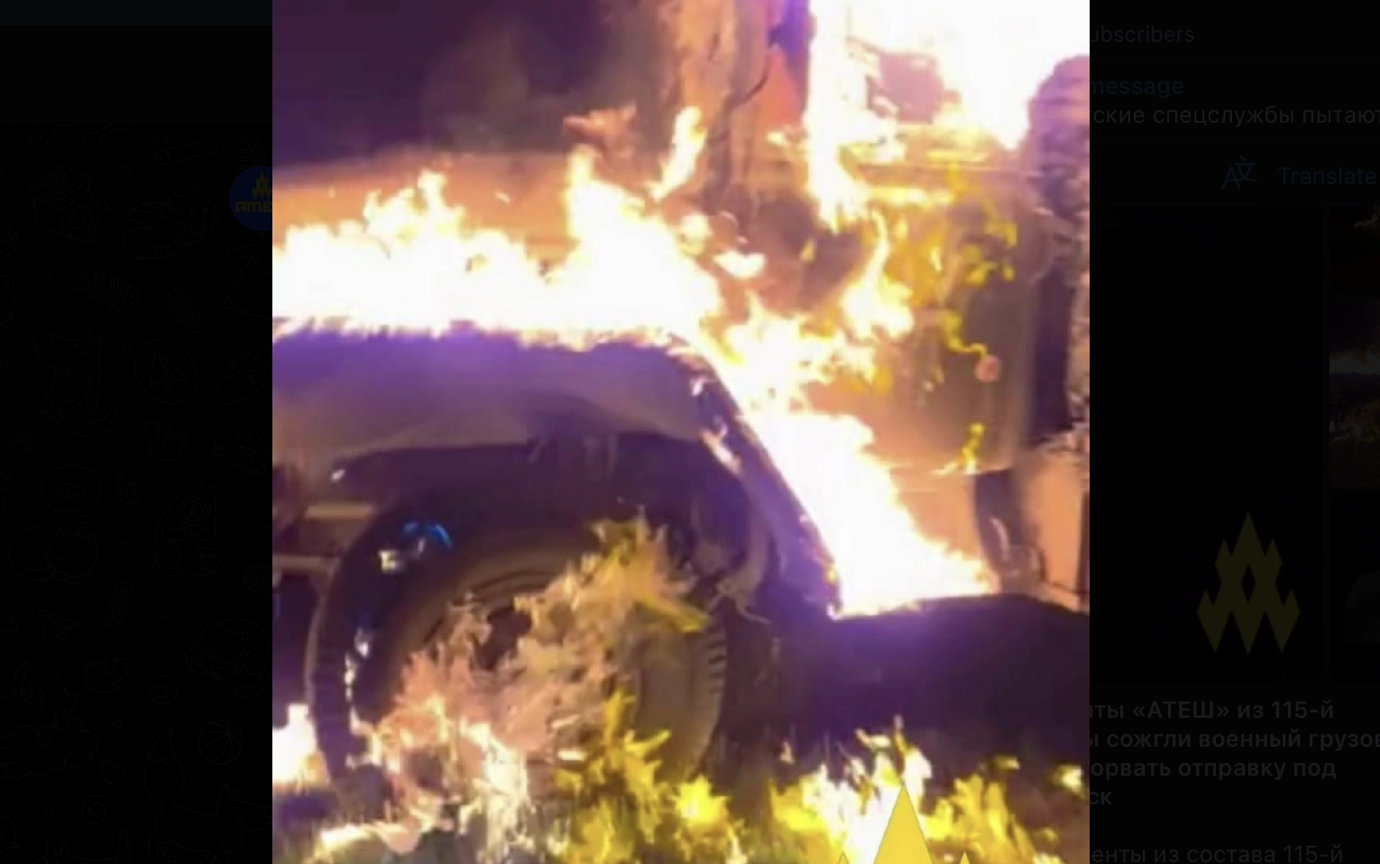
A burning Russian military truck, which Ukrainian partisan group Atesh said was set ablaze by a dissident soldier within Russia’s 115th Separate Motorized Rifle Brigade. (Photo by Atesh / Telegram)
In the shadows of Russia’s war effort, resistance took quieter forms. Ukrainian partisan group Atesh reported that one of its agents within Russia’s 115th Separate Motorized Rifle Brigade had set a military truck on fire to prevent the unit’s deployment to Pokrovsk.
Video footage without narration showed a person filming as they ignited a flammable substance on a Russian truck bearing the pro-war “Z” insignia. The unit, stationed near Avdiivka—the key battleground captured by Russian forces in February 2024—had been preparing to reinforce Russian operations in Pokrovsk when the sabotage occurred.
Atesh claimed the sabotage delayed the unit’s deployment and secured the agents’ lives. “The soldiers see their command abandoning personnel to certain death, giving them no rest or evacuation,” the group’s statement said, echoing complaints heard across Russian units suffering catastrophic casualties.
The report aligned with broader patterns of internal resistance. Independent Russian media had recently identified over 100 commanders accused of torturing and executing their own troops in Ukraine for reasons ranging from disobeying orders to refusing to hand over a share of injury pay. The brutality had created conditions ripe for sabotage.
“Our agents prove that every Russian soldier can fight for their life without leaving their unit!” Atesh declared. “Sabotage is the most effective way to avoid being sent to the slaughter. We call on all Russian service members to do the same! Save your lives!”
The Kyiv Post could not independently verify Atesh’s reports. But the group’s narrative of internal dissent and self-preservation resonated with the broader reality: Russian soldiers were dying in staggering numbers for gains measured in city blocks, and some had begun choosing survival over orders.
Russia’s Kindergarten Corps: When Patriotism Targets Preschoolers
As Russia’s military struggled to sustain its offensive, the Kremlin looked to its youngest citizens for future recruits. Over 100 kindergartens across Russia had started military cadet programs since the full-scale invasion began, according to independent Russian media outlet Verstka.
Preschool children were being taught to march, practice hand-to-hand combat “in a playful manner,” handle firearms, and meet with participants in what Russia calls its “special military operation.” The courses were designed to promote patriotism, awareness of military basics, and serve as “early career guidance”—a chilling euphemism for preparing five-year-olds to view military service as destiny.
Open-source reporting indicated that some cadet groups were associated with particular armed services such as police or border guards. Others connected to the Russian Ministry of Defence youth organization Yunarmiya and the Kremlin youth organization Movement of the First. The programs formed part of plans for a law on cadet education currently under development.
The militarization of Russian education had intensified since 2022, with ideology and patriotic indoctrination becoming central to the curriculum. The kindergarten programs represented the logical extreme of that trajectory—a society preparing its children for perpetual conflict from the moment they could understand authority.
Western analysts assessed that the politicization and militarization of Russian education, coupled with increasing ideological indoctrination of Russian children more broadly, would perpetuate aggressive, expansionist Russian nationalism in the longer term. The kindergarten corps thus represented not just propaganda but infrastructure—building a generation that would view conquest as normal and questioning authority as treason.
Belgium’s Uninvited Guests: Drones Over NATO’s Nuclear Base
The war’s shadow extended beyond Ukraine’s borders in unexpected ways. Belgian officials reported unidentified drone incursions near the Kleine Brogel Air Base over three consecutive nights from October 31 to November 2.
Belgian Defense Minister Theo Francken reported that three large drones flew at higher-than-typical altitudes above the base on the night of November 1 to 2. “The drones were clearly conducting a mission involving Kleine Brogel Air Base,” Francken said, adding that Belgian forces unsuccessfully attempted to jam and intercept the aircraft.
The base carries strategic significance. Belgian media noted that Kleine Brogel will host F-35 fighter jets in 2027—aircraft capable of carrying nuclear weapons. The repeated incursions suggested reconnaissance, though no attribution was made publicly.
The timing was notable. As Ukraine demonstrated its long-range drone capabilities against Russian infrastructure, unidentified drones probed NATO facilities in Western Europe. Whether the incidents were connected remained unclear, but they underscored the war’s expanding geography—a conflict that now reached from Tuapse to Brussels, from kindergartens in Siberia to air bases in Belgium.
Kremlin Silencing: When VChK-OGPU Went Dark
In Russia’s information war against its own citizens, another voice fell silent. Russian authorities instructed Telegram administrators to remove the reserve accounts of VChK-OGPU, a prominent insider source that shared information about the Kremlin and Russian security services.
VChK-OGPU stated on its website that Telegram removed its accounts VChK-OGPU-Info and VChK-OGPU-Info2 after arresting one of the channel’s authors. The crackdown came after authorities had already targeted the main account, part of a wider effort to cleanse the Russian information space of sources publishing information the Kremlin deemed threatening to regime stability.
The channel had provided rare glimpses into internal Kremlin dynamics and security service operations—information that contradicted official narratives and exposed corruption, incompetence, and dissent within Russia’s power structures. Its silencing reflected the Kremlin’s growing intolerance for any information it could not control, even from sources operating within Russia’s own borders.
The move demonstrated that as Russia’s war abroad intensified, so too did its repression at home. Victory required not just defeating Ukraine but ensuring that Russians saw only the version of events the Kremlin chose to broadcast.
The Occupied Depot Burns: Shakhtarsk in Flames
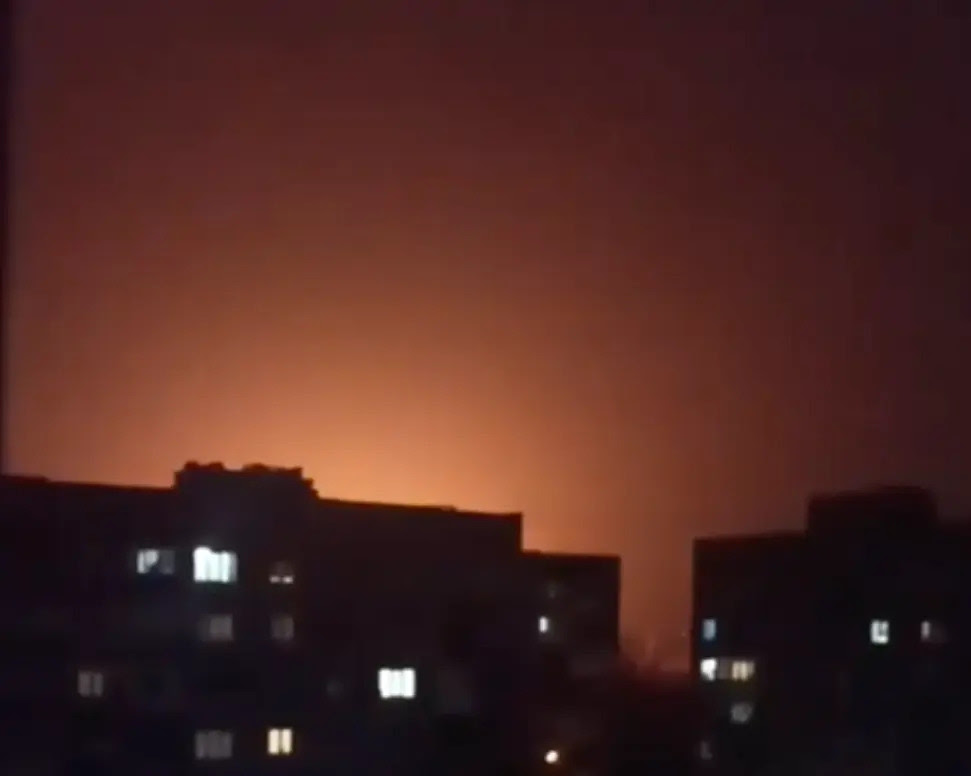
Explosions light the sky over Russian-occupied Shaktharsk, Donetsk Oblast, after a reported strike on a local oil depot. (Screenshot / ExilenovaPlus / Telegram)
In Russian-occupied Donetsk Oblast, another fire illuminated the night. An oil depot in the city of Shakhtarsk was attacked on the evening of November 2, according to footage posted to social media. Powerful explosions rocked the facility shortly before 8 p.m. local time, with air defenses continuing to operate in the region.
Shakhtarsk has been under Russian occupation since 2014, making it a valid target for Ukrainian forces operating behind enemy lines. The city had seen similar attacks before—a fire broke out at the facility in July 2023 following an alleged missile attack, and flames consumed the depot again in October 2022, which Russian proxy officials blamed on Ukrainian shelling of a nearby railway station.
Ukraine regularly carries out strikes on oil facilities in Russian and Russian-occupied territory, though authorities do not always comment on or confirm reported attacks. Kyiv considers these facilities valid military targets, as fossil fuel profits fund Moscow’s war machine.
SBU chief Vasyl Maliuk had reported on October 31 that Ukraine had carried out nearly 160 successful strikes against oil extraction and refining facilities across Russia in 2025. The Shakhtarsk strike added to that total, demonstrating that Ukraine’s reach extended not only into Russia proper but into the territories Russia claimed as its own.
The Grinding Fronts: From Sumy to Zaporizhia
Beyond Pokrovsk’s drama, the war’s other fronts ground forward in their familiar rhythms. In northern Sumy Oblast, Russian forces continued offensive operations without confirmed advances, though a milblogger affiliated with the Northern Grouping claimed Ukrainian forces had nearly encircled Russian troops in Bezsalivka. The same source reported that Russian and North Korean forces were conducting demining operations and recovering bodies near Tetkino in Kursk Oblast.
In the Kupyansk direction, geolocated footage showed Russian forces had recently advanced in central Kupyansk, though the change had not occurred within the previous 24 hours. Russian attacks continued near Kupyansk itself and in multiple directions radiating from the city, suggesting sustained pressure on this critical logistics node.
In the Lyman sector, Ukrainian 11th Army Corps Spokesperson Dmytro Zaporozhets reported that Russian forces had intensified assaults near Yampil, shifting from infiltration operations to deliberate assaults. Russian forces were accumulating in forests east of Yampil and exploiting the surrounding woodland to bypass Ukrainian positions. Rainy and cloudy weather complicated Ukrainian drone operations, giving Russian forces temporary advantages in obscured terrain.
In the Kramatorsk direction, Zaporozhets reported that Russian military command was decreasing assault intensity in the Chasiv Yar area to prioritize repositioning troops. Russian forces were conducting desultory assaults into Pivnichnyi Microraion of Chasiv Yar while preparing for renewed efforts elsewhere.
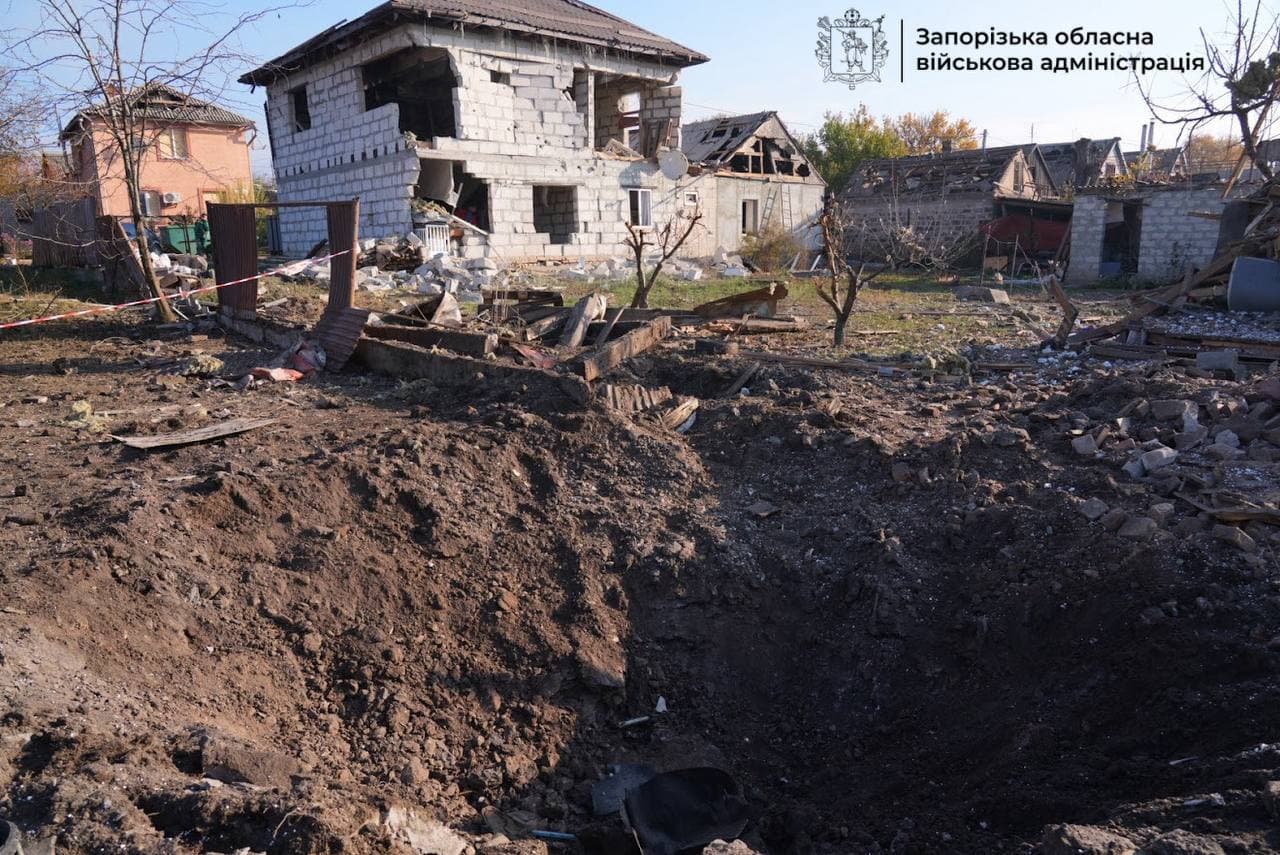
Aftermath of a Russian attack on Zaporizhzhia Oblast overnight. (Zaporizhzhia military administration / Telegram)
South toward Zaporizhia, Russian forces continued offensive operations in the Hulyaipole and Orikhiv directions without confirmed advances. The pattern remained consistent: Russian forces probing, attacking, repositioning—seeking weaknesses in Ukrainian lines while Ukrainian forces held, counterattacked where possible, and waited for the weapons that might shift the balance.
The War in Two Directions
November 1 captured the war’s split personality. Ukraine struck outward with drones that traveled 1,500 kilometers to ignite Russian oil infrastructure, severed fuel pipelines in Moscow’s suburbs, and knocked substations dark across three oblasts. The long-range campaign demonstrated reach, innovation, and the will to carry the war to Russia’s heartland.
But in Pokrovsk, the war contracted to its most elemental form—soldiers fighting block by block, special forces landing from helicopters in contested terrain, Russian infiltrators probing for gaps while Ukrainian defenders struggled to hold what they could not afford to lose. The city’s fate remained unresolved, suspended between Russia’s grinding offensive and Ukraine’s desperate defense.
Across the war’s broader geography, contradictions multiplied. Trump ruled out Tomahawks while suggesting wars must “fight out.” Putin’s Kremlin said there was “no need” for talks while insisting on maximalist demands. Germany delivered Patriots while Turkey quietly turned away from Russian oil. Belgian drones circled NATO bases while Russian kindergartens taught children to march.
And in the spaces between strategy and survival, fifteen civilians died—including two children in Dnipropetrovsk Oblast whose names would join the thousands already lost to a war that showed no signs of ending.
The day’s events revealed the war’s two paths forward. Ukraine could strike far into Russia, disrupting logistics and imposing costs that might eventually force negotiation. Or the war could be decided in places like Pokrovsk—urban battlegrounds where hundreds die for control of residential blocks and the side that runs out of soldiers first will lose regardless of how many oil refineries burn.
By nightfall, both paths remained open. The oil terminals still burned at Tuapse. The Ring pipeline still lay severed outside Moscow. And in Pokrovsk, Ukrainian soldiers still held—though for how much longer, no one could say.