
A day when Russia threatened atomic testing, Hollywood came to Kherson, and the machinery of war consumed lives across a dozen blood-soaked fronts
The Day’s Reckoning
The world watched as Russian Defense Minister Andrei Belousov sat before television cameras in Moscow and calmly recommended that his country begin immediate preparations for full-scale nuclear weapons testing. President Vladimir Putin listened, nodded, and asked his security council to study the proposal further—a response that somehow felt more ominous than an outright approval.
This was the 1,351st day of a war that had started with tanks rolling across borders and evolved into something far more complex and deadly. A conflict where nuclear threats had become routine enough to deliver on state television. Where Russian forces wore civilian clothes to commit war crimes in Pokrovsk. Where fiber-optic drones hunted soldiers with mechanical precision. Where Russian systematically destroyed bridges to trap Ukrainian defenders. Where Oscar-winning actresses navigated military checkpoints in artillery-bombarded cities. Where governments integrated entire national economies while soldiers died for meters of devastated ground.
The same day brought a grim catalog of violence and diplomacy, innovation and atrocity, hope and despair. Ukrainian drones struck power stations hundreds of kilometers inside Russia. A Russian glide bomb killed two civilians and wounded four others in Pokrovska Hromada. A Russian drone strike killed one person and wounded three more in Sumy Oblast. Ukrainian forces advanced near Shakhove while Russian forces gained meters in Rodynske. Norwegian diplomats pledged $7 billion while American presidents cancelled peace summits. Anti-corruption agents arrested an Energoatom official while soldiers fought and died. Belarus and Russia integrated their electricity markets while Ukrainian defenders faced Russian forces on motorcycles and buggies exploiting dry weather.
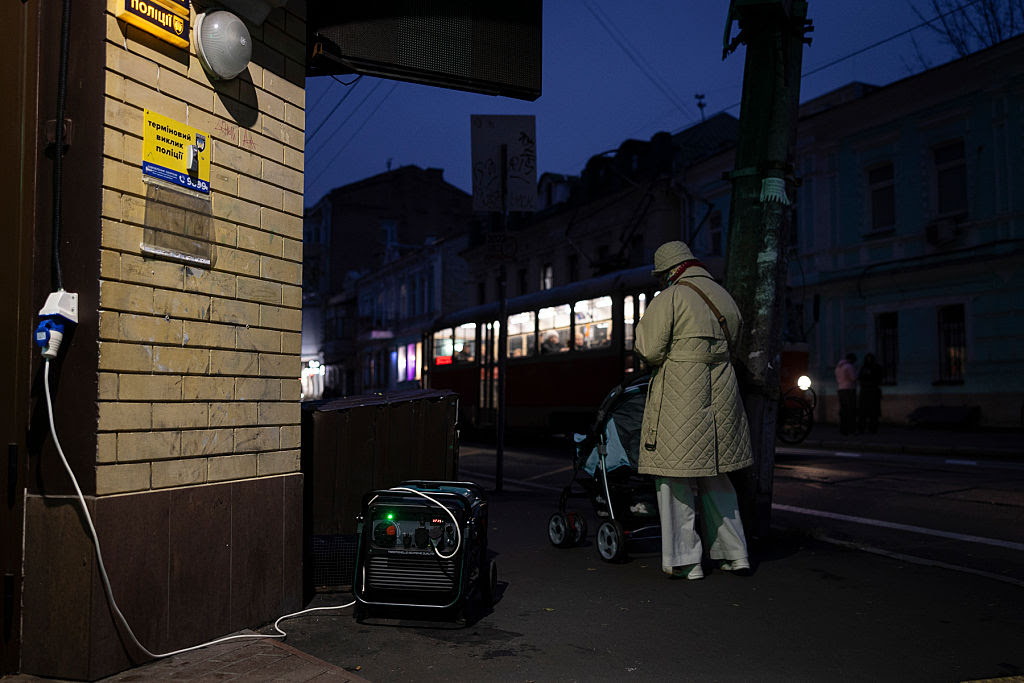
A view of a darkened street amid ongoing emergency power outages, following intensified Russian missile strikes on Ukraine’s energy infrastructure in Kyiv. (Danylo Dubchak/Frontliner/Getty Images)
The day revealed a conflict that had metastasized beyond anyone’s comprehension—where every domain of human activity became weaponized, where nuclear threats and corruption arrests, celebrity visits and economic integration, tactical innovations and systematic atrocities combined into a grinding machine that consumed everything it touched.
The Nuclear Theater: Moscow’s Calculated Escalation
The choreography of the Security Council meeting was too deliberate to be spontaneous. Putin sat at the head of a long table, flanked by Russia’s most powerful officials: Defense Minister Andrei Belousov, Chief of the General Staff Valery Gerasimov, Foreign Intelligence Service Head Sergei Naryshkin, Security Council Secretary Sergei Shoigu, and Federal Security Service Head Alexander Bortnikov. The cameras were positioned perfectly. The lighting was professional. This was theater, but theater involving weapons that could end civilization.
Belousov delivered his lines with bureaucratic precision. “The United States is engaged in the accelerated modernization of its strategic offensive weapons,” he stated. “I believe it is advisable to begin preparations immediately.”
Putin’s response was equally calculated—neither approval nor rejection, but rather a studied request for further analysis. “I want to emphasize: the president did not give an order to start preparing the tests,” Kremlin spokesman Dmitry Peskov clarified later. “The president instructed to work out the issue of the feasibility of starting preparations for such tests.”
It was political judo at its finest—creating the threat without quite making it, raising the stakes without committing to action, sending a message to Washington while maintaining plausible deniability. The threat existed in the space between words, in the implication rather than the declaration.
The meeting’s real target was American President Donald Trump, who had announced on October 30 that he would resume nuclear weapons testing for the first time since 1992. Trump’s declaration had come after Russia tested its Burevestnik nuclear-powered cruise missile on October 26. But Trump hadn’t specified whether he meant testing actual nuclear warheads or merely their delivery systems. US Energy Secretary Chris Wright had clarified on November 2 that Trump likely meant the latter.
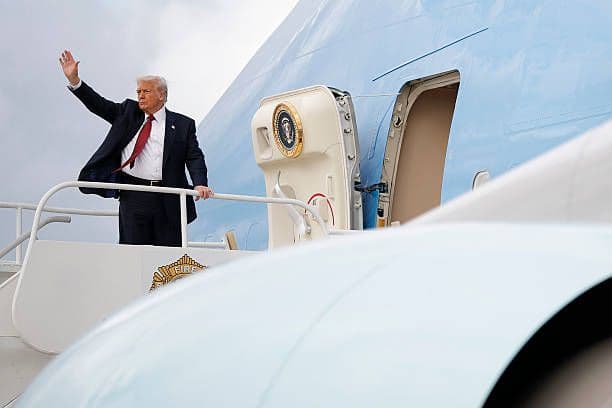
U.S. President Donald Trump waves as he boards Air Force One at Miami International Airport in Miami, Florida. President Trump is returning to Washington after delivering remarks at the America Business Forum. (Kevin Dietsch/Getty Images)
Russian officials chose to interpret Trump’s statement as threatening actual atomic detonations, giving them justification for their own escalatory rhetoric. Gerasimov admitted as much: “The American side may continue to evade official explanations, but this changes nothing.”
Belousov revealed that Russia’s testing facilities at Novaya Zemlya remained operational. “The readiness of the forces and assets at the Central Test Site on the Novaya Zemlya archipelago allows for this to be carried out within a short timeframe.”
The deeper irony was impossible to ignore: Russia had already violated the Comprehensive Nuclear-Test-Ban Treaty, likely conducting low-yield nuclear tests in 2019. Russia had also violated the New Strategic Arms Reduction Treaty. The meeting wasn’t about responding to American provocations—it was about creating justification for actions Russia wanted to take anyway.
For Putin, the nuclear threat served multiple purposes simultaneously. It reminded Western powers of Russia’s ultimate deterrent. It signaled to domestic audiences that Russia remained a superpower. And it provided negotiating leverage for whatever diplomatic process might eventually emerge.
The Grinding Machine: Pokrovsk’s Deadly Mathematics
The numbers that emerged from the Security Service of Ukraine told a story of systematic slaughter disguised as military advance. In October alone, SBU units operating in the Pokrovsk direction had killed over 1,500 Russian servicemembers and destroyed 20 tanks, 62 armored fighting vehicles, and 532 transport vehicles.
And those numbers only counted casualties inflicted by SBU forces—they didn’t include losses from regular army units, artillery strikes, drone attacks, or the dozens of other ways that soldiers died in Ukraine’s most contested sector. The actual Russian death toll in Pokrovsk was likely several times higher.
Yet Russian forces continued grinding forward, measuring progress in meters rather than kilometers. Geolocated footage showed Russian troops had recently advanced in western Rodynske, north of Pokrovsk. Milbloggers claimed advances in northeastern Pokrovsk itself, southeast of Hryshyne, and southwest of Sukhetske.
The advance came with a sinister twist that violated international law. Ukrainian soldiers reported that Russian troops were wearing civilian clothing as part of infiltration tactics—an act of perfidy explicitly prohibited under the Geneva Conventions. A servicemember of a Ukrainian brigade stated that Russian forces were concentrating their efforts against Ukrainian positions in southern Pokrovsk and were wearing civilian clothes as part of deception tactics.
The Russian military command had committed massive resources to capturing Pokrovsk—significant portions of three entire combined arms armies: the 2nd, 41st, and 51st CAAs. Elements of the 35th and 74th Motorized Rifle Brigades operated in western Pokrovsk. The 30th Motorized Rifle Brigade, alongside the 506th and 589th Motorized Rifle Regiments, fought in eastern sections. The 9th Motorized Rifle Brigade held positions in Rodynske. The 5th Motorized Rifle Brigade operated in Myrnohrad to the east.
This wasn’t a localized operation—it was an all-consuming campaign that had been grinding forward for 21 months, degrading three of Russia’s most important army formations. The forces taking the highest casualties on the entire battlefield were concentrated in this single direction.
Ukrainian soldiers reported that Russian forces rarely employed mechanized vehicles in the Pokrovsk direction except near Myrnohrad. Instead, Russian commanders relied on infiltration tactics—small groups penetrating between Ukrainian positions, accumulating in hidden locations, then launching coordinated attacks.
The strategy occasionally worked, but at catastrophic cost. Russian soldiers infiltrated with limited ammunition and no provisions, accumulating in basements and damaged buildings before attacking. Many died of exposure, starvation, or were killed by Ukrainian forces before they could participate in assaults.
The Pokrovsk campaign had become the defining example of Russia’s approach to this war: accept unlimited casualties in pursuit of territorial gains measured in city blocks, trusting that sheer numerical superiority would eventually overwhelm Ukrainian defenses regardless of the human cost.
Death from the Skies: The Daily Toll on Civilians
While military forces contested Pokrovsk with infiltration tactics and grinding attrition, Russian forces demonstrated their systematic targeting of civilians across multiple locations. In Pokrovska Hromada in Dnipropetrovsk Oblast, a Russian glide bomb strike killed two civilians and wounded four others. The Ukrainian State Emergency Service reported the attack on an unspecified village, adding to the mounting toll of civilian casualties from precision-guided weapons deliberately used against non-military targets.
Further north in Sumy Oblast, Russian forces conducted a drone strike against a civilian vehicle in Seredino-Budska Hromada, killing one civilian and wounding three others. The Sumy Oblast Prosecutor’s Office confirmed the attack, which fit the pattern of Russian forces systematically targeting civilian transportation across the region.
These weren’t stray munitions or accidental strikes. Russian forces were using expensive glide bombs—precision weapons converted from Soviet-era free-fall bombs—to attack villages. They were using drones to hunt civilian vehicles on roads. The pattern was too consistent, too systematic, too deliberate to be anything other than policy.
The attacks represented just two incidents from a single day, but they illustrated the routine nature of Russian war crimes. Across Ukraine’s front-line regions, similar attacks occurred daily—drones hunting civilians, glide bombs destroying homes, artillery strikes hitting neighborhoods. The violence had become normalized through repetition, each individual atrocity lost in the statistical accumulation of thousands of similar crimes.
The Reservist Trap: Moscow’s Careful Legal Preparation
Putin signed two laws that appeared routine but carried ominous implications for Russia’s mobilization capacity. The first allowed active reservists to participate in special training sessions to protect critical facilities. The second extended monthly payments to any military personnel serving to “repel an armed invasion” or during operations near areas where Russia was conducting its “special military operation.”
The language was deliberately vague, and the vagueness was the point. Russian officials claimed reservists would only protect infrastructure within their home regions, but the laws contained no such territorial restrictions. Since the Kremlin defined the four illegally annexed Ukrainian oblasts as part of Russia, the absence of geographic limitations meant these reservists could legally be deployed to occupied Ukrainian territory.
By extending combat payments to those serving near “special military operations”—a category that explicitly included Ukraine—Putin was simultaneously authorizing reservist deployment and ensuring they would receive the same financial benefits as regular contract soldiers.
It was typical of the Kremlin’s approach to mobilization: create legal frameworks for expanded deployments while publicly claiming no such plans existed. Russian officials emphasized that reservists would only guard oil refineries and power plants from drone attacks. But the legal language permitted far broader applications.
A source from one of Russia’s largest oil and gas companies told Russian opposition outlet Verstka that security personnel “do not have high expectations” for the active reservists. Only real army air defense systems could provide adequate protection against drone attacks—suggesting that the official justification for reservist deployment didn’t match practical reality.
The laws revealed Russia’s fundamental manpower challenge: the military needed more personnel, but Putin wanted to avoid another formal mobilization that might trigger domestic backlash like the September 2022 “partial mobilization” had sparked.
By incrementally expanding who could be deployed and under what circumstances, the Kremlin hoped to achieve mobilization’s benefits without its political costs. Active reservists could be called up through administrative procedures rather than dramatic presidential decrees. They could be deployed to “protect infrastructure” rather than “fight in Ukraine,” even if that infrastructure happened to be located in occupied Ukrainian territory.
It was mobilization by stealth, disguised as security enhancement, authorized through bureaucratic procedures rather than presidential pronouncements.
The Frontline Mosaic: Advances and Retreats Across the Line
While Pokrovsk consumed international attention and Russian lives, the war ground forward across a dozen other sectors, each with its own tactical rhythms and strategic significance.
In northern Sumy Oblast, a Ukrainian drone battalion reported that Russian forces still occupied Oleksiivka, north of Sumy City. Russian milbloggers claimed unspecified Russian naval infantry elements had marginally advanced by 100 meters near Sadky. Russian forces attacked near Varachyne, while Ukrainian forces counterattacked near Novokostyantynivka, Andriivka, Kindrativka, and Varachyne.
In northern Kharkiv Oblast, geolocated footage indicated that Russian forces had recently advanced to the T-2104 Vovchansk-Chuhunivka highway in southern Vovchansk. Other footage showed Ukrainian forces maintained positions or advanced near the same highway in central Vovchansk. Russian sources claimed advances east of Tykhe and near Synelnykove.
In the Kupyansk direction, Russian forces attacked in Kupyansk itself and in surrounding areas. Russian milbloggers claimed advances north of Kamyanka, within Kindrashivka, and between Kupyansk and Kucherivka. A Ukrainian drone regiment commander reported that Russian forces were attempting to infiltrate between Ukrainian positions and that Ukrainian forces had cleared the west bank of the Oskil River in Kupyansk of Russian sabotage groups.
In the Lyman direction, Russian milbloggers claimed advances east of Lyman, in Maslyakivka, Drobysheve, Yampil, and near Yarova. A Ukrainian brigade spokesperson reported that Russian forces were infiltrating between Ukrainian positions with limited ammunition and no provisions, then accumulating before subsequent attacks. The tactics occasionally succeeded but resulted in high casualties.
In the Kostyantynivka-Druzhkivka tactical area, geolocated footage indicated that Russian forces had recently marginally advanced east of Katerynivka. Russian forces attacked multiple locations northeast, east, southeast, south, and southwest of Kostyantynivka.
But the frontline wasn’t uniformly bleak for Ukrainian forces. In the Dobropillya tactical area, geolocated footage indicated that Ukrainian forces had recently advanced northeast and southeast of Shakhove. Other footage showed Ukrainian forces maintained positions or advanced east of Shakhove, areas where Russian sources had previously claimed Russian presence.
And in the Velykomykhailivka direction, geolocated footage showed Ukrainian forces had recently advanced in southern Oleksiivka, even as other footage showed Russian forces had also advanced in the same area—testament to the contested, fluid nature of combat in certain sectors.
These weren’t major breakthroughs or catastrophic collapses. They were the daily arithmetic of attrition warfare: meters gained here, positions lost there, contested areas changing hands, tactical successes offset by tactical failures. But the cumulative effect was grinding pressure that wore down both sides, testing endurance and resolve as much as tactical skill.
The Innovation of Attrition: New Methods for Old Problems
Across these frontline sectors, both sides continued adapting tactics to battlefield realities that defied conventional military doctrine. A Ukrainian brigade spokesperson operating in the Velykomykhailivka direction reported that Russian forces were using motorcycles, buggies, and modified cars to transport supplies and troops, exploiting dry weather to conduct rapid attacks.
The shift to lightweight vehicles reflected Russian adaptation to Ukrainian drone superiority. Heavy armored vehicles were too easily detected and destroyed. But motorcycles and buggies could move quickly, present smaller targets, and disperse rapidly. The tactic worked best in dry weather when off-road movement was possible and when Ukrainian drone operations faced fewer weather constraints.
The innovation cut both ways. A Ukrainian drone battalion commander operating in the same direction reported that Russian forces were systematically using fiber-optic drones to interdict Ukrainian ground lines of communication. These drones, connected to operators by fiber-optic cables rather than radio links, were immune to Ukrainian electronic warfare systems that jammed radio-controlled drones.
The fiber-optic drones represented the latest evolution in the drone arms race that had characterized the war. Radio drones led to jamming systems. Jamming systems led to frequency-hopping drones. Frequency-hopping drones led to more sophisticated jammers. And now fiber-optic drones—physically tethered to operators, limited in range but immune to electronic countermeasures—represented the next adaptation.
The same commander reported that Russian forces had conducted a systematic two- to three-week campaign of airstrikes destroying bridges near Kolomiitsi, Pokrovske, and Dobropasove, degrading Ukrainian logistics in the Velykomykhailivka area to set conditions for subsequent attacks. Satellite imagery collected on October 23 showed that a Russian airstrike had heavily damaged a bridge on the T-04-01 road crossing the Yanchur River northwest of Danylivka.
The bridge destruction campaign demonstrated systematic Russian operational planning. First destroy bridges to disrupt Ukrainian logistics and complicate reinforcement. Then attack while Ukrainian forces struggled with degraded supply lines. It was textbook operational warfare, Soviet military doctrine applied with patient precision.
Economic Integration: Belarus Binds Itself Closer
While military forces contested frontlines with fiber-optic drones and bridge destruction campaigns, the Kremlin continued its long-term effort to integrate the Belarusian and Russian economies in ways that would make Belarus’s independence increasingly theoretical. Belarusian state news agency Belta reported that Belarusian parliamentarians had ratified an agreement between Belarus and Russia to form a unified electricity market.
The agreement represented another step in economic integration that had proceeded gradually but inexorably since 2022. A Belarusian National Assembly deputy stated that Russia and Belarus were planning to establish a unified gas market and currently had a unified energy market. Belarusian Minister of Energy Denis Moroz stated that Belarus and Russia were in the final stage of negotiating a common price for natural gas for Belarus and Russian customers.
The creation of unified energy markets meant Belarusian energy policy would be determined in Moscow rather than Minsk. Belarusian energy prices would be set by Russian officials. Belarusian energy infrastructure would be integrated with Russian systems. The economic sovereignty that Belarus theoretically possessed would erode further, replaced by integration that made separation increasingly difficult and costly.
For Lukashenko’s regime, the integration was the price of Russian support that kept him in power despite domestic opposition. For the Kremlin, it was patient construction of empire through economic means, binding Belarus so closely to Russia that future separation became practically impossible.
Hollywood in the War Zone: Jolie’s Unexpected Visit
The photographs that emerged seemed surreal: Oscar-winning actress Angelina Jolie wearing a bulletproof vest in a basement in Kherson. Former city council member Vitalii Bohdanov announced Jolie’s visit on Facebook. Local media reported she had traveled as part of a charitable program to support civilians, visiting medical facilities including maternity and children’s hospitals.
Kherson remained under constant artillery bombardment from Russian forces across the Dnipro River. Daily attacks killed or wounded civilians. Infrastructure lay in ruins. Yet here was one of Hollywood’s most recognizable faces, visiting families who had chosen to remain despite the danger.
The Kherson Regional Military Administration presented Jolie with a commemorative “Kherson” coin—a small gesture that carried enormous symbolic weight. International celebrities rarely ventured into active war zones, and when they did, it generated far more attention than official statements.
But the visit nearly ended in farce. Jolie’s motorcade was stopped at a checkpoint in Mykolaiv Oblast, where territorial recruitment center representatives detained one of her drivers. Despite his protests that he was escorting “an important person, a peacekeeper,” the driver was taken to the recruitment office and held for an extended period.
Jolie herself eventually visited the building to secure his release. Ukrainian media confirmed the driver, being a reserve officer, lacked proper documentation and was redirected to resolve the issue. The incident was simultaneously absurd and revealing: Ukraine’s mobilization system was sufficiently robust that even drivers for international celebrities weren’t exempt from document checks.
Her statement through the Legacy of War Foundation captured what she witnessed: “The people of Mykolaiv and Kherson live with danger every day, but they refuse to give in. At a time when governments around the world are turning their backs on the protection of civilians, their strength and their support for each other is humbling.”
She had seen underground spaces where medical and educational institutions continued operating despite daily bombardment. She had seen netting placed above roads to protect locals from drone attacks. She had seen “exhaustion” but also “determination” among families who refused to abandon their homes.
For Ukrainians living through the war, celebrity visits provided validation that the world still noticed their suffering. For international audiences, seeing a globally recognized figure in a war zone made the conflict feel more immediate than any news report.
Trump’s Diplomatic Absence: The G20 Decision
Donald Trump announced he wouldn’t attend the G20 summit in Johannesburg, removing one potential venue for Ukraine peace talks. Finnish President Alexander Stubb had suggested the November 22-23 summit might provide an opportunity for Zelensky, Putin, and Trump to meet—but Trump’s absence killed that possibility.
“I’m not going to represent our country there,” Trump told reporters. “It shouldn’t be there.”
His reasoning had nothing to do with Ukraine and everything to do with his dispute with South Africa over land policies. Vice President JD Vance would represent the United States instead, while Russia announced Putin wouldn’t attend either, sending Deputy Chief of Staff Maksim Oreshkin.
The decision reflected broader patterns in Trump’s approach to Ukraine peace efforts: frequent promises of breakthroughs, repeated scheduling of summits, and consistent failure to produce diplomatic progress. Trump had avoided meeting Zelensky at the June G7 summit. His planned summit with Putin in Budapest had been scrapped. Months of diplomatic efforts had produced zero substantive progress.
The Kremlin had repeatedly stated that “conditions” must be met before talks, and suggested Zelensky should come to Moscow—a humiliating demand that Ukrainian officials correctly interpreted as capitulation rather than negotiation.
Trump’s G20 absence eliminated another opportunity for the face-to-face meeting he claimed would quickly resolve the conflict. With each cancelled summit, the gap between Trump’s rhetoric about ending the war and the reality of continued fighting grew wider.
Striking Back: Ukraine’s Long Reach Into Russia
Ukrainian forces struck deep into Russian territory overnight, hitting energy infrastructure across multiple regions. In Vladimir Oblast, drones struck the Vladimirskaya power substation near Vladimir City. In Oryol Oblast, explosions erupted near the thermal power plant. In Yaroslavl Oblast, drone strikes damaged oil pumping stations in two districts.
The geographic spread demonstrated Ukraine’s capability to project force hundreds of kilometers beyond front lines. Vladimir Oblast lay approximately 800 kilometers from Ukrainian-controlled territory. The attacks forced Russian air defense systems to respond to threats from multiple directions simultaneously.
Regional governors scrambled to respond. Vladimir Oblast Governor Alexander Avdeev claimed drones had struck energy infrastructure but insisted damage was minimal. Oryol Oblast Governor Andrei Klychkov reported Russian forces had downed two drones, not mentioning how many had gotten through. Yaroslavl Oblast Governor Mikhail Evraev acknowledged “minor damage” to oil pumping infrastructure.
The attacks reflected Ukraine’s strategy of forcing Russia to defend vast territory impossible to adequately protect. Every soldier guarding a power station was one less soldier for front-line combat. Every air defense system protecting infrastructure couldn’t defend elsewhere. Every disruption reduced Russia’s export revenues.
For Russian citizens in cities that had seemed safely distant, the strikes brought the war home. Air raid alerts interrupted normal life. Evacuated airports disrupted travel. Damaged energy facilities meant power restrictions. The “special military operation” was now reaching into Russia’s heartland.
Norway’s Commitment: Sustaining Ukraine’s Defense
Ukrainian Prime Minister Denys Shmyhal announced that Norway would provide Ukraine with $7 billion in 2026—the kind of long-term commitment Kyiv desperately needed as American support wavered. Shmyhal met with Norwegian Defense Minister Tore O. Sandvik and discussed cooperation on air defense, long-range strike capabilities, and counter-drone systems.
The two countries signed memorandums establishing unified quality standards for defense products and launching joint defense production inside Ukraine. Norwegian companies would partner with Ukrainian manufacturers—a strategic shift from Ukraine as weapons recipient to arms producer.
“I am grateful to the government and the people of Norway for their significant contribution,” Shmyhal stated. The gratitude reflected relief that at least some Western partners maintained consistent commitment regardless of American political volatility.
Norway’s pledge contrasted sharply with Trump’s approach, which alternated between threatening to cut aid and periodically announcing packages while pressuring Ukraine to accept territorial concessions.
For Ukraine, Norwegian support represented insurance against American abandonment—not sufficient to replace American assistance entirely, but substantial enough to sustain critical defense production if American aid declined.
Corruption in the Rear: The Energoatom Scandal
While soldiers fought at the front, Ukrainian anti-corruption agencies arrested the deputy general director of Atomnergomash, a subsidiary of Energoatom, for running a systematic bribery scheme.
The official had demanded kickbacks worth 10-15% of contract values from companies seeking timely payment for completed work. Between June and November, he had received 1.67 million hryvnias ($40,000) in illicit payments, with the total scheme valued at over 6.6 million hryvnias ($156,000).
Energoatom operated Ukraine’s four nuclear power plants and was the country’s largest electricity producer. The company’s importance made corruption within its ranks particularly corrosive—every hryvnia stolen was a hryvnia that couldn’t support energy infrastructure.
The arrest came amid mounting evidence of systematic corruption in Energoatom. In July 2024, agencies had accused four members of an organized group of embezzling 100 million hryvnias. In September 2024, another official was detained for accepting a 100,000 hryvnia bribe.
For Ukrainian reformers, corruption cases presented dilemmas. Aggressive enforcement demonstrated rule of law even during existential crisis—important signals to Western partners. But prosecutions also revealed corruption’s persistence despite reform efforts.
The arrest suggested Ukrainian authorities had chosen continued enforcement over cosmetic reform. It was the right choice, but a reminder that Ukraine was fighting two battles: one against Russian invasion, another against internal corruption.
The Day’s Meaning: When Everything Grinds Forward Together
The day revealed a war that had evolved far beyond its original boundaries. Russian defense ministers discussed nuclear testing on television. Hollywood actresses visited artillery-bombarded cities. American presidents skipped summits that might facilitate peace talks. Ukrainian drones struck energy infrastructure inside Russia. European allies pledged billions while American commitment wavered. Russian forces wore civilian clothing in violation of international law. Civilians died from glide bombs and drone strikes. Belarus integrated its economy with Russia’s. Ukrainian forces advanced near Shakhove while losing ground elsewhere. Fiber-optic drones hunted soldiers. Bridges were systematically destroyed. Anti-corruption agencies arrested officials while soldiers died.
The nuclear threat was likely theater, but theater involving weapons that could end civilization. Trump’s G20 absence was one cancelled meeting among many, but revealed the gap between rhetoric and reality. The corruption arrest was a single case among thousands, but demonstrated Ukraine’s determination to maintain rule of law during crisis.
Individually, each development might have seemed manageable. Collectively, they painted a picture of systematic escalation across multiple domains: military, diplomatic, technological, legal, moral.
The war that Putin started believing it would quickly subjugate Ukraine had metastasized into something far larger and more dangerous. Russian forces gained meters of rubble at the cost of thousands of dead. Russia threatened nuclear testing while Ukrainian drones struck Russian facilities with increasing frequency. Moscow passed laws preparing to deploy reservists while claiming no mobilization plans existed.
For Ukraine, the day represented both danger and opportunity. The nuclear threats were serious but likely too serious to implement. The grinding advances in Pokrovsk consumed Russian forces faster than Moscow could regenerate them. International support from Norway provided hope that Ukraine could sustain defense even if American commitment eroded.
The question was no longer whether Russia could win quickly—that possibility had disappeared in 2022. The question was whether Russia could win slowly, grinding forward through unlimited casualties while the West lost interest.
The day didn’t answer that question, but clarified the stakes. This wasn’t just a conflict over territory. It was a test of whether international law had meaning, whether nuclear threats could compel surrender, whether democracies could sustain commitment longer than autocracies could sustain losses.
The war had become a contest of wills, resources, and endurance. Russia had numbers and ruthlessness. Ukraine had determination and increasingly sophisticated weapons. The West had wealth but wavering political commitment.
The nuclear testing threats demonstrated Russian willingness to escalate rhetoric regardless of truth. The reservist laws demonstrated Moscow’s preparation for expanded mobilization. Ukrainian strikes demonstrated Kyiv’s growing capabilities. Jolie’s presence demonstrated that some in the West still cared. The Energoatom arrest demonstrated Ukraine’s refusal to tolerate corruption. The civilian deaths demonstrated Russia’s systematic targeting of non-combatants. The frontline advances and retreats demonstrated the grinding nature of attrition warfare.
Three years and 1,351 days after the invasion began, the war had become something no one intended and no one understood. But it continued, grinding forward, accumulating casualties, testing boundaries, threatening escalation.
The day was just another day in that long, brutal test. A day when everything ground forward together—when nuclear threats and celebrity visits, energy strikes and diplomatic failures, corruption arrests and civilian deaths, tactical innovations and systematic atrocities combined to illustrate how complex, dangerous, and unpredictable this war had become.
The world kept spinning. The war kept killing. And no end appeared in sight.