
In Kyiv, Zelensky unveiled a $60 billion arms industry that would sell weapons to fund the war. In Pokrovsk, Russian forces hurled their 220th assault in three days, bleeding for a city that mattered more as symbol than objective. In Moscow, the Kremlin’s largest tank factory began firing workers it could no longer afford. November 7—when the war’s economic mathematics started rewriting the military kind.
The Day’s Reckoning
The briefing room in Kyiv started before most Americans finished breakfast. President Zelensky stood before reporters with numbers that redefined October: 25,000 Russian soldiers killed by Ukrainian drones in a single month. Not wounded. Not captured. Dead.
The highest monthly toll since the invasion began.
Three hundred kilometers east, Russian commanders were throwing everything at Pokrovsk—220 assaults in seventy-two hours—not because the logistics hub was strategically decisive, but because Moscow needed a story to tell Donald Trump. Look, they could whisper to Washington, Ukraine is losing. Force them to surrender Donbas.
Inside Pokrovsk, 314 Russian soldiers discovered the difference between entering a city and controlling it.
While Zelensky briefed journalists, his defense minister was briefing investors. Ukraine’s arms industry had hit $35 billion in annual capacity and could reach $60 billion by 2026. The twist? Ukraine would sell weapons abroad to friendly nations, using those profits to expand production at home. The defense industry would finance itself through export capitalism—a revolution born when neither budgets nor allies could sustain the war machine alone.
In Yekaterinburg, Russia’s primary tank manufacturer quietly announced layoffs. Ten percent of the workforce by February. The country’s sole producer of modern tanks was contracting during wartime.
The day’s mathematics didn’t lie: Ukraine’s drone production was scaling while Russia’s tank production was shrinking. One side was adapting to the war’s new physics. The other was trapped in the old one, bleeding soldiers to capture meters while its industrial base rusted.
The City That Became a Weapon
Zelensky didn’t sugarcoat it. Standing before reporters in Kyiv, he laid bare Russia’s actual strategy at Pokrovsk: “They want to promote the narrative that they can allegedly take Donbas, and to call on Western countries to force Ukraine to give Donbas to Russia.”
The assault wasn’t just military. It was theatrical.
Russia needed Pokrovsk to reshape Western calculus—to convince decision-makers in Washington and Brussels that Ukraine’s position was hopeless, that sanctions could wait, that accommodation was inevitable. “Russia is very afraid of strong US decisions,” Zelensky said, “and with this story about Pokrovsk they want to show success on the battlefield.”
The battlefield told a different story. Ukrainian forces repelled 220 Russian assaults in seventy-two hours. When Russian armor tried to storm the city on November 5, it suffered losses and abandoned equipment in streets that had become kill zones. Inside Pokrovsk, 314 Russian soldiers remained—not conquering, but surviving. Ukrainian special forces and intelligence units were systematically dismantling the invasion force, turning every building into a trap.
Moscow’s obsession revealed something crucial: in modern warfare, perception can matter as much as possession. Capture one logistics hub and you might not win the war—but you might win the argument about whether the war is winnable.
For Ukraine, holding Pokrovsk wasn’t just about defending concrete and steel. It was about defending the narrative that resistance could endure—that Russia’s story of inevitable conquest was a fiction no amount of blood could make real.
When Weapons Become Investment Capital
Behind closed doors in Kyiv, Defense Minister Denys Shmyhal and presidential advisor Oleksandr Kamyshin revealed a plan that turned war economics inside out. Ukraine’s defense industry had reached $35 billion in annual production capacity—and could hit $60 billion by 2026, with over $35 billion dedicated to long-range capabilities alone.
The problem? Ukraine couldn’t afford to buy everything it could make.
“We are unable to cover the full cost of domestic defense production either from its budget or through the financial assistance of Western allies,” they told journalists. The solution was audacious: controlled export to friendly nations. Sell weapons abroad, reinvest those profits into domestic production. The defense industry would finance itself.
The math was brutal but clear: better to produce 100 units and sell 20 to expand capacity to 200, than produce only 80 while waiting for foreign funding that might never arrive.
The same day brought another long-game announcement: an agreement with Sweden to localize production of Gripen fighter jets by 2033. The timeline stretched nearly a decade into an uncertain future, but the deal reflected Ukraine’s determination to build a defense base that could sustain itself beyond any single conflict.
Across town, Ambassador Olha Stefanishyna told Bloomberg that talks with Washington on Tomahawk missiles were “rather positive.” She pressed the case bluntly: every Tomahawk delivered would mean fewer Ukrainian children murdered in their beds.
President Trump had said days earlier he wasn’t planning to provide them. “Things can change,” he’d added, “but at this moment I’m not.”
The diplomatic dance continued. Ukraine building what it could, begging for what it couldn’t, and betting that necessity would eventually move mountains—or at least budgets.
October’s Drone Revolution
The number seemed impossible: 25,000 Russian soldiers killed by Ukrainian drones in a single month.
President Zelensky attributed the spike to two shifts. First, Ukraine’s “gamification” system was finally working—drone units competing for points based on confirmed kills, standardizing reporting across the front, incentivizing performance. What had once been loosely tracked was now measured with the precision of a leaderboard. Accountability that saved Ukrainian lives by taking Russian ones more efficiently.
Second, Ukraine had flooded the battlefield with drones. Mass production was paying off. Every village, every trench, every Russian position now operated under the assumption that something was watching from above, waiting to strike.
The psychological effect matched the kinetic one.
According to Ukraine’s General Staff, Russia had lost roughly 1,148,910 troops since the invasion began—a number so vast it defied comprehension. The previous day alone cost Moscow 1,170 casualties. The war had become grotesque attrition arithmetic, both sides calculating survival in daily casualty reports and monthly production quotas.
But October’s toll represented something new: evidence that Ukraine’s transformation into a drone superpower wasn’t rhetoric. It was reshaping battlefield mathematics in real time, forcing Russia to adapt tactics that hadn’t yet caught up to the technology hunting them from the skies.
Flames Over Crimea
Before dawn, Ukrainian drones found the Hvardiiska oil depot twenty kilometers north of Simferopol. The target wasn’t random—it was calculated to cripple Russian logistics in occupied Crimea while broadcasting a message: nowhere on the peninsula was safe.
Ukraine’s Special Operations Forces destroyed a full RVS-400 storage tank—a massive reservoir designed for petroleum products—along with two trains loaded with fuel. Then the drones spread out, hitting multiple depots and storage facilities across Simferopol and surrounding areas.
Geolocated footage showed flames consuming storage tanks in both Hvardiivske and Komsomolske, black smoke climbing into the early morning sky. The Russian occupation administration stayed silent—the familiar void that follows a successful strike.
The economics were elegant: relatively cheap drones inflicting damage worth millions of rubles, disrupting supply chains feeding Russian forces across southern Ukraine. Every tank of fuel that burned in Crimea was one less tank available for armor grinding toward Pokrovsk or artillery shelling Kherson.
Asymmetric warfare at its simplest. Ukraine didn’t need to occupy Crimea to make occupation costly. It just needed to keep the fires burning.
Striking a Thousand Kilometers Deep
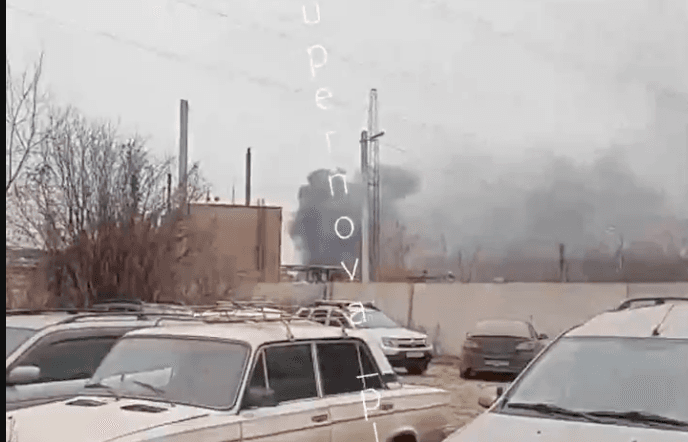
Over a thousand kilometers from Ukraine’s border, deep in Russia’s Republic of Bashkortostan, fire lit the Sterlitamak Petrochemical Plant. Ukrainian military intelligence claimed its drones struck a workshop producing agidol—an additive crucial for aviation fuel.
It was the second hit on the facility in three days. Ukraine wasn’t harassing the plant. It was systematically degrading it.
The plant’s significance extended beyond immediate production. By targeting facilities supplying Russia’s war machine at its source—not frontline depots but industrial complexes deep in the homeland—Ukraine forced Moscow to defend an impossibly large perimeter. Every air defense system protecting Bashkortostan was one less protecting Belgorod. Every interceptor scrambled over the Urals was unavailable over Ukraine.
Sweden had just committed $23 million to fund 400 Ukrainian long-range drones through the “Danish model”—direct payment to Ukrainian producers. The FP-1 drones cost $55,000 to $60,000 each. For the price of a single Tomahawk cruise missile, Ukraine could field dozens of drones capable of hitting similar distances.
Radiy Khabirov, head of Bashkortostan, stayed silent. Moscow had learned that acknowledging successful Ukrainian attacks only amplified their psychological impact.
Better to let fires burn quietly than broadcast vulnerability.
The Shmavic Goes Industrial
At a Kyiv briefing, President Zelensky announced something that sounded prosaic but was actually revolutionary: mass production of Ukraine’s own DJI Mavic drone.
For years, Ukrainian forces had depended on Chinese-made DJI drones, often jailbroken to bypass restrictions. The government had teased a Ukrainian “Shmavic” for months, but Chinese originals remained ubiquitous because they worked.
Now domestic production was reaching scale.
It was more than import substitution. By manufacturing Mavics locally, Ukraine could customize them for military use without workarounds, integrate them seamlessly with domestic systems, and—crucially—insulate supply from Chinese government pressure. Beijing had already restricted sales of certain components. That vulnerability was being engineered away.
The announcement reflected a broader pattern: Ukraine was systematically building industrial independence in every critical technology. Drones, missiles, electronic warfare systems—anything that kept soldiers alive or killed enemies was being brought in-house.
The lesson was stark. Sovereignty in modern war required sovereignty over supply chains.
When the Lights Went Out
The casualties arrived in drumbeats throughout the day. A glide bomb in Zaporizhzhia Oblast’s Orekhova killed a man in his home, injured his wife and two neighbors. Seventeen other towns in the oblast fell under Russian fire, residential homes shredded by shrapnel. By evening, emergency services confirmed another resident dead in a separate strike.
In Kherson Oblast, Russian fire killed a 53-year-old man mid-morning. Ten others were injured throughout the day, including one child. Heavy drone attacks in Dnipro struck residential buildings, critically wounding three and injuring three more. Kharkiv Oblast saw widespread attacks on civilian structures, injuring four.
Then UkrEnergo, the national electricity utility, announced widespread power cuts across Dnipropetrovsk and Donetsk oblasts.
The outages weren’t accidents. They were strategy. Russia was systematically targeting Ukraine’s energy infrastructure, trying to break civilian morale before winter truly arrived.
It was a pattern older than the invasion itself: when Russia couldn’t win militarily, it waged war on normalcy. Every blackout was a message. Every civilian casualty was terrorism disguised as military necessity.
For Ukrainian families, the war wasn’t an abstraction reported in briefings. It was the sudden darkness, the distant explosion, the nightly gamble that the drones wouldn’t find your home.
The Ceasefire Nobody Celebrated
The International Atomic Energy Agency announced a localized ceasefire at the occupied Zaporizhzhia Nuclear Power Plant beginning November 8. The pause would allow repairs to the Ferrosplavna-1 power line, restoring external electricity to critical systems.
For a month, Europe’s largest nuclear facility had operated without reliable external power—a situation that kept safety experts awake at night. The plant needed outside electricity to maintain cooling systems and prevent catastrophe.
That the war had severed those connections wasn’t unusual. That both sides agreed to stop shooting long enough for repairs was.
The ceasefire wouldn’t be celebrated because it shouldn’t have been necessary. The plant’s occupation remained an ongoing war crime, its reactors held hostage to Moscow’s strategic calculations. But pragmatism sometimes trumps principle. Preventing a nuclear disaster required cooperation even from those who created the danger.
The IAEA’s announcement was clinical, professional—engineers solving problems that soldiers had created. Technicians would work knowing that outside the perimeter, the war continued.
It was the kind of surreal normalcy that defined Ukraine’s existence: fixing what shouldn’t be broken, negotiating what shouldn’t need negotiation, surviving what shouldn’t be endured.
The Tank Factory That Couldn’t Afford Tanks
In Yekaterinburg, Russia’s primary tank manufacturer announced plans to lay off up to ten percent of employees by February 2026, with a hiring freeze imposed across the facility.
According to workers who leaked documents to local media, the reduction actually amounted to half the workforce in most departments. Uralvagonzavod’s press service offered bland corporate speak about “streamlining management expenses.” But the reality was harder to spin: Russia’s sole producer of modern tanks was contracting during wartime.
The factory had already shifted some employees to four-day weeks, citing “declining demand for civilian vehicle production.” But if civilian demand was falling and military demand presumably remained high, why layoffs at a defense facility?
The answer lay in Russia’s evolving tactics. The war had become drone-centric, relying on dismounted infantry, motorcycles, and light vehicles rather than armored columns. Tanks had become targets in kill zones where drones hunted from above. Moscow might be deliberately deprioritizing tank production, accepting that armor was less valuable than mass infantry and swarm tactics.
Or—more troubling for the Kremlin—sanctions on Russian oil exports were starving even defense industries of investment capital.
The layoffs suggested Russia’s economy was entering a phase where even military priorities couldn’t fully escape the degradation affecting civilian sectors. The war machine was rusting at the edges, not catastrophically, but noticeably—a slow degradation that accumulated over years rather than months.
Brussels Slams the Door
The European Union announced it would deny Russian nationals multi-entry visas. EU foreign policy chief Kaja Kallas framed it bluntly: “Starting a war and expecting to move freely in Europe is hard to justify.”
Under the new rules, Russian citizens would need to apply for a fresh visa for every trip, allowing authorities to scrutinize each application individually. The number of visas issued to Russians had already plummeted from over four million before the war to around 500,000 in 2023. But that figure had begun climbing again in 2025.
Brussels was slamming the door before it could open wider.
The policy drew immediate criticism from unexpected quarters. Yulia Navalnaya, widow of poisoned opposition leader Alexei Navalny, had urged the EU not to isolate ordinary Russians. Broad restrictions fed the Kremlin’s narrative that Europe was hostile to all Russians, not just Putin’s regime. “For the purpose of achieving peace in Europe it is counterproductive to assist Russian authorities in isolating Russian society,” she wrote.
But European security officials had grown increasingly nervous. Unidentified drones had repeatedly violated airspace near Swedish airports, Belgian nuclear facilities, and EU government buildings. German troops had deployed to Belgium to assist with drone detection.
The incidents fit a pattern of Russian “Phase Zero” operations—destabilizing NATO through ambiguous threats that stayed below the threshold of open conflict.
For tourist destinations like France, Spain, and Italy, the policy meant turning away revenue. For Poland and the Baltic states, it meant finally treating Russian citizens as potential security threats.
The visa debate encapsulated Europe’s split personality: some nations prioritizing engagement, others demanding isolation, and nobody quite sure which approach would hasten the war’s end.
The Coalition That Only Waits
Anders Fogh Rasmussen had led NATO during a different era—2009 to 2014—when Russia’s threats seemed manageable, and the alliance’s expansion seemed inevitable. Now, touring European capitals with a warning, the former secretary general spoke with the urgency of someone watching a disaster unfold in slow motion.
“If we do not carry out major changes in strategy, we will look into a forever war,” he told The Guardian.
His prescription was sweeping: European troops deployed to Ukraine, a NATO-backed missile and drone shield stretching across Ukrainian skies, and long-range weapons unleashed deep into Russia. He called out the “Coalition of the Willing” for becoming a “Coalition of the Waiting”—nations that talked about deploying protection forces after a ceasefire but refused to act while the war still raged.
The logic was simple. If Poland hosted air defense systems that shot down Russian missiles over Ukraine, Moscow would have to calculate whether attacking those systems meant war with NATO. The ambiguity itself might stay Putin’s hand.
Rasmussen urged Germany to break the deadlock on Taurus cruise missiles. If Berlin provided its long-range weapons to Ukraine, Washington might reconsider Tomahawks. “That would send a clear signal across the Atlantic and put pressure on the White House.”
He also pushed for unlocking €150 billion in frozen Russian assets held by Euroclear, turning Moscow’s own wealth into Ukraine’s weapons.
Whether anyone would listen remained uncertain. Rasmussen was a voice from the past warning about the future, carrying credibility but not power. The gap between what he prescribed and what Europe would accept remained vast—but shrinking, slowly, as the war ground on.
The Frontline’s Grinding Arithmetic
While diplomats talked and industries produced, soldiers died for meters.
Near Vovchansk in Kharkiv Oblast, Russian troops accumulated before launching waves of attacks. Ukrainian officers reported Russia was using Molniya drones as motherships, dropping FPV drones to strike rear areas—innovation born of desperation when traditional attacks foundered.
In Kursk Oblast, things were worse. A Russian milblogger claimed Ukrainian forces had encircled elements of a motorized rifle regiment. Attempts to relieve the encirclement failed with heavy casualties. More troubling were reports of friendly fire between Russian and North Korean troops—a consequence of command structures unprepared for coalition warfare.
The Kupyansk and Lyman directions saw continued Russian pressure but no breakthrough. Geolocated footage showed incremental advances, but settlements remained contested. Every tree line became a battle, every trench a killing ground. Ukrainian forces counterattacked, reclaiming lost ground, then losing it again days later. The map flickered with gains and losses that ultimately signified stalemate.
Near Kostyantynivka, Russian forces employed small group tactics with infantry and motorcycles after mechanized assaults failed. The shift revealed adaptation: armor was too vulnerable, so soldiers advanced on foot or wheels, trading speed for survivability. It worked—barely. Russian forces nibbled at edges, gaining meters rather than kilometers.
South toward Zaporizhzhia, Russian troops attempted infiltration tactics, using high reeds along the Kakhovka Reservoir to bypass Ukrainian positions. Sabotage groups tried reaching rear areas, exploiting vegetation to mask movement. Asymmetric warfare within asymmetric warfare—small groups seeking gaps that conventional assaults couldn’t breach.
The frontline’s story was grinding, incremental, bloody stalemate. Neither side could break through decisively. Neither side could afford to stop trying. Every day produced casualty reports, claims of advances, and tactical adjustments that added up to strategic deadlock.
This wasn’t the war anyone had planned. It was the war both sides were trapped in, unable to win, unwilling to lose, and paying in blood for the privilege of not surrendering.
The Drones Europe Can’t Explain
At Gothenburg Landvetter Airport in Sweden, unidentified drones forced authorities to cancel or divert over a dozen flights. Swedish police investigated suspected aviation sabotage.
Belgian authorities closed Brussels Airport for the third time in a week after a drone appeared near air traffic control. Near the Belgian Nuclear Research Center in Mol, more unidentified drones circled. German troops arrived in Belgium to assist with drone detection and defense.
The pattern was troubling: critical infrastructure, major airports, government quarters—all targeted by drones nobody claimed responsibility for.
European security analysts saw Russia’s fingerprints. The incidents fit perfectly into Moscow’s “Phase Zero” campaign—destabilizing NATO through ambiguous operations that sowed fear without triggering Article 5. The drones were sophisticated enough to evade immediate detection but not so threatening they justified military response.
They existed in the gray zone Russia had perfected: disruptive enough to matter, deniable enough to escape retaliation.
NATO couldn’t shoot down drones over member territory without knowing who launched them. Police couldn’t arrest operators without catching them. The incidents accumulated into a psychological operation designed to make Europeans feel vulnerable in their own skies, to question whether their authorities could protect them, to wonder whether the war in Ukraine was really so distant after all.
The drones were a message written in the language of anxiety: we can reach you whenever we want, and you can’t stop us.
Whether that message was true hardly mattered. The uncertainty itself was the weapon.
The Men Who Couldn’t Escape

In western Ukraine’s Volyn region, the Security Service arrested a former militant from the so-called “Donetsk People’s Republic” who had fought in the 2015 battle for Donetsk airport. After being wounded and dismissed from the Russian-backed “Somali” battalion, he tried to obtain a Ukrainian passport to flee to the European Union.
Investigators found Russian and “DNR” passports in his hotel room, along with military ID and patches from Russian formations. He faced charges of high treason and participation in illegal armed groups—fifteen years in prison if convicted. The SBU was investigating whether he’d been working for Russian intelligence, whether his escape attempt was part of a broader sabotage mission.
It was a glimpse into the chaos of occupation and collaboration. A man who had fought for Russia’s proxies in 2015 now desperately sought escape through Ukrainian documents in 2025. Ideology had given way to survival.
Meanwhile, Ukraine’s Foreign Minister revealed that at least 1,436 citizens from thirty-six African countries were fighting for Russia in Ukraine. Andriy Sybiha claimed Moscow used “money, lies, and coercion” to recruit foreigners, many of whom didn’t understand what they’d signed up for. “Signing a contract is equivalent to signing a death sentence,” he wrote, noting that most foreign recruits were sent directly into “meat assaults” where survival rarely exceeded a month.
Kenya’s Foreign Ministry confirmed that Kremlin-linked recruiters continued luring Kenyans under false job promises, with many ending up detained in military camps. In September, Kenyan authorities had arrested a Russian embassy employee accused of recruiting mercenaries.
The stories painted a picture of Russia’s recruitment desperation. When mobilization couldn’t produce enough soldiers, Moscow turned to Africa, Central Asia, anywhere bodies could be found and promises made.
For the men who signed them, the war became a trap. They couldn’t advance without dying, couldn’t retreat without punishment, couldn’t surrender without risking execution as deserters.
Sybiha’s message to them was stark: “Desert, surrender, save your life. Ukrainian captivity provides a ticket to live and return home.”
What November 7 Revealed
Two economies collided. Ukraine announced a $60 billion arms industry that would finance itself through exports while Russia’s primary tank manufacturer fired workers it could no longer afford. One side was scaling drone production that killed 25,000 soldiers in a month. The other was trapped between tactical adaptation and industrial decline.
At Pokrovsk, Russia threw 220 assaults in three days—not to capture a city, but to craft a narrative for Washington. The battle revealed how perception had become as contested as territory. Moscow needed a story about inevitable conquest to pressure Western policy. Ukraine needed to prove that story was fiction.
The mathematics were shifting beneath the surface. Ukrainian drones were rewriting battlefield calculus while Russian tanks became liabilities in kill zones. Sweden funded long-range strikes. Turkey remained silent on frozen assets. Germany hedged on Taurus missiles. Each decision—or non-decision—accumulated into the question of which side could sustain the war’s grinding arithmetic longer.
The strategic uncertainty remained: Could Ukraine’s industrial revolution outpace Russia’s economic degradation? Would Western support accelerate or fatigue? Could Moscow’s narrative warfare succeed where its military warfare had stalled?
Rasmussen called it the risk of a “forever war.” The term captured the day’s essential paradox—both sides possessed enough strength to prevent defeat but insufficient power to secure victory. The war had become sustainable enough to continue indefinitely, costly enough to break neither side, deadly enough to prevent peace.
November 7 didn’t answer which reality would prevail. It only showed both realities intensifying simultaneously—Ukraine building what it needed, Russia losing what it had, and the gap between industrial capacity and territorial control widening with every passing month.
The fires would keep burning in Crimea. The drones would keep hunting in Bashkortostan. And soldiers would keep dying for land that neither side could truly hold.