
In Myrnohrad, Russian forces strangled the last supply routes into town while five billion dollars in American weapons sat frozen in Washington’s government shutdown—the 1,355th day when logistics collapsed on both sides of the Atlantic.
The Day’s Reckoning
The Ukrainian drone battalion commander stared at his map of Myrnohrad and saw what military analysts had been documenting for weeks in sterile reports: every access road marked in red. Fire control. Direct control. It didn’t matter which—both meant the same thing. No supplies getting through. Not by truck. Not on foot. Not at all.
Russian motorcycle groups were already probing the northern edge of town. His troops reported seeing them install barbed wire, dig defensive positions. The stranglehold was tightening.
Three thousand kilometers west, five billion dollars in American weapons—AMRAAM missiles, HIMARS launchers, Aegis systems—sat in bureaucratic purgatory. State Department employees who processed export licenses were furloughed. The paperwork sat unsigned on empty desks. Some of those weapons were destined for NATO allies who would transfer them to Ukraine. Some were direct purchases. All of them were frozen because Washington couldn’t agree on a budget resolution that had nothing to do with the war.
The irony was almost obscene.
Above Vilnius, balloons drifted across the border from Belarus. Lithuanian air traffic controllers made the call: close the airport. Russian hybrid warfare in action—cheap, deniable, effective. Eighteen seconds over Lithuanian airspace was all it took to ground civilian flights and scramble NATO air defenses. In Belgium, unidentified drones probed critical infrastructure for the seventh consecutive night.
And in Voronezh, flames consumed a combined heat and power plant after Ukrainian drones found their mark. Twenty thousand Russians lost power in the border regions. The energy war continued its grim arithmetic—strike and counterstrike, infrastructure for infrastructure, while winter approached and heating systems became military targets.
This was day 1,355 of Russia’s full-scale invasion. A day when the war revealed itself not in dramatic breakthrough or decisive battle, but in the slow mathematics of strangulation. When access roads mattered more than armor. When government shutdowns delayed weapons as effectively as artillery destroyed convoys. When balloons became strategic threats and heating plants became legitimate targets.
The war had evolved into something more patient and more terrible than the dramatic mechanized assaults of 2022. It had become a contest of logistics, endurance, and political will—fought simultaneously in Donbas trenches, Washington offices, and Lithuanian airspace.
And nobody knew which battlefield would prove decisive.
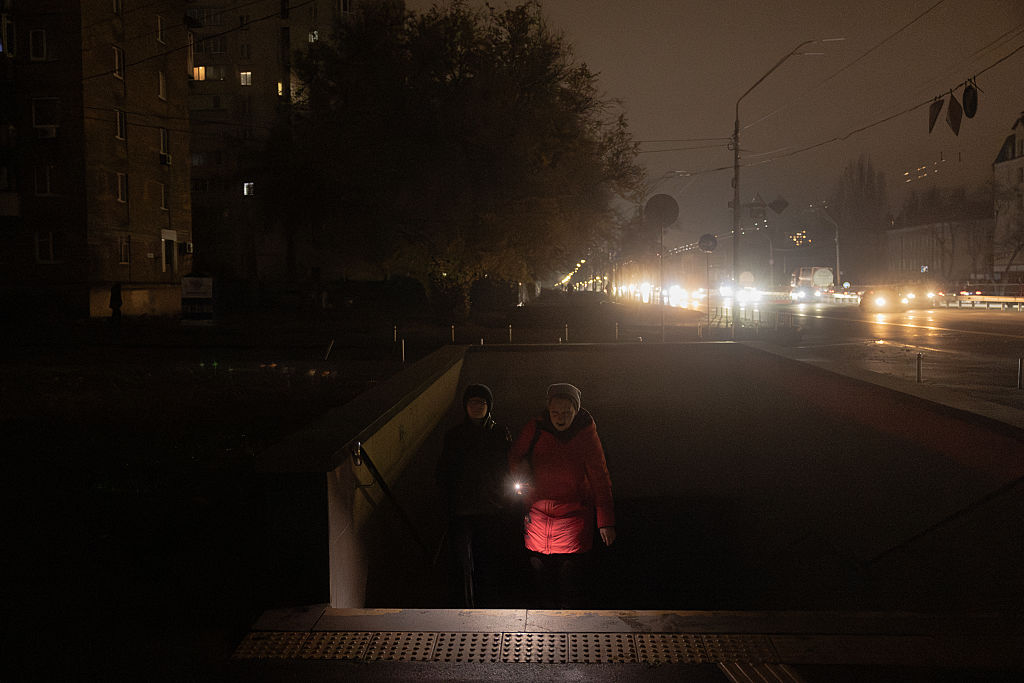
Underground commute in Kyiv after Russian strikes knocked out power overnight. Navigating by phone light through darkened passages has become routine. Day 1,355—when walking through blackouts is just another morning. (Roman Pilipey/AFP via Getty Images)
The Stranglehold: Myrnohrad’s Logistics Collapse
The Ukrainian military intelligence source didn’t mince words: “Almost no logistics” into Myrnohrad. Translation: the town was dying by strangulation.
Every access road into the settlement—cut off or covered by Russian fire. Ukrainian forces couldn’t bring supplies by truck. They couldn’t even move on foot. Russian infiltration groups, drones, and minefields turned every approach route into a kill zone.
Russian motorcycle groups had already reached northern Myrnohrad, probing defenses. More ominously, they were installing barbed wire and building defensive positions. Not just seizing terrain—preparing to hold it.
The footage showed a FAB-3000 glide bomb—three thousand kilograms of high explosive—slamming into the town. The kind of weapon you use when you want to reduce buildings to rubble and terrorize anyone still breathing inside.
This wasn’t Pokrovsk, where Russian and Ukrainian forces interpenetrated through southern neighborhoods in chaotic house-to-house fighting. This was more methodical. More patient. Cut the supply lines first. Let defenders run out of ammunition, food, medical supplies. Wait for the inevitable collapse.
Russian forces had learned from Pokrovsk’s meat grinder. Infiltration without controlling supply routes meant unsustainable casualties. Better to strangle the town first, set conditions for surrender through logistics failure rather than frontal assault.
The Ukrainian 7th Rapid Reaction Corps assessed that Russian forces would likely change their direction of attack soon. Russian milbloggers claimed advances in northeastern and southern Myrnohrad, consolidation on eastern outskirts. Hard to verify. What was certain: Russian forces were degrading Ukrainian defensive capabilities through systematic interdiction—cutting off resupply while maintaining constant pressure with indirect fire and infiltration missions.
For Ukrainian defenders, the mathematics were brutal and simple. Without supplies, ammunition dwindles toward zero. Without ammunition, positions become untenable. Without tenable positions, the town falls.
Russian forces were betting they could wait longer than Ukrainian forces could hold out.
The stranglehold tightened daily.
The Washington Paralysis: Five Billion Dollars in Limbo
Five billion dollars in American weapons sat gathering dust while Ukrainian forces fought to keep supply corridors open in Myrnohrad. AMRAAM air-to-air missiles. Aegis naval combat systems. HIMARS rocket launchers. All destined for Denmark, Croatia, Poland—and potentially Ukraine.
All frozen because the United States government had shut down.
State Department employees who processed export licenses were furloughed. The paperwork sat unsigned. Congressional approvals for new weapons sales had slowed to a crawl. A senior State Department official told Axios the delays affected both direct government sales and private defense company exports.
The final destinations remained murky. Some NATO allies were buying American systems specifically to transfer to Ukraine. Some purchases were direct. Either way, the weapons weren’t moving.
The irony cut deep. Ukrainian forces in Myrnohrad faced logistics collapse as Russian forces systematically cut supply routes. Simultaneously, American weapons that could help counter Russian interdiction—air defense missiles to protect convoys, rocket systems to strike Russian logistics nodes—sat awaiting signatures from workers who weren’t allowed to come to work.
This was the fundamental asymmetry. Putin could redirect Russia’s economy toward war production through presidential decree. He could accept astronomical casualties without electoral consequences. He could maintain indefinite commitment regardless of cost.
American weapons exports halted because Congress and the White House couldn’t agree on a continuing resolution that had nothing to do with Ukraine.
President Zelensky had told The Guardian that Ukraine wanted to order twenty-seven Patriot air defense systems from American companies while borrowing systems from European allies in the meantime. “It’s never enough,” he said. “It’s enough when the war ends. And enough when Putin understands that he has to stop.”
But first, the weapons had to actually arrive.
Five billion dollars. Sitting in bureaucratic purgatory. While Ukrainian defenders counted ammunition in besieged towns and Russian forces tightened their stranglehold.
The shutdown continued. The delays continued. The war continued.
The Balloon War: Lithuania’s Airport Closure
Lithuanian air traffic controllers watched the radar screens on the night of November eighth. Balloons. Multiple contacts. Drifting across the border from Belarus toward Vilnius Airport.
They made the call. Close it down.
The airport closure lasted only hours. The balloons themselves posed no direct threat—they weren’t bombs or sophisticated surveillance platforms. But that wasn’t the point. The point was forcing Lithuania to respond. The point was demonstrating vulnerability. The point was creating fear and uncertainty across NATO’s eastern flank.
Hybrid warfare. Cheap. Deniable. Effective.
Lithuania had already closed its border with Belarus indefinitely on October twenty-sixth after escalating incursions. Now the provocations had moved into the air. Lukashenko’s regime could claim the balloons were weather instruments blown off course. Lithuanian officials knew better. This was Russia’s Phase Zero campaign—the psychological conditioning designed to prepare European populations for possible future NATO-Russia war.
Lithuania wasn’t alone. In Belgium, unidentified drones had probed critical infrastructure for seven consecutive nights between October thirty-first and November sixth. The United Kingdom sent military personnel and equipment—likely RAF No. 2 Force Protection Wing—to help Belgian forces respond. German troops arrived days earlier with drone detection systems.
The pattern was clear. Russia and Belarus were systematically testing European airspace, gauging response times, mapping air defense capabilities, measuring political reactions. Operating in the gray zone between peace and war where NATO’s Article Five collective defense commitments didn’t clearly apply.
Each balloon. Each drone. Each airspace violation. Adding data points to Moscow’s intelligence picture. Forcing expensive responses. Creating public anxiety. Demonstrating that critical infrastructure remained vulnerable to low-cost provocations.
The Lithuanian airport reopened after a few hours. Flights resumed. Everything returned to normal.
Except everyone now knew that “normal” included balloons from Belarus forcing airports to shut down. And nobody knew when the provocations would escalate from harassment to something worse.
The testing continued. The mapping continued. Phase Zero continued.
The Energy War: Ukrainian Strikes on Russian Infrastructure
The explosions lit up Voronezh’s night sky at 3:47 a.m. Ukrainian drones had found the Combined Heat and Power Plant—the main heating supplier for surrounding residential and commercial areas. Geolocated footage showed visible damage. Flames consuming critical infrastructure.
In Taganrog, Rostov Oblast, another Ukrainian drone struck the T-24 Electrical Substation. The facility supplied power and water to most districts in the city. Open-source analysts confirmed the hit. Russian opposition outlet Astra reported several explosions, widespread outages, infrastructure damage.
More than twenty thousand people lost power in Russian border regions. Heating networks sustained severe damage, according to Belgorod Governor Vyacheslav Gladkov. Russian officials issued carefully worded statements about “unspecified utility facilities” and “emergency shutdowns.” Translation: they didn’t want to admit how vulnerable their infrastructure had become.
The strikes demonstrated Ukraine’s growing long-range capabilities despite Western restrictions on using provided weapons inside Russia. Ukrainian drones—domestically developed systems—could reach Voronezh, Taganrog, Belgorod. They could strike heating plants as winter approached. They could hit electrical substations that supplied both civilian populations and military facilities.
The strategic calculus was brutal but clear. Russian forces had spent nearly four years systematically destroying Ukrainian energy infrastructure, trying to freeze civilians into submission. Now Ukraine was returning the favor. Heating plants. Power stations. Oil depots. All legitimate targets when they supported the Russian war machine.
The attacks forced Russia to divert air defense resources to protect homeland targets rather than supporting front-line operations. Russian forces increased deployments around critical infrastructure, acknowledging vulnerability to strikes that could reach hundreds of kilometers into Russian territory.
Late on November ninth, Ukrainian forces struck again—this time hitting a Russian oil depot near Gvardeyskoye village in occupied Crimea. Residents reported several explosions. Russian Defense Ministry claimed air defenses shot down ten Ukrainian drones over the peninsula. The photo posted online showed a bright night sky over Gvardeyskoye.
The depot sat near the airbase that launched Russian aircraft bombing Ukrainian cities.
What goes around comes around.
3:47 a.m. in Voronezh: Ukrainian drones strike Russia’s main heating plant. Twenty thousand lose power as winter approaches. Heating infrastructure is now a legitimate military target. (Exilenova+ / Telegram)
The Grinding Front: Pokrovsk and Peripheral Advances
No confirmed Russian advances in Pokrovsk on November ninth. But the absence of territorial gains didn’t mean the fighting had stopped. It meant Russian forces were consolidating, bringing forward logistics, positioning units for the next push.
The interdiction war intensified. Ukrainian drones struck Russian supply routes into southern Pokrovsk. Russian forces deployed FPV drones and winged drones against Ukrainian logistics. Both sides bleeding each other’s supply lines while preparing for the next phase.
Some Russian milbloggers claimed the fighting wasn’t so intense that Pokrovsk was “engulfed in flames.” Machine gun fire remained relatively rare. This was infiltration warfare, not Stalingrad. Drone strikes and mortar fire instead of close-quarters infantry battles. Others claimed Russian forces were clearing Dinas Microraion in eastern Pokrovsk, had cut Ukrainian logistics to Rodynske, were operating in northern, northeastern, and southern sections.
The Institute for the Study of War assessed that Russian forces would likely increase their operational tempo in coming days. The slowdown was temporary—a pause for reinforcement, not Ukrainian success in pushing Russian forces back.
Elsewhere along the eastern front, Russian forces achieved several documented advances. Geolocated footage showed Russian troops moving into central Dronivka, east of Siversk. Along the Oskil River east of Holubivka, Russian forces advanced on the east bank, gradually turning the natural defensive line through persistent pressure.
In Vovchansk, northern Kharkiv Oblast, a Ukrainian brigade spokesperson reported buildup of six hundred Russian soldiers. Russian forces continued using small infantry groups—fireteams of two to three poorly trained penal recruits in first waves, followed by more experienced soldiers. Attritional tactics. The spokesperson noted Russian forces possessed sufficient penal recruits to sustain this indefinitely.
In southern Ukraine, geolocated footage showed Russian servicemembers raising flags at multiple locations in Rybne. The settlement had likely fallen. The Russian Ministry of Defense credited the 37th Motorized Rifle Brigade with its capture.
The front lines shifted by hundreds of meters. Not kilometers. Not breakthroughs. Just grinding, methodical pressure at dozens of points simultaneously.
Day 1,355. The mathematics of attrition continued.
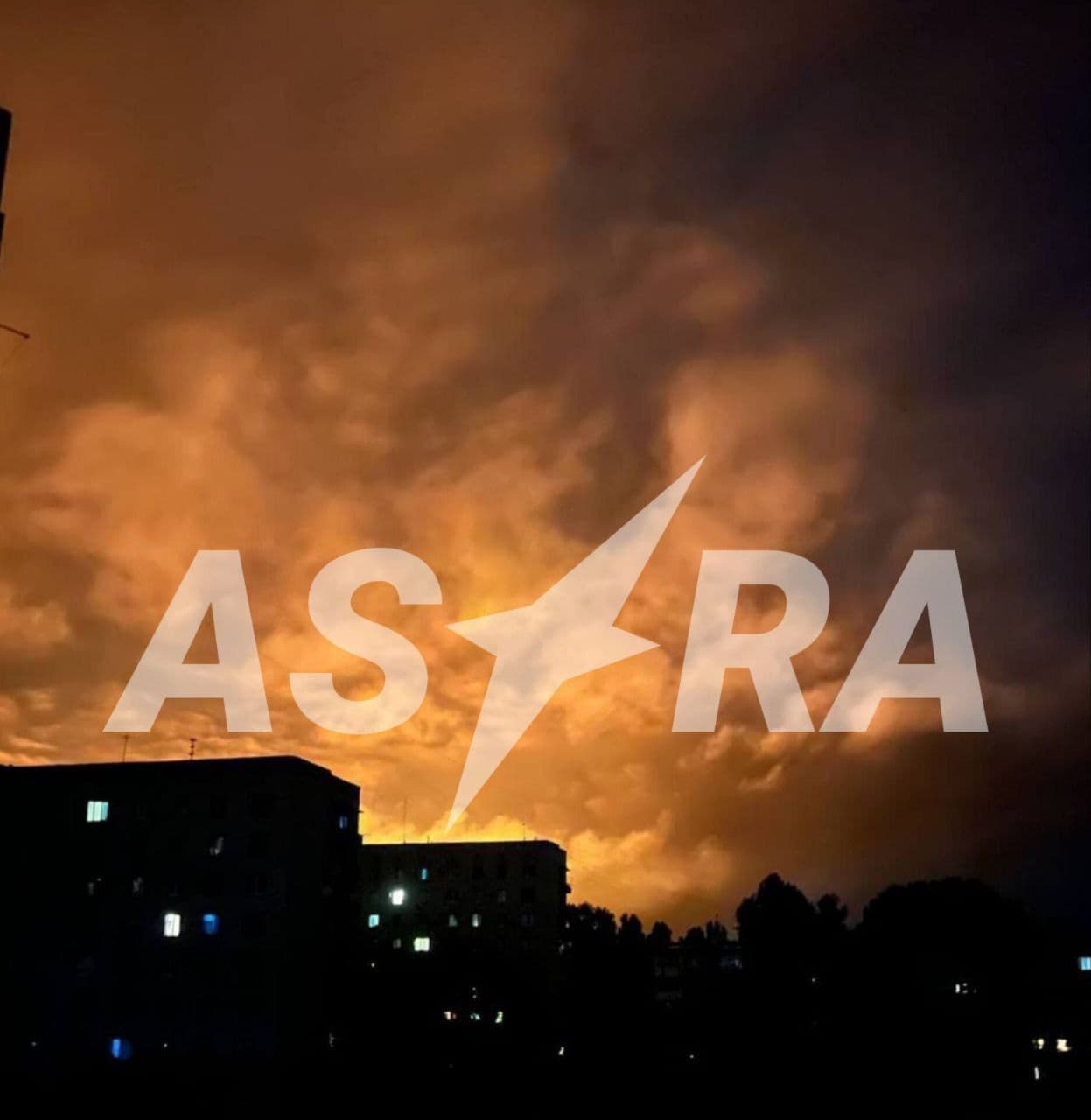
Occupied Crimea burns: Ukrainian drones hit the oil depot near Gvardeyskoye airbase—the same facility that launches Russian aircraft bombing Ukrainian cities. What goes around comes around. (ASTRA/Telegram)
The Humanitarian Toll: Drone Strikes and Daily Casualties
Sixty-nine drones launched from Kursk, Oryol, Millerovo, and Primorsko-Akhtarsk on the night of November eighth to ninth. Shahed-type. Gerbera-type. Others. The Ukrainian Air Force shot down thirty-four. Thirty-two struck targets across nine locations.
The math was simple and terrible. Civilian infrastructure. Energy facilities. Private homes. In Chernihiv, Dnipropetrovsk, Odesa, and Sumy oblasts, the explosions came in darkness.
Morning brought damage assessment. In southern Odesa Oblast, Russian drones struck several private garages—one destroyed completely. Windows shattered in a multi-story residential building. No casualties reported. This time.
In Kherson Oblast, the attacks never really stopped. Russian forces across the Dnipro River maintained constant pressure. Artillery. Drones. Air strikes. Residential areas. Apartment buildings. Private homes. Administrative buildings. Vehicles. Schools operated underground when they operated at all. Clinics tried to function in basements. Daycares became bunkers.
Families made impossible calculations. Stay in destroyed homes near combat zones? Or abandon everything to become internally displaced persons in unfamiliar cities? One hundred thirty-seven people evacuated from frontline areas in Donetsk Oblast on November ninth, including twenty-four children. They joined millions of Ukrainians who had fled since the invasion began.
Nineteen instances of Russian shelling in Donetsk Oblast alone. Systematic targeting of populated areas. No military objectives. Just homes. Just people trying to survive.
The casualty statistics captured only direct deaths from explosive ordnance. They didn’t count deaths from inadequate medical care in regions cut off from hospitals. Deaths from exposure in areas without power and heating. The cascading health impacts of infrastructure destruction. The slow-motion humanitarian catastrophe unfolding across frontline regions.
Russian forces called this a “special military operation.” International humanitarian law had clear terms for deliberately targeting civilian populations. So did Ukrainians living under daily bombardment.
But the terminology didn’t matter to families sheltering in basements. The violations were documented, condemned, and never stopped.
Day 1,355. The killing continued.
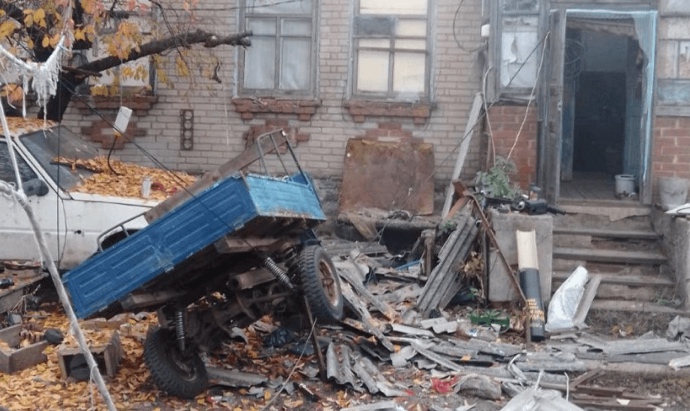
Another civilian building gutted in Donetsk Oblast. Nineteen Russian artillery strikes yesterday on populated areas. No military targets—just homes and people trying to survive. (Vadym Filashkin/Telegram)
The Diplomatic Chess: Patriots, Sanctions, and Moscow’s Hardline
President Zelensky told The Guardian what Ukraine needed: twenty-seven Patriot air defense systems. He’d like to order them from American companies. He’d look to borrow systems from European allies in the meantime.
The practical challenges were enormous. The United States didn’t have twenty-seven unused Patriot batteries sitting in warehouses. Global Patriot production was measured in single digits annually. Existing units were committed to American forces or already provided to allies including Ukraine. Twenty-seven systems implied multi-year procurement timelines, billions of dollars in payments, and political commitments from future administrations whose priorities remained unknown.
European allies similarly lacked excess Patriots to loan. They had their own air defense requirements—requirements they’d neglected for decades under assumptions of permanent peace that Russia’s invasion had shattered.
Zelensky knew this. The statement functioned as public diplomacy more than realistic near-term procurement. Emphasizing Ukraine’s legitimate defense needs. Pressing Western partners to do more.
“It’s never enough,” he said. “It’s enough when the war ends. And enough when Putin understands that he has to stop.”
Meanwhile, the European Union’s twentieth sanctions package entered development. Ready “within a month,” Zelensky announced—mere weeks after the nineteenth package was implemented in late October. Kyiv would propose targeting Russian entities profiting from energy resources, updating lists of officials involved in abducting Ukrainian children, increasing pressure on schemes enabling Russian military production.
The frustration was clear. Nineteen previous sanctions packages had inflicted economic pain without fundamentally altering Moscow’s ability to sustain military operations. Russian war production continued at high levels. Energy exports continued flowing. The defense industrial base adapted through parallel imports and sanctions evasion networks.
Ukraine imposed its own sanctions on eight senior Kremlin officials including special envoy Kirill Dmitriev, plus five Russian publishing houses spreading propaganda. Russian Foreign Minister Sergey Lavrov indicated readiness to meet Secretary of State Marco Rubio but reiterated Moscow’s hardline stance: the war’s “root causes” must be addressed.
Translation: Russia demanded Ukraine abandon territorial claims and accept permanent neutrality.
The diplomatic chess continued. Combat operations proceeded independently. Nobody knew which would prove decisive.
What November 9th Revealed
Two wars ran simultaneously. Russian forces strangled supply lines in Myrnohrad while American weapons sat frozen in Washington. Lithuanian airports closed under balloon incursions while Ukrainian drones struck Russian heating plants. Diplomats negotiated sanctions packages while artillery killed civilians in Kherson.
The day exposed the war’s fundamental asymmetries. Moscow could sustain operations indefinitely through presidential decree and accepted casualties. Washington couldn’t export already-purchased weapons because Congress and the White House couldn’t agree on budget resolutions. Putin redirected the economy toward war production without electoral consequences. Democratic governments faced voters questioning whether distant war merited continued sacrifice.
But the deepest revelation was how logistics had become the war itself. Not enabler of combat operations—the primary target of combat operations. Russian success in Myrnohrad came not through urban assault but through methodical strangulation of supply routes. Ukrainian defenders faced mathematical certainty: without resupply, positions become untenable. The equation was brutal and simple.
Questions remained unanswered. How long could Ukraine sustain defense when Western assistance arrived in increments that stabilized without transforming? How many more sanctions packages before Russia’s war economy buckled—or would it ever? When would Phase Zero provocations escalate from harassment to direct confrontation? Could democracies match autocratic commitment to indefinite conflict?
The balloons over Vilnius. The FAB-3000 hitting Myrnohrad. The five billion dollars in bureaucratic limbo. The heating plant burning in Voronezh. Each data point in a war that had normalized into chronic condition requiring management rather than acute crisis demanding resolution.
Day 1,355 passed into history. Tomorrow would bring new attacks, new casualties, new diplomatic initiatives, new Russian advances, new Ukrainian resistance. The patterns would repeat until something changed that nobody could foresee.
The war ground on. The world watched. The killing continued.