
While fog shielded Russian assaults in the east, Ukrainian strikes turned refineries across Russia into pillars of flame.
𝗧𝗵𝗲 𝗗𝗮𝘆’𝘀 𝗥𝗲𝗰𝗸𝗼𝗻𝗶𝗻𝗴
The fog came first. It rolled in before dawn across the plains of Zaporizhzhia, soft and gray, swallowing villages and tree lines until even the sound of artillery seemed to drift without direction. Soldiers said it felt like the world had turned to smoke. Drones couldn’t see. Satellites couldn’t help. And in that blindness, Russia moved.
Through fields slick with dew, small assault groups crept forward—three, sometimes five men at a time, walking their motorcycles through the haze until they were close enough to fire. Ukrainian defenders, stripped of their eyes in the sky, fell back from Uspenivka and Novomykolaivka, retreating to stronger ground under the ghostly veil that covered the steppe. The fog had become a weapon.
But while the east disappeared into mist, the skies over Russia burned clear. Hundreds of miles away, Ukrainian long-range drones found their marks with surgical precision. In Saratov, fire bloomed again from the refinery stacks—the fourth strike in a month. In Orsk, a primary processing unit erupted into a column of black smoke so tall it drew traffic to a stop on the highway. For every mile Russia advanced through fog, Ukraine answered with flame.
It was the war’s paradox laid bare: tactical retreat paired with strategic reach, withdrawal in one place and vengeance in another. From Pokrovsk’s ruined streets to the oil fields of Orenburg, the day’s front lines stretched across an entire continent—each battle feeding the same equation of attrition, resilience, and defiance.
Nature had picked its side that morning. But by nightfall, so had the fire.
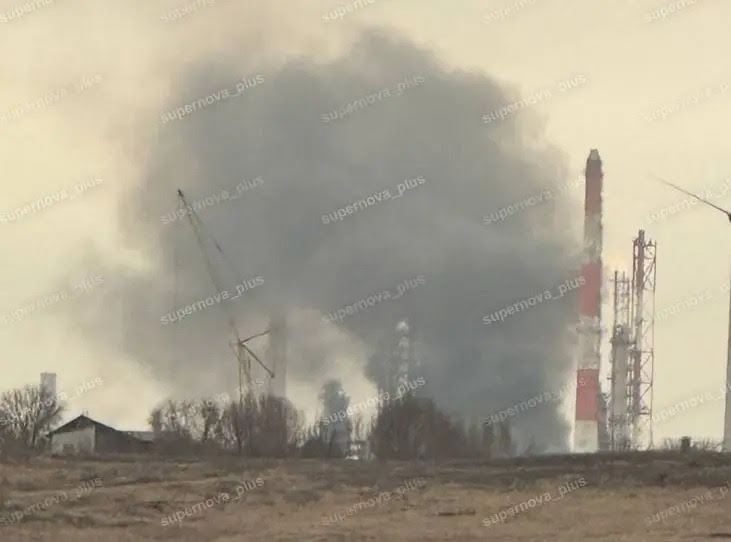
A pillar of smoke rises from Orsk’s shattered refinery—Russia’s own fuel feeding the fire it began. (Supernova+ /Telegram)
𝗙𝗼𝗴 𝗮𝘀 𝗔𝗺𝗺𝘂𝗻𝗶𝘁𝗶𝗼𝗻
By dawn, the steppe had vanished. The fog lay thick as ash across the fields northeast of Hulyaipole, muffling sound and swallowing light. In that silence, Russia advanced.
Ukrainian soldiers could hear them before they could see them—motorcycles idling somewhere in the white murk, footsteps crunching frost, the short metallic cough of automatic fire. Drones sat grounded, their lenses blind. By midmorning, Colonel Vladyslav Voloshyn confirmed what was already clear to those on the line: Uspenivka and Novomykolaivka had been abandoned. Yablukove still burned.
For days, Russian gunners had softened the front—two thousand shells a day, Voloshyn said—grinding bunkers into dust. Then came the fog, and with it, small assault groups pushing forward in threes and fours, carrying flags to plant in the smoke. Geolocated footage showed them raising banners in Novouspenivske, though Western analysts dismissed it as a probe, not a capture. One civilian died in Hulyaipole when a Russian drone found his car on a street emptied by fear.
The pattern was methodical: Russia firing, Ukraine absorbing, the gray zone widening between them like a bruise. Villages such as Zlahoda and Yablukove flickered between possession and ruin. Moscow’s 114th Motorized Rifle Regiment appeared at the edge of the fog, regular soldiers stepping where irregulars had failed.
But the same mist that gave them cover also sealed their fate. Once the air cleared, Ukraine’s drones took flight again—circling, marking, striking. The steppe that had hidden them now exposed every movement. By sunset, the fog had lifted, leaving bodies scattered across the churned mud of positions gained for only a few hours.
Weather had given Russia its advance. The dawn after would decide whether it could keep it.
𝗣𝗼𝗸𝗿𝗼𝘃𝘀𝗸: 𝗧𝗵𝗲 𝗖𝗶𝘁𝘆 𝗧𝗵𝗮𝘁 𝗦𝗲𝗲𝘀 𝗡𝗼 𝗦𝘂𝗻𝗿𝗶𝘀𝗲
In Pokrovsk, the war breathes through the ruins. The city’s streets are silent until they aren’t—until the hum of a drone slices through the fog, or a wall gives way under the impact of another glide bomb. Somewhere in that maze of collapsed concrete and frozen mud, more than 300 Russian soldiers are fighting to hold positions they can barely supply.
General Oleksandr Syrskyi calls the situation tense but controlled. The control lies in knowing every corner, every line of sight, every bombed-out stairwell that can still be defended. Russia has poured 150,000 troops—naval brigades, mechanized divisions, and unending waves of infantry—into this one sector. Their gains are measured not in kilometers, but in rooms.
Geolocated footage shows them crawling forward in southeastern Pokrovsk and nearby Myrnohrad, claiming advances that vanish as quickly as they’re posted online. Ukrainian strike teams hunt them block by block—three soldiers, a drone, a mortar, and a map. They move in silence until the sky erupts again. Each street becomes a trap, each building a duel of patience and sound.
Even Russia’s elite drone operators from the Rubikon Center cannot turn infiltration into control. They open gaps that ordinary soldiers are too exhausted or too exposed to hold. Bombers drop FAB-1500s and FAB-3000s, but the explosions only dig new fortresses for the defenders. Rubble becomes protection. Destruction becomes defense.
By nightfall, Pokrovsk remains what it was that morning—a scar that refuses to close. Russia bleeds for every floor it takes. Ukraine bleeds to deny it. And somewhere between the two, the city keeps breathing through dust.
𝗧𝗵𝗲 𝗜𝗻𝗱𝘂𝘀𝘁𝗿𝗶𝗮𝗹 𝗛𝗲𝗮𝗿𝘁 𝗕𝘂𝗿𝗻𝘀
Night fell quiet over Russia’s heartland—until the first explosion. A low thud, then another, rolling across Saratov’s industrial plain. Within minutes, the skyline pulsed orange. The Saratov Oil Refinery, a giant that fed the Russian army’s war machine, was burning again. Fourth time in a month. Same coordinates. Same failure to stop it.
Ukrainian drones had slipped through hundreds of miles of airspace to strike with surgical precision. Fire climbed the towers, consuming the pipelines that turned crude into war. Regional officials called it “damage to civilian infrastructure,” though everyone watching the flames knew better.
Farther east, Orsk was next. The Orsknefteorgsintez refinery—an enormous plant capable of processing 6.6 million tons of oil a year—was hit in its primary refining unit. Geolocated footage caught the moment black smoke surged into a sky so clear it could have been drawn. Another governor claimed “drone debris” had caused a minor fire. It was a lie told for the fifth time this month.
Then came Crimea. In Feodosia, Ukrainian drones dove toward oil tanks on the Marine Terminal, turning the shoreline into a chain of fire. Russian gunners opened up at the sky, tracer rounds carving frantic lines through the dark. The air defense system that once guarded the terminal was gone—either moved or destroyed.
Hours later, deep in occupied Donetsk, a Ukrainian strike lit up the Starobesheve power plant. One explosion, one flash—and another piece of Russia’s war engine broke apart.
Across four fronts, the message was identical: the fog might shield the front lines, but the skies above Russia were no longer safe.
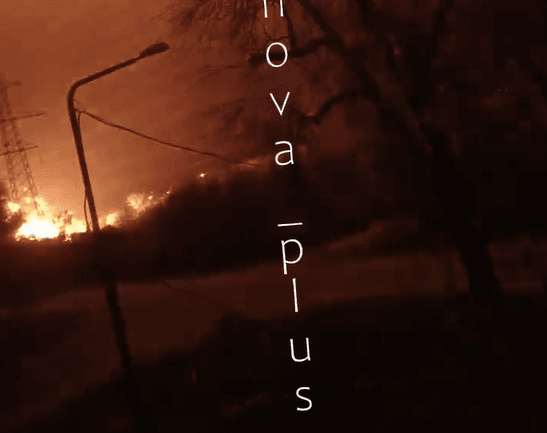
Flames bloom over the Starobesheve power plant in occupied Novyi Svit—a flash of Ukrainian defiance caught on a trembling phone screen. (Supernova_plus/Telegram)
𝗧𝗵𝗲 𝗗𝗿𝗼𝗻𝗲 𝗪𝗮𝗿 𝗔𝗯𝗼𝘃𝗲 𝗮𝗻𝗱 𝗕𝗲𝗹𝗼𝘄
The night sky over Ukraine never truly sleeps. Around midnight, radar screens flickered alive—first in Kharkiv, then Odesa, then the Donbas. From Kursk, Oryol, Bryansk, Millerovo, and occupied Crimea, Russia launched another swarm—119 drones, most of them Iranian-made Shaheds, their engines humming like an approaching storm.
For hours, Ukrainian air defenses lit up the darkness, tracing white arcs through black sky. Fifty-three drones fell. The rest kept coming. Explosions followed in eighteen regions—energy grids, railway yards, warehouses, apartment blocks. In Odesa Oblast, 16,000 homes lost power. Somewhere in Kharkiv, a family woke to the sound of glass imploding before the power cut out completely. The war had come back to their living room.
But not all the drones stayed within Ukraine. One crossed the invisible border and fell into Romania—five kilometers from the Danube. Soldiers found its remains near Grindu village, twisted metal in the grass, still warm from the fall. It was the second time in two months a Russian weapon had landed on NATO soil. Bucharest’s foreign minister called it “a systematic provocation.” The alliance called it “unacceptable.”
The risk has always been baked into Moscow’s strategy. The ports of Izmail lie just across the river from NATO’s frontier, vital for Ukrainian grain exports and fuel imports. Russia’s drones fly low there, skimming the water, one navigation error away from starting a different kind of war.
That night, Ukraine counted its craters. Romania counted its warnings. And the drones kept flying—above the Danube, beneath the radar, testing how close the world could come to catastrophe without crossing the line.
𝗧𝗵𝗲 𝗪𝗮𝗿 𝗢𝘂𝘁𝘀𝗶𝗱𝗲 𝘁𝗵𝗲 𝗕𝗮𝘁𝘁𝗹𝗲𝗳𝗶𝗲𝗹𝗱
While soldiers fought in the mud of Pokrovsk and Zaporizhzhia, another kind of battle unfolded in marble corridors and conference rooms far from the front. Diplomacy and economics—Ukraine’s quieter fronts—moved with their own urgency.
In Istanbul, Rustem Umerov arrived beneath gray skies, carrying a list of 2,500 names. Prisoners of war. Men who had vanished into Russia’s camps. His mission: to restart the exchange talks that had frozen for a month. Turkey had once brokered a deal; perhaps it could do so again. But everyone in the room knew what Moscow was really trading—leverage, not lives. Every negotiation was another form of captivity.
In Lviv, the preparations had already begun for a different kind of summit. EU ministers would meet there in December to discuss Ukraine’s progress toward membership—a meeting Hungary was trying to derail. Nearly every other European nation agreed Kyiv had met the benchmarks. Still, Budapest warned of “harm to farmers” and “criminal networks,” arguments few took seriously. Holding the gathering inside Ukraine itself was the message: the country was not waiting for Europe’s approval—it was already part of Europe’s struggle.
And in Bucharest, Romania made a move that rattled boardrooms from Moscow to Brussels. Its government announced plans to seize control of Lukoil’s local subsidiary, citing sanctions compliance and national security. The company supplied a quarter of Romania’s fuel. Taking it over meant crossing a line Europe had tiptoed around since 2022—turning sanctions into expropriation.
The guns thundered in Donetsk, but in these rooms of quiet defiance, another war was being fought—one measured not in kilometers, but in signatures, sanctions, and the slow tightening of an economic noose.
𝗧𝗵𝗲 𝗕𝗮𝘁𝘁𝗹𝗲𝗳𝗶𝗲𝗹𝗱 𝗪𝗶𝘁𝗵𝗼𝘂𝘁 𝗘𝗻𝗱𝘀
While the headlines centered on Pokrovsk and the fog-choked fields of Zaporizhzhia, the war stretched far beyond. Across a thousand kilometers of front, small fires burned everywhere—Kharkiv to Kherson, Kupyansk to the Dnipro. Russia pressed on all of them at once, a strategy that promised motion but rarely momentum.
In the north, artillery thudded along the border near Kharkiv and Sumy, where Russian drones hunted cars on empty highways. One missile hit a civilian vehicle near Kozacha Lopan, injuring its driver—a small act of terror in place of a military victory. Moscow was still moving men and shells toward the line, pretending these modest attacks were an offensive. The pretense was its own kind of weapon.
Around Vovchansk, exhausted battalions rotated out after the strike that had burst Belgorod’s reservoir weeks earlier. The new units that replaced them arrived half-filled and ill-equipped, more names than soldiers. Even Russian bloggers admitted the truth: formations were expanding faster than they could be manned. Commanders could paper over losses, but not replace them.
Farther east, Kupyansk lived under the constant lie of being “nearly captured.” Official statements claimed victory every week; reality said otherwise. Both sides fought from the city’s edges, trading drone fire and reconnaissance gains measured in meters. Ukrainian officers described new “sleeper drones” tethered by fiber optics, waiting silently for hours before detonating when an engine or heat signature crossed their path. The war was learning new tricks.
In the Donbas, Lyman and Siversk saw the same rhythm—Russian assaults that died on the wire, Ukrainian counter-moves that reclaimed little but proved the army still had teeth. Even Chasiv Yar, declared “liberated” by Moscow in August, remained defiantly under Ukrainian control, its defenders posting videos from streets Russia swore it owned.
South of there, the industrial cities of Kostyantynivka and Druzhkivka endured another wave of precision terror. Glide bombs meant for bunkers smashed into apartment blocks. One FPV drone chased a motorcyclist through the streets before striking—proof that technology and cruelty often travel together.
Down by the Dnipro, Russian troops kept up their shelling from the far bank, achieving nothing except noise and casualties. Yet the Kremlin insisted on the illusion of progress, keeping dozens of offensives alive to show movement on maps.
Across every front, the pattern held: Russia advanced a few meters, Ukraine endured another day, and both sides kept the war alive through exhaustion alone.
𝗪𝗵𝗮𝘁 𝗧𝗵𝗲 𝗗𝗮𝘆 𝗥𝗲𝘃𝗲𝗮𝗹𝗲𝗱
When the fog lifted, the truth returned with it. Russia had moved the lines—but not the war. Its gains in Zaporizhzhia and Pokrovsk came not from mastery of the battlefield but from the accident of weather, a few hours when Ukraine’s eyes in the sky went blind. When visibility returned, so did the balance of power.
This was the 1,357th day of a war that has learned to disguise paralysis as progress. Moscow’s armies still pushed everywhere at once—Kupiansk, Lyman, Siversk, Kherson—stretching themselves thin across a front too long to master. Each thrust won a few meters at catastrophic cost, each “breakthrough” collapsing before it could become momentum. Ukraine, for its part, traded space for time and lives for endurance, choosing to bleed slower rather than break.
Kyiv’s strategy has grown cold and pragmatic: withdraw when defense becomes untenable, preserve strength for the long war, and strike deep where it hurts most—Russia’s fuel, its factories, its illusion of safety. Those distant refinery fires mattered more than any village lost in the fog. They showed that Ukraine could still reach deep into the heart of the machine sustaining the invasion.
The contradiction could not be clearer. Russia can seize ground but not control the war’s direction. Ukraine can strike powerfully but cannot yet reclaim what’s been taken. The result is a stalemate that feels less like stillness and more like grinding motion—bodies, machines, and nations wearing themselves down.
Nature gave Moscow its best day in weeks, an illusion of momentum conjured from mist. But fog is fleeting. When the sun burns through, when drones rise again, the same math will reassert itself—manpower against precision, propaganda against endurance.
By nightfall, smoke still rose from Orsk and Saratov. Ukrainian troops dug new trenches along the same muddy ridges. The lines had shifted, but the story had not. The war endures, waiting for a day when weather alone no longer decides its course.