
Breathe the acrid smoke of a Kyiv high-rise at 12:45 a.m., feel the floor buckle beneath your feet as a Shahed drone detonates against the facade—November 14th, 2025, Day 1,356, when Russian terror from above collided with Ukrainian vengeance striking 1,000 kilometers deep.
The Day’s Reckoning
Duck into a Desnianskyi District stairwell as the first wave crashes. Three hundred Shahed-type drones hum like a plague of mechanical locusts, mingled with Gerberas and decoys, while 19 missiles slice the darkness—three Kinzhals screaming from Ryazan Oblast, a Zircon vanishing from unknown waters, six Iskander-K/Calibers arcing from Crimean seas, nine Iskander-M/KN-23 ballistics erupting from Bryansk. Apartment blocks shudder and ignite across the capital. Six souls are lost in the rubble, 25 wounded, including a pregnant woman cradling her belly and two boys aged 7 and 10 with shrapnel-laced faces. Yet Ukrainian gunners in mobile Patriot batteries and hidden SAM sites claim 419 kills. Four hundred five drones are shredded mid-flight, two Kinzhals swallowed by interceptors, all six cruise missiles erased, six ballistics tumbling harmlessly into fields.
Eight hundred kilometers east, stand on a Saratov rooftop as orange fireballs bloom from Rosneft’s refinery for the fourth time this fall. Ukrainian drones dance through shredded air-defense nets. In Novorossiysk, watch the Black Sea horizon flash white as Long Neptune missiles—evolved from the 300 km Moskva-slayer into a 1,000 km predator—rip into the Sheskharis oil terminal. Pipelines rupture, S-400 launchers crumple in secondary blasts. Zelensky’s voice cuts through the static: “A justified response to terror.” Intelligence whispers darker tidings. Russia plans 120,000 glide bombs next year, 500 of them long-range enough to glass towns far behind the lines.
Walk the scarred streets of a key eastern town where Russian infiltrators plant observation posts in abandoned apartments, only for Ukrainian JDAM-ERs to turn their command nodes into craters. North Korean laborers—12,000 more by year’s end—march toward drone factories under slave contracts, while Ukraine’s own Octopus interceptors roll off assembly lines. Germany pledges 11.5 billion euros, Hungary sues the EU over gas bans, corruption tapes implicate Kyiv’s inner circle, and a Russian spy ship ghosts past Hawaii. Four currents surge: aerial apocalypse and deep-strike payback; the grinding siege in the east; technological arms races; global fault lines cracking wider. The day ends not with resolution but with embers glowing on both sides of the border.
The Night the Sky Fell: Kyiv Under the Swarm
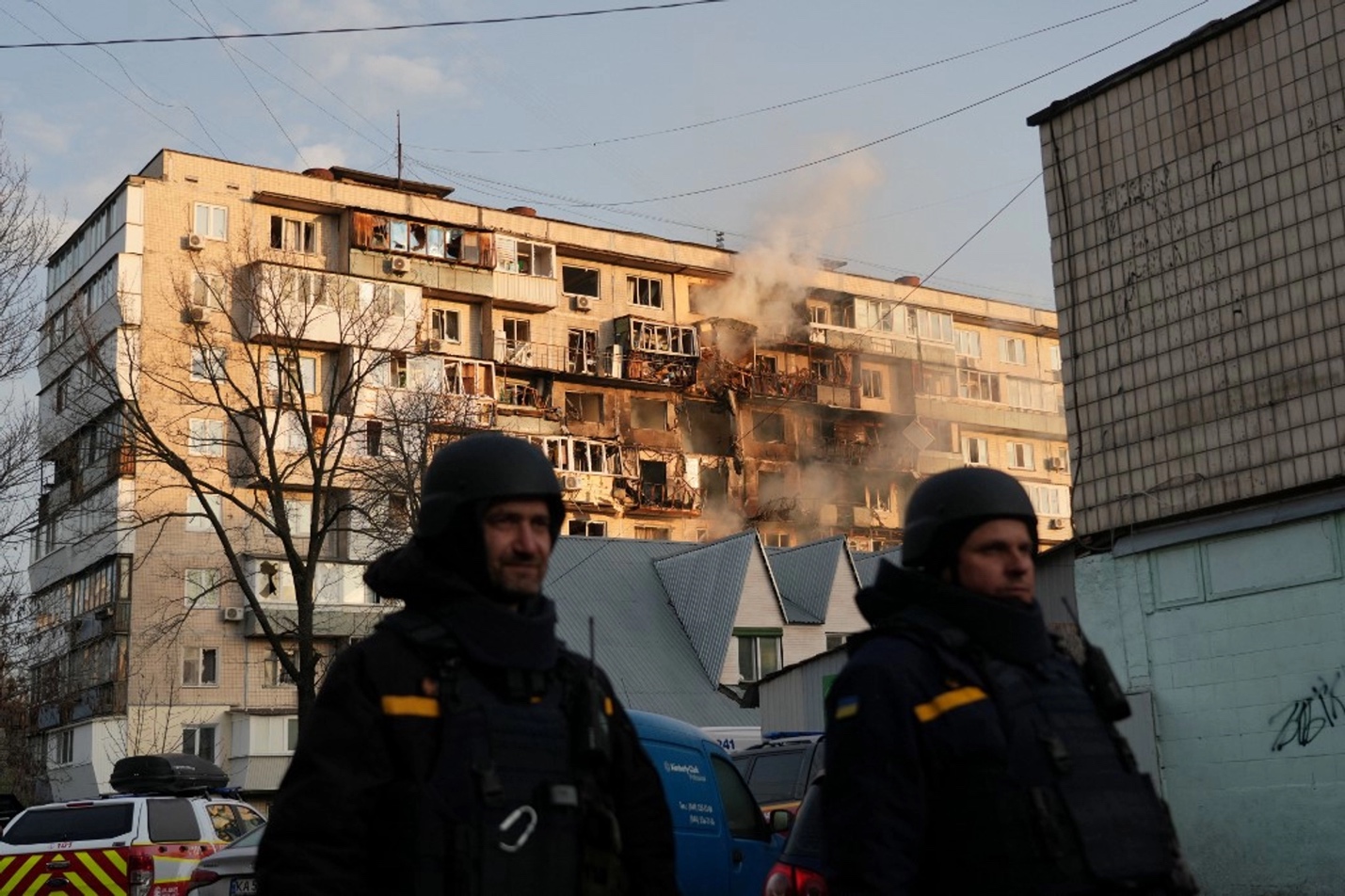
Ukrainian rescuers trudge past a shattered high-rise, its gutted facade weeping debris and smoke after Russia’s midnight barrage claimed lives in Kyiv. (Photo by OLEKSII FILIPPOV / AFP)
You are Dmytro, a young father in a 16-story block in Desnianskyi District. The clock reads 12:45 a.m. when the first explosion rocks the building. Smoke pours under the door. Your wife clutches your three-year-old son Denys as you sprint barefoot down smoke-filled stairs. A meter to the left and your apartment would be the one with the hole punched through three walls. Outside, flames lick from the 5th to 8th floors where a Shahed found its mark. One neighbor is gone, body still under rubble when dawn comes. Rescuers in breathing masks haul out 40 survivors across the district, their faces streaked with soot and disbelief.
The onslaught unfolds in relentless waves. Historic brick facades crack in Podilskyi. Panel blocks spew glass like shrapnel in Dniprovskyi. Heating mains burst in Solomianskyi, scalding steam hissing into the freezing air. A hospital’s maternity ward loses windows. A school’s gym roof caves in. A sports complex’s wooden bleachers burn like tinder. Mayor Vitaliy Klitschko’s voice crackles over emergency radio: “Eleven high-rises hit—stay low, stay calm.” Power flickers out in entire neighborhoods. District heating pipes rupture, leaving thousands to huddle under blankets as temperatures plummet.
President Zelensky, voice raw from briefing allies, tweets from an undisclosed location: “About 430 drones and 18 missiles—ballistic, aeroballistic, aimed at residential areas and energy facilities.” He instructs diplomats to flood partners with evidence: debris stamped with Russian serial numbers, geolocated launch sites, civilian casualty lists. Air Force crews in camouflaged launchers claim their toll. Four hundred five drones shredded by guns and missiles, two Kinzhals detonating harmlessly over fields, every cruise missile erased. Yet 23 drones and one Iskander slip through, striking 13 sites, debris raining on 44 more. Ukrenergo chief Vitaly Zaichenko appears on television at 4 a.m., eyes bloodshot: “Distribution networks damaged, a thermal plant’s water pipeline hit. Without further attacks, we restore full consumption in three weeks.” He begs citizens to ration electricity as blackouts roll across Donetsk, Kyiv, and Odesa oblasts.
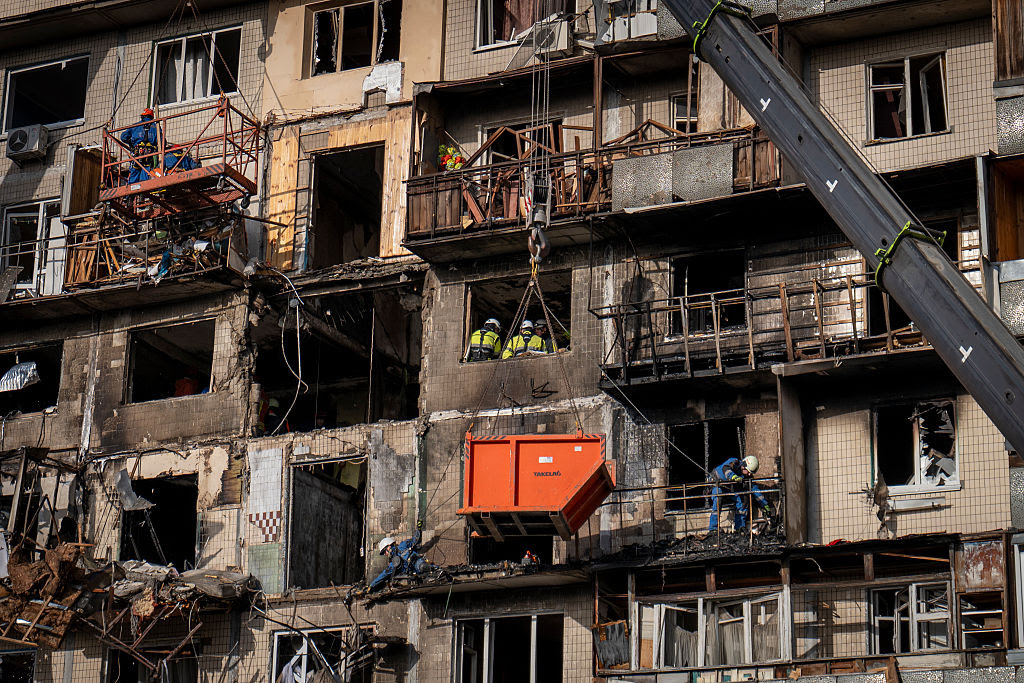
Rescuers sift through twisted rebar and shattered glass, pulling rubble from a Kyiv apartment block where families once slept—now scarred forever by Russia’s drone-and-missile fury. (Dan Bashakov/Global Images Ukraine via Getty Images)
Eighty-one-year-old Valentina, wrapped in a wool shawl in her cracked apartment, tells rescuers: “It shook like an earthquake. I’ve lived through Stalin, through Chernobyl—Russia won’t let anyone live in peace.” Her words echo in basements citywide, where strangers share tea and stories, defiance hardening with every aftershock. The Azerbaijani embassy takes shrapnel damage from an Iskander fragment, a diplomatic scar amid the chaos. Rescuers evacuate over 40 from targeted buildings, the State Emergency Service reporting fires, strikes, and evacuations in six districts. The attacks damage a hospital, a school, and wooden structures at a sports facility. Emergency crews assess ruptured heating networks, while the Energy Ministry urges rational electricity use throughout the day.
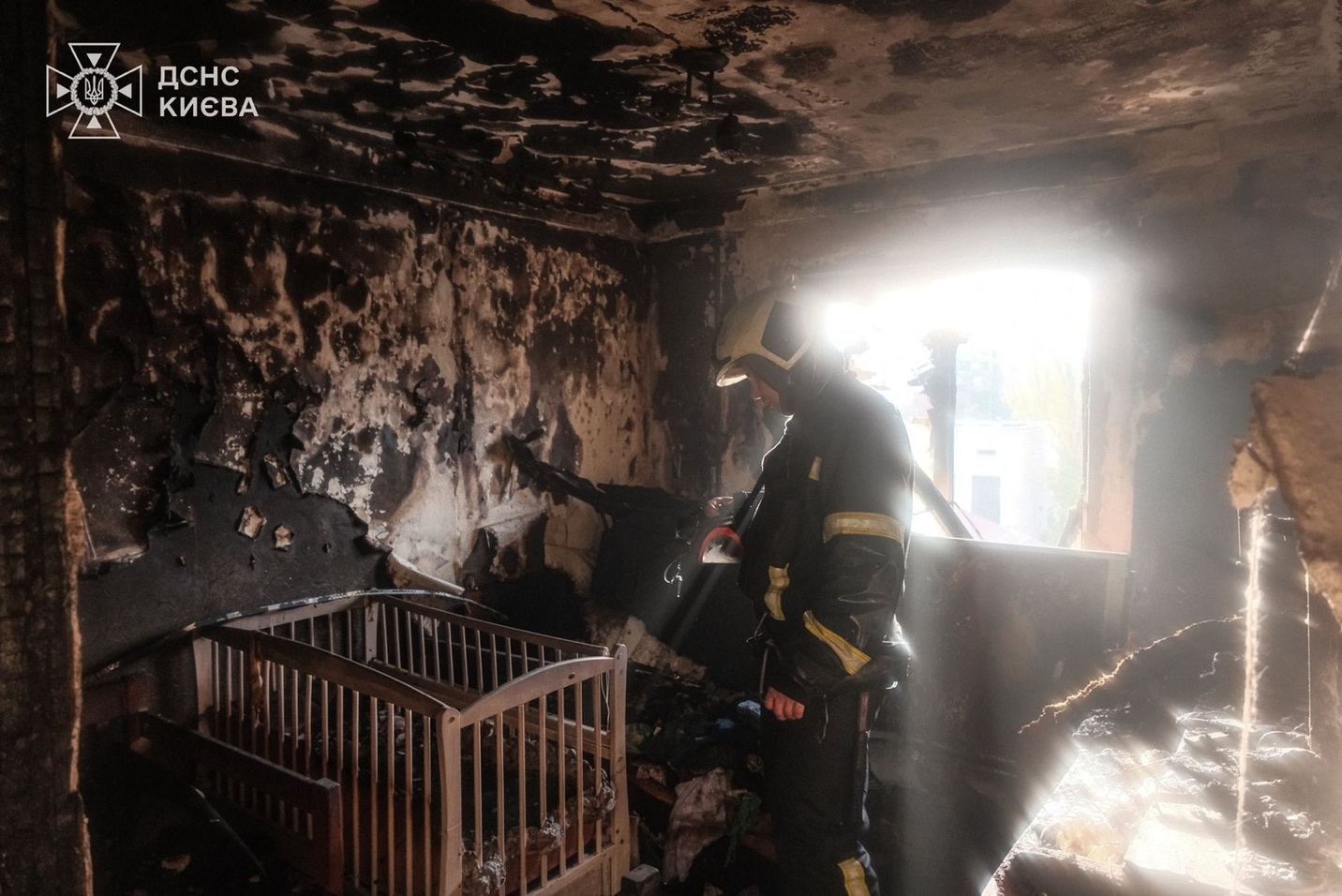
Ukrainian rescuer Serhii Vlasenko stands amid the ruins of his own home, walls blown open and life scattered in the dust after a Russian drone stole his sanctuary in Kyiv’s overnight inferno. (Interior Minister Ihor Klymenko/Facebook)
Echoes of Grief: The Regions Bleed
Dawn reveals fresh devastation in the south and east. In Zaporizhzhia Oblast, strikes on two districts claim four lives. Homes are flattened, families erased in seconds. Governor Ivan Fedorov walks the craters, voice breaking as he lists the dead without names, respecting privacy in a nation that has buried too many.
In Kharkiv Oblast’s rural villages, three elderly residents—two women of 70 and a man of 72—are struck down while fetching water. Another 70-year-old woman clutches a bandaged arm. Nearby, a 54-year-old man staggers from rubble, blood drying on his shirt. Governor Oleh Syniehubov posts photos of the wreckage, a silent accusation.
Residential neighborhoods in Kherson Oblast absorb four more injuries. Shrapnel tears through windows, children scream as parents drag them to shelters. Governor Oleksandr Prokudin catalogs the wounds: lacerations, concussions, a teenager with glass in his eyes. In Donetsk Oblast, one more civilian limps to aid stations. Governor Vadym Filashkin adds the injury to a ledger that never shrinks.
Across Ukraine, the day’s toll crystallizes: 13 dead, 32 wounded. Each a story cut short by Moscow’s calculus that civilian suffering equals Ukrainian surrender. The massive combined strike—launched from Kursk, Oryol, Bryansk, Rostov, Krasnodar, and occupied Crimea—demonstrates Russia’s retained stockpiles despite sanctions, a reminder that distance from the front provides no immunity.
Neptune’s Fury: The Black Sea Port Burns
The scene shifts to Novorossiysk at 3 a.m. The Black Sea mirrors a fireworks inferno. Ukrainian drones swarm first, drawing S-400 fire that lights the sky like strobe. Then the Long Neptunes arrive—sleek, 1,000 km predators evolved from the 2022 Moskva-killer. The first missile punches through the Sheskharis oil terminal’s perimeter, rupturing pipelines that feed Transneft’s global network. Secondary blasts ripple. Oil tankers list. Pumping stations collapse. A civilian vessel catches fire from falling debris.
Geolocated video captures an air defense regiment’s base erupting. An S-400 launcher is flipped like a toy, missile storage bunkers venting fire. SBU sources whisper to journalists: “Port infrastructure, tankers, pipelines, and an entire S-300/400 battery—gone.” Krasnodar’s operational headquarters admits the oil depot blaze, claims drone debris started it, but Reuters industry contacts confirm the truth. Exports halted, crude supplies to the terminal suspended indefinitely. Zelensky, in a midnight address, christens the weapon officially: “Long Neptune—our answer to terror.” The strike starves Russian armor in Ukraine, forces Moscow to guard every port, every pipeline, every kilometer of coast. Once an anti-ship rocket with 300 km range, the modernized version unveiled in August now reaches deep into Russian territory, a symbol of Ukraine’s growing missile program that Zelensky thanks for improved accuracy and range.
Saratov’s Recurring Nightmare: The Refinery That Won’t Stay Dark
Six hundred kilometers east, Saratov residents wake to the now-familiar roar of drones. The Rosneft refinery—processing 140,000 barrels daily into over 20 petroleum products including gasoline, diesel, fuel oil, and bitumen—erupts again, the fourth hit since autumn began. Flames leap from fuel storage tanks, visible for kilometers. Opposition media pins the origin to a precise drone strike that bypassed anti-drone netting shredded in prior attacks.
The governor’s Telegram post is terse: “Civilian infrastructure damaged, emergency services on site.” Russian Ministry of Defense claims 45 drones downed over the oblast, but the fire tells another story. Ukrainian General Staff adds a second target: the Krystal Plant’s fuel and lubricants enterprise in Engels Raion, another blaze feeding the night. Each strike chips away at Russia’s war chest, forces air defenses to spread thin, makes every repair crew wonder if they’ll finish before the next wave. The facility, a logistics hub along the Volga, supplies the military directly, its repeated targeting a pattern of Ukrainian doctrine: identify critical nodes, strike repeatedly, force choices between repair and defense.
The Glide Bomb Horizon: A Storm of 120,000 Shadows
In a Kyiv bunker, Maj. Gen. Vadym Skibitskyi, deputy head of Defense Intelligence, unfolds satellite photos of Russian factories. “They plan 120,000 glide bombs in 2025,” he says, voice low. “Including 500 of the new long-range variant—propulsion kits that let jets drop them from safety, hit towns 70 km behind the lines.” October saw over 5,300 dropped. Now it’s 200–250 daily, up from 170 last month. Cheap Soviet bombs gain wings and engines, turning aircraft into untouchable artillery. The buildup represents a threat that dilutes air defenses everywhere, as every potential target requires protection. Skibitskyi calls it a calculus Ukraine must answer, the growing stockpile a shadow over both frontlines and rear cities.
Octopus Rising: Ukraine’s Night Hunters Take Wing
Ukrainian factories hum under floodlights. Welders in masks assemble sleek interceptor drones. Defense Minister Denys Shmyhal tours the line: “Octopus is in serial production—three manufacturers now, eleven more joining.” Designed for pitch-black skies, electronic warfare chaos, and treetop altitudes, they hunt Shaheds with infrared eyes and explosive warheads. September saw nearly 7,000 Russian drones. October promises worse. Shmyhal’s promise: “They will protect our skies as soon as possible.” The name evokes tentacles snaring prey—Ukraine’s answer to endless swarms, born of necessity and ingenuity. The technology, capable in EW-contested environments, builds on prior UK production announcements, a scalable shield addressing the urgent need for affordable air defense.
Pyongyang’s Human Pipeline: 12,000 Workers for the Drone Factories
Barbed wire and guard towers enclose hangars in Tatarstan’s Alabuga special economic zone, churning out Gerans and Gerberas. HUR intelligence reveals the latest shipment: 12,000 North Korean workers by year’s end, negotiated in October between Russia’s foreign ministry and Jihyang Technology Trade Company—a front for Green Pine, the sanctioned hub of Pyongyang’s weapons trade, nuclear program, and ballistic missiles. They join 20,000 already in factories, plus 25,000 considered earlier per Japanese reports. Pre-war, Russia relied on North Korean labor for hard tasks, especially in the Far East amid low birth rates and substance issues. Contracts pay the regime, workers endure slave-like camps. North Korean sappers demine Kursk Oblast alongside Russians, freeing combat troops. The flow amplifies war output, exports drone expertise home, a deepening partnership sustaining Moscow’s offensive.
The Eastern Siege: A Key Town Slips Through Russian Fingers
Fog shrouds a strategic eastern town at dusk. Russian forces infiltrate northern and eastern districts, plant drone stations in gutted supermarkets, set observation posts in high-rise skeletons. Geolocated footage shows advances in southern areas, but the town remains contested. Ukrainian positions hold firm in the north. Counterattacks reclaim streets Russia claimed days ago. Milbloggers admit ongoing fights. ISW analysts note Moscow’s command prioritizes seizing the town itself over closing a wider pocket. Southern elements press from multiple directions, but the northern shoulder crumbles under pressure. Ukrainian Special Operations Forces strike troop concentrations packed into buildings during bad weather. Air Force precision bombs turn transport hubs south of the town into smoking ruins. The 51st Combined Arms Army, meant to encircle from the north, disperses defensively. Every Russian gain costs double in consolidation. Every Ukrainian counter forces reaction over methodical advance. The highway lifeline survives despite attempts to sever it, resupply flowing, reinforcements arriving. The pocket endures, not isolated but connected, viable rather than doomed.
Border Shadows: Probes Along the Northern Edge
Frost-rimed fields stretch along the northern border. Russian assaults probe rural areas southwest and north of border cities, testing defenses without breaking through. Ukrainian counters flare in response. Milbloggers warn of a coming push—Chechen units and tank elements massing after weeks of flooding and engineering. Artillery from airborne divisions pounds from afar, a buffer-building effort that yields no territory, only the constant threat of escalation. The pattern reveals sustained pressure without operational momentum, Ukrainian resistance preventing concentration at decisive points.
The Ledger of Attrition: Russia’s Mounting Losses
In a dimly lit command bunker, officers update a grim board. Since the full-scale invasion began on February 24, 2022, Russia has lost 1,156,400 troops—1,040 in the past day alone. Armored fighting vehicles stand at 23,569, with two more destroyed. Fuel tanks reach 67,306, up 95. Artillery systems hit 34,423, an increase of 35. Anti-aircraft systems total 1,242. Multiple rocket launchers are at 1,540. Drones destroyed: 80,387, with 442 added yesterday. The numbers, reported by the General Staff, paint a picture of erosion—each loss a tactical hole, a logistical strain, a strategic weight accumulating on Moscow’s shoulders.
Allies Converge: The Next Ramstein Looms
Defense ministers connect via secure video links. Ukraine’s defense minister announces the next Ukraine Defense Contact Group meeting for December 3—the Ramstein format, uniting over 50 nations since March 2022. Created by the U.S. to coordinate military support, the meetings continue despite shifts in Washington. London and Berlin assume leadership, the U.S. defense secretary skipping a session. The coalition endures, coordinating arms as winter approaches and strikes intensify, a vital lifeline amid escalating needs.
The Drone Wall Descends: Europe’s Gift to Ukraine’s Skies
Engineers uncrate a new defensive system in Ukraine. Layers of first-person-view drones sit on launch platforms, triggered by radar, guided by artificial intelligence even in GPS-denied environments. One operator commands 100 drones. No pilot training is needed. Pre-installed 3D maps defy jamming. Identification technology prevents friendly fire. Destined for cities and critical infrastructure first, with potential to intercept glide bombs later. Shipped by a European defense company, the system operates autonomously, augmenting EW resilience. A defensive marvel, distinct from Ukraine’s tactical strike drone concepts, it offers Europe hard lessons in countering Russia’s evolving aerial threats. The West is urged to support Ukraine’s interceptor programs not only for its defense but for Europe’s own.
French Skies Under Siege: Drones Haunt Strategic Sites
A commercial Chinese-made drone buzzes over a French gunpowder factory at dusk on November 12, the third illegal overflight in days. The plant, owned by a leading European ammunition company, produces 1,200 tons of artillery powder annually. Prosecutors launch investigations. Operators vanish. The incident is part of a continent-wide rash affecting airports, bases, and refineries in Germany, Denmark, and the Netherlands. Belgium orders shoot-downs over nuclear plants and air bases. Russia’s hand is suspected, echoing recent NATO airspace violations—drones downed by Polish jets, incursions over Estonian and Lithuanian territory. Europe awakens to hybrid threats on its doorstep, prompting calls for forceful responses.
Berlin’s Billion-Euro Pledge: Germany Steps Up
Lawmakers in the Bundestag’s budget committee approve 11.5 billion euros for Ukraine in 2026—an increase of 3 billion from initial plans. The funds will cover artillery shells, drones, armored vehicles, and replacement of two Patriot systems. A full vote is set for November 28, enabled by loosening Germany’s debt brake. Defense Minister Boris Pistorius, meeting with counterparts from the UK, France, Poland, Italy, and the EU’s top diplomat in an E5 format, announces another 150 million euros under the Prioritized Ukraine Requirements List—buying U.S. weaponry for Kyiv. He condemns Putin’s winter campaign against civilians, as power outages spread from the night’s strikes. The hike, made possible by coalition decisions, counters U.S. uncertainty, a welcome boost amid intensifying Russian operations.
Budapest’s Lone Rebellion: Hungary Sues Over Russian Gas
The Hungarian prime minister takes to his weekly radio show, voice defiant. “We take the EU to court over the Russian gas import ban.” The EU Council’s October decision phases out Moscow’s energy by 2027, approved by qualified majority. Hungary and Slovakia alone opposed it. The leader explores “non-legal” options, clinging to dependency despite U.S. sanctions on Russian oil firms under President Trump, who urged Europe to cut ties. Budapest secures a one-year exemption—claims it’s unlimited; Washington says otherwise. Oil and gas remain key Russian revenue, fueling the war. A Kremlin-friendly outlier in a uniting West, obstructing aid and sanctions.
Paris Embrace: Macron Hosts Zelensky for Winter Guarantees
The French president greets his Ukrainian counterpart at the Élysée Palace on November 17—the ninth visit since 2022. Energy cooperation, economic ties, defense pacts, and security guarantees under the “Coalition of the Willing” top the agenda. Fresh from signing an energy deal in Greece, Zelensky hints at a “major deal with France” soon, to be finalized imminently. Pleas for air defenses and grid support ring urgent after the night’s blackouts. France, a key ally providing jets, artillery, and long-range missiles, leads in post-war peacekeeping proposals. The visit reaffirms long-term support amid Russian grid attacks and corruption concerns in Kyiv.
Berlin’s Blunt Call: Merz Wants Young Ukrainians Home
The German chancellor speaks firmly on the phone with Ukraine’s president. “Reduce the number of young Ukrainian men coming to Germany—they are needed to serve in their own country.” After travel rules eased in August for ages 18-22, registrations spiked from 100 to 1,000 weekly. Germany hosts 1.3 million Ukrainian refugees—the EU’s highest—with 490,000 on unemployment benefits. The far-right Alternative for Germany party criticizes, suggesting asylum-level payments. The coalition drafts a bill slashing aid for post-April arrivals, incentivizing work amid Kyiv’s manpower crisis under martial law.
Corruption’s Dark Web: Arrest Warrant for a Former Deputy Prime Minister
Investigators unravel tapes in a Kyiv courtroom. Former Deputy Prime Minister Oleksiy Chernyshov is charged with illicit enrichment in the Energoatom nuclear company scandal. Over 1.2 million dollars and 100,000 euros are traced to his accounts. Visits to a money-laundering office are caught on camera. Investigative journalists from Bihus.info reveal the spoils: luxury villas near Kyiv built with scheme funds, intended for himself, Zelensky associate Timur Mindich—the alleged ringleader—and “the country’s leadership.” Chernyshov’s career was a revolving door—Kyiv Oblast governor, communities minister, Naftogaz CEO, deputy prime minister for national unity—until separate bribery charges in June, 120 million UAH bail in July, and dismissal. NABU files a motion to arrest him, one of eight charged. The scandal, involving seven others, rocks the energy sector amid winter grid threats.
Leaks in the Watchdog: Anti-Corruption Deputy Under Scrutiny
An internal investigation targets a deputy in the specialized anti-corruption prosecutor’s office. Chief prosecutor Oleksandr Klymenko launches the probe into Andriy Synyuk for allegedly leaking search plans in the Energoatom case, allowing Mindich to flee before November 10 raids. Ukrainska Pravda footage shows Synyuk meeting lawyer Oleksiy Meniv, who visited Mindich’s building in the prior two weeks. Synyuk denies, citing friendship—Meniv’s ex-wife and children live there. A runner-up in the 2021 chief prosecutor contest, his ties to then-Prosecutor General Iryna Venediktova and appointment by a Zelensky loyalist raised independence questions. Klymenko confirms the probe, a possible criminal case looming. The leak occurred in the weeks before searches, undermining the massive corruption investigation.
Minerals Pact Takes Shape: A New Advisor at the Helm
A New York-based firm, Alvarez & Marsal, is named investment advisor to the U.S.-Ukraine Reconstruction Investment Fund. Experienced in critical minerals, energy, and infrastructure, the firm will prepare projects, conduct due diligence, and analyze finances. The fund’s steering board—six representatives each from the U.S. and Ukraine—selected it. Next: appointing an administrator for investment guidelines to launch projects. Each side contributed 75 million dollars—the U.S. via its development finance corporation, Ukraine splitting between budgets. Post a 43-day U.S. shutdown, scouts examined a titanium, zirconium, and hafnium deposit in September. Signed April 30 after tense Trump-Zelensky talks, the landmark deal gives U.S. favorable access to resources, infrastructure, even defense. Profits reinvest fully in Ukraine for the first decade, rebuilding economy and strengthening bilateral industries.
Pacific Phantom: Russian Spy Ship Near Hawaii
U.S. Coast Guard crews monitor a Russian intelligence vessel on October 29. The Kareliya, a Vishnya-class ship from Russia’s Pacific Fleet, operates 15 miles south of Oahu, home to Honolulu. An overflight and transit ensure maritime security. The vessel, one of six active, gathers signals intelligence. It operates legally outside territorial waters but under watchful eyes. Prior sightings occurred near Kauai in 2021 and the chain in 2022. Routine monitoring continues with allies, protecting U.S. waters and sovereign interests.
Deportation’s Bitter Homecoming: 80 Ukrainians Ordered Out
U.S. immigration courts process final removal orders for 80 Ukrainians—the highest in years under tightened policies. Ukraine’s ambassador confirms the number for law violations, a routine procedure regardless of nationality. One case involves 41-year-old Roman Surovtsev, facing return to mobilization and possible death; attorneys fight. Kyiv’s response is pragmatic: an advisor says “We’ll find good use for them.” Logistics consider military flights to Ukraine or charters to Poland. Roughly 250,000 arrived under a lapsed Biden-era program; many face status and employment uncertainties. Part of over six million displaced globally since 2022, the deportations underscore shifting U.S. immigration under Trump.
What November 14th Revealed
Stand on Kyiv’s smoldering rooftops as the sun rises over Saratov’s distant flames. Long Neptune’s reach bridges the impossible. Hear the factory hum of Octopus drones countering glide bomb shadows, foreign hands assembling Russia’s swarms. Walk the contested eastern streets where salients collapse and infiltrators bleed, borders bristle with probes, and sabotage derails empires.
Day 1,356 laid bare the war’s merciless arithmetic. Russian terror kills civilians yet fails to break spirits. Ukrainian strikes burn billions in Russian fuel yet cannot end the barrage. Technological races accelerate—interceptors versus glide bombs, drone walls versus swarms. Global alliances strain and strengthen: German billions, Hungarian defiance, French embraces, American deportations. Corruption festers at home, labor imports sustain the foe abroad.
The contradictions endure: occupation ambitions versus resilient counters, maximalist plans versus mounting costs. No side yields, no breakthrough looms—only the grind, the fire, the unanswerable question of who exhausts first. The embers cool, but the skies remain contested, the night ever ready to ignite again.