
As defense fractures deepen and internal power struggles tear at the Kremlin, Russia’s own weapons now fall on Russian soil while Ukraine strikes deeper than ever before.
The Day’s Reckoning
Imagine you’re a woman in Belgorod, watching from your window as the eighth bomb in eleven days falls from a Russian aircraft onto Russian soil. Not Ukrainian artillery. Not a drone from Kyiv. A Russian glide bomb, equipped with guidance systems that failed, plummeting onto the parking lot where your neighbors keep their cars. Twelve people wounded. Two minibuses destroyed. Eight vehicles burning. And above it all, the bitter knowledge that your own air force did this to you.
November 17 revealed a war turning inside out. While Ukrainian forces withdrew from positions near Pokrovsk and Zaporizhzhia under relentless pressure, they struck back with surgical precision across a thousand kilometers of Russian territory. Refineries burned. Power grids failed. A thermal plant in occupied Donetsk erupted in flames. And in the corridors of power from Warsaw to Paris, alliances shifted as Europe prepared for a conflict that would not end in 2026, or perhaps 2027.
But beneath the tactical movements and diplomatic maneuvering, something far more dangerous had begun to metastasize: Russia’s internal collapse. The Kremlin power structure, once monolithic under Vladimir Putin’s iron grip, was fracturing from within. Two elite factions waged war against each other—one using raids and arrests, the other audits and asset seizures—each bleeding the state’s capacity to sustain the invasion. Every Ukrainian strike triggered another Moscow blame game. Every military failure spawned another purge.
The day’s paradox stood stark: Russia could still advance on fog-shrouded fields, but it could no longer protect its own cities from its own weapons, its own elites from each other, or its economy from slow strangulation. The war had come home.
The Bombs That Russia Dropped on Russia
The intercepted call came through on Ukrainian military intelligence channels, a woman’s voice carrying the exhausted disbelief of someone who had run out of ways to rationalize the absurd.
“In eleven days, Russian pilots dropped eight bombs—eight bombs on the territory of Belgorod Oblast. Can you imagine?”
She wasn’t describing Ukrainian strikes. These were Russian glide bombs, equipped with planning and correction modules, launched from Russian aircraft toward Ukrainian targets. But the guidance systems failed. The bombs fell short. And they landed on Russian soil, in Russian towns, killing and maiming Russian civilians.
The day before her call, twelve people were wounded in a single strike. The blast wave tore through a parking lot, flipping cars like toys and ripping balconies from apartment buildings. Two minibuses were destroyed completely. Eight private vehicles burned where they stood. Glass rained down on streets where children had played hours earlier.
Ukrainian intelligence released the call with grim satisfaction, noting that Russian aviation continues to strike Ukrainian cities with these same weapons—bombs that sometimes work, and sometimes don’t. The defects weren’t anomalies. A document obtained by The Washington Post showed Russia had dropped glide bombs on its own territory nearly forty times in a single year, most incidents concentrated in Belgorod Oblast, where the border runs so close that malfunction becomes catastrophe.
The Belgorod city emergency department had compiled the data: thirty-eight incidents between April 2023 and April 2024. Each entry a small tragedy of incompetence, each one buried under official silence. The Russian military had deployed thousands of these weapons against Ukrainian cities, accepting a failure rate that turned their own border regions into secondary targets.
For the woman on the phone, there were no more explanations left. Just the counting of bombs, the tally of wounded, and the waiting for the next one to fall.
The Flamingo’s Promise
In Prague, a crowdfunding campaign closed after less than forty-eight hours, having raised more money than its organizers had dared to hope. The goal had been 12.5 million Czech crowns—enough for one Flamingo missile. The final total reached 16.1 million crowns, and Fire Point, the Ukrainian manufacturer, agreed to deliver two missiles instead of one.
The Flamingo had become legend before most people had seen one. President Zelensky called it Ukraine’s most successful long-range missile—3,000 kilometers of reach, a 1,150-kilogram warhead, and a track record of precision that terrified Russian commanders. It could strike Moscow from Lviv. It could reach the Urals from Kyiv. Every refinery, every military depot, every command center deep in Russia’s interior now lived within its shadow.
New photographs emerged showing the sleek body of the missile, its guidance fins folded like a predator at rest. The first would be named DANA 1, honoring Dana Drábová, a Czech nuclear physicist and politician who had passed away the previous month. The second would carry the same legacy: DANA 2.
Czech volunteers had organized the campaign under the banner “Gift for Putin,” and the name fit. Every missile delivered was a promise that distance no longer meant safety, that Russia’s strategic depth had collapsed to nothing, that the interior of the Russian Federation was now as vulnerable as the Ukrainian cities it had spent three years demolishing.
The additional funds—3.5 million crowns beyond the goal—would be allocated by public vote. The choices: ambulances for medical evacuation, plastic explosives for sabotage operations, or a training aircraft for pilot instruction. Each option reflected the same brutal calculus: Ukraine needed everything, and every donation mattered.
Fire Point, the company behind the Flamingo, had attracted scrutiny over alleged ties to Timur Mindich, a businessman implicated in corruption investigations. The company denied the connections and commissioned an international audit. But the missiles kept flying, and the targets kept burning, and for now, that was what mattered most.
By nightfall, the Czech donors had their answer. The money had been raised. The missiles would be built. And somewhere deep in Russia, another target was already marked.
“Our Defense Is Falling Apart”
Serhii Sternenko didn’t mince words. On November 17, the prominent Ukrainian activist and volunteer posted a warning so stark it seemed to echo across the entire front line.
“Our defense is falling apart,” he wrote. “Under a stunning silence about it.”
Sternenko wasn’t a general or a politician. He was a man who spent his days coordinating drone deliveries to frontline units, sourcing equipment that should have been there already, filling gaps that official channels couldn’t close. He saw the bleeding up close—the battalions stretched too thin, the fortifications built too late, the mistakes repeated sector after sector because no one at the top seemed able to learn.
His post came with screenshots from war correspondent Anna Kaliuzhna, who had criticized the military leadership’s allocation of scarce manpower. The army was scaling up assault troops, she argued, by bleeding regular brigades dry—robbing defense to fuel offense in a war where holding ground often mattered more than taking it.
The pattern was visible everywhere. Russian forces had pierced Ukrainian lines near Pokrovsk, grinding forward through fog and artillery until entire neighborhoods became kill zones. South of there, near Huliaipole in Zaporizhzhia, Ukrainian troops had withdrawn from villages they could no longer defend. And this year alone, Russia had opened new fronts in areas once considered secure—Dnipropetrovsk Oblast, Sumy Oblast—each breakthrough revealing that Ukraine’s ability to anticipate and fortify had failed again.
Sternenko’s warning went further. Without major changes in both military and political leadership, he wrote, Russian tanks reaching cities like Dnipro or Zaporizhzhia was “only a matter of time.” Dnipro sat 110 kilometers from the current fighting. Zaporizhzhia, just thirty.
The silence he referenced was deafening. No officials responded. No generals issued rebuttals. The warning hung in the digital air, shared thousands of times, acknowledged by everyone and addressed by no one.
It was the kind of truth that required courage to speak and even more courage to hear. And on this day, as Russian forces ground forward meter by meter and Ukrainian counterattacks struggled to hold the line, the silence Sternenko described felt heavier than any artillery barrage.
For soldiers in the trenches, the message was clear: they were holding the line not because the system was working, but in spite of it.
Hell on Earth in Kostiantynivka
The Ground Forces released the photographs without commentary, letting the images speak for themselves. Kostiantynivka, once a city of 70,000 in Donetsk Oblast, now resembled the surface of a bombed-out moon.
Buildings collapsed into themselves; their facades ripped away to expose the empty rooms where families once lived. Burned cars littered the streets, twisted metal marking the places where evacuation had become death. The outskirts were worse—blackened craters where glide bombs had struck, rubble piled so high it blocked entire roads.
Only 4,800 civilians remained. Most had fled months earlier, when Russian forces surrounded the city on three sides and began the methodical work of destruction. The few who stayed now lived without electricity, without gas, often without clean water. Local authorities said evacuation was still possible, but the burned vehicles told a different story.
“Numerous burned cars on the outskirts of the city and on all major roads indicate how dangerous and difficult evacuation operations are now,” the Ground Forces wrote.
Staying was no safer. Russian pilots dropped controlled aerial bombs—FAB-1500s and FAB-3000s—on residential neighborhoods, each explosion carving new craters into ground already scarred beyond recognition. The blasts came without warning, day and night, turning survival into a lottery where the only prize was waking up alive.
The phrase the Ground Forces used was deliberate: “cells of hell on Earth.” Kostiantynivka had become a place where humanity’s capacity for destruction was laid bare, where every block told the same story of methodical annihilation.
Since June, the city had faced what officials called a looming humanitarian catastrophe. Now, in November, the catastrophe had arrived. Critical infrastructure lay in ruins. The few aid workers who could reach the city spoke of conditions beyond anything they had witnessed elsewhere in the war.
For journalists who had visited in August, the destruction was shocking even then. By November, it had accelerated. Russian forces had closed the noose, and the city was dying street by street, building by building.
The photographs circulated across Ukrainian social media, shared not as news but as testimony. This was what Russia meant when it spoke of liberation. This was the future it offered the cities it claimed to protect. And this was the cost of every meter Russia gained in its grinding advance.
The Rafale Deal
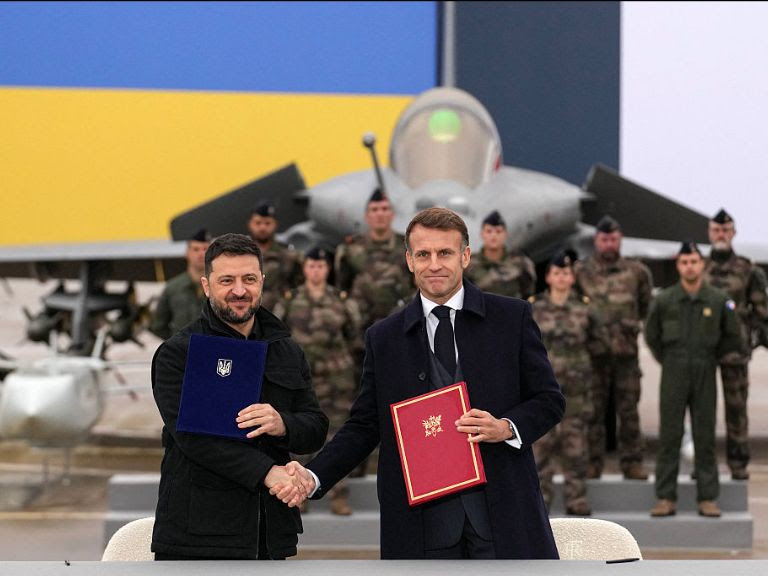
In a gesture thick with solidarity and quiet desperation, Ukraine’s President Volodymyr Zelensky (L) clasps the hand of France’s Emmanuel Macron (R) after signing a crucial arms agreement—a fragile promise of survival for a nation under siege. (Christophe Ena / POOL / AFP / Getty Images)
President Zelensky stepped off the plane at Villacoublay air base near Paris into cold November air and a reception that felt like the opening act of a strategic realignment. French President Emmanuel Macron waited on the tarmac, and beside him sat the hardware that would reshape Ukraine’s air war: Rafale fighter jets and SAMP/T air defense systems.
By evening, the two presidents had signed a declaration that one called “truly historic.” Ukraine would purchase one hundred Rafale F4 aircraft by 2035—fourth-generation fighters that represented some of Europe’s most advanced aviation technology. Eight SAMP/T systems would follow, each battery comprising six launchers capable of intercepting ballistic missiles. Radars, air-to-air missiles, aerial bombs, and technology transfers for joint production would round out the package.
The Rafale was more than a fighter. It was a symbol of European commitment to a war that had long since stopped being Ukraine’s alone. Macron emphasized the point during the press conference afterward, speaking of pressure that must be maintained on Russia and support that cannot weaken.
“I hope that peace will be achieved by 2027,” he said. “And I believe that the past months have been marked by decisions that have become real turning points.”
The timeline mattered. 2027 was the horizon where hope and planning converged—far enough away to be realistic, close enough to sustain morale. But everyone in the room knew the calculation: Ukraine needed the jets not for peace, but for the war that would determine whether peace was possible at all.
The SAMP/T systems carried particular weight. Only two air defense platforms could reliably intercept Russian ballistic missiles: American-made Patriots and French-Italian SAMP/T batteries. Kyiv already operated one SAMP/T system. Eight more would create a defensive network capable of protecting major cities and critical infrastructure from the missile barrages that had plunged Ukraine into darkness repeatedly over the past three winters.
Macron clarified that the agreement included next-generation SAMP/T systems still in development. Ukraine would receive the first deployed versions—effectively becoming a testing ground for technology that hadn’t yet reached full operational capability. The risk was clear, but so was the need.
Beyond the hardware, the deal included joint production initiatives. Ukrainian and French defense industries would collaborate on interceptor drones, with component development beginning in 2025. Paris also pledged a new aid package before year’s end.
For Zelensky, the trip was part of a broader European tour designed to shore up support as winter approached and Russian strikes intensified. He had visited Greece the day before to secure new gas supply routes. Spain would follow, with more air defense deals expected.
The Rafale agreement underscored a larger reality: Ukraine was building an air force not for the war it was fighting, but for the wars it expected to fight in the decade ahead. The F-16s from Denmark and the Netherlands had arrived. The Gripens from Sweden were contracted. Now the Rafales would join them, creating a mixed fleet of Western fighters that could challenge Russian air superiority for the first time since 2022.
Macron’s parting message carried an edge of warning. The past months had seen decisions that changed the war’s trajectory, he said. But those decisions required follow-through. Weakening now, backing away from support, would undo the turning points he had referenced.
Zelensky flew out that evening knowing that the declaration in his briefcase was both a promise and a test. The jets would come. The missiles would be delivered. Whether they arrived in time to matter was another question entirely.
The Money Running Out
In a conference room in Kyiv, an International Monetary Fund team sat down with Ukrainian finance officials to discuss a problem that would have seemed impossible three years earlier: Ukraine was running out of other people’s money.
The country’s own tax revenues—every hryvnia collected—went entirely to the military. The draft budget for 2026 allocated $62.8 billion to defense, consuming everything Ukraine could generate domestically. Everything else—pensions, schools, hospitals, civil servants, infrastructure—depended on foreign financing. And that financing was about to fall off a cliff.
Ukraine needed $61 billion to balance its books in 2026 and 2027. The current IMF program, approved when everyone still believed the war would be over by 2026, was expiring. Of the $15 billion committed, $10.6 billion had been disbursed. What came next depended on negotiations that had only just begun.
“The current IMF program was implemented on the back of expectations that the war would be over by 2026,” explained Serhiy Fursa, deputy managing director at Dragon Capital. “Now we know that this won’t happen. Ukraine needs much more financing, including a new IMF program.”
The new program under discussion would reportedly be worth $8 billion spread over 2026-2029—helpful, but nowhere near sufficient to close the gap. The real problem was structural: the IMF only lends to countries that can credibly maintain sustainable debt levels. For Ukraine, that meant proving that other donors would fill the remaining $53 billion hole.
Europe had already failed one critical test. The elaborate plan to use frozen Russian central bank reserves as collateral for a 140-billion-euro “reparations loan” had collapsed when European countries declined to back it. Without that commitment, the IMF couldn’t approve new financing. The board wouldn’t sign off on loans to a country whose debt trajectory pointed toward default.
So, the negotiations taking place in Kyiv focused not on immediate approval, but on what a future program could look like once external funding was secured. The IMF team, led by Ukraine representative Priscilla Toffano, outlined expectations: economic policy objectives, structural reforms to strengthen governance, efforts to combat corruption, measures to enhance growth.
The subtext was clear: Ukraine needed to become more efficient at squeezing revenue from its own economy. The IMF encouraged “deshadowing” the economy—forcing businesses operating in gray markets into the formal tax system. Customs reform was another priority, eliminating the corruption that let goods cross borders without proper duties being paid.
Finance Minister Serhii Marchenko framed the talks positively, emphasizing that “the new program will help meet Ukraine’s budgetary needs in the medium term and support the implementation of structural reforms aimed at economic recovery and European integration.”
But the reality was harsher. Ukraine was approaching a moment where the gap between what it needed and what donors would provide might become unbridgeable. Every month of war consumed billions in revenue that could never be recovered. Every missile strike on infrastructure destroyed tax-generating capacity. Every displaced person reduced the labor force and domestic consumption.
The IMF negotiations were taking place against a ticking clock. If Europe couldn’t deliver concrete funding commitments soon, the program would stall. And if the program stalled, the entire edifice of international support—bilateral aid, World Bank loans, EU assistance—might begin to crack.
For Ukrainian officials sitting across the table from IMF economists, the message was unavoidable: the war wasn’t just being fought on battlefields. It was being fought in spreadsheets and budget projections, in negotiations over decimal points and debt-to-GDP ratios. And if Ukraine lost that fight, the soldiers in Pokrovsk and Zaporizhzhia would find themselves without ammunition, fuel, or salaries.
The IMF team would return to Washington with proposals and projections. Ukraine would continue lobbying Europe for the commitments that might unlock IMF approval. And in the background, the $61 billion gap kept growing with every day the war continued.
Sabotage on the Warsaw-Lublin Line
The explosion tore through the railway track in the early hours of November 16, ripping steel from concrete and severing one of Poland’s most critical supply routes to Ukraine. A train driver noticed the damage first—twisted rails, scorched ground, the unmistakable signature of a carefully placed explosive device.
By November 17, Polish Prime Minister Donald Tusk had seen enough to call it what it was: “An unprecedented act of sabotage aimed at the security of the Polish state and its citizens.”
The blast occurred near the village of Mika in Masovian province, about 130 kilometers from the Ukrainian border. Investigators found additional damage further along the same route, suggesting coordinated strikes meant to cripple the line for days or weeks. The Warsaw-Lublin railway was not just infrastructure—it was a lifeline, carrying Western military aid, humanitarian supplies, and equipment that kept Ukraine’s defense functioning.
Polish authorities had not yet attributed the attack to a specific actor, but the context left little doubt. Warsaw had been raising alarms for months about mounting sabotage operations linked to Russian and Belarusian intelligence services. Fires in warehouses. Drones crossing borders. Cyberattacks on critical systems. The railway explosion fit the pattern perfectly.
Investigative journalist Christo Grozev published images showing a 300-meter electrical cable laid across another section of track near Warsaw, leading to a parking lot where a saboteur could remotely detonate explosives without being present when the blast occurred. Whether that incident connected to the Lublin-Warsaw attack remained unclear, but the method—remote detonation, strategic targeting, minimal forensic evidence—spoke to professional tradecraft.
Tusk didn’t wait for formal attribution. In a recent interview, he had warned that Russia was already waging a sophisticated hybrid war against Europe, maintaining “a fifth column” aimed at dividing societies and destabilizing NATO’s eastern flank. The railway sabotage, he argued, was part of that campaign—an attempt to sever the logistics that sustained Ukraine’s defense and signal to Europe that supporting Kyiv carried costs.
“Russia is already waging war against the West,” he said. The conflict wasn’t hypothetical or future-tense. It was happening now, in parking lots and power grids and railway lines across Poland and beyond.
For Ukraine, the explosion carried immediate implications. Every delay in deliveries meant fewer shells reaching artillery units, fewer drones reaching reconnaissance teams, fewer spare parts keeping aging equipment operational. The Warsaw-Lublin line was one artery in a larger network, but disrupting it created ripple effects that reached all the way to the trenches around Pokrovsk.
Polish repair crews worked through the day and night, welding new rails and testing tracks for additional sabotage. Security patrols increased. The message from Warsaw was defiant: the line would reopen, the deliveries would continue, and whoever planted the explosives had underestimated Poland’s resolve.
But the attack had achieved its purpose. It had shown that Russia’s reach extended deep into NATO territory, that no supply line was truly safe, and that the war’s front lines were no longer confined to Ukrainian soil.
Tusk’s final comment in the interview captured the stakes: “Poland’s geopolitical future will look really good if Ukraine does not lose the war. If it loses, Poland’s situation will change radically for the worse.”
The sabotage on the Warsaw-Lublin line was not just an attack on infrastructure. It was an attack on that future.
Strike on Balakliia
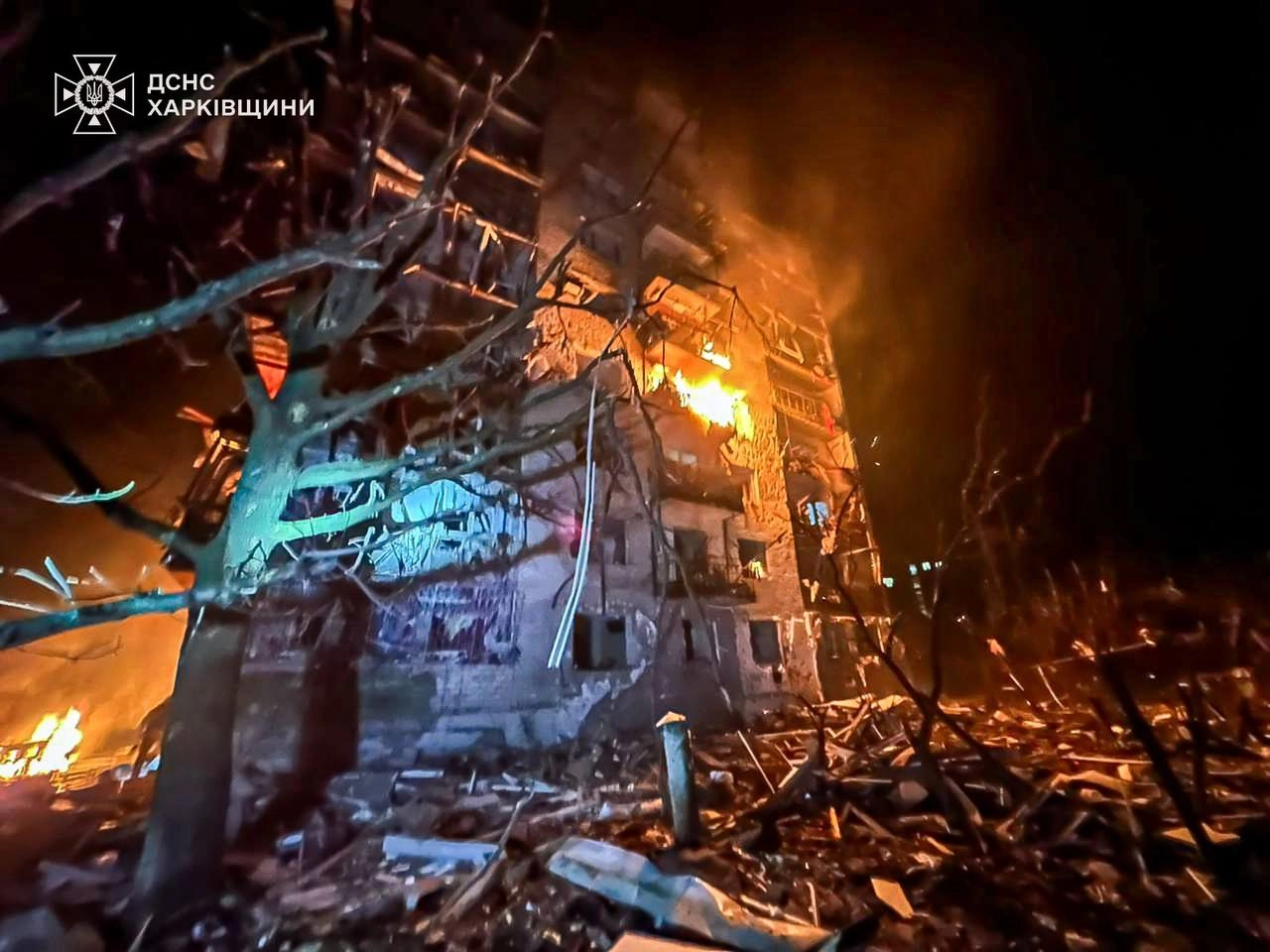
Residential building ablaze following Russian missile strike in Balakliya. (Photo by The State Emergency Service of Ukraine/Telegram)
The missiles came in the early hours of November 18, tearing through the pre-dawn darkness over Balakliia, a town in northeastern Kharkiv Oblast that had survived three years of war only to find itself targeted again.
The first missile hit a densely populated residential area. Fire erupted instantly—a private home consumed in seconds, balconies torn from apartment blocks, cars igniting in their parking spaces. Emergency services arrived within minutes, but the damage was already catastrophic. Three people dead. Fifteen wounded, including four children—a fourteen-year-old, a twelve-year-old, and two others whose names officials had not yet released.
The strike damaged seven apartment buildings, some nine stories tall, others five. A kindergarten took shrapnel, its windows blown out, walls scarred by debris. Then the second missile fell, hitting the same area again, a deliberate double-tap meant to kill first responders and maximize casualties. Two more nine-story buildings were damaged.
A sixty-one-year-old man was among those hospitalized, his injuries severe enough that doctors gave no prognosis. The children’s conditions were not disclosed, but the fact that they were wounded in a missile strike on a residential neighborhood said everything about the nature of the war Russia was waging.
Balakliia had no military significance that would justify the strike. It was a civilian town, far enough from the front lines that residents had begun to believe the worst was behind them. The missiles proved otherwise. Russia’s targeting patterns had long since abandoned any pretense of military necessity. The goal was terror—to make every Ukrainian city feel the war’s reach, to turn daily life into a gamble where survival depended on luck.
The strike came one night after another massive Russian assault—176 drones and missiles launched across fourteen Ukrainian regions, killing four civilians and injuring dozens more. Ukrainian air defenses intercepted 139 of the drones, but the numbers didn’t capture the exhaustion of trying to sleep while sirens wailed, or the constant calculation of whether to shelter in place or risk the streets.
In Balakliia, emergency crews worked through the morning extinguishing fires and pulling survivors from rubble. The town would bury its dead, repair what could be repaired, and wait for the next strike. The rhythm had become routine—not normal, but familiar. The only question was when, not if.
Russia’s message was clear: no town was safe, no neighborhood was off-limits, and the price of Ukrainian resistance would be paid in blood and fire until the nation broke or the war ended.
The Kremlin’s Civil War
Behind the front lines, beyond the artillery and the burning cities, a different kind of collapse was accelerating. Russia’s power structure—the network of officials, security services, and oligarchs that had sustained Vladimir Putin’s regime for two decades—was tearing itself apart.
Two factions waged a silent war inside Moscow’s corridors of power. One used raids, arrests, and intimidation to seize budgets and suppress rivals. The other employed audits, asset seizures, and legal pressure to expand influence and accumulate wealth. Both sides drew from the same pool of security services, prosecutors, and financial investigators. Both claimed to serve Putin. And both were hollowing out the state’s capacity to sustain the war effort.
The evidence was everywhere. Ukrainian drone strikes on refineries triggered internal investigations not into how the drones penetrated defenses, but into which faction should be blamed for the failures. Military commanders hesitated to move supplies because competing networks of corruption meant any decision could trigger a purge. Bureaucrats delayed critical paperwork, fearful that signing the wrong document would make them targets in the next round of arrests.
Tanks guarding Moscow streets revealed the depth of the paranoia. The regime wasn’t protecting itself from protests or foreign threats. It was guarding against its own security services and power brokers. The elite war had reached a point where trust had evaporated completely, where every official suspected every other official of plotting, and where the only certainty was that the next purge was coming.
The paralysis extended to the battlefield. Russian forces struggled to replace losses because recruitment offices answered to different power networks, each extracting bribes and protection payments that reduced the number of actual soldiers reaching the front. Defense industrial plants operated at partial capacity because competing factions controlled supply chains and used them as leverage in internal negotiations. Even battlefield intelligence became weaponized—shared selectively, withheld strategically, manipulated to settle scores in Moscow.
Ukrainian intelligence had documented some of the internal chaos, intercepting communications that revealed the scale of the infighting. But the details mattered less than the overall pattern: Russia’s regime was consuming itself, spending energy on internal conflicts that should have been directed toward the war.
The irony was perfect. Putin had built a system where loyalty mattered more than competence, where patronage networks determined success, and where fear kept everyone in line. That system had worked for decades because the threats were external or imaginary. But now, with the war grinding into its fourth year and no victory in sight, the internal contradictions had metastasized into open warfare between the very institutions meant to protect the state.
Every Ukrainian strike on a refinery didn’t just damage infrastructure—it triggered another round of arrests and purges inside Moscow’s security apparatus. Every military failure spawned another investigation into who was stealing, who was leaking, who was planning a coup. The Kremlin’s civil war had become Russia’s second front, and unlike the front in Ukraine, this one had no clear battle lines and no possibility of victory.
By November 17, Western intelligence agencies were watching the internal collapse with a mix of satisfaction and concern. Satisfaction because it revealed vulnerabilities they could exploit. Concern because a Russia tearing itself apart was unpredictable, potentially more dangerous than a Russia operating under unified command.
For Ukraine, the Kremlin’s infighting offered a sliver of hope. Every day Moscow spent investigating its own officials was a day it wasn’t strengthening defenses. Every purge that weakened a power network weakened the war machine. The question was whether the internal collapse would accelerate fast enough to matter before Russia’s sheer mass ground Ukraine into exhaustion.
The answer remained unclear. But one thing was certain: the war Vladimir Putin had started was now devouring the regime he had built to sustain it.
The Corruption That Won’t Stay Buried
While Russian forces ground forward on the front lines, a different kind of battle consumed attention in Kyiv: the unraveling of a massive corruption scheme at Energoatom, Ukraine’s state nuclear power company. And on November 17, a parliamentary commission made clear that the rot extended deep into the law enforcement agencies supposedly investigating it.
The case centered on Timur Mindich, a businessman with close ties to President Zelensky, who stood accused of orchestrating a $100 million money laundering scheme in the energy sector. The National Anti-Corruption Bureau had charged eight suspects with bribery, embezzlement, and illicit enrichment. But the investigation had revealed something more troubling than individual criminality: systematic complicity by the very institutions meant to fight corruption.
At a parliamentary meeting, lawmakers lambasted representatives from multiple law enforcement agencies for failing to investigate their own employees’ alleged involvement in the scheme. The message from Anastasia Radina, head of parliament’s anti-corruption committee, was blunt: “A lack of responses or a response like ‘the probe will be completed in half a year’ will be considered as complicity not only by lawmakers but also by society.”
The leaked audio tapes were damning. In recorded conversations, suspects discussed bribing officials from the State Investigation Bureau, the Security Service of Ukraine, and the Prosecutor General’s Office. One suspect, Ihor Myroniuk, could be heard referencing these agencies by location and nickname: “The train station and the Service and Riznytska will join in, and they’ll start fabricating cases.”
In other recordings, Mindich himself mentioned arrangements about money with prosecutors and security services. The suspects discussed how they had “close ties” with Investigation Bureau leadership and were receiving information on criminal investigations in real time—the kind of access that could only come from inside collaboration.
Chief Anti-Corruption Prosecutor Oleksandr Klymenko revealed that his office had documented several leaks over fifteen months—information flowing from inside the Anti-Corruption Bureau and the Specialized Anti-Corruption Prosecutor’s Office to the very suspects they were investigating. One of Klymenko’s own deputies, Andriy Synyuk, was under investigation for allegedly tipping off Mindich about planned searches, giving him time to flee the country.
Video footage published by Ukrainska Pravda showed Synyuk meeting with a lawyer who had visited Mindich’s apartment building during the same period. Synyuk denied everything, but the optics were catastrophic.
The State Investigation Bureau’s response at the parliamentary meeting was particularly revealing. Bohdan Chobitok, head of the bureau’s audit department, confirmed that an internal probe and criminal case had been opened into alleged bribery and abuse of power. But no one had been identified or suspended. No timeline existed for completing the investigation.
Deputy Prosecutor General Oleksiy Khomenko went further, stating there was no internal probe at all into prosecutors’ possible participation. “I believe that any internal probe or criminal investigation would be premature until a person is charged,” he said—a position that effectively guaranteed no one would be charged, since investigating requires evidence that can only be gathered through probing.
The Security Service of Ukraine faced particularly sharp criticism for failing to address national security threats embedded in the scheme. Suspects were linked to Andrii Derkach, a former Ukrainian lawmaker now serving as a Russian senator after fleeing Ukraine on treason charges. Intercepted communications suggested suspects had transferred $2 million to Moscow. One investigation indicated that Mindich had owned a stake in a Russian diamond producer until 2024—well into the full-scale invasion.
The SBU’s chief of staff, Oleh Holovash, claimed the service was investigating but couldn’t disclose investigative secrets. The explanation satisfied no one.
Perhaps most troubling was the State Financial Monitoring Service’s apparent inability to track suspicious cash flows. The Anti-Corruption Bureau’s chief, Semen Kryvonos, revealed at the meeting that his agency had been having problems obtaining information on cash flows linked to defense procurement—specifically transactions connected to Fire Point, the drone and missile manufacturer.
The connections formed a web too complex to untangle in a single hearing: Mindich allegedly linked to Energoatom corruption and Fire Point, Fire Point linked to defense procurement and international fundraising, and law enforcement agencies either unable or unwilling to investigate any of it effectively.
For ordinary Ukrainians watching the parliamentary commission, the message was corrosive: the institutions meant to fight corruption were themselves corrupted. The security services meant to protect national interests were compromised by the same networks they should have been dismantling. And the system’s response to being exposed was not accountability, but delay, denial, and deflection.
The commission ended without resolution. Law enforcement representatives returned to their offices. The suspects remained at large or under minimal restrictions. And the war continued, draining resources into a system where billions could disappear while investigators protected the thieves.
Anastasia Radina’s warning hung in the air: silence was complicity. But in Ukraine’s war against corruption, silence seemed to be winning.
The Pokrovsk Pocket
Russian forces were attempting to encircle Pokrovsk from two directions, but the operation was faltering for a reason that would have been predictable in any competent military: they were trying to do too many things at once.
Elements of the 2nd Combined Arms Army attacked from the southwest, attempting to cut Ukrainian supply lines while simultaneously pushing into Pokrovsk itself and advancing north toward Myrnohrad. Elements of the 51st Combined Arms Army attacked from the northeast, trying to close the encirclement from the opposite direction while also defending against Ukrainian counterattacks near Dobropillya.
Neither army could concentrate sufficient force to complete its mission. The 51st CAA had overextended itself months earlier during an August offensive toward Dobropillya—a push timed to create the appearance of significant gains ahead of diplomatic talks. The offensive created a salient too narrow to sustain stable logistics, leaving Russian positions vulnerable to the exact Ukrainian counterattacks now threatening their eastern flank around Pokrovsk.
Meanwhile, the 2nd CAA had made faster progress infiltrating Pokrovsk but lacked the mass to clear Ukrainian defenders from the northern sections of the city. Small Russian infantry groups operated under conditions of sub-tactical encirclement—cut off from support, surviving on ammunition they carried in, fighting block by block against Ukrainian forces who knew every street.
The result was a stalemate at operational scale. Russian forces had seized parts of Pokrovsk, but not the city. They had threatened encirclement but not achieved it. And every day the pocket remained open was another day Ukrainian forces could withdraw equipment, rotate exhausted units, and prepare defensive lines further west.
Ukrainian military observer Kostyantyn Mashovets assessed that Russian commanders were attempting to fix Ukrainian forces inside Pokrovsk and Myrnohrad to prevent an orderly withdrawal. If Ukrainian troops retreated before the encirclement closed, the seizure of Pokrovsk would lose its operational significance—another Pyrrhic victory, expensive in blood and meaningless in outcome.
Russian forces had taken staggering losses in the Pokrovsk direction—some of the highest casualty rates on the entire front. The 51st and 2nd Combined Arms Armies were likely degraded, their combat power diminished by months of grinding assaults against prepared defenses. Yet they continued attacking, driven by a command structure that measured success in kilometers taken rather than sustainable control.
The fog had helped. Russian forces had used inclement weather to transport troops in vehicles, moving larger groups into contested areas when Ukrainian drones couldn’t see them. But once the weather cleared, the advantage evaporated. Drones returned to the skies. Precision strikes resumed. And the Russian forces inside Pokrovsk found themselves trapped in the same urban kill zone that had consumed so many assault groups before them.
Western analysts assessed that Russian forces would very likely complete the seizure of Pokrovsk and Myrnohrad eventually. The timing and operational implications remained unclear, but the math favored the attacker willing to accept unlimited casualties. Russia had demonstrated that willingness repeatedly. Whether it could maintain it indefinitely was another question.
For Ukrainian defenders, the calculation was simpler: hold as long as possible without being encircled, withdraw before the pocket closes, bleed the Russians for every meter, and pray that Moscow’s civil war accelerates faster than its advance.
What November 17 Revealed
The day’s contradictions lay bare like shrapnel on a street. Russia advanced on fog-shrouded fields near Pokrovsk and Zaporizhzhia, grinding forward through Ukrainian defenses that bent but refused to break. Yet the same Russian air force that struck Balakliia with lethal precision dropped eight glide bombs on Belgorod—its own territory, its own people—because guidance systems failed and no one in the chain of command seemed capable of fixing the problem.
Ukraine withdrew from villages it could no longer defend, pulling back from Uspenivka and Novomykolaivka while Russian assault groups planted flags in the mud. But those same Ukrainian forces struck a thermal power plant in occupied Donetsk, hit refineries across Russia’s interior, and watched as Moscow’s oil prices collapsed under the weight of sanctions and buyer boycotts. Tactical retreat paired with strategic reach—the war’s essential paradox made visible in a single day’s operations.
In Paris, President Zelensky signed a deal for one hundred Rafale fighter jets that wouldn’t arrive for years. In Prague, donors raised money for two Flamingo missiles in less than two days. In Poland, saboteurs blew up a railway line carrying Western aid to Ukraine, proving that Russia’s hybrid war extended deep into NATO territory. And in Moscow, two elite factions waged a civil war inside the Kremlin that was as damaging to Russia’s war effort as any Ukrainian strike.
The numbers told part of the story. Russia was losing more soldiers each month than it could recruit. Its industrial base was shutting down plants because demand had collapsed and imports undercut domestic production. Its oil sold at the steepest discount in years, with major buyers in India and China refusing new purchases. The regime was burning through reserves—financial, military, human—at a rate that suggested the question was not whether Russia could sustain the war indefinitely, but how long before the collapse became visible to everyone.
Yet Russia still advanced. Still launched missiles. Still dropped glide bombs—on Ukraine and on itself. The war had entered a phase where both sides were exhausted, where momentum came from inertia rather than strategy, and where the outcome would be determined not by who fought better but by who could endure longer.
November 17 revealed that endurance had become its own kind of warfare. Ukraine endured Russian advances by withdrawing strategically rather than being encircled. Russia endured economic strangulation by finding new buyers and accepting steeper discounts. Europe endured sabotage by rebuilding railways and increasing patrols. And all of them endured the grinding certainty that the war would continue through another winter, another spring, another year of calculated destruction.
Serhii Sternenko’s warning echoed across the day’s events: “Our defense is falling apart under a stunning silence about it.” But so was Russia’s. The difference was that Ukraine’s fractures were visible—broadcast by activists, reported by journalists, debated in parliament. Russia’s fractures were hidden behind purges and propaganda, visible only in intercepted calls and Western intelligence assessments.
The question was which kind of collapse would come first: the visible kind that could be addressed, or the invisible kind that metastasized in silence until the entire structure gave way.
By nightfall, Ukrainian defenders had dug new trenches along the same lines they’d held for months. Russian forces counted their gains in meters while Moscow counted its losses in billions. And somewhere between those two calculations, the war kept grinding forward, waiting for the day when endurance finally ran out.