
As Trump’s envoys draft surrender terms without Ukraine’s consent, 476 drones and 48 missiles prove what history already taught—appeasement doesn’t stop dictators, it only delays their next conquest.
The Day’s Reckoning
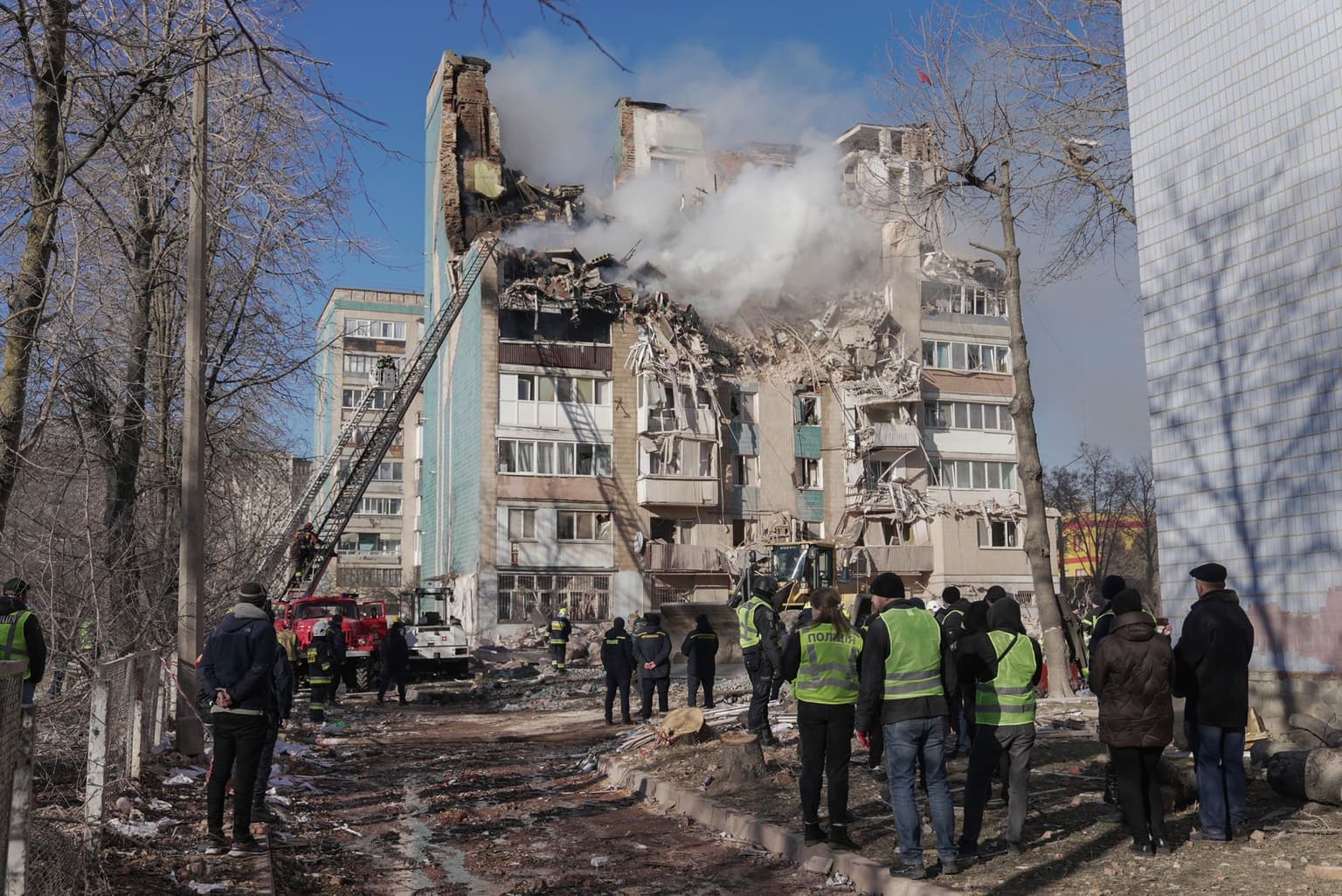
Picture a nine-story apartment building in Ternopil at 2:47 a.m. The Kh-101 cruise missile—launched from a strategic bomber circling somewhere over Vologda Oblast, 1,200 kilometers away—struck with such precision that floors three through nine simply ceased to exist as separate entities. They collapsed into each other like a deck of cards, trapping families in pockets of crushed concrete while flames climbed the walls. Some residents, Interior Minister Ihor Klymenko would later reveal, leaped from high windows to escape the inferno. Nineteen people died in the fire alone.
This was November 19, 2024—the 1,365th day of a war that has learned to disguise its brutality as routine. Russia launched 476 drones and 48 missiles at Ukraine in a single night, the largest combined assault in weeks. Ukrainian air defenses intercepted 442 drones and 41 missiles, but the mathematics of survival meant that 34 drones and 7 missiles still found their marks. They killed at least 26 civilians, injured 141 others, and carved fresh scars across cities located more than 500 kilometers from any front line. Ternopil. Kharkiv. Lviv. Ivano-Frankivsk. Places where the war was supposed to be distant, theoretical, survivable.
Yet even as rescue workers dug through rubble and doctors treated shrapnel wounds, a different kind of devastation unfolded in the marble corridors of power. American and Russian officials, meeting secretly in Miami and communicating through encrypted channels, had drafted a 28-point peace plan that would require Ukraine to surrender the very territories it has bled to defend. The proposal—confirmed by multiple Western outlets but denied by key Kremlin officials—would cap Ukraine’s military at half its current strength, prohibit foreign weapons capable of striking deep into Russia, and create a demilitarized zone in Donbas built from Ukrainian withdrawals. In exchange, Ukraine would receive unspecified security guarantees that history suggests are worth less than the paper they’re written on.
It was Munich 1938 all over again, except this time the betrayal came with American accents. British Prime Minister Neville Chamberlain had forced Czechoslovakia to surrender the Sudetenland to Hitler without Czech participation in the negotiations, declaring “peace for our time” while condemning a democracy to dismemberment. Six months later, Germany seized the rest of Czechoslovakia anyway. The “guarantees” Chamberlain had promised became historical footnotes to conquest. Now, 87 years later, Trump’s envoys were drafting nearly identical terms—forcing Ukraine to cede territory, disarm, and accept worthless “security guarantees” while Russia rebuilt for its next invasion. History doesn’t repeat, but it rhymes with the cadence of cowardice.
The contradiction could not be starker: missiles falling on apartment buildings while diplomats draft surrender terms. Bodies pulled from fire-blackened ruins while negotiators discuss territorial concessions. A nation fighting for survival while its supposed allies calculate the acceptable cost of abandonment.
By dawn, Ternopil’s air quality had degraded to six times normal levels from the chemical smoke. Twenty-six people remained missing beneath the rubble. And somewhere in the corridors of the Kremlin and the White House, officials continued discussing peace plans that would give Russia what it could never take by force—legitimacy for conquest, a road map for future aggression, and proof that terror, given enough time, wears down even the strongest resolve.
The Midnight Barrage: When Quantity Becomes Its Own Weapon
The attack began with the hum. Residents of Kyiv who have survived nearly three years of war know the sound intimately—the distant, persistent drone of Shahed engines approaching like a swarm of mechanical wasps. Around midnight, air raid sirens wailed across eighteen oblasts. Ukrainian radar operators watched their screens fill with hostile contacts: 476 drones launching from Kursk, Oryol, Bryansk, Millerovo, and occupied Crimea. Behind them came the heavy missiles—40 Kh-101 cruise missiles, 7 Kalibrs, 1 Iskander-M ballistic missile—each capable of leveling a city block.
Ukrainian F-16 and Mirage 2000 pilots scrambled into the darkness. Air defense batteries came alive, painting the sky with tracer fire and surface-to-air missiles. For hours, the battle raged in three dimensions—drones weaving through valleys to avoid detection, missiles streaking toward power stations and warehouses, interceptors hunting both while ground crews reloaded launchers as fast as humanly possible. Ukrainian defenders shot down 442 drones and 41 missiles, a success rate that would have seemed miraculous in any previous war.
But mathematics is a cruel arbiter. Seven missiles and 34 drones penetrated the defensive net, and each one carried enough explosive to rewrite lives. In Ternopil, that Kh-101 that struck the apartment building didn’t just kill—it erased. Entire families vanished in an instant. Interior Minister Klymenko walked through the aftermath and described burnt walls and apartments where “whole lives” had been destroyed. Residents had tried to escape by jumping from ninth-floor windows, choosing a quick death over burning alive.
In Kharkiv, 19 Geran-2 drones targeted the Slobidskyi and Osnovianskyi districts. Forty-six people were injured, including two girls aged 9 and 13. A high-rise residential building, a hospital, and a school all took damage. The drones came in low, skimming rooftops, each one carrying 40 kilograms of explosive and shrapnel designed to maximize human casualties.
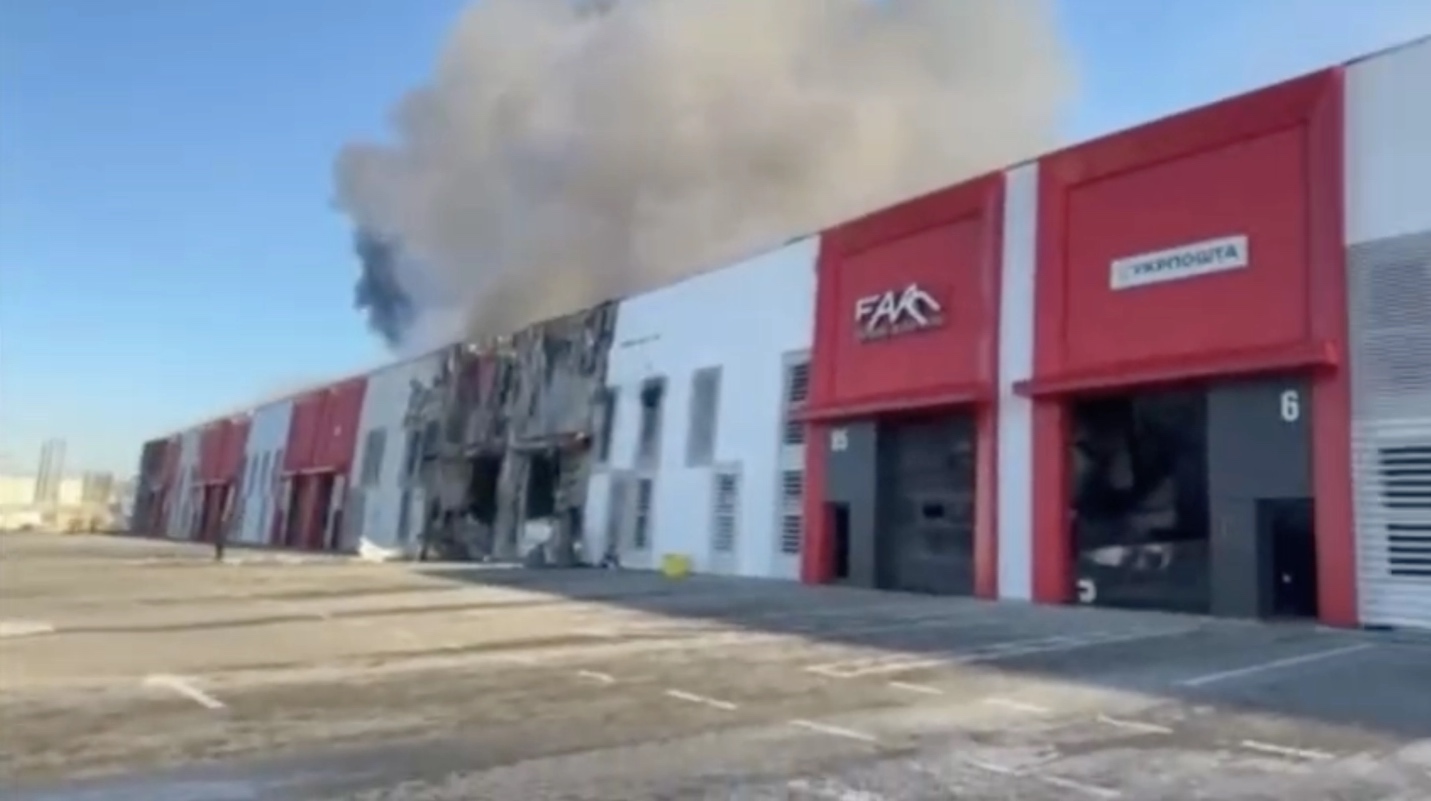
Across western Ukraine—Lviv, Ivano-Frankivsk, Khmelnytskyi—the pattern repeated. Energy infrastructure sparked and died. A thermal power plant operated by DTEK, Ukraine’s largest private energy company, suffered its fifth attack since October. A Ukrposhta postal facility in Lviv burned, destroying 900 parcels and the livelihoods they represented. In Lviv, a warehouse storing tires erupted into a toxic inferno, sending black smoke across the city and forcing residents to seal their windows against chemical fumes.
The strikes forced Ukraine to implement emergency power outages across multiple oblasts. Temperatures had dropped to -3°C overnight. Families huddled in darkness, burning what they could for warmth while wondering when—not if—the next wave would arrive.
Ukraine’s Energy Ministry confirmed what everyone already knew: Russia was attacking in waves, moving from east to center to west, systematically degrading the power grid to ensure another winter of suffering. Vitaly Zaichenko, head of Ukrenergo, warned that western regions would experience “load shedding” for the first time this autumn—controlled blackouts to prevent total grid collapse. The assault was smaller than October’s devastating strikes, but it was enough. Russia doesn’t need to destroy everything at once. It only needs to ensure nothing ever fully recovers.
By dawn, search and rescue teams were still pulling bodies from Ternopil’s rubble. Twenty-six people remained missing, presumed trapped in air pockets or crushed beyond recognition. Three days of mourning were declared. Entertainment events were canceled. Flags flew at half-mast. And across Ukraine, millions of people went to work, sent their children to school, and tried to pretend that normal life was still possible when death could arrive on wings at any moment without warning.
The Secret Peace: Chamberlain’s Ghost Walks Through Washington
While rescue workers in Ternopil sifted through ashes, a different kind of devastation was unfolding in luxury hotels and secured conference rooms thousands of kilometers away. The war’s most dangerous weapon wasn’t falling from the sky—it was being drafted in Microsoft Word, and it bore the unmistakable stench of Munich 1938.
American and Russian officials had been meeting secretly for weeks, crafting a 28-point peace proposal that historians would recognize instantly. Steve Witkoff—Trump’s Special Envoy with no foreign policy experience but deep loyalty to the president—had spent three days in Miami from October 24-26 “huddled” with Kirill Dmitriev, head of Russia’s sovereign wealth fund and a key Kremlin diplomat. They were negotiating Ukraine’s future without Ukrainian participation, exactly as Chamberlain and Hitler had negotiated Czechoslovakia’s future without Czech representatives at Munich.
The parallels were so precise they could have been copied from 1938 diplomatic cables. Chamberlain forced Czechoslovakia to surrender the Sudetenland—its industrial heartland and defensive mountain fortifications—to Hitler. Trump’s plan would force Ukraine to surrender Donetsk and Luhansk—its industrial heartland and defensive Fortress Belt. Chamberlain demanded Czechoslovakia reduce its military to make it incapable of future resistance. Trump’s plan would cap Ukraine’s military at 50 percent of current strength. Chamberlain prohibited Czechoslovakia from receiving weapons from France and Britain. Trump’s plan would prohibit Ukraine from receiving long-range weapons capable of striking Russia.
The details, leaked to Axios and other outlets, read like Russia’s wish list wrapped in the language of 1930s appeasement. Ukraine would withdraw from the unoccupied portions of Donetsk and Luhansk oblasts, ceding cities along its defensive Fortress Belt that Russia has failed to capture after a decade of trying. The Ukrainian military would be capped at 50 percent of current strength and prohibited from acquiring “key categories of weaponry”—effectively disarming while Russia rebuilds and rearms without restriction. No foreign troops could deploy to Ukraine. No foreign weapons capable of striking deep into Russian territory could be provided. Russian would become an official state language alongside Ukrainian. The Russian Orthodox Church-Moscow Patriarchate would receive official status within Ukraine.
In exchange, Ukraine would receive “security guarantees” from the United States. Czechoslovakia had received security guarantees too. Britain and France promised to defend Czech independence after Munich. Six months later, in March 1939, Germany seized the rest of Czechoslovakia. Britain and France did nothing. The guarantees weren’t worth the paper they were written on, just as Trump’s guarantees would prove equally worthless when Russia—rearmed and reconstituted—launched its next invasion.
The Institute for the Study of War pulled no punches in its analysis: this plan amounts to “Ukraine’s full capitulation” and would “set conditions for renewed Russian aggression.” Chamberlain’s capitulation had done the same. By surrendering the Sudetenland, Czechoslovakia lost its only defensible borders, its industrial capacity, and its ability to resist. By surrendering Donetsk, Ukraine would lose its main defensive line, critical industrial cities, and strategic positions that have cost Russia rivers of blood to approach. Hitler used his six-month reprieve to prepare for full conquest. Putin would do the same.
Dmitriev told reporters he felt “optimistic” because “the Russian position is really being heard” for the first time. Hitler had felt similarly optimistic after Munich, marveling at how easily Western leaders had abandoned their ally. Putin’s position—complete subjugation of Ukraine, permanent prohibition of NATO membership, severe military limitations, and effective veto power over Ukrainian domestic policy—was identical to Hitler’s position on Czechoslovakia: total domination disguised as reasonable compromise.
Meanwhile, Zelensky’s scheduled meeting with Witkoff in Turkey was abruptly canceled. The parallel to 1938 was exact: Czech President Edvard Beneš had desperately tried to participate in Munich negotiations. Chamberlain refused. The Czechs learned their fate from radio broadcasts, just as Zelensky was learning his from news leaks. Witkoff didn’t need to hear from Ukrainians—he’d already gotten his instructions from the Kremlin, just as Chamberlain had taken his from Hitler.
A White House official told Axios that Trump “believes that there is a chance to end this senseless war if flexibility is shown.” Chamberlain had used nearly identical language in 1938, speaking of “peace with honor” and “peace for our time” while returning from Munich with his worthless agreement. The official added that “the timing is good for this plan now” because of Russia’s “additional successes on the battlefield.” This too echoed Munich, where Chamberlain justified surrender by pointing to Germany’s military strength, ignoring that appeasement only made Germany stronger for the next war.
History offers a brutal judgment on Chamberlain. His name became synonymous with cowardice, weakness, and the catastrophic failure to stand against dictators when standing still mattered. “Appeasement” entered the lexicon as a term of contempt. Chamberlain’s umbrella became a symbol of willful blindness. He died believing he had prevented war; history remembers him as the man who guaranteed it by teaching Hitler that democracies would surrender rather than fight.
Trump was walking the same path, drafting the same betrayal, courting the same historical infamy. If he forced this surrender on Ukraine, history would remember Trump exactly as it remembers Chamberlain—as an ineffective, weak leader who chose temporary political convenience over the survival of democracy, who mistook a dictator’s tactical pause for genuine peace, and who guaranteed future wars by rewarding present aggression.
The cruel mathematics were clear: Russia was losing militarily but winning diplomatically. Its forces were advancing at footpace while suffering catastrophic losses. Yet American officials, eager to declare victory and move on, were drafting terms that would reward aggression, legitimize conquest, and guarantee future wars. They were repeating Chamberlain’s catastrophic mistake—mistaking Putin’s desperation for strength, Ukraine’s exhaustion for willingness to surrender, and appeasement for statesmanship.
History would remember November 19 for the missiles that fell on Ternopil. But it would also remember it as the day Trump’s administration began drafting America’s Munich moment—proof that even democracies that defeated Hitler can forget why they fought him.
Pokrovsk: The City That Bleeds Daily
In Pokrovsk, death wears civilian clothing. Russian soldiers infiltrating the ruined city have abandoned military uniforms in favor of jackets and jeans, transforming into ghosts that fire from windows where families once cooked breakfast. Ukrainian defenders from the 68th Jaeger Brigade described the new reality to Suspilne: they often identify the enemy only after firefights have already begun, because civilians don’t open fire on Ukrainian units—but Russian saboteurs dressed as civilians do.
This isn’t combat. It’s a war crime performed in broad daylight. The laws of armed conflict explicitly prohibit combatants from disguising themselves as civilians or wearing enemy uniforms. Such acts fall under “perfidy,” violations so severe they’re classified as war crimes under the Geneva Conventions. Yet Russian forces in Pokrovsk receive instructions to change clothes before entering the city, using Ukraine’s unwillingness to shoot civilians as a tactical advantage. The commander, callsign “Liutyi,” was blunt: “They have been changing clothes for a long time and receive instructions to do so.”
The Russian infiltration tactics reflect desperation disguised as innovation. After months of failed mechanized assaults that left burned-out tanks littering the approaches to Pokrovsk, Russian commanders shifted to small sabotage and reconnaissance groups—two or three men moving through fog or rain, exploiting weather that grounds Ukrainian drones. They avoid bringing heavy equipment into the city because, as Liutyi explained, “it is difficult to hide equipment from us. We will find it anyway and burn it.” On November 19, soldiers of the 68th Brigade demonstrated this by striking a Russian tank as it approached the city, turning it into a smoking monument to failed ambition.
But the infiltrators still complicate Ukrainian logistics. Russian forces have created a “kill zone” stretching 10-15 kilometers around Pokrovsk—an area where drone strikes and remote mining make vehicle movement suicidal. Ukrainian soldiers must cover this distance on foot, carrying supplies that used to arrive by truck. Robotic ground systems now deliver provisions to frontline positions because so much equipment has been destroyed by enemy drones. The commander was frank about the threat: “The enemy has brought many of its best crews here to work against us. The intensity of enemy drone strikes is so great that sometimes it is simply impossible to drive in.”
Inside Pokrovsk, Russian forces don’t hold solid lines—they move like rats through the ruins, setting up temporary positions in basements and blown-out apartments before Ukrainian counterstrikes force them to relocate. The city has become a three-dimensional battlefield where the front line exists on every floor of every building. Russia poured 150,000 troops into this sector—naval brigades, mechanized divisions, endless waves of infantry—yet their gains are measured in rooms, not neighborhoods.
Despite the pressure, Ukrainian interdiction efforts are working. Mined roads prevent Russian heavy equipment from entering. Artillery strikes target any vehicle spotted on the M-30 highway. Russian forces attempted to use heavy fog on November 10-11 to drive supplies into Pokrovsk from the south, and Russian milbloggers celebrated the footage—until Ukrainian guns found the convoy. The exposure cost Russia the ability to reliably conduct logistics with vehicles, forcing soldiers to transport supplies on foot in groups of two or three.
The siege of Pokrovsk has become Russia’s defining failure—a microcosm of the entire war. They can seize territory but cannot control it. They can infiltrate the city but cannot supply it. They can dress as civilians but cannot disguise the criminality of their methods. And every day they remain, Ukrainian defenders extract payment in blood, turning Pokrovsk into a grave that Russia keeps filling with its own soldiers while pretending each shovelful of dirt represents progress.
By nightfall on November 19, Pokrovsk remained what it was that morning—a city that sees no sunrise, hears no silence, and refuses to fall.
The Black Sea Burns Again: Neptune’s Long Reach
Five days after Ukrainian Neptune missiles struck Russia’s Black Sea port of Novorossiysk on November 14, the consequences were still rippling across global oil markets. Reuters reported on November 18 that the strike had delayed oil shipments by two to three days after damaging a jetty at the Sheskharis oil harbor—one of Moscow’s main crude export hubs. Novorossiysk and the neighboring Caspian Pipeline Consortium terminal together handle about one-fifth of Russia’s crude exports. Both halted operations immediately after the strike.
The numbers tell the story of Ukraine’s strategic reach. Russia exported 3.22 million tons of crude through Novorossiysk in October—about 760,000 barrels per day—generating revenue that funded the very missiles falling on Ternopil and Kharkiv. The Neptune strike didn’t just damage infrastructure; it attacked the financial engine sustaining Russia’s war effort. Reuters called it “the most damaging Ukrainian attack so far on Russia’s main Black Sea crude export infrastructure,” a designation that carries weight given Ukraine’s sustained campaign against Russia’s oil sector.
The Kremlin promised to “quickly restore exports,” but the reality was more complicated. Damaged jetties require specialized repairs. Global shipping companies become nervous when ports become combat zones. Insurance rates spike. Alternative routes must be found. Each day of delay costs Moscow millions in lost revenue and damages its reputation as a reliable energy supplier. The November 14 strike demonstrated what Ukrainian military planners have known for years: strategic effects don’t require occupying territory. Sometimes a well-placed missile does more damage than an entire offensive.
Novorossiysk wasn’t an isolated event—it was part of a pattern. On November 19, explosions rocked the Ilsky Oil Refinery in Ilsk, Krasnodar Krai. Russian social media users reported the blasts before officials could spin the narrative. Krasnodar Krai authorities eventually claimed that “Ukrainian drone debris” had damaged civilian infrastructure, using language that had become a dark comedy of euphemism. Debris from shot-down drones somehow always managed to strike exactly the targets Ukraine intended to hit—refineries, military installations, ammunition depots. The laws of physics apparently bend differently in Russian airspace.
The campaign against Russia’s oil infrastructure reflected Ukraine’s evolving strategy: if the front lines move slowly, change the calculus by attacking what makes those front lines possible. Every refinery fire reduces Russia’s fuel production. Every damaged export terminal cuts revenue. Every successful strike demonstrates that Ukraine possesses weapons capable of reaching deep into Russia’s industrial heartland, transforming the invader’s rear areas into contested space.
F-16 and Mirage 2000 fighters—jets that Ukraine fought for years to acquire—were proving their worth in unexpected ways. The Ukrainian Air Force announced on November 19 that these aircraft had intercepted over 1,300 air targets since August 2024, including at least 10 Russian cruise missiles during the previous night’s massive assault. The F-16s weren’t just defensive—they’d struck over 300 Russian ground targets, including command posts, drone control points, ammunition depots, and logistics nodes. The aircraft that skeptics claimed would arrive too late to matter were rewriting the geometry of the war.
Neptune missiles and F-16s shared a common characteristic: both represented Ukraine’s transition from Soviet-era equipment to Western systems designed for precision and range. Russia had invaded expecting to fight a post-Soviet military armed with leftover weapons and outdated tactics. Instead, it was fighting a hybrid force that combined Ukrainian ingenuity with Western technology, creating capabilities Moscow never anticipated and could barely counter.
As night fell on November 19, the flames at Ilsky Oil Refinery continued burning. Somewhere in the Black Sea, Ukrainian Neptune crews were already planning the next strike. And in the corridors of the Kremlin, officials were calculating how many more refineries they could afford to lose before the math of war turned definitively against them. The answer was probably fewer than they thought.
The Forgotten Fronts: Where Attrition Wears Many Faces
While Pokrovsk dominated headlines and Ternopil counted bodies, the war ground on across dozens of other locations where progress meant nothing more than survival. These weren’t the dramatic breakthroughs that fill news reports—they were the daily exchanges of artillery fire, drone strikes, and small-unit infiltrations that defined modern attrition warfare. Here, both sides bled for positions that would be footnotes in history if they were remembered at all.
In the Kupyansk direction, Russian forces launched repeated assaults but found themselves trapped by their own ambition. Ukrainian Joint Forces Spokesperson Colonel Viktor Trehubov reported on November 19 that Russian soldiers who had infiltrated northern Kupyansk were now cut off from supply lines, isolated in a city they could enter but couldn’t control. A Russian milblogger affiliated with the Northern Grouping of Forces revealed the human cost: over 300 Russian servicemembers killed since late September, with only 150-200 remaining in the city. The 112th Motorized Rifle Brigade sent 100 soldiers to attack as part of assault groups; 80 refused to fight. The 26th Motorized Rifle Regiment was at half strength with 200 servicemembers in the Hlushkivka area, of which only 100 were on frontlines.
These weren’t statistics—they were collapse dressed up as operations. Russian command continued preparing to deploy the 3rd Battalion of the 1432nd Motorized Rifle Regiment, but elements of the unit were already complaining that the road to the front was too dangerous. Ukrainian strikes and persistent harassment had turned logistics into a death sentence. The fog of war had lifted just enough to reveal the rot beneath: units refusing orders, commanders forcing infiltrations through natural gas pipelines that Ukrainian forces anticipated, and casualty rates that made tactical gains impossible to sustain.
North of Kupyansk in the Borova direction, Russian forces advanced north of Borivska-Andriivka, but geolocated footage also showed the Ghostly Spartans Drone Group striking Ukrainian ground lines of communication in central Borova. The battlefield air interdiction campaign was mutual—both sides attempting to strangle the other’s logistics while maintaining their own. In the Slovyansk-Lyman direction, Russian forces attacked near Lyman itself and a dozen surrounding settlements, but made no confirmed advances. Elements of the 3rd Motorized Rifle Division continued operating there, grinding forward through mud and mine fields for territorial gains measured in hundreds of meters.
The Siversk direction saw Russian infiltrations into central Siversk—geolocated footage confirmed Russian servicemembers in the town center—but these were reconnaissance missions, not seizures of terrain. Russian milbloggers claimed advances throughout southern Siversk, but a Kremlin-affiliated blogger admitted the truth: Russian forces hadn’t yet degraded Ukrainian defenses enough to actually capture the town. In the Kostyantynivka-Druzhkivka tactical area, Russian forces attacked near Chasiv Yar using small infantry groups, cars, and motorcycles. A Ukrainian brigade spokesperson noted that weather degraded both sides’ drone capabilities, but Russian tactical drones could reach from Chasiv Yar to Kostyantynivka while Ukrainian drones covered Chasiv Yar to Bakhmut. The implication was clear: range matters, and Russia’s fiber-optic drones were getting longer tethers and heavier payloads.
In the Novopavlivka direction, Russian forces infiltrated northern parts of the town, but Ukrainian forces struck Russian positions along Molodizhna Street. Russian milbloggers claimed advances along the T-04-28 highway, while other bloggers refuted claims that Russian forces had seized western and northern Novopavlivka. The truth lived somewhere in the disputed middle—Russian troops inside the town but unable to hold it, Ukrainian defenders striking back but unable to fully clear it. Southwest toward Velykomykhailivka, Russian forces attacked multiple settlements but made no confirmed advances. A Russian milblogger claimed they’d seized Tykhe, though no independent confirmation existed.
And in Zaporizhzhia Oblast’s Hulyaipole direction, Russian forces advanced west and southwest of Pryvillya while attacking at least a dozen settlements. The 114th Motorized Rifle Regiment continued pushing toward Hulyaipole itself while Russian drones struck civilian cars in Vozdvyzhivka, injuring two. It was the same pattern: creeping advances paid for with heavy casualties, artillery duels that produced more sound than progress, and a front line that moved like continental drift—slow, inexorable, catastrophic in aggregate but barely perceptible day to day.
Across all these fronts, the Ukrainian strategy remained consistent: defend where possible, withdraw when necessary, inflict maximum casualties, and preserve combat power for counterstrikes when opportunities emerged. Russia’s strategy was equally consistent: attack everywhere simultaneously, accept catastrophic losses, claim every meter gained as progress, and hope that Western resolve broke before Russian manpower ran out.
Neither strategy promised swift victory. Both guaranteed continued suffering. And on November 19, as soldiers sheltered in frozen trenches from Kharkiv to Kherson, the only certainty was that tomorrow would bring more of the same.
Kursk and Kharkiv: The Northern Stalemate
Russia’s offensive along Ukraine’s northern border had devolved into the military equivalent of motion without progress—attacks that produced sound and fury but little else. In Kursk and Sumy oblasts, Russian forces launched assaults near Kindrativka, Andriivka, and Yunakivka on November 18-19, but gained no confirmed ground. Ukrainian forces counterattacked near Oleksiivka and Varachyne, demonstrating that Russia couldn’t even secure the small tactical gains it managed to achieve.
The pattern reflected a deeper problem: Russia had committed significant forces to the northern axis months earlier, promising to create “defensible buffer zones” along the international border. Instead, it created kill zones where Russian soldiers died trying to advance through terrain Ukrainian defenders knew intimately. Artillery thudded back and forth across the line. Geran-2 drones struck unspecified targets in Sumy City. And units like the 51st and 56th Airborne Regiments rotated through, achieving nothing more permanent than their predecessors.
Northeast of Kharkiv City, Russian forces attacked near Synelnykove and Vovchansk but didn’t advance. A Russian milblogger claimed they’d targeted Kharkiv with Geran-2 drones, Molniya fixed-wing drones, and heavy fiber-optic drones over the past two weeks, turning residential areas into test ranges for new weapons. The strikes achieved terror but not military objectives—Ukrainian defenders remained in position, Ukrainian logistics continued flowing, and Ukrainian artillery kept answering.
In the Velykyi Burluk direction, Russian forces attacked near Khatnie, Odradne, Kamyanka, and Dvorichanske, trying to find weak points in Ukrainian lines that didn’t exist. A Russian milblogger affiliated with the Northern Grouping claimed that the 15th Motorized Rifle Regiment’s command was forcing servicemembers to infiltrate through the Aidar-Shebelinka natural gas pipeline near Lozova—a tactic Ukrainian forces anticipated so thoroughly that it amounted to suicide. The infiltrators were detected and repelled so consistently that even Russian military bloggers questioned the sanity of continuing the operations.
The northern fronts had become graveyards of ambition. Russia kept attacking because admitting failure would mean acknowledging that months of casualties had purchased nothing. Ukraine kept defending because letting Russia advance would threaten Kharkiv City itself—Ukraine’s second-largest city and an industrial hub the country couldn’t afford to lose. The result was mutual exhaustion punctuated by artillery exchanges, drone strikes, and small-unit actions that changed nothing except the body count.
By nightfall on November 19, the northern front looked exactly as it had at dawn. Russian forces were still attacking, Ukrainian forces were still defending, and both sides were still losing soldiers for terrain that would be contested again tomorrow. It was attrition in its purest form—war reduced to mathematics where the only victory lay in bleeding slightly slower than the enemy.
The Diplomatic Earthquake: When History’s Warnings Go Unheeded
The announcement came buried in Reuters reporting, but its implications were seismic: General Keith Kellogg, Trump’s Special Envoy for Ukraine, would step down in January. The White House confirmed it immediately, offering bland reassurances about natural term limits and Senate approval requirements. But timing tells truth, and Kellogg’s exit was scheduled for the exact moment Ukraine needed him most.
In 1938, British Foreign Secretary Anthony Eden had resigned in protest over Chamberlain’s appeasement policies toward Hitler and Mussolini. Eden understood what Chamberlain refused to see: dictators interpret compromise as weakness and concessions as invitations. His resignation was a warning that Britain’s government had lost its moral compass. Few listened. Now, 87 years later, Kellogg’s departure carried the same message. The one American official who understood that Putin operates by Hitler’s playbook was leaving exactly as Trump embraced Chamberlain’s catastrophic strategy.
Kellogg had been Ukraine’s strongest advocate in the Trump administration—a former general who understood military realities and refused to accept Kremlin talking points disguised as diplomacy. He negotiated the U.S.-Ukraine critical minerals deal, secured the release of political prisoners in Belarus, and condemned Russian attacks on Ukrainian cities in language that made Moscow uncomfortable. Ukrainian President Zelensky had even joked that Kellogg’s visits protected Kyiv as effectively as Patriot air defenses, a comment that revealed how much Ukraine valued having someone in Washington who actually cared whether they survived.
Now Kellogg was leaving, and his replacement—if there even was one—remained unknown. The timing coincided perfectly with Steve Witkoff’s ascendance and the emergence of the 28-point surrender plan drafted in consultation with Russian officials. Witkoff, a real estate mogul with no foreign policy experience but deep loyalty to Trump, had become Moscow’s preferred negotiator—much as Chamberlain had been Hitler’s preferred British counterpart because of his willingness to sacrifice allies for illusory peace. The Kremlin had reportedly objected to Kellogg’s involvement in peace talks, viewing him as “too pro-Ukrainian.” Hitler had made similar objections about Eden, correctly identifying him as someone who wouldn’t be bullied into betraying Britain’s commitments.
Ostap Yarysh from Razom for Ukraine captured the significance: Kellogg had been “crucial in building this bridge between Washington and Kyiv when it comes to President Trump’s peace efforts.” More importantly, Kellogg could see through “Russia’s delay tactics or other mechanisms that they use to prolong this war.” He understood that Moscow negotiated in bad faith, seeking concessions through diplomacy that it couldn’t win through combat—the same tactics Hitler had used with Chamberlain. Witkoff, by contrast, appeared to view negotiations as real estate deals where everyone compromises and walks away happy—a perspective that ignored the reality that Putin’s definition of compromise meant Ukraine’s complete subjugation, just as Hitler’s compromise had meant Czechoslovakia’s destruction.
The implications were already visible. Kellogg’s scheduled meeting with Zelensky in Turkey had been abruptly canceled—echoing how Chamberlain had refused to include Czech representatives at Munich. Witkoff was developing a peace plan that “aligns with Kremlin demands” according to multiple reports. Territorial concessions were back on the table. And Ukraine, facing its fourth winter at war, would soon lose the one American official who consistently fought for its interests in rooms where decisions got made.
The political crisis added another layer of instability. Inside Ukraine, corruption scandals were consuming government attention just when unity was most critical. Lawmakers from Zelensky’s own Servant of the People party were calling for a government of national unity, warning that the ongoing corruption investigation centered on state nuclear company Energoatom had created “a crisis of trust in key state institutions.” Justice Minister Herman Halushchenko and Energy Minister Svitlana Hrynchuk—both implicated in the scheme—had resigned and were subsequently dismissed by parliament on November 19.
The scandal’s ringleader, Timur Mindich, was a close associate of Zelensky himself. The president’s inner circle was being investigated for massive kickbacks involving energy contracts, nuclear fuel procurement, and exactly the kind of corruption that erodes Western support. Opposition parties were demanding that Zelensky’s Chief of Staff Andriy Yermak resign, arguing that the President’s Office had “monopolized state power” and created conditions for corruption to flourish. A meeting between Zelensky and his parliamentary faction was scheduled for November 20, and sources said the future of their relationship depended entirely on whether Yermak was fired.
It was the worst possible timing—domestic crisis meeting international betrayal. Czechoslovakia had faced similar internal challenges in 1938 as different political factions debated how to respond to Hitler’s demands. Chamberlain’s betrayal at Munich destroyed what little unity remained, leaving Czechoslovakia’s government paralyzed between resistance and capitulation. The same pattern was emerging in Kyiv: Trump’s peace plan was fracturing Ukrainian politics exactly when solidarity mattered most.
Ukraine was entering its most dangerous period since the war began. Russian attacks were intensifying. American diplomatic support was evaporating. Domestic political unity was fracturing. And the one American official who understood the stakes was walking away in January, leaving Ukraine to face Witkoff’s Munich-style peace plan—and Moscow’s Hitlerian demands—alone.
History reserves its harshest judgment for leaders who learn nothing from past catastrophes. Chamberlain at least had the excuse of not knowing how Munich would end—though Eden and Churchill warned him loudly enough. Trump has no such excuse. He can read about Munich in any history book. He can see how Chamberlain’s name became synonymous with weakness and failure. He can understand that appeasement doesn’t prevent wars—it guarantees them while making the eventual conflict more costly and more deadly.
Yet Trump was choosing to repeat Chamberlain’s mistake anyway, drafting the same betrayal, courting the same infamy. If he forced this surrender on Ukraine, history would judge him exactly as it judged Chamberlain: as an ineffective, weak leader who chose political convenience over principle, who mistook a dictator’s pause for peace, and who guaranteed future aggression by rewarding present conquest.
By evening on November 19, the diplomatic earthquake was still unfolding. The aftershocks would be felt for decades. And in Kyiv, officials who had built their strategies around American support were beginning to understand what abandonment looked like when it wore Chamberlain’s smile and promised “peace for our time.”
What November 19 Revealed
The day’s brutal arithmetic told competing stories. Russia launched 524 aerial weapons and killed 26 civilians, demonstrating unchanged capacity for terror. Yet Ukraine’s air defenses intercepted 91% of incoming threats while F-16s proved their worth with 1,300 targets downed since August. On battlefields from Pokrovsk to Kupyansk, Russian forces bled catastrophically for meter-by-meter gains their logistics couldn’t sustain. Militarily, Russia was losing. Diplomatically, it was winning—because Trump’s administration had chosen to repeat history’s most infamous mistake.
The day’s true revelation was the return of Munich 1938. While missiles fell on Ternopil, American and Russian officials finalized peace terms that Chamberlain would have recognized instantly: territorial concessions, military limitations, worthless security guarantees, and the complete absence of the victim nation from negotiations about its own fate. Keith Kellogg’s announced January resignation removes Ukraine’s strongest Washington advocate exactly as Steve Witkoff—Moscow’s preferred negotiator—ascends to draft surrender terms. The timing wasn’t accidental. It was Munich’s choreography repeated with American actors.
History offers brutal clarity about what happens next. Chamberlain forced Czechoslovakia to surrender the Sudetenland in September 1938, promising “peace for our time.” Six months later, Germany conquered the rest of Czechoslovakia. The peace had been an intermission, not an ending. The security guarantees were worthless. The appeasement had only taught Hitler that democracies would surrender rather than fight, guaranteeing the larger war Chamberlain thought he was preventing.
If Trump forces this peace on Ukraine, history will judge him exactly as it judged Chamberlain—as an ineffective, weak leader who mistook a dictator’s tactical pause for genuine compromise, who chose political convenience over democratic survival, and who guaranteed future wars by rewarding present aggression. Trump’s name will become synonymous with betrayal and failure, his legacy forever tied to the destruction that follows when democracies abandon their principles to appease tyrants. He will be remembered not for ending the war, but for ensuring its continuation under worse terms, with higher costs, and greater devastation.
The contradiction defines the moment: Ukraine demonstrates it can strike Russian refineries 1,200 kilometers away, defend against massive aerial assaults, and bleed Russian forces white in urban combat—yet Western allies draft surrender terms as if battlefield realities favor Moscow. Neptune missiles damage Novorossiysk’s oil infrastructure while diplomats discuss capping Ukraine’s military at half strength. The war endures not because peace is impossible, but because the peace Trump offers isn’t peace at all—it’s Munich, repackaged for a generation that forgot why we swore “never again.”