
As Russian forces tightened their grip on two more villages, the world negotiated Ukraine’s future—while Kyiv’s drones reminded Moscow that no factory, no matter how distant, was beyond reach.
The Day’s Reckoning
The explosions came first—at 2:40 a.m. in Cheboksary, eight hundred kilometers from the Ukrainian border, where residents woke to the sound of fire tearing through a weapons factory. Then came the diplomatic cables from Brussels, the IMF announcements from Washington, the NATO declarations from Madrid. And finally, by afternoon, the confirmation that two more villages had fallen: Promin in Donetsk, Vysoke in Zaporizhzhia.
November 26th unfolded like a complex equation written in three languages—violence, finance, and politics—each speaking to the same question: How does a war end when no one can agree on what victory looks like?
On the ground, Russia pressed forward through mud and fog, taking hamlets most people will never find on a map. In the air, Ukrainian drones reached deeper into Russian territory than ever before, turning navigation equipment factories into burning testaments to Ukraine’s reach. And in boardrooms and conference halls across two continents, diplomats haggled over frozen Russian assets, IMF loans, and security guarantees—trying to construct a peace that might outlast the next offensive.
It was a day when everything happened at once: territorial loss and strategic strikes, financial lifelines and diplomatic roadblocks, children being militarized in occupied territories and billion-dollar lending agreements being finalized in Geneva. The war’s many fronts—military, economic, legal—collided in a single twenty-four hours, each one shaping the others in ways that won’t be clear for months.
By nightfall, smoke still rose from Cheboksary. Diplomats were still drafting documents. And soldiers on both sides were digging trenches that would define tomorrow’s front line, wherever the negotiations might lead.
Two Villages, One Pattern
The names won’t matter to history. Promin and Vysoke—tiny settlements that have changed hands, been shelled, abandoned, and retaken so many times their original populations are long gone. But on November 26th, they became Russian again.
DeepState, the Ukrainian mapping group that tracks every meter of contested soil, confirmed what soldiers on the line already knew: both villages had fallen. Promin sat near Myrnohrad, a city that has spent weeks nearly encircled, its defenders clinging to supply routes that grow more dangerous by the day as Russian forces continue grinding through neighboring Pokrovsk. Vysoke lay northeast of Huliaipole, where the front—stable for most of the war—has suddenly come alive with Russian assaults.
These weren’t dramatic breakthroughs. No armored columns racing across open steppe, no collapsing defensive lines. Just the slow, methodical advance that has defined Russia’s 2025 offensive: artillery barrages followed by small assault groups, villages taken building by building, trenches abandoned when holding them costs more lives than retreating.
The losses reflected what military analysts have been warning for months: Russia is positioning itself for the winter fighting season, consolidating gains before the ground freezes solid and movement becomes even harder. Every village taken now means one less to fight for when negotiations resume, one more piece of leverage in whatever deal eventually emerges from Geneva or Istanbul or Brussels.
For the families who once lived in Promin and Vysoke, the news was just confirmation of what they’d already mourned. Their homes were gone long before the flags changed. What remained was rubble, craters, and the strategic value of coordinates on a map—places where soldiers would die for reasons that felt both urgent and meaningless at once.
The Children Who Won’t Escape
While diplomats in Geneva debated peace plans and territorial compromises, researchers in Kyiv presented evidence of something darker unfolding in the territories Russia already controls: the systematic preparation of children for war.
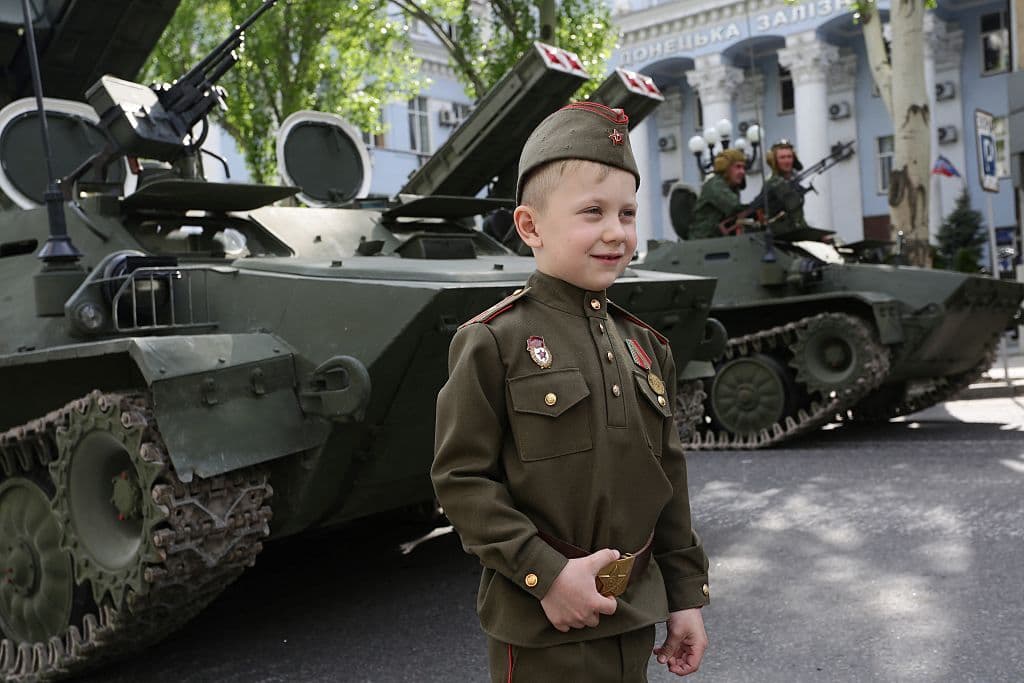
A Ukrainian boy being propagandized to hate his own country.
The roundtable at The Reckoning Project on November 25th wasn’t about the future—it was about the present, about what’s happening right now to Ukrainian children living under occupation. Roman Avramenko, the project’s executive director, described a machinery of militarization that has been operating since 2015, long before the full-scale invasion, reaching down to preschoolers.
It’s not subtle. Schools in occupied Donetsk and Luhansk have been transformed into indoctrination centers where children learn to strip Kalashnikovs, where youth camps double as military training grounds, where the curriculum revolves around service to the Russian state. The goal isn’t education—it’s conscription deferred, creating a generation that will fill Russia’s ranks when their time comes.
The researchers argued these practices constitute war crimes: the forced assimilation of children, the militarization of education, the erasure of Ukrainian identity through state-sponsored indoctrination. They’re building cases, documenting evidence, preparing for prosecutions that may take years to reach international courts—if they ever do.
But the timeline for justice moves slowly. The timeline for a child’s education moves faster. Every year that passes under Russian control is another cohort lost, another generation whose formative years are spent learning that their homeland is the enemy and their future is in Russian uniform.
The peace plans circulating through diplomatic channels rarely mention them—these children who can’t wait for negotiations to conclude, whose lives are being reshaped while adults argue over borders and security guarantees. Yet they represent the war’s longest shadow: the cost that compounds long after the last shell falls.
The Factory That Shouldn’t Burn
At exactly 2:40 a.m., the residents of Cheboksary learned that distance no longer meant safety. The city sits in the Chuvashia Republic, eight hundred kilometers from Ukraine—deeper into Russian territory than most thought Ukrainian drones could reach.
The first explosion shattered the pre-dawn silence. Then another on the city’s outskirts. Footage spread quickly online: flames licking up from an industrial district, thick black smoke billowing into the November sky.
By afternoon, Ukraine’s General Staff confirmed what many suspected: the VNIIR-Progress factory had been struck. This wasn’t random. The facility manufactures navigation systems and electronics for Russia’s entire aerial arsenal—Shahed drones, cruise missiles, ballistic weapons, the glide bomb kits that have terrorized Ukrainian cities for months. Take out the factory, and every weapon system using its components becomes harder to build, guide, and deploy.
The strike was precise, calculated, symbolic. While Russian forces captured two villages in eastern Ukraine—tactical gains measured in square kilometers—Ukraine demonstrated it could reach the factories that make those gains possible.
It’s the strategy Ukraine has embraced out of necessity: unable to match Russia’s manpower or artillery, Kyiv strikes the supply chain itself—refineries, ammunition depots, rail hubs, electronics factories that make modern warfare possible. Each successful strike doesn’t just destroy equipment; it forces Russia to disperse production, increase security, reroute supplies—turning the entire rear area into contested space.
As dawn broke over Cheboksary, firefighters were still battling the blaze. In Ukraine, analysts were already plotting the next target.
Encircled or Enduring
The rumor spread faster than truth: Ukrainian forces near Huliaipole were surrounded, cut off, trapped. Russian military bloggers amplified it. Social media echoed it. And on November 26th, Ukraine’s Southern Defense Forces issued a statement denying what should have been obviously false.
The troops weren’t encircled. Supply lines remained open. Medical evacuations continued. But the mere suggestion had done its work, sowing doubt among those desperate for good news.
What the statement didn’t deny was the intensity of fighting. Over twenty-four hours, Russian forces launched more than thirty assaults in the Huliaipole sector. They fired over 2,100 artillery rounds. Conducted a dozen airstrikes, dropped 250 bombs from drones, and sent nearly 2,000 kamikaze drones screaming toward Ukrainian positions.
That’s not encirclement—it’s sustained pressure across an entire sector, relentless assault that grinds units down through attrition rather than breakthrough. Ukrainian forces were holding, but holding costs lives, ammunition, morale.
The Zaporizhzhia front had become what analysts warned it would: Russia’s new focus after gains in the east stalled. According to DeepState’s October figures, 69 percent of all Russian territorial gains came from this area, even though it saw only 16 percent of total assault operations. Russia was getting more ground for less effort here than anywhere else.
Ukrainian units pulled back when positions became untenable, trading space for preservation. It’s the calculus of a smaller army facing a larger one: you can’t win every fight, but you can avoid losing catastrophically.
The Toll in Names and Numbers
The overnight attack came in waves: two Iskander-M ballistic missiles from Rostov Oblast, followed by ninety drones—fifty-five Shaheds among them, buzzing through the darkness like mechanical locusts. Ukrainian air defenses rose to meet them, knocking down seventy-two, but eighteen found their marks.
Zaporizhzhia city bore the worst. Eleven airstrikes in a single day. Nineteen people injured. The explosions ripped through residential districts where families were sleeping, where the war arrived without warning.
In Donetsk Oblast, nine civilians were wounded—seven in Sloviansk, two in Kostiantynivka. In Kherson Oblast, seven more including a child, as Russian forces hit four apartment blocks and twenty-one private houses.
Then came the drone attack on Kherson city’s Korabelnyi district. A 63-year-old man targeted with precision modern warfare allows. The explosion left him with a concussion and head injuries. Doctors are working to save his sight.
Up north in Sumy Oblast, seventy attacks across thirty-four settlements in a single day. A 45-year-old woman wounded in Velykopysarivska. And in Kharkiv, a 51-year-old man died from wounds sustained three days earlier—another name added to the toll.
At least one killed, thirty-seven injured. But those numbers don’t include the man in Kherson still fighting for his vision, or the terror that spreads through neighborhoods when sirens wail.
Each number represents a person who woke up that morning not knowing they’d become a casualty statistic. Their names won’t appear in peace treaties. But they are the war’s true currency—the price paid daily while negotiators argue.
The Money Behind the Survival
While shells fell on Kherson and drones struck Cheboksary, accountants in Washington finalized a different intervention: 8.2 billion dollars spread across four years, money that would keep Ukraine’s economy from collapsing while its military kept fighting.
The IMF’s staff-level agreement, announced November 26th, wasn’t dramatic. No grand speeches. Just technical financial engineering that makes survival possible when a country spends every tax dollar on weapons and relies on foreign assistance to pay teachers, doctors, pensioners.
Ukraine needs $61 billion to balance its books for 2026-2027. The IMF’s $8.2 billion won’t close that gap—but it plugs part of it, signals other donors, and comes with strings that keep corruption reforms moving forward even during existential war.
The agreement requires Kyiv to preserve independent anti-corruption institutions, prevent tax fraud, increase procurement competition, and broaden the tax base. These aren’t suggestions—they’re conditions. Miss the benchmarks, the money stops flowing.
The funding extends Ukraine’s current program through 2029, creating a financial bridge across negotiation uncertainty and whatever unstable arrangement emerges from Geneva.
But the IMF was clear: “Prompt action by donors is indispensable.” This money alone won’t save Ukraine. It needs the European reparations loan, frozen Russian assets, continued NATO military aid.
The same day, Bloomberg reported Europe was preparing legal documents to seal the $140 billion reparations loan—lending Russia’s own frozen reserves to Ukraine. The convergence wasn’t coincidental. As diplomats pushed Ukraine toward territorial compromise, financial institutions quietly ensured Kyiv would have resources to refuse unacceptable terms.
The Ally Next Door, Growing Closer
While diplomats debated Ukraine’s future in distant capitals, Alexander Lukashenko sat beside Vladimir Putin in Bishkek, Kyrgyzstan, and reaffirmed what everyone already knew: Belarus isn’t neutral, it never was, and it’s sliding further into Russia’s orbit with every passing month.
The November 26th meeting at the Collective Security Treaty Organization summit was theater, but the props were real. Lukashenko offered Belarus as a venue for Ukraine-Russia peace talks—the same Belarus that hosts Russian troops, stores Russian weapons, and serves as a staging ground for attacks on Ukrainian cities. The proposal was absurd enough to ignore, but it revealed the deeper truth: Russia is in the endgame of a decades-long project to absorb Belarus entirely through the Union State framework.
The day before, Belarus announced it had received another shipment of Tor-M2 air defense systems from Russia. Not purchased—received. The distinction matters. Every weapon system Moscow transfers to Minsk is another thread binding the two militaries together, another step toward the kind of integration that makes formal annexation unnecessary.
For Ukraine, Belarus represents the nightmare scenario: what happens when a neighboring country doesn’t fall through invasion but through slow diplomatic strangulation, when sovereignty erodes not in battles but in summit meetings, when a nation becomes Russian without ever officially ceasing to exist.
Lukashenko’s performance in Kyrgyzstan wasn’t about peace—it was about demonstrating Belarus’s role as Russia’s most reliable subordinate, willing to host negotiations that would legitimize Moscow’s gains while Russian missiles continue launching from Belarusian soil.
When Neutrality Becomes Complicity
The Russian Red Cross should be neutral. That’s the premise of every humanitarian organization—that medicine and aid operate above politics, that suffering knows no flag. But an investigation published November 25th by Follow the Media revealed something darker: Russia’s Red Cross has become another weapon in the Kremlin’s arsenal.
The investigation detailed how the RRC’s development strategy through 2028 outlines formal allegiance with the Movement of the First—a “patriotic” youth organization. In mid-November, they co-organized a first aid competition for children from Russia and occupied Ukrainian territories, turning medical training into nationalist indoctrination.
Regional RRC branches participated in Zarnitsa 2.0, a nationwide military competition where children practice warfare under the guise of civic education. The Red Cross was helping Russia prepare the next generation of soldiers.
The funding reveals deeper corruption. Moscow provides significant portions of the RRC’s budget, but the ICRC and IFRC also contributed 13.5 million euros in 2024—a quarter of the RRC’s annual budget, partially funded by European taxpayers who believe they’re supporting humanitarian work, not militarization.
The European Commission insists none of its direct funding reached the RRC, but money flows through the ICRC and IFRC before distribution. Neither organization would clarify how much ended up supporting an entity that helps organize military competitions for children.
The investigation exposes the challenge: at what point does providing aid become enabling aggression? When does neutrality cross into complicity? For Ukrainian families whose children are being indoctrinated in occupied territories, the distinction has collapsed entirely.
The Drone That Landed Wrong
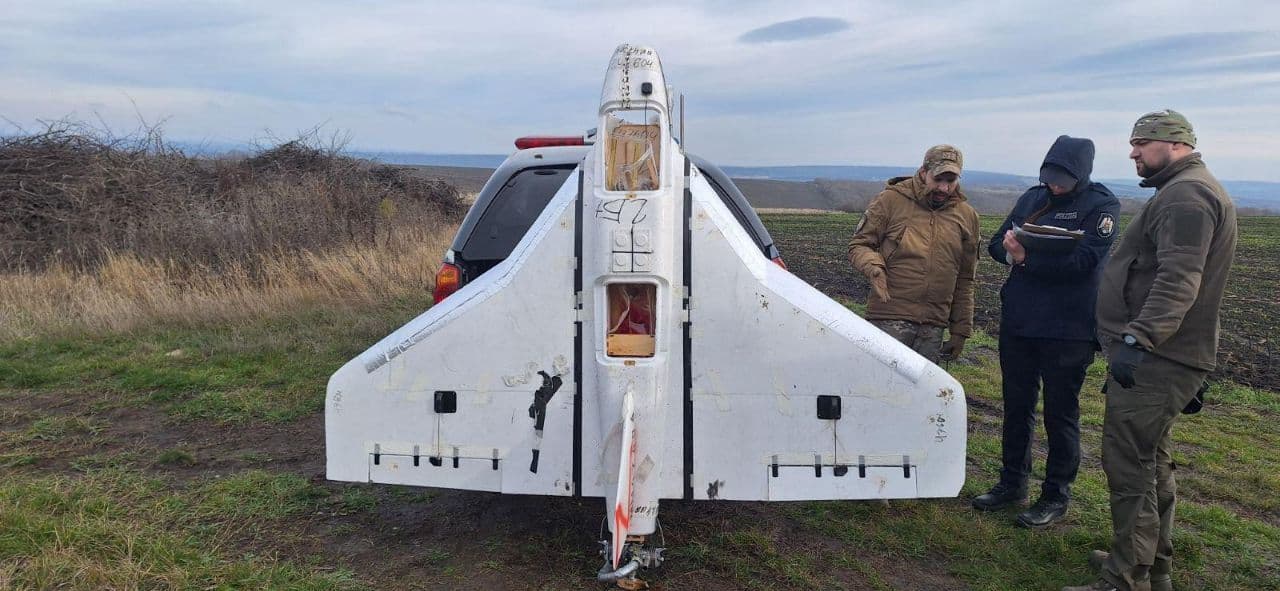
The drone fell onto a roof in a Moldovan village near the Ukrainian border—intact, identifiable, undeniable. A Russian-made Gerbera surveillance model, no explosives but plenty of evidence. On November 26th, Moldovan authorities did something unusual: they placed it outside their Foreign Ministry and summoned Russia’s ambassador to look at it.
Oleg Ozerov arrived to find his country’s weapon displayed like a museum piece, a physical accusation he couldn’t talk around. Six drones had violated Moldovan airspace during the November 25th mass attack on Ukraine. This one survived, giving Moldova proof too tangible to dismiss.
Foreign Minister Mihai Popsoi was blunt: “Such incidents are unacceptable. The Republic of Moldova has rejected and will firmly reject every attack against its security and territorial integrity.” The language was diplomatic, but the staging was confrontational.
Ozerov claimed there was “no evidence” the drone was Russian—a denial so absurd it barely warranted response. The Gerbera model is manufactured in Russia for Russian forces.
The incident marked the latest in Moldova’s uncomfortable education about proximity to war. Since the full-scale invasion began, Moldovan airspace has been repeatedly violated by missiles and drones that “accidentally” stray across borders. Each violation reminds that small nations have sovereignty only so long as the powerful choose to respect it.
President Maia Sandu has accused Moscow of attempting to interfere in Moldova’s parliamentary elections, trying to engineer victory for pro-Russian parties just as Moldova pursues EU membership. The drone on the Foreign Ministry steps was a message: we see what’s happening, we’re documenting it, and we won’t pretend these are accidents.
The Weapons Maker’s Defense
Fire Point should be Ukraine’s success story: a startup that didn’t exist before the invasion, now producing the Flamingo cruise missile that carries Ukraine’s hopes for long-range strikes. But on November 21st, the company’s leadership took a stage in Kyiv not to celebrate but to defend their reputation.
Chief technology officer Iryna Terekh, director Yehor Skalyha, and chief constructor Denys Shtilierman faced questions about ownership, effectiveness, and the corruption investigation circling the company. The timing was pointed: President Zelensky had just given a grim speech about deteriorating conditions, and Fire Point’s fate had become intertwined with Ukraine’s international reputation.
The numbers were staggering. General Staff spokesperson Dmytro Lykhoviy claimed Fire Point’s drones represented 51 percent of Ukraine’s deep-strike arsenal, responsible for 59 percent of successful strikes. The company touted 64 major strikes from oil refineries to radar systems.
But questions weren’t about effectiveness—they were about money. Fire Point’s growth from zero employees to a claimed 3,500 has drawn suspicion, particularly around alleged links to Timur Mindich, recently charged with allegedly stealing $100 million from Ukraine’s energy infrastructure.
More troubling: Igor Fursenko, a key corruption scheme figure, had been a Fire Point employee according to court records.
Shtilierman’s sudden acquisition of 97.5 percent ownership three days before the event raised more questions. When asked about funding, he claimed personal wealth predating the war. The contradiction: Fire Point might produce Ukraine’s most effective weapons while representing everything wrong with wartime procurement—rapid growth without transparency, political connections breeding suspicion.
What Ukrainians Actually Think
While diplomats in Geneva edited peace proposals, the Kyiv Post walked Ukraine’s capital asking: what compromises, if any, are acceptable?
Soldier Yaryna Chornohuz, deployed in Kherson, called any territorial concession betrayal: “I will consider any order to retreat a criminal order and will not obey it.”
But in Kyiv, blocks from the previous night’s drone strikes, calculations felt different. Pensioner Vyacheslav: “I think we will have to make compromises. It is important to understand what is acceptable and what is not.” Student Hlib agreed. Student Anna suggested “concessions will be made by both Ukraine and Russia.”
Laborer Pavlo pointed to brutal reality: “Unfortunately, Ukraine has nothing to fight with; there is not enough weaponry.”
Others rejected the premise. Bank employee Vladyslav: “Ukraine will not make compromises; the war will continue.” Student Alina: “We should not make any compromises when our military is fighting for our independence.”
On specific concessions, consensus emerged on one point: neutering Ukraine’s military was unacceptable. Territorial concessions proved divisive. Hlib: “As for occupied territories, they can be a matter of discussion; we cannot take them back now.” But energy worker Alina: “I would never agree to territorial concessions. It is our land.”
What emerged wasn’t a clear mandate but something messier: exhaustion mixed with defiance, pragmatism shadowed by principle. The only agreement was disagreement—over what Ukraine can afford to lose, what Russia might accept, and whether any peace will last long enough to justify what’s surrendered.
Russia’s Answer: Everything or Nothing
While Ukraine debated compromises, Russia made its position clear: none. On November 26th, Russian Deputy Foreign Minister Sergei Ryabkov delivered Moscow’s response with characteristic bluntness.
“There can be no talk of any concessions” of Russia’s position, Ryabkov stated. Russia would continue pursuing its “stated goals”—maximalist demands repeated since before the invasion—and would continue the war if negotiations encountered “any setbacks.”
Kremlin spokesperson Dmitry Peskov reinforced the message when asked if Ukraine and Russia had ever been closer to a peace deal. “It is too early to say”—diplomatic language for “we’re not interested.”
A leaked Bloomberg transcript exposed the cynicism. In an October 29th call between lead negotiator Kirill Dmitriev and Presidential Aide Yuriy Ushakov, Ushakov expressed concern that the United States would “correctly interpret Russia as unwilling to meaningfully engage.”
The anxiety was telling. Moscow fears not that negotiations will fail, but that failure will be correctly attributed to Russian intransigence. The Kremlin wants the war to continue until total victory, but wants the world to blame Ukraine.
Russia’s demands haven’t changed: recognition of occupied territories, Ukrainian demilitarization, constitutional changes preventing NATO membership, acceptance of Russia’s “sphere of influence.” These aren’t negotiating positions—they’re capitulation terms.
Ryabkov’s statement wasn’t a basis for negotiation—it was rejection of negotiation’s premise. Russia will accept only terms amounting to Ukrainian surrender, leaving Ukraine defenseless for the next invasion.
The NATO Door That Won’t Open
Mark Rutte’s words were diplomatic but brutal: Russia has no veto over NATO membership—but several NATO members do, including the United States, and they’re using it to keep Ukraine out.
The NATO Secretary General’s interview with El País on November 26th came during frantic diplomacy over Trump’s 28-point peace plan. The original version reportedly included provisions effectively barring Ukraine from NATO membership.
“Within the Alliance, membership requires unanimity,” Rutte explained—diplomatic code that Ukraine’s path is blocked not by Moscow’s demands but by allies who fear escalation, worry about Article 5 commitments, want peace more than victory.
The irony was thick: Russia invaded partly because it claimed NATO expansion threatened security. Yet Sweden and Finland both joined after the invasion. Ukraine, the actual victim, remained outside.
Rutte acknowledged the dilemma. If NATO membership isn’t an option, the alliance must provide “security guarantees strong enough to make Russia never try again.” But what guarantees matter to a country that already gave up nuclear weapons for territorial integrity assurances Russia violated twice?
Rutte tried reassurance, noting Russia’s minimal offensive progress—”only a few meters a day.” But tell that to residents of Promin and Vysoke, the villages that fell that day. Tell soldiers facing thirty assaults and 2,000 kamikaze drones daily.
A few meters multiplied across months adds up to kilometers. Russia is willing to sacrifice those million lives Rutte mentioned.
“Russia will remain a long-term threat,” Rutte concluded. If that’s true—if Russia remains dangerous regardless of any deal—then what peace are we negotiating? What happens to Ukraine when the war ends but the threat doesn’t?
What November 26th Revealed
When the day ended, nothing had been settled. Two villages had fallen, but a weapons factory had burned. Ukraine lost ground in Zaporizhzhia, but gained IMF commitments. NATO kept its door closed, but Europe moved closer to releasing frozen Russian assets. Diplomats spoke of peace while artillery spoke louder in Huliaipole.
This was the war’s new normal: simultaneous movement on every front—military, diplomatic, financial—each influencing the others in ways that won’t be clear until historians look back. Russia advances meters while Ukraine strikes hundreds of kilometers deep. The West offers loans while withholding membership. Peace negotiations accelerate while fighting intensifies.
The contradictions aren’t bugs—they are the system. This is great power conflict when nuclear weapons prevent decisive victory: a grinding contest fought with artillery and drones, currencies and frozen assets, diplomatic cables and IMF agreements. The question isn’t whether Ukraine can win militarily—it’s whether it can sustain itself long enough to secure a peace worth having.
November 26th offered glimpses of all possible futures. Russia slowly absorbing eastern Ukraine while the world tires of resistance. Ukrainian strikes making war too costly for Moscow. Financial lifelines creating stability for frozen conflict neither side calls peace.
What it didn’t offer was resolution. Cheboksary proved Ukraine could hurt Russia deep inside its borders. Promin and Vysoke proved Russia could still advance. The IMF agreement proved the world wasn’t ready to let Ukraine collapse. Rutte’s comments proved the world wasn’t ready to embrace Ukraine’s victory either.
As midnight approached, soldiers settled into trenches. Diplomats prepared for another round. Ukrainian drones, somewhere over Russia, continued searching for targets that might tip the balance.
The war endures, measuring itself not in days but in accumulated exhaustion. November 26th was just one more data point in an equation no one has yet solved.