
In Kupyansk, Ukraine’s president stood before a bullet-scarred city sign Russia claimed to control—while 1,500 kilometers east, Ukrainian drones burned oil platforms in the Caspian Sea, and in Brussels, American envoys prepared weekend talks that could force Kyiv to trade battlefield victories for diplomatic concessions.
The Day’s Reckoning
The video from Kupyansk told one story. The fires in Yaroslavl told another. And the weekend talks in Brussels would determine which mattered more.
Volodymyr Zelensky stood beneath anti-drone netting on December 12, 2025—day 1,388—filming an address before a bullet-scarred city sign Russia claimed to control. Explosions crackled behind him. The Kremlin had invited journalists to tour “liberated” Kupyansk weeks earlier. Now Ukraine’s president stood exactly where propaganda said he couldn’t.
Seven hundred kilometers north, flames consumed the Slavneft-YANOS refinery. Ukrainian drones had crossed the night. In the Caspian Sea—1,500 kilometers distant—more drones struck the Filanovsky platform for the second time in a week. Geography had stopped protecting Russia.
In Brussels, American envoys prepared weekend talks testing whether battlefield defiance could translate into diplomatic leverage. Steve Witkoff would meet Zelensky and European leaders, carrying Washington’s impatience.
In Kyiv, the SBU detained three men hours after a bombing killed a National Guard serviceman. Russian handlers had recruited them through Telegram. And Prosecutor General Kravchenko threatened to “personally pursue” those spreading resignation rumors.
Day 1,388. The war fought on every front simultaneously.
Where Propaganda Dies
The video was simple. Zelensky stood in Kupyansk, the city’s bullet-scarred entrance sign visible behind him, anti-drone netting swaying overhead. Explosions crackled in the background. “Many Russians have talked about Kupyansk—we see,” he said, tone flat, message unmistakable.
The Kremlin had claimed Kupyansk’s capture in late November, inviting journalists to tour the “liberated” city alongside Russian troops. Now Ukraine’s president stood exactly where Russian propaganda said he couldn’t.
The timing was deliberate. Washington was intensifying pressure on Kyiv to accept territorial concessions, floating “demilitarized zones” requiring Ukrainian withdrawals from positions currently held. Zelensky’s message was visceral: These aren’t abstract lines on maps. These are places where Ukrainian soldiers fight and die.
Ukraine’s 2nd Khartiia Corps had provided the military foundation. The National Guard unit reported spearheading counterattacks after the situation became critical, reaching the Oskil River north of the city and “completely blocking land routes” for Russian reinforcement. They’d liberated Kindrashivka and Radkivka, systematically cutting off enemy supply paths. Over three months: 1,027 Russian servicemen killed, 291 wounded, 13 captured. Grinding combat that generated no headlines but determined whether the city remained Ukrainian.
Ukrainian command stated that over 200 Russian servicemen were now encircled in Kupyansk. Not just holding ground—trapping enemy forces for systematic elimination.
Fighting continued in the city center. But conducting a presidential visit—complete with video for social media—demonstrated enough control to undermine Russian claims.
“Today, it is extremely important to achieve results on the front so that Ukraine can achieve results in diplomacy,” Zelensky said. “All our strong positions inside the country are strong positions in the conversation about ending the war.”
Battlefield realities would determine negotiating positions. Every meter held, every Russian claim refuted, every presidential visit became a diplomatic weapon.
Exhausting. Expensive. Absolutely necessary.
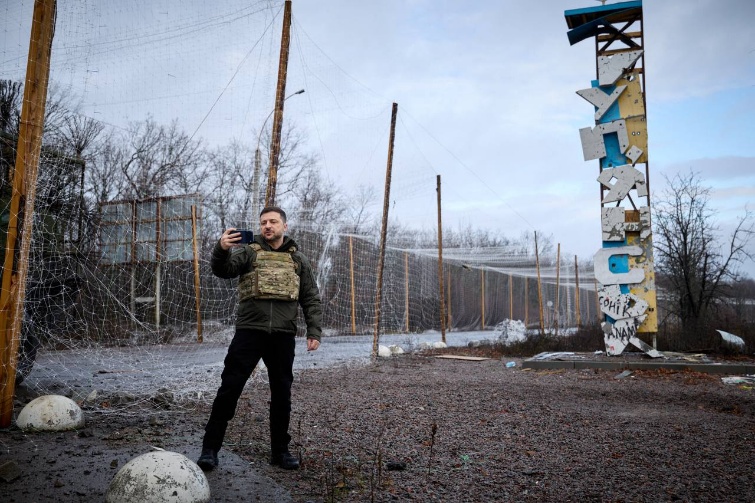
Kupyansk: Zelensky films an address beneath anti-drone netting and a bullet-riddled city sign Russia claimed to have captured. Explosions crackle in the background. This is what defiance looks like on day 1,388. (President Volodymyr Zelensky/Telegram)
Three Puzzles, No Single Solution
In his Friday evening address, Zelensky outlined Ukraine’s tripartite approach to securing “dignified” peace—a structure revealing both complexity and fragmentation.
Germany: Representatives from Ukraine’s army, intelligence, and security forces discussing mechanisms to prevent Russia from regrouping after any ceasefire. Security guarantees. Defense architecture. The practical details of preventing round two.
United States: Prime Minister Yulia Svyrydenko leading talks on economics, reconstruction, and investment. The financial architecture that would replace American aid if Washington’s commitment wavered.
The third channel was most amorphous: “Virtually constant contact between national security advisers.” Late-night calls. Encrypted messages. Rustem Umerov coordinating between Washington, Kyiv, and European capitals.
The structure was elegant on paper but reflected uncomfortable reality: Ukraine no longer had a single negotiating partner. Germans wanted security details. Americans wanted economic frameworks reducing their burden. Everyone wanted Ukraine to decide fast enough to satisfy Trump while maintaining positions defensible to Ukrainian voters.
Like solving three puzzles while someone kept changing the pieces.
Special Envoy Steve Witkoff would meet Zelensky and European leaders in Brussels over the weekend—Macron, Starmer, Merz expected. The gathering would test whether Europe’s powers could coordinate their response to American pressure.
By creating multiple channels, Zelensky preserved flexibility. Talks stalled in one forum? Try another. But more partners meant more opportunities for competing priorities.
The economic discussions carried particular urgency. Zelensky expected “$15 to $16 billion” via the Prioritized Ukraine Requirements List—NATO states paying first for American weaponry at 10% markup. The program had delivered $5 billion by 2025’s end. Projected 2026 figures would require either substantial allied increases or painful domestic cuts.
Ukraine’s budget deficit: $38.8 billion—42% of expenditures. Total budget: $95.5 billion. Domestic revenues: $50-57 billion. The gap filled by allied donations and loans, creating dependency that gave foreign partners enormous leverage.
When Geography Stopped Mattering
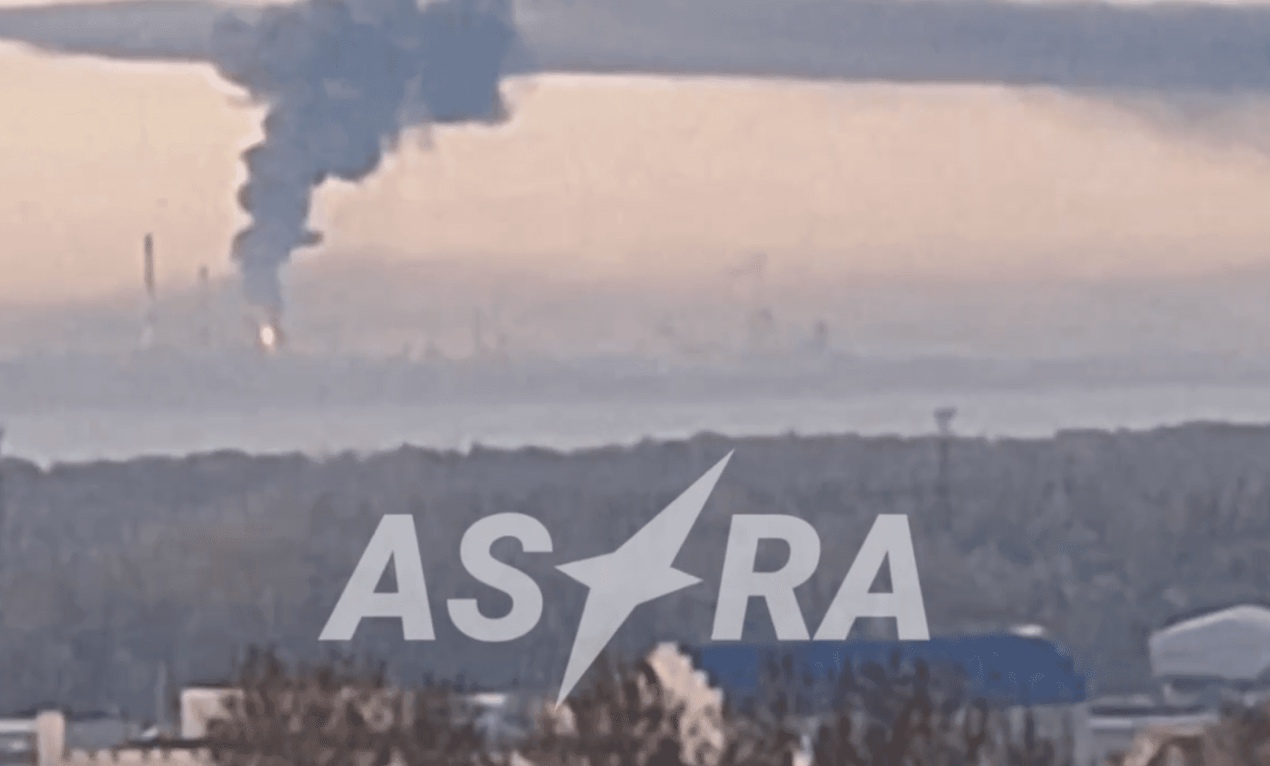
Seven hundred kilometers from Ukraine, the Slavneft-YANOS refinery burns after Ukrainian drones crossed the night sky. One of Russia’s five largest oil processing facilities—15 million tons of fuel annually—now sending black smoke across Yaroslavl. Distance means nothing anymore. (Screenshot/Astra/Telegram)
The orange glow across Yaroslavl came from the Slavneft-YANOS refinery, where Ukrainian drones had struck after a 700-kilometer journey. Seven explosions. Then fire consuming one of Russia’s five largest oil processing facilities.
Ukraine’s General Staff confirmed the strike. Slavneft-YANOS processed 15 million tons of oil annually, producing gasoline, diesel, jet fuel—the liquid logistics keeping Russian military vehicles moving.
The General Staff revealed additional strikes: ammunition depot near Avdiivske, personnel concentrations near Myrnohrad and Rodynske. Destroying stockpiles before they reached the front.
But Yaroslavl was just one target. In the Caspian Sea—1,500 kilometers from Ukrainian territory—SBU drones struck Russia’s Vladimir Filanovsky oil platform for the second time in a week.
The Filanovsky and Korchagin platforms, both operated by Lukoil, suffered damage forcing production suspensions. One of Russia’s largest explored reserves—129 million tons of oil, 30 billion cubic meters of natural gas—now vulnerable to attacks Russia couldn’t intercept.
Second strike in a week. Not opportunistic—systematic.
The platforms sat 1,500 kilometers away, requiring drones to traverse Russian airspace for hours. That SBU operators could coordinate such strikes suggested either remarkable technological advancement or gaps in Russian air defense Moscow couldn’t close.
“The SBU continues its systematic work aimed at reducing revenues from the oil and gas sector,” a source told journalists. “The frequency, geography, and accuracy are a signal—all Russian facilities supporting the war will burn.”
The message was psychological as much as military. Every refinery fire reminded Russian civilians that geography no longer provided security. The “special military operation” was reaching Russia’s heart.
Local authorities suspended airports and cut mobile internet—measures disrupting civilian life while doing little to stop drones. Russia’s air defense couldn’t protect such vast territory.
Each strike reduced fuel supplies, forcing Moscow to divert resources toward protection. And each strike undermined the Kremlin’s narrative that the war was proceeding according to plan.
The Asymmetry
While Ukrainian drones ranged hundreds of kilometers into Russian territory, Moscow demonstrated it retained capacity to punish Ukrainian cities in return. A Russian airstrike on Odesa damaged infrastructure and left parts of the city without electricity and water.
Serhiy Lysak, head of the Odesa Military Administration, reported a residential building damaged during the attack, with emergency and utility services deployed to assess damage and restore services. The strike was part of a pattern intensifying throughout the war—Russia’s systematic campaign to destroy the systems making Ukrainian life possible.
The targeting followed grim logic: If Russian forces couldn’t advance on the ground, they’d make Ukrainian cities unlivable from the air. Power stations, water treatment facilities, heating systems—mundane infrastructure of modern life became military targets. Warfare against an entire population, collective punishment disguised as military necessity.
The Odesa attack underscored fundamental asymmetry: Ukraine could strike Russian refineries and military depots deep inside enemy territory, but Russia could strike Ukrainian homes with relative impunity. Ukrainian air defenses had improved dramatically, but they couldn’t intercept everything. And what got through invariably hit civilian areas.
Unable to achieve decisive battlefield victories, Moscow targeted infrastructure making modern life possible. It was collective punishment, warfare against an entire population rather than just its armed forces.
The attack came as Russia employed increasingly creative tactics, including using ropes attached to drones to tangle Ukrainian aerial vehicles midair. The innovation reflected the war’s technological evolution, where new adaptations appeared weekly and civilians paid the price.
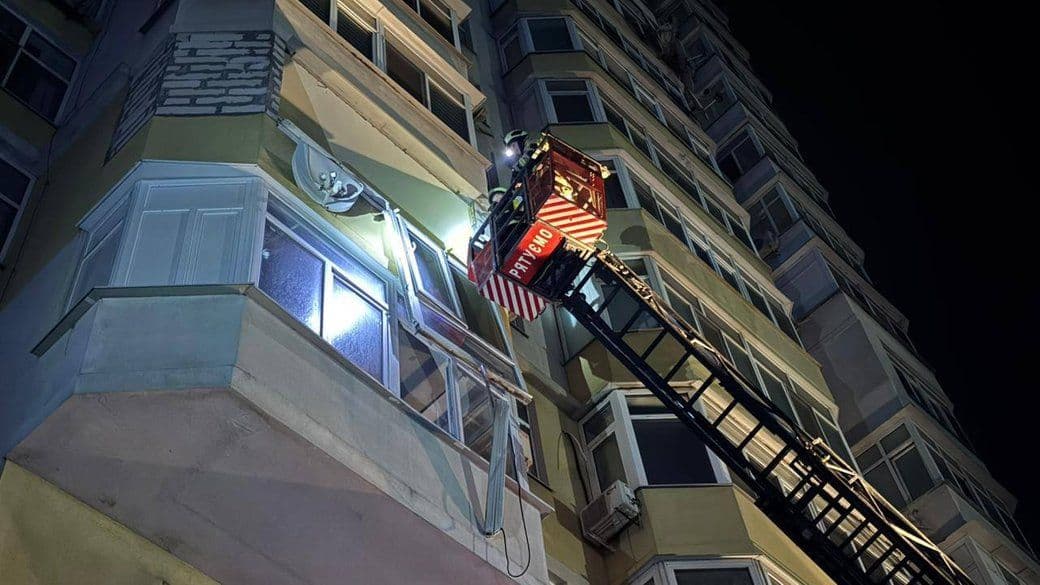
While Ukrainian drones struck Russian refineries 700 kilometers away, Russian missiles answered in Odesa—cutting power and water, punching holes in apartment blocks. The asymmetry of this war: Ukraine hits infrastructure that fuels Russia’s military; Russia hits homes where people sleep. (Serhiy Lysak / Telegram)
Easy Money, Hard Death
The Security Service announced that it had detained three men suspected of planting improvised explosive devices that killed a National Guard serviceman and wounded four others in Kyiv the previous day. Arrests within six hours—either excellent intelligence or pure luck.
The suspects were Ukrainian citizens aged 23, 25, and 27 from Odesa and Donetsk oblasts, construction laborers recruited through Telegram channels offering “easy money.” They bought bomb components, assembled devices, placed them at locations their Russian handler provided.
The first device exploded in Kyiv’s Darnytskyi district as two National Guard personnel approached, killing one and injuring the other. A security guard nearby was wounded. When law enforcement arrived, a second device detonated, injuring two officers—classic secondary attack targeting first responders.
The suspects set up mobile phones near blast sites to stream video to their handler and coordinate explosions remotely. Low-tech terrorism enabled by encrypted apps and motivated by financial desperation. Men with no ideology beyond economic need, willing to kill fellow Ukrainians for cryptocurrency that seemed substantial but represented pocket change to Russian intelligence.
The case highlighted Russian recruitment of Ukrainians for sabotage. The SBU warns repeatedly that Moscow’s security services use Telegram to find people willing to set fires, plant bombs, conduct surveillance for money. The agency operates a chatbot for reporting recruitment attempts.
But such measures can’t prevent every attack. The three men slipped through, recruited and equipped before counterintelligence identified them. The template repeats: Economic vulnerability meets Russian handlers providing instructions, components, payment—young men with few prospects, willing to risk prison for amounts Moscow can afford to pay hundreds or thousands.
For Ukraine’s security services, tactical successes but strategic failures. Catching bombers after explosions was damage control. The challenge: disrupting recruitment networks before devices were built.
Recruitment was happening faster than counterintelligence could track it.
Performance Art with €210 Billion
The Russian Central Bank’s announcement that it was suing Euroclear in a Moscow court was performative outrage perfected. The Belgian financial institution held roughly €210 billion in frozen Russian assets Moscow could neither access nor use.
The lawsuit arrived with exquisite timing—days before a European Council summit where EU leaders would advance plans for a “reparations loan” to Ukraine. The mechanism would replace frozen Russian deposits with EU-backed bonds, using interest generated by Russian cash to guarantee loans for Ukrainian reconstruction.
Russia called the proposal “illegal” and “contrary to international law,” threatening to pursue “all available legal and other mechanisms” to challenge it. The rhetoric was fierce. The practical effect would be minimal.
A legal memo from Covington & Burling, seen by the Kyiv Independent, assessed litigation risk as “minimal.” The document noted that “it would be well-nigh impossible for Russia to persuade an international court or tribunal to find and exercise jurisdiction over such a claim.”
Most scholars agreed the EU’s approach was well-crafted, threading the needle between legal constraints and Ukraine’s urgent funding needs. By using interest rather than seizing underlying capital, Brussels avoided problematic aspects of outright confiscation while still mobilizing Russian resources for Ukrainian benefit.
The mechanism’s success depended on unanimous EU approval—the same requirement that had derailed similar efforts before. With almost all frozen Russian assets held by Brussels-based Euroclear, the proposal offered a pathway to unlock billions without technically confiscating the principal. Financial engineering in service of strategic goals, using Russia’s own money against it while maintaining legal defensibility.
Moscow’s lawsuit was theater for domestic consumption—evidence the Kremlin was “fighting back” against Western financial warfare. But theater that couldn’t change fundamental reality: Russia’s frozen assets remained frozen, and Europe was finding creative ways to put them to work regardless of Moscow’s legal protests.
“I Will Come After Each of You Personally”
Prosecutor General Ruslan Kravchenko used his statement to draw a line. “I have not resigned and do not intend to resign,” he declared, adding a pointed threat: “I know everyone who is currently working against me and the prosecutor’s office. You don’t need to hide; I will come after each of you personally.”
The sharp language came in response to anonymous posts alleging he had submitted a resignation letter—claims the Prosecutor General’s Office had rejected earlier that day. But Kravchenko’s combative tone suggested the rumors had touched a nerve, particularly amid controversy over a high-profile case.
The arrest of NABU detective Ruslan Mahamedrasulov and his father on charges of cooperating with Russia had generated intense scrutiny. The SBU accused them of maintaining Moscow contacts and facilitating cannabis sales to Russia’s Dagestan region. Mahamedrasulov argued the case amounted to political retaliation for his work on a corruption investigation involving President Zelensky’s associate, Timur Mindich.
After months of detention, a Kyiv court ordered Mahamedrasulov’s release—undercutting prosecution claims about the threat he posed. Public criticism intensified, with questions raised about whether sufficient evidence had existed to justify the arrest.
Responding to criticism, Kravchenko described the reaction as “emotional” and “manipulative,” insisting investigators presented “sufficient” evidence. His December 12 statement suggested he viewed the resignation rumors as coordinated campaign rather than organic speculation.
The controversy arrived at an awkward moment. European officials were preparing reforms to the prosecutor selection process, including input from the Venice Commission. Kravchenko’s combative response suggested sensitivity about external scrutiny.
The reforms were part of Ukraine’s effort to meet EU membership requirements demanding judicial reforms. The Prosecutor General’s position had long been contentious—critics argued political appointment created conflicts undermining prosecutorial independence. Kravchenko’s predecessor resigned after a scandal involving fraudulent disability claims.
As a political appointee widely seen as close to Zelensky, Kravchenko occupied a position where institutional independence and political loyalty existed in tension. His threat revealed which value he prioritized under pressure.
What December 12 Revealed
December 12, 2025, revealed a war where symbolic gestures competed with brutal realities. Zelensky stood before a bullet-riddled sign in Kupyansk while diplomats prepared weekend talks in Brussels. Ukrainian drones struck refineries 700 kilometers inside Russia while Russian missiles knocked out power in Odesa. The SBU detained bombers in Kyiv while the Prosecutor General threatened critics with personal vengeance.
The war had penetrated every aspect of national life. Presidential visits to contested cities doubled as diplomatic weapons. Oil platform strikes served as psychological warfare. Even the Prosecutor General’s office had become a battlefield where political retaliation collided with demands for reform.
Zelensky’s tripartite diplomatic structure—parallel talks in Germany, the United States, and through national security advisers—reflected Ukraine’s attempt to maintain multiple channels toward peace that wouldn’t be surrender. But multiplication of forums revealed fragmentation, difficulty maintaining allied unity when Washington pressured Europe to pressure Ukraine.
The pattern repeated: Ukraine achieving tactical successes—drone strikes, territory defense, bomber arrests—while facing strategic pressures it couldn’t control. The president could visit Kupyansk but couldn’t prevent American envoys pushing territorial concessions. The SBU could strike oil platforms but couldn’t stop missiles hitting Odesa. Investigators could arrest bombers but couldn’t prevent recruitment networks finding volunteers.
Russia’s Central Bank lawsuit against Euroclear was theater revealing anxiety about Europe’s creativity in mobilizing frozen assets. Kravchenko’s threats exposed tensions between loyalty and independence.
The question wasn’t whether Ukraine could achieve isolated victories. The question was whether tactical successes could accumulate into strategic advantage before diplomatic pressure, financial constraints, or exhaustion forced concessions making victories meaningless.
Zelensky’s statement captured the calculation: “Strong Ukrainian positions in defense mean strong positions in diplomacy.” But the inverse was equally true—weak positions at the table could undermine everything soldiers died to defend.
On this single day, Ukraine fought on every front simultaneously: military, diplomatic, financial, judicial, psychological. The outcome remained uncertain. The scope was brutally clear.