
As Putin doubles down on conquest and contempt, Ukraine is squeezed between Russian escalation, Europe’s half-promises, and a looming financial cliff that diplomacy alone may not stop.
The Day’s Reckoning
By noon, the war had spoken in three voices. In Moscow, Vladimir Putin stood before his generals and sneered at Europe as “piglets,” vowing unconditional victory and hinting at weapons meant to intimidate a continent. In Zaporizhzhia, guided bombs tore into apartment blocks, filling stairwells with smoke and leaving families bleeding in daylight—32 wounded, a child among them. And in Western capitals, the language softened: “Article 5-like” promises, frozen assets still debated, and an $800 million U.S. vote spread thin across two years.
Nothing aligned. Russia escalated while demanding surrender. Europe spoke in guarantees that might someday matter. Ukraine fought everywhere at once—on the front lines, in conference rooms, and in treasury ledgers—against a winter tightening its grip. By nightfall, oil burned in Rostov, diplomats prepared talks, and the gap between words and consequences widened again. The day made one truth unavoidable: this war is no longer waiting on negotiations—it is testing resolve.
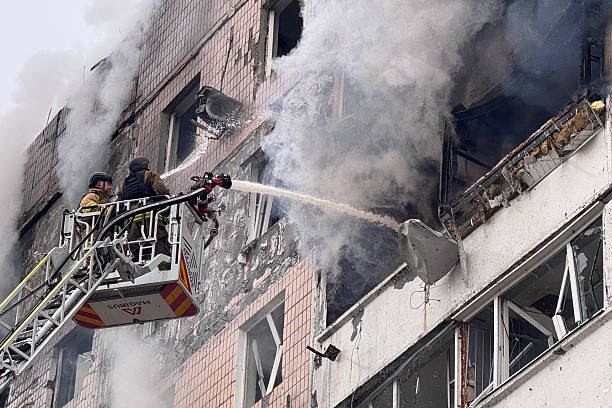
Ukrainian rescuers battle flames inside a shattered Zaporizhzhia apartment block after a midday airstrike wounded 32 civilians, including a child. (Darya Nazarova / AFP via Getty Images)
When Contempt Became Policy
Putin didn’t misspeak. He chose his words carefully, standing before Russia’s military elite and letting contempt do the work of strategy. European leaders were dismissed as “piglets,” pawns in someone else’s game, weak enough to mock and small enough to ignore. The insult wasn’t theater—it was a signal.
Broadcast across state television, the message hardened. Russia would pursue victory “unconditionally.” There would be no compromise over territory, no pause for diplomacy that didn’t end in submission. The language of peace was flipped on its head: if the war continued, Putin said, the fault lay with Ukraine and the West for refusing to accept Russia’s terms.
Those terms reached far beyond the land already seized. “Historical lands” was not shorthand—it was a claim without borders. Odesa was spoken of as Russian. “Novorossiya,” a name pulled from imperial memory, hovered over southern and eastern Ukraine like a threat. Any peace that froze today’s front lines was already, in Moscow’s telling, illegitimate.
Others echoed the line. Lawmakers spoke again of “denazification” and “demilitarization,” code words for dismantling Ukraine as a sovereign state and replacing its government with something obedient. Even the idea of security guarantees was rejected outright. No foreign troops. No protective presence. No ceasefire that might give Ukraine time to breathe.
The Kremlin’s message was blunt and stripped of pretense: Russia would keep fighting, would not accept restraints on future aggression, and viewed Western efforts to contain it with open scorn. This was not a negotiating posture. It was a declaration that force—not diplomacy—remained the point.
Victory Claimed, Inches Gained
Andrei Belousov stepped to the podium with numbers meant to sound like momentum. Six thousand square kilometers seized in 2025, he said—progress framed as inevitability. But the math told a quieter story. Spread across an entire year and a thousand-kilometer front, the gains amounted to a crawl. A city’s worth of ground each month, traded for tens of thousands of lives.
Even taken at face value, the figures described attrition, not collapse. Russia was not rolling forward; it was grinding. Belousov spoke of Zaporizhzhia Oblast as if its fall were already scripted, pointing to pressure near Hulyaipole and Orikhiv. Yet seizing the rest of the region would require more land than Russia had taken in all of 2025 combined. The promise sounded larger than the reality beneath it.
Then came Kupyansk. Belousov declared it taken. At the same moment, Ukraine’s commander said his troops had reclaimed nearly all of it. Two realities, one city—proof that control on this battlefield shifted by streets and hours, not speeches.
The recruitment numbers strained belief. Four hundred ten thousand contracts signed, Belousov claimed—just enough, almost conveniently, to offset Russia’s monthly casualty rate. If volunteers were truly plentiful, forced reserve mobilization wouldn’t be creeping back into policy discussions. The inflation served a purpose: to reassure families watching closely, to delay fear of another draft.
He spoke, too, of darkness—power plants disabled, grids weakened, winter leveraged as a weapon. And he detailed adaptations: drones overhead, motorcycles darting through kill zones, electronic warfare humming from trenches. These were not tools of breakthrough. They were tools of endurance.
What emerged wasn’t a portrait of victory, but of a war settling into its shape: slow, brutal, and measured in meters rather than miles.
Threats Dressed as Reassurance
Putin insisted Europe had nothing to fear—and then spent his breath explaining why it should. Standing before the cameras, he waved away claims that Russia threatened the continent as “nonsense,” even as he rolled out a catalog of doomsday hardware meant to unsettle every capital listening. Nuclear-powered cruise missiles. Underwater drones designed to haunt coastlines. Weapons that, he promised, already existed—or soon would.
The contradiction wasn’t accidental. It was the point.
Russia’s nuclear shield, Putin said, was more advanced than any rival’s. New systems were coming online. Others would be placed on combat duty by year’s end. This was not the language of restraint. It was intimidation wrapped in technical detail, a reminder that Moscow wanted Europe to picture devastation while being told it was safe.
Belousov followed, shifting blame outward. NATO, he argued, had created the conditions for continued war. Russia therefore had no choice but to push forward into 2026, refine its methods, and act before its enemies could. Defense was recast as necessity; aggression as prevention.
Then the tone sharpened. A lawmaker warned Europe it was playing “Russian roulette”—a game Russians, he claimed, always win. Germany was urged to remember the Soviet banner over Berlin and to “think about its future.” The history lesson was clear enough without being spelled out.
Put together, the message collapsed any pretense of peace. Russia denied threatening Europe while rehearsing the threats in public. It demanded the West stop preparing for aggression while openly planning more of its own. These weren’t overtures. They were warnings—delivered with a smile, backed by shadows, and meant to linger long after the cameras cut away.
Promises With an Asterisk
Friedrich Merz offered reassurance with careful phrasing. Ukraine, he said, could receive “Article 5-like” security guarantees—arrangements that might allow Western troops, deployed after a ceasefire, to respond if Russia struck again. The words sounded firm. The details did not.
A demilitarized zone. A promise to “move against” violations. And always the qualifier: like. NATO’s real Article 5 is blunt and binding—an attack on one is an attack on all. What Merz described carried none of that certainty. No automatic response. No shared obligation. No structure that could outlast a change in political winds.
Analysts in Washington had warned where this led. Guarantees built on goodwill rather than law dissolve under pressure. Each country keeps the right to hesitate, debate, or opt out entirely. Moscow understands this calculus well. Ambiguity is not a deterrent; it is an invitation.
Merz insisted progress had been made in Berlin, especially with signs that Washington might join Europe in backing postwar security arrangements. Others were less convinced. Britain’s defense minister spoke carefully, noting that the mission’s tasks—what troops would actually do when challenged—remained undefined.
The same uncertainty haunted the money meant to underpin those promises. Frozen Russian assets were acknowledged as leverage, their interest already flowing to Kyiv. But using the principal to secure real financing still faced resistance. “Fifty-fifty,” Merz admitted, when asked if Europe could decide.
The imbalance was stark. Europe wanted guarantees strong enough to sound serious, but flexible enough to avoid war. Russia wanted them weak enough to ignore. “Article 5-like” lived in the space between—and in that space, illusions flourished, waiting to be tested.
Europe’s Nerve, Measured in Billions
By the next day, the question wouldn’t be military—it would be arithmetic. Whether Ukraine could keep paying soldiers, repairing roads, and keeping lights on through another winter hinged on a room full of European leaders and a pile of frozen Russian money they already controlled.
Iryna Mudra did not soften the stakes. Failure, she warned, would not just hurt Ukraine—it would expose Europe itself. Without new financing, Kyiv would hit a wall by spring 2026, staring at a €135 billion gap that no speeches could fill. If Russian assets remained locked away despite clear legal pathways, the lesson would echo far beyond Kyiv: European solidarity ends where fear begins.
The mechanism was there. €210 billion in Russian central bank reserves sat immobilized after Moscow shattered international law. Brussels wouldn’t even need to seize them outright—just replace them with EU-backed bonds, using Russian interest payments to guarantee loans. A financial bridge, not a confiscation. Support now, legal debates later.
But courage stalled where consensus was required. Belgium, home to Euroclear and most of the frozen funds, worried aloud about risk. Diplomats met day after day, circling the same objections, filing the same reassurances, waiting for political gravity to shift.
This wasn’t just about Ukraine’s budget. It was a referendum on Europe’s agency—on whether the continent could defend its own security using its own resources, without waiting for Washington’s permission or Moscow’s approval. The money already belonged to Russia’s central bank, frozen because Russia chose war. Using it to defend the victim was lawful. It was moral.
What remained uncertain was will. Europe held the funds, the mechanism, and the justification. What it lacked—still—was the nerve to act before hesitation became defeat.
Seven Hundred Thousand Shadows at the Line
Oleksandr Syrskyi put a number on the winter pressure—and it landed with weight. Roughly 710,000 Russian troops, he said, were now inside Ukraine, massed for continued offensive operations despite months of losses. Along more than a thousand kilometers of front, the attacks kept coming—especially in the northeast and east—testing defenses that held, but never rested.
He did not pretend otherwise. The situation, Syrskyi told allies, was “difficult.” Russia had poured manpower into the fight, trying again to force momentum where it had failed before. Yet even with that mass, the breakthrough never came.
Kupyansk became the clearest fault line between claim and reality. Moscow declared the city taken. Kyiv said its forces had clawed back nearly all of it. On the ground, Ukrainian units moved block by block, drones hovering overhead as eyes and weapons. Russian soldiers, short on ammunition and supplies, tried to cross open fields in daylight—and were met by first-person-view drones diving from the sky.
Footage from the “Achilles” regiment showed the rhythm of this war: small assault groups advancing under artillery cover, then breaking apart under precision strikes. Operators watched constantly, striking as Russian troops moved, then supporting counterattacks that pushed the line back again.
Nothing here was decisive. Control shifted by streets, by hours, sometimes by rumors amplified far beyond the battlefield. Kupyansk was not won in speeches or lost in headlines—it was contested in cold air and churned earth, where neither side could claim final ground.
What Syrskyi’s assessment revealed was not collapse or triumph, but endurance. Russia had numbers. Ukraine had resistance. And between them lay a war measured not in announcements, but in how long each side could keep standing where it was.
Pokrovsk Under Siege—and Still Standing
Pokrovsk did not sleep. Day and night, Russian assault groups pushed forward through rain, fog, and snow, probing for weakness in a city that refused to give way. Syrskyi called it the hottest sector on the front, and the numbers backed him up—near-record Russian casualties piling up against defenses that bent but did not break.
Russian commanders tried to use the weather as cover. When drones struggled to fly, infantry moved—larger assault groups this time, backed by elite elements of the 76th Airborne Division sent into the city itself. Streets became choke points. Buildings became traps. Yet one line held firm: the Donetska railway. Russian forces could not cross it. Instead, they searched for a way around, pressing from the flanks, especially west toward Hryshyne, hoping to slip past what they could not smash through.
When the skies cleared, the balance shifted again. Ukrainian drone pilots returned in force, spotting columns and striking vehicles before they reached cover. Losses climbed. The machines overhead restored sight—and with it, control.
In just twenty-four hours, Ukrainian units repelled eighty-two assaults around Pokrovsk. The number spoke to Russian persistence, but also to the cost of that persistence. Each attack ended the same way: bodies, wreckage, withdrawal.
Elsewhere, the pattern repeated. Near Oleksandrivka, Russian troops advanced through bad weather, well-trained but bleeding ground for meters. Near Lyman, fresh reinforcements arrived—new, poorly equipped, and quickly fed into assaults that gained territory slowly and lost men quickly.
Pokrovsk remained the symbol. Not untouched. Not quiet. But unbroken—a fortress not because it could not be attacked, but because every attack failed to move it.
Midday Fire Over Zaporizhzhia
The bombs came at noon, when the day was still ordinary. Guided aerial munitions slammed into Zaporizhzhia’s apartment blocks, ripping open concrete and glass, setting homes alight while people were inside. Two multistory buildings burned. Schools and infrastructure were hit. By the time the smoke thickened, at least thirty-two civilians were wounded—one of them a child.
Firefighters climbed ladders into blackened windows, hoses arcing into rooms that had been living spaces minutes earlier. Medics worked in the open air, stepping around shattered balconies and fallen walls. Officials warned that more people could still be trapped beneath the rubble as emergency crews searched floor by floor.
Another strike elsewhere in the region injured a woman, a quieter line in the report that carried the same meaning. Zaporizhzhia—home to more than 700,000 people before the invasion—has learned this rhythm. The attacks arrive without warning and leave nothing military behind. The weapons do the talking. KAB guided bombs are not crude or accidental; they are precise, expensive, and aimed. Their purpose is not the battlefield. It is fear.
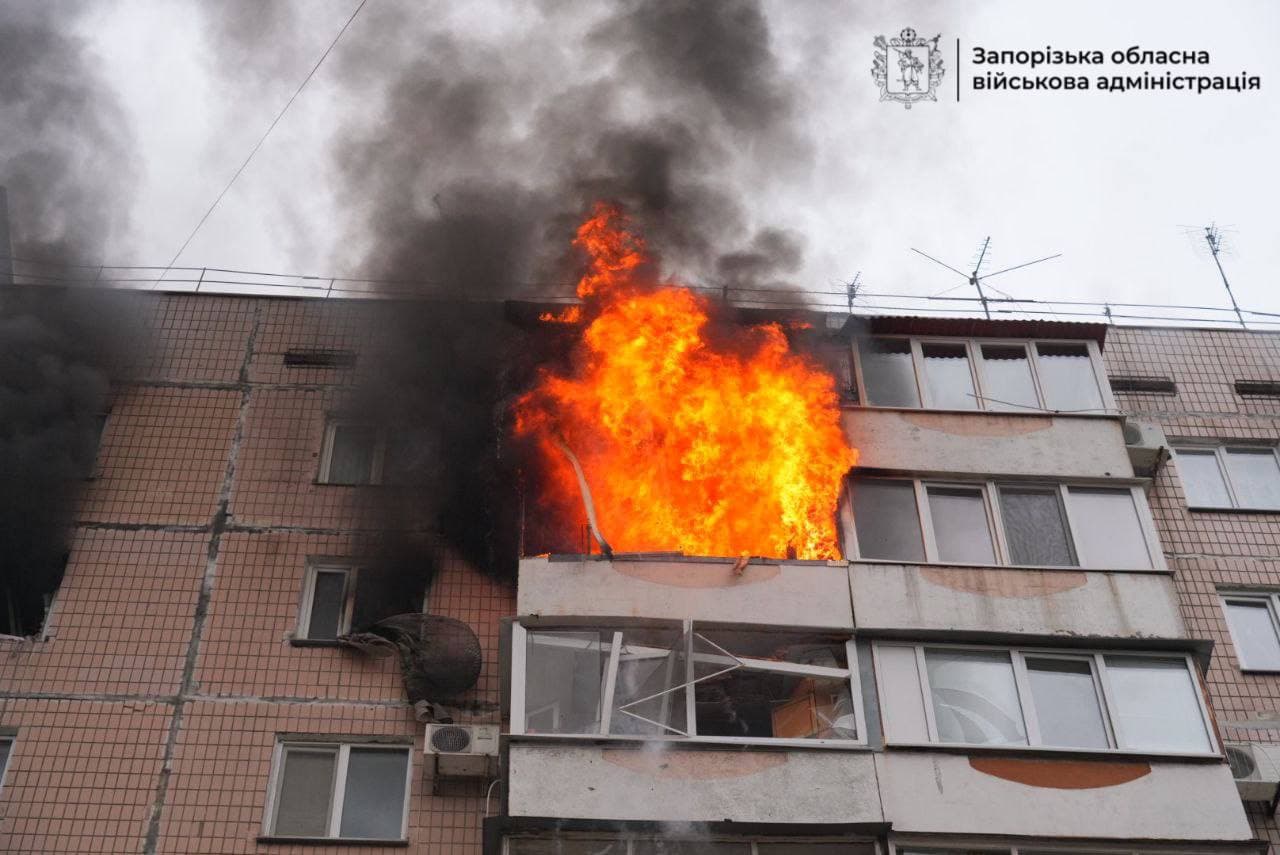
The ruins of ordinary life in Zaporizhzhia after a Russian strike—burned facades, shattered windows, and homes turned into wreckage. (Zaporizhzhia regional military administration / Telegram)
Amid the wreckage, a small rescue told its own story—a cat pulled alive from the debris, shaken but breathing, a fragile counterpoint to the violence around it.
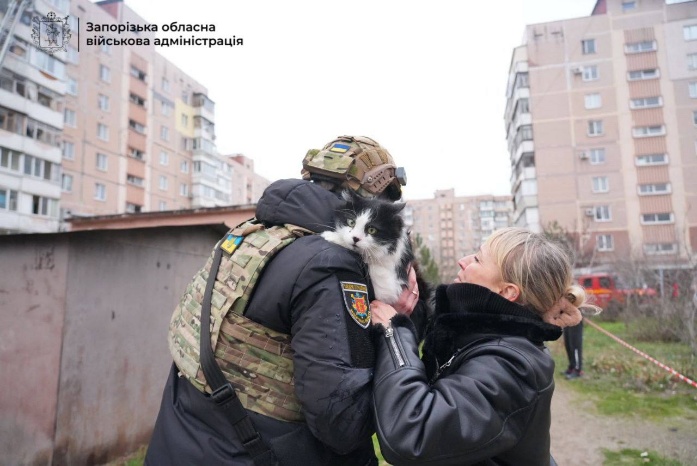
A rescued cat pulled from the rubble in Zaporizhzhia—small, shaken, and alive amid the destruction. (Zaporizhzhia regional military administration / Telegram)
The cruelty did not stop with the strike. In Druzhkivka, Russian forces followed a familiar and forbidden pattern: a second drone attack aimed at emergency responders rushing to a fire caused by an earlier strike. Four rescue workers were injured. The message was clear enough—help itself was a target.
To the south, Russian units continued probing toward Hulyaipole under cover of poor weather, slipping small groups into the outskirts while using vehicles only to resupply. Even there, the pattern held. Pressure without purpose. Violence without necessity. A war waged not just to advance lines, but to break the sense of safety at any hour of the day.
When the Flames Came to Rostov
The fire lit the night sky over Rostov’s port, bright enough to travel far beyond the docks. Ukrainian drones had struck an oil vessel overnight—whether tanker or cargo ship mattered less than the result. Flames climbed into the darkness. At least three people were killed. Others were pulled from the chaos as emergency crews fought to contain a blaze that did not belong on Russian soil.
Local officials argued over details. One called it a tanker. Another insisted it was something else. The dispute missed the point. What mattered was reach. Ukraine had shown it could hit deep inside Russia, striking targets that powered the war rather than fighting it at the front.
The Rostov strike was not alone. Across the night, Ukrainian drones fanned out toward Russia’s energy arteries. The Slavyansky Oil Refinery in Krasnodar Krai—processing millions of tons of crude each year for military supply—burned after a confirmed strike. An oil depot in Rostov Oblast was hit. So was an artillery and ammunition depot of Russia’s 101st Logistics Brigade, more than 140 kilometers from the front.
Each fire told the same story. This war does not stay where Moscow wants it. Refineries, ports, depots—these are not symbols, but systems. When they burn, trains stop. Fuel tightens. Supply chains fracture.
For Russian civilians watching videos spread across social media, the message landed closer than official statements ever could. The war their government launched was no longer distant thunder. It had arrived in ports and pipelines, in neighborhoods once assumed untouchable.
Ukraine’s campaign was not about spectacle. It was about consequence—forcing the cost of war to follow the money, the fuel, and the logistics that keep it alive. Rostov burned not as revenge, but as proof that distance no longer guaranteed safety.
When the Sky Became a Weapon
The drones came at night, when distance disappears. Sixty-nine Russian Shahed-type, Gerbera-type, and other drones rose into the air from multiple directions—Kursk, Oryol, Rostov Oblast, Krasnodar Krai, and occupied Crimea—turning the darkness itself into an attack vector.
Ukrainian air defenses intercepted thirty-seven of them. Others broke through. Twenty-nine drones struck twelve locations, hitting civilian infrastructure across Kharkiv, Kyiv, and Odesa regions. The targets were not military formations but systems that keep cities alive.
This was part of Russia’s renewed winter strategy: pressure the energy grid, sap industrial capacity, and grind down civilian endurance. Drones are cheap, persistent, and hard to fully stop. Each one forces defenders to look everywhere at once.
The aim was not a single blackout, but cumulative strain—darkness layered onto cold, uncertainty layered onto fatigue. As winter approaches, the sky has become a front line, and the war has learned how to linger overhead.
Diplomacy on One Track, Pressure on Another
American officials prepared to sit down with Russian counterparts in Miami, talking peace while the war burned on. According to Politico, the talks would pair U.S. envoy Steve Witkoff and Jared Kushner across the table from Kirill Dmitriev, the head of Russia’s sovereign wealth fund—a meeting framed as another attempt to find an off-ramp from a grinding conflict.
The discussions followed earlier consultations with Ukrainian and European officials, where familiar phrases resurfaced: “Article 5-like” guarantees, postwar reconstruction, future stability. The language suggested structure. The reality remained unresolved.
At the same time, another message leaked out. Bloomberg reported that Washington was considering new sanctions on Russia’s energy sector if Putin rejected a deal—measures aimed at shadow fleet tankers and the traders who keep Russian oil moving. The threat sounded forceful. It was also hypothetical.
A White House official confirmed that agencies were drafting options, not decisions. No sanctions had been approved. Nothing had been imposed.
The contradiction was hard to miss. Talks in Miami promised dialogue. Sanctions talk promised leverage. Yet the administration was also pressing Kyiv to consider territorial concessions, signaling urgency to compromise even as pressure on Moscow remained conditional.
Announcing sanctions instead of applying them raised the quiet question hanging over all of it: was this strategy, or hesitation? Real leverage is felt, not previewed. As diplomats packed briefing folders and reporters tracked leaks, the gap between American words and actions widened—leaving allies to wonder which message Russia was meant to hear.
A Check Written in Pencil
The Senate moved the bill through with ease. A $900 billion defense package passed 77–20, bipartisan and orderly, on its way to the president’s desk. Buried inside it was Ukraine’s share: $800 million, spread thin over two years.
That meant $400 million in 2026, and the same again in 2027—delivered through Pentagon contracts rather than direct transfers. Enough to help, enough to keep systems running, but nowhere near the scale that once defined American backing. Not surge funding. Maintenance.
Lawmakers added a safeguard of their own. The Defense Department would have to notify Congress within forty-eight hours if intelligence sharing with Ukraine were curtailed—a quiet admission of concern that support could be dialed down without a vote, without noise.
The bill also locked in a floor for U.S. troop levels in Europe, barring reductions below 76,000 for more than forty-five days. A signal to allies that Washington wasn’t leaving the continent, even as its commitment to Ukraine narrowed.
The contrast was stark. The $800 million mattered—it would buy weapons, sustain defenses, and save lives. But it was also a fraction of what had come before, and less than the cost of a single major U.S. weapons platform. Big enough to claim continuity. Small enough to mark a shift.
What passed the Senate was not abandonment. It was something colder: a recalibration. Support reduced to a baseline, war funding treated as upkeep. For Ukraine, it meant help that arrived—but with the clear message that the era of full-throated American backing was quietly giving way to something leaner, and more uncertain.
Berlin Sends Steel, Not Promises
The help from Germany came in the language Ukraine understands best: hardware, parts, and production lines. Kyiv announced new defense agreements with Berlin worth €1.2 billion—deals designed not for headlines, but for endurance.
At the center were air defenses. Germany committed to long-term spare parts for Patriot systems already protecting Ukrainian skies, cutting repair times and keeping launchers alive under constant strain. Defense Minister Boris Pistorius confirmed what had already arrived—two Patriot systems delivered earlier in the year, plus a ninth IRIS-T battery now in service.
The support went deeper than air defense. Berlin backed €200 million in Ukrainian-made drone procurement and the production of 200 Bohdana self-propelled howitzers, mounted on German Mercedes-Benz Zetros chassis. Electronic warfare systems were included. So was something new: joint production of reconnaissance drones between Germany’s Quantum Systems and Ukraine’s Frontline Robotics—the first foreign-based drone manufacturing effort dedicated to Ukraine’s military.
More missiles are coming too. Pistorius announced a transfer of AIM-9 Sidewinders next year. Designed for air combat, many have already been adapted by Ukrainian forces for ground-based defense—another example of necessity reshaping doctrine.
This was not a security guarantee. It did not promise retaliation or red lines. But it mattered. Germany has now committed €11.5 billion in aid for 2026, easing Ukraine’s looming budget pressure and reinforcing its defenses with tools that can be used immediately.
In a war crowded with conditional pledges, Berlin’s gesture stood apart. It did not speculate about the future. It delivered what Ukraine needs to survive the present.
The Bill Comes Due for Abramovich
Keir Starmer drew a line and named a sum. £2.5 billion—money frozen since the sale of Chelsea Football Club—was meant for Ukraine, and Britain was done waiting. Standing before Parliament, the prime minister gave Roman Abramovich a final chance to honor the promise he made when sanctions forced him to sell the club: the proceeds would go to victims of the war.
“The clock is ticking,” Starmer said, and the message carried weight. If Abramovich refused to act, Britain was prepared to take the matter to court.
The funds have sat untouched since 2022, locked in a British bank while lawyers debated terms and intentions. Abramovich pledged the money “for the benefit of all victims of the war in Ukraine,” but disagreements over how it should be distributed stalled any transfer. Meanwhile, the need in Ukraine only grew.
The government moved to break the stalemate. A license was issued allowing the money to be released—on one condition: every pound must go to humanitarian causes in Ukraine. Abramovich could agree, propose an acceptable alternative, or face legal action designed to force the issue.
Chancellor Rachel Reeves made clear the government’s patience was gone. Britain, she said, would do whatever was necessary to ensure the money reached those whose lives had been shattered by the invasion.
The ultimatum carried broader meaning. While the European Union wrestled with how to use frozen Russian state assets, Britain showed that private wealth tied to the war could be mobilized—decisively, publicly, and without apology. The money was there. The justification was clear. And now, the demand was simple: pay what was promised.
The Spy Among the Medics: Trust Betrayed
The Security Service of Ukraine detained a soldier who allegedly spied for Russia’s Federal Security Service while serving in Ukraine’s military. The man headed a medical unit in the Ukrainian Armed Forces and supposedly transmitted geolocations of warehouses targeted by Russian drone and missile strikes in Kyiv, Zhytomyr, and Chernihiv oblasts.
According to the SBU, the suspect had traveled to military units and logistics bases in northern Ukraine under cover of business trips. While at the facilities, he marked locations on Google Maps for reporting to the FSB, which sought coordinates of warehouses storing ammunition, drones, medical equipment, and vehicle fleets supplying the front line.
In exchange for cooperation, Russians offered money and promised to evacuate him to relatives in Russia. The SBU’s military counterintelligence exposed the plan, documented the allegations, and detained the suspect at his workplace.
The investigation revealed the FSB had recruited the suspect through Telegram channels where he urged Ukrainians to surrender to Russia. The SBU seized a smartphone and laptop the suspect allegedly used to communicate with his FSB handler.
The suspect faced life imprisonment with property confiscation if convicted under Ukraine’s treason statutes. The case illustrated challenges of maintaining security when frontline forces numbered hundreds of thousands and rear-area personnel included tens of thousands more.
A Familiar Figure Steps Back Into Command
In a brief but telling move, Oleksandr Korniyenko was elected to lead the ruling Servant of the People party once again. At 41, the deputy speaker of parliament returned to a role he once held, reclaiming the party leadership he first assumed after entering parliament in 2019 before stepping aside in 2021.
The transition was swift and unceremonious—more adjustment than upheaval. David Arakhamia, head of President Volodymyr Zelensky’s parliamentary faction, thanked the outgoing leader and publicly wished Korniyenko success.
In wartime Kyiv, even routine political reshuffles carry meaning. Stability, continuity, and familiarity now matter as much as innovation—and Korniyenko’s return signaled a preference for experience in a moment that allows little margin for distraction.
The Day’s Meaning: When Contempt Meets Calculation
This day stripped the war down to its essentials. Russia spoke in absolutes—contempt, conquest, “historical lands”—while the West answered with mechanisms, qualifiers, and promises that bent under their own weight. Putin mocked Europe as he vowed unconditional victory. Europe replied with phrases that sounded firm until examined too closely. Somewhere between them, Ukraine kept fighting.
Language did much of the damage. “Article 5-like” echoed the real thing without carrying its force. “Reparations loans” implied justice while postponing action. “Peace talks” suggested compromise even as Moscow demanded capitulation. Each phrase softened reality, turning urgency into process and danger into delay.
The gap showed everywhere. Europe had money, weapons, and legal authority—but hesitated to convert them into guarantees. Germany delivered steel and systems, but not protection. Brussels debated frozen billions while Kyiv counted the months until its budget broke. Courage, not capability, remained the missing piece.
America’s posture only deepened the uncertainty. Miami talks were announced. Sanctions were floated, not imposed. Aid arrived in maintenance-sized installments. Leverage was discussed as if it were something that could wait. The message to allies and adversaries alike was blurred.
On the battlefield, clarity returned. Pokrovsk held. Kupyansk remained contested, claimed by both sides but owned by neither. Zaporizhzhia burned at noon, civilians wounded while negotiations continued. Ukrainian drones carried the war into Rostov, proving distance no longer meant safety. Numbers—710,000 troops, 82 assaults repelled, billions frozen—meant less than resolve.
Even betrayal found its place, as a medic turned spy reminded Ukraine that trust itself is a front line.
By nightfall, the pattern was unmistakable. The war continued not because peace was unreachable, but because choosing it—through decisive action or decisive defeat—cost more than delay. Russia pressed forward on will. Ukraine resisted on necessity. Europe calculated. America hesitated.
The war, for now, belongs to those willing to act without qualifiers.