
Putin doubles down on total war aims during his annual press conference, Ukrainian drones hit Russian shadow fleet in the Mediterranean, and Zelensky meets European allies while US strikes Syria
The Story of a Single Day
December 19, 2025, marked the 1,395th day of Russia’s invasion of Ukraine, and it was a day when Vladimir Putin’s mask slipped completely. Standing before cameras during his annual Direct Line televised press conference, the Russian president didn’t just reaffirm his war aims—he revealed the absurdity of believing Russia would settle for anything less than total victory. Putin demanded Ukraine’s complete withdrawal from four oblasts he doesn’t even fully control, the replacement of Ukraine’s government with a Moscow puppet regime, and international recognition of Russian annexations. These weren’t negotiating positions. They were fantasies dressed as ultimatums.
While Putin spun tales of inevitable Russian victory and economic resilience, reality told different stories. Ukrainian forces maintained control of settlements Putin claimed Russia had seized. Ukrainian drones struck a Russian oil tanker in the Mediterranean Sea—more than 2,000 kilometers from Ukraine—in an unprecedented operation. Ukrainian President Volodymyr Zelensky met with Poland’s new president in Warsaw while a Ukrainian delegation held crucial talks in Washington about security guarantees.
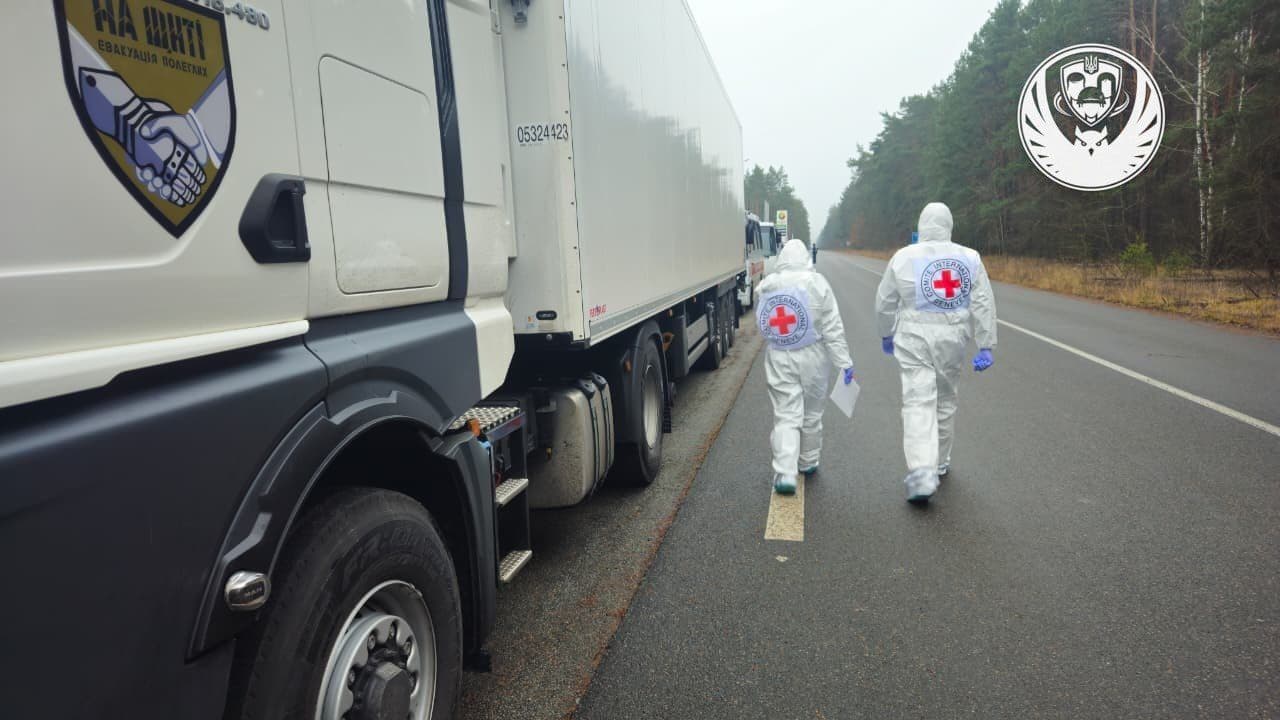
A photo published by the Coordination Headquarters for the Treatment of Prisoners of War, where two International Committee of the Red Cross workers walk on the road as the repatriation takes place. (Coordination Headquarters for the Treatment of Prisoners of War/Telegram)
The contrast between Putin’s theatrical certainty and the day’s actual developments revealed the central paradox of the war in its fourth year: Russia’s president could claim anything he wanted, but he couldn’t make those claims true.
The Dictator’s Wishlist: Putin’s Maximalist Demands
Imagine negotiating to end a war by demanding everything you failed to achieve while starting it. This was Putin’s approach during his December 19 Direct Line speech, where he laid out conditions that directly contradicted every peace proposal currently under discussion.
Putin stated that Russia would end the war only if Ukraine completely withdrew from all of Luhansk, Donetsk, Zaporizhia, and Kherson oblasts—including territory Russia doesn’t occupy—and abandoned NATO membership permanently. But he didn’t stop there. Putin’s “fundamental” position required Ukraine’s neutral status, demilitarization to the point where Ukraine couldn’t defend itself, and “denazification”—the Kremlin’s euphemism for regime change.
The demands grew more fantastical. Putin wanted international recognition of Russia’s annexation of Crimea and the four oblasts enshrined in treaties. He wanted all Western sanctions lifted. He wanted, in essence, total capitulation disguised as peace.
These maximalist demands directly contradicted the U.S.-proposed 28-point peace plan that had been circulating in recent months. That plan called for freezing the war along current frontlines and de facto U.S. recognition of occupied territories—already controversial concessions that would reward Russian aggression. But even this wasn’t enough for Putin.
The Russian president’s December 19 performance revealed a fundamental truth about negotiations with Moscow: Putin might make temporary compromises, as he claimed to have done during the August 2025 Alaska summit, but his ultimate goals never change. Any peace agreement that doesn’t include robust security guarantees for a strong Ukraine would simply give Russia time to rearm for the next invasion. The Kremlin had already explicitly rejected such security guarantees multiple times.
Putin’s fantasy demands demonstrated that he remained committed to destroying Ukrainian statehood entirely—not just seizing territory, but eliminating Ukraine’s ability to exist as an independent nation. It was a reminder that this war wasn’t about borders or security concerns. It was about one man’s refusal to accept that Ukraine had the right to chart its own course.
The Lying Liar’s Battlefield Fiction: Putin’s Exaggerated Claims
Vladimir Putin’s relationship with truth reached new depths during his Direct Line speech when he claimed Russian forces had seized settlements they demonstrably hadn’t captured. His exaggerations were so extreme they contradicted even his own military officials’ inflated claims.
Putin announced that Russian forces had seized the town of Siversk in Donetsk Oblast and Vovchansk in Kharkiv Oblast. He claimed Russia controlled 50 percent of Lyman and Hulyaipole and more than half of Kostyantynivka. None of these claims matched observable reality.
ISW’s analysis showed Russian forces maintained a presence in only 7.3 percent of Hulyaipole and 2.9 percent of Lyman. Even Russian military bloggers—typically enthusiastic amplifiers of Moscow’s propaganda—claimed Russian forces held a maximum of seven percent of Lyman and 11 percent of Kostyantynivka. Ukrainian military observer Kostyantyn Mashovets reported that Russian forces were still struggling to push Ukrainian troops out of southern Vovchansk, not celebrating its capture.
Putin’s fabrications exceeded even the claims made by Defense Minister Andrei Belousov and Chief of the General Staff Valery Gerasimov in recent days. Belousov and Gerasimov had claimed fighting was ongoing in Lyman and Hulyaipole without offering specific figures. Putin apparently decided that restraint was for subordinates.
The pattern behind Putin’s lies revealed strategic intent. He framed Russian seizures of small settlements—Vovchansk, Lyman, Siversk, Hulyaipole, each with pre-war populations between 12,000 and 20,000—as evidence that Russian forces would easily capture significantly larger cities. Putin claimed advances in Siversk and Lyman paved the way for seizing Slovyansk, a city of 105,000 people fortified since 2014.
The arithmetic didn’t work. Russian forces had spent months and suffered massive casualties capturing small towns. The cities of Slovyansk and Kramatorsk that comprised Ukraine’s Fortress Belt in Donetsk Oblast were larger, more densely populated, and far more heavily fortified than anything Russia had seized since 2022. ISW’s assessment remained unchanged: at current rates of advance and losses, it would take Russian forces two or more years to seize the remainder of Donetsk Oblast at catastrophic cost.
Putin’s exaggerations served the Kremlin’s cognitive warfare campaign aimed at convincing Ukraine and the West that Russian victory was inevitable and resistance was futile. But when a dictator has to lie about capturing towns his forces haven’t taken, it reveals weakness rather than strength.
The Kupyansk Cover-Up: When Defeat Becomes Victory
Putin’s most desperate lies concerned Kupyansk, where he tried to conceal one of Russia’s most significant recent defeats by doubling down on false narratives of success.
Putin repeated his military officials’ claims that Russian forces had seized Kupyansk “several weeks ago.” This was provably false. Putin then claimed Russian forces weren’t advancing westward from the town because they needed to eliminate Ukrainian forces on the Oskil River’s east bank and seize Kupyansk-Vuzlovyi to the south—an attempt to explain away the fact that Ukrainian counterattacks had pushed Russian forces back.
In perhaps his most absurd claim, Putin suggested that video footage of Ukrainian President Volodymyr Zelensky’s December 12 visit to Kupyansk’s southwestern outskirts was fake, arguing that Russian and Ukrainian drone activity made approaching the town impossible. The footage was genuine. What was fake was Putin’s narrative.
Reality on the ground contradicted every element of Putin’s story. Mounting evidence indicated Ukrainian forces had liberated significant portions of Kupyansk. Mashovets reported that Ukrainian forces had encircled up to two understrength Russian companies in central and southern Kupyansk along both banks of the Oskil River. The Russian Western Grouping of Forces would likely have to commit forces from other sectors to prevent complete disaster in Kupyansk.
Russia’s inability to secure Kupyansk had ripple effects across nearby sectors. The 6th Combined Arms Army found itself thinly stretched between the Vovchansk, Velykyi Burluk, and Kupyansk directions, unable to concentrate forces anywhere.
Yet Putin claimed Ukrainian attempts to retake Kupyansk had been unsuccessful and resulted in heavy losses. He suggested these failures should “encourage” Ukraine to end the war peacefully since Ukraine had “practically” no forces left to commit. It was cognitive warfare at its most transparent—using a Russian defeat as evidence Ukraine should surrender.
Putin’s explicit focus on Kupyansk demonstrated how much the battlefield reality there undermined the Kremlin’s narrative efforts. The Russian military command had falsely claimed complete control of Kupyansk in late November 2025. Ukrainian success in recapturing the town exposed those claims as lies and dealt a major blow to Russia’s efforts to portray victory as inevitable during ongoing negotiations.
When a dictator has to deny video evidence and claim his defeated forces are actually winning, it reveals the fragility of his position more clearly than any battlefield report could.
Economic Fantasy Meets Reality: The Crumbling Facade
Putin’s December 19 celebration of Russia’s economic strength would have been more convincing if his government’s own policies didn’t contradict every optimistic claim he made.
Putin proudly announced that Russian inflation would reach only 5.6 to 5.8 percent by year’s end, meeting the Kremlin’s goal of reducing it to at least six percent. He praised the Central Bank’s decision to cut the key interest rate by 0.5 percent to 16 percent. He congratulated the government on balancing the budget, though acknowledging they’d had to raise the value-added tax to do so. He lauded Russia’s unemployment rate of 2.2 percent, even lower than 2024’s historic low of 2.5 percent.
Every metric Putin cited told a different story when examined closely. U.S. Treasury Secretary Scott Bessent estimated actual Russian inflation at over 20 percent in October 2025—nearly four times Putin’s claimed figure. Russia’s extremely low unemployment rate reflected severe labor shortages rather than economic health, driving wage inflation across both civilian and defense sectors that contributed to overall inflation.
The most revealing indicator came from what Russia’s Central Bank was doing rather than what Putin was saying. In late November 2025, the Bank began selling its physical gold reserves for the first time to fund the state budget. This desperate measure revealed that Russia had steadily depleted its sovereign wealth fund’s liquid reserves financing the war and had resorted to selling gold because spending had become unsustainable.
Putin claimed the Central Bank’s international reserves were growing and currently stood at $741.5 billion. But growing reserves mean little when you’re selling gold to pay bills and raising taxes to balance budgets.
The contradiction between Putin’s triumphant economic narrative and Russia’s actual fiscal policies demonstrated the gap between propaganda and reality. The Kremlin’s effort to promote Russian economic resilience aimed to convince Ukraine and the West that Russia could outlast Ukraine on the battlefield, making capitulation the only rational choice. But Russia’s economic indicators—the real ones, not Putin’s fantasy versions—told a story of mounting strain and unsustainable trajectories.
When a government claims victory while quietly selling its gold reserves and raising taxes, the claims deserve skepticism.
The Diversity Performance: Putin’s Multinational Russia Fantasy
Putin’s December 19 promotion of Russia as a harmonious multinational, multireligious state revealed the delicate balancing act he must perform between different constituencies—and the fundamental contradictions in his vision of Russian identity.
Putin used his Direct Line speech to praise ethnic minorities serving in the Russian military, highlighting how soldiers of different nationalities and religions fight “for their homeland shoulder to shoulder.” He specifically spotlighted Senior Lieutenant Naran Ochir-Goryaev, a native of the Republic of Kalmykia who commanded an assault company, in several likely staged interactions throughout the broadcast.
The performance built toward Putin’s announcement that 2026 would be the Year of the Unity of the Peoples of Russia. Putin claimed this designation carried special importance during wartime because “when a country faces such challenges, it unites.” He stated that a Russian soldier’s religion doesn’t matter under fire and that all Russia’s peoples share common values.
Putin gave particular attention to Islam, praising it for sharing many traditional values with the Russian Orthodox Church and noting that over 10 percent of Russian citizens are Muslim. He promised to support Islamic education in Bashkortostan and all traditional religions within Russia. He praised Tatarstan as an example of peaceful coexistence that Islamic countries looked to as a model.
The narrative of civic nationalism Putin promoted—a Soviet-style vision where diverse peoples united under love for the Russian Federation—directly contradicted the views of Russia’s ultranationalist community, one of Putin’s core constituencies and among the war’s most ardent supporters. Russian ultranationalists believed Russian identity should center on ethnic Russians and the Russian Orthodox Church, not on multicultural harmony. They loudly complained about migrants, especially Muslim migrants, viewing them as threats to Russian culture.
Putin had long struggled to balance Russia’s demographic problems and labor shortages—both significantly worsened by his war in Ukraine—with ultranationalist demands for ethnic purity. His December 19 performance leaned heavily toward civic nationalism, attempting to paper over tensions that his war had exacerbated.
The gap between Putin’s harmonious vision and Russia’s actual ethnic and religious tensions revealed another contradiction at the heart of his regime. He needed bodies for his war machine from Russia’s ethnic minorities and Muslim populations. But he also needed support from ultranationalists who viewed those same populations with suspicion and hostility.
Putin’s solution was theatrical performance—staged interactions with ethnic minority officers, promises of support for Islamic education, praise for diversity and unity. But performance couldn’t resolve the fundamental tension between needing a multicultural army and maintaining support from those who wanted a monocultural Russia.
Mediterranean Strike: Ukraine’s Expanding Reach
The explosions that ripped through the Russian shadow fleet tanker QENDIL in neutral Mediterranean waters more than 2,000 kilometers from Ukraine represented something unprecedented: Ukrainian drones operating at intercontinental range against maritime targets in one of the world’s most heavily trafficked seas.
Sources within Ukraine’s Security Service published footage showing a series of blasts on the vessel and confirmed that Ukrainian long-range drones had struck the tanker in what they called “a new unprecedented special operation.” The SBU claimed the attack caused critical damage that rendered the ship unable to perform its intended purpose.
The QENDIL was empty at the time, carrying no cargo, but its role in Russia’s sanction-busting shadow fleet made it a legitimate military target according to Ukrainian intelligence. “Russia used this tanker to circumvent sanctions and earn money that financed the war against Ukraine,” the SBU source explained. “Therefore, from the point of view of international law and the laws and customs of war, this is an absolutely legitimate target.”
Russia’s shadow fleet consisted of tankers employing opaque ownership structures, flags of convenience, and irregular shipping practices to move Russian oil despite Western restrictions. Each successful tanker voyage generated revenue that funded Russia’s war machine. Each tanker damaged or destroyed reduced that revenue stream.
The Mediterranean strike followed recent Ukrainian attacks on Russian tankers in the Black Sea. In late November, the SBU claimed strikes on the sanctioned tankers Kairos and Virat off Turkey’s coast. On December 10, Ukrainian Sea Baby naval drones struck another shadow fleet vessel in the Black Sea.
The expanding geographic range of Ukrainian strikes demonstrated technological advancement and strategic calculation. Ukrainian forces were systematically targeting Russia’s ability to generate war revenue wherever that capacity existed—whether in refineries 1,500 kilometers inside Russia or tankers in Mediterranean shipping lanes.
The operation’s unprecedented nature—Ukrainian drones operating in neutral waters of an enclosed sea surrounded by multiple nations—raised questions about international response and potential limitations. But for Ukrainian planners, the calculation was straightforward: Russia used these vessels to fund aggression against Ukraine, making them legitimate targets regardless of location.
The SBU’s emphasis on causing no environmental damage, noting the tanker was empty, suggested awareness of international sensitivities about maritime strikes. But the operation’s success demonstrated that Ukrainian forces could reach Russian assets nearly anywhere, transforming the war’s geographic scope.
The Eastern Front: Reality Beyond Putin’s Claims
While Putin fabricated tales of captured cities, actual combat across eastern Ukraine told a different story—one of grinding Russian assaults that achieved limited gains at enormous cost while Ukrainian forces maintained defensive positions and even counterattacked successfully.
Russian forces did make some confirmed advances. In northern Kharkiv Oblast, Ukrainian military observer Kostyantyn Mashovets reported Russian seizure of Synelnykove and Tsehelne northeast of Kharkiv City. Geolocated footage showed Russian advances south of Pleshchiivka southeast of Kostyantynivka and to the northern outskirts of Zapovidne southeast of Dobropillya.
But these tactical gains came amid broader patterns that contradicted Putin’s victory narrative. In the Vovchansk direction, Russian forces remained unable to advance along the T-2104 road despite constant attacks. Ukrainian brigade spokespeople reported maintaining control of settlements—Stavky and Novoselivka—that Russia’s Ministry of Defense claimed to have seized in November.
Weather conditions across the front significantly affected operations. Fog, rain, and snow degraded drone operations for both sides, creating windows for mechanized assaults but also opportunities for defensive stands. Ukrainian commanders reported Russian forces struggling to coordinate armored attacks during foggy weather despite attempting to exploit reduced Ukrainian drone effectiveness.
In the Kupyansk direction, Ukrainian forces gained fire control over the Kupyansk-Holubivka road, a critical Russian ground line of communication. Mashovets assessed that Russian forces’ culture of false reporting to superiors had influenced the command’s decision-making while Ukrainian counterattacks progressed. Muddy conditions made wheeled vehicle operations difficult for Russian forces.
The Lyman direction saw continuous Russian attacks using infiltration tactics, though Ukrainian sources reported Russian forces sometimes sent assault infantry into combat without drone support. The 425th Skelya Regiment spokesperson noted most Russian servicemembers received only a month of training before frontline deployment—a detail that explained much about Russian tactical performance.
Across multiple sectors, Ukrainian forces demonstrated resilience that made mockery of Putin’s claims about inevitable collapse. In the Oleksandrivka direction, Ukrainian forces repelled a reinforced platoon-sized Russian mechanized assault, destroying one tank, one armored fighting vehicle, one infantry fighting vehicle, two trucks, and killing 35 personnel. Ukrainian drone operators extended their effective strike range to over 21 kilometers from frontline positions near Pokrovsk.
The reality of the eastern front—small Russian gains purchased at massive cost, Ukrainian defensive successes, weather-dependent tactical windows—bore no resemblance to Putin’s fantasy narrative of rapid advances toward major city seizures.
The Long-Range Campaign: Striking Russia’s War Economy
While Putin praised Russian economic resilience, Ukrainian drones continued systematically dismantling the infrastructure that generated war revenue, with December 18-19 strikes demonstrating the breadth and sophistication of Ukraine’s long-range campaign.
Ukrainian Security Service sources published footage of their strike on a Lukoil oil rig in the Rakushechnoye field in the Caspian Sea—the third such facility Ukrainian forces had recently struck in that body of water. The rig’s gas turbine became another casualty in Ukraine’s campaign against Russia’s energy sector.
Geolocated footage showed fire at the Oryol Thermal Power Plant in Oryol City following a reported Ukrainian drone strike. Regional Governor Andrey Klychkov confirmed the attack caused power outages in Sovetsky Raion. The strike demonstrated Ukrainian ability to target energy infrastructure hundreds of kilometers inside Russia.
In Tolyatti, Samara Oblast, Ukrainian forces likely struck the TogliattiAzot plant, one of Russia’s largest chemical facilities with annual production capacity of three million tons of ammonia. The facility’s products included both agricultural fertilizers and components for explosives manufacturing—dual-use capacity that made it a legitimate military target.
The pattern across these strikes revealed strategic calculation. Ukrainian forces weren’t randomly attacking Russian infrastructure—they were systematically targeting facilities that generated revenue, produced military materials, or sustained Russia’s war-making capacity. Each refinery fire, each damaged power plant, each disrupted chemical facility reduced Russia’s ability to fund and equip its invasion.
The strikes also served psychological purposes. Every Russian city that experienced air raid alerts, every region that dealt with power outages, every facility evacuation reminded Russian civilians that their government’s war had consequences reaching far beyond distant battlefields. Geographic distance no longer guaranteed safety.
For Russian authorities, the expanding strike campaign created impossible security problems. Thousands of energy facilities, chemical plants, refineries, and transportation nodes across Russia’s vast territory couldn’t all be defended. Every soldier assigned to infrastructure protection was one less soldier available for frontline combat.
The long-range campaign demonstrated Ukraine’s evolution from a nation pleading for weapons to defend itself into a force capable of projecting power across a continent, striking targets that generated the resources funding Russian aggression.
The Human Cost: Odesa Under Fire
The Russian missile strike on port infrastructure in Odesa Oblast the night of December 19 killed at least eight people and injured 27 others, with some victims caught on a bus at the strike’s epicenter. It was the latest in Russia’s sustained campaign against civilian targets disguised as attacks on military infrastructure.
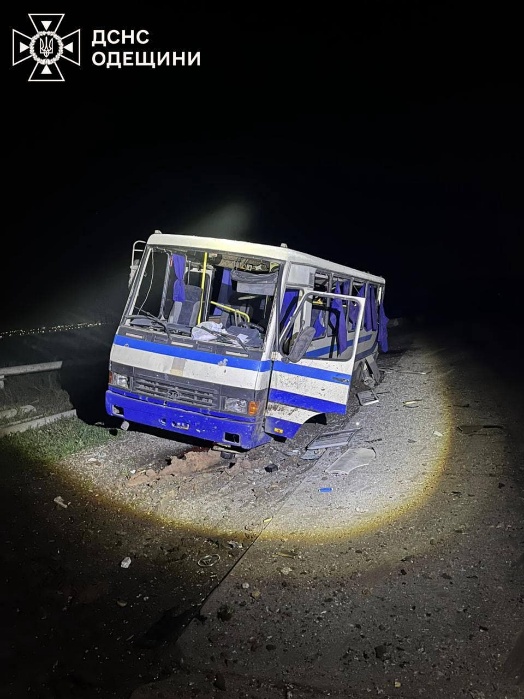
A bus damaged in a Russian missile attack on Odesa Oblast, which killed eight people and injured 27 others late. (State Emergency Service/Telegram)
Regional Governor Oleh Kiper reported that Russian ballistic missiles “massively attacked” the port facility, causing fires among cargo trucks in the parking area. Nearby cars sustained damage. The State Emergency Service worked to extinguish fires and extract victims from debris—work that had become grimly routine in Odesa Oblast.
The strike followed a Russian drone attack the previous night that damaged a bridge on the M15 Odesa-Reni highway near Mayaky, leading neighboring Moldova to close nearby border checkpoints. Ukrainian electronic warfare expert Serhiy Beskrestnov reported that Russian forces had targeted the Mayaky bridge with 10 Shahed drones overnight, five more during the day, and an unspecified ballistic missile in the afternoon—all using cluster warheads.
The cluster munition use revealed Russian tactical evolution in infrastructure strikes. The warheads couldn’t damage the bridge itself, but they could kill repair crews attempting to restore functionality. Ukrainian military observer Yuriy Butusov published footage showing a Russian drone striking a car on an Odesa bridge, killing one civilian and injuring three children—what observers called Russia’s “human safari” tactics.
Ukrainian Energy Research Center Director Oleksandr Kharchenko noted that Russian forces were increasingly targeting smaller transformer stations rather than major power facilities, especially in Odesa Oblast and frontline areas. This tactical shift aimed to complicate repairs by hitting distribution networks and striking repair teams.
The sustained campaign against Odesa Oblast—targeting ports, bridges, energy infrastructure, and civilians—served multiple Russian objectives. It disrupted Ukraine’s ability to export goods and receive supplies. It degraded civilian morale through constant alerts and blackouts. It demonstrated Russian willingness to strike civilian targets regardless of international condemnation.
For Odesa residents enduring the fifth day of blackouts, without water or heat in winter, the war wasn’t an abstraction debated in press conferences or negotiation rooms. It was the sound of air raid sirens, the sight of missile impacts, the cold darkness of apartments without power, and the bodies of neighbors killed while simply trying to live their lives.
Bodies Returned: The Grim Accounting
The return of 1,003 fallen Ukrainian soldiers’ bodies on December 19 represented both diplomatic progress and tragic reminder of the war’s human cost. Each body returned was a family that could finally bury their loved one, a soldier who came home even if not alive.
Vladimir Medinsky, an aide to Putin serving as chief negotiator, stated that Moscow returned the Ukrainian bodies under the Istanbul agreements in exchange for 26 fallen Russian soldiers. The wildly asymmetric exchange ratio—39 Ukrainian bodies for each Russian one—reflected either the intensity of Russian casualties that made comprehensive repatriations impossible or Moscow’s negotiating priorities.
The announcement came as Moscow and Kyiv continued peace talks under American pressure to end the war. More bodies of fallen Ukrainian soldiers had returned home after negotiations began in early 2025 than in previous periods, suggesting body exchanges might be one area where talks produced tangible results.
The Istanbul agreements referred to 2025 Moscow-Kyiv negotiations held in Turkey that established frameworks for repatriation. The first exchange under these agreements occurred in June, and thousands of bodies had returned since then—each one representing a story ended too soon, a future cancelled by violence.
The Coordination Headquarters for the Treatment of Prisoners of War thanked the International Committee of the Red Cross and Ukrainian institutions for assistance in repatriation efforts. Law enforcement and Interior Ministry institutions would conduct examinations to identify the bodies, as Russia often commingled remains or provided incomplete documentation.
The grim mathematics of body exchanges revealed truths about the war’s human cost that official casualty figures obscured. Every returned soldier represented families waiting months or years for closure, frontline units unable to retrieve their dead from contested ground, and the permanent demographic wounds Russia’s invasion inflicted on Ukraine.
For those receiving returned loved ones, Putin’s December 19 press conference claims about inevitable victory and economic strength meant nothing. Their reality was loss made permanent, grief finally allowed proper expression through burial, and the knowledge that someone they loved had died defending Ukraine from the megalomaniac spouting lies on television.
Warsaw Summit: When Presidents Meet
The meeting between Ukrainian President Volodymyr Zelensky and Poland’s newly inaugurated President Karol Nawrocki in Warsaw on December 19 carried weight beyond standard diplomatic protocol. It was Nawrocki’s first meeting with a foreign leader since taking office, and he chose to make it about Ukraine.
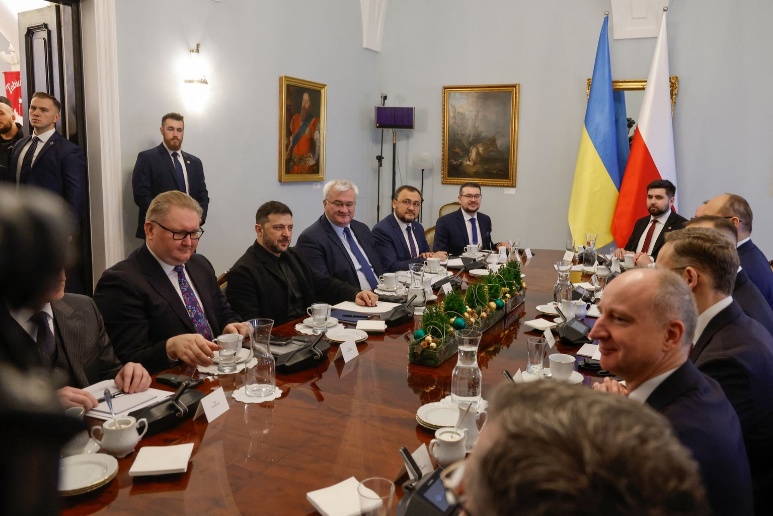
President Volodymyr Zelensky and his Polish counterpart Karol Nawrocki and their delegations take part in talks at the Presidential Palace in Warsaw, Poland. (Wojtek Radwanski/AFP via Getty Images)
“President Volodymyr Zelensky’s visit is evidence that in strategic matters and security issues, Poland, Ukraine, and the countries of the region stand together,” Nawrocki told journalists. He added pointedly that the meeting was “bad news for Russia.”
The two leaders discussed security, economic, and historical matters—the full range of issues that complicated and connected their nations. Nawrocki acknowledged that Poland felt its extensive aid to Ukraine since the invasion began “has not been sufficiently recognized.” Zelensky responded by expressing gratitude while emphasizing shared stakes: “Without our independence, Moscow will inevitably push further into Europe and will come for Poland.”
The substantive discussions centered on war-related cooperation. Kyiv proposed consultations with Warsaw on drone defense, particularly relevant given Russian drones’ repeated violations of NATO airspace over Poland in recent months. Nawrocki didn’t exclude the possibility of delivering MiG-29 fighter jets to Ukraine and expressed expectations that Kyiv would share drone production technologies with Poland in exchange.
The meeting occurred against a backdrop of growing Polish-Ukrainian tensions despite Poland’s role as one of Ukraine’s key allies. Since taking office, Nawrocki had spoken critically about Kyiv’s EU and NATO ambitions while highlighting historical grievances, particularly the Volyn massacre of 1943-1944 when Ukrainian Insurgent Army members killed tens of thousands of Poles.
Representatives from the National Memory Institutes of Ukraine and Poland held talks in Warsaw the same day. Zelensky addressed the historical tensions directly: “We respect the Polish perspective on the path of our nations, and we honor your memory of what has been. We count on your respect for our Ukrainian memory.”
Later that day, Zelensky also met with Polish Prime Minister Donald Tusk. The visit to Warsaw followed his trip to Brussels and came as Ukraine navigated increasingly complex diplomatic waters—balancing historical reconciliation, security cooperation, and resistance to pressure for territorial concessions.
The choice of Warsaw for this high-level diplomacy carried its own message. While Putin demanded capitulation and Washington pushed for deals, Ukraine was reinforcing alliances with frontline NATO states that understood existential threats weren’t abstractions but realities at their borders.
Washington Talks: Security Guarantees in Focus
While Zelensky navigated European diplomacy in Warsaw, a Ukrainian delegation led by Rustem Umerov, secretary of the National Security and Defense Council, met with American and European officials in the United States on December 19 for another round of talks amid the ongoing peace push.
General Andrii Hnatov, chief of Ukraine’s General Staff, participated in the discussions that focused on what Umerov called “priorities defined by the president: Ukraine’s security must be guaranteed reliably and in the long term.”
“We agreed with our American partners on further steps and the continuation of our joint work in the near future,” Umerov reported after the meeting, adding that he had briefed Zelensky on the discussion details.
The talks came as the Trump administration increased pressure on Kyiv to consider territorial concessions as part of a broader effort to end the war at all costs. Earlier in the week, U.S. Special Envoy Steve Witkoff and Trump’s son-in-law Jared Kushner had held meetings in Berlin with Ukrainian and European officials, where discussions focused on “Article 5-like” security guarantees for Ukraine as well as post-war recovery and reconstruction funding.
The American officials were also expected to meet with Kirill Dmitriev, head of Russia’s sovereign wealth fund, over the weekend—a detail that revealed the complex diplomatic dance underway. Moscow continued seeking major territorial concessions, including Ukraine relinquishing the entire Donbas region, encompassing both Russian-occupied territories and areas still held by Ukrainian forces.
Zelensky had reaffirmed Kyiv’s position on December 15, telling journalists that Ukrainian troops wouldn’t withdraw from embattled Donetsk Oblast. The December 19 Washington talks represented Ukraine’s attempt to secure the robust security guarantees necessary to prevent renewed Russian aggression—the very guarantees the Kremlin had explicitly rejected multiple times.
The parallel diplomatic tracks—Zelensky in Warsaw, Umerov in Washington—demonstrated Ukraine’s multi-front approach to negotiations. European allies needed reassurance about continued cooperation. American officials needed reminding that sustainable peace required genuine security guarantees, not just territorial concessions that would invite future invasion.
“We are committed to a constructive process,” Umerov had written before the talks. The challenge was ensuring that “constructive” didn’t become code for “accommodating Russian demands at Ukraine’s expense.”
Syria Strikes: When Trump Declares Vengeance
The United States carried out major airstrikes in Syria on December 19 in what Defense Secretary Pete Hegseth called “Operation Hawkeye”—a retaliation for the deaths of two American soldiers and a civilian interpreter in a December 13 shooting Washington attributed to ISIS.
“This is not the beginning of a war—it is a declaration of vengeance,” Hegseth wrote, adding that “the United States of America, under President Trump’s leadership, will never hesitate and never relent to defend our people.”
The Defense Department’s Central Command announced that U.S. forces had commenced “a large-scale strike against ISIS infrastructure and weapons sites in Syria.” Hegseth stated the operation aimed to “eliminate ISIS fighters, infrastructure, and weapons sites.”
The strikes came just over a month after Trump had hosted Syrian President Ahmed al-Sharaa at the White House—the first visit to Washington by a Syrian head of state since 1946. Trump had cast the move as support for al-Sharaa, a former rebel commander once labeled a terrorist by the U.S., whose coalition had ousted the Russian-backed Bashar al-Assad regime in December 2024.
Trump claimed al-Sharaa was “fully in support” of the operation. “We are striking very strongly against ISIS strongholds in Syria … the government of Syria led by a man who is working very hard to bring greatness back to Syria, is fully in support,” Trump wrote on Truth Social.
The operation’s name—Hawkeye—referenced Iowa, home state of the two killed soldiers, nicknamed the Hawkeye State. It was characteristic Trump theater: dramatic naming, declarations of vengeance, emphasis on decisiveness and strength.
The irony wasn’t subtle. Trump ordered massive airstrikes in Syria in response to three American deaths while simultaneously pressuring Ukraine to accept a peace deal that would reward Russia for killing tens of thousands of Ukrainians and devastating entire regions. American blood demanded immediate military retaliation. Ukrainian blood apparently demanded diplomatic accommodation of the aggressor.
The strikes also complicated the regional situation. Assad had fled to Russia and remained there, a reminder that Moscow’s influence in Syria persisted despite the regime change. Ukraine and Syria had restored relations in September after al-Sharaa met Zelensky during the U.N. General Assembly, creating diplomatic connections that Russia surely noticed.
For Ukrainian observers, the contrast between American responses to different conflicts was stark. Three American deaths triggered “Operation Hawkeye” and declarations of vengeance. Hundreds of thousands of Ukrainian casualties triggered pressure for territorial concessions and warnings not to escalate tensions with Russia.
Rubio’s Caribbean Focus: When Russia Isn’t the Priority
U.S. Secretary of State Marco Rubio told reporters on December 19 that the United States was “not concerned” about escalating tensions with Russia as Washington built up military forces in the Caribbean and ramped up aggression against Venezuela.
“We’re not concerned about an escalation with Russia, with regards to Venezuela,” Rubio said at a press briefing. “We’ve always expected them to provide rhetorical support for the Maduro regime. I think they have their hands full in Ukraine.”
The statement came as the U.S. had been carrying out deadly strikes on boats in the Caribbean Sea, claiming without evidence that vessels were linked to drug trafficking. The Trump administration had deployed thousands of troops to the region, seized a sanctioned oil tanker off the Venezuelan coast, and declared a “total and complete blockade” of all sanctioned oil vessels entering and leaving Venezuela.
Rubio’s remarks followed a Russian Foreign Ministry warning the previous day that Trump shouldn’t make a “fatal mistake” in Venezuela. Rubio dismissed the statement as “expected” and “not a factor in how we consider this whole thing.” He interrupted his own remarks to wish Russian Foreign Minister Sergey Lavrov a “merry Christmas.”
Venezuela’s government maintained close ties with Moscow, and President Nicolas Maduro had denounced Western sanctions on Russia. The Washington Post had reported that Venezuela requested military aid from Russia amid Trump’s escalating strikes, with Maduro writing Putin requesting repairs for radars, military aircraft, and possibly missile supplies.
Trump had announced plans to designate the Maduro regime a “terrorist organization.” Maduro accused Trump of attempting to seize Venezuela’s natural resources, including oil, gas, and gold.
The Caribbean focus revealed Trump administration priorities that jarred with its Ukraine policies. Rubio could dismiss Russian warnings about Venezuela as irrelevant because Russia had “their hands full in Ukraine.” But that same administration pushed Ukraine toward territorial concessions partly to avoid escalating tensions with Russia.
The message was clear: American interests in the Caribbean justified ignoring Russian objections and risking escalation. Ukrainian interests in defending its territory didn’t justify similar resolve. Russia’s hands being “full in Ukraine” made it safe to ignore Moscow’s preferences in Venezuela but somehow made it necessary to accommodate Moscow’s demands regarding Ukraine.
For Ukrainian officials watching these statements, the contradiction was painfully obvious. The United States would confront Russia when American interests were at stake. But when Ukrainian survival was on the line, avoiding escalation with Russia became the priority.
The Day’s Meaning: When Lies Met Reality
December 19, 2025, crystallized the fundamental dynamic of the war entering its fourth year: the growing gap between what Russia’s president claimed and what actually existed on the ground.
Putin could claim Russia had seized cities it demonstrably hadn’t captured. He could insist Russia’s economy was thriving while his government sold gold reserves and raised taxes. He could demand Ukraine’s complete capitulation while Russian forces struggled to hold small towns and Ukrainian drones struck targets across continents. He could perform elaborate theatrical celebrations of diversity while needing bodies from ethnic minorities to sustain his war.
But claiming something doesn’t make it true. And the day’s actual developments—Ukrainian success in Kupyansk, Ukrainian drones in the Mediterranean, Zelensky’s diplomatic push in Warsaw, continued strikes on Russian infrastructure, American military action in Syria while pressuring Ukraine for concessions—revealed reality’s stubborn resistance to propaganda.
The contrasts were stark everywhere. Trump ordered massive airstrikes in Syria to avenge three American deaths while pushing Ukraine toward territorial concessions despite hundreds of thousands of Ukrainian casualties. Rubio dismissed Russian objections about Venezuela because Moscow had its “hands full in Ukraine” while simultaneously accommodating Russian demands regarding Ukraine itself. Putin claimed economic strength while selling gold to fund his war.
The war had evolved beyond Putin’s ability to control its narrative. Ukrainian forces that were supposed to have collapsed kept fighting and even counterattacking successfully. An economy that was supposed to be resilient kept showing strain. Allies that were supposed to abandon Ukraine kept supporting it, even if that support came with frustrating contradictions. A nation that was supposed to surrender kept striking back across thousands of kilometers.
Putin’s December 19 performance demonstrated that he remained committed to total victory regardless of cost or feasibility. His maximalist demands showed he would accept nothing less than Ukraine’s destruction as an independent state. His lies about battlefield success revealed his need to maintain the illusion of inevitable triumph even as evidence contradicted his claims.
But the same day that exposed Putin’s fantasies also demonstrated Ukraine’s growing capabilities, diplomatic resilience, and the determination of a nation that refused to disappear no matter how many times Russia’s president declared its defeat inevitable.
The bodies of 1,003 fallen soldiers returned home that day—a grim reminder that the war’s human cost continued mounting. But those soldiers had died defending a Ukraine that remained free, independent, and capable of striking back at the aggressor who launched this catastrophic invasion.
The question wasn’t whether Putin would continue lying—that was certain. The question was whether Ukraine and its allies would maintain the strength and unity to ensure those lies never became reality. On this single day in December, despite all the contradictions and complications, the answer remained clear: they would.