
As Russian diplomats met U.S. envoys in Miami, Ukraine answered on the battlefield—obliterating fighter jets in Crimea while Russian missiles turned a civilian bus in Odesa into a mass-casualty scene.
The Day’s Reckoning
On December 20, 2025, the war delivered its reckoning with unforgiving clarity. In Miami, Russian negotiator Kirill Dmitriev sat across from American envoys Steve Witkoff and Jared Kushner, speaking the language of diplomacy, while on the ground Ukraine spoke in fire and steel. Ukrainian drones obliterated Russian Su-27 fighter jets at Belbek Airbase in occupied Crimea. In Odesa, rescue workers pulled bodies from a shattered bus at the center of a Russian missile strike on port infrastructure. In Kyiv, President Volodymyr Zelensky rejected U.S.-backed proposals for Ukrainian troop withdrawals and signaled change by moving to replace his Southern Air Command chief. Far beyond Ukraine’s borders, Ukrainian Special Operations Forces struck a Russian patrol vessel in the Caspian Sea, proving distance no longer guaranteed safety.
This was the 1,396th day of a war waged in two irreconcilable realities: one of conference rooms, ceasefire frameworks, and “free economic zones,” and another of burned aircraft, shattered civilians, and drones reaching farther than anyone thought possible. The day offered no synthesis between those worlds—only a reckoning that diplomacy and destruction were advancing side by side, neither yet powerful enough to end the other.
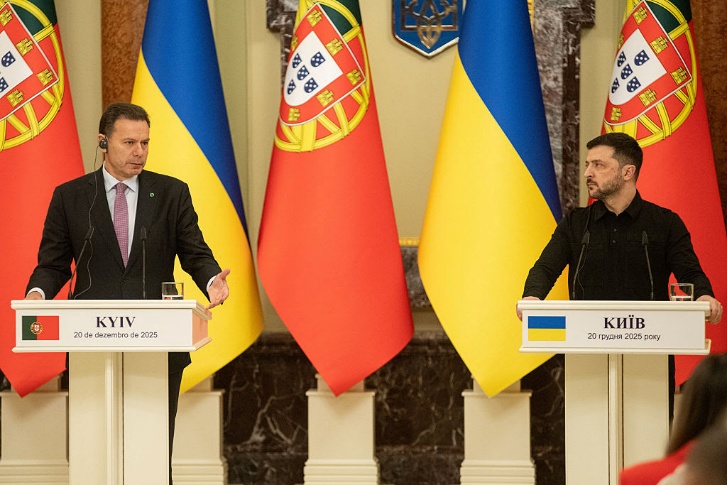
Portuguese Prime Minister Luís Montenegro stands beside President Volodymyr Zelensky in Kyiv, a moment of diplomacy set against the daily reality of a nation at war. (Photo by Stringer / Anadolu via Getty Images)
Across the Table, an Ocean Away from the War
Miami’s palm-lined calm made an uneasy stage for a war still burning. When Kirill Dmitriev arrived, there were no flags lowered, no ceasefire silencing the guns—only conference rooms and careful words. Russia’s chief investment executive and Kremlin envoy sat down with American intermediaries Steve Witkoff and Jared Kushner, calling the talks “constructive,” even as the fighting that framed them showed no sign of pause.
Outside the meetings, Dmitriev confirmed the conversations would continue. What he also confirmed—quietly but decisively—was what would not happen: there would be no Ukrainians at the table. The negotiations moved instead in relay, envoys shuttling between sides that refused to face each other directly. It was diplomacy by distance, shaped by the reality that Moscow and Kyiv were not speaking the same language about what peace even meant.
As the talks unfolded, President Volodymyr Zelensky seized the moment to redirect the narrative. Peace, he insisted, could not be separated from legitimacy. He said Ukraine was prepared to hold presidential elections—but only if they could be real: soldiers voting from the front, international observers watching closely, and at least a temporary ceasefire to make democracy possible. Behind the scenes, Ukraine’s Foreign Ministry worked on the logistics of giving millions of displaced citizens abroad a voice.
The point was not just procedure. It was principle. Zelensky made clear that no agreement could claim legitimacy while Russian forces occupied land where Ukrainians could not vote. And he stripped the negotiations of illusion with a blunt reminder: this war was never about borders alone. It was about power—who gets to decide a nation’s future. And Russia, he warned, would never be satisfied with territory freely handed over.
Fire on the Runway: Crimea’s Illusion of Control Goes Up in Smoke
The runway at Belbek Airbase was quiet when the drones arrived. One Su-27 sat on the taxiway near Sevastopol, fuelled, armed, and moments away from a combat sortie. Its pilot never climbed aboard. Ukrainian long-range drones, launched by the Security Service of Ukraine’s Alpha Special Operations Center, struck first—turning the fighter into a fireball of aviation fuel, ammunition, and twisted metal. A second Su-27 followed. By dawn, two of Russia’s frontline jets were gone.
The SBU released geolocated footage within hours. The images did more than confirm success. They delivered a blunt reminder: eleven years after Russia seized Crimea, Moscow still could not shield its most prized military assets. Roughly $70 million in aircraft burned on the tarmac, and the airfield’s control tower took damage serious enough to disrupt flight operations. Belbek, once a symbol of Russia’s grip on the peninsula, had been publicly humbled.
This was not supposed to happen. Belbek was layered with air defenses, early-warning radars, and electronic warfare systems refined over years. Yet Ukrainian drones pierced those layers with lethal precision, striking jets loaded with live ordnance. The failure pointed to an uncomfortable truth for Moscow—either its defenses were dangerously porous, or Ukraine’s drone warfare had leapt far beyond what Russia had prepared to counter.
The timing sharpened the message. While Russian negotiators in Miami spoke confidently about holding Crimea “forever,” Ukrainian forces were dismantling the military infrastructure that made that claim plausible. Occupation looked less permanent when fighter jets exploded under the cameras’ gaze.
The pressure did not stop at Belbek. Ukraine’s General Staff reported a successful strike on an RSP-6M2 landing radar near Krasnosilske, a system critical for guiding aircraft during poor visibility. Its loss mattered in winter. Storms, fog, and darkness now meant higher risk for every Russian pilot trying to land on the peninsula.
Together, the strikes rewrote the balance sheet of control. Crimea was still occupied—but it was no longer secure. And each burning aircraft made Moscow’s promises sound thinner than the smoke rising from Belbek’s runway.
Nowhere Is Far Enough: Ukraine Takes the War to the Caspian
The Caspian Sea was supposed to be beyond the war. Ringed by Russia, Iran, Kazakhstan, Turkmenistan, and Azerbaijan, it lay hundreds—possibly more than a thousand—kilometers from Ukraine’s borders. Strategic depth made water feel safe. Then Ukrainian drones arrived.
Special Operations Forces confirmed what Russian planners had long assumed was impossible: kamikaze drones struck a Russian Project 22460 Hunter-class patrol vessel and an oil platform at the Filanovsky oil and gas field. The patrol ship, built specifically to counter aerial and surface threats, never saw the weapon that found it. Systems designed to defend against drones failed to stop one. The irony was brutal—and unmistakable.
How the drones reached the Caspian remains classified. What mattered was the distance. Depending on launch points and flight paths, the journey may have exceeded 1,500 kilometers. Western analysts had already revised Ukrainian drone range estimates upward multiple times. The Caspian strikes rendered even those revisions obsolete. If Ukraine could thread drones through Russian airspace to hit maritime targets in an enclosed sea, then Russia’s concept of strategic rear areas was no longer real.
The oil platform strike carried weight beyond the explosion itself. Filanovsky, operated by Lukoil, held an estimated 129 million tons of oil and 30 billion cubic meters of gas. This was not just infrastructure—it was revenue. Continuous extraction fed Russia’s budget and, by extension, the war. Hitting it meant targeting the economic bloodstream that kept Russian forces moving.
The psychological effect traveled farther than the drones ever could. Distance had been Moscow’s comfort. Geography, its shield. The Caspian operation shattered both assumptions. The war Putin promised would stay on Ukrainian soil was now reaching deep into Russia’s own spaces.
For Russian coast guardsmen and oil workers far from the front, the message was personal and unsettling. The war had found them too.
A Bus, a Blast, and a Harbor of Death: Odesa Pays the Price
The missile struck without warning. A civilian bus—moving through Odesa near the port—vanished at the center of the explosion. By morning, at least eight people were dead and 27 wounded, their lives folded into what Russia framed as an attack on “infrastructure.” The port had been the target. The bus was collateral. The dead were civilians who happened to be there.
Fire tore through a parking area packed with cargo trucks. Shrapnel shredded nearby vehicles. Smoke rose over the harbor as emergency crews worked through twisted metal and burning debris. Deputy Prime Minister Oleksiy Kuleba called the strikes systematic—an intentional effort, he said, to break the Odesa region by terrorizing civilians and crippling logistics that kept southern Ukraine connected and supplied.
The violence did not end with the first blast. After 8 a.m., another missile hit the port of Pivdennyi, slamming into storage tanks in a follow-up strike that underscored intent. This was not a single blow. It was a campaign.
Overnight, Russia launched three Iskander-M ballistic missiles from occupied Crimea and 51 attack drones, including roughly 30 Shahed loitering munitions. Ukrainian air defenses shot down 31 drones. Ballistic missiles and 20 drones got through, striking 15 locations across the country.
Energy facilities absorbed much of the damage. Power generation, transmission, and distribution sites were hit in Mykolaiv, Kherson, Donetsk, and Dnipropetrovsk oblasts. In Odesa alone, more than 37,000 households lost electricity. Water and heat held—for now.
President Volodymyr Zelensky made the strategy explicit. Russia was trying to choke bridges and ports to trigger shortages of fuel, food, and medicine. His response carried consequence: the planned replacement of Southern Air Command chief Dmytro Karpenko. Air defenses had failed. Command would change.
Elsewhere, the toll kept rising. One person killed in Donetsk Oblast. Ten injured in Zaporizhzhia. Eight wounded in Kherson, including two children. Apartment blocks cracked open. Houses shattered.
In Odesa, it started with a bus. And ended with a city counting its dead.
Trading Blood for Ground: The War That Moves by Meters
While drones burned jets in Crimea and diplomats talked peace in Florida, the real war crept forward on foot. It moved in fog, snow, and shattered streets—measured not in breakthroughs, but in meters paid for with lives.
In Kupyansk, Ukrainian troops pushed forward along the P-79 highway, inching through the city’s center under constant pressure. Russian forces pressed from every direction—near the city itself, east toward Petropavlivka, southeast near Stepova Novoselivka and Pishchane, and south near Kupyansk-Vuzlovyi. Geolocated footage showed Ukrainian gains, but Russian milbloggers countered with claims of Ukrainian attacks from Sobolivka, Myrove, and within Kupyansk itself. The truth lay between them: a city still contested, no side able to force a decisive turn.
Farther south, the Hulyaipole direction told the same story. Russian units advanced into central Dobropillya and Varvarivka, with infiltrations reaching into Hulyaipole itself. Yet videos soon surfaced of Ukrainian forces taking Russian prisoners in areas Moscow had already declared “liberated.” Control shifted block by block, sometimes room by room, in fights where maps lagged behind reality.
Near Pokrovsk, Russian tactics shrank. Assaults came in small groups, then smaller still—two soldiers raising a flag in Svitle, a gesture more symbolic than territorial. Russian sources proclaimed progress in northern Myrnohrad, even announcing the city’s capture, only to be corrected by their own peers as Ukrainian troops remained inside.
A Ukrainian battalion deputy commander described the rhythm: constant infiltrations, probing attacks, then strikes aimed at drone pilots and firing points when advances stalled. Equipment was destroyed faster than it could be replaced. Survival meant adaptation.
In the Kostyantynivka sector, Russian forces shifted again—abandoning team assaults for lone soldiers slipping forward under snow and rain. Drones had made mass deadly. Stealth was cheaper.
Across the front, neither side broke. Ground changed hands slowly, painfully. This was the war behind the headlines—a war that advanced by meters, and counted its progress in blood.
From Survival to Strength: Ukraine Begins Selling the Weapons That Saved It
When Portuguese Prime Minister Luís Montenegro stepped onto the tarmac in Kyiv, the announcement that followed marked a quiet turning point in the war. Ukraine would not just defend itself anymore. It would build—and export—the weapons that had rewritten modern naval warfare.
The agreement with Portugal centered on sea drones, the unmanned surface vehicles that had helped drive Russia’s Black Sea Fleet from its own waters. President Volodymyr Zelensky called the partnership “one of the most promising areas of our defence efforts,” but added a warning born of wartime experience: cooperation had to produce real hardware, not paper promises.
Alexander Kamyshin, Zelensky’s advisor on strategic affairs, made the subtext explicit. Ukraine had already proven its USVs in combat—against Russian warships and submarines. Now those same systems would be produced for a NATO ally, helping defend Europe’s coastline. What began as desperate improvisation under fire had matured into export-ready capability.
The shift was profound. For much of the war, Ukraine had pleaded for air defenses, artillery shells, and armored vehicles. Now it was offering something few allies possessed: weapons refined by survival. Sea drones tested against real Russian fleets, iterated under constant pressure, and improved through loss and success alike. This was battlefield knowledge no laboratory could replicate.
Montenegro’s visit also carried broader meaning. Zelensky highlighted Portugal’s backing of Ukrainian communities and its role in rebuilding schools in Chernihiv and Cherkasy. More quietly, Portugal had supported a European financial security guarantee totaling €90 billion—money meant to sustain Ukraine beyond the next crisis.
The partnership signaled a future still under threat but no longer defined solely by dependence. Ukraine’s defense industry had crossed a threshold—from emergency production to trusted supplier. Even as the war raged, Ukraine was preparing for a world where it would not only survive aggression, but help others deter it.
Three Doors, All Locked: Why Peace Talks Keep Slamming Shut
President Volodymyr Zelensky did not speak in abstractions. He listed the obstacles plainly, almost clinically—three problems that refused to bend no matter how often diplomats circled them. Territory. The Zaporizhzhia Nuclear Power Plant. Money to rebuild what had been destroyed.
Each one blocked the others.
On territory, Moscow’s demand was absolute: Ukraine would surrender the entire Donbas—land Russia occupied and land it had failed to take. Zelensky rejected the premise outright. Ukrainian forces would not withdraw from Donetsk Oblast, not on promises Russia had broken before. “We are sure that the Russian army will want to enter our territory at any moment,” he said, reminding listeners that this war had begun with guarantees that proved worthless.
That reality haunted Washington’s proposal for a “free economic zone” in Ukrainian-held Donbas. Kyiv would retain civilian authority. Ukrainian troops would pull back. Translation: Ukraine would reopen the very door Russia had kicked in repeatedly. Zelensky’s response was blunt. Any withdrawal would have to be mirrored. Meter for meter. “The best, honest option is to stand where we stand,” he said. Fewer compromises. Less illusion.
The second locked door was Zaporizhzhia. Europe’s largest nuclear power plant could not be split like disputed land. Its systems were tied to Ukraine’s European-synchronized grid, not Russia’s. Experts had already warned that shared control would destabilize power supplies and raise serious safety risks. Legally Ukrainian. Militarily occupied. Technically indivisible.
The third door—reconstruction—could not open without the first two. Who would pay to rebuild cities still within artillery range? Would Russia compensate for destruction it continued to inflict? Could frozen assets be unlocked without a durable settlement?
Zelensky widened the lens. Only the United States, he said, had the leverage to force real compromise—and even that leverage was being used to hurry talks rather than solve them. Alternatives existed on paper. Europe. The Middle East. China. “We clearly see no desire from China to end this war,” he said.
Three doors. All closed. And no negotiation clever enough, yet, to find a key.
Names We Will Never Know: The War’s Quiet Accounting
The numbers came first. Eight dead in Odesa. One killed in Slovyansk. Dozens more erased from maps and futures elsewhere. But the numbers were not the story.
The story was the bus in Odesa—ordinary, crowded, moving through the city near the port. The people aboard had chosen nothing about the war. They were going to work, going home, passing through. When the ballistic missile struck, it did not ask who supported whom, or what they believed. It turned a routine ride into a death sentence, leaving families to identify bodies where seats had been moments before.
In Slovyansk, the violence was smaller, colder, and just as final. A Russian first-person-view drone found a civilian vehicle on the city’s edge and destroyed it. One life ended in seconds, filmed by the weapon that delivered the blow. No military target. No battlefield. Just a car, a road, and a person who did not make it home.
Farther south, Russian forces released footage from the Hulyaipole direction showing a reduced platoon-sized mechanized assault annihilated in central Dobropillya. Twenty or thirty soldiers. Several vehicles. A brief clip meant to demonstrate success. What it actually showed were futures collapsing at once—families who would receive phone calls, knock-on-the-door visits, messages that would change everything.
These moments rarely appear in diplomatic summaries or battlefield maps. They are folded into phrases like “casualties” and “losses.” But each number hides a face, a voice, a life interrupted.
This is how the war really counts itself. Not in kilometers gained or talks scheduled, but in empty seats on buses, abandoned cars on the roadside, and families learning—one by one—that statistics always arrive after the damage is already done.
The Day’s Meaning: Living in Two Worlds Simultaneously
The day unfolded on two clocks that refused to synchronize.
In Miami, Kirill Dmitriev sat across from American envoys and called the talks “constructive,” the kind of word that signals motion without direction. At the same moment, in occupied Crimea, Ukrainian drones turned Russian fighter jets into burning wreckage—$70 million erased in seconds, eleven years after Moscow claimed the peninsula was permanently secure.
Those contradictions were not accidents. Russian negotiators talked peace while Russian missiles killed bus passengers in Odesa. American proposals sketched out “free economic zones” as Ukrainian soldiers advanced through Kupyansk under artillery fire. Zelensky spoke about how displaced Ukrainians might vote in future elections, then announced command changes after air defenses failed to stop civilian deaths.
This was not dysfunction. It was the war as it actually existed.
The battlefield could not deliver a clean ending. Russia pushed forward in small, costly increments. Ukraine held, countered, and struck deep, but without a breakthrough that would force Moscow to yield. At the same time, diplomacy could not bypass reality. Zelensky’s three unsolved problems—territory, the Zaporizhzhia nuclear plant, and reconstruction—were not technical disputes waiting for clever formulas. They were collisions between conquest and survival.
Even the day’s hopeful signal—the partnership with Portugal to produce sea drones—came with an asterisk. Ukraine was becoming an exporter of proven defense technology, not just a recipient of aid. But that future depended on endurance, and endurance depended on Western resolve that politics in Washington made uncertain.
Belbek’s burning jets. A patrol vessel struck in the Caspian. A bus shattered in Odesa. Soldiers inching forward in Kupyansk. Each event told the same story: this war would end only when force reshaped negotiations, or when pressure made the unthinkable unavoidable.
For now, Ukraine lived between two worlds—one where peace was always discussed, and another where survival had to be earned every day.