
As Vladimir Putin was fed optimistic fiction in Moscow, Ukrainian partisans torched fighter jets, negotiators admitted the hardest questions were untouched, and the war exposed how progress, power, and reality no longer align.
The Day’s Reckoning
The briefing landed on the Kremlin desk the way it always did—clean, confident, reassuring. On December 22, 2025, the 1,398th day of Russia’s full-scale invasion, Valery Gerasimov once again described a war going Russia’s way. Ukrainian losses were high. Russian advantages were growing. Tactical failures were absent. According to a report by the Financial Times, this wasn’t optimism. It was performance—designed for an audience of one: Vladimir Putin.
The irony defined the day. Putin, engaged in his own cognitive warfare to exaggerate Russian momentum and pressure Ukraine into concessions, was himself absorbing exaggerated momentum from his generals. Lies flowed upward, then outward. A closed loop. A hall of mirrors. Somewhere far below that loop, soldiers were still dying for ground measured in meters.
Outside the briefing rooms, reality looked different. Ukrainian partisans slipped into a supposedly secure Russian airfield and burned two Su-30 fighter jets inside their hangar—roughly $100 million reduced to ash by patience and planning. On another track, American and Ukrainian negotiators spoke of “90 percent” progress on a peace framework, even as the remaining ten percent—territory, nuclear safety, populations, reconstruction—contained everything that actually mattered. Progress, claimed loudly. Resolution, nowhere in sight.
And beyond both war and talks, the global economy kept moving. While Western officials spoke of isolation, China quietly expanded its role as a major buyer of Russian liquefied natural gas, absorbing discounted energy and blunting sanctions’ impact.
By nightfall, the pattern was clear. In Moscow, confidence was curated. In negotiations, optimism was procedural. On the battlefield, results were real—and limited. December 22 revealed a war increasingly fought through narratives that contradicted one another, all while the core problems remained untouched and unsolved.
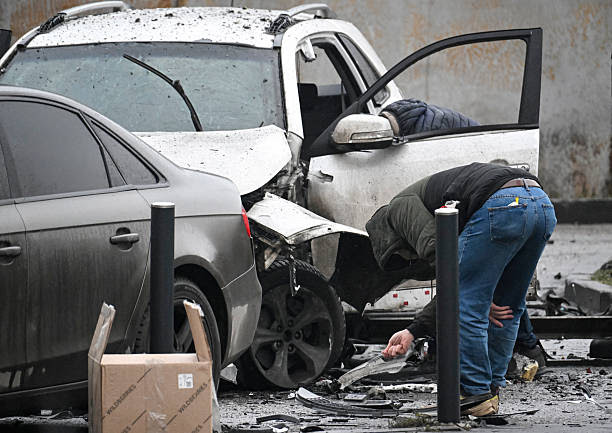
Investigators work at the car blast site in southern Moscow. Lieutenant General Fanil Sarvarov, head of the training department within Russia’s General Staff, was killed in Moscow on Dec. 22 after an explosive device placed under his car went off, investigators said in a statement. (Alexander Nemenov / AFP via Getty Images)
The War Putin Is Winning Only on Paper
The briefing room rewards confidence, not accuracy. Russian generals lined up to deliver what the Kremlin expects: victory, momentum, inevitability. According to an investigation by the Financial Times, this ritual has become competitive. Tell the best story, not the truest one. Inflate Ukrainian losses. Emphasize Russian advantages. Omit failures. Repeat until it sounds real.
At the center of the performance sits Vladimir Putin—and standing closest to him is Valery Gerasimov. Two officials told the Financial Times that Gerasimov’s briefings have grown so optimistic that Putin genuinely believes Russia is winning a war that continues to bleed men, armor, and money for gains measured in meters.
The competition doesn’t stop at the top. Russian milbloggers—often more reliable than official channels—describe a cascade of fiction flowing upward. Battalion commanders submit “beautiful” reports. Regimental headquarters polish them. Army staffs improve them further. By the time the story reaches Moscow, the battlefield has been transformed into a success narrative untethered from reality. Operations planned on those narratives send soldiers forward into conditions that don’t exist. The casualties do.
Then there is the contrast. While generals sell optimism, Russia’s economic officials speak in numbers that refuse to bend. Central Bank chief Elvira Nabiullina and Finance Minister Anton Siluanov have warned openly that Russia’s “free resources” are nearly gone and energy revenues are shrinking. One official even told the Washington Post a banking crisis is no longer unthinkable.
Why the split? Budgets don’t lie. Inflation can’t be rebranded. Military failure, by contrast, can be reframed—dead assaults become “fixing operations,” meters gained become breakthroughs. The dead don’t file rebuttals.
Putin’s own information war completes the loop. His public exaggerations are meant to pressure Ukraine into concessions. His generals know that—and feed him intelligence that supports the script. Fiction becomes policy.
The final irony is strategic. Putin’s theory of victory depends on endurance. But endurance requires clarity. Instead, he is being reassured into continuing a war he may not actually be winning.
Ninety Percent Finished, Zero Percent Solved
The announcement sounded reassuring by design. Volodymyr Zelensky said Ukrainian and American negotiators had completed “90 percent” of the first phase of talks and produced a 20-point framework. The phrase traveled well—progress, momentum, diplomacy working. But within hours, the illusion collapsed.
Standing beside that number was JD Vance, calmly listing what the remaining ten percent contained. Donetsk. The Zaporizhzhia Nuclear Power Plant. Millions of civilians living under occupation. Minority protections. Reconstruction money. In other words: land, nuclear risk, people, and survival. Everything that turns a framework into peace was still untouched.
Translation: the easy sentences were written. The impossible ones were still blank.
Vance acknowledged what everyone in the room already knew but rarely said out loud. Russia “really wants” all of Donetsk Oblast—territory it does not fully control and may need more than a year to take by force. Ukrainians, he said, privately accept they may eventually lose it. Eventually. Not now. Not while their forces still hold ground and their defenses still work.
That gap defined the talks. Russia demanded immediate concessions for land it hadn’t captured. Ukraine demanded security guarantees and reconstruction support before surrendering land it still defended. Neither side was prepared to move first.
Then came elections. Kyiv began exploring legal mechanisms to vote under martial law, even though Ukraine’s constitution forbids it. Washington pushed for democratic legitimacy. Moscow demanded elections it could later dismiss as illegitimate—or manipulate outright. Ukraine tried to thread an impossible needle: legitimacy without vulnerability.
Asked for clarity in Florida, Donald Trump offered none. “The talks are going okay,” he said. Everyone was “tired.” Deadlines vanished into generalities.
Zelensky, that night, sounded different. He spoke of documents, security guarantees, and pressure still required. Progress, yes—but only if Russia could be forced to choose something other than aggression.
By day’s end, all issues were “out in the open.” That was the breakthrough.
The distance between them hadn’t shrunk at all.
No Truce for the Holidays: Why Moscow Said No
The proposal was modest by design.
A Christmas ceasefire. A temporary pause. A signal—nothing more—that both sides might still believe diplomacy was possible. President Volodymyr Zelensky revealed that Russia rejected it outright.
The answer came from Deputy Foreign Minister Sergei Ryabkov, and it left little to interpret. Moscow, he said, did not support temporary ceasefires. What Russia wanted was permanent peace—on its terms. Any agreement would have to address the so-called “root causes” of the war, Kremlin shorthand for Ukraine’s submission to Russia’s original demands.
Ryabkov spelled them out. Ukraine would have to accept the results of Russia’s sham 2022 referendums. It would have to recognize Russia’s constitutional claims to all of Luhansk, Donetsk, Zaporizhzhia, and Kherson—entire regions, including large areas Russian forces did not control and could not realistically seize in the near term.
The demand was staggering. Stop the war, Moscow said, and we will stop attacking—once you give us everything.
Ryabkov tried to soften the message for Europe. Russia, he claimed, was ready to “legally formalize” its intention not to attack EU or NATO states as part of a future settlement. The assurance rang hollow. This was the same country that had violated the 1994 Budapest Memorandum, abandoning formal guarantees of Ukraine’s sovereignty once they became inconvenient.
Legal promises carried little weight in a system where Putin had rewritten the Russian constitution to extend his own rule indefinitely. Agreements could be signed today and erased tomorrow.
The rejection of a Christmas pause clarified everything. Moscow was not interested in confidence-building gestures, incremental progress, or temporary restraint. It offered a single choice: total capitulation or endless war.
That was the point of the proposal—to test sincerity. The answer arrived quickly.
Russia wasn’t negotiating for peace. It was negotiating for victory by other means.
Meters at a Time: Where the War Refuses to Break
Away from conference rooms and long-range strikes, the war along the front line moved the way it has learned to move—slowly, violently, and without illusion.
Across December 21–22, neither side achieved a breakthrough. Instead, the line shifted by fragments. Ukrainian forces pushed forward in northern Kleban-Byk, southeast of Kostyantynivka, and again along the E-50 highway northwest of Pokrovsk. The gains measured in hundreds of meters, not kilometers—but they mattered. They showed Ukraine still had the ability to take ground, not merely absorb pressure.
Pokrovsk remained the hinge. Russian forces had embedded drone operators inside the town, firing small arms at close range and targeting roads and tunnels to choke Ukrainian logistics. Yet Ukrainian units still held the north of the city and continued rotations in and out—a sign the battle was unresolved, not lost.
The cost was visible. Ukraine’s 7th Rapid Reaction Corps reported 373 Russian casualties in one week and over 1,200 in December alone. Russian assaults came mostly in small infiltration groups, including motorcycle attacks around Hryshyne. One suspected mechanized push near Fedorivka ended in wreckage: at least eight tanks, eighteen infantry fighting vehicles, five armored personnel carriers, and eleven motorcycles destroyed by Ukrainian defenders. For most armies, that would halt an offensive. Russia attacked again anyway.
Further north in Kupyansk, Ukrainian forces continued clearing encircled Russian troops cut off from supply—short of food, ammunition, and options. Russian military bloggers broke ranks, criticizing premature victory announcements and reporting the replacement of a regimental commander for failing to seize nearby villages. Orders were issued. Deadlines were set. Equipment shortages—especially drones—were acknowledged openly.
Across the map, Russian forces attacked toward Kupyansk, Lyman, Siversk, Kostyantynivka, Pokrovsk, and deep into Zaporizhzhia Oblast. The breadth of pressure remained intact. The gains did not.
This was the war stripped bare: attrition without spectacle, advances counted in meters, commanders replaced, equipment burned, and neither side close to collapse. The outcome would not hinge on speeches or headlines—but on who ran out of endurance first.
Two Weeks, Two Jets: How Patience Turned Into Fire
The car bomb that killed Lieutenant General Fanil Sarvarov rattled Moscow. But what happened at an airfield near Lipetsk told a deeper story—one about patience, observation, and how little force it can take to cause enormous damage.
According to Ukrainian military intelligence, the operation took two weeks. A single partisan watched the airfield—340 kilometers from Ukraine’s border—mapping patrol routes and guard rotations, learning when security thinned and when it didn’t. There were no daring raids, no explosions meant for spectacle. Just time.
On the night of December 21, the operative slipped inside the facility, reached a protected hangar, and set fire to two Su-30SM fighter jets. Then he left. No alarms. No pursuit.
By morning, the loss was unmistakable. Each Su-30SM is a modern, two-seat multirole fighter—used for air patrols over Ukraine, intercept missions, and strike support. Ukrainian intelligence estimated the damage at roughly $100 million. These were not reserve aircraft. They were active, combat-ready jets.
The operation’s power wasn’t complexity—it was discipline. Two weeks of waiting produced results that missiles struggle to match. No launch signatures. No warning. Just absence where capability once stood.
The same night, Ukraine struck deeper still. Ukrainian forces hit the Tamanneftegaz oil terminal in Krasnodar Krai, damaging a pipeline, two berths, and two vessels and igniting a fire that spread across more than 1,000 square meters. Drones also reportedly struck the Stavrolen petrochemical plant in Budyonnovsk, a Lukoil subsidiary Ukraine identified as supplying materials for Russian military equipment. Local photos showed flames climbing into the night sky.
Together, the attacks told a single story. Ukraine didn’t need mass to inflict strategic loss. It needed access, intelligence, and time.
Two weeks of planning burned through aircraft, fuel, and certainty—leaving Russia to defend not just fronts, but everywhere.
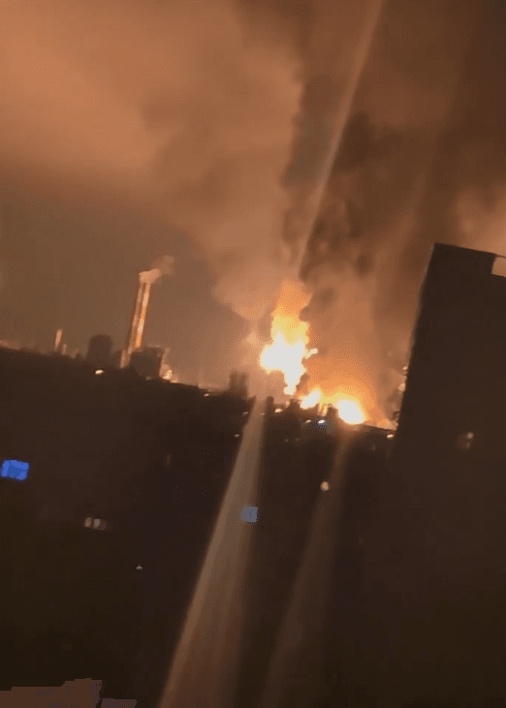
A screenshot of a purported video of a fire at the Stavrolen petrochemical plant following a Ukrainian strike. (Exilenova_plus/Telegram)
Eighty-Six Drones and a Darkened Sky
The night didn’t belong to one side alone.
As Ukrainian partisans struck airfields and oil terminals deep inside Russia, Moscow answered the way it now answers most nights—by flooding the sky. Eighty-six strike drones lifted off toward Ukraine, launched from five directions: Oryol, Millerovo, Primorsko-Akhtarsk, occupied Donetsk Oblast, and Cape Chauda in Crimea. Shaheds led the wave, mixed with Gerbera and other variants.
By morning, Ukrainian air defenses had destroyed fifty-eight. Twenty-six got through.
They hit twelve locations, cutting into energy infrastructure across Odesa, Zaporizhia, Donetsk, Dnipropetrovsk, and Zhytomyr oblasts. In Odesa, power failed. An agricultural warehouse burned. One civilian was injured. It was damage measured not in headlines, but in hours without light and heat.
Near Korosten in Zhytomyr Oblast—fifty kilometers from the Belarusian border—the consequences were sharper. Drones struck transport and energy facilities, injuring four Ukrainian Railways workers. An explosion derailed a freight train. The blockage forced a passenger train into an emergency stop; its locomotive jumped the tracks as well.
Then came the second strike.
Local officials said Russian forces launched a “double tap,” hitting the area again after emergency crews arrived. Infrastructure became a trap. First responders became targets.
Russian military bloggers speculated that AI-enabled Geran drones may have been used to track moving trains—an unsettling possibility reinforced by earlier drone pursuits of locomotives in northern Ukraine. Whether launched from Belarus or extended range, the message was the same: motion no longer guaranteed safety.
Electronic warfare expert Serhiy “Flash” Beskrestnov explained why the attacks kept coming. Russia, he said, had stockpiled roughly 2,000 strike drones—about 1,400 Shaheds among them—enough to sustain mass attacks or spread pressure evenly through winter. What began as imported weapons had become domestic production.
This was the exchange now. Ukraine struck carefully, precisely, far from the front. Russia responded broadly, nightly, against infrastructure and civilians. No decisive blows—only endurance tested, resources drained, and skies that never quite emptied.
Beneath the Talks: Where Money, Power, and Will Begin to Slip
While peace frameworks were debated and battlefield maps adjusted, the war kept shifting along a quieter fault line—economics and political will.
In St. Petersburg, an empty chair spoke volumes. Azerbaijani President Ilham Aliyev skipped the Commonwealth of Independent States summit, citing a “busy schedule.” Moscow had been preparing for his arrival. The excuse landed as a snub. For a Kremlin accustomed to obedience within its former Soviet orbit, absence was a statement.
The rupture had context. In December 2024, an Azerbaijani passenger plane flying from Baku to Grozny crashed near Aktau, killing 38 people. Preliminary findings pointed to Russian air defenses firing near the aircraft. Moscow hesitated, deflected, then partially acknowledged missile launches—without formal responsibility. Relations cooled fast. Azerbaijan shut Russian propaganda outlets, detained Russian citizens, canceled cultural events, and accused Russian police of torturing two Azerbaijanis who later died in custody. Russia answered indirectly, striking sites in Ukraine linked to Azerbaijani companies.
Aliyev’s no-show wasn’t symbolic. It signaled a relationship sliding from alignment into open friction—and showed how Russia’s influence was thinning even where geography once guaranteed loyalty.
Further west, strain surfaced inside Ukraine’s support network. In Prague, Prime Minister Andrej Babiš announced a security council review of the Czech-led artillery ammunition initiative. The program had delivered 1.5 million shells to Ukraine in 2024 and aimed for up to 1.8 million by the end of 2025. Babiš questioned transparency and floated NATO oversight—moves critics read as preparation to disengage.
The initiative worked. It closed gaps. It kept Ukrainian guns firing. Yet domestic politics threatened to end it over process, not performance.
Together, the signals converged. Russia’s ability to command loyalty was eroding. Ukraine’s ability to sustain defense depended on foreign political calculations it couldn’t control.
Wars aren’t decided only by firepower. They’re decided by who keeps showing up—and who quietly stops.
The Day’s Meaning: Nothing Was Real—And That Was the Point
This December day exposed the war’s defining feature: almost everything on display was performance.
In Moscow, Russian generals fed Putin the most optimistic versions of the battlefield they could construct—stories of momentum and looming breakthroughs that bore little resemblance to reality. Putin repeated those claims publicly, turning internal fiction into diplomatic pressure. The danger was obvious: a leadership making strategic choices based not on facts, but on lies it wanted to hear.
In Miami, another illusion took shape. American and Ukrainian negotiators announced that “90 percent” of a peace plan was complete. It sounded decisive—until the missing ten percent came into focus. Territory. Sovereignty. Nuclear plants. Populations. Reconstruction. Everything that mattered remained untouched. The progress existed mostly on paper.
Russia’s response cut through the rhetoric. Moscow rejected even a temporary ceasefire, making clear it wanted no confidence-building steps. There would be only one peace, and it would look like Ukrainian surrender.
Away from microphones, the real war moved differently. Ukrainian partisans spent two quiet weeks watching guard rotations before burning two Su-30 fighter jets inside a secure hangar—$100 million erased without a single missile. Ukrainian intelligence killed a Russian general in Moscow. Drones and sabotage hit oil terminals and military facilities far from the front. None of it was flashy. All of it was deliberate.
At the same time, Ukraine’s position depended less on battlefield skill than on foreign politics. Czech debates threatened an ammunition program that worked. Sanctions leaked as Russia found new buyers. Support wavered not because Ukraine failed, but because allies hesitated.
Every layer contradicted the next. Russian officials spoke of victory while worrying privately about economic strain. Diplomats announced progress while admitting nothing fundamental had changed. Western leaders talked isolation as Russian energy flowed east.
This was no longer a conventional war. It was fought in briefing rooms, parliaments, negotiating tables, and darkened hangars—each arena obeying different rules.
On this day, one truth stood out: no one actually knew how this would end. And anyone claiming certainty was almost certainly lying—if not to the world, then to themselves.