
By blinding Russia’s lone submarine-hunting aircraft, Ukraine opened a narrow window that ended with a Kilo-class submarine crippled in its own harbor.
The Day’s Reckoning
Picture the flight line at Yeysk airfield on the night before the submarine died. Russia’s only Il-38N “Sea Dragon” reconnaissance aircraft sat ready, its specialized radars built for one purpose: hunting underwater threats in the Black Sea. Ukrainian operators destroyed it with a drone carrying an above-ground warhead. The timing was deliberate. With the Sea Dragon gone, the water opened—and Ukrainian “Sub Sea Baby” drones slipped through, striking a Varshavyanka-class submarine in Novorossiysk harbor for the first time.
Eight hundred kilometers north, Russia demonstrated what strategic thinking now looks like in this war. Three Kinzhal hypersonic missiles. Four Iskander-M ballistic missiles. Five converted S-300s. Then the swarm—635 Shahed-type drones launched from four directions. Ukrainian air defenses intercepted most of them. Thirty-nine still got through. A child was killed in Zhytomyr Oblast. Rivne, Ternopil, and Khmelnytskyi oblasts went almost completely dark. Zaporizhstal shut down to avoid catastrophe.
On the ground, the pattern repeated. Ukrainian forces withdrew from Siversk after 41 months, not because of breakthrough, but because Russian infantry kept coming—small groups, on foot, grinding forward through fog and weather. Near Dobropillya, Russian naval infantry tried daylight mechanized assault instead. It failed spectacularly. Tanks burned. Vehicles were shredded. Even Russian milbloggers admitted commanders were repeating tactics that “rarely lead to anything good.”
In Kupiansk, Ukrainian troops cleared house by house as Russian units inside the town ran out of supplies and options. Fewer than a hundred remained.
In Hrabovske, Russian soldiers crossed the border in a sudden raid—and abducted 52 civilians, including children.
Day 1,378. Aircraft burned so submarines could be killed. Missiles flew while ceasefires were discussed. Armor failed in daylight while infiltration succeeded in fog. The war kept revealing what worked—and what didn’t—no matter how either side tried to explain it.
Blinding the Sea Dragon
The problem facing Ukrainian naval drone planners wasn’t the submarine. It was the eye watching the water.
At Yeysk airfield, Russia’s Il-38N “Sea Dragon” waited on the tarmac—an aging but lethal hunter refitted for a modern war. Its specialized radars were built to do one thing well: find what moved beneath the surface. Submarines. Marine drones. Anything that tried to sneak through the Black Sea approaches unseen. As long as it flew, Ukrainian underwater drones would never reach Novorossiysk alive.
So the operation didn’t begin at sea.
On the eve of the submarine strike, Ukrainian operators sent a drone toward Yeysk. It carried an above-ground warhead. When it hit, the $24 million aircraft burned where it stood. The Sea Dragon never took off again.
Only then did the real mission begin.
With Russia’s sole submarine-hunting aircraft in the area gone, the Black Sea changed character. The invisible shield around Novorossiysk thinned. Russian naval commanders lost their early warning—no sweeping radar passes, no alerts of movement below the surface.
Into that silence slipped Ukraine’s Sub Sea Baby drones.
They reached a Varshavyanka-class submarine—known to NATO as Kilo-class—inside the harbor itself. For the first time in the war, an underwater drone struck a submarine. Not because the submarine was vulnerable, but because the system protecting it had been dismantled first.
This was not a lucky hit. It was sequencing.
Ukraine identified what guarded the target, destroyed the guardian, and only then struck the prize. A layered defense collapsed one layer at a time.
Russia’s Black Sea Fleet learned a hard truth that night: harbors are only safe as long as the hunters remain alive.
Steel into the Kill Zone
The Russian columns rolled forward at dawn near Dobropillya, engines loud in the cold air, armor catching the first light of morning. Twenty-four armored vehicles. Dozens of motorcycles. All-terrain vehicles fanning out behind them. Naval infantry from the Pacific Fleet—the 40th Brigade and the rebranded 155th, now called the 55th Naval Infantry Division—moving as if this were still a war where daylight and steel could force a decision.
The conditions were perfect. And that was the problem.
Ukrainian drones were already watching. Four armored columns advanced along separate routes, formations confirmed by Ukraine’s National Guard. Then the fire came—precision strikes layered over artillery, rockets, mines, and small arms. The battlefield closed in.
Six tanks burned. Nine infantry fighting vehicles were torn apart. Five armored personnel carriers disappeared into smoke and twisted metal. One recovery vehicle never recovered anything. When the assault collapsed into its final gamble, ATVs surged forward, trying to exploit gaps that no longer existed. Ten of eleven were destroyed.
Geolocated footage later showed the aftermath near Razine and Fedorivka: wreckage scattered like markers on a map of failure. This was what mechanized maneuver looked like under total surveillance, where every movement triggered a response.
Russian milbloggers didn’t hide their anger. Daylight assaults without fog, one wrote, “rarely lead to anything good.” Another pointed at Lieutenant General Sukrab Akhmedov—removed once before for costly attritional tactics—now back with more authority and repeating the same mistakes. Larger formations, they warned, were death sentences. Only one- or two-man infiltration teams moving on foot could survive here.
The same lesson echoed near Kostyantynivka, where a smaller mechanized probe lost two tanks and three ATVs before breaking off.
Dobropillya wasn’t a failed experiment. It was confirmation. The battlefield had already decided: armor advances in daylight would be punished, patience rewarded, and commanders who ignored that reality would keep feeding steel into the kill zone.
The Night the Sky Wouldn’t Empty
Before dawn, Ukrainian air defense screens filled with tracks. First the missiles—three Kinzhals arcing in from Lipetsk airspace, four Iskander-Ms rising from occupied Crimea, five repurposed S-300s fired from Kursk. Then the real assault arrived.
Six hundred thirty-five drones.
They came from four directions at once—Kursk and Oryol, Millerovo, Primorsko-Akhtarsk—fanning out across hundreds of kilometers. Roughly four hundred were Shaheds, slow, loud, relentless. Ukrainian crews worked the problem in real time, assigning intercepts, shifting batteries, vectoring fighters. F-16s hunted cruise missiles in the dark, finally flying the mission they had been built for.
By morning, the numbers told two stories at once. Ukrainian forces destroyed 587 drones and 34 cruise missiles—an interception rate above 90 percent. And yet thirty-nine drones still broke through. They struck 21 locations across 11 oblasts.
In Zhytomyr Oblast, a four-year-old child was killed. In Kyiv Oblast, a woman died in a burning two-story building. In Kherson, a man was killed when a drone dropped explosives directly on him. Across the country, dozens more were injured. Power vanished almost completely in Rivne, Ternopil, and Khmelnytskyi oblasts. Zaporizhstal shut down to prevent catastrophe.
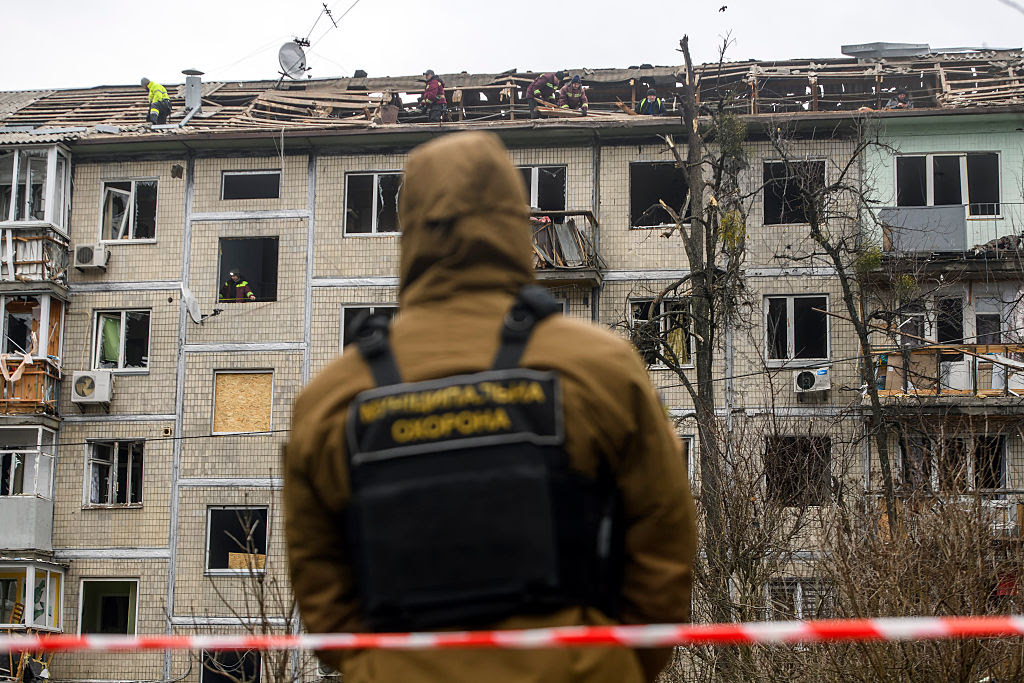
A shattered apartment block in Kyiv stands open to the night after a Russian Shahed drone strike, one of hundreds unleashed in a single wave of attacks. (Photo by Maxym Marusenko / NurPhoto via Getty Images)
Ports burned in Odesa. A Lebanese-flagged cargo ship carrying Ukrainian soy was damaged alongside civilian infrastructure. This was commerce under fire, days before Christmas.
President Zelensky marked the timing with bitter clarity: Russia launched the strike after rejecting a proposed Christmas ceasefire. Kremlin officials were more blunt earlier—no truce if it gave Ukraine breathing room.
Translation: the darkness was deliberate.
Six hundred thirty-five drones in a single night. Most were stopped. Enough got through. The math of the war was cruel and constant—Ukraine had to be nearly perfect every night, or civilians would pay the difference.
Forty-One Months for Rubble
The General Staff’s statement was spare and precise. Ukrainian forces had withdrawn from Siversk to preserve lives and combat capability. Nothing more. Nothing emotional. Just the math of survival.
What mattered was how the town was taken.
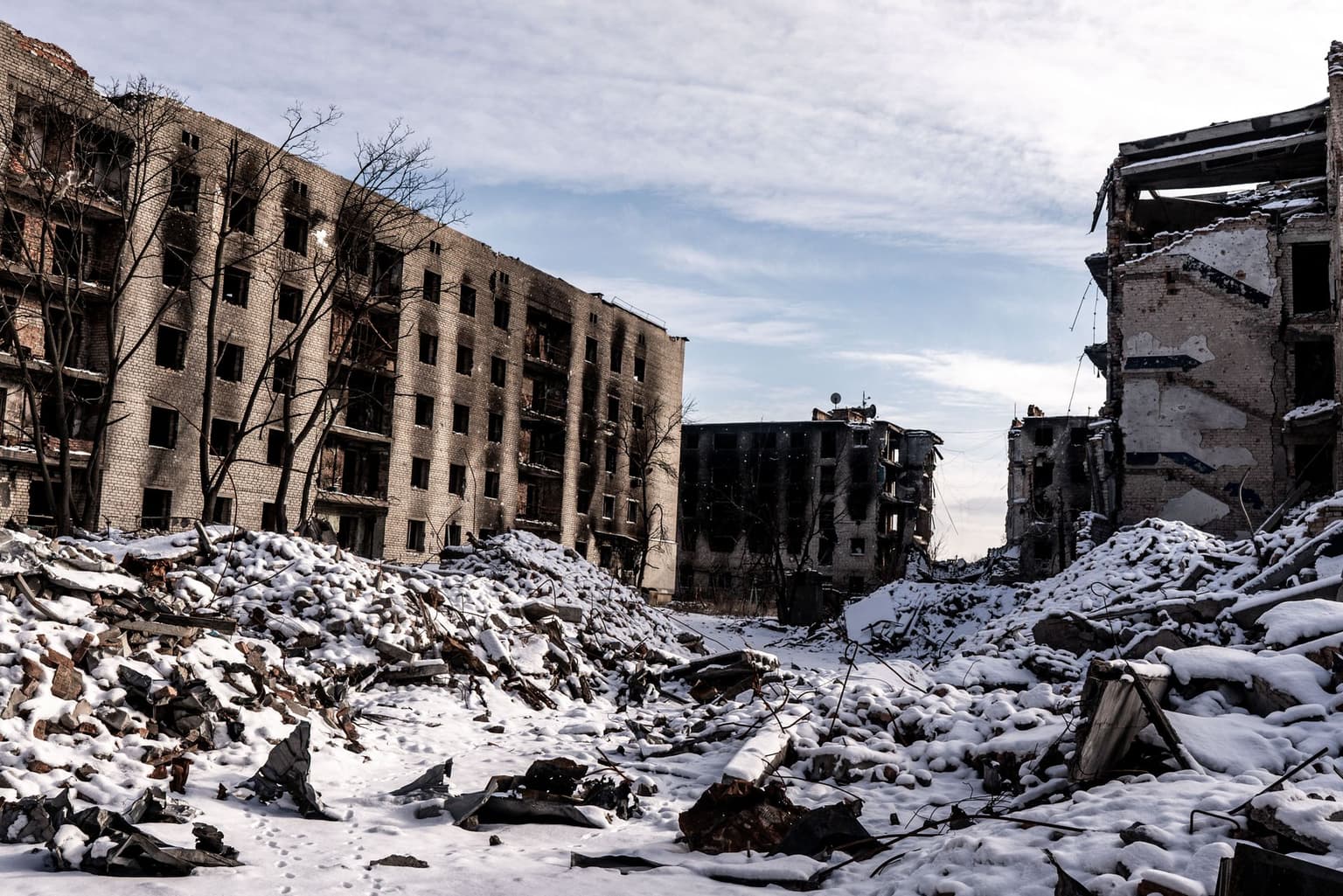
The ruins of residential complexes in Siversk stand frozen in winter silence, a city hollowed by war. (Vincenzo Circosta / Anadolu / Getty Images)
Not with armor. Not with a breakthrough. Russian forces entered Siversk the way water enters cracks—small assault groups moving through fog, pressing forward meter by meter. Numerical superiority did the rest. The pressure never stopped, even when weather grounded drones and blurred sightlines. Eventually, Ukrainian commanders faced a question with no heroics left in it: how many lives was rubble worth?
Siversk once held fewer than 11,000 people. After forty-one months of fighting, only a few hundred civilians remained. Yet the town mattered. It sat on the approaches to Slovyansk and Kramatorsk—cities Moscow still hadn’t taken and desperately wanted at the negotiating table. Losing Siversk didn’t open those gates. It only removed one layer in front of them.
Even in withdrawal, Ukrainian forces never truly left. Artillery and drones kept the ruins under fire control. Russian units inside the city found their supply routes severed, their movements constrained. Occupation did not mean security.
The fighting itself revealed the war’s degradation. Ukrainian brigades reported Russian troops crossing the Siverskyi Donets in rubber boats under fog cover. Others entered the city without body armor or helmets, carrying rifles and little else. Either desperation or depletion—or both.
Putin had declared Siversk captured days earlier. Flags appeared on buildings for cameras. British intelligence quietly noted Russian troops slipping into the center while Ukrainians held the west. The final withdrawal confirmed the reality.
Forty-one months for a town reduced to debris. Ukraine chose not to die defending it. Russia chose to inherit it—and the cost of holding it.
They Crossed the Border and Took the Children
The Russian soldiers came suddenly. Around a hundred of them crossed into Hrabovske from Belgorod Oblast on December 20, moving straight into a village where the border is close enough to reach on foot. Ukrainian officials would later describe the attack with a single word—sudden—the kind that leaves no time for civilians to decide what to save or where to run.
Fighting followed, predictable and grim. Elements of Russia’s 36th Motorized Rifle Brigade pushed toward the nearby settlement of Riasne. Ukrainian units counterattacked, trying to drive them out of Hrabovske’s southern streets. As of December 23, the battle was still unresolved.
But the crime had already happened.
Russian soldiers abducted 52 civilians from the village. Children were among them. They were taken across the border into Russia—not evacuated, not protected, simply removed. President Zelensky later confirmed that Ukrainian forces did not repel the initial incursion more aggressively because civilians were still present. Thirteen Ukrainian servicemembers were also captured.
This was not fog-of-war chaos. It was a deliberate act. Forcible transfer of civilians from occupied territory is a war crime under the Fourth Geneva Convention. Russia did not disguise it as humanitarian aid. These were hostages moved while diplomats elsewhere spoke of peace frameworks.
The geography made the crime easier. Border villages like Hrabovske cannot be secured without control zones extending kilometers into Russian territory—a step Ukraine has so far avoided. That vulnerability became a weapon.
Days earlier, the Kremlin rejected a proposed Christmas ceasefire, arguing that a truce would give Ukraine breathing room. Days later, Russian troops were loading civilians—including children—onto buses bound for Russia.
As soldiers traded fire in Hrabovske, families were already gone, removed from homes they had lived in long before invasion turned geography into a trap. The fighting looked like war. The abductions made it something else entirely.
He Mapped the Border for the Enemy
He didn’t wear a uniform. He didn’t cross lines at night or trade secrets in parking lots. He walked.
Along Ukraine’s northern border in Volyn Oblast, a 24-year-old unemployed man moved from road to road, village to village, phone in hand. He noted checkpoints. Counted fortifications. Marked routes. When he finished, he didn’t encrypt the data or hide it in a dead drop. He uploaded it to Google Maps.
Belarus’s KGB had recruited him to do exactly that.
Ukrainian counterintelligence detained him in July. By December 23, a court handed down the sentence: fifteen years in prison for treason under martial law. The charge carried an added weight—conspiracy by a group—suggesting he wasn’t the only one walking and mapping.
His method revealed the war’s quiet side. Espionage no longer required stolen documents or secret radios. A smartphone and public mapping software were enough. Every pin dropped on a map became potential artillery coordinates. Every photo of a checkpoint became a targeting reference.
SBU officers documented his movements and seized the phone he used to contact his handler. The device told the story cleanly: messages sent, coordinates shared, borders turned into data for a hostile service.
Belarus’s role was no abstraction. From its territory, Russian forces launched attacks at the start of the invasion. Mapping Ukraine’s northern defenses wasn’t academic—it was preparation.
The court cited Articles 28 and 111 of Ukraine’s Criminal Code: treason committed during wartime. The sentence was meant to deter others tempted by money, grievance, or apathy.
While Ukrainian soldiers stood guard along the same border, this man chose a different role. He didn’t fight. He mapped. And for fifteen years, he will sit with the consequences of turning his country’s defenses into an enemy’s guide.
House by House, the Noose Tightens
In Kupiansk, the fighting moved room by room.
Ukrainian soldiers advanced through shattered buildings, clearing stairwells and basements where Russian troops had slipped in under cover of fog. What had begun as infiltration was turning into entrapment. President Zelensky said only 80 to 100 Russian servicemembers remained inside the town. Ukraine’s military intelligence reported they were already cut off from logistics.
The geography betrayed them. Ukrainian units pushed inward from multiple directions, sealing streets and blocking escape routes. Russian reinforcements tried to break through from the north and failed. The city that Russian forces had entered quietly was closing around them.
Russian milbloggers admitted the problem. Drone teams from the Rubikon Center rushed in to help the 68th Motorized Rifle Division, but most Russian launch sites sat east of the Oskil River. Longer flight times gave Ukrainian defenders precious seconds to react. Fog that once helped infiltration now hindered Russian strikes.
Attempts to expand the foothold collapsed. Russian troops claimed entry into Petropavlivka and Kucherivka but couldn’t hold either. Elements of the 27th Motorized Rifle Brigade slogged more than 30 kilometers through forests under Ukrainian drone and mortar fire just to reach attack positions. Even commanders struggled to know what was controlled and what wasn’t—the “gray zone” swallowing units sent into supposedly secured areas.
Geolocated footage showed Ukrainian forces advancing south of Zapadne, north of Kupiansk, while counterattacks flared inside the city itself—near Kindrashivka, Radkivka, Holubivka, Sobolivka, and Myrove. The pattern was unmistakable. Ukraine wasn’t just defending Kupiansk. It was reclaiming it.
For Russian commanders, the choices narrowed. Reinforce trapped troops and lose more men—or abandon them while withdrawal was still possible. Infiltration had brought soldiers into Kupiansk. Logistics and fire control would decide whether any of them made it back out.
Pokrovsk: Where the Ground Refuses to Stay Taken
Around Pokrovsk, the front refused to settle. Streets, tree lines, and industrial edges changed hands not by sweeping breakthroughs but by pressure—advance, counterattack, reclaim, repeat.
Ukrainian forces pushed east of Rodynske, north of Pokrovsk, reclaiming positions Russian troops had previously infiltrated. The move showed that even here—where Russian pressure never relented—Ukraine could still go on the offensive and take ground back.
Russia answered in kind. Russian units advanced south of Zatyshok, northeast of Pokrovsk, and edged into northeastern Myrnohrad. Milbloggers claimed further gains west of Zatyshok, though those reports remained unconfirmed. The contested zone expanded, not because either side achieved dominance, but because neither could fully dislodge the other.
Inside Pokrovsk itself, the numbers told a darker story. President Zelensky said roughly 1,100 Russian servicemembers were operating within the city—too many to ignore, too exposed to leave unchallenged. Ukrainian units worked to isolate those forces while Russian reinforcements tried to keep corridors open.
Drone warfare shaped everything. The arrival of Russia’s Rubikon Center months earlier had transformed the battlefield. Ukrainian soldiers told Suspilne that Russian FPV drone strikes surged after Rubikon appeared—up to 200 drones targeting a single road in a day. Along the T-0515 Pokrovsk–Rodynske highway, that number climbed as high as 350 daily strikes, a deliberate effort to sever logistics and slow movement.
The pressure worked. Ukrainian drone teams were pushed farther back, degrading their ability to strike Russian rear areas. The implications stretched beyond Pokrovsk itself. If Russian forces advanced their drone operators and seized dominant heights, Ukrainian soldiers warned, strikes could reach as far as Pavlohrad.
This was why Pokrovsk mattered. Not because of a single advance or setback, but because every meter gained or lost shifted supply lines, drone reach, and the balance of pressure in the war’s most unforgiving sector.
Flags Without Ground, Pressure Without Breakthrough
Away from the headline battles, the war ground on across a wide arc—from Hulyaipole to Kherson—without decisive movement, only exhaustion.
Near Hulyaipole, Russian soldiers slipped into Andriivka in small groups. Geolocated footage showed four men raising flags in the village’s northern, central, and southern areas—gestures meant for cameras more than command posts. The Russian Defense Ministry declared Andriivka seized. The footage suggested something else: infiltration, not control. Russian milbloggers went further, claiming 60 percent of Hulyaipole had fallen. The exaggeration followed a familiar pattern—flags first, consolidation later, if at all.
Fighting rippled outward. Russian units pressed near Hulyaipole itself, northwest toward Ternuvate and Kosivtseve, north toward Andriivka and Radisne, northeast near Solodke and Pryvilne, and south near Dorozhnianka. Ukrainian forces counterattacked near Andriivka and Ternuvate, turning Russian advances into contested pockets rather than stable gains.
Farther west in Zaporizhia Oblast, Russian forces kept probing. Attacks rolled southeast of Orikhiv near Mala Tokmachka and west toward Shcherbaky, Stepove, Plavni, Stepnohirsk, Prymorske, and Lukyanivske. Elements of Russia’s 108th Airborne Regiment and 143rd Motorized Rifle Regiment cycled through the sector, maintaining pressure without finding a seam to exploit.
Along the Kherson front, Russian ground assaults flared east of the city near the Antonivskyi Bridge—limited, costly, inconclusive. A Russian milblogger claimed Ukrainian strikes hit a substation in occupied Vynohradove, roughly 50 kilometers from the front, a reminder that Ukraine’s reach extended well beyond trench lines.
Across these fronts, the pattern held. Russia pressed. Ukraine resisted and countered. The lines moved by meters, not kilometers—pressure applied without payoff, attrition without breakthrough.
A New Division Rises While the Old Ones Burn
In Kaliningrad, far from Ukraine’s front lines, Russian naval infantry were training for a war that had not gone the way Moscow planned.
The Baltic Fleet was reshaping its 336th Naval Infantry Brigade into something larger—the 120th Naval Infantry Division. It was the ninth new maneuver division Russia had created since late 2022, another step in a quiet expansion happening even as units bled on the battlefield. Local outlet Russkiy Zapad reported on December 2 that the transformation was underway. Weeks later, the Defense Ministry confirmed elements of the new division were training intensively at the Khmelevka Training Ground.
The division did not stay theoretical for long. Open-source analysts spotted elements of the 120th operating near Shakhove in the Dobropillya direction, fighting alongside the newly formed 55th Naval Infantry Division, the 40th and 61st Separate Naval Infantry Brigades, and the 117th Naval Infantry Regiment. Naval infantry—supposedly maritime troops—clustered hundreds of kilometers from the sea.
This was not an accident. Earlier this month, the Pacific Fleet reformed the battered 155th Brigade into the 55th Naval Infantry Division. That move traced back to a declaration made in December 2022, when then–Defense Minister Sergei Shoigu announced plans to create 17 new maneuver divisions, including five naval infantry divisions grown from brigades.
At least nine of those divisions now exist. Some were airborne. Others motorized rifle formations. Two—now three—were naval infantry.
The logic was strategic, not tactical. Russia was rebuilding for scale. Division-level formations meant mass, endurance, and the ability to fight a future NATO war—even if current battles consumed men and armor at alarming rates.
For Ukraine, the implication was sobering. Russia was not just cycling units through combat. It was expanding its force structure while absorbing losses. The 120th Division training in Kaliningrad would eventually follow the same path as the 55th—sent forward to replace shattered units, carrying fresh flags into a war already littered with burned ones.
When Desperation Rode into the Drones
The first figures appeared moving toward Ukrainian lines in a way no one expected—slow, upright, unmistakable.
They were on horseback.
Soldiers from Ukraine’s 5th Assault Battalion, part of the 92nd Separate Assault Brigade, watched the approach through drone feeds and recorded what they saw with a kind of stunned restraint. Russian infantry, deprived of armored vehicles and unwilling to cross the kill zone on foot, were riding horses toward entrenched positions defended by FPV drones.
Ukrainian commentary was blunt. Russian equipment losses had been so severe during repeated “meat assaults” that commanders were now trying animals where machines had failed. The theory didn’t last long.
FPV drones struck riders and horses as they crossed open ground. The footage showed bodies and animals collapsing together. Ukrainian servicemember and civic activist Mykola Voroshnov reacted with disbelief—this wasn’t satire or AI manipulation, he said. It was real. The horses, he added, were the true victims.
The logic behind the decision was grimly simple. Tanks burned. Infantry fighting vehicles drew instant strikes. Motorcycles and ATVs offered speed but no protection. Horses, someone decided, might move quietly enough to survive.
They didn’t.
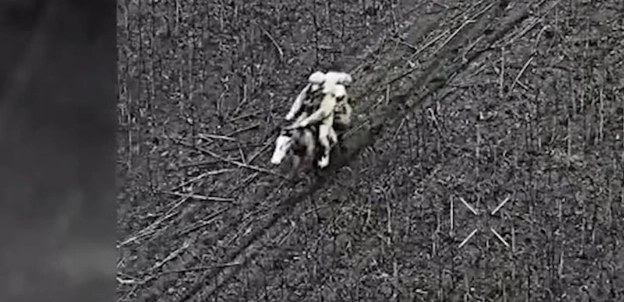
A Russian cavalryman rides into the modern battlefield, moments before drones turn horses and men into targets. (Screenshot from 92nd Brigade video / Facebook)
The cavalry charge marked the point where modern warfare collapsed into dark absurdity. Russia still had artillery, ammunition, and drones. What it increasingly lacked was any safe way to move infantry across exposed ground. The solution was not innovation—it was regression.
Earlier reports had shown donkeys used for transport. Now horses carried assault troops into drone kill zones where nothing mechanical or organic survived. The riders made their choices. The animals had none.
For Ukrainian drone operators, targets on horseback were no different—just slower. The assault failed. The riders died. The horses died with them. And somewhere behind the lines, commanders searched for the next way to cross ground already proven lethal.
Plastic, Not Fuel: Striking the Drone Supply Chain
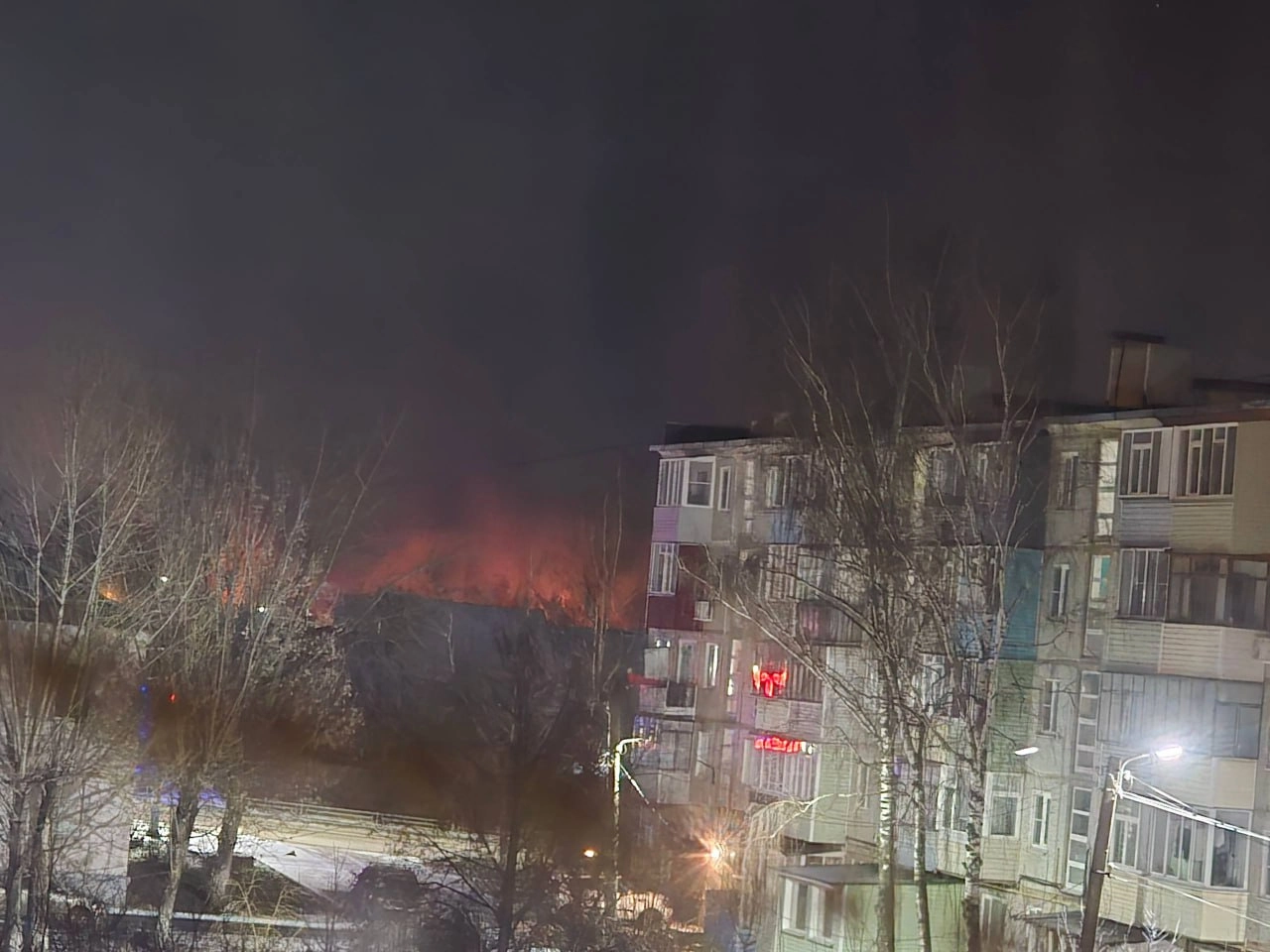
Flames tear through the Yefremov Synthetic Rubber Plant in Russia’s Tula region as night gives way to fire. (Photo via Supernova+ / Telegram)
The fire at Budyonnovsk didn’t rise from a fuel tank or a refinery tower. It burned inside a petrochemical plant that most people would never associate with war.
Overnight on December 22, Ukrainian forces struck the Stavrolen Petrochemical Plant in Stavropol Krai. Flames spread through the industrial zone, captured in geolocated footage that showed one of Russia’s largest plastics producers burning far from the front lines. Opposition outlet Astra identified Stavrolen as a major manufacturer of polyethylene and polypropylene. Ukrainian defense analysts quickly explained why that mattered.
These weren’t civilian plastics. They were war materials.
Polyethylene and polypropylene form the hidden skeleton of modern weapons—wire sheathing in drones, insulation in missiles, housings for electronics and electronic-warfare systems. They don’t explode or burn brightly on impact, but without them, production slows, designs stall, and supply chains fracture months later.
The choice of target revealed a shift in Ukrainian strike logic. Oil refineries and fuel depots still mattered, but this was something more precise: attacking the materials that made drones and missiles possible in the first place. Not the gasoline—the wiring.
Stavropol Krai’s governor acknowledged the strike and the resulting fire but offered no details on damage or production impact. Lukoil, which operates Stavrolen, remained silent. The absence of information spoke for itself. Facilities like this aren’t easily replaced, and even temporary shutdowns ripple outward into factories waiting on components that never arrive.
The strike fit a widening pattern. Ukrainian drones had already hit refineries in Saratov and Nizhny Novgorod, ship repair yards, and logistics hubs. Each forced Moscow into the same dilemma: repair or defend, protect one site or spread defenses thin across many.
As Stavrolen burned, Russia launched hundreds of drones at Ukrainian energy infrastructure. Both sides were hitting industry. Only one was targeting what made weapons work, rather than homes go dark.
Forty Rockets, One Drone, No Second Chance
The Grad was parked and loaded when the drone found it.
In Malynivka, a Russian BM-21 launcher sat ready to fire—forty 122-millimeter rockets stacked in their tubes, a full salvo waiting for coordinates. Operators from Ukraine’s 79th Separate Tavriya Airborne Assault Brigade spotted it before it could move. The Perun Corps strike drone unit took the shot.
They only needed one.
The FPV drone struck the launcher while it was fully loaded. What followed wasn’t a clean kill—it was annihilation. The impact detonated all forty rockets at once, turning the truck and its ammunition into a single violent explosion. The Grad never fired. The crew never redeployed.
This was Soviet artillery doctrine caught in the present. The BM-21 was designed to saturate entire areas, emptying its tubes in seconds before fleeing counterbattery fire. Range gave it reach. Mobility gave it survival.
Neither mattered anymore.
Ukrainian drone operators didn’t wait for launches or shell impacts. They hunted launchers before they fired—when they were stationary, exposed, and most vulnerable. A loaded Grad wasn’t a threat. It was a target.
The brigade released no precise timing or coordinates beyond Malynivka, protecting operational details. The footage was enough. One launcher destroyed. Forty rockets erased before they could land on Ukrainian positions.
For Russian artillery crews, the lesson was brutal and unmistakable. Mobility meant nothing if a drone could find you while loading. Firepower meant nothing if you never fired. Every minute spent preparing a strike was now a minute under surveillance.
Forty rockets that would never fall. One drone that ensured they never would.
Burned on the Ground: Two Fighters Lost Without a Shot
The Su-30SMs never left the hangar.
Sometime overnight on December 20–21, fire crept through a protected aircraft shelter at a Russian airfield near Lipetsk. Inside sat two of Russia’s frontline multirole fighters—advanced, expensive, and fully intact. When the flames died down, both were finished.
Ukraine’s Main Intelligence Directorate later revealed the details. What had first been reported as damage to a Su-27 and a Su-30SM turned out to be worse. Analysts at Militarnyi traced red nose numbers to registration codes and confirmed both aircraft were Su-30SMs—red “12” (RF-95838) and red “82” (RF-81740), assigned to the 14th and 31st Fighter Aviation Regiments. Together, they were worth up to $100 million.
These weren’t air-superiority relics. The Su-30SM is Russia’s long-range, two-seat strike fighter—closer to an F-15E than an older Su-27—designed for interdiction, deep strikes, and all-weather operations. Losing two mattered.
The operation unfolded slowly. HUR said preparation took two weeks. Local resistance operatives mapped patrol routes, studied guard rotations, and waited for the right moment. When they moved, they slipped inside the perimeter unnoticed and set the aircraft on fire where they were parked.
Video released afterward showed the arson itself—flames blooming inside the hangar, no alarms, no scramble. The fighters burned quietly, destroyed by heat and smoke rather than missiles or dogfights. Militarnyi assessed both jets were disabled beyond economical repair.
This was not a drone strike or a lucky hit. It was human intelligence and patience, carried out by people risking execution to reach a single hangar.
Two fighters lost without a shot fired. No pilots killed. No defenses engaged. Just empty airspace where Su-30SMs were supposed to be—and another reminder that in this war, the front line sometimes runs straight through a locked door.
Fire at the Strait: Burning the Lifeline to Crimea
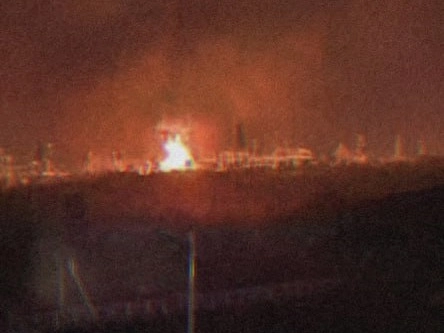
Flames rip through Volna’s port after a Ukrainian drone strike, turning maritime infrastructure into an inferno. (Photo by Russian social media “Temruk info” / Telegram)
The fires at Volna rose beside the water.
Ukrainian drones struck two piers and two Russian vessels in the settlement near the Kerch Strait, close enough to the Kerch Bridge that the glow carried strategic weight. Russian emergency services said crews and shore personnel evacuated in time, but the damage spread quickly—blazes racing across 1,000 to 1,500 square meters of pier infrastructure as firefighters rushed to contain them.
The port itself became the story. Social media footage showed flames licking through the harbor area, with unverified reports of a damaged pipeline at the oil terminal adding another layer to the strike. If confirmed, it meant fuel infrastructure had been hit alongside maritime targets—ships, piers, and the systems that keep them operational.
Volna was not an isolated target. It fit a clear pattern. Ukrainian forces were methodically degrading Russia’s maritime support network—piers where ships docked, vessels that ferried supplies, repair facilities that kept hulls afloat, fuel terminals that fed the fleet. Each strike reduced Russia’s ability to sustain naval operations from ports along the Black Sea coast.
The location mattered. Volna sits near the Kerch Bridge, Russia’s primary logistics artery linking the mainland to occupied Crimea. Even when the bridge itself remained standing, strikes in its shadow sent a message: the surrounding infrastructure was vulnerable. Logistics didn’t stop at the bridge deck—they depended on ports, pipelines, and piers nearby.
For Russian Black Sea Fleet planners, the lesson was growing harder to ignore. Ukrainian drones could reach deep into maritime rear areas, forcing Russia to defend not just ships at sea, but every stretch of coastline that kept those ships supplied.
The fires eventually went out. The vulnerability did not.
Fire on the Volga: When the Rear Areas Ignite
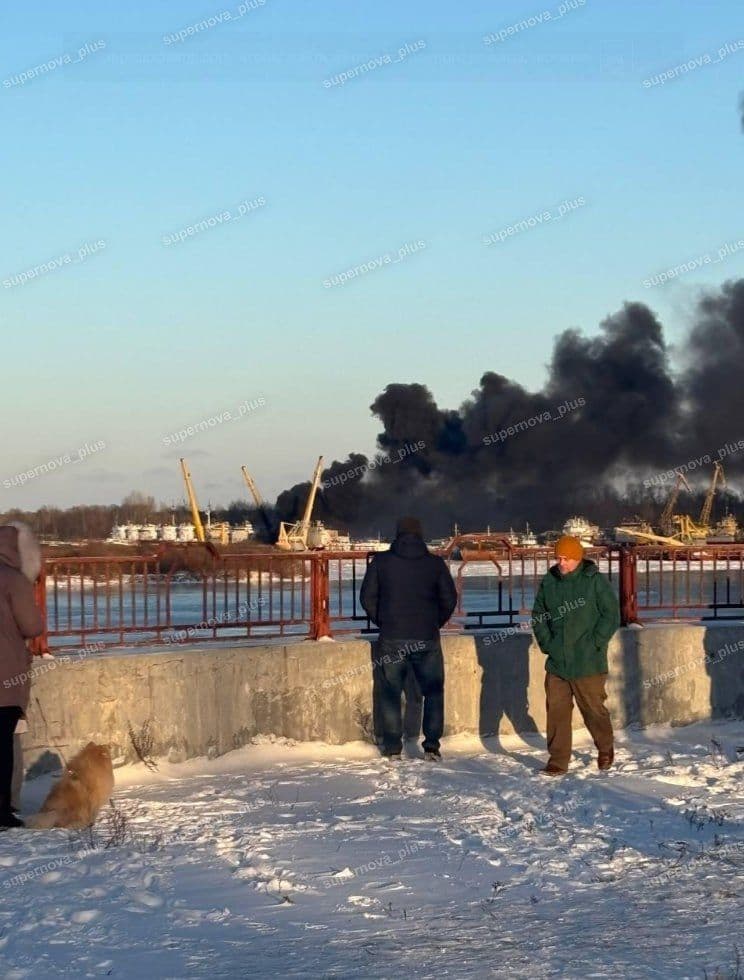
Flames rise in Nizhny Novgorod following a reported incident. (Exilenova+ / Telegram)
The fire began beside the river.
Flames tore through a crane vessel at a ship repair facility in Russia’s Nizhny Novgorod Oblast, rising from the Sibirsky Zaton area along the Volga as residents reported the sound of explosions before the blaze was visible. Russia’s Transport Prosecutor’s Office said the vessel caught fire while repair work was underway, and emergency officials confirmed fuel was burning across roughly 100 square meters—close enough to an adjacent floating crane that the risk of spread remained acute.
Russian emergency services later confirmed one fatality.
Local residents identified the burning vessel as belonging to the Borskaya Ship Repair Company. Video circulating on Russian Telegram channels showed thick smoke and active flames at the site, though independent verification remained impossible. Ukrainian officials offered no comment.
The incident did not occur in isolation. Nizhny Novgorod Oblast had already drawn attention weeks earlier, when a Lukoil oil refinery in the region was struck by Ukrainian drones during repairs—an operation involving more than fifty Ukrainian-made UAVs, including long-range and FPV models. That earlier strike demonstrated Ukrainian reach deep into Russia’s industrial interior.
Whether the ship repair fire resulted from a drone strike, sabotage, or accident remained officially unclear. But the pattern was increasingly difficult to dismiss. Fires and explosions were recurring at industrial and logistical facilities far from the front—sites essential to sustaining Russia’s war effort rather than symbolic civilian targets.
Ship repair yards play a quiet but critical role. They keep inland fleets operational, maintain heavy lift vessels, and support transport networks that feed larger military systems. A crane vessel lost to fire is not easily replaced, especially under sanctions and wartime strain.
As smoke rose over the Volga and firefighters worked to keep the blaze from spreading, the larger implication lingered. Ukraine’s war was no longer confined to front lines and air defenses. The rear areas—the workshops, docks, and repair yards that made everything else function—were beginning to burn.
Chornobyl’s Cracked Shield: When Containment Becomes a Countdown
The steel shell over Chornobyl was never meant to be tested by war.
After a Russian drone strike earlier this year tore a hole into the protective structure above the destroyed reactor, the question is no longer whether the shelter is damaged—but whether it will survive the next shock. Plant director Serhii Tarakanov warned that the structure could collapse if struck again, or even shaken by nearby explosions.
“No one can guarantee that the shelter facility will remain standing after that,” he said.
The International Atomic Energy Agency confirmed on December 5 that the outer shield suffered serious damage: a large breach, multiple smaller perforations, and fire-related weakening of the steel. That shell, installed in 2019, was designed to seal in radiation from the 1986 disaster—not to absorb modern weapons.
Tarakanov said full repairs would take three to four years. Until then, the inner sarcophagus—the rushed concrete-and-steel structure thrown together after the original explosion—remains exposed. It was never designed for long-term stability. Another strike, or even the shockwave from a nearby Iskander missile, could trigger collapse. A “mini-earthquake,” Tarakanov warned, would be enough.
Chornobyl sits just 130 kilometers north of Kyiv and 15 kilometers from Belarus. Any radiation release would not stop at borders. Winds would carry contamination across Ukraine, Belarus, Russia, and into Europe—a nuclear consequence without passports.
This is not unprecedented behavior. Russian forces previously occupied the Zaporizhzhia Nuclear Power Plant and conducted military operations around it despite the obvious risks. Chornobyl fits the same pattern: nuclear safety treated as expendable.
Thirty-nine years after the reactor melted down, the danger is no longer buried history. It hangs overhead—cracked, burning, and waiting—while engineers race a clock set by war.
Howard Buffett in the Evacuation Zone
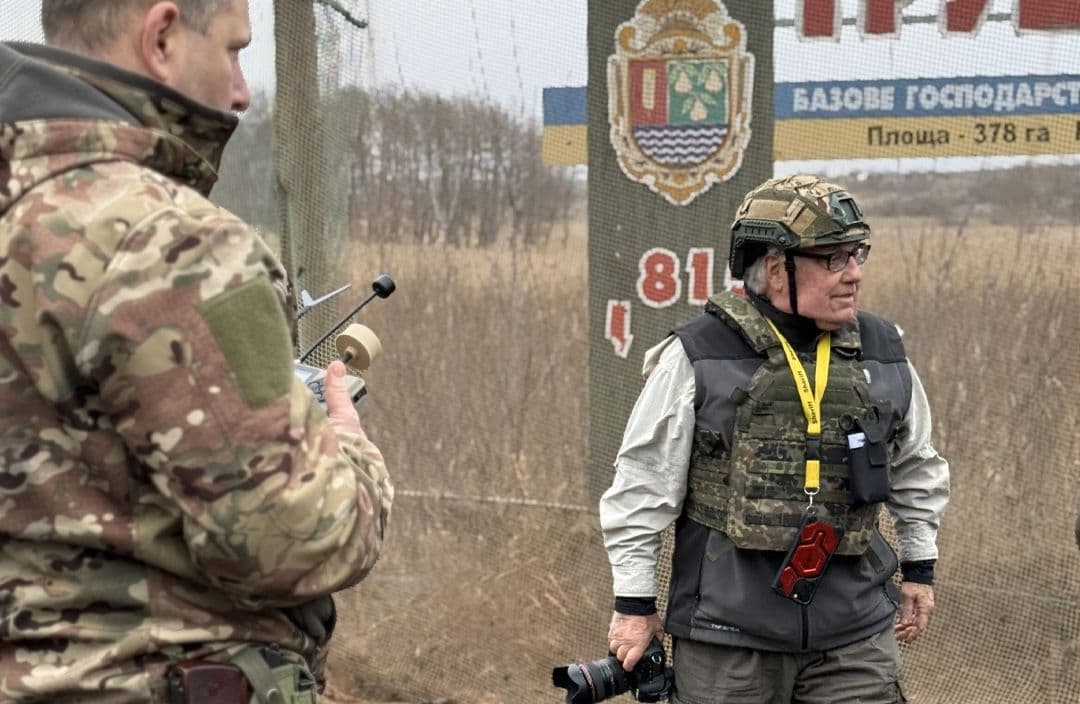
The armored vehicles rolled into Kupiansk not as symbols, but as necessities.
In the shattered suburbs of the city, where artillery, drones, and small arms fire still defined daily life, American philanthropist Howard Buffett joined Ukrainian police units evacuating civilians from frontline neighborhoods. He did not observe from a safe distance. He rode with the teams pulling people out.
The vehicles enabling those evacuations were supplied by the Howard G. Buffett Foundation. More than 200 civilians were moved to safety using armored transport—protection that often marked the difference between survival and death on exposed roads leading out of combat zones. The National Police later presented Buffett with a unit chevron in recognition, a gesture reserved for those who share risk, not just resources.
Kupiansk sits dangerously close to the Russian border and remains one of the most contested cities in Kharkiv Oblast. Evacuations there are not humanitarian logistics; they are combat operations. Civilians must pass through areas under constant surveillance and fire. Unarmored vehicles do not last long. The foundation’s armored transports did.
Buffett’s involvement was not an isolated act. He was awarded Ukraine’s “National Legend” honor in 2024 as the country’s largest private donor. His foundation pledged nearly $11 million toward rebuilding Kyiv’s Okhmatdyt Children’s Hospital after it was struck on July 8, 2024, and helped restore Kharkiv’s FactorDruk printing house following its destruction on May 23, 2024.
Across Ukraine, evacuations have moved nearly 147,000 people from frontline regions since June 1, including thousands of children and people with limited mobility. Specialized police and emergency units conduct these missions daily, often with insufficient equipment.
In Kupiansk, armored vehicles carried civilians to safety because one American chose not only to give—but to show up.
Crawling for Freedom: The Pipeline That Became an Exit
Somewhere beneath western Ukraine, men were crawling through darkness to avoid the draft.
The State Security Service uncovered a network of mobilization-evasion schemes that revealed how far some Ukrainians were willing to go to escape conscription. Eight ringleaders were arrested, each facing up to ten years in prison. One operation stood out for its sheer desperation.
A 62-year-old man from Lviv was “delivering” draft evaders toward the border, then guiding them into a non-operational gas pipeline that crossed into the European Union. On the other side, an accomplice living abroad waited to receive them. The service was openly advertised on TikTok.
The logistics alone bordered on the surreal. Someone had identified which pipelines were no longer in use, mapped entry and exit points, coordinated timing across borders, and convinced clients to crawl through metal darkness to avoid military service. It worked—until it didn’t.
Other schemes were less theatrical but equally corrosive. In Poltava Oblast, a former law enforcement officer arranged fake medical diagnoses through neurologists he knew. Men were briefly admitted as hospital patients, then discharged with fabricated papers declaring them unfit for service. In Odesa, evaders were transported in car trunks by a man posing as a military officer. Elsewhere, camouflage uniforms and forest paths replaced pipelines.

Two men stand detained after Ukraine’s security services dismantled a mobilization evasion scheme, part of a wider crackdown during wartime. (SBU)
Since the start of the full-scale invasion, nearly 49,000 draft-age men have been detained attempting to flee Ukraine illegally, according to border authorities in May. Many succeeded before being caught.
Each scheme represented manpower missing from the front. While Ukrainian units fought outnumbered in places like Siversk and Kupiansk, others were bribing doctors, hiding in trunks, or crawling through pipelines—choosing fear over duty in a war that leaves no one untouched.
Coming Home From Fear: Children Returned From Occupation
They came back quietly—children carrying memories no one their age should have.
Ukraine recovered a group of children aged 9 to 16 from Russian-occupied Kherson Oblast, returning them from months of intimidation, surveillance, and fear. The exact number was not disclosed. What mattered was what they had endured.
One was a nine-year-old girl whose family lived in constant danger because her father had once served in the Ukrainian military. Under occupation, that history marked the entire household. Leaving meant passing checkpoints, document inspections, and interrogations designed to identify families with ties to Ukraine’s armed forces. Staying meant living under threat.
Another was a sixteen-year-old girl who learned how dangerous truth could be. She photographed a destroyed building near her home—evidence of Russian strikes on civilian areas. For that, Russian military personnel and FSB officers threatened her. The message was unmistakable: don’t record what we do.
Occupation was not passive control. It was coercion. Searches. Interrogations. The quiet erasure of safety. Children grew up learning which questions not to ask and which memories to keep hidden.
All returned children are now receiving psychological care, help with documentation, and assistance finding housing. The need for trauma support speaks volumes. Fear does not disappear when borders are crossed.
Their return is part of a broader effort to recover Ukrainian children taken or trapped under Russian control. In March 2023, the International Criminal Court issued arrest warrants for Vladimir Putin and Russia’s commissioner for children’s rights over the illegal deportation of Ukrainian children. But warrants do not bring children home. People do.
Each child returned is a small victory against a systematic crime. Thousands remain.
For now, a nine-year-old no longer hides because of her father’s past. A sixteen-year-old can photograph the truth without fearing a knock on the door.
Small victories. An unfinished rescue.
Ballots Under Fire: Democracy’s Test in Wartime Ukraine
Ukraine began preparing for something few nations attempt while fighting for survival: how to vote while under attack.
Parliament approved the creation of a cross-party working group to design a legal framework for elections during martial law—a framework meant to be used once, and only once. Speaker Ruslan Stefanchuk described the task as building elections that would be “safe, democratic, and trusted by the world,” even while missiles and drones still crossed Ukrainian skies.
The group brings together all parliamentary factions, civil society, and the Central Election Commission. Its mandate is daunting. How do soldiers vote while deployed across hundreds of kilometers of frontlines? How do millions of internally displaced citizens cast ballots without exposing their locations or creating security risks? How do refugees scattered across Europe participate in a national election?
And then there is the question with no clean answer: occupied territory. Elections cannot be held where Ukrainian election officials cannot enter, observers cannot observe, and voters risk arrest—or worse—for participating. Democracy requires choice. Occupation erases it.
The pressure to act is not only internal. In recent weeks, former U.S. President Donald Trump publicly questioned Ukraine’s democratic legitimacy, arguing that elections delayed by war undermined democratic claims. His remarks echoed across international media, landing heavily in a country where the law explicitly bans elections under martial law.
President Volodymyr Zelensky responded earlier this month by saying he was not clinging to power and that Ukraine must be ready for any scenario—if security conditions and international partners toggle allow it.
Behind the political debate lie stark realities. More than six million Ukrainians remain abroad. Millions more are displaced inside the country. The Central Election Commission has only recently resumed updating the voter register, acknowledging how radically the war has reshaped the population.
The working group does not guarantee elections. It acknowledges uncertainty.
But even while civilians are abducted from border villages and energy infrastructure is bombarded, Ukraine is doing something rare in wartime: arguing not whether democracy matters—but how to preserve it without getting people killed.
Christmas Under Sirens: Kyiv Chooses to Live
Steam rose from cups of mulled wine as children spun beneath Christmas lights, their laughter carrying across the square. A carousel turned. A giant tree glowed. For a moment, Kyiv looked like any other European capital in December.
Except this city learned to celebrate with one ear tuned for sirens.
Vlada Ovchinnikova posed for photos near a holiday stall, smiling despite knowing how fragile the moment was. Kyiv lived with almost nightly air raid alerts, missiles and drones striking apartment blocks just miles away. “People think we only have shelters and missiles,” she said. “But we have holidays too.” The joy, she admitted, felt borrowed. Temporary. Necessary.
The Winter Wonderland market drew hundreds of thousands despite power cuts and generators humming beneath the music. Food stalls flickered when electricity failed. Ice skates scraped over frozen rinks powered by backup systems. Children screamed with delight, unbothered by the machinery keeping the lights on.
Svitlana Yakovleva clutched her grandchildren as they watched a holiday performance. Her routine was practiced: check alerts, judge distance, decide when to hide and when to endure. The children knew the rules too. “There are always power cuts,” six-year-old Myroslava complained. “But we have inverters,” her brother replied instantly. They had learned survival alongside multiplication tables.
Not everyone could celebrate freely. Some argued energy should not be spent on decorations. Others said joy itself was resistance. Christmas, officially moved to December 25, became part of that choice—an assertion of identity as much as tradition.
Nearby, grief walked beside the lights. Friends buried husbands. Parents buried sons. “It hurts,” one woman said softly, tears forming. “But we have to keep living. Otherwise it was all for nothing.”
Kyiv’s Christmas was not denial. It was defiance. Choosing laughter while drones hunted the power grid. Choosing childhood while war tried to erase it. Choosing to live—because refusing to do so would mean letting the war win twice.
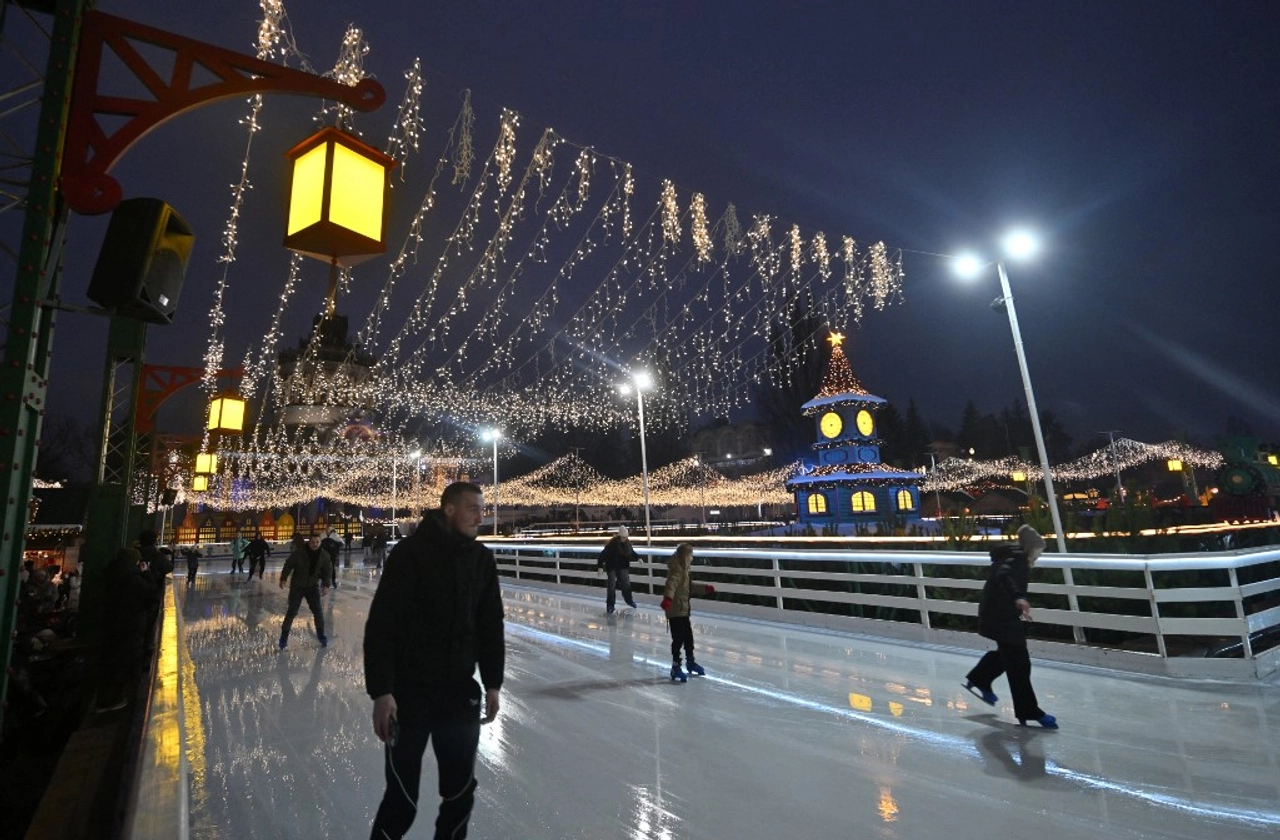
A Christmas rink glows in Kyiv as skaters move in quiet defiance of a war that never sleeps. (Photo by Sergei SUPINSKY / AFP)
Homes Stolen by Decree: When Occupation Becomes Erasure
Anna Shevchenko cannot go home.
Her apartment in Mariupol—where her childhood unfolded, where memories still cling to the walls—is now marked as “ownerless.” Not because it was abandoned, but because Russia decided fleeing war counts as forfeiture.
A Kremlin decree allows occupation authorities to seize residential property showing “signs of being ownerless.” In practice, that means homes whose owners were killed, displaced, or forced to flee. Proving ownership requires appearing in person with documents—and a Russian passport. Without one, the home can be taken. With one, returning Ukrainians risk arrest, violence, or worse.
“I am powerless to stop it,” Anna said. Her cousin still lives in the apartment, but his name isn’t on the deed. At any moment, occupation authorities could evict him.
This isn’t new theft. It’s theft legalized.
Occupation monitors report thousands of apartments already seized in Mariupol alone, with hundreds more taken every week. Properties labeled “ownerless” are redistributed—to occupation officials, security forces, public employees, and settlers brought in from Russia. Resistance groups and aid organizations describe Russian realtors selling seized Ukrainian apartments at bargain prices to Russian buyers.
For many families, the decree turns evacuation into an impossible choice. Leave and lose everything. Stay and live under occupation. Some who fled now consider returning—not out of loyalty, but fear of erasure.
Yanina Andrieieva’s grandmother died during the siege of Mariupol. Now strangers may walk the floor where she died, in the home where Yanina was brought from the maternity ward. “They took away any choice,” she said.
This policy is not about housing. It is about removing Ukrainians from Ukrainian land—paperwork as a weapon, law as a tool of cleansing.
Homes are not empty. They are being emptied.
The Warm-Up Night: Eighty-Six Drones Before the Storm
The night before the sky filled with hundreds of drones, it filled with dozens.
Russian forces launched 86 strike drones—Shaheds, Gerberas, and others—probing Ukraine’s defenses across multiple regions. By morning, Ukrainian air defenders had destroyed or suppressed most of them. It was a solid performance. It was not enough.
Twenty-six drones still reached their targets. Fires burned at a dozen locations. Wreckage fell in another. The pattern was familiar now: interception rates that looked impressive on paper, paired with damage that still hurt real people.
Odesa Oblast absorbed the heaviest blows. Energy infrastructure was struck again, igniting a fire that sent one civilian to the hospital. The region was already limping. Crews were still repairing damage from earlier attacks, including a ballistic missile strike on the bridge near Maiaky—one of only two routes connecting southern Odesa Oblast to the rest of Ukraine. When that bridge was hit, movement slowed to a crawl. Logistics bent. Daily life constricted.
Hospitals kept working. Emergency services adapted. Ukrainians always did.
This was not escalation for its own sake. It was conditioning.
Russian forces were establishing a rhythm—nightly drone waves measured in the dozens, designed to exhaust air defenses, drain repair crews, and keep civilians awake. Even when two-thirds of the drones were stopped, the remainder were enough to wound, burn, and disrupt.
The eighty-six drones were not the main act. They were rehearsal.
Ukraine’s air defenders could never stand down, never assume a “small” night would remain small. Any darkness might bring another probing strike—or something far worse.
Twenty-four hours later, the sky would answer that question.
When the Hunter Becomes the Target: Shaheds Turn on the Sky
The Mi-24 was doing what Ukrainian helicopters had done night after night—climbing into the dark to hunt drones before they reached cities.
It never came back.
A Ukrainian helicopter crew was killed while intercepting a Shahed attack earlier this month when their aircraft collided with a drone flying unnaturally low. Initial assessments pointed to a new threat: a modified Shahed designed not just to strike ground targets, but to counter the very helicopters sent to stop it.
Some Russian sources claimed the drone carried an R-60 air-to-air missile. Whether through missile strike or collision, the result was the same. A one-way attack drone killed an air-defense helicopter mid-mission.
The shift is chilling. Ukrainian helicopters and mobile fire teams had become some of the most effective tools against Shaheds, intercepting them during their long, noisy approach. Russian forces responded by changing the drone itself—adding low-altitude flight profiles, optical reconnaissance, and weapons capable of engaging aircraft and vehicles.
What was once a relatively simple flying bomb is becoming something else: a hunter that can defend itself.
For Ukrainian planners, the dilemma is stark. Helicopters remain indispensable. Without them, hundreds of drones would reach cities unchecked. But sending crews into the sky now carries new risk—drones designed specifically to kill those trying to stop them.
The Mi-24 crew died protecting civilians they would never meet. They were not attacking a frontline trench or a military base. They were intercepting a drone meant for homes, power stations, and streets.
The evolution of the Shahed means the air war is no longer one-sided. The sky itself is becoming contested terrain, where even the act of defense can be fatal.
The hunters are still flying. But now, they know they are being hunted too.
The War Comes Home: Belgorod Feels the Border Burn
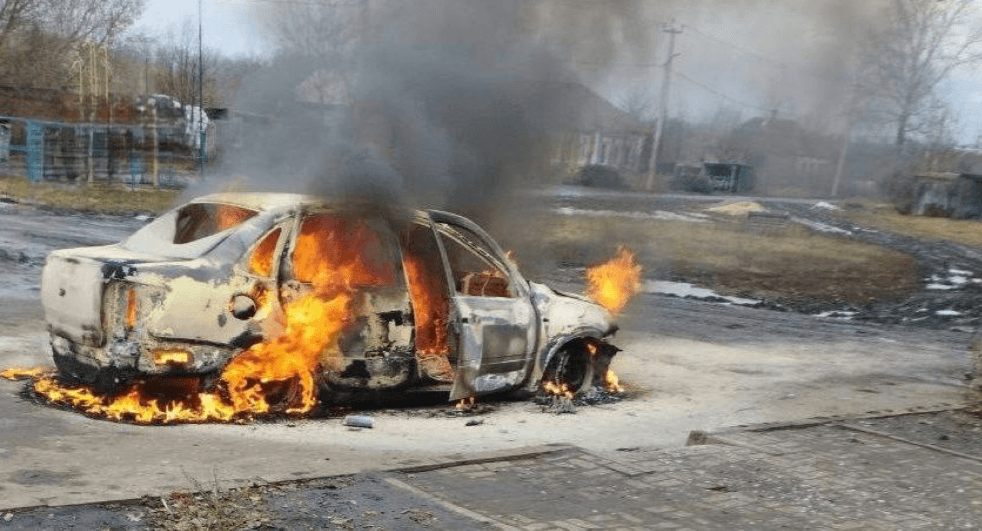
Imagery showing the aftermath of a reported Ukrainian drone strike in Russia’s Belgorod Oblast. (Vyacheslav Gladkov / Telegram)
The border does not stop missiles. It only delays them.
In villages and towns just across the line from Ukraine’s Kharkiv Oblast, drones exploded in streets that had once felt safely distant from the war. In Nova Tavolzhanka, a car was struck, killing one person and injuring another. In Shebekino, blasts damaged homes and vehicles. In Grayvoron, a woman and a thirteen-year-old boy were wounded when a drone detonated nearby.
Russian officials blamed Ukrainian drones. Kyiv made no comment. Independent verification was impossible. But the geography told its own story.
Belgorod Oblast has long served as a rear area for Russia’s war—housing logistics hubs, troop concentrations, and launch points for strikes into Ukraine. From this region, missiles and artillery have crossed the border daily, killing civilians in Kharkiv and beyond. For months, the war moved in one direction.
Now it moves in both.
Ukrainian forces have increasingly struck military infrastructure inside Russia’s border regions, aiming to disrupt the machinery sustaining the invasion. These strikes are not symbolic. They are operational—meant to slow logistics, complicate deployments, and force Russia to defend territory it once treated as a safe staging ground.
That does not spare civilians. It never does.
The injured woman and the teenage boy in Grayvoron did not choose this war. Neither did the people of Nova Tavolzhanka or Shebekino. But neither did the families in Kharkiv whose neighborhoods are shelled from positions across this same border.
This is the arithmetic of invasion. When a war is launched from your territory, it eventually returns there. Russia could end this cycle at any moment—by withdrawing its forces from Ukraine.
Until then, the border burns both ways.
Sabotage Without Borders: Russia’s Shadow War in Europe
The war does not stop at Ukraine’s borders. It slips quietly across them.
A Ukrainian national was extradited from Switzerland to Germany in connection with an alleged Russian-directed sabotage plot—one strand in a growing web of covert attacks aimed at destabilizing Europe. German prosecutors say the network planned arson and bombing operations on behalf of Russian intelligence, targeting countries that support Ukraine’s defense.
Investigators believe the suspects were already testing their routes. Parcels fitted with GPS trackers were mailed to Ukrainian addresses, allowing planners to study delivery paths, security routines, and vulnerabilities before moving on to real attacks. It was reconnaissance disguised as logistics.
Two other alleged participants were arrested in Germany. Similar cases have surfaced elsewhere. In Poland, authorities charged Ukrainian nationals accused of aiding Russian-backed sabotage against rail infrastructure. The pattern is unsettling: Moscow recruiting Ukrainians to attack the very countries sheltering them from Russian invasion.
How those recruits are obtained remains an open question. Coercion. Money. Threats against family members still living under occupation. Desperation inside refugee communities stretched thin by war. Russian intelligence has long specialized in exploiting fracture lines. Europe is now part of that battlefield.
For European security services, the threat is twofold. Sabotage operations risk real damage to infrastructure and public safety. At the same time, they threaten to poison trust toward millions of Ukrainian refugees who fled violence, not to carry it with them.
The extradition itself is a counter-signal. Swiss authorities detained the suspect. German prosecutors assembled the case. Legal cooperation moved faster than Moscow’s shadows.
The man now faces trial in Germany—accused of plotting attacks on European soil for the same state launching drone swarms against Ukrainian cities and abducting civilians from border villages.
This is the war’s quieter front. Fewer explosions. Less footage. But the same intent: destabilize, divide, and make support for Ukraine feel dangerous at home.
Three Months of Warmth: Serbia’s Quiet Deal With Moscow
Winter concentrates the mind.
Serbia secured a short-term agreement to continue buying Russian natural gas through the end of March, a decision framed by President Aleksandar Vučić as reassurance for ordinary people. Enough gas, enough electricity, a winter without fear. “So that people can sleep peacefully,” he said.
But peace of mind came with an asterisk.
Serbia remains deeply dependent on Russian energy, even as it publicly pursues closer ties with the European Union. A long-term gas contract with Moscow expired earlier in the year, and no replacement has been finalized. The three-month extension is not a solution—it is a pause, a bridge over winter cold.
Belgrade has taken steps to diversify. Contracts with Azerbaijan promise future gas supplies. Plans are underway to connect Serbia to liquefied natural gas terminals in Greece through regional pipelines. But energy infrastructure moves slowly, and winter arrives on schedule.
For now, Russian gas still heats Serbian homes.
That dependence carries political weight. Energy security has long been one of Moscow’s most reliable tools of influence, especially in countries balancing between Russia and the EU. When heating depends on a single supplier, foreign policy becomes cautious by necessity.
From Brussels, the deal looks like hesitation. From Belgrade, it looks like pragmatism. Leaders can talk about diversification, but voters feel cold immediately.
The three-month window buys time—nothing more. It allows Serbia to get through winter while alternative routes inch closer to readiness. Whether that time leads to genuine independence or simply another short extension will reveal how much leverage Moscow still holds in the Balkans.
For now, Serbia stays warm. And Moscow stays connected.
Poland’s Border Defense: Anti-Drone Systems at Krynki
Poland moved to strengthen its eastern border defenses by installing the first element of a new anti-drone system near Krynki, close to the Poland-Belarus frontier. A radar mounted on an observation tower became operational as part of an effort to detect unmanned aerial vehicle incursions originating from Belarus.
Interior Minister Marcin Kierwiński said the installation marked the initial phase of a system designed to counter repeated violations of Polish airspace by Russian and Belarusian drones. These incursions had become a persistent problem rather than isolated incidents.
Russian drones crossing into Poland from Belarus served several purposes. They tested NATO response times and air defense procedures. They gathered intelligence on Polish defensive positioning. And they normalized airspace violations, blurring the line between incidents requiring diplomatic handling and those demanding military response.
Each violation imposed costs on Poland. Fighter jets were scrambled, air defense units activated, and readiness levels elevated—expensive responses to relatively cheap drones launched by Russia. The imbalance strained military resources while providing Moscow with valuable operational insight.
The Krynki radar was intended to address that imbalance. Positioned near the border, it provided earlier detection of drone launches, allowing Polish forces to respond more efficiently and reducing reliance on reactive air patrols after drones had already crossed into national airspace.
Officials indicated this was only the first installation in what would become a broader detection network along the border. Additional systems would narrow the window for undetected incursions and strengthen Poland’s ability to manage repeated violations.
As Ukraine continued to absorb Russia’s invasion, Poland quietly prepared for spillover risks. The radar at Krynki reflected a shift from ad-hoc responses to sustained border defense, signaling that repeated drone incursions would no longer go unanswered.
Day 1,378: When Everything Burned at Once
Fire bloomed in the Black Sea harbor as a Russian submarine burned at its moorings. Hours earlier, Ukrainian forces had erased the aircraft watching over it—an Il-38 reconnaissance plane reduced to wreckage on the runway at Yeysk. Without its eyes, the fleet was blind. The strike came anyway. Precision first. Then destruction.
Elsewhere, Russian commanders sent armored columns into daylight, exactly as Ukrainian drones waited. Tanks burned. Infantry fighting vehicles exploded. Milbloggers screamed online, warning it would fail. It did. Near Dobropillya, twisted steel marked another attempt at mechanized warfare that died before it began.
At Lipetsk, resistance operatives slipped into a guarded hangar after weeks of quiet study. Two Su-30SM fighters—$100 million in modern airpower—burned where they sat. No missiles. No air defenses. Just fire and patience.
In Kupiansk, Ukrainian troops moved door to door, cutting off infiltrated Russian units from food, ammunition, and escape. Fog and surprise got them in. Logistics decided whether they stayed alive.
Overhead, 635 drones filled the sky in a single night. Most were intercepted. Enough got through to darken cities and hospitals. At Chornobyl, the shield meant to hold back history itself now stood damaged—one more strike away from catastrophe.
Yet Kyiv’s Christmas market glowed between air raid sirens. Children rode carousels powered by generators. Grandmothers checked phones for missile paths while grandchildren laughed. Life continued because surrender would mean letting Russia decide whether joy was allowed.
Day 1,378 revealed the war’s truth: precision versus mass, adaptation versus repetition, life stubbornly lived beneath falling fire. Nothing resolved. Everything exposed.